Pope Leo XIV presides at Celebration of Vespers with Bishops, Priests, Deacons, consecrated men and women, and Seminarians in Notre-Dame Cathedral on September 25, 2026 in Paris, France. (Photo by Simone Risoluti – Vatican Media via Vatican Pool/Getty Images)
(PARIS) — Pope Leo XIV began a four-day visit to France on Friday, meeting with President Emmanuel Macron and cautioning against allowing technological developments to come at the expense of human life.
Leo, who is making the first official papal visit to France in nearly two decades, spoke at the Élysée Palace before nearly 500 guests. He identified artificial intelligence as one of the major challenges facing humanity and reiterated the Catholic Church’s opposition to assisted dying and surrogacy.
“When science and technology are not guided by consciousness, it can offer immediate solutions that seem to alleviate human suffering, but it can lead them astray,” said Leo.
Macron added, “In the face of the power of digital technology, human beings must retain their rightful place. Artificial intelligence must be a servant, not a master. The digital revolution must liberate, not enslave.”
The papal visit comes after years of reported loss in public support for the church and recent challenges to its stance on ethical life issues like assisted death, which was recently legalized by the French parliament.
Although the French government is completely secular, Catholicism is still the dominant religion in France. Under a third of the French population identifies as Catholic and religious disaffiliation has been on the rise over the past decade, according to the National Statistics Bureau of France. However, the country has seen a surge in adult baptisms in recent years, according to national statistics.
At the presidential palace, Leo said he was “concerned at times by those trends in society that risk turning science and technology into profit-driven ventures promoting genetic manipulation, surrogacy, the trade in human organs or the possibility of arranging one’s own death.”
Leo continued his visit with a speech at the United Nations Educational, Scientific and Cultural Organization headquarters in Paris before holding a prayer service at the Notre-Dame Cathedral. Leo is the first pope to visit the cathedral since a 2019 fire engulfed the landmark. The cathedral reopened in September 2025 after years of restoration.
The pope will conclude his visit in the northeastern city of Metz where he will hold an interfaith dialogue and celebrate Mass before returning to Rome.
A person pumps gas at a Mobil gas station on September 24, 2026 in Austin, Texas. (Brandon Bell/Getty Images)
(WASHINGTON) — Consumer sentiment dropped in September close to the lowest level ever recorded in the 74-year history of the University of Michigan’s monthly survey, fresh data on Friday showed.
Shopper attitudes soured as a monthlong bout of inflation squeezed consumers and an underlying oil supply shock showed little sign of imminent resolution.
The final reading of the University of Michigan index registered at 48.1 in September, marking the second-lowest final reading ever recorded. The index hit a historic low of 44.8 in May, just months after the outbreak of the Iran war, before ticking slightly upward to a level of 51.7 by August.
Prices rose at an annual rate of 3.4% in August, the most recent month on record, federal government data showed. Inflation stands more than a percentage point higher than the Federal Reserve’s target rate of 2%.
The average price of a gallon of gas in the U.S. is $4.49, according to AAA, marking a roughly 50% jump since the war began in late February.
Shoppers expect inflation to rise even more over the next year, the University of Michigan consumer survey found, while individuals’ view of their financial outlook has worsened.
Democrats and Republicans alike displayed sizable declines in consumer sentiment in September from the previous month, Surveys of Consumers director Joanne Hsu said in a statement on Friday.
In response to rising prices, a key long-term Treasury rate hit its highest level in nearly two decades on Wednesday, days after the Federal Reserve raised benchmark borrowing costs. The rise in borrowing costs has pushed up rates for loans like credit cards and mortgages, threatening to worsen the financial crunch.
Investors peg a two in three chance of another quarter-point interest rate hike next month, according to the CME FedWatch Tool, a measure of market sentiment.
Despite a stubborn bout of inflation, the economy remains fairly robust by some measures.
A blockbuster jobs report earlier this month showed employers added 162,000 workers in August, demonstrating continued resilience for the nation’s labor market. The economy grew over three months ending in June, defying fear of a downturn triggered by the Iran war.
Still, persistently elevated prices have continued to take a toll on shoppers, Fed Chair Kevin Warsh said at a press conference in Washington, D.C., last week.
“The plain fact is that inflation is too high and has been for too long,” Warsh said.
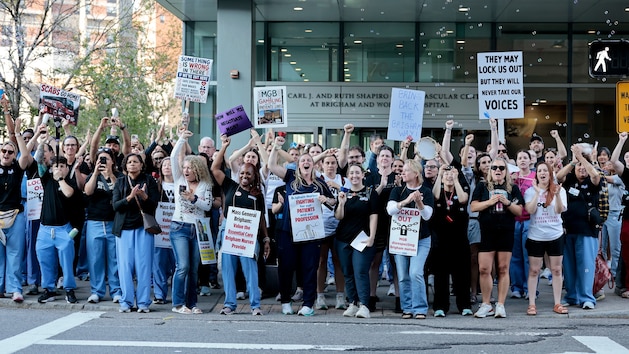
Brigham and Women’s Hospital nurses strike, July 13, 2026, outside the hospital in Boston, Massachusetts. (Pat Greenhouse/Boston Globe via Getty Images)
(BOSTON) — About 4,000 registered nurses at Brigham and Women’s Hospital (BWH) in Boston voted “overwhelmingly” on Thursday to authorize an open-ended strike.
The Massachusetts Nurses Association (MNA), which represents the nurses, said this could be the largest open-ended registered nurse (RN) strike in state history.
No strike date has been set yet. Before it occurs, the nurses will be legally required to give 10 days’ notice. If the strike is held, it would continue until the nurses reach a contract agreement with the hospital.
Nurses say they are seeking a fair contract that will protect patient care, strengthen the workforce and provide affordable health insurance.
“[Mass General Brigham] cannot tell nurses to choose between the care our patients deserve, affordable health insurance, or fair cost-of-living wage increase,” Jim McCarthy, RN, a nurse in the post-anesthesia care unit and vice chair of the BWH MNA Bargaining Committee, said in a statement.
The statement went on, “We have offered to negotiate and work toward an agreement, but CEO Anne Klibanski, who makes $9.2 million a year, and the billionaires on MGB’s Board of Directors, have refused to bargain. Our vote gives nurses the power to push back hard if the MGB billionaires keep putting corporate greed over safe patient care.”
Among the nurses’ proposals are limiting the hospital’s use of temporary nurses, fair compensation including a cost-of-living increase and affordable health insurance with plan choice.
MNA said that the hospital told nurses in August it was not willing to negotiate unless significant changes were made to the latest proposal.
“Brigham nurses have made clear that we are prepared to stay on strike for as long as it takes to win a contract that protects our patients and respects the nurses who care for them,” Kelly Morgan, RN, a labor and delivery nurse and chair of the BWH MNA Bargaining Committee, said in a statement.
“An open-ended strike is a serious step that will undoubtedly create a healthcare crisis in Massachusetts. MGB can prevent the strike by returning to the table and negotiating the contract our nurses need to keep providing world-class care,” the statement continued.
BWH did not immediately return ABC News’ request for comment.
President Donald Trump looks on as New York Mayor Zohran Mamdani speaks to reporters following their meeting at Gracie Mansion on September 21, 2026, in New York City. (Photo by Spencer Platt/Getty Images)
(WASHINGTON) — The Supreme Court has given the Trump administration a green light to use a federal citizenship database to verify voters ahead of the midterm elections.
In a 6-3 opinion, the Supreme Court, for now, lifted a lower court order that blocked the Department of Homeland Security from expanding a 40-year-old immigration database — known as the Systematic Alien Verification for Entitlements system — to help states screen voter records for noncitizens.
The immediate impact of the ruling is unclear, since states are prohibited by law from purging their voter rolls within 90 days of Election Day.
“The District Court’s order thus inhibits the Federal Government’s efforts to assist state and local agencies in the proper administration of the midterm elections. Under these circumstances, the equities weigh in favor of a stay,” the majority wrote.
President Donald Trump has characterized noncitizen voting as a pressing threat to free and fair elections, but audits of voter rolls have suggested that voting by noncitizens is exceedingly rare.
This is a developing story. Please check back for updates.
Bridget Maeve Zeigler, 2, went missing in Cumberland County, Va. on Thursday, Sept. 24. (Virginia State Police)
(NEW YORK) — A 2-year-old girl went missing Thursday evening in Southwest Virginia, setting off a search by police and help from the local school district, according to officials.
The child, Bridget Maeve Zeigler, is described as a white female with short brown hair and blue eyes, and is about 2 feet tall and 30 pounds, according to a Virginia State Police alert.
Zeigler was last seen at 6 p.m. on Thursday in Cumberland County, Virginia in an area that appears to be heavily forested, according to police.
Zeigler was last seen wearing an orange dress, blue coat and white tennis shoes, according to the alert.
Police said the child is believed to be on foot.
Virginia State Police issued a CODI alert at approximately 11:30 p.m. Thursday on behalf of the Cumberland County Sheriff’s Office.
Cumberland County Public Schools also issued an alert, encouraging community members to contact authorities with any information regarding Zeigler’s whereabouts.
Anyone with knowledge of the child’s location or disappearance is directed to reach out to the Cumberland County Sheriff’s Office at (804) 492-4120.
Rep. Ro Khanna speaks during a campaign event with Tom Steyer, Democratic gubernatorial candidate for California in Santa Rosa, Calif., May 27, 2026. (David Paul Morris/Bloomberg via Getty Images)
(WASHINGTON) — Democratic Rep. Ro Khanna is unveiling an ambitious nearly $1 trillion proposal on Friday calling for universal childcare as he continues crafting legislative policies that may ultimately serve as the cornerstones of a potential presidential campaign in 2028.
“The biggest thing killing us is childcare,” Khanna, who represents California, told ABC News in a phone interview while he crisscrosses the country campaigning for progressive candidates and reelection ahead of the midterm elections.
In an exclusive interview with ABC News, Khanna said he wanted to introduce a childcare bill before the high-stakes midterm elections as a “north star” and blueprint for “what we should be passing.”
The Free Child Care for America Act is a nearly $1 trillion, 10-year package aimed at building a universal childcare system — creating three taxpayer-funded pathways to provide flexibility and options for American families.
Khanna ticked off several potential spending reductions to offset the cost of the $1 trillion package — such as savings realized by ending the war in Iran; $400 billion in new revenue collected by instituting a 5% “billionaire tax,” or cutting the Pentagon’s budget by $200 billion.
“What this childcare proposal — in my view — is speaking to [is] the needs of working class families, and it’s something we can deliver,” he said.
Khanna’s plan calls for billions of dollars that funds grants for states and tribal organizations to cover the cost of licensed childcare for eligible families, aims to increase the supply of childcare, support providers’ operating costs, and raise compensation across the childcare workforce.
“If you want to do this right, it’s going to be an $80 to $90 billion price tag,” Khanna said. “That’s what it takes to make childcare free. That’s what it takes to pay people well, and that’s what it’s going to take to make it flexible.”
His pitch comes as Vice President JD Vance has championed an administration proposal to expand federal childcare subsidies — as much as $9,000 annually — to married couples who have a stay-at-home parent.
Khanna said he believes families should be able to choose from a menu of childcare options.
“It should be value neutral between staying at home, going to a childcare center, or having friends or family, and that is maximizing the choice,” Khanna said. “Vance’s proposal is trying to tip the scales a bit on the choice of people who are stay-at-home parents.”
Khanna explained his middle-class upbringing in Bucks County, Pennsylvania, motivated him to tackle the issue of childcare.
“Childcare is one of those things that didn’t have the same exorbitant cost, and if we can fix that issue, provide people with childcare, you’re going to give more Americans the shot to have economic security in a modern economy, and that’s the whole point of economic patriotism: that people should be able to have economic independence in today’s economy,” he said.
The five-term congressman, whose net-worth is estimated to be in the hundreds of millions of dollars, explained how his own experience as a father of two children while working a demanding job has informed his perspective.
“I believe there’s nothing more important than being there for kids at a young age, and I have an extraordinary wife who’s an exceptional mom,” Khanna said. “It has given me an admiration for parents who do incredibly, incredibly hard work, and my view is that we’ve got to make it possible for parents who want to give their kids the best ability to do that.”
Khanna says that his agenda — which he has dubbed “America’s next new deal” — is also informed through his conversations with families in swing states. Khanna has been holding town halls and participating in campaign events in swing states alongside progressive candidates.
“Economic patriotism is all about making the future economy work — not just for the billionaires in my district, but work for the people I grew up with in Pennsylvania,” he said. “As I traveled around the country, and I started with like, ‘How do we bring good jobs?’ I kept hearing, ‘Well, that’s fine, but how am I going to take care of our kids and do these jobs?'”
First elected to represent California’s 17th Congressional District in 2016 — the same election President Donald Trump first won the White House — Khanna has built a progressive voting record coupled with savvy media engagement. While Vermont Sen. Bernie Sanders has led the national progressive movement over the past decade, Khanna is striving to position himself as a potential successor — though he is not breaking through any Democratic primary polls for 2028 so far.
Khanna’s profile continues to grow as he engages with voters and weighs his future options — sometimes even before Republican audiences on Fox News or in GOP-held districts. Last year, he laid out a political reform agenda focused on combating corruption — hoping it would form the basis of the Democrats’ platform in the upcoming midterm elections. He also took center stage alongside GOP Rep. Thomas Massie in the congressional effort to force the Department of Justice to release tens of thousands of records related to its investigation of Jeffrey Epstein.
Ahead of the midterms, Khanna continues to campaign on behalf of candidates across the country — though he’s not coy about his political ambitions.
“I want 2028 to be a big-ideas primary,” Khanna said. “I want it to be a contest on who’s going to have ideas of the future that meet the moment where many Americans feel that the economic and political system are broken and not working for them.”
Khanna concedes that some stakeholders and supporters alike have expressed concern over the $1 trillion cost of his proposal, which would offer $1,000 per month to eligible stay-at-home parents with an eligible child under age 3 and a household income at or below 100% of their state’s median income. But he says he is being transparent about the cost and argues that his package is worth the investment.
“Why would you think that giving entrusting the care of young people at their most impressionable, where their experience is going to shape the rest of their lives, and we have data showing that? Why would we think that that’s cheap?” Khanna said. “Of course, it’s expensive, and that’s why there’s this huge market failure because it’s expensive, and yet people aren’t being paid appropriately, and that’s why it’s a public good. And so this is really saying, OK, if you want to do this right, it’s going to be a $80 to $90 billion price tag. That’s what it takes to make childcare free.”
House Democratic leaders have not endorsed Khanna’s childcare legislation, but agree that lowering childcare costs must be a priority if they take back the House majority.
“I want it to be front and center in the conversation of the first 100 days for the speaker,” Khanna said regarding Democratic prospects to win the House majority. “Even if they don’t do the whole $90 billion, I mean, obviously that’s my hope that the House should pass this bill, they can take three elements of it.”
As for the 2028 presidential race?
“Whether I run, which obviously I’m considering, or whether I am actively supporting other candidates, I want to be leading in putting forth bold ideas about what that Democratic Party should be,” Khanna said. “I think we need to offer a new vision of ideas that are actually going to deliver for working- and middle-class families who have been left out.”
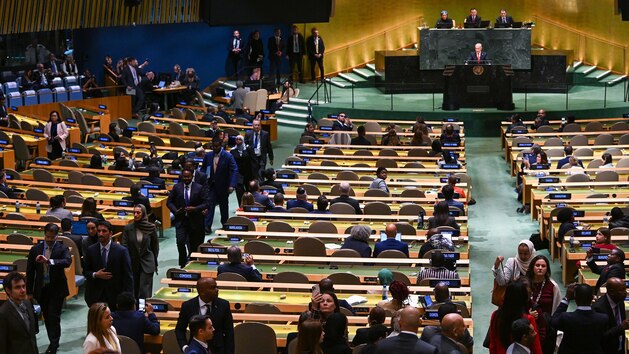
Delegations leave before Israeli Prime Minister Benjamin Netanyahu begins his address to the 81st United Nations General Assembly at UN headquarters in New York City, September 24, 2026. (Alexi J. Rosenfeld/Getty Images)
(NEW YORK) — An unapologetic Prime Minister Benjamin Netanyahu addressed the United Nations General Assembly on Thursday, defending Israeli military actions in the Middle East while going on the attack against his political enemies.
“Devastating Iran’s nuclear facilities was hard. It was very hard to do. But for me, it was one of the easiest decisions I’ve ever had to make as prime minister,” Netanyahu asserted during his speech. “Because if we hadn’t done it, we’d all be dead!”
The atmosphere in the hall shifted sharply before the prime minister’s speech began. As he approached the podium, the room erupted in chants, cheers and boos as dozens of delegates from various countries walked out in protest.
“Before I begin, just a quick announcement: if there are any other moral cowards who haven’t yet left this hall, please do so now,” Netanyahu said in response.
The Israeli prime minister claimed that the leaders of many of the countries whose delegations exited had privately thanked him for hitting Iran’s nuclear sites, calling it “mind-blowing hypocrisy.”
Netanyahu used much of his lengthy speech to criticize his political opponents for spreading what he said were lies about Israel and fomenting hatred against Jews, calling foreign governments and world leaders out by name.
The prime minister also zeroed in on New York City Mayor Zohran Mamdani, calling him antisemitic for asserting Israel’s response to Hamas’ Oct. 7 terrorist attack amounts to genocide.
“Shame on you for distorting the facts. Shame on you for inverting victim and aggressor. Shame on you for spitting in the face of truth,” he said. “Mr. Mamdani, since you were elected mayor of this city, many jews no longer feel safe in New York.”
Mamdani responded by accusing Netanyahu of spreading “baseless lies meant to sanitize his genocide of Palestinians.”
“Yet no lie can change the fact that he remains the subject of an International Criminal Court arrest warrant alleging war crimes and crimes against humanity,” the mayor said in a statement.
Netanyahu is expected to spend less than a day in the U.S. and return to Israel without meeting with President Trump, a stark departure from recent precedent that comes as the relationship between the two leaders has become increasingly strained.
But despite recent tension, the prime minister heaped praise on Trump — extolling his leadership and declaring that Israel had “no greater partner” in its “battle against the barbarians.”
Earlier on Thursday, Palestinian President Mahmoud Abbas addressed the assembly through a video message recorded in his Ramallah office because the Trump administration declined to grant him and other Palestinian officials visas to travel to New York for the gathering.
In his remarks, Abbas said Palestinians were facing a “genocidal war” and urged the international community to do more to confront Israel.
“How long will some countries continue to remain silent about Israel, or continue supplying it with weapons that it uses against our people? he asked.
“We will not leave our homeland. We will not accept displacement. And we will not allow anyone to decide our future on our behalf,” Abbas said.
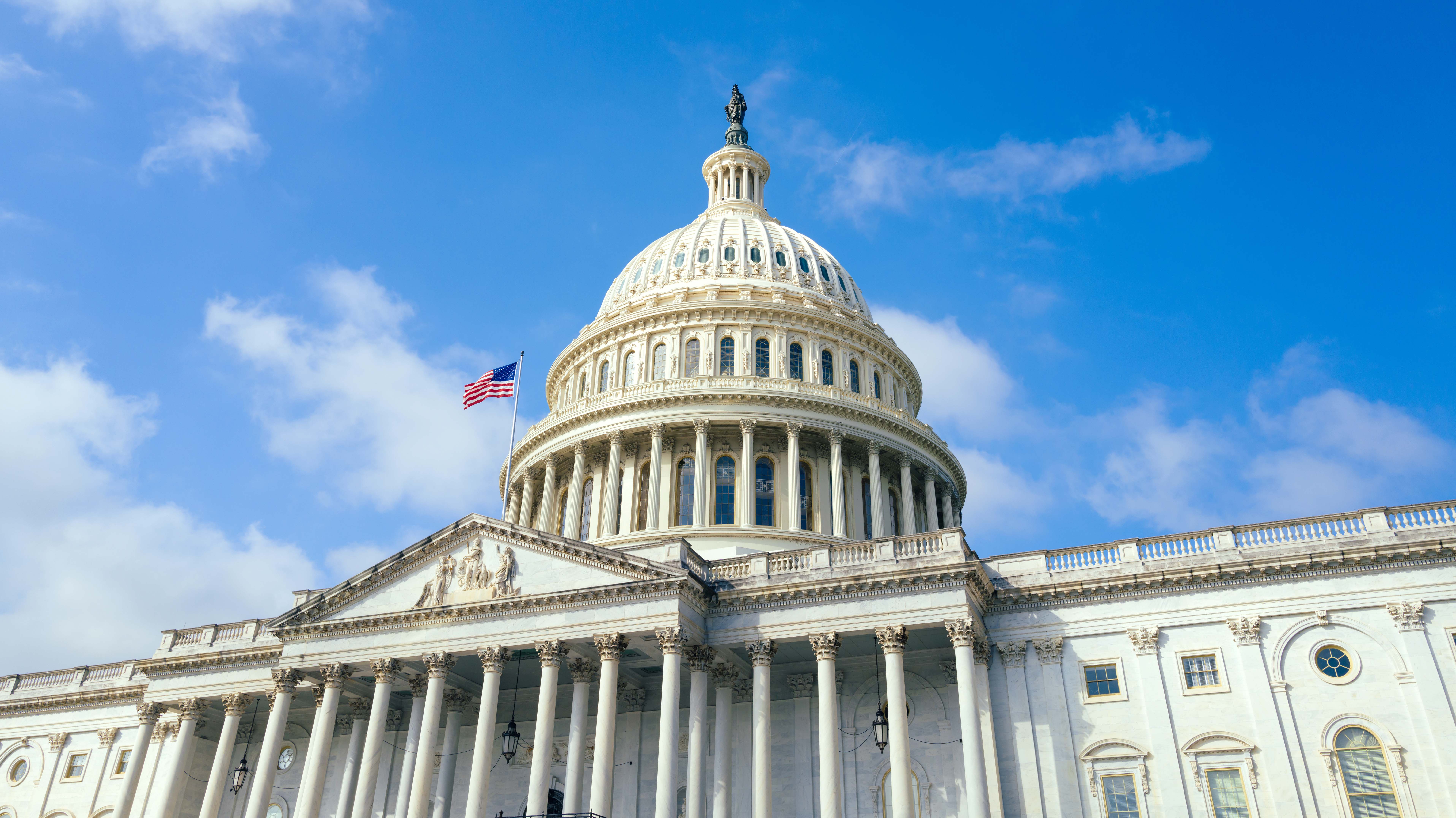
United States Capitol building. (Getty Images stock photo)
(WASHINGTON) — After a week in which more Republicans have emerged to call for an end to the war in Iran, the Senate failed to adopt a House-passed war powers resolution on Thursday by a vote of 49-50.
Republican Sens. Lisa Murkowski, Susan Collins, Rand Paul and Thom Tillis joined all but one Democrat, Sen. John Fetterman, in voting in favor of the resolution. Democratic Sen. Angela Alsobrooks did not vote. Democrats would’ve needed full attendance and five Republicans to vote with them in order for the resolution to pass.
The vote underscores the political tightrope vulnerable Republicans are attempting to walk with a little over a month until the midterm elections. While some Republican senators have grown increasingly critical of the war and its impact on diesel and gasoline prices, they have also stopped short of supporting measures that could directly challenge President Donald Trump’s policy.
For example, Republican Sen. Jon Husted, who is in a close race up against Democratic candidate Sherrod Brown, told POLITICO this week that the “war needs to come to an end as quickly as possible so that we can lower gas prices,” before voting against the war powers resolution on Thursday. Other Republicans who are also in tight reelection races voted to kill the resolution including Sens. Dan Sullivan and Roger Marshall.
Democrats did however pick up another Republican during this vote: Tillis, who voted for the resolution for the first time, citing a lack of concrete information on a solution to end the war.
“On July 10th, I heard the administration refer to the conflict in Iran as a war for the first time, and I arbitrarily use that date to say ‘I need to be briefed up over the next 60 days to be convinced that we’re tracking in the right direction.’ And the first outreach I got was last week,” Tillis said ahead of Thursday’s vote.
“They need to inform Congress more. They need to be clear on their strategic objectives, and they need to be more engaged. At least to the Armed Services Committee,” Tillis said, adding “the reason I’m inclined to vote on it today is to say, ‘it is time to engage Congress, folks, if we’re going to be there for the long term.'”
Trump initially estimated the war in Iran would last four to six weeks. Instead it’s nearing its eighth month and 50,000 American service members remain deployed in the region. Eighteen U.S. service members have been killed and over 800 wounded since the U.S. and Israel launched strikes against Iran.
The Senate has voted on an Iran War Powers Resolution 13 times, but has only passed it only once. The Senate first adopted a House-passed Iran War Powers resolution in late June when Sens. Collins, Murkowski, Paul and Bill Cassidy voted for it while Sens. Mitch McConnell and Dave McCormick missed the vote, clearing the way for the resolution’s passage.
The administration refused to make any changes with their strategy in Iran as a result of the resolution’s passage, calling the efforts “poorly timed and meaningless.”
However, since that June vote, the Senate has yet to pass another war powers resolution on Iran during its three attempts since then. That’s because Cassidy had previously flipped his vote back to voting against the resolution after a briefing with Trump administration officials following a contentious GOP meeting that Trump attended in June.
Cassidy, who argued he was undecided on how he would vote leading up to it, sidestepped reporters upon leaving the Capitol on Thursday, claiming he couldn’t talk because he was trying to make a flight out of town.
The USS Abraham Lincoln aircraft carrier departs Laem Chabang Port, September 6, 2026 in Si Racha, Thailand. (Thananuwat Srirasant/Getty Images)
(WASHINGTON) — Eight U.S. Navy personnel attached to the USS Abraham Lincoln carrier strike group have attempted suicide since the start of their extended deployment tied to the war in Iran, according to a letter ABC News obtained from Acting US Navy Secretary Hung Cao.
In the letter, sent to Sen. Kirsten Gillibrand on Tuesday, a member of the Senate Armed Services Committee, Cao says that there have been eight suicide attempts since the USS Lincoln’s deployment began around 10 months ago.
“Since the beginning of LINCOLN’s deployment, there have been a total of eight suicide attempts across the strike group — this number includes the LINCOLN crew and Sailors from the carrier air wing, strike group and destroyer squadron staff, escorting destroyers, and all embarked aviation squadrons,” Cao wrote in response to questions from Gillibrand about the health and well-being of the personnel aboard the fleet.
The letter was first reported by CNN.
A Navy official told ABC News that while they treat every attempted suicide case very seriously, they maintain the number is not out of the norm for a long deployment.
Throughout the deployment, the Lincoln had between 2,500 and 2,800 sailors aboard, according to Cao’s letter. Eight attempts among that population of sailors appear to be roughly consistent with Navy records for suicide attempts in the broader Navy ranks.
The Navy recorded 356 suicide attempts in 2024, that last year of publicly available data. Over three years, the figure represents a nearly 50% increase in attempted suicides, according to Navy records.
President Donald Trump and Defense Secretary Pete Hegseth have dismissed reports of poor conditions and mental health issues aboard the USS Lincoln. Cao confirmed that a sailor went overboard in early August from the Lincoln and was quickly recovered.
In his letter, Cao confirmed a piping issue aboard the USS Lincoln and that meal options were reduced from two to one during periods of higher-tempo operations, but that both issues were resolved.
Despite the USS Lincolns’ record-long deployment, Trump said in August that the vessel hasn’t been deployed for “nearly long enough.” Hegseth in August pushed back on reports of a sailor going overboard from the Lincoln and accounts of sailors struggling through an unusually long deployment have been “completely misrepresented.”
Adm. Brad Cooper, the commander of U.S. Central Command, said in an August social media post that “the Lincoln currently has among the lowest number of cases related to mental health” among the Navy’s 11 active aircraft carriers. Cooper also acknowledged in the post that it “doesn’t mean that all is perfect” and that a long deployment at sea “is uniquely challenging and tough, and every single one of us, including me, reacts to stressors in different ways.”
In a statement to ABC News, Gillibrand said Trump and Hegseth dismissed concerns that “turned out to be serious and deteriorating conditions for our service members.” Gillibrand called the treatment of service members under the Trump administration “completely unacceptable.”
The ship was slated for a normal six-month deployment to the Pacific but had been extended on an unusually long deployment due to the war with Iran, where it was redirected earlier this year.
The president initially estimated the war in Iran would last four to six weeks. Instead it’s nearing its eighth month and 50,000 American service members remain deployed in the region. Eighteen U.S. service members have been killed and over 800 wounded since the U.S. and Israel launched strikes against Iran.
The Lincoln Strike group left the Middle East late last month — replaced by the USS George Washington — and is en route to its home port in California. The ship docked in Thailand earlier this month with a record 286 days at sea.
If you are struggling with thoughts of suicide or worried about a friend or loved one, call or text the Suicide & Crisis Lifeline at 988 for free, confidential emotional support 24 hours a day, seven days a week.
ABC News’ Chris Boccia contributed to this report.
The USS Abraham Lincoln aircraft carrier departs Laem Chabang Port, September 6, 2026 in Si Racha, Thailand. (Thananuwat Srirasant/Getty Images)
(WASHINGTON) — Eight U.S. Navy personnel attached to the USS Abraham Lincoln carrier strike group have attempted suicide since the start of their extended deployment tied to the war in Iran, according to a letter ABC News obtained from Acting US Navy Secretary Hung Cao.
In the letter, sent to Sen. Kirsten Gillibrand on Tuesday, a member of the Senate Armed Services Committee, Cao says that there have been eight suicide attempts since the USS Lincoln’s deployment began around 10 months ago.
“Since the beginning of LINCOLN’s deployment, there have been a total of eight suicide attempts across the strike group — this number includes the LINCOLN crew and Sailors from the carrier air wing, strike group and destroyer squadron staff, escorting destroyers, and all embarked aviation squadrons,” Cao wrote in response to questions from Gillibrand about the health and well-being of the personnel aboard the fleet.
The letter was first reported by CNN.
A Navy official told ABC News that while they treat every attempted suicide case very seriously, they maintain the number is not out of the norm for a long deployment.
Throughout the deployment, the Lincoln had between 2,500 and 2,800 sailors aboard, according to Cao’s letter. Eight attempts among that population of sailors appear to be roughly consistent with Navy records for suicide attempts in the broader Navy ranks.
The Navy recorded 356 suicide attempts in 2024, that last year of publicly available data. Over three years, the figure represents a nearly 50% increase in attempted suicides, according to Navy records.
President Donald Trump and Defense Secretary Pete Hegseth have dismissed reports of poor conditions and mental health issues aboard the USS Lincoln. Cao confirmed that a sailor went overboard in early August from the Lincoln and was quickly recovered.
In his letter, Cao confirmed a piping issue aboard the USS Lincoln and that meal options were reduced from two to one during periods of higher-tempo operations, but that both issues were resolved.
Despite the USS Lincolns’ record-long deployment, Trump said in August that the vessel hasn’t been deployed for “nearly long enough.” Hegseth in August pushed back on reports of a sailor going overboard from the Lincoln and accounts of sailors struggling through an unusually long deployment have been “completely misrepresented.”
Adm. Brad Cooper, the commander of U.S. Central Command, said in an August social media post that “the Lincoln currently has among the lowest number of cases related to mental health” among the Navy’s 11 active aircraft carriers. Cooper also acknowledged in the post that it “doesn’t mean that all is perfect” and that a long deployment at sea “is uniquely challenging and tough, and every single one of us, including me, reacts to stressors in different ways.”
In a statement to ABC News, Gillibrand said Trump and Hegseth dismissed concerns that “turned out to be serious and deteriorating conditions for our service members.” Gillibrand called the treatment of service members under the Trump administration “completely unacceptable.”
The ship was slated for a normal six-month deployment to the Pacific but had been extended on an unusually long deployment due to the war with Iran, where it was redirected earlier this year.
The president initially estimated the war in Iran would last four to six weeks. Instead it’s nearing its eighth month and 50,000 American service members remain deployed in the region. Eighteen U.S. service members have been killed and over 800 wounded since the U.S. and Israel launched strikes against Iran.
The Lincoln Strike group left the Middle East late last month — replaced by the USS George Washington — and is en route to its home port in California. The ship docked in Thailand earlier this month with a record 286 days at sea.
If you are struggling with thoughts of suicide or worried about a friend or loved one, call or text the Suicide & Crisis Lifeline at 988 for free, confidential emotional support 24 hours a day, seven days a week.
ABC News’ Chris Boccia contributed to this report.