Carlos Santana has released a fourth advance track from his upcoming studio album, Blessings and Miracles, a genre-blending song titled “Joy” that features the guitar legend collaborating with Grammy-winning country star Chris Stapleton.
“Joy,” which was co-written, produced and sung by Stapleton, combines elements of reggae, rock, country, blues and gospel music.
“I was very intrigued to work with Chris,” Carlos says. “We talked on the phone about the COVID situation and how there’s so much fear in the world, and I said, ‘We need to create music as a healing force. We must bring hope and courage and disinfect twisted minds infected with darkness.’ That gave him the ammunition to write such incredible words.”
He adds, “Somewhere I said, ‘flying on the wings of angels,’ so it’s a collaboration. And what an incredible song it is. The choir in it — it’s like the Staple Singers.”
“Joy” is available now via digital formats, and you also can check out a colorful, animated lyric video for the tune at Santana’s official YouTube channel. The clip brings images from the Blessings and Miracles cover art to life.
Blessings and Miracles, which you can pre-order now, will be released this Friday, October 15. As previously reported, the album features Carlos and his band teaming up with an eclectic variety of guest musicians. The three other tracks that already have been released from the record are a cover of the Procol Harum classic “A Whiter Shade of Pale” featuring Steve Winwood; the new Rob Thomas collaboration, “Move“; and “She’s Fire,” a song written by acclaimed songwriter Diane Warren that also features singer-rapper G-Eazy.
(NEW YORK) — The United States has been facing a COVID-19 surge as the more contagious delta variant continues to spread.
More than 713,000 Americans have died from COVID-19 while over 4.8 million people have died from the disease worldwide, according to real-time data compiled by the Center for Systems Science and Engineering at Johns Hopkins University.
Just 66% of Americans ages 12 and up are fully vaccinated against COVID-19, according to data from the CDC.
Here’s how the news is developing. All times Eastern:
Oct 11, 12:41 pm
Daily death average nearly 8 times higher than in mid-July
Although daily deaths have declined by about 17% in the last four weeks, the U.S. is still reporting an average of 1,465 new deaths each day, according to federal data. Over the last four days alone, the U.S. reported another 7,500 confirmed COVID-19 deaths.
The death average is nearly eight times higher than in mid-July when the national average had dropped to a near pandemic low of 192 daily deaths, according to federal data.
But hospitalization admissions have dropped by about 11.4% in the last week, according to federal data.
There are currently about 65,000 COVID-19 patients in U.S. hospitals, down from 104,000 patients in late August.
In the Mountain Region — Colorado, Montana, North Dakota, South Dakota, Utah and Wyoming — hospital admissions are steadily trending up, federal data show. In the Northeast, hospital admissions are no longer trending down.
-ABC News’ Arielle Mitropoulos
Oct 11, 12:13 pm
Boston Marathon returns with COVID protocols in place
The Boston Marathon returned with 18,000 runners on Monday following a two-year hiatus.
The field size was reduced by 36% this year while another 28,000 runners participated in the race virtually.
Runners were required to provide proof of vaccination or a negative COVID-19 test. Although masks were not mandated for the 26.2-mile course, face coverings were enforced on participant transportation, as well as for volunteers who interacted with participants.
According to the Boston Marathon Association, 95% of all Boston Marathon volunteers were vaccinated and 100% of Boston Marathon medical volunteers were vaccinated.
Christopher Polk/NBC/NBCU Photo Bank via Getty Images
Drake is giving some major Instagram love to his son Adonis, in celebration of his fourth birthday.
Over the weekend, Drake, who shares Adonis with ex Sophie Brussaux, took to Instagram to share photos from his son’s race-car-themed birthday party.
“TEACHA,” Drake captioned one photo that showed him smiling as he crouched down and posed next to his son. “MORE LIFE KID.”
In another post, which appeared to be taken at a photo booth, Drake holds his son, who stretches out into a Superman pose. Drake simply captions the image with a runner emoji.
The “One Dance” performer also posted footage on his Instagram Story of Adonis sharing some popcorn with someone in a Bugs Bunny costume from the film Space Jam: A New Legacy.
This isn’t the first time Drake showed his baby boy on Instagram. Last year, Drake shared a rare photo of Adonis, writing in part that he “love[s] and miss[es] [his] beautiful family and friends..”
Apple TV+’s critically-hailed sci-fi epic Foundation has been picked up for a second season by the streaming service, so cast members need to get their dancing shoes ready.
That’s because Lee Pace, who plays the series’ villain, Emperor Day, has a habit of starting dance-offs on set — even though one led to his Guardians of the Galaxy character’s defeat. And while he told ABC Audio he didn’t get a chance to repeat the activity on Foundation, he’s got his eyes on a certain co-star for season two.
“Jared Harris, I’m calling you out!” Pace said with a laugh about his Emmy-winning co-star. “Let’s see what moves you got!”
For her part, co-star Lou Llobell, who plays Gaal [Gail] Dornick, is ready. “I will take Lee on,” she joked. “I can’t promise anything, but, that would be a great experience.”
Llobell also praised her co-star, who at 6 foot 5 made a visually intimidating foil for the actress, who plays a genius mathematician from a backwater planet with knowledge that threatens the galactic empire, ruled by Pace’s Brother Day.
“Lee was great,” the actress enthuses. “I mean, he’s an amazing person off-camera as well, and we all get along like the whole cast got along so well, which I’m very grateful for.”
Llobell adds, “But…it was pretty intimidating to see. I mean, I’m five foot two and Lee’s like, six foot however. And so looking up at him and it was perfect for me in that moment, especially for me playing Gaal as well.”
Machine Gun Kelly has joined the pantheon of celebrities who were impersonated on Saturday Night Live.
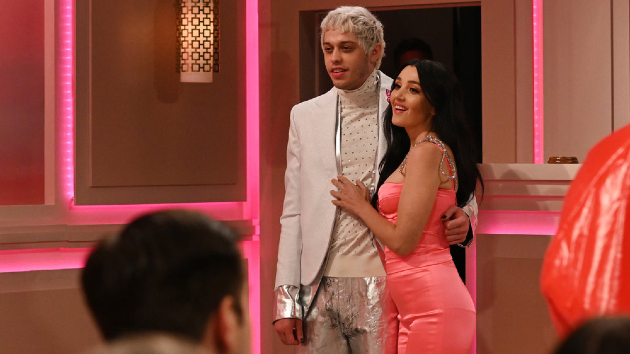
This past weekend’s episode featured a sketch in which host Kim Kardashian West played her sister Kourtney as the judge in a court show called The People’s Kourt. In the middle of the skit, Kourtney introduces her “bailiff and best friends,” MGK and Megan Fox, played by SNL cast members Pete Davidson and Chloe Fineman.
“Wait, why are we best friends?” Fineman’s Fox asks. “Because our boyfriends have tattoos for necks,” Kim’s Kourtney replies.
Kourtney’s boyfriend, of course, is Blink-182‘s Travis Barker, who collaborated with Kelly on his 2020 album Tickets to My Downfall. Barker also shows up in the sketch, as played by Mikey Day.
In a tweet in reaction to the sketch, Kelly wrote, “I think it’s time for me to come on the show as Pete.”
While he waits for the call from SNL, Kelly has been working on his Tickets follow-up album, Born with Horns. In an interview with NBC’s Sunday Today, Kelly teased that Born with Horns, which will also be produced by Barker, is set to be “more guitar-heavy” than its predecessor.
“Every album is a juxtaposition of the last album,” Kelly explained. “So I went and studied Tickets, and I heard the bright sound that I had, and for this album I just turned the lights off.”
Kelly dropped the lead Born with Horns single, “Papercuts,” back in August. As for the rest of the record, Kelly hinted at a release date in the interview.
“I almost feel like the second you open your eyes and it’s 2022…you’ll have something to listen to,” he said.
Dierks Bentley and Jason Aldean will try their hands at coaching on The Voice.
The country superstars are both serving as advisors during the Battle Rounds, Dierks coaching Blake Shelton‘s team while Jason lends his talents to Kelly Clarkson‘s contestants.
In a preview of the upcoming episodes, Blake and Dierks can’t get over each other’s hair upon reuniting.
“What happened to your hair?” Blake exclaims. “It’s the longest I’ve ever seen it.”
“What happened to yours?” Dierks jokes, referring to the mullet Blake used to have at the start of his career. “Yours is as gray as I’ve ever seen it.”
Between jabs, the “What Was I Thinkin'” singer meets the four contestants of Team Blake, in addition to coming up with a new team name, like that of celebrity couples.
“Team D-lake. The two of us,” Dierks calls them.
“D-lake, I like it,” Blake approves with a smile.
Meanwhile, Kelly and Jason reminisce on their hit duet, “Don’t You Wanna Stay” that earned them a Grammy nomination and led them to previously appearing on The Voice together.
“It was a huge song that introduced me to a whole different fan base,” Jason remarks, citing it as “the biggest duet of my career,” while Kelly calls it “one of my favorite songs ever. …I feel very fortunate to have the career I’ve had and to be able to come and share that.”
“I’m so excited to get a chance to go in there and offer any advice that I can that’s going to help them not only here at The Voice but down the road with whatever they do with their career,” Dierks reflects.
The Voice Battle Rounds begin airing tonight at 8 p.m. ET on NBC.
Following their performance on SNL over the weekend, Halsey took to social media to address comments about their post-baby body.
The singer shared photos of what their body really looked like post-pregnancy — stretch marks and all — and acknowledged it’s still changing.
“I did SNL two nights ago and a lot of people were quick to say how good I looked,” they write. “That was a weird feeling. My body has felt like a stranger’s for a long time.”
Halsey, who welcomed baby Ender in July, admitted, “I have no interest in working out right now. I’m too tired and too busy playing with my darling son.”
“With that being said, the body behind all those compliments the other night was wearing a custom tailored outfit and lighted perfectly after much testing, so I could feel good and do my job,” they wrote. “I do not want to feed the Illusion that you’re meant to feel and look ‘great’ immediately postpartum. That is not my narrative currently.”
Halsey concluded by explaining that they’ll never have their “pre baby body back” and that’s OK, but they acknowledged that the journey is still “really hard” and they are “not a superhuman.”
“Doing my best to serve my art and my family whilst keeping it all so very real. Love,” they ended their message.
(NEW YORK) — The 2021 U.S. Chess Championships are underway and Irina Krush is back to defend her title.
Krush is an eight-time U.S. women’s champion and the only female American grandmaster. She told ABC Audio’s Perspective podcast that becoming a grandmaster is not easy.
“People will become grandmasters by making things called norms, which is a certain performance, a certain high performance,” Krush said. [It’s] three sets of three tournaments where they’re playing against other grandmasters as well,” Krush said. “When you make those norms and you get your rating to a certain point, which is a threshold of 2500, then you earn your Grandmaster title for life.”
Krush said she knew from an early age that she was better than most girls and boys in her age group.
“I became a master at age 12, and I won the U.S. Women’s Championship for the first time when I was 14,” Krush said. “I was very serious about chess from a young age. I spent my weekends playing chess and sometimes my weekends and my weekdays representing the U.S. in world youth competitions around the world since the age of seven.”
Since then, Krush has been in training.
“In my eyes, chess is definitely a sport,” Krush said. “It really does require a decent level of physical fitness because it is not as easy as it looks to concentrate at your full capacity [for] four or five or sometimes six hours.”
According to Krush, becoming a grandmaster requires mastering perfecting all parts of the game, from the opening moves to the middle tactics and the strategy at the end of the game.
“It requires being exposed to better and better competition, so playing people that are better than you,” Krush said. “From the time I was a young girl, I was playing adults, and that certainly helped me improve. Going to tournaments, traveling domestically [then] later on internationally. And you know, when you make that your life, you will see results.”
And playing chess isn’t the only part of her training. Krush said it also requires a physical commitment, too.
“Certainly, from the time I was an adolescent, I started training physically, jogging regularly, playing table tennis, swimming,” Krush said. “You’re not a basketball player or a tennis player, but you have to be in good physical condition.”
Bryan Adams has released the title track and video for his brand-new album, So Happy It Hurts, due out next year.
Bryan says in a statement, “The title song…is about freedom, autonomy, spontaneity, and the thrill of the open road. The album of the same name, touches on many of the ephemeral things in life that are really the secret to happiness — most importantly, human connection.”
Bryan says those themes were inspired by the COVID-19 pandemic. “The pandemic and lockdown really brought home the truth that spontaneity can be taken away,” he explains. “Suddenly all touring stopped, no one could jump in the car and go.”
In the video for “So Happy It Hurts,” an upbeat rocker about the joys of hitting the road, Bryan does just that, driving a convertible with, variously, his real-life mother, a dog, a group of young girls dressed for a dance recital, a couple of women twerking, headbanging guitarists and a drummer, drag queens, a bodybuilder, and a dancing woman wearing a sari.
Bryan will no doubt perform some songs from the new album at a new residency he’s kicking off at the Encore Theater at the Wynn Las Vegas starting on November 10. Those dates run through November 20.
So Happy It Hurts will be available digitally, as well as a deluxe CD, and a limited edition box set that includes a hardbound book, the album on vinyl and an autographed photo. You can pre-order the album now.
So Happy It Hurts is scheduled for release March 11, 2022.
(NEW YORK) — Children can safely celebrate Halloween this year even as the coronavirus pandemic upends the holiday for the second straight year, according to the nation’s top infectious disease expert.
White House chief medical adviser Dr. Anthony Fauci told CNN Sunday that kids can “go out there and enjoy Halloween,” an approach he attributed to the fact that more and more people are now vaccinated against COVID-19 and that most Halloween activities, including trick-or-treating, are held outdoors.
“It’s a good time to reflect on why it’s important to get vaccinated,” he said, urging unvaccinated adults and teens to get shots before Halloween. “But go out there and enjoy Halloween.”
“This is a time that children love,” Fauci added. “It’s a very important part of the year for children.”
Fauci’s go-ahead on Halloween comes as COVID-19 hospitalizations, cases and deaths are declining nationwide.
But experts caution the virus could rebound if enough people remain unvaccinated.
Last week, Pfizer and BioNTech submitted a request to the Food and Drug Administration (FDA) for emergency use authorization for their vaccine for kids ages 5 to 11. But the timing means the vaccine will not be available for kids in that age group before Halloween.
The Pfizer vaccine is currently authorized for emergency use in children ages 12 to 15 and is approved by the FDA for people ages 16 and older.
Dr. John Brownstein, an epidemiologist and chief innovation officer at Boston Children’s Hospital, is the father of two young children. He said he plans to have a more “normal” Halloween with his kids this year, complete with outdoor trick-or-treating.
“It’s safe to say that trick-or-treating is an activity that all kids can partake in,” said Brownstein, who is also an ABC News contributor. “Kids can feel quite excited by the fact that I think they will have a generally normal Halloween compared to last year.”
Here are four questions answered by Brownstein about how to have a safe Halloween this year.
1. Does my child need to wear a mask while trick-or-treating this year?
In most cases, no, according to Brownstein.
“Every parent has to make their own sort of risk calculation, but given where we are in this pandemic, I think, generally, mask wearing outside is probably unnecessary,” he said, noting that data from nearly two years of the pandemic show that outdoor activities are “generally safe,” even for children who are not yet vaccinated.
“Of course, every family should make decisions that are right for them and the underlying risks of their kids and household members,” Brownstein added. “And luckily, Halloween costumes can make mask-wearing less stigmatizing.”
2. Are indoor Halloween events safe for my kids to attend?
While Brownstein is planning to trick-or-treat outdoors with his kids, he said they are planning to wait another year before attending big, indoor Halloween events.
“The bigger questions that come into play around indoor activities may involve unvaccinated people,” he said. “That’s where masking and good ventilation may be more appropriate.”
Brownstein added that people who do choose to attend indoor Halloween events this year should make sure that people at the event are vaccinated if they are eligible. He also suggests relying on additional layers of protection like social distancing and COVID-19 testing, in addition to masking and good ventilation.
3. Should my family use rapid tests? Are they reliable?
Brownstein said that in addition to vaccination, another major difference between this Halloween and last is that rapid tests are now widely available for use and are particularly smart for indoor events.
“Because rapid tests are becoming more and more pervasive, we should all be using them as a tool to limit the risk to unvaccinated people or the risk of breakthrough infections,” said Brownstein. “Within a short time frame of an event, taking a rapid test, while not 100% foolproof, will give some good reassurance that you’re not putting other people at risk by joining an indoor event.”
“I have a bunch on hand at home, ready to use as needed, so I think those are incredibly effective,” he said.
4. Does a ‘normal’ Halloween mean we’ll also have a ‘normal’ Thanksgiving and Christmas?
Brownstein said he is hopeful that more and more families and friends will be able to spend the holidays safely together this year, but stressed the importance of maintaining good public health practices to keep everyone safe, especially since the upcoming holidays typically involve more travel and time spent indoors.
“While this holiday means that we can gather more seamlessly and in a slightly more normal way, there are small things that we can all do to try to limit transmission,” he said, citing masking as a critical tool. “Transmission takes place through droplets and aerosols so whatever we can do to limit transmission will ultimately have a direct impact on whether we see a surge post-holiday.”
He added, “As we know, those surges can lead to even more significant public health measures that we’re all trying to avoid, so the small things we do during the holiday can mean even a more enjoyable life post-holiday.”