Christina Perri is releasing a new lullaby album called songs for rosie, dedicated to the daughter she lost last year.
Christina’s second child, Rosie, was born silent on November 24, 2020, and the album is set to be released on November 24 this year in her honor. It follows Christina’s 2019 lullaby album, songs for carmella: sing-a-longs and lullabies, written for her first child, her now three-and-a-half-year-old daughter, Carmella.
Songs for rosie features duets with Christina’s husband, Paul, and with Carmella, as well as special appearances by Chris Martin and Jacob Collier on the new song “roses in the rain (lullaby).” It also features a cover of The Beatles’ “Here Comes the Sun,” which debuted on Wednesday.
“rosie’s short and powerful life already served such a huge purpose in our world, and she has lovingly changed me, paul and carmella forever,” Christina wrote on Twitter. “we are more capable of love and compassion than we ever knew we could be.”
She added, “we learned how to hold space for loss and how to navigate unimaginable grief together and music always heals. releasing these songs for rosie is so important for our hearts.”
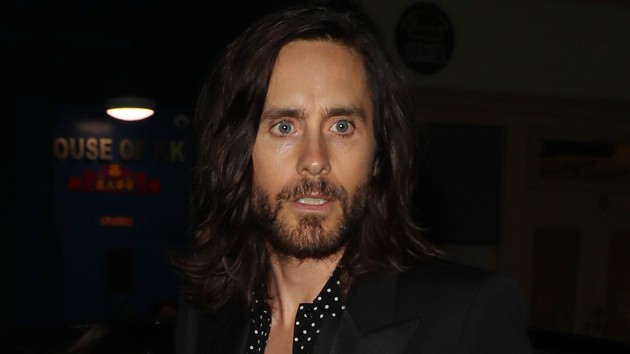
(NOTE LANGUAGE, CONTENT) While he’s gone on the record as having done so, Oscar winner Jared Leto now claims he was joking when he said he’d sent his Suicide Squad co-stars gross “gifts,” like sex toys and used condoms, from his Joker alter-ego.
His co-stars had corroborated the stories, with Oscar-winner Viola Davis once telling Vanity Fair, “He gave us some really horrific gifts,” claiming Leto had a “henchman” drop a dead pig on a table on set. “And then he sends Margot Robbie a black rat. It was still alive, in a box. She screamed, and then she kept it.”
At the time, Leto claimed playing the Clown Prince of Crime in the movie led him to create an “element of surprise” for his co-stars. Leto, however, now says his outrageous claims were “all in jest.”
The House of Gucci actor and 30 Seconds To Mars frontman just told Entertainment Weekly, “99.9 percent of what people read is bulls**t. [T]here were no used condoms.”
He added, “Any of the very few gifts that were ever given were given with a spirit of fun and adventure and received with laughter, fun, and adventure. It’s all filmed! They filmed it all! People were dying. We were just having a goof.”
Leto also said, “I’m playing a guy called the Joker, it’s OK to play some jokes. Nothing ever crossed any lines, and it’s not up to other people on the internet to create those lines.”
A senior crew member on the set of the movie Rust has filed suit against Alec Baldwin, armorer Hannah Gutierrez-Reed and assistant director Dave Halls over the fatal October 21 shooting that killed cinematographer Halyna Hutchins.
Serge Svetnoy was a key gaffer on the production — the person responsible for positioning lights for the camera — and incidentally, the crew member who posted what is believed to be the last photo of Hutchins alive.
ABC News has confirmed Svetnoy is suing the previously mentioned people, and others, claiming their negligence led to the shooting that killed Hutchins and injured director Joel Souza, when Baldwin fired a live round at the pair from what he was allegedly told by Halls was a “cold,” or empty, pistol.
The suit claims Baldwin “owed a duty to the Plaintiff and [others] on the ‘Rust’ set to handle the Colt Revolver provided to him by defendant Halls with reasonable care and diligence for the safety of ‘Rust’ cast and crew.”
It also says, “This duty called for Defendant Baldwin to double-check the Colt Revolver…to ensure that it did not contain live ammunition.”
Furthermore, the suit claims Baldwin wasn’t supposed to pull the trigger, because he was just rehearsing.
Svetnoy claims that the bullet that struck both Hutchins and Souza nearly struck him, too, and that he rendered aid to his friend after she was shot. The incident left him with severe emotional distress, the suit alleges. Svetnoy also reportedly claims in the suit that guns acquired for Rust were in fact also being used for target practice, something an attorney for Gutierrez-Reed denies.
Investigators say live rounds, blanks and dummy rounds were found on the set. Gutierrez-Reed’s attorney recently told ABC’s Good Morning America that he believes someone intentionally placed a live round in a box of dummy ammunition.
Authorities haven’t ruled out criminal charges in the case as the investigation continues.
Underoath has announced a streaming concert ahead of the band’s upcoming album, Voyeurist.
The virtual event, dubbed Digital Ghost, will feature the debut performance of Voyeurist in its entirety. It premieres December 3 via the streaming platform Moment House.
“When we started conceptualizing the Voyeurist event, we knew that we wanted to do something different than a traditional live stream,” says guitarist Tim McTague.
“One of the biggest goals was the idea of blending narrative with the visuals,” he explains. “Threading the needle on a live performance while adding in cinematic elements was a big part of Digital Ghost.”
The CMA Vocal Group of the Year category always delivers stiff competition, and that’s no exception in 2021. Among the nominees are Old Dominion — who’ve won it for the past three years running — as well as Zac Brown Band, Midland, Little Big Town and Lady A.
Midland has yet to win, but it’s their fourth time nominated in the category, and they think that their former tour mates Little Big Town might be the act to beat.
“We’ve toured a lot with Little Big Town and they’re all really good friends of ours. And the fact that they do four-part harmonies, it gives them an edge,” the band explains. “But win or lose, either way, we’re gonna use it as fuel for fire.”
Despite the competition, there’s plenty of camaraderie at the CMAs. That feeling of community with other country artists is something that Lady A still remember from their first-ever CMAs performance in 2008, where they sang their debut single, “Love Don’t Live Here.”
“Just to look out in the audience and see all your heroes in the first two rows looking at you, kind of getting to see what you’re made of for the first time,” recounts band mate Charles Kelley. “I just remember walking off feeling that we killed it. It was just a really cool moment.”
Look out for more unforgettable performances during this year’s CMAs, which airs tonight on ABC beginning at 8:00 p.m. ET.
(GLASGOW, Scotland) — Leaders from nearly every country in the world have converged upon Glasgow, Scotland, for COP26, the United Nations Climate Change Conference that experts are touting as the most important environmental summit in history.
The conference, delayed by a year due to the COVID-19 pandemic, was designed as the check-in for the progress countries are making after entering the Paris Agreement, which aims to limit global warming to well below 2 degrees Celsius, a value that would be disastrous to exceed, according to climate scientists. More ambitious efforts aim to limit warming to 1.5 degrees Celsius.
Not one country is going into COP26 on track to meeting the goals of the Paris Agreement, according to experts. They will need to work together to find collective solutions that will drastically cut down on greenhouse gas emissions.
“We need to move from commitments into action,” Jim Harmon, chairman of the World Resources Institute, told ABC News. “The path to a better future is still possible, but time is running out.”
All eyes will be on the biggest emitters: China, the U.S. and India. While China is responsible for about 26% of the world’s greenhouse gas emissions, more than all other developed countries combined, the cumulative emissions from the U.S. over the past century are likely twice that of China’s, David Sandalow, a senior research scholar at Columbia University’s Center on Global Energy Policy, told ABC News.
Latest headlines:
-US, China announce joint statement addressing climate crisis
-America ‘ready to take on the challenge,’ Pelosi says
-Obama addresses COP26, endorses Biden’s ‘Build Back Better’ bill
-American agriculture is ready to tackle climate change, agriculture secretary says
-US needs to ‘get in the game’ on clean energy transitions, energy secretary say
-New climate targets announced for sports worldwide
-Biden, world leaders push to conserve global forests
-‘It’ll take trillions,’ Jeff Bezos says of his $10 billion climate pledge
-Biden apologizes for Trump administration pulling out of the Paris Agreement
Here’s how the conference is developing. All times Eastern.
Nov 10, 3:29 pm
US, China announce joint statement addressing climate crisis
Top carbon emitters U.S. and China have committed to working together on reducing emissions and transitioning to renewable energy over the next decade, according to U.S. Special Envoy for Climate John Kerry.
Kerry said it’s important that the countries work together on climate issues.
“And as I’ve said many times, the United States and China have no shortage of differences. But on climate, cooperation is the only way to get things done,” he told reporters Wednesday.
ABC News’ Stephanie Ebbs
Nov 09, 1:39 pm
America ‘ready to take on the challenge,’ Pelosi says
House Speaker Nancy Pelosi focused on the domestic political success of the Build Back Better plan and its investment in climate change while speaking to reporters at COP26, continuing the message that America is back on the international climate stage.
“We come here equipped, ready to take on the challenge to meet the moment,” Pelosi said.
Pelosi said she still plans to pass the reconciliation bill the week of Nov. 15 and backed up remarks made by former President Barack Obama on Monday — that both he and President Biden could take more aggressive action on climate change if it wasn’t for near Republican control on Capitol Hill.
“Let me just say that when President Obama was president and we had majority in the first term … we did pass in the House a very strong climate bill,” she said.
“Sixty votes in the Senate is an obstacle that is very hard to overcome and is another subject for another day.”
Rep. Alexandria Ocasio-Cortez also declared that “America is back” but was more critical, saying that leaders will need to “actually deliver.”
“We’re here to say that we’re not just back, we’re different … and we are more open, I think, to questioning prior assumptions about what is politically possible and that is what is exciting about this time,” she said.
ABC News’ Stephanie Ebbs
Nov 08, 5:23 pm
Obama addresses COP26, endorses Biden’s ‘Build Back Better’ bill
During his speech at Monday’s COP26 events, former President Barack Obama shined a spotlight on the upcoming midterm elections and called upon young Americans to consider climate when deciding how to vote.
“Saving the planet isn’t a partisan issue,” Obama said, frustrated over the divided government.
Obama endorsed President Joe Biden’s “Build Back Better” bill and drew a comparison to when “one of our two major parties” made climate change a partisan issue back during his tenure.
On climate change, Obama harkened back to the Paris Agreement, saying, “We have not done nearly enough to address the crisis.”
He called for countries to push for ambitious action and acknowledged that while older generations have failed the young, they “can’t afford hopelessness.”
Addressing the youth participating in protests outside COP26 in Glasgow, Scotland, the former president encouraged them to get more involved to deal with their anxiety over climate change.
“Protests are necessary to raise awareness. Hashtag campaigns can spread awareness,” Obama said. “But to build the broad-based coalitions necessary for bold action, we have to persuade people who either currently don’t agree with us or are indifferent to the issue.”
Nov 05, 1:23 pm
Greta Thunberg leads youth activist march
Swedish activist Greta Thunberg, 18, was among thousands of young people demonstrating outside of COP26.
Thunberg spoke at the Fridays for Future march, the group she founded in 2018, criticizing politicians and labeling the conference as a “failure.”
“It should be obvious that we cannot solve a crisis with the same methods that got us into it in the first place,” Thunberg said.
Many of the demonstrators who spoke to ABC News said they attended the rally to see Thunberg speak.
Some demonstrators said they did not trust their leaders to create real change but were encouraged to see how many other young people were fighting for climate action.
Ugandan activist Vanessa Nakate, 24, also spoke at the protest, where she said Africa was experiencing some of the harshest effects from climate change.
Nakate said she envisions a future when “the world is green again.”
As the 2021 CMAs loom, Kelsea Ballerini and Carly Pearce are two artists who say they’ll be trying something new with their fashion choices on the big night. Carly hints she’s keeping it straightforward with a “classy” look, but it’s going to be “in a color I’ve never worn before.”
“I’m going to wear all the weave, and it’s going to be — I’m excited,” she adds with a laugh.
Meanwhile, Kelsea’s taking risks with a “fashion forward,” “futuristic feeling” ensemble that she says is just one example of how she’s trying to push herself and grow.
“I’m trying to start doing [the glam aspect] myself. I did it myself on tour, and I really started enjoying the hair and makeup and stuff,” she explains. “I’m trying to push myself out of my comfort zone in every area of my life. And so I’m wearing this stunning dress that is like nothing I’ve ever worn.”
But not every artist has such lofty goals for their awards show night looks. Chris Young says that in the midst of a busy week, the awards show look is just one piece of the puzzle. “I don’t think people realize just how busy it is, with doing all the interviews and everything else,” he says.
“Making sure the rehearsals are good,” he adds with a laugh, “and making sure your clothes are correct, so you’re not gonna be on, like, the ‘worst-dressed’ list somewhere.”
The 2021 CMA Awards airs tonight at 8:00 p.m. ET on ABC.
Nicki Minaj is loving her “Super Bass” RIAA Diamond certification for the coveted achievement of selling over 10 million units.
The Trinidadian-born rapper made the announcement Tuesday night on Instagram with a video of the glittering plaque.
“#SuperBassDiamond Thank you for over a decade of support. #Barbz special thx to Ester Dean, Kane, Juice, Taylor Swift, Sofia Grace & Rosie, Ellen, Young Money/Cash Money & Republic,” Nicki commented. “This one was released b4 the streaming era, so millions of fans actually purchased the song. I’m so grateful for you guys. Sending love & blessings your way.”
Nicki previously credited Taylor Swift with much of the success of the song. In 2011, the pop superstar tweeted that she liked “Super Bass,” inspiring many of her fans to purchase the track, and it quickly climbed the charts. Later that year, Swift invited Nicki on stage during her concert at Staples Center in Los Angeles to perform the song.
“Super Bass” was the fifth single from Minaj’s 2010, three-times Platinum debut album, Pink Friday. Released in April, 2011, “Super Bass” won the 2012 MTV Video Music Awards honor for Best Hip Hop Video.
(NEW YORK) — As the COVID-19 pandemic has swept the globe, more than 5 million people have died from the disease worldwide, including over 757,000 Americans, according to real-time data compiled by Johns Hopkins University’s Center for Systems Science and Engineering.
Just 68.4% of Americans ages 12 and up are fully vaccinated against COVID-19, according to data from the U.S. Centers for Disease Control and Prevention.
Latest headlines:
-White House confident pace of shots for kids will increase in coming days
-Over 900,000 kids 5-11 will have 1st shot by end of day, White House estimates
-10 states see increase in hospital admissions
-Pfizer asks FDA to amend booster authorization to include all adults
Here’s how the news is developing. All times Eastern.
Nov 10, 1:35 pm
White House confident pace of shots for kids will increase in coming days
White House COVID coordinator Jeff Zients said Wednesday that the pace of vaccines for kids is expected “to continue to accelerate across the coming days and weeks.”
CDC director Dr. Rochelle Walensky made the case that children get vaccinated against far less deadly vaccines.
“In the years prior to the recommendation for Hepatitis A, meningococcus and varicella vaccination, the average annual reported deaths from these infections were three, eight and 16 respectively,” she said. “All of those numbers are far lower than 66 — the number of deaths we have seen from COVID-19 in children 5-to-11 over the past year.”
ABC News’ Cheyenne Haslett
Nov 10, 8:55 am
Over 900,000 kids 5-11 will have 1st shot by end of day, White House estimates
The White House estimates that by the end of Wednesday over 900,000 children ages 5 to 11 will have received their first vaccine shot.
That’s 3% of the 28 million newly eligible kids in this category.
Another 700,000 kids in that age range have appointments booked at pharmacies to get their first jab, according to the White House.
ABC News’ Justin Gomez
Nov 09, 10:36 pm
Mask mandate ending in Florida’s largest school district
Masks will be optional for students in Miami-Dade County, Florida’s largest school district, beginning on Friday, the district announced Tuesday.
This change is “based on significantly improved COVID-19 conditions in the community and within our schools,” school officials said in a statement.
Fully vaccinated employees also have the choice to not wear a mask.
ABC News’ Will McDuffie
Nov 09, 4:41 pm
Boosters required for people 65+ to retain health pass in France
French residents over the age of 65 must get a booster in order to keep their health pass, President Emmanuel Macron said Tuesday.
The health pass, which indicates a person is vaccinated, is mandatory for restaurants, theaters, museums and similar institutions throughout the country.
Old Dominion are up for Vocal Group of the Year at tonight’s CMA Awards, and it’s far from the first time. They’re five-time nominees in the category, and they’re on a three-year winning streak, taking home the trophy at every awards show since 2018.
But that doesn’t mean the nomination gets less special, the group says. In fact, it’s an even bigger deal to them now than it was the first time around.
“Every time we get nominated, it means more and more each time,” band member Matthew Ramsey explains. “I think when it first happened, I thought, ‘It’ll never be as special as that,’ but I was wrong. Every time it happens now, it’s just an amazing thing.”
As the trophies keep stacking up, the band mates will have to find new spots in their house to keep their CMAs hardware — but the guys of Old Dominion joke that guitarist and keyboardist Trevor Rosen already has that problem figured out, as he’s got a “Trevor Rosen Museum” in his basement.
“Yeah, it’s [the] Trevor Rosen Museum, so there definitely is an Old Dominion wing to that which is pretty sizeable,” Trevor elaborates with a laugh. “It’s a great display of hockey sticks and guitars, things like that. Former glory days to current glory days, you would say.”
In addition to being nominees, Old Dominion are performing their single “I Was on a Boat That Day” at the 2021 CMAs. The show kicks off at 8 p.m. ET on ABC.