(LOS ANGELES) — A California school safety officer has been charged with murder in the fatal shooting of an 18-year-old unarmed woman.
Los Angeles County District Attorney George Gascón announced the charge against former Long Beach Unified School safety officer Eddie Gonzalez, whose arraignment is scheduled for Friday at the Los Angeles County Superior Court, Long Beach Branch. The case remains under investigation by Long Beach police.
“We must hold accountable the people we have placed in positions of trust to protect us,” Gascón said in a statement. “That is especially true for the armed personnel we traditionally have relied upon to guard our children on their way to and from and at school.”
On Sept. 27, Gonzalez was patrolling an area near Millikan High School in Long Beach when he noticed a physical altercation between the 18-year-old, Manuela Rodriguez, and a teenage girl.
Rodriguez tried to leave the scene and hopped into the rear passenger seat of a nearby car when Gonzalez allegedly fired his handgun at the vehicle and hit Rodriguez.
She was taken to a hospital, where she died Oct. 5. Rodriguez is said to have suffered brain damage before being declared brain dead and taken off life support, according to her family’s attorneys.
“Not only did he commit a horrible crime, he destroyed an entire family,” attorney Luis Carrillo said at a press conference.
Gonzalez was fired the following day by the Long Beach Board of Education for violating the district’s use-of-force policy.
According to school officials, the policy states that officers “shall not fire at a fleeing person,” “shall not fire at a moving vehicle” and “shall not fire through a vehicle window unless circumstances clearly warrant the use of a firearm as a final means of defense.”
In a statement, district school board officials said: “We will continue to monitor the progress of the criminal case and will defer questions on investigatory matters to law enforcement. We acknowledge the impact of this tragedy and we again extend our sincerest condolences to everyone who has been impacted, especially the family, friends and loved ones of the shooting victim, Manuela Rodriguez.”
(PHOENIX) — Arizona Cardinals defensive end JJ Watt will have season-ending shoulder surgery, according to ESPN’s Adam Schefter.
The team had already ruled Watt out for Thursday’s game against the Green Bay Packers, and he was listed as Did Not Participate all week during practice.
Watt injured his shoulder during the second quarter of Sunday’s win over the Titans. He ends the year with ten tackles and one sack for the 7-0 Cardinals.
It is the latest injury for the 3-time Defensive Player of the Year. Watt missed 13 games in 2016 after two back surgeries, 11 games in 2017 with a fractured tibia, and eight games in 2019 with a torn pectoral muscle.
This latest injury will be his fourth season-ending injury in six seasons after starting all 80 games in his first five seasons as a member of the Houston Texans.
The team did get good news this week.
Arizona activated linebacker Chandler Jones and defensive lineman Zach Allen off the Reserve/COVID-19 list. Both players missed the past two games.
(NEW YORK) — As the COVID-19 pandemic has swept the globe, more than 4.9 million people have died from the disease worldwide, including over 740,000 Americans, according to real-time data compiled by Johns Hopkins University’s Center for Systems Science and Engineering.
Just 67.3% of Americans ages 12 and up are fully vaccinated against COVID-19, according to data from the U.S. Centers for Disease Control and Prevention.
Here’s how the news is developing. All times Eastern:
Oct 28, 10:11 am
5 states see hospital admissions jump by at least 15%
Hospital admissions have fallen by about 55% since late August, according to federal data.
But five states have seen at least a 15% increase in hospital admissions over the last two weeks: Alaska (21.7%), Colorado (15.9%), Maine (35.3%), New Hampshire (38.9%) and New Mexico (19.6%).
Alaska currently has the country’s highest infection rate, followed by Montana, Wyoming, North Dakota and Idaho.
The U.S. reported approximately 1,600 COVID-19 deaths on Tuesday alone. Deaths are about 1.5 times higher in non-metropolitan areas than in metropolitan areas, according to federal data.
Oct 28, 9:38 am
Colorado ICU beds at lowest point of pandemic
Colorado’s number of ICU beds is at the lowest point of the pandemic following a dramatic spike in hospitalizations and the winding down of extra beds added in the last surge.
Colorado currently has 1,191 COVID-19 patients, according to state data, and 29% of hospitals anticipate an ICU bed shortage in the next week.
State health officials told ABC News that hospitals in El Paso County have turned away transfer requests over the lack of beds.
“We are continuing to move very much in the wrong direction,” Scott Bookman, the state’s COVID-19 chief, said at a briefing.
Oct 27, 6:43 pm
New York City braces for possible mandate-related reduction in fire, EMS service
New York City Fire Commissioner Daniel Nigro said Wednesday he’s preparing to make major operational changes next week as significant portion of the city’s firefighters and EMS personnel haven’t complied with the city’s vaccine mandate.
“We will use all means at our disposal, including mandatory overtime, mutual aid from other EMS providers, and significant changes to the schedules of our members,” he said in a statement.
The mandate for all New York City public employees will go into effect at the end of day Friday. The FDNY said that 65% of its members were vaccinated as of Wednesday.
An FDNY official told ABC News that by Monday fire and ambulance services could be reduced by as much as 20%.
FDNY leadership has held virtual meetings with uniformed staff explaining the vaccine mandate and imploring them to comply, and will continue doing so throughout the week, the official said.
Oct 27, 3:29 pm
CDC advisers to vote Nov. 2 on pediatric vaccines
The CDC’s independent advisors plan to discuss and hold a non-binding vote on the recommendations for the pediatric vaccine on Nov. 2.
CDC Director Rochelle Walensky will likely endorse those recommendations for 5 to 11-year-olds following the vote that day.
Vaccinations can start as soon as Walensky sends out final recommendations.
Meanwhile, the FDA’s decision to authorize the pediatric vaccine is expected in the coming days.
Oct 27, 10:22 am
Nearly two-thirds of Americans have had at least 1 vaccine dose
Nearly two-thirds of all Americans — 220 million people — have had at least one vaccine dose, according to federal data.
But 111 million Americans remain completely unvaccinated, including about 48 million children under the age of 12, who are not yet eligible to get the shot.
National metrics continue to fall, according to federal data. About 51,000 Americans are currently hospitalized with COVID-19, down from 104,000 patients at the end of August
Deaths are are trending down, though numbers remain quite high at over 1,100 fatalities each day.
Costumes emulating both the players and the guards from Netflix’s smash Squid Game are flying off shelves for this Halloween season, but one New York school district has given them the red light.
According to local news site CNY Central News, principals at several upstate New York elementary schools have banned the costumes.
Administrators at Mott Road, Enders Road, and Fayetteville Elementary schools sent emails to parents about the restriction, which also applies to the kids “playing” Squid Game themselves during free time. The breakout South Korean import involves unwilling participants who play kids’ games to win a massive cash prize. But if they lose, they’re executed.
“We have observed that some students at recess have been playing a version of the squid game which is intended for mature audiences, ages 16 and older,” reads the email from Mott Road Elementary school that was apparently not proofread by the English department.
Superintendent Dr. Craig Tice also issued a message about it, reading in part, “Due to concerns about the potential violent nature of the game, it is inappropriate for recess play or discussion at school. Additionally, a Halloween costume from this show does not meet our school costume guidelines due to the potential violent message aligned with the costume.”
Looks like the kids will have to save their money from babysitting or paper routes instead of going for that 45.6 billion won cash prize.
As teased earlier this week, Imagine Dragons has released a new song called “Enemy.”
The track, a collaboration with hip hop artist JID, was recorded for the upcoming animated Netflix series Arcane, which was inspired by the popular League of Legends video game.
You can download “Enemy” now via digital outlets. Its accompanying video, which features animated versions of ID and JID spliced in with Arcane footage, is streaming now on YouTube.
By the way, Imagine Dragons previously entered the League of Legends world with their song “Warrior,” which was recorded for the game’s 2014 World Championship.
As for ID’s non-LoL music, the band just dropped a new album, Mercury — Act 1, in September. It includes the singles “Follow You” and “Wrecked.”
Dimitrios Kambouris/WireImage for Rock and Roll Hall of Fame
This weekend in Cleveland, it’s the Rock & Roll Hall of Fame Induction Ceremony. And each year, there’s always a story about an artist who doesn’t want to go because they either don’t like Rock Hall, or they’re feuding with their former band mates. Back in 2017, Steve Perry was one of those artists who wasn’t going to show up for his induction as a member of Journey…but now, looking back, he’s really glad he did.
“Yeah, it turned out to be one of the most fun things I’ve ever done,” Perry told ABC Audio. In his case, he said he was concerned because “it had been so many years and the band’s moved on.” In addition, he didn’t want to make Journey’s current lead singer, Arnel Pineda, feel uncomfortable.
“I love Arnel and I thought, y’know, out of respect for him and just where they’d gone, I thought I would just leave it alone,” he says. “Then I had a friend of mine telling me, ‘Look, you deserve to be there — you should be there too.'”
“One thing led to another, and I went,” he recalls. “And backstage, it became clear to me what I was doing there, and what I needed to say. I sketched some stuff on a paper, and when I got out there, I pulled the paper out and said, ‘I got some things to say!'”
He laughs, “They gave us all about five to six minutes…and I thought, ‘That’s not going to cut it for me!’ So I went ahead and took the moment, and thanked everybody.”
The first person Perry thanked was ex-Journey manager Herbie Herbert, who was responsible for him joining the band. Herbert passed away Monday at age 73.
Perry’s first Christmas album,The Season, is out November 5.
Ava DuVernay says she and Colin Kaepernick had a similar story in mind when it came time to create the Netflix limited series Colin in Black & White.
“It wasn’t just [a] story that appeal[ed] to me, it was a story that appealed to Colin Kaepernick as well and the things that we wanted to say about his early life,” DuVernay tells ABC Audio.
Serving as both co-creator and director, DuVernay says the six-episode journey allows viewers to see “how anyone’s early life really adds up to who they are today.”
“And it’s worthy of examination,” she says. “It’s worthy about thinking, ‘Where do I come from? And how do I get these thoughts in my head? And do I still believe those things? Or is this just a habit?’… And all of these questions that we embed in the piece.”
While the Kaepernick-centered series primarily focuses on Colin’s young-adult years after being adopted by a white family, DuVernay says the drama also showcases an experimental “new form” of storytelling which includes elements of animation, live action, and social commentary.
“I think some people think this is a documentary, it’s not,” she says. “Some people think it’s just a straight kind of celebrity childhood biopic thing. It’s not that either. And so discovering a new form for it was really challenging, but fun.”
Meanwhile, Jaden Michael, who plays a young Kaepernick, thanks DuVernay for consistently creating opportunities for people of color to tell these important stories.
“I think with time… we will have greater and more nuanced conversations,” he says. “And I think Colin in Black & White is a great way to start that conversation of ‘Let’s change it up a little bit.'”
Colin in Black & White launches on Netflix Friday.
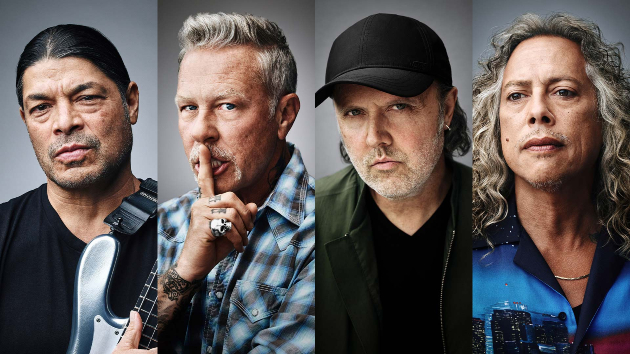
Forget never never land, Metallica is off to the classroom.
The metal legends are launching their own Masterclass series, in which they will teach “being a band,” including everything from making an album to “navigating egos” and “giving criticism.”
“We have sustained our bond for more than 40 years because we’ve learned a lot about each other and ourselves over time,” says frontman James Hetfield. “In our class we not only teach MasterClass members how we write songs and find inspiration for our music, but how the experiences we’ve had together have contributed to successful creative collaboration.”
All four Metallica members will take part, and will be breaking down the making of classics including “Enter Sandman,” “One” and “Master of Puppets.”
For a preview of what you can expect, you can check out a trailer for the Masterclass streaming now on YouTube. Additional info can be found at MasterClass.com.
This report is a part of “Rethinking Gun Violence,” an ABC News series examining the level of gun violence in the U.S. — and what can be done about it.
(NEW YORK) — In the bitter debate over gun control, battle lines are often drawn around the Second Amendment, with many in favor of gun rights pointing to it as the source of their constitutional authority to bear arms, and some in favor of tighter gun control disagreeing with that interpretation.
But if the purpose of the debate is to reduce the tragic human toll of gun violence, the focus on Second Amendment is often misplaced, according to many experts on guns and the Constitution.
They say the battle lines that actually matter have been drawn around state legislatures, which are setting the country’s landscape on guns through state laws — or sometimes, the lack thereof.
Joseph Blocher, professor of law and co-director of the Center for Firearms Law at Duke Law School, described the patchwork of state laws that exists across the country as a “buffer zone” for the Second Amendment.
“Before you even get to the Constitution, there’s a huge array of other laws super protecting the right to keep and bear arms,” Blocher said. “This collection of laws is giving individuals lots of protection for gun-related activity that the Second Amendment would not necessarily require, and certainly, and in almost all of these instances, that no lower court has said the Second Amendment would require.”
Adam Winkler, a professor of law at the UCLA School of Law, also said the Second Amendment is losing its legal relevance in distinguishing lawful policies from unlawful ones as the gap between what he calls the “judicial Second Amendment” and the “aspirational Second Amendment” widens.
Winkler defines the “judicial Second Amendment” as how courts interpret the constitutional provision in their decisions, and the “aspirational Second Amendment” as how the amendment is used in political dialogue. The latter is “far more hostile to gun laws than the judicial one,” he said — and also more prevalent.
“The aspirational Second Amendment is overtaking the judicial Second Amendment in American law,” he wrote in the Indiana Law Journal in 2018, a sentiment he repeated in a recent interview with ABC News. “State law is embracing such a robust, anti-regulatory view of the right to keep and bear arms that the judicial Second Amendment, at least as currently construed, seems likely to have less and less to say about the shape of America’s gun laws.”
Winkler told ABC News the aspirational or “political” Second Amendment has become the basis for expanding gun rights in the last 40 years.
“In the judicial Second Amendment, gun rights advocates haven’t found that much protection,” Winkler said. “Where they found protection was by getting state legislatures, in the name of the Second Amendment, to legislate for permissive gun laws.”
The debate around the Second Amendment (and why some say it might be overrated)
The Second Amendment of the U.S. Constitution reads in full:
“A well-regulated militia, being necessary to the security of a free State, the right of the people to keep and bear Arms, shall not be infringed.”
The role of the Second Amendment, like many constitutional rights, is to put limits on what regulations the federal government can pass, and scholars and lawyers have debated its scope since it was ratified in 1791.
Before the U.S. Supreme Court’s landmark District of Columbia v. Heller decision in 2008, much of the debate revolved around the meaning of a “well-regulated militia.” The Heller decision struck down a handgun ban in Washington, D.C., and established the right for individuals to have a gun for certain private purposes including self-defense in the home. The court expanded private gun ownership protection two years later in McDonald v. City of Chicago, determining that state and local governments are also bound to the Second Amendment.
“The Bill of Rights, by its terms, only applies to the federal government, but the Supreme Court, through a doctrine known as incorporation, has made almost all of its guarantees applicable against state and local governments as well. That’s what the question was in McDonald,” Blocher said. “But some states have chosen to go above and beyond what the court laid out.”
Notably, the court in Heller carved out limitations on that individual right and preserved a relatively broad range of possible gun regulation — such as allowing for their restriction in government buildings, schools and polling places — but in many instances, state legislatures have decided not to use the authority that the court has granted them.
“Most states have chosen not to use their full regulatory authority,” Blocher said. “If a state decides not to forbid people from having large-capacity magazines, for instance, that doesn’t necessarily result in a law. It can be the absence of a law that has the most impact.”
It goes back to that widening gap between the judicial Second Amendment as the courts interpret it and the aspirational Second Amendment as used in politics, according to Winkler and Blocher.
“There’s a difference between the Second Amendment as interpreted and applied by courts and the Second Amendment as it’s invoked in political discussions. And for many gun rights advocates, the political version of the Second Amendment is quite a bit more gun protective than the Second Amendment as the Supreme Court and lower courts have applied it,” he said.
Laws based on the ‘aspirational’ Second Amendment
There are a few laws many experts say bolster gun rights in ways the Second Amendment does not explicitly require.
In more than 40 states, preemption laws expressly limit cities from regulating guns — with some going so far as to impose punitive damages such as fines and lawsuits on officials who challenge the state’s rules. This means, even if a highly populated city had overwhelming support to pass a local ordinance regulating guns, a preemption law in the state would restrict local officials from taking any action.
After the National Rifle Association formed its own political action committee in 1977, it began targeting state legislatures with the preemption model and found it was a more effective way to bolster the rights of gun owners than going through Congress.
The effort picked up momentum when a challenge, on Second Amendment grounds, to a local ordinance in Illinois banning handgun ownership failed in 1982 — years ahead of the 2008 Heller decision. So, he said, the NRA raised the specter of Quilici v. Village of Morton Grove to lobby for preemption laws in order to lessen local governments’ abilities to regulate guns in the first place.
In 1979, two states in the U.S. had full preemption and five states had partial preemption laws. By 1989, 18 states had full preemption laws and three had partial, according to Kristin Goss in her book “Disarmed: The Missing Movement for Gun Control in America.”
“There’s been a concerted effort by gun rights organizations to enact gun-friendly legislation in the states. And they do so using the rhetoric of the Second Amendment, even though nothing about the Second Amendment necessarily requires the state to pass such legislation,” said Darrell Miller, another expert on gun law at Duke University School of Law.
While a densely populated area with a high crime rate may want to enact stricter gun policies not necessarily suited for other areas in a state, preemption laws restrict local governments from doing so.
For example, in Colorado, a preemption law had prevented cities and municipalities from passing gun regulation measures. Boulder tried to ban semi-automatic weapons in 2018 after a gunman with an AR-15-style rifle opened fire at a high school in Parkland, Florida, leaving 17 dead and surpassing the Columbine High School shooting as the deadliest high school shooting in American history.
But a state court struck down the ban on March 12 of this year — 10 days before a 21-year-old man with a semi-automatic Ruger AR-556 pistol killed 10 people at a King Soopers grocery store in Boulder. The judge’s decision did not hang on the Second Amendment but rather a violation of Colorado’s preemption law.
Colorado in June became the first state to repeal its preemption law — a move gun-regulation activists such as those at the Giffords Law Center to Prevent Gun Violence have hailed as a reflection of what voters want. More than half of Americans support more gun regulation, according to data from recent surveys by Pew Research Center and Gallup.
There’s also the presence of “permitless carry regimes,” said Jake Charles, another gun law expert at Duke University, which is when legislatures interpret the Second Amendment as giving individuals the right to bear arms in public without a permit, an interpretation the Supreme Court has not made.
In all 50 states, it is legal to carry a concealed handgun in public, subject to varying restrictions depending on the state, but at least 20 do not require permits for either open or concealed carry of firearms, with Texas becoming the latest to enact what advocates call “constitutional carry.”
Permitless or “constitutional carry” is not something the Supreme Court’s reading of the Second Amendment currently calls for.
Experts say that could change.
In New York state, a person is currently required to prove a special need for self-protection outside the home to receive a permit to carry a concealed firearm. A challenge to the constitutionality of a “may-issue” permit law, New York State Rifle & Pistol Association Inc. v. Corlett, will be heard by the Supreme Court this fall — the court’s first major case on guns in a decade, coming as the makeup of the court swings right due to three appointments from former President Donald Trump.
“There are about half a dozen states which have laws similar to New York’s, so if the court strikes it down, we can expect to see challenges to those states’ laws in short order,” Blocher said.
The partisan debate continues
Allison Anderman, senior counsel at the Giffords Law Center to Prevent Gun Violence, stressed that, in part because of the influence of state statutes, the Second Amendment should not be a barrier to gun regulation.
She also said that because the Second Amendment’s political definition is entrenched in the true, judicial one, the debate surrounding it gets muddied up and the passion is, perhaps, misplaced.
“It’s a rallying cry. It’s easy. It’s a sound bite,” she said. “But the Second Amendment gets thrown around politically in a way that’s not based in law.”
Blocher agreed and argued the Second Amendment debate is among the most partisan in the nation.
“The gun debate has gone far beyond judicial interpretations of the Second Amendment and these days has much more to do with personal, political and partisan identity,” he said.
Foo Fighters and Machine Gun Kelly are among the nominees for the 2021 American Music Awards.
Dave Grohl and company will compete against the “Bloody Valentine” rocker in the Favorite Rock Artists category, along with All Time Low, Glass Animals and AJR.
Glass Animals and AJR are also up for the Favorite Pop Duo or Group award.
2021 breakout star and pop-punk disciple Olivia Rodrigo leads all nominees, with a total of seven nods.
The 2021 American Music Awards will take place Sunday, November 21 at 8 p.m. ET. The ceremony will broadcast live on ABC.