More than two decades after the acclaimed original premiered, a continuation of the animated series The Proud Family, called The Proud Family: Louder and Prouder, drops Wednesday on Disney+.
The streaming service is also home to the original series, which stars Kyla Pratt as Paula Proud, Tommy Davidson as her dad, Oscar, Paula Jai Parker as her mom, Trudy Proud, and Jo Marie Payton as Paula’s grandma, Suga Mama.
Tommy tells ABC Audio that after the original series signed off on 2005, fans couldn’t wait for a return. “Over the years, there’s been a presence for The Proud Family…” he explains. “You know, and I’m out there tactile in every market in the country, and I know for a fact that people are wanting the show back from from from the time that we went off the air. You know, so with it coming back, if it’s just double, it’s double the amount of people that want it.”
In his long career, Davidson explains he’s often recognized for his animated alter-ego, no matter where he goes — including a particular comedy club, he recalls.
“There was a really young waitress there, and all of the staff…were like waiting to say hey, goodbye and take pictures. And she was like, ‘I don’t know who he is. I don’t know.’ So they were saying, Ace Ventura and all this stuff…”
“And then somebody said, ‘What about The Proud Family?'” Affecting Oscar Proud’s boisterous voice, Tommy replied, “Yeah, what about The Proud Family?” He laughs, “She was like, ‘AHHH!'”
We now have an on-sale date for tickets for the new musical based on Neil Diamond’s life.
Tickets for The Neil Diamond Musical: A Beautiful Noise will go on sale to the general public March 4 at 10 a.m. ET; a presale is available starting March 1 at 10 a.m. ET. To sign up to buy those presale tickets, visit ABeautifulNoisetheMusical.com.
As previously reported, A Beautiful Noise, featuring hits from Diamond’s legendary song catalog, will have its pre-Broadway premiere at Boston’s Emerson Colonial Theatre. The six-week limited engagement starts June 21 and runs through July 31.
In his 50-plus years of performing, Diamond has played Boston and the surrounding area nearly 40 times; his signature song “Sweet Caroline” is famously played during the eighth inning of all Red Sox games at Fenway Park.
There’s no word on when A Beautiful Noise –– titled after Diamond’s 1976 album of the same name, which was produced by The Band‘s Robbie Robertson — will arrive on Broadway.
After over 100 million people viewed the Super Bowl halftime show, Dr. Dre and Eminem — who performed alongside Mary J. Blige, Snoop Dogg and Kendrick Lamar — are reaping the benefits on the Billboard 200.
Slim Shady signed to Dre’s Aftermath Entertainment label in 1998, and now both stars have returned to the top 10 of the album chart. Eminem’s 2005 compilation Curtain Call: The Hits, which has been certified seven-times Platinum by the RIAA, vaulted from #126 to #8 this week. The album includes his Academy Award-winning “Lose Yourself,” which he performed during the halftime performance. This is the first time Curtain Call has been in the Billboard 200’s top 10 since 2006.
Dre’s second studio album, 2001, which was released in 1999, jumped from #109 to #9. The six-times-Platinum record has not been in the top 10 since 2000. Songs from the album performed at the Super Bowl included “The Next Episode,” “Forgot About Dre” and “Still D.R.E.”
As previously reported, all the Super Bowl performers experienced big sales bumps immediately after the game.
Sales of the songs heard during the performance increased by an overall factor of 775% compared to the two days prior to the show. The top-selling song performed was “The Next Episode,” which opened the show. Sales of that song alone increased 994%.
The next best-selling songs were “Lose Yourself“; “Still D.R.E.”; Blige’s Dre-produced 2001 hit “Family Affair”; and 2Pac‘s 1995 song “California Love,” which also was produced by Dr. Dre and was performed by Dre and Snoop during the show.
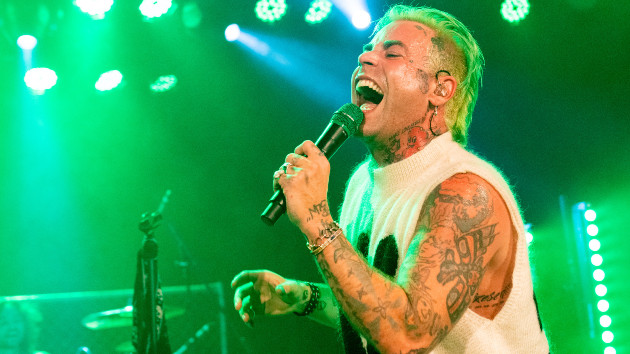
Mod Sun has announced a new song called “Rick Kids Ruin Everything.”
The track, which follows Mod’s album Internet Killed the Rockstar, will drop March 11.
“This one’s for the kids who grew up broke [and] didn’t have s***,” Mod says. “The new era is here.”
Internet Killed the Rockstar, which features the Avril Lavigne collaboration “Flames,” was released in 2021. Mod later dropped an expanded, deluxe version of the record, plus “Down,” a new tune with Blink-182‘s Travis Barker.
Halestorm has premiered the video for “The Steeple,” a track off the band’s upcoming album, Back from the Dead.
The clip finds frontwoman Lzzy Hale dressed in all white and surrounded by interpretive dancers as she preaches rock n’ roll salvation. You can watch it now streaming on YouTube.
“The Steeple,” which premiered earlier this month, is the second track to be released from Back from the Dead, following the lead single and title track. The record is set to arrive in full on May 6.
Halestorm is about to launch a tour of the U.K. this weekend. They’ll be back in the U.S. in May to play the Welcome to Rockville festival.
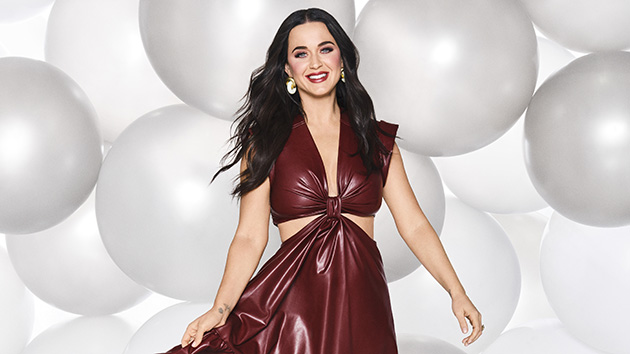
Katy Perry is finding out real fast how stressful it can be to have a toddler. Her daughter, Daisy Dove, is doing a great job preparing her for the so-called “terrible twos” after developing a fascination with electrical outlets.
Speaking Tuesday on Live with Kelly and Ryan, Katy opened up about her child’s stressful new habit. “If you gave [her] all of the toys that you ever wanted to [give] to a kid, they would still want to touch electrical outlets,” Katy lamented, which earned sympathetic remarks from host Kelly Ripa.
The Grammy nominee then beseeched toymakers to “make a plushy electrical outlet” so she can use “reverse psychology” on Daisy. “She loves to push her boundaries,” Katy explained, hinting that is how she hopes to teach her daughter that electricity is not a toy.
In other developments, Katy revealed her little one also has a penchant for throwing her “food on the floor to the dogs.” The singer then recreated the creepy, wide-eyed smile her daughter displays whenever she drops her food.
Speaking alongside her fellow American Idol judges about the times they prefer to record music, Katy also revealed she puts Daisy to bed at 7 p.m. before she heads into the studio.
Another round of ACM Awards performers have been announced, adding more superstars to the lineup.
Carrie Underwood, Luke Bryan, Kane Brown, Jason Aldean, Eric Church and Jordan Davis have been tapped to perform at the show, along with Brothers Osborne, Chris Young, Mitchell Tenpenny, Brittney Spencer, Kelsea Ballerini and host Dolly Parton in a series of collaborative performances.
Dolly and Kelsea are set to team up on “Big Dreams and Faded Jeans,” an original song featured on Dolly’s album Run, Rose, Run, that will be released in tandem with a book of the same name. Dolly’s co-hosts, Jimmie Allen and Gabby Barrett, will open the show with a two-song set, while Luke will take the stage with Jordan to perform their recent #1 hit, “Buy Dirt.”
Brittney will make her ACM Awards debut with a special performance with Brothers Osborne, while Chris and Mitchell will join forces on their duet, “At the End of a Bar.” Kane will use the ACMs to debut his brand-new song, “Leave You Alone.”
The ACM Awards air live from Allegiant Stadium in Las Vegas on March 7 at 8 p.m. ET. The two-hour show will air uninterrupted on Amazon Prime Video.
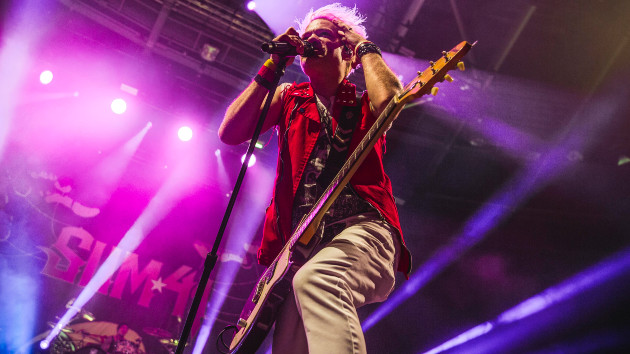
Sum 41 and Simple Plan are joining forces for a co-headlining tour.
The joint outing, dubbed the Blame Canada tour after the two bands’ home country, will launch April 29 in Raleigh, North Carolina, and will conclude August 18 in Denver.
For the tour, both Sum 41 and Simple Plan will be celebrating the 20th anniversary of their respective debut albums, All Killer No Filler and No Pads, No Helmets…Just Balls.
“We have known the guys in Simple Plan for a very long time and know these shows are going to be great, ” says Sum 41 frontman Deryck Whibley. “We cannot wait to hit the road with them!”
Tickets go on sale this Friday, February 25, at 10 a.m. local time. For the full list of dates and all ticket info, visit Sum41.com or OfficialSimplePlan.com.
In the meantime, you can also check out Simple Plan’s new song “Ruin My Life,” which features Whibley.
Bill Pullman narrates the upcoming PBS documentary Nature: American Horses, which explores the story of the horse, and how various breeds helped shaped the American landscape. Turns out the Independence Day and Spaceballs actor knows more than a little about horses himself.
“In our valley in southwest Montana there’s a few people that are go-to riders that can do a little whispering, because it’s fairly hazardous,” says Pullman, who splits time between New York and his Montana ranch, where he says life there “teaches you to get up in the morning.” He tells ABC Audio the connection between man and horse runs deep: “You learn so much about what it is to be human by being around horses.”
Nature: American Horses, centers on four signature breeds: The Appaloosa, Morgan Horse, Mustang, and the American Quarter Horse, the latter of which can gallop at speeds up to 55 MPH, faster than any other breed. But Pullman recalls his first riding experience was a little more tame.
“It was a pony so it was really easy to get up on,” he says. “[J]ust throw yourself on the horse, no saddle or anything else and just…skinny up there and feel that connection to an animal bigger than yourself!”
As a rancher, Pullman also has tremendous respect for environmental preservation, and the lands on which the horses and other animals roam.
“Our connection to parks has changed in the last couple of years with the COVID thing,” says Pullman, “and everybody is appreciating their connection to vistas, and what responsible ranching is with maintaining good pasture use.”
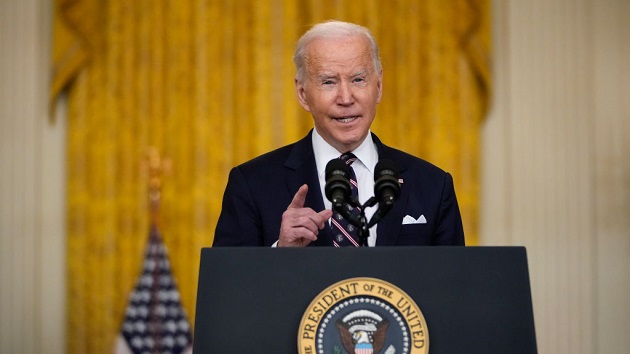
(WASHINGTON) — Saying the world is witnessing “the beginning of an invasion — of a Russian invasion — of Ukraine,” President Joe Biden announced Tuesday he would begin to impose major new sanctions on Russia, threatening to add more if Russian President Vladimir Putin takes even more aggressive action.
“This is the beginning of a Russian invasion of Ukraine, as he indicated and asked permission to be able to do from his Duma,” referring to the Russian parliament, Biden said in remarks from the White House. “So, I’m going to begin to impose sanctions in response — far beyond the steps we and our allies and partners implemented in 2014,’ when Russian forces took over Crimea and tried to destabilize the Ukrainian government.
“If Russia goes further with this invasion, we stand prepared to go further as with sanctions,” Biden continued.
Putin, in ordering Russian troops into two Russian-backed separatist regions in eastern Ukraine, was “setting up a rationale to take more territory by force,” he said. “Who in the Lord’s name does Putin think gives him the right to declare new so-called countries on territory that belonged to his neighbors?”
Calling the Russian moves “a flagrant violation of international law” and one that “demands a firm response from the international community,” Biden said “full blocking sanctions would be placed on two large Russian financial institutions and “comprehensive sanctions’ on Russia’s sovereign debt.
“That means we’ve cut off Russia’s government from western financing. It can no longer raise money from the West and can not trade in its new debt on our markets or European markets either,” he said.
Starting Wednesday, he said, “we’ll also impose sanctions on Russia’s elites and their family members. They share in the corrupt gains of the Kremlin policies and should share in the pain as well.”
By calling it the “beginning of an invasion,” Biden appeared to be addressing the question of how the U.S. would characterize and react to Putin’s moves.
After for weeks saying the U.S. would impose “severe and swift” sanctions on Russia if it invaded Ukraine, the Biden administration was grappling with whether Russia’s decision to send troops across the border would trigger the most severe punishments it had prepared.
The U.S. has condemned Russia for recognizing the independence of two breakaway Ukrainian provinces already partially controlled by pro-Russian separatists — imposing limited sanctions on Monday — and blasted Russian President Vladimir Putin for ordering troops into those regions.
But as the White House stopped short of putting in place sanctions it said would make Russia an “international pariah,” observers were left to parse what, in President Joe Biden’s eyes, would actually prompt that.
“Russia will be held accountable if it invades,” Biden said at a news conference on Jan. 19. “And it depends on what it does. It’s one thing if it’s a minor incursion and then we end up having a fight about what to do and not do, et cetera.”
Within hours, his press secretary, Jen Psaki, clarified: “If any Russian military forces move across the Ukrainian border, that’s a renewed invasion, and it will be met with a swift, severe, and united response from the United States and our allies.”
The next day, Biden, too, added: “If any — any — assembled Russian units move across the Ukrainian border, that is an invasion” that “would be met with severe and coordinated economic response that I’ve discussed in detail with our allies.”
And his top national security adviser, Jake Sullivan, said in a Feb. 6 interview with NBC News: “President Biden has spoken to the fact that if a Russian tank or a Russian troop moves across the border, that’s an invasion” that would result in “severe economic consequences.”
But with Putin so far ordering troops into regions where Russian operatives already operate — albeit within Ukraine’s internationally recognized borders — it was unclear what, exactly, would trigger the larger sanctions.
“We think this is, yes, the beginning of an invasion, Russia’s latest invasion, into Ukraine, and you already seeing the beginning of our response that we’ve said would be swift and severe,” Jon Finer, the principal deputy U.S. national security adviser, said in an interview with CNN Tuesday.
“An invasion is an invasion, and that is what is underway,” he said. “But Russia has been invading Ukraine since 2014.”
Administration officials, though, had in the past suggested to reporters that sanctions would not come in a piecemeal fashion.
Psaki, though, said Monday that the sanctions the U.S. was announcing were “separate from and would be in addition to the swift and severe economic measures we have been preparing in coordination with allies and partners should Russia further invade Ukraine.”
The linguistic dance took place in Europe, as well, where the European Union’s foreign policy chief, Josep Borrell, on Tuesday told reporters that “Russian troops are on Ukrainian soil” but that he wouldn’t call Russia’s actions “a fully-fledged invasion.”
NATO’s secretary-general, Jens Stoltenberg, also said Tuesday that there was evidence additional Russian forces had moved into Ukraine, and that Russia had moved from “covert attempts to destabilize Ukraine to overt military action.”
After Russia’s actions Monday, the U.S. and its allies began imposing a series of cascading sanctions.
The U.S. on Monday targeted people connected to the two separatist-controlled areas. On Tuesday, Germany took the major step of suspending the Nord Stream 2 gas pipeline from Russia; the UK imposed sanctions on three Russian oligarchs, five Russian banks and Russian parliamentarians; and the European Union put penalties on banks, decision makers and lawmakers involved in the independence recognition, and limits on Russia’s ability to access EU financial markets and services.
But the moves — particularly from the United States – stopped far short of the most severe sanctions the White House has threatened. It has warned it was preparing to restrict Russians’ access to semiconductors; punish Russia’s aerospace, defense, and high-tech industries; cripple the country’s largest financial institutions; and hit even Putin and those around him.
“If Russia invades Ukraine, it would become a pariah to the international community, it would become isolated from global financial markets, and it would be deprived of the most sophisticated technological inputs,” the White House’s top national security official crafting sanctions, Daleep Singh, said Friday.
U.S. officials have for weeks been working to get European allies to act in unison on reacting to Russia. Biden and other top U.S. officials have repeatedly threatened “swift and severe consequences.”
American officials have signaled that there is more agreement with other Western nations on what would happen if Russia carries out a full-scale invasion of Ukraine – but that if Russia stops short and the world sees other scenarios play out – like a partial invasion of eastern Ukraine, or solely recognizing the regions’ independence, for example – the kaleidoscope of possible penalties might not come into full harmony.
ABC News’ Mary Bruce and Christine Theodorou contributed to this report.