(NEW YORK) — The alleged suspect in the unprovoked fatal shooting of 48-year-old Daniel Enriquez on a Q train in New York City was ordered held without bail on Wednesday.
Andrew Abdullah, 25, of Brooklyn, was arrested Wednesday after arranging a surrender through his pastor to officers at the 5th precinct, according to law enforcement sources.
During a court appearance Wednesday, prosecutors described Abdullah as a man with an extensive criminal history who, after allegedly shooting Enriquez in the chest, told the other passengers to put their cell phones away, according to ABC New York station WABC-TV.
Abdullah’s attorney, Kristin Braun of Legal Aid Society, told the judge that only one of six witnesses in a lineup could identify the suspect, whom officials have said was wearing a mask on the train, WABC reported.
Abdullah did not speak during the arraignment, according to WABC. His next court date is scheduled for Friday.
Abdullah has about 20 prior arrests, including an outstanding gun charge from last year, according to sources. He also has prior arrests for assault, robbery, menacing and grand larceny, sources said.
Abdullah has three cases that are still pending, including an April arrest for fourth-degree criminal possession of stolen property for allegedly being found with a stolen motorcycle, as well as a June 2021 arrest for violating a protective order and March 2021 arrest for assault.
“We moved over 2,900 illegal guns off our streets,” Mayor Eric Adams said in a Tuesday press conference on the arrest. “As soon as we placed them on, more return with bad guys who feel comfortable enough even after we arrest them, that they can come back out and wreak havoc on our city. The industry pumps guns into the community faster than we can take them out. The rest of the shooter doesn’t change what is going on every day in this industry.”
Detectives have also recovered the gun used in the shooting.
It is believed the suspect handed the gun to a homeless man as he fled the Canal Street station. The homeless man then apparently sold the gun for $10 to a third person, who reported it to police, the sources said.
The New York Police Department released surveillance photos Monday of the suspect believed to have shot Enriquez taken shortly after he exited the subway.
The motive for the shooting is still unknown.
In January 2020, Abdullah was arrested as part of a gun-related case and in May 2017 he was charged with second-degree attempted murder as part of an 83-count federal indictment of the Harlem-based street gangs Fast Money and Nine Block. Abdullah was sentenced to three years in federal prison, but served just four months before being released in 2019.
Witnesses say the suspect, alleged to be Abdullah, was pacing back and forth in the last car of a Manhattan-bound train around 11:45 a.m. when he pulled out a gun and fired it at Enriquez unprovoked, according to NYPD Chief of Department Kenneth Corey.
The shooting comes a little over a month after a Brooklyn subway rider opened fire on a train car, wounding 10 people. The suspect in that shooting, Frank James, was arrested one day later in lower Manhattan.
Transit crime is up 62.5% in the city year-to-date from 2021, according to NYPD statistics.
Between crowning the country-leaning Kentucky native Noah Thompson as this season’s American Idol champ and performing “Where We Started,” her current duet with Thomas Rhett, on the show’s season finale, pop superstar Katy Perry is feeling the twang these days.
“You know, it was my first time stepping in, dipping my toe into that water,” Katy tells E!News, speaking about her foray into country collaborations with “Where We Started.” “I love it because it’s all about songwriting. It’s all about telling a story.”
She’s picking up some of the country lifestyle, too, thanks to her fiancé, actor Orlando Bloom.
“Orlando has been shooting a movie in Kentucky, and I’ve been in and out of there for a month now,” she says. “… And I just love that heartland. There is definitely something in the water in Kentucky.”
As the newest Idol winner, Noah’s following in the footsteps of an impressive line of Kentucky legends, Katy adds. “The heart of America is amazing.”
However, Katy quickly clarified to Extra that, as much as she enjoyed soaking up the country culture, she’s not planning a full-time move to Kentucky anytime soon. “You’ve got to hear it from the source, and the source is telling you ‘no,’” she added.
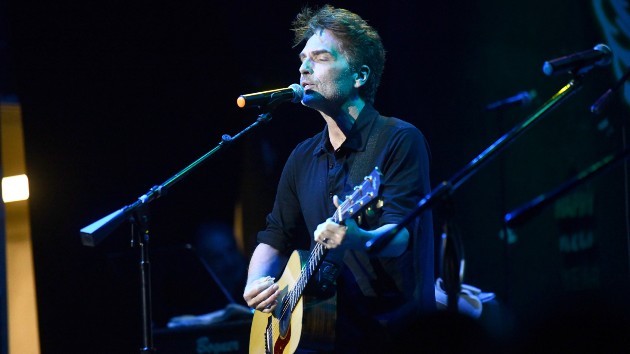
Thirty-five years ago today — May 26, 1987 — Richard Marx released his debut single, “Don’t Mean Nothing.” It hit #3, earned him a Grammy nomination and launched a career that’s still going today. Richard tells ABC Audio that while he’d never say the song is his favorite, it does occupy a very special place in his heart.
“It’s the most important song. Because the question I’ve been getting for 30, however many years that I’ve been doing this, [is] ‘What’s your favorite song you’ve ever written?’ And there’s no answer to that,” he says.
As Richard notes, “I could never pick a favorite song I’ve written. But I did realize in the last couple of years, performing night after night after night, that if I hadn’t written ‘Don’t Mean Nothing’ … [I] probably wouldn’t be standing on that stage.”
As Richard details in his 2021 memoir Stories to Tell, “Don’t Mean Nothing” was inspired by his struggles in the music industry and by Hollywood in general. It also featured harmonies and guitar work from three members of The Eagles: Randy Meisner, Timothy B. Schmit and Joe Walsh.
“I cherish it. I also still love it,” Richard says of the song. “I mean, all humility aside, I just love ‘Don’t Mean Nothing’ and I love singing it. It still holds up for me, is a really good song.”
He laughs as he remembers, “I wrote this very cynical, biting lyric about frustration and being led down horrible paths and being lied to and this song that just drips of cynicism … and I wrote it when I was 22!”
And today, it’s still a centerpiece of his concerts.
“I’ve never done a show where I haven’t played it,” he says. “And I’ve never done that song where I didn’t see people smiling and dancing and into it.”
Edgar Winter and Ringo Starr in 2010; David Livingston/Getty Images
Ringo Starr and his All Starr Band launch their 2022 North American tour this Friday, May 27, in Rama, Canada.
The lineup of the former Beatles drummer’s group is slightly different than when they last hit the road in 2019, with veteran rocker Edgar Winter rejoining the All Starrs after a 2006-2011 stint with the band.
Interestingly, Winter released a star-studded tribute album in April called Brother Johnny — an homage to his late sibling, Johnny Winter — that features contributions from Ringo and two other All Starr Band members — Toto guitarist Steve Lukather and veteran session drummer Gregg Bissonette.
“I’m really looking forward to it,” Edgar tells ABC Audio about touring with the All Starrs again. “And it’s perfect in that the album [has] just been released, and I get to see all my friends again…So it’s gonna be a beautiful reunion. I can’t wait!”
Winter, who is best known for his 1970s hits “Frankenstein” and “Free Ride,” says he’ll definitely play those songs on the new tour, and possibly a tune from Brother Johnny.
“Ringo…always wants your biggest hits. That’s the whole idea. And it’s a great model,” Edgar notes. “I love the All Starr Band. It’s unlike any tour. You know, I think of it as the ‘peace and love’ tour, because there’s just so much positive energy.”
Winter, who idolizes The Beatles, says it’s an honor to play with Starr.
“I have such respect for him, not only as a drummer, but…as a human being,” he declares. “He’s such a heartfelt advocate and spokesman for peace and love. And, you know, having played Woodstock and being an old hippie myself…peace and love is something the world can always use more of.”
Visit RingoStarr.com to check out the full tour schedule.
Wedding bells for Ben Affleck and Jennifer Lopez will come “sooner rather than later” — that is, if J-Lo has her way.
“Jennifer will tell you she’s not in a rush to get married, but her friends think otherwise,” a source tells Us Weekly. “The truth is that if Ben wanted to push this forward as early as this summer, she’d be totally down with that.”
The insider also says the 52-year-old actress/singer, “wants the formalities out of the way so they can start their journey as man and wife sooner rather than later,” and she intends to have a big wedding.
“She definitely wants a spectacular celebration at some point and money won’t be an object!” the source continues. “They’re both committed to making this work and taking all the steps necessary to respect each other’s boundaries and learn from their mistakes the last time around.”
Ben and Jennifer, aka “Bennifer,” rekindled their romance last summer after Jennifer broke up with Alex Rodriguez. They first met in 2002 on the set of their film Gigli. In June 2002, Lopez filed for divorce from then-husband Chris Judd after two years, and began publicly dating Affleck.
Affleck proposed the following November, but called things off in September of 2003, just days before they were supposed to tie the knot. By January 2004, they had officially split.
If the couple makes it to the altar, it’ll be the Jennifer’s fourth marriage, and Affleck’s second. Jennifer shares twins Max and Emme, 14, with her ex-husband Marc Anthony, while Affleck has three kids with his ex-wife Jennifer Garner.
(SAN FRANCISCO) — Police will be barred from wearing their uniforms at the June 26 Pride march in San Francisco, one of the biggest Pride celebrations in the world. Instead, officers are being advised to march in T-shirts that represent their local law enforcement agency.
The decision has caused a heated debate in the city. However, the discourse stretches across the country, as cities reconsider the presence of police at LGBTQ-led events.
Last year, New York City’s Pride parade organizers banned officers from marching in the parade for the first time in decades.
Police presence was reduced at the event, as organizers say they are reckoning with the legacy of police brutality and abuse against LGBTQ people that the community says continues today.
The heated relationship between San Francisco police and others in the LGBTQ community came to a head in 2019 when a protest on the parade route ended with people being arrested, shoved and allegedly injured by police.
“Some members of our community, the presence of the police in the parade is difficult for them, given their history with the police department,” San Francisco Pride Director Suzanne Ford has said on the impact of the march on the community. “So we want to honor and make sure that we protect and make people feel safe.”
The difficult relationship between police and members of the LGBTQ community has a longstanding history. In 1969, a police raid on patrons at The Stonewall Inn in New York City led to an uprising that gave rise to the gay-rights movement. The bar is now a National Historic Landmark. However, that raid was just one of many examples of police violence against the LGBTQ community, according to historians.
There was a time when every state in America criminalized same-sex sexual behavior. That changed in 1962 and, in 2003, the landmark case Lawrence v. Texas led to the nationwide decriminalization of sexual activity between same-sex couples.
San Francisco officers have responded to the uniform ban by collectively refusing to march in the parade, which will take place on June 26, 2022.
In a statement, the San Francisco Police Department said it “supports the decision of our LGBTQ+ officers” but will still be in attendance for security reasons.
“The San Francisco Police Department is committed to not only serving the diverse communities of San Francisco, but to embracing the diversity of our members,” the statement read. “We recognize the struggles that our LGBTQ+ members have overcome, both within the department as well as outside the department.”
San Francisco Mayor London Breed denounced the event organizers’ decision to bar police uniforms from the parade. She said she loves the parade, but will refuse to join the festivities if parade organizers don’t reverse their decision, according to a statement sent to ABC News
“I’ve made this very hard decision in order to support those members of the LGBTQ community who serve in uniform, in our Police Department and Sheriff’s Department, who have been told they cannot march in uniform, and in support of the members of the Fire Department who are refusing to march out of solidarity with their public safety partners,” Breed said.
(NEW YORK) — Nineteen children and two teachers are among those killed Tuesday at an elementary school in Uvalde, Texas, a small rural town. The gunman, who has been identified as an 18-year-old who attended the local high school, is also dead, according to authorities.
As the country is left reeling in the wake of another mass shooting, Manuel Oliver, father of Joaquin Oliver, who was killed in a school shooting in Parkland, Florida, in 2018, and Mary Ann Jacob, who survived the Sandy Hook school shooting in Connecticut in 2012, speak on the surge of deadly gun violence.
“I think we all thought after the shooting at Sandy Hook School when 20 first-graders died and six teachers, that would drive change and if that was true, then Manuel wouldn’t be on TV with us tonight losing Joaquin, and these parents wouldn’t be going through what they’re going through today,” Jacob told ABC News Live Prime.
It is nearly 10 years since the Sandy Hook Elementary School shooting — one of the deadliest school shootings in U.S. history. On that day, Jacob saved 19 children by barricading them in a closet.
Since then, there have been nearly 980 active and non-active school shooting situations, according to data from the Center for Homeland Defense and Security Naval Postgraduate School.
“It is shocking to me really that after seeing all the different communities it has happened in, we still don’t believe that it can happen in our own community and if we’re not willing to do something,” said Jacob. “Our legislatures are not going to do anything, unless we push them to do something. So vote for people who care about what you care about and make sure that they are going to drive change.”
Jacob said there is no way to shield American children from gun violence, but there is a way to make change through legislative and political action.
“There really is no way to protect your kids from it. I mean your kids are affected just like every kid in the country by watching on TV, knowing other kids who have died, hiding under their desks during active shooter drills,” said Jacob. “But there is a way to change it and that’s by electing people and making sure that the people you elect are accountable for what we need to be doing and every single person in America ought to be doing that.”
Sen. Chris Murphy, D-Conn., delivered an impassioned argument on the Senate floor late Tuesday afternoon. President Joe Biden and Vice President Kamala Harris are among the political leaders who have spoken out and are demanding change.
Oliver lost his son Joaquin in the Marjory Stoneman Douglas High School shooting in Parkland, Florida, that left 17 people dead and more injured. The gunman, Nikolas Cruz, was 19 years old at the time.
Oliver said it shouldn’t have taken another school shooting for a national debate on gun laws.
“The myth behind the ‘good guy with the gun’ is just broken after what happened today in Texas. Where there are a lot of ‘good guys with guns,’” said Oliver.
According to the Centers for Disease Control and Prevention, guns are the leading cause of death among American children and teens. Nearly 1 out of 10 gun deaths are among those 19 and younger.
Oliver said he cannot offer any comforting words for parents who have lost a child to gun violence.
“There is no comfort possible here,” said Oliver. “You need to take advantage of those cameras today to expose your anger, your sadness, your frustration. Not only to our leaders, we’re talking about corporations here that allow this to happen… This is something that happens only in America. We are known all around the world for this.”
He added that other parents should realize that the same thing could happen to their own child.
“I don’t need to worry about losing my kid because I already lost him – but you do. It’s not about one person, or your kids, in particular, but everyone in America,” said Oliver. “We provide those guns. We provide those inactions. [Children] should go to school like I went to school, have fun, enjoy the day and go back home. Make them stay safe.”
(NEW YORK) — Here are the scores from Wednesday’s sports events:
MAJOR LEAGUE BASEBALL
INTERLEAGUE
Tampa Bay 5, Miami 4
AMERICAN LEAGUE
Detroit 4, Minnesota 2
Oakland 4, Seattle 2
NY Yankees 2, Baltimore 0
Chi White Sox 3, Boston 1
Houston 2, Cleveland 1
Texas 7, LA Angels 2
NATIONAL LEAGUE
Pittsburgh 10, Colorado 5
San Francisco 9, NY. Mets 3
Washington 1, L.A. Dodgers 0
Milwaukee 2, San Diego 1
Cincinnati 4, Chi Cubs 3
Atlanta 8, Philadelphia 4
NATIONAL BASKETBALL ASSOCIATION PLAYOFFS
Boston 93, Miami 80 (Boston leads 3-2)
NATIONAL HOCKEY LEAGUE PLAYOFFS
St. Louis 5 Colorado 4 (OT) (Colorado leads 3-2)
WOMEN’S NATIONAL BASKETBALL ASSOCIATION
Los Angeles 99, Phoenix 94
Rolando Otero/Sun Sentinel/Tribune News Service via Getty Images, FILE
(NEW YORK) — On Feb. 14, 2018, Sari Kaufman was a 15 year old high school student at Marjory Stoneman Douglas High School in Parkland, Florida, when a gunman opened fire and killed 17 people, a majority of whom were her fellow classmates.
Four years later, she says she continues to relive her trauma through the growing number of others like her who are personally affected by gun violence. Most recently, the mass shooting at an elementary school in Uvalde, Texas, when authorities say an 18-year-old high school student opened fire and killed at least 21 people, including 19 children.
“It’s just really upsetting, especially to see young students, elementary-aged students, have to go through what I went through,” said Kaufman on the Start Here podcast. “And I know from a personal level how difficult it is to deal with that trauma.”
Kaufman said that not only will these children grieve the loss of their classmates and teachers today, but will wake up for the rest of their life with the belief that they can be murdered while at school.
“It forces you to become an adult before you need to be and it takes away your innocence to know that you go to school and that there’s a possibility,” said Kaufman.
“These students are not just going to be affected today, it’s not just going to be tonight. That’s difficult. It’s going to be every day afterwards. And I think that’s what hurts me the most, because I know on a personal level that it’s really difficult to deal with the aftermath and to be this young and have to deal with that the rest of their lives,” Kaufman added.
Over the past five years, there have been 94,057 deaths and 183,926 injuries due to gun violence in the United States, according to a Gun Violence Tracker a part of ABC News’ multimedia series “Rethinking Gun Violence,” which partnered with the independent, nonprofit Gun Violence Archive.
As a growing number of American students have been affected by active school shooters, parents who have lost their children to gun violence will have to continue to live without their child.
Nelba Marquez-Greene lost her six-year-old daughter Ana Grace in the Sandy Hook Elementary School shooting in 2012. Now, she is watching other parents go through the same thing she went through nearly a decade later.
“Right now, the families are surviving, but I would say to anyone who wants to help, if you really want to help a family, find out ways to help them directly,” said Marquez-Green on “The View.” “Show up now. Show up 10, 15, 20 years from now. We will need you for a lifetime.”
Marquez-Green said there is more work to be done than just sending thoughts and prayers to the suffering community.
“We must not be unserious in our faith. Thoughts and prayers, faith without work is dead,” she said.
Marquez-Green also urged the country to force change from the lawmakers.
“It is grotesque abdication of duty, abdication of their responsibility to American families, to fail us in this way and we see them,” she said. “Let’s call out the bull crap. Let’s say we see them.”
(WASHINGTON) — Experts examine America’s history with guns, the real-life impacts of gun violence and what can be done going forward to mitigate the problem.
As the nation mourns the latest American massacre of 19 elementary school students and two teachers in Texas, the deadliest mass school shooting in nearly a decade, gun control efforts remain stalled in Washington, as they have for almost 30 years.
President Joe Biden on Tuesday night made impassioned remarks expressing outrage at lawmakers who are blocking “common-sense” gun laws and rejected the argument often heard from Republicans that gun violence is a mental health issue.
“These kinds of mass shootings never happen with the kind of frequency they happen in America. Why? Why are we willing to live with this carnage?” Biden said with outrage. “Where in God’s name is our backbone to have the courage to deal with and stand up to the lobbies?”
Since the National Rifle Association formed its own political action committee in 1977, the organization has used its deep pockets to lobby lawmakers at the federal and state level to stave off gun control efforts.
According to the Brady Campaign to Prevent Gun Violence, the NRA spent $1.6 million in the first half of 2019 alone lobbying members of Congress to vote against a proposal to expand background checks for gun sales.
With Republicans offering sympathy to the loved ones of victims in the Robb Elementary shooting, several critics on social media called out their contributions from the gun lobby, citing $13.6 million to Sen. Mitt Romney, R-Utah, and $1.2 million to Minority Leader Mitch McConnell, over their careers.
The last meaningful gun reform legislation passed on Capitol Hill was the 1994 assault weapons ban, which expired in 2004 due to a “sunset” clause in the legislation. In the nearly 30 years since, gun control measures have mostly stalled on Capitol Hill, and in the current Democratic-controlled Congress, that’s due, in large part, to the Senate filibuster rule.
In the current 50-50 Senate, Democrats need 10 Republicans to join them to reach the 60-vote threshold required by the Senate’s filibuster rule in order to end debate on a bill, allowing it to proceed to a final vote. Republicans have warned even a single exception to the Senate’s 60-vote threshold to advance legislation would be dangerous to the rights of whichever party is in the minority (although both parties have used the so-called “nuclear option” in the last decade — requiring 51 votes to confirm all executive branch and judicial nominees, for example).
Republicans Sens. Ted Cruz and John Cornyn headed back to their home state of Texas on Wednesday to visit Uvalde.
Cornyn has supported bipartisan talks to expand background checks in the past. Cruz has not, and has faced backlash, along with Abbott, for being slated to speak at the NRA’s annual meeting in Houston this weekend, only a few hundred miles away from the massacre in Uvalde. Because former President Donald Trump is also attending, the NRA said Wednesday that firearms would not be allowed at the event, citing Secret Service protocol.
The last time Congress came close to passing substantial gun reform was in the wake of the Sandy Hook massacre in 2012, when a single gunman killed 20 students and 6 adults. Biden was tasked with the White House response on Capitol Hill while serving as vice president, but that effort ultimately failed to garner enough bipartisan support.
In lieu of congressional action, Biden has taken some executive actions aimed at curbing gun violence but conceded last week while in Buffalo there’s “not much” more he can do without congressional support.
Where does gun control stand in Congress?
House Democrats passed two gun control bills last year — one aimed at expanding background check requirements for gun sales, and the second aimed at extending the review period for background checks from three days to 10 days. But Democrats don’t have the votes needed to squash a GOP-led filibuster to pass either bill in the Senate.
Two Senate Democrats — Joe Manchin of West Virginia and Kyrsten Sinema of Arizona — have been adamant in their opposition to changing the Senate filibuster rule.
“If we can’t get 60 or 70 or more votes, we’ll talk then,” Manchin said Wednesday, expressing some confidence that senators could find some common ground before ending the rule.
Sinema, asked directly if she could support scrapping the filibuster to pass gun control legislation, told ABC News’ Trish Turner, “I don’t think that D.C. solutions are realistic here.”
Senate Majority Leader Chuck Schumer moved Tuesday evening to put the two House-passed bills on the chamber’s calendar, but it’s unclear if and when a vote would be held. If Schumer does bring legislation to the floor, it would likely be an effort to put every single senator on the record, as he’s done with failed legislation on abortion and voting rights.
When eviscerating Republicans in a floor speech Wednesday, Schumer signaled he was disinclined to put up that vote.
“I accept the fact that most of my Republicans are not willing to do what it takes to present this needless loss of life. The NRA will have a hold on them. That’s just the reality, unfortunately, but it is unacceptable to the American people to think that there are not 10 of my Republican colleagues just 10 — one out of five over here — would be ready to work to pass something that we reduce this plague of gun violence,” Schumer said. “It’s unacceptable, that there are not 10 members of the Republican caucus willing to save lives, find a way to do it. And yet, that’s where we are.”
Chris Murphy, D-Conn., who has represented his state since the Sandy Hook massacre also questioned his colleagues on the Senate floor Monday night in a speech that quickly went viral on social media.
“What are we doing? Just days after a shooter walked into a grocery store to gun down African American patrons. We have another Sandy Hook on our hands,” he said. “There are more mass shootings than days in the year. Our kids are living in fear every single time they set foot in the classroom because they think they’re going to be next. What are we doing?”
Renewed talks but will there be action?
While lawmakers on both sides of the aisle often talk about taking action in the wake of deadly mass shootings, there’s not widespread bipartisan agreement on what action to take.
Sen. Marco Rubio, R-Fla., pushed for The School Safety Act, which would create a federal clearinghouse database and collect information to establish best practices for school safety nationwide. Rubio will try to force a vote on that legislation Wednesday.Republican Sen. Rob Portman, who has accepted more than $3 million from the NRA in his career, told ABC News Congressional Correspondent Rachel Scott that he does support background checks.
“It’s not just about these horrific mass shootings, it’s also about this broader issue of gun violence, and then what are the actual solutions — what’s actually going to make a difference,” he said. “If we’re passing something to make us feel better here, that doesn’t have any impact on the actual issue.”
Democratic Sen. Richard Blumenthal said he thinks there could be common ground on red flag laws, noting his bipartisan red flag law bill with Republican Sen. Lindsey Graham. Red-flag laws allow police or family members to petition a court to order the removal of firearms from a person who may present a danger to others or themselves.
But Graham, asked by Scott on Wednesday if he can assure the American people that — this time — something will get done, said, “I can’t assure the American people there’s any law we can pass that would have stopped this shooting.”
With an apparent eye on midterms, Sen. Cory Booker, D-S.C., said he’s urging Schumer to put every senator on the record.
“I’m hoping it comes to the floor for a vote. It will fail. Americans should know that,’ Booker said. “Right now, there are not seemingly 10 senators that want to do the most moderate of things, which is universal background checks supported by almost 90% of Americans, the majority of gun owners, but I do think at this moment its important we put people on the record.”
Americans across party and demographic lines overwhelmingly support expanded background checks (89%) and red flag laws (86%), according to an ABC News-Washington Post poll from 2019.
ABC News Congressional Correspondent Rachel Scott, Trish Turner and Allie Pecorin contributed to this report.