The pandemic era love story Alone Together has officially hit theaters.
Written, directed by, and staring Katie Holmes, it follows June, a food critic who leaves New York City to quarantine during the pandemic, and she finds love in an unexpected place.
It’s Holmes’ first feature film wearing all three hats and shared some of her influences for the project, telling ABC Audio, “Well, I love this the style of filmmaking of John Cassavetes, of like Woman Under the Influence and Shadows – some of those scenes were just all improve.”
“And then like just the idea of that, you know, finding, not being afraid to improv something, finding moments,” she adds. “And then specifically is like Manhattan, Annie Hall, When Harry Met Sally, things like, you know, a lot of Diane Keaton.”
Holmes also shared that one of her goals in making Alone Together was to “create a time capsule story.”
“You know, like for all of us, to remember those little things that we were all doing to cope with what was happening in the world,” the actress explained.
“I also wanted to create a love story with hope and the idea of this disaster as our backdrop, but a disaster that we all experienced and where, you know, two people kind of or do make the best of it and really do have something beautiful come out of it.”
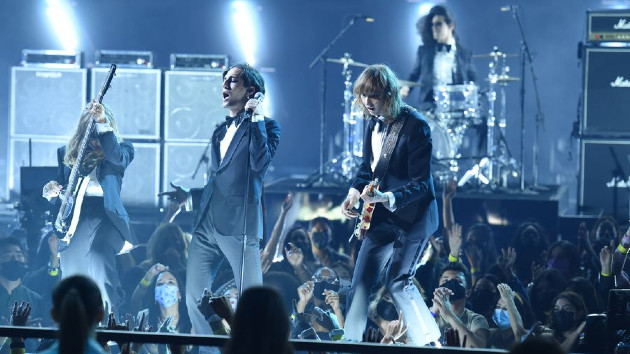
Måneskin‘s wild ride to stardom continues this weekend with the band’s first performance at Chicago’s Lollapalooza. Earlier this year, the Italian rockers made their debut at another U.S. festival institution: Coachella.
Speaking with ABC Audio, frontman Damiano David recalls Måneskin’s “crazy” experience at Coachella.
“Every year, the whole Coachella thing reaches Italy, ’cause it’s huge,” David shares. “We always watched through Instagram or Twitter or whatever, and we always dreamt of playing there.”
As thrilling as it was to be performing at Coachella, the Måneskin members were just as excited about the rest of the festival’s lineup.
“When we got to play there, it was super cool to know that, while you’re playing, on the other stage at the same time, Doja Cat is playing,” David says. “So you feel like you’re getting into … the major league of music.”
Måneskin will play Lollapalooza on Sunday, July 31. They’ll launch their debut North American headlining tour in October.
Lady A and Breland will take the spotlight when ABC’s CMA Fest TV special airs next week, performing a special duet version of the classic Lady A hit “Need You Now” from the mainstage.
Breland and the Lady A bandmates may come from different generations, but Lady A’s Charles Kelley says that makes collaborating with the younger star even more exciting.
“He told me he grew up on that song,” Charles says, talking about “Need You Now.” “And I really, truly think he’s one of the most talented artists, up and coming, that we have. And so anytime you can be part of that energy — you know, us doing this for 15 years now, we like to feed off that youthful energy and that excitement.”
They were excited to collaborate on a personal level, too. “We became buddies backstage, and I told him I was a fan,” Charles says.
One thing led to another, and they decided to write a song together. “We wrote a song and he asked if Lady A would feature on it,” Charles adds. “And while we were there, I was like, ‘Well, we’ve gotta do a song, you know, for the fans!’ And so we did ‘Need You Now.’”
Someone at CMA Fest got wind that they’d done a duet version of the Lady A classic and asked them to do it as part of the show, which took place in Nashville in June.
CMA Fest airs on ABC on August 3. Dierks Bentley and Elle King are co-hosting the show.
As he waits to head back out on tour with his All Starr Band in September, Ringo Starr has posted a video update at his YouTube channel in which he shares some news about an upcoming release he has planned.
In the clip, the former Beatles drummer starts by sending out his usual “peace and love” message to fans, explaining that he’s hanging out on a beautiful day.
Then, after noting that the tour will be picking up again in September after a bunch of June dates were postponed, he declares, “I have another EP out in September. It’s called EP 3. And so, September’s gonna be pretty busy, thank you.”
As previously announced, Ringo and the All Starr Band’s postponed shows were rescheduled to run right into their fall North American leg, which is mapped out through an October 19-20 stand in Mexico City.
As its title suggests, Starr’s upcoming EP with be the third EP he’s released in the last couple of years. The first, Zoom In, was issued in March 2021, while the second, Change the World, arrived in September of last year.
Meanwhile, the end of the update video features footage of Ringo having fun while briefly jamming out with Toto and All Starr Band guitarist Steve Lukather on a version of Deep Purple’s “Smoke on the Water,” with Ringo accompanying Steve on bongos.
After he stops playing, Starr comments, “Let’s do a version of that,” then declares, “Bongo boy!”
You can check out the All Starr Band’s full list of tour dates at RingoStarr.com.
(SACRAMENTO, Calif.) — A 7-year-old California boy is being heralded as a hero for his quick-thinking actions that helped save a toddler at the bottom of a pool.
Massiah Browne, of Sacramento, was swimming with relatives at the apartment complex where he lives with his mom and brother when he said he saw something out of the ordinary.
“I was just playing in the pool and then I saw a boy at the bottom of the pool,” Massiah, a second-grade student, told “Good Morning America.” “And I went to go get him.”
Massiah, who was in the pool with a 9-year-old relative, swam down in 6-feet deep water to rescue the boy, according to his mom, Tiara Delvalle, who said she rushed to the scene from her apartment after being alerted by relatives who were with her son at the pool.
Massiah said he noticed the 3-year-old boy, a stranger, with his mouth and eyes open and dove down to get him, grabbing his arm and pulling him to the pool’s surface.
From there, his 9-year-old relative, a girl named Savannah, pulled the boy onto the pool deck, where adults came to help and then called 911.
“Savannah brought him to his mom and then they did CPR on the boy and then they called the doctor,” Massiah said.
A spokesperson for the Sacramento Fire Department confirmed to ABC News that first responders responded to a 911 call at the apartment complex’s pool on July 19.
Bystanders performed CPR on the boy, who was breathing by the time first responders arrived, according to the spokesperson.
“The child was transported in critical condition with advanced life support efforts provided by Sacramento firefighters,” the spokesperson said.
Delvalle said she is in touch with the mother of the boy, whom she reports is doing well.
“It’s a miracle,” Delvalle said of the boy’s survival.
Massiah’s father, Marcus Browne, a boxer who competed for the United States at the 2012 London Olympics, said that although his son swims like “a fish,” he was in shock when he learned of his heroic efforts.
“I just couldn’t believe it,” Browne said of his son, who also goes by his superhero nickname, “Siah Fire.” “He’s a good kid.”
In the U.S., drowning is the leading cause of death for kids between the ages of 1 and 4, and the second leading cause of death for kids up to age 14, according to the Centers for Disease Control and Prevention.
A report released last year by the American Academy of Pediatrics (AAP) found that male toddlers and teenage boys are at the highest risk of drowning.
Here are four water safety tips from the AAP:
1. Close, constant, attentive and capable adult supervision when children are in and around water, as well as life jacket use among children and adults.
2. To prevent unsupervised access to water, use four-sided pool fencing at least 4 feet tall with self-closing and self-latching gates that completely isolates the pool from the house and yard.
3. In the home, be aware that infant bath seats can tip over, and children can slip out of them and drown in even a few inches of water in a bathtub. Infants should never be left alone in a tub, even for a minute.
4. Water should be emptied from containers, such as pails and buckets, immediately after use.
(NEW YORK) — Alena Analeigh Wicker, a 13-year-old from Texas, is not preparing for back to school like most kids her age.
Alena has already been accepted to medical school, with plans to attend the Heersink School of Medicine at the University of Alabama at Birmingham.
“After I was accepted, it was the most amazing moment,” Alena said Thursday on “Good Morning America.” “Just knowing that I’ve reached the goal of getting into medical school at this age was amazing for me.”
She expects to start medical school in 2024, after graduating from the two undergraduate programs she’s currently enrolled in, studying biological sciences at Arizona State University and Oakwood University.
“My goals right now are to definitely make it through college so I can go into medical school,” she said, adding that she wants to become a viral immunologist to be able to “study viruses and really help communities.”
Alena, who on Thursday was awarded the President’s Volunteer Service Award’s lifetime achievement award, graduated from high school last year at just 12 years old.
She is also the founder of Brown Stem Girl, an organization she said she launched to provide an outlet for girls of color in STEM (science, technology, engineering, and mathematics classes).
“I started the organization because when I was about 3 and I had first had my passion of working for NASA, I didn’t see a lot of people who looked like me,” said Alena. “I didn’t see a lot of girls and a lot of women getting into the STEM field.”
“That’s what struck my passion for advocating for them, really giving them those opportunities and showing them that they can do whatever they put their mind to,” she continued. “They can have the same path as me and become whatever they want to become without anybody telling them it’s impossible.”
Only 13% of engineers are women and just 8% of female college students enter their freshman year intending to major in engineering, math, statistics or computer science, according to the Society of Women Engineers.
Among STEM workers, Black individuals make up only 9% of the industry, with that number dropping to 7% for Hispanic individuals, according to the Pew Research Center.
Alena’s mom, Daphne McQuarter, said she saw her daughter’s STEM and academic talents early on.
“She was just always smart, gifted and she was always ahead,” McQuarter said on “GMA.” “There was just something about her that I knew I had to nurture her gift.”
Alena called her mom her “biggest supporter.”
“She always gave me opportunities over things and she believed in me,” she said.
Asked what advice she would give to other kids who also want to dream big, Alena said to ignore those who tell them “no.”
“First I would say don’t let anybody tell you no, because there was a lot of people who told me no, or that I couldn’t do what I dreamed to do,” she said. “I also had that support system. They were there when I needed them and they gave me that support to say, ‘Don’t give up on your dreams.'”
(ALABANY, N.Y.) — New York state’s health commissioner declared monkeypox an “imminent threat to public health” on Thursday amid a rapid increase in cases.
The declaration means that “local health departments engaged in response and prevention activities will be able to access additional State reimbursement, after other Federal and State funding sources are maximized,” Commissioner Dr. Mary Bassett said in a statement.
The United States has one of the highest levels of monkeypox in the world, with over 4,600 confirmed cases as of Wednesday, according to the Centers for Disease Control and Prevention. New York has the highest number of cases out of any state reporting those figures, CDC data shows.
There are 1,341 confirmed monkeypox cases in New York as of Thursday, according to state data.
San Francisco declared monkeypox a public health emergency on Thursday, effective Aug. 1, which will also help expedite resources to better respond to the “rapidly rising cases,” city officials said. The city has reported 261 cases of monkeypox.
“We need to be prepared and this declaration will allow us to serve the city better,” San Francisco Department of Public Health Director Dr. Grant Colfax said in a statement. “Our COVID-19 response has taught us that it is imperative that we mobilize city resources. The declaration helps us ensure we have all the tools available to augment our outreach, testing and treatment, especially to the LGBTQ+ [community] who remain at highest risk for monkeypox.”
The Biden administration continues to weigh whether monkeypox should be declared a public health emergency, federal health officials said on Thursday.
“We continue to monitor the response throughout the country on monkeypox,” Health and Human Services Secretary Xavier Becerra told reporters Thursday.
“We will weigh any decision on declaring a public health emergency based on the response we’re seeing throughout the country. The bottom line is: We need to stay ahead of this and be able to end this outbreak,” he continued.
Last week, the World Health Organization declared the monkeypox outbreak a public health emergency of international concern. Globally, more than 20,000 cases have been reported in over 75 countries, including in dozens that have not historically reported monkeypox cases.
U.S. health officials have warned for weeks that the number of monkeypox cases would likely increase nationwide, as the government ramps up testing capacity and surveillance.
“We know monkeypox symptoms usually start within three weeks of exposure to the virus, so we anticipate we may see an increase in cases throughout the month of July and into August,” CDC Director Dr. Rochelle Walensky said during a press briefing earlier this month.
Monkeypox is primarily spread through close, physical contact between people. Symptoms include fever, headache, fatigue and muscle aches. Patients can develop a rash and lesions that often begin on the face before spreading to the rest of the body.
Most cases in the U.S. have been reported among the gay, bisexual and other men who have sex with men community and related to male-to-male sexual contact. Though health officials have repeatedly stressed that the virus can affect anyone who has close contact with people who have monkeypox. Those with weakened immune systems, pregnant people and children under the age of 8 may be at heightened risk for severe outcomes, according to the CDC.
“Every American should pay attention on monkeypox,” Becerra said. “Monkeypox is not COVID, but it is contagious. It is painful and can be dangerous.”
ABC News’ Arielle Mitropoulos contributed to this report.
A new box set featuring remastered versions of former Dire Straits frontman Mark Knopfler‘s four most recent solo studio albums, plus a disc of bonus songs, will be released on October 7 as a six-CD set, a nine-LP vinyl collection and on digital formats.
Mark Knopfler: The Studio Albums 2009-2018, which can be preordered now, includes 2009’s Get Lucky, 2012’s Privateering, 2015’s Tracker and 2018’s Down the Road Wherever. It also features the companion compilation Back in the Day: The Bonus Tracks 2009-2018, which includes studio B-sides and bonus tracks, as well as two previously unreleased songs from the Down the Road Wherever era — “Back in the Day” and “Precious Voice from Heaven.”
The vinyl box set will feature two LP versions of Get Lucky, Privateering, Tracker and Down the Road Wherever, plus the single-disc Back in the Day, all pressed on 180-gram vinyl. The collection also will come with five embossed prints of the cover art of each album.
Get Lucky, Privateering, Tracker and Down the Road Wherever peaked at #17, #65, #14 and #15, respectively, on the Billboard 200.
The upcoming box set is the follow-up to the Mark Knopfler: The Studio Albums 1996-2007 collection, which focused on Mark’s first five solo albums and was released in the U.S. in April.
(NEW YORK) — A New York City police officer has adopted the same dog that she helped save from a hot car last month.
Aruna Maharaj, an officer with the NYPD’s 19th Precinct, adopted the pup after helping with its rescue.
“A month ago, this sweet doggo was rescued after his owner left him in his hot locked car for hours; yesterday, one of its rescuers, Officer Maharaj, adopted him,” the 19th Precinct posted on its Twitter account.
The dog was found in a hot car on June 18. Nearby residents had noticed the dog locked in the car on 88th Street near Third Avenue for over two hours and called 911, police said.
Passersby said the dog looked distressed inside the vehicle, according to police.
Police broke open one of the car’s windows to rescue the dog, helping it out of the vehicle before taking it to veterinary care.
A 26-year-old man was charged with animal cruelty, according to police.
The dog was taken in by the American Society for the Prevention of Cruelty to Animals, before Maharaj adopted the dog from their care.
“This pup will never be neglected again!” the 19th Precinct said in its post.
The ASPCA said that animals should never be left alone in hot cars. The organization also said it’s important to look for signs of heatstroke in pets.
Excessive panting or difficulty breathing, increased heart and respiratory rate, drooling, mild weakness, stupor or collapsing, are all signs of your pet overheating, the ASPCA said.
According to the NYPD, it only takes 10 minutes for the inside of a car to reach 102 degrees on an 85-degree day.
The Humane Society said that it’s also important to watch out for humidity.
“It’s not just the ambient temperature, but also the humidity that can affect your pet,” Dr. Barry Kellogg, senior veterinary advisor of the Humane Society Veterinary Medical Association, said in a Humane Society statement.
Kellogg said that animals pant to evaporate moisture from their lungs, which takes heat away from their body. If the humidity is too high, however, they are unable to cool themselves down and their temperature can quickly reach dangerous levels.
The Humane Society encourages pet owners to limit their pets’ exercise on hot days and provide lots of shade and water. They also note not to rely on fans, which don’t work as effectively for animals as they do for humans.
(DANBURY, Conn.) — A Connecticut mother allegedly killed her three children before taking her own life, the Danbury Police Department said Thursday.
Police identified the mother as 36-year-old Sonia Loja and her three children as Junior Panjon, 12; Joselyn Panjon, 10; and Jonael Panjon, 5.
“A truly horrible event occurred in our city yesterday and we mourn the tragic loss of life. In the coming days, mental health and counseling services will be provided through collaboration with the Danbury Public Schools and the City of Danbury. Our community grieves for the innocent lives taken from us. We will get through this together,” Danbury Mayor Dean Esposito said in a statement.
Police found the four bodies Wednesday night after receiving a 911 call from someone distraught and crying, according to WTNH. Police said they believe the mother strangled her children before killing herself.
Autopsies are scheduled for Thursday at the Office of the Chief Medical Examiner in Farmington, Connecticut, authorities said.
Police said the family lived in the home with two other adults. The adults were not present when police arrived on the scene, but they and other family members have been contacted and informed of the incident, police said.
“The kids were really good kids. They were really friendly kids,” neighbor Ralph Baugher told ABC News Connecticut affiliate WTNH. “When you drive by, they would wave and say, ‘How are you doing?’ Wave back to them, ‘Hi, how are you doing?’ They were always happy kids. Always playing in the yard, having fun, laughing all the time.”
The mayor’s office and other local government agencies said they are providing support for family and friends of the deceased and for first responders who responded to the scene, officials.