(LONDON) — A rare pink diamond has been unearthed in Angola and is claimed to be one of the largest ever recovered in the world.
The 170-carat precious stone, called the “Lulo Rose,” was found at the Lulo alluvial mine in Angola’s diamond-rich Lunda Norte region, according to a press release from the mine’s Australia-based owner, the Lucapa Diamond Company.
Lucapa said the Lulo Rose is believed to be the biggest pink diamond recovered in the last 300 years and the fifth-largest diamond ever discovered at the Lulo alluvial mine, where the stones are extracted from a riverbed. It’s the 27th diamond of 100 carats or more to have been found at the mine, according to the company.
The two largest diamonds ever recovered in Angola were previously found at the same mine, with the biggest being a 404-carat clear diamond, according to Lucapa, which is now searching for the mine’s kimberlite pipes, or underground deposits that would be the main source of the stones.
“Lulo is an exceptional alluvial resource and is truly a gift. We are once again made very proud by yet another historic recovery,” Lucapa’s CEO and managing director Stephen Wetherall said in a statement Wednesday. “We too look forward to our partnership progressing its exploration effort, where we are now bulk sampling the priority kimberlites, in search for the primary kimberlite sources of these exceptional and high-value diamonds.”
The rare colored gemstone will be sold via international tender by Angola’s state-owned diamond marketing company, Sodiam.
Angola is among the world’s top 10 producers of diamonds. Only one in 10,000 diamonds found are colored, according to the Gemological Institute of America, a California-based nonprofit that researches gemology.
“This record and spectacular pink diamond recovered from Lulo continues to showcase Angola as an important player on the world stage for diamond mining and demonstrates the potential and rewards for commitment and investment in our growing diamond mining industry,” Angolan Minister of Mineral Resources, Petroleum and Gas Diamantino Azevedo said in a statement Wednesday.
(NEW YORK) — A TikTok account with more than 17 million followers has sparked a discussion about children’s privacy and safety online.
The mom behind the popular TikTok shares photos and videos featuring her 3-year-old daughter, whom she calls Wren Eleanor and whom the account is named after.
Over the past month, other parents on the social media app have started raising their concerns about the account and about the potential dangers of sharing videos and photos of young children online.
Some users have pointed out, for example, that certain photos of Wren Eleanor have been saved tens of thousands of times. Other users have highlighted inappropriate comments on some posts using hashtags like #savewren.
In response, some parents have said that they are taking their own children’s photos off social media.
“I just deleted all photos of my son on social media I can’t take that chance,” one TikTok user wrote.
“Just removed videos of my own child. This is so sad,” wrote another.
Wren Eleanor’s mom has now disabled comments on her posts. She did not immediately reply to ABC News’ request for comment.
Sarah Adams, a TikTok user from Vancouver, British Columbia, said she has been aware of the account for the past year, since joining the app.
She told ABC News she believes the mom’s account is in the spotlight now because of its large following.
“I think this is the start of a conversation, a much larger and broader conversation about accounts like this,” she said. “This is being used as an example for the larger conversation about our children and social media and the exploitation of them.”
“It’s not just one account,” she added. “This is a big problem that we have on social media right now.”
Adams, a stay-at-home mom of two kids under 4, said she started her own TikTok account after becoming a parent and seeing how many people put their children on social media.
She said she started posting videos of herself on TikTok to see if other parents noticed the same things she had, and were as concerned as she was.
“I felt like I’m a stranger and I shouldn’t have had access to all that information about other people’s kids,” said Adams, who said she does not post photos of her own children online. “I just wanted to see if anyone else out there felt the same, like does anyone else think this is reaching worrisome new heights and things are getting a little out of control?”
Adams said what concerns her most are social media accounts run by parents that primarily feature their children.
“It’s different for parents who occasionally include their child in their content versus a child being their content,” she said. “No baby, no toddler, no child under the age of 13 should have a social media account that’s dedicated to them.”
A TikTok spokesperson told ABC News they cannot comment on a specific account.
The spokesperson said there are many features built into the app to help protect users’ safety, particularly kids, including the Family Pairing features that gives parents and caregivers control over content settings on their child’s app. The app also allows users to control their own account settings, like limiting who can comment on videos and turning off the ability for other users to download their videos.
In addition, according to the spokesperson, the app removes content that “depicts or promotes physical abuse, neglect, endangerment, or psychological disparagement of minors,” as outlined in TikTok’s Community Guidelines.
Takeaways for parents
Jasmine Hood Miller, director of community content and engagement for Common Sense Media, a nonprofit organization focused on media safety for families, said parents should remember that every photo posted online creates a digital footprint for their child.
“That’s basically an electronic paper trail that doesn’t go away for your kids,” Hood Miller told ABC News. “So it’s something to really, really think about even as early as when you have a newborn and you’re so excited and you want to share.”
“As a parent, you need to stop and think before you kind of jump on that bandwagon,” she added.
Hood Miller said posting on social media has become so “normalized” in today’s world that parents may not always think about what it could mean for their child both in the present and long term, citing risks such as loss of privacy and safety.
“When you put something out there, you don’t have any control over it. You lose control over those photos,” she said. “Anyone can easily copy the photo, tag it and save it and use it for things that you are not intending and maybe not even thinking of.”
Here are five tips for parents from Hood Miller herself:
1. Stop and think before posting: “Have that critical thinking before posting. That’s what we teach our kids, our students. We’re telling them, ‘Think about your digital footprint because it may impact you when you’re going to apply for college or a job,’ and so we have to do the same thing as parents. Someday your preschooler is going to grow up and they may not want documentation of their potty training online for their friends to find,” said Hood Miller.
2. Turn off your phone’s GPS for pics: “We recommend that you turn off your phone’s GPS when you take those photos so that there’s no geotagging where people can find your location,” she said.
3. Add privacy settings wherever possible: “Limit the audience of the posts. If you have a private account, you know the people who are following you, like friends and family,” said Hood Miller, adding that parents can also use nicknames for their children on social media instead of their birth names.
4. Use photo-sharing sites instead of social media: “Something like Google Photos requires users to log in to see the photos so that way you can keep it more contained,” she said. “There are a few different options that still gives families the ability to share, especially with relatives who maybe don’t live nearby, and watch little ones grow.”
5. Talk to your kids early and often about social media: “You can have those conversations as early as possible,” said Hood Miller, noting that kids today are automatically born into a world of social media. “They’re not afraid to tell you what they like and what they don’t like, what they want and what they don’t want, so you can start asking them.”
“But ultimately, as a parent, you want to have their best interests in mind and try to make the right decisions to be proactive and protective,” she added.
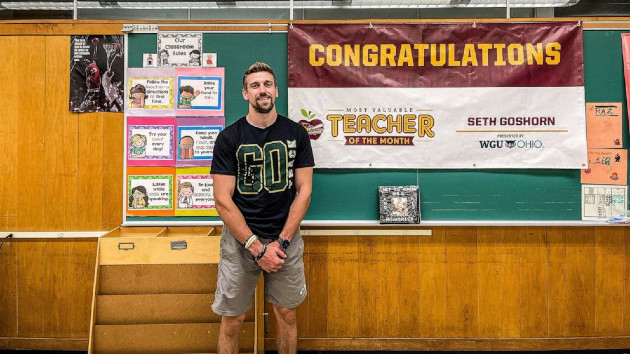
(NEW YORK) — A former teacher in northeast Ohio is opening up about why he walked away from years of teaching to go work at Walmart.
Seth Goshorn decided to share his personal story through TikTok, posting a short clip of him holding up and displaying Walmart’s signature blue uniform in the same way athletes hold up their team jersey on draft day.
The 28-year-old’s post, just 6 seconds long with a caption that read “Leaving teaching after 6 years to go be a manager at Walmart and make more not using my degree,” quickly went viral. It has now been viewed more than 810,000 times in the last week.
Goshorn told ABC News’ Good Morning America he left education after careful consideration and doing his research, tapping his family members who also work at the retailer for their input. In the end, he said he made the switch, even though he “absolutely” loved teaching, for more growth and a higher salary, especially since he hopes to start a family with his fiancée in the near future.
“My biggest thing was the opportunity,” he said. “You don’t have to go and get another degree or more initials or letters in front of your name to move up.”
“The compensation,” he added. “It was a lot better than I think people are used to and what people would expect.”
As a stocking 2 coach at a Walmart store in Massillon, Ohio, Goshorn said he makes about $55,000 a year before bonuses, a figure Walmart corroborated to GMA.
It was an upward move for him after working for five-and-a-half years in education, first as a reading tutor in a lower-paying school district and then as a second-grade teacher in a district he described as a “middle [to] upper” paying district. He said when he was teaching with Plain Local Schools in Ohio’s Stark County last year, he was earning $43,000 a year. The district confirmed to GMA that their elementary teacher salaries range from $43,896 to $83,766.
Goshorn said he hoped to shine a light on how he felt hard-working teachers and his former colleagues are underappreciated, in the wake of a national teacher shortage and amid high burnout among educators since the COVID pandemic.
“There’s a misconception that we only work six or nine months out [of] a year,” he said, explaining that often, teachers spend many extra hours outside the classroom to draw up lesson plans, grade assignments and so forth.
“Think about how good our teachers can be if they could focus on just teaching and not have to work a second job on the weekends, or I know some that would work at Starbucks after their shifts,” he said, adding that he also coached two sports and worked summer school sessions while holding down his teaching position. “They chose to be a teacher because they’re passionate about it. They didn’t choose to have to work a second job that comes along with it. And that’s the thing that I would have loved to see go away.”
But although he’s giving up full-time teaching, for now, he said he plans on keeping and renewing his teaching license and doesn’t discourage others to pursue the same path he was once on.
“If that’s what you’re passionate about, absolutely,” Goshorn told GMA. “Just make sure going into it, figure out what the [return] is on your investment and make sure that it makes sense for you.”
“I absolutely don’t want this to be that I’m just trying to discourage anybody from becoming a teacher. That’s not the case. I just want my teacher friends to be paid as they should be,” he added.
(NEW YORK) — Lakia Johnson, the mother of Flau’jae Johnson, remembers her daughter’s basketball journey like only a mother can.
“She goes, ‘I want to play basketball.’ And I said, ‘Basketball? Well, there’s no 4-year-old girls playing basketball’,” said Lakia Johnson. “So I put her on a team with the boys – it’s been hell ever since.”
Now, under the new NCAA rules, Flau’jae Johnson is set to become one of the highest-paid female athletes in collegiate sport history.
“There’s just something about seeing that ball go to the hoop and the splash and everybody screaming,” said Johnson. “I always wanted [them] to like me, that was my goal.”
Johnson will begin playing for LSU in the fall.
“Having a university offer you a full scholarship to attend… That stunned me. Like you’re willing to pay for my education, pay for this just for me to play basketball and represent,” said Johnson.
Last year, the NCAA adopted a policy that collegiate athletes could profit through their “Name, Image and Likeness,” known as NIL, and that is now in effect.
“God just blessed me… I can take care of my family for generations just what I do in these four years right here. People don’t understand how big, big of an opportunity that is,” said Johnson. “I’m not taking it for granted; like everything I’ve gotta do I’m going to make sure I do it.”
It’s not only her performance on the court that sets her apart from other athletes. Johnson doubles as a rapper, garnering nearly one million followers on social media and a distribution deal with Roc Nation, Jay-Z’s record company. The combination means Johnson could potentially be one of the highest earning student-athletes ever.
Johnson made it to the quarterfinals of NBC’s America’s Got Talent in 2018, which spurred her career as a performer.
“[Simon Cowell] told me I was going to be a star. I took that and I ran with it,” said Johnson.
Lakia Johnson remains protective of her daughter’s hard work. She said the internet is not always a kind place.
“It was a roller coaster because the internet was in full effect and people were so mean to her,” said Lakia Johnson.
Johnson said it was important for her daughter to keep rapping to remain close to her father, Jason Johnson, who was shot and killed. He was a rapper who went by the name Camouflage.
“He died, but a connection that we shared [was] the music. It’s like I feel like an energy whenever I’m making music,” said Johnson. “I just knew that he was a storyteller and, like a poet, he really spoke for the people who didn’t really have a voice.”
Lakia Johnson said her daughter’s name was the last big decision her husband got to make before he died.
“I was a single mom raising her… Jason’s death was sudden for all of us,” said Lakia Johnson. “[Before he died] we argued 3 to 4 days about that name. But after he passed away, like a month later, I was like, ‘This is the last big decision that he’s going to have to make for her.’”
Flau’jae Johnson said she carries her father’s legacy with her, but has also learned the importance of leaving her own mark on the world.
“With basketball I have my own legacy and I’m still carrying my dad’s with music,” said Johnson.
Johnson added that she is excited to inspire the next generation of female athletes and musicians to follow all of their passions — no matter how many there may be.
“I can show little girls [there’s] another way to do it. You can keep it clean, you can keep a positive impact on people,” she said. “So keep a net positive energy and that’s how I am.”
(NEW YORK) — Mark Hall, a nurse practitioner who was diagnosed with monkeypox, says he isn’t exactly sure who he contracted the disease from.
However, he found out he was exposed by someone a week before he started showing symptoms. That person, he says, knew they had monkeypox and didn’t tell him.
Hall, a gay man living in New York City, said shame and stigma surrounding the virus have made some people afraid to come forward.
“Whenever anybody gets sick — even if it’s COVID — half the time, people don’t want to tell because sometimes it feels like a moral failure,” Hall told ABC News in an interview. “We’ve stigmatized these things in so many ways that if you get sick, that you somehow have failed morally. I think people are scared to admit that.”
“It’s a system problem rather than an individual problem,” Hall added.
Of the more than 18,000 confirmed monkeypox cases reported globally, in countries that don’t usually have monkeypox researchers have found the vast majority are among gay, bisexual and other men who have sex with men.
In the U.S., the Centers for Disease Control and Prevention says that most known cases in the current outbreak are among people who identify as gay or bisexual, but that anyone can get it.
“Stigma and discrimination can be as dangerous as any virus,” said WHO Director-General Tedros Adhanom Ghebreyesus at a press conference Saturday. “In addition to our recommendations to countries, I am also calling on civil society organizations, including those with experience in working with people living with HIV, to work with us on fighting stigma and discrimination.”
The parallels between the failings of the HIV/AIDS crisis — including slow-moving action from the government and poor outreach that failed to contain the epidemic — were highlighted by monkeypox’s growing impact on gay and bisexual people, activists say.
Prior to the outbreak, most cases occurred in countries where the virus is usually found or endemic — typically central and western Africa.
Monkeypox, a cousin of the smallpox virus, is generally a mild illness with the most common symptoms being rash, swollen lymph nodes, fever, headache, fatigue and muscle aches. The rash may be painful and have lesions that look like pimples or blisters that can occur on the face and other parts of the body.
Hall said his lesions caused “probably some of the worst pain that I’ve ever experienced in my life.”
People are typically infected by close person-to-person contact though it is possible to be infected by animals through a bite or a scratch or through preparation and consumption of contaminated bush meat.
However, in the current outbreak, most of the spread has come from coming into prolonged skin-to-skin contact with infected people’s lesions or bodily fluids. The illness can also be contracted from the clothes or other fabrics, such as bedsheets, used by an infected patient.
Anyone can contract the virus and despite misinformation circulating online, it is not a sexually transmitted disease or infection though it can be contracted through sexual contact.
One study in The New England Journal of Medicine reported that 95% of recent cases were likely transmitted through sexual close contact.
“Let’s start with the designation and differentiation between a sexually transmitted infection, and disease you can get when being intimate. These are two different concepts,” Dr. Perry Halkitis, dean of Rutgers School of Public Health in New Jersey, told ABC News. “Syphilis, gonorrhea, chlamydia are sexually transmitted infections, but you can make out with someone as a precursor to sex and give them COVID. That doesn’t make COVID a sexually transmitted infection.”
He continued, “It’s the same thing with monkeypox. Monkeypox is a disease that does not require sexual intercourse to be transmitted and if we continue to call it a sexually transmitted infection, it mischaracterizes the manner in which it is transmitted.”
At least two pediatric cases have been identified in the United States as well as one case in a pregnant woman, according to the CDC.
“The stigma associated with this disease and gay men happened because this disease ended up, first and foremost, attacking and perpetuating in the gay population,” Halkitis said. “I call [monkeypox] an infection or a disease of connectedness and intimacy that you could get from your grandma or you can get from your child or you can get from someone you’re not engaging in sex with.”
Activists say misinformation about monkeypox can worsen public health efforts.
The rollout of the monkeypox vaccine, as well as outreach to populations at a higher risk of contracting the virus, faced a rocky start.
“We’re all experiencing this, and it seems like either nobody’s listening or everybody’s downplaying,” Zac Mordechai Levovitz, clinical director of LGBTQ Jewish youth group JQY, told ABC News.
Activists say that shame and lack of outreach have silenced those who contracted the illness and have left many at-risk populations mis- or underinformed.
“[There’s] a lot of slut-shaming messaging that we’re seeing,” Jason Rosenberg, an activist at ACT UP NY, told ABC News. “We need to meet each other where we are. And that is through harm reduction, that is through sharing healthy ways to reduce risk.”
Stigma against the illness has prompted concern from activists, who say monkeypox has become a tool for anti-LGBTQ haters against the community.
LGBTQ activists say they have noted a rise in homophobic or transphobic messages about monkeypox online, something doctors say may make those diagnosed with monkeypox — LGBTQ or not — reluctant to come forward about their illness.
“I’m certain there are patients out there with monkeypox who are not coming forward or who have a concern they have monkeypox or were exposed to monkeypox who, because of the stigmatization, are not reaching out to their health care providers or getting the help that they need at a time when it is really critical,” Dr. Scott Roberts, an assistant professor and the associate medical director of infection prevention at Yale School of Medicine, told ABC News.
He continued, “We’re at this critical phase of this outbreak where we should be doing everything we can to stop this before it becomes endemic. The obvious risk is that people go about their daily lives while infected and spread this to other people.”
Roberts said he has seen patients who have told him that monkeypox is restricted to the men who have sex with men community so there is no reason for them to be concerned.
“We do need to warn people who have exposures that they might be at risk if this continues to grow,” he said. “As this does get bigger, which we’re all anticipating, it’s only a matter of time until this hits other groups.”
“And when that happens, you know, our hope is that we haven’t really done damage from stigmatization where either people haven’t come forward or those people who are exposed do not seek vaccination or any medical care because they don’t think they can be infected with it,” Roberts added.
Hall said he shared his story online in hopes of shattering the stigma.
“I want to normalize this for people and say like, ‘Hey, I’m here. Here’s my face. I have monkeypox. This is what the experience has been like for me. And it’s okay to talk about it,”‘ Hall said.
(NEW YORK) — In September 2016, Kai Li stepped off a plane from the United States to his native China to visit relatives and attend a memorial for his late mother. He never returned.
The Chinese government had imprisoned the 59-year-old Li, an act the United Nations has condemned, and which his family says is based on bogus charges of espionage. A U.S. citizen who lived in Long Island, New York, since 1989, Li is only allowed to call his wife and son once a month for conversations that last just minutes.
His six-year absence has been “devastating,” said Harrison Li, his son. Not only did it throw his family into debt, but it also forced them to shutter two gas stations Li owned and operated as a way to make his family prosper in his adopted country, he said.
“Our government has failed us by allowing this to continue for so long,” he said. “They need to find the will and motivation to get him released.”
Li joins the chorus of dozens of families who say the Biden administration is failing to adequately confront a crisis that experts say is only getting worse. According to the James W. Foley Legacy Foundation, a Washington organization that advocates for hostages and journalist safety, at least 67 U.S. citizens are currently being held overseas; 90 percent of those are wrongly detained by foreign governments hostile to the U.S.
Cynthia Loertscher, director of research, hostage advocacy and legislative affairs for the Foley foundation, says there is a greater interest among countries like Venezuela, Russia and China to use U.S. citizens as “geopolitical pawns” whose imprisonments can be leveraged to demand change in U.S. policy or to force concessions like a prisoner exchange.
“They become human collateral to try to get the United States to budge on its policies on a very large scale which is why these cases are so difficult to solve,” Loertscher said.
The problem, she said, “is absolutely” worsening as an increasing number of countries are testing the waters for potential gain.
Last week, President Joe Biden issued an executive order that allows federal agencies to impose financial sanctions and other consequences on parties involved in hostage-taking or wrongful detentions. It also creates a new State Department indicator to alert Americans where there’s a risk of being wrongfully detained by a foreign government.
Loertscher said the new tools show the administration is taking the issue seriously, but it is too soon to tell of its lasting effect considering the order did not name specific countries or cases like Li’s.
For Neda Sharghi, whose brother Emad has been wrongfully detained in Iran since 2018, she says nothing short of meeting with Biden directly will be satisfactory. Emad Sharghi, an American-Iranian dual citizen based in Washington, is one of at least four Americans wrongfully detained in Iran currently. Months after his capture more than four years ago, he was released, but not allowed to leave the country.
Two months before Biden took office, Emad Sharghi was rearrested and sentenced to 10 years in prison for charges that remain unclear to his family.
Neda Sharghi said her family has written to Biden and Secretary of State Antony Blinken but have not received a response from either. She said the issue “transcends politics” and should be one that both political parties could work on together.
Holding people captive fraudulently “cuts against every principle we as Americans hold onto,” Sharghi said.
“It’s baffling to me why it’s so difficult to get them released and why it isn’t a more focused priority for our administration,” she said.
A senior State Department official would not discuss specific cases with ABC News, but said that the new executive order is an example of the administration being “willing to make tough but important decisions” on the issue.
“Anyone who has worked on these issues for any period of time knows that strategies need to be case specific. They have to be informed by the intelligence and information about a particular case. They need to take into account country-specific facts, regional facts and anything we can bring to bear to get what we all ultimately want, which is an American home with his or her loved ones,” the official said.
Biden recently met with the families of Austin Tice, detained in Syria since 2012, and Trevor Reed, who was recently released from Russia in a prisoner exchange. Families say the media attention thrust on both cases, along with that of basketball star Brittney Griner, detained in Russia on drug charges, are bringing public awareness to an issue that for so many years has been lost in the news cycle.
For Alexandra Forseth, the “biggest obstacles” for families like her own “is not the government holding our own people — it’s our own government.”
Her father, Alirio Zambrano, and uncle, Jose Luis Zambrano, are members of the so-called “Citgo 6,” a group of Houston-based Citgo oil executives imprisoned in Venezuela since 2017 on corruption charges. Last year, the men were released under house arrest but in November were suddenly sent back to prison where conditions are so poor their families say they must purchase their clothes and food and ferry them in through intermediaries.
The arrests came around the same time the U.S. extradited a Colombian financier with close ties to Venezuelan President Nicolás Maduro. In February, a Venezuelan court upheld the executives’ prison sentences.
In March, the Biden administration announced the release of one member of the Citgo 6, Gustavo Cardenas, along with another American held in the country, Jorge Fernandez.
“We did get a couple of Americans out and that was a great thing,” White House national security adviser Jake Sullivan told reporters this month regarding the release of the men. “But it was bittersweet because there’s a lot of Americans still there, and we’ve got to get them home.”
Forseth said her family has been working closely with Roger Carstens, the special presidential envoy for hostage affairs (SPEHA), a special State Department position created during the Obama years. While Carstens has “unanimous support” by the families, she said he and others working on their behalf are ultimately hindered by bureaucracy.
The characterization is supported by Loertscher who said these efforts ultimately need the full support of the administration to be fully effective.
“There are some people absolutely working their tails off for us. They are going way above what to do, but there are some people who are full-on obstacles to making creative solutions because don’t want to bring up these men as priorities to the president,” Forseth said.
“The short answer is, I’m mad at the people who won’t allow the negotiating process to be dynamic and swift,” she said.
Families banded by Bring Our Family Home, an organization tasked to raise the profile of the missing, unveiled a block-long mural in Washington last week that features the portraits of 18 loved ones being detained by foreign governments, including Griner and the Citgo 6.
“We would love it if President Biden came to look at it and hopefully inspire him to reach out and want to meet with us,” said Sharghi.
The project is also a catalyst for hope, something Li said, for him, is in short commodity over the years.
“There’s always hope and hope always gets dashed,” he said. “My father is still suffering behind bars.”
(NEW YORK) — Laura High has a brain tumor, but she says that’s not her defining characteristic.
High is a stand-up comedian whose routine consists of jokes about being a millennial and living in New York City. High also jokes about being a donor-conceived child and her search for her biological father.
“I’m what happens when a woman needs to become a mother and a man needs $200,” High joked at a recent appearance in New York City.
Behind all the giggles, High said she is fighting for concrete action to help protect donor-conceived people and provide them access to their medical records.
“It’s shocking to learn and to find out how many donor-conceived people [there are] especially in my age group, who have never been told, and who only found out by accident via a DNA test,” said High, 34, referring to donor-conceived people who discover their biological parent only through a DNA test.
High said her parents told her when she was 14 that she was conceived using donor sperm.
She took her own DNA test many years later, after she got engaged, because she said she feared that the man she loved might be her half-brother.
“I live in the same city that my donor was donating, so chances are the majority of my siblings are probably in New York City,” High said. “I have no idea if my neighbor is a sibling. I have no clue.”
High said she discovered she and her fiancé were not related — but through the DNA test, she found three of her biological siblings.
All of the siblings had similar genetic health issues. In High’s case, she was diagnosed with a brain tumor in 2016.
Without medical records, High said doctors can’t prove it is due to a genetic issue, but it’s suspected given her biological siblings’ own medical records.
When High found her father, she said he refused to give her and her siblings access to his medical records, which High claims could have helped catch her brain tumor sooner.
High said she and her siblings all have hormonal disorders that she said, in her case, put her at risk of developing her brain tumor. She said she was diagnosed when she was just 13.
“I’m very lucky I caught it in time before I needed surgery, and before I started trying to have children, because the tumor, while it is still in my head, essentially makes me infertile,” High said. “It’s taking a year for it to [decrease in size], so thank God I caught it now.”
As she continues to undergo treatment, High is continuing to fight for access to her own medical records and to pave the way for other donor-conceived people.
A bill proposed in High’s home state of New York would require disclosures from donors on diagnosed medical conditions, family medical conditions, doctors seen, names of schools attended and criminal felony convictions.
The bill, called the Donor Conceived Person Protection Act, would require fertility clinics to give donor-conceived people access to their updated medical records.
“It’s not going to just save my life, it’s also going to potentially save my children’s lives,” High said, adding that donor-conceived people “are just asking for the same knowledge you would get if you knew your parents.”
The fight for donor-conceived rights
New York State Sen. Patrick Gallivan, a Democrat, is the sponsor of the bill, S7602A. He said he believes most people are not aware of what he described as the loose regulations that currently exist around the fertility industry.
“People have the same reaction I did,” Gallivan told ABC News. “So far, they’re completely shocked.”
Gallivan explained that state requirements vary, but in New York, there is no requirement for screening for mental health, physical health or criminal records in order to be a donor.
The U.S. Food and Drug Administration requires that sperm donors be tested within a week of their donation. Donations are tested for nine sexually transmitted diseases, but certain donors could be tested for more, according to a 2020 FDA pamphlet.
Gallivan’s bill would create action against fertility fraud and a doctor would not use reproductive tissue from a donor if the recipient did not consent. If a doctor used a donation that was not the one a client consented to use, it would become a crime of aggravated assault, according to the bill.
In High’s case, she claims the sperm donation her mother received was not the one her mother and father selected. She said she later found that her biological father was a colleague and friend of her mother’s OB-GYN.
High has advocated for Gallivan’s bill on TikTok, where she has more than 10 million likes on her platform.
Gallivan said his bill would help provide structure to New York fertility procedures. Currently, for example, it is not illegal for a doctor to switch out a promised sperm donation with any other donation or a doctor’s own sample.
The bill also would give a definition of professional misconduct for physicians, physician’s assistants and specialist assistants. Fertility clinics would have to disclose donor information such as medical records, prior felonies and previous doctor visits, according to Gallivan.
The bill would require that information would have to be updated as children become adults and donors find more potential medical issues as they age.
New York State Sen. George Borrello, a Republican, co-sponsored the bill and said there is no reason for donor-conceived children to suffer mental and physical health issues when genetic testing and background checks are widely available.
“If you buy a vehicle, that used car that has some problems, you have recourse,” Borrello said. “In this, you’re talking about a human being, a life.”
Gallivan and Borrello said that no one from the fertility industry has reached out to their offices directly, but emphasized that this area in protecting children is one of the few bipartisan efforts they think everyone can support.
The bill is currently in the New York Senate’s Health Committee, where Gallivan and Borrello say they are pushing their colleagues to see the necessity of this bill.
While there are other bills around the U.S. that deal with donor anonymity, this is the first proposed bill that would directly provide access to medical records for donor-conceived people.
ABC News reached out to six fertility clinics in the New York area for comment on the bill. None have responded.
Richard Vaughn, the founder of International Fertility Law Group, said that the New York bill is a good start, but that laws need to look at the fertility industry as a whole.
“The issue with donor-conceived persons and their right to know is a bit of a love triangle,” Vaughn said.
He said the donor-conceived children, the donors and the parents all have to be represented, but the bill only looks at protection for the children.
“I don’t think anybody disagrees with the part that it’s so important that donor-conceived kids have accurate information about their medical history and their genetic heritage,” Vaughn said. “So the trick is balancing all three of those, and in the middle, you’ve got medical providers.”
Vaughn said in his practice, about half of parents choose to tell their kids if they are donor-conceived.
Vaughn said the issue is balancing the health of the family with the accessibility of donors. He said there is a fear that shifting to making more personal information about donors accessible would cause fewer people to donate.
“All donations should be open,” Vaughn said. “That’s healthy for the donor-conceived children, it’s healthy for the parents to know that this isn’t something you really have to hide.”
Georgetown Law professor Susan Crockin, who specializes in fertility ethics, said she believes New York’s law could be the start of a national trend.
She said she hopes new laws don’t go too far to place an “impossible burden” on providers to fully investigate every donor.
“My biggest hope is that we have laws that are reasonable, and that provide more assurances, that donors don’t shrink back from it, but that we give everybody more background and more context for who they are,” Crockin added.
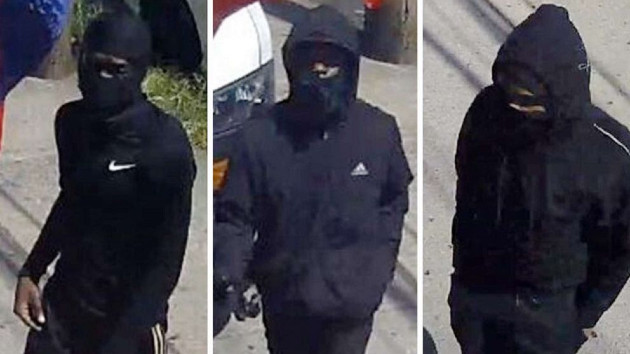
(NEW YORK) — Police released footage of three suspects wanted in connection with the armed robbery of a Brooklyn, New York bishop during a livestream of his service.
Bishop Lamor Whitehead said he and his wife were robbed of “hundreds of thousands” in jewelry, including his wedding band, during a targeted incident on Sunday at his church, Leaders of Tomorrow International Ministry.
The New York Police Department released surveillance footage late Tuesday that shows the suspects, dressed in all black and wearing masks, crossing the street and entering the location shortly after 11 a.m. Sunday. Police said Wednesday there were no updates in the case.
Footage of the livestream, which is also part of the police investigation, shows the bishop saying “alright, alright” and lowering himself to the ground as one of the masked men enters the frame.
“When I see them come into the sanctuary with their guns, I told everybody, ‘Get down,'” Whitehead said in a video posted on Instagram. “I didn’t know if they wanted to shoot my church up or if they were coming for a robbery.”
Police said the men displayed firearms and stole a “large sum of jewelry” before fleeing in a white Mercedes.
Whitehead said that he chased after the suspects, whom he said had changed clothes and took their masks off, but ended up driving past them.
The bishop said the ministry was “traumatized” by the incident, and that a gun was pointed in the face of his 8-month-old baby. He has since offered a $50,000 reward for information leading to the “healthy” arrest of the three men.
“I don’t want nothing happening to these young men,” he said in a video posted on Instagram announcing the reward. “I want the law to deal with these people.”
He decried the robbery, saying that he would have helped the men if they needed it.
“I would have been able to show love,” he said.
Following news of the robbery, Whitehead has also defended himself against criticism over his “flashy” lifestyle.
“It’s not about me being flashy,” he said. “It’s about me purchasing what I want to purchase.”
“It’s my prerogative to purchase what I want to purchase,” he added.
Terry Wyatt/Getty Images for Country Music Hall of Fame and Museum
Trisha Yearwood is celebrating the one-year anniversary of Dottie’s Yard, her non-profit fund dedicated to shelter dogs and cats, this week.
The country singer named her fund after one rescue dog in particular: Dottie, who spent 14 years with Trisha and her husband, fellow country star Garth Brooks, before her death. To honor Dottie’s memory, Trisha started the fund to support shelter pets and spearhead rescue efforts across the country.
On Wednesday, Trisha hopped on TalkShopLive to celebrate Dottie’s Yard’s anniversary and raise money for the cause with new sweatshirts from her Trisha Yearwood Pet Collection.
“Dottie was the ultimate rescue who showed up and changed everybody’s lives on our farm,” Trisha reflects. As a tribute to her, the singer’s organization is raising money to be dispersed across 27 shelters nationwide, in partnership with the Empty the Shelters adoption event campaign.
Beyoncé’s Renaissance album has apparently leaked, just two days before its release.
According to Variety, “high-quality FLAC [Free Lossless Audio Codec] files that certainly sound like the album” were found online Wednesday. There were also social media posts that showed physical copies of the album for sale, apparently in European stores.
Beyoncé first revealed a new album was on the way last month. She has since followed up a reveal of the album’s cover art, track list, and collaborators, which include Drake, Nigerian singer Tems and producer Pharrell Williams.
Renaissance, which is the “Break My Soul” singer’s seventh studio album, is set to officially drop Friday. This will be Beyoncé’s first conventional solo album since 2016’s Lemonade.