
This is how much money Black women lose to the pay gap

This is how much money Black women lose to the pay gap
Marko Geber/Getty Images

(NEW YORK) — The wage gap that sees Black women earning less than white, non-Hispanic men can cost them as much as $2,000 per month, $23,000 per year and more than $900,000 over the course of a 40-year career, according to the National Women’s Law Center, a policy-focused organization that fights for gender justice.

Sept. 21 marks Black Women’s Equal Pay Day, the date that Black women have to work to in 2022 to earn what their male, white, non-Hispanic counterparts earned in 2021.

Last year, the day fell on Aug. 3, meaning that Black women this year have had to work over six weeks longer into the year to try to make up for their lost wages.

In the United States, Black women are on average paid 58 cents for every dollar earned by men, according to Census Bureau data shared by the American Association of University Women, a non-profit organization dedicated to empowering women and girls.

Women of all races working full-time in the U.S. are paid 83 cents to every dollar earned by men, according to the AAUW. Equal Pay Day fell on March 15, the day that women have to work into 2022 to earn the same as their male counterparts did last year.

“Because women earn less, on average, than men, they must work longer for the same amount of pay,” the National Committee on Pay Equity said in a statement on Equal Pay Day. “The wage gap is even greater for most women of color.”

According to National Women’s Law Center data, a Black woman who starts working at age 20 would have to work until she is almost 80 years old to earn what a white, non-Hispanic man is paid by age 60.

Black Women’s Equal Pay Day comes this year as Black women are still trying to recover from the economic fallout of the coronavirus pandemic, a time during which they lost jobs at a higher rate than other groups in the country.

Unemployment rates dropped or remained the same for almost every race or ethnicity except Black women, with an unemployment rate almost double that of white Americans, according to the National Women’s Law Center. In August, while many groups joined the labor force, 45,000 Black women left.

Black women also continue to be hit hardest by the student debt crisis in the U.S., with around 1 in 4 Black women holding student debt, according to data from the Census Bureau and the American Association of University Women.

Just over a decade after starting college, Black women, on average, owe 13% more than they borrowed, while white men, on average, have paid off 44% of their debt, according to The Education Trust.

One of the reasons Black women owe so much more in the years after graduating college is the gender pay gap, experts say.

Gloria Blackwell, CEO of the American Association of University Woman, said because Black women earn less, many are burdened by student debt for the larger part of their career. She described what Black women face in the workplace as the “perfect storm” of both a racial wealth gap and gender pay gap.

“When you are a Black woman and you have this burden of student loans, it impacts every aspect of your life,” Blackwell told ABC News last month. “It impacts whether you can pay for basic living expenses, whether you can afford transportation or even the rent in order to have a decent place to live, let alone save for a house or be able to start a family or take care of your family. It’s a burden on Black women on whether they can save for retirement or afford rent or be able to move to a better neighborhood.”

Black women enroll in college at higher rates than other groups. However, a 2020 report from the Lean In organization found that the gender pay gap is largest for Black women who have bachelor’s degrees.

“Black women are ambitious — they’re more likely than white men (35%) and white women (26%) to say they want to become top executives,” the report stated. “But even in the same job, Black women are paid less than white men.”

Experts including Blackwell and Nicole Mason, president and CEO of the Institute for Women’s Policy Research, say the solution for closing the gender pay gap for Black women needs to come from both the government and private sectors.

On the federal level, Mason said the passage of legislation like the Paycheck Fairness Act can help promote pay equity and transparency, while enforcement of existing civil rights and equal employment laws can help lower workplace discrimination.

“Employers have a role to play in terms of making sure there is pay equity and making sure that women across the board earn what they’re worth and the skills and talents they bring to the table,” Mason previously told ABC News. “And as a culture and a society, we have a lot of work to do in terms of breaking gender stereotypes around women in the workplace, their value and how much women should be paid for their work.”

Copyright © 2022, ABC Audio. All rights reserved.

‘Andor’ launches today on Disney+

‘Andor’ launches today on Disney+
Disney+

Andor, the latest Star Wars small-screen project, launches on Disney+ Wednesday with a three episode premiere. 

The 12-episode prequel series follows Diego Luna‘s Rogue One: A Star Wars Story character Cassian Andor, and his early days with the Rebellion against the evil Galactic Empire. 

The series was written and produced by Rogue One‘s Tony Gilroy, and the show matches that beloved movie’s “boots on the ground” feel of that galaxy far, far away as the Empire tightens its grip. 

Kyle Soller plays Syril Karn, a tightly-wound Imperial agent trying to be promoted off of the backwater planet he’s stationed. He and Denise Gough, who plays icy Imperial Security Bureau agent Dedra Meero, explained they were spared from revealing any Andor secrets because the day after they got their jobs, COVID-19 hit. 

“We went into lockdown,” Soller says.

Gough laughs, “Yeah, the world sort of became more interested in other things, you know, life and death.”

She adds, “And now we’re becoming really aware, ‘Oh, Jesus, we’re in Star Wars. This is really actually quite full on.'” 

Genevieve O’Reilly again plays Senator-turned Rebel leader Mon Mothma. O’Reilly first played her in 2005’s Episode III – Revenge of the Sith, but her scenes were cut.

She called it “a unique experience” to play the character in again in Andor, set five years before the events of Rogue One.

She adds, “…I think it’s also important for me to acknowledge just what George Lucas did back then of creating the leader of the rebel alliance who was a woman! I am ever grateful for him.”

Disney is the parent company of ABC News.

Copyright © 2022, ABC Audio. All rights reserved.
Hurricane Fiona updates: Category 4 storm moves north after wreaking havoc in Puerto Rico

Hurricane Fiona updates: Category 4 storm moves north after wreaking havoc in Puerto Rico
ABC News

(NEW YORK) — Hurricane Fiona strengthened to a Category 4 storm on Wednesday, after killing at least four people in Puerto Rico and leaving the entire island without power.

The storm dropped 6 to 20 inches of rain in Puerto Rico and the U.S. Virgin Islands, with up to 30 inches of rain falling in southern and southeastern Puerto Rico. The rain caused rivers to rise over their banks and triggered rock and mudslides, according to officials with the Federal Emergency Management Agency.

As of early Wednesday morning, the storm system was carrying maximum sustained winds of 130 miles per hour as it moved away from Turks and Caicos after dropping heavy rains over parts of the islands. Winds could possibly increase to 140 mph, according to the National Weather Service.

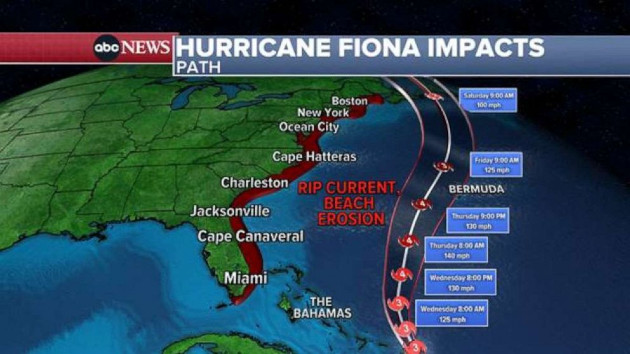
Fiona is expected to move parallel to the eastern United States, passing between the East Coast and Bermuda late Thursday into early Friday, the National Weather Service said.

The East Coast could see high surf, rip currents and even coastal flooding over the coming days. Meanwhile, a tropical storm watch remains in effect for Bermuda, which could see heavy rain, gusty winds and coastal flooding on Thursday night and Friday morning, according to the National Weather Service.

FEMA officials said during a press conference Tuesday that at least four people have died in Puerto Rico due to Fiona. A public health emergency was declared in the U.S. territory.

On Monday, officials reported that one person was killed as the then-Category 1 storm slammed the island. The Arecibo resident was attempting to fill his generator with gasoline while it was on, causing an ignition, officials said.

No one has been reported missing as of Tuesday afternoon, according to Steve Goldstein, the National Weather Service’s liaison to FEMA.

FEMA officials were still assessing the extent of the damage in Puerto Rico, saying it is too early to estimate the financial impact of the storm.

Fiona made a second landfall Monday in the Dominican Republic near Boca de Yuma on the eastern side of the island with sustained winds of 90 mph and even higher gusts.

Puerto Rico Gov. Pedro Pierluisi warned residents that more rain was expected on the island through Tuesday evening.

“We are going through a difficult moment but our people are strong and very generous,” he said during a press conference.

Four helicopters are in the air surveying damage from Fiona. The governor said it would take at least a week to determine the extent of the damage left by the storm.

In addition to the four deaths cited by FEMA, at least two other people died in a shelter due to natural causes, but those have not been labeled as storm-related, Pierluisi said.

Restoring power in Puerto Rico

LUMA Energy said that only 300,000 out of 1.5 million clients have had power restored on the island as of Tuesday morning, with more expected in the coming days.

“We assure you that a large part of Puerto Rico will have electricity today and tomorrow,” Abner Gomez, spokesperson for LUMA Energy, said at a press conference Tuesday.

In an update Tuesday afternoon, FEMA said that 80% of customers still remain without power.

The governor said Monday the goal is for “a large number of LUMA customers” to have power “in a matter of days.” However, LUMA said in a statement Sunday that “full power restoration could take several days.”

Hospitals on the island are currently operating on generators, according to the governor.

Only 34% of households on the island have potable water after rivers grew and heavy rainfall impacted the system — meaning more than 834,000 people are without drinking water, the governor said Monday.

More than 1,000 people have been rescued by authorities, including a woman rescued Sunday who was stuck in a tree for seven hours after trying to look at the damage, officials said.

Heavy rainfall causes flooding across the island

Fiona strengthened to a hurricane from a tropical storm Sunday morning. The National Hurricane Center said Fiona made landfall in southwestern Puerto Rico on Sunday at 3:20 p.m. ET, dumping torrential rain on much of the island.

Some regions measured up to 25 inches of rain by 8 a.m. Monday.

A flash flood emergency was issued due to many rivers rising very quickly out of their banks. The Rio Grande de Arecido river rose 13 feet in one hour.

A bridge near Utuado, a town in the central mountainous region of the island, has collapsed, cutting off the communities of Salto Arriba and Guaonico, local newspaper El Vocero de Puerto Rico reported.

The portion of the bridge that collapsed is on Highway 123, a branch of Highway 10, which serves as a link between both roads and is one of the accesses to the University of Puerto Rico at Utuado campus, according to El Vocero.

The bridge, installed by the National Guard following Hurricane Maria, cost about $3 million to construct, the newspaper reported.

The rain saturated areas in the southeastern part of Puerto Rico, along with the mountainous areas, where potential mudslides could cause the most damage.

Prior to landfall, Pierluisi said Puerto Rico was prepared as it could be, with enough resources and manpower in place to respond — adding that the island learned its lessons from the devastating effects of Hurricane Maria in September 2017.

“We’re much in a much better position than we were five years ago,” he said.

Where Fiona heads next

After passing through the Caribbean, the storm system will head northward, passing just east of Turks and Caicos before tracking near Bermuda, forecasts show. The storm system will continue to gradually strengthen in the coming days as it moves north and then northeast this week.

The Dominican Republic is expected to receive up to 10 inches and some regions in Turks and Caicos are expected to see 8 inches of rain.

On Tuesday, Puerto Rico and the Dominican Republic will continue to see gradually improving conditions, however, lingering showers and thunderstorms will still be likely, potentially impacting initial cleanup and recovery efforts.

Winds could be as high as 125 mph as the storm passes near Bermuda, bringing strong winds, heavy rain and storm surge. The latest model shows Bermuda will not see a direct hit, with the worst of the storm passing just west of the island.

While it won’t make landfall in the U.S., the hurricane will affect the entire East Coast with huge waves, rip currents and coastal flooding from Florida to Maine as it moves northward.

President Joe Biden approved an emergency declaration for Puerto Rico on Sunday, which allows federal agencies to coordinate all relief efforts.

Biden’s decision has the “purpose of alleviating the hardship and suffering caused by the emergency on the local population, and to provide appropriate assistance for required emergency measures, authorized under Title V of the Stafford Act, to save lives and to protect property and public health and safety, and to lessen or avert the threat of a catastrophe in all 78 municipalities in the Commonwealth of Puerto Rico,” the White House said in a statement.

FEMA Administrator Deanna Criswell arrived in Puerto Rico on Tuesday to coordinate the emergency response, the White House said. “Hundreds” of federal responders are already on the island, including members of the U.S. Army Corps of Engineers.

Copyright © 2022, ABC Audio. All rights reserved.

Woman allegedly assaulted by suspect in Eliza Fletcher case speaks out

Woman allegedly assaulted by suspect in Eliza Fletcher case speaks out
ABC News

(NEW YORK) — When terrible things happen, like the kidnapping and murder of Memphis, Tennessee teacher Eliza Fletcher, many wonder what could have been done to prevent it.

A young woman who said she was sexually assaulted by the same suspect in the murder of Fletcher said police did not do enough for her case — and failed Fletcher.

“I’m angry. Not a day goes by that I didn’t think about this,” said Alicia Franklin.

Franklin, 22, spoke to ABC News’ Good Morning America in her first television interview.

Franklin was allegedly assaulted by suspect Cleotha Abston Henderson a year before Fletcher went missing, but the DNA results from her rape kit were not reported until after Fletcher disappeared.

“They had more than enough evidence that night when they interviewed me to get him off the streets. But they didn’t,” Franklin told ABC’s Erielle Reshef.

Henderson only appeared in court last week for charges related to Franklin’s incident, including especially aggravated kidnapping, aggravated rape and illegal possession of a firearm after results from the submitted 2021 rape kit linked him to Franklin’s case. He pleaded not guilty.

Franklin and her lawyers contend that if Franklin’s rape kit had been processed sooner, authorities would’ve been able to identify Henderson and get him off the streets.

“I didn’t want to believe it because I just never thought that my case would have [been] tied to [Fletcher’s] case. I was shocked,” she said. “I’m still kind of trying to process everything.”

In Sept. 2021, Franklin said she met a man who went by “Cleo” on an online dating site and the two texted and talked on the phone for weeks before finally planning to meet in-person for a dinner date.

She said she agreed to pick him up from what he claimed was his apartment, which she says turned out to be abandoned.

“When we walked in the house, he put a gun to my neck,” said Franklin, who said he brought her to a White Dodge Charger behind the apartment. “He forced me in the car, he raped me.”

At the time, Franklin says she was four months pregnant.

“I told him I was pregnant. He didn’t care,” she said.

Afterwards, Franklin said he brought her back into the vacant apartment at gunpoint before he left in a car and Franklin escaped.

She said the next thing she did was drive herself to the hospital, then to a Rape Crisis Center, where she was given a rape kit and interviewed by sex crimes detective. She said, on the night of her attack, she gave authorities the man’s phone number, walked them through the crime scene, described his car, his dating profile and all the details of the assault.

Franklin said she was told at the time that there was “not enough evidence” to charge the man for rape. Over the next year, she said she kept pressing authorities for answers, but felt she was given the “runaround.”

GMA reached out to the Memphis Police Department for comment, but did not receive a response. The Tennessee Bureau of Investigation (TBI) said they were unable to answer specific questions about Franklin’s case, but offered a statement.

“TBI’s role in forensic processing of evidence and providing the results of that analysis is to support law enforcement investigations,” the TBI said in part of a statement. “We do not make decisions on how the information we provide is utilized. That decision is solely made by the investigative agency, usually in consultation with the prosecuting attorney.”

Franklin is now suing the city of Memphis and the apartment complex where she says the attack happened.

Earlier this month, Henderson was charged with especially aggravated kidnapping and tampering with evidence in connection to Fletcher’s disappearance. Henderson has yet to enter a plea to the charges stemming from Fletcher’s homicide.

After Fletcher’s body was found near a vacant duplex, Henderson was also charged with first-degree murder, premeditated murder and first-degree perpetration of kidnapping.

Fletcher, a married mother of two, was last seen jogging near the University of Memphis campus early in the morning, when she was approached by a man and forced into a dark-colored GMC Terrain, which was caught on surveillance video.

If her case had been processed sooner, Franklin claims that Fletcher’s death could have been prevented.

“I definitely believe she would have still been alive today,” she said.

Copyright © 2022, ABC Audio. All rights reserved.

Water problems in Jackson, Mississippi, go deeper than pipes, experts say

Water problems in Jackson, Mississippi, go deeper than pipes, experts say
Tim Graham/Getty Images

(JACKSON, Miss.) — When Jackson, Mississippi, residents lost access to clean water late last month, federal, state and local officials scrambled to fix an infrastructure problem deeper than just money could solve.

In August, historic flooding in Mississippi damaged a major pump at the O.B. Curtis Water Plant, the main water treatment facility in Jackson, which left around 150,000 of the city’s mostly Black residents without drinkable water.

Residents were forced to line up on streets and highways throughout the city to pick up water at distribution sites because of the shortage.

The most recent water crisis highlighted residents’ yearslong plight with the city’s ongoing water issues, and raised questions about how the city came to be in this situation and what the long-term plans are to fix the issue.

How did Jackson get here

While water pressure did return to Jackson about a week after the shortage, the city’s mayor, Chokwe Antar Lumumba, at a press conference earlier this month, attributed the crisis to staffing shortages, system issues and multiple equipment failures.

“This is due to decades, decades and decades, of possibly 30 years or more of deferred maintenance, a lack of capital improvements made to the system, a lack of a human capital, a workforce plan that accounted for the challenges that our water treatment facility suffers from,” Lumumba told “ABC News Prime” last month.

Over the last 40 years, Jackson’s population has shrunk as more of the city’s white residents left and moved to the suburbs, a practice known as “white flight,” resulting in not as many taxes coming into the city, policy experts told ABC News.

“Infrastructure is crumbling in a lot of different places, not just Black places,” Andre M. Perry, Ph.D., a senior fellow at Brookings Metro, a policy arm of the Brookings Institution, told ABC News. “However, in Jackson, there was a direct link to a loss of revenue to white and middle-class flight, which were facilitated by investments in the ’60s and ’70s that led to the building up of the suburbs.”

Black people make up 82.5% of Jackson’s population, while white people make up 16.2%, according to the U.S. Census Bureau. The most recent census data also showed that Jackson’s population went from slightly more than 173,000 people in 2010 to around 149,000 people as of July 2021.

That “white flight” cost the city of Jackson the opportunity to build its infrastructure, according to Perry.

“In its highest form, infrastructure lays the foundation for economic and community development across regions,” he said.

Here are the issues experts and officials say Jackson needs to address to move forward and tackle its water crisis:

Show me the money

Mississippi is one of the most dependent states on the federal government, currently ranking third in federal funding, behind West Virginia and New Mexico, according to a 2022 study from financial tech company SmartAsset.

For every $1 it pays in income tax, the state receives $2.53 in federal funding, according to SmartAsset.

Government officials have discussed how much it will cost to fix Jackson’s water issue, and the figures have varied.

Environmental Protection Agency Administrator Michael Eagan met with Lumumba and Mississippi Gov. Tate Reeves earlier this month to discuss the water crisis and said the state has already received millions of dollars to solve the water issue.

Mississippi is set to receive more than $26 million in State Revolving Funds (SRF) this year, which is on top of the $30 million it received in 2021 for Jackson, Eagan said during a Sept. 7 press conference. Around $13 million is currently being spent, he said.

The state funds help public water systems bankroll the costs of infrastructure projects needed to reach or maintain compliance set under the Safe Drinking Water Act.

In December, the EPA announced that Mississippi would get nearly $75 million for water infrastructure projects, as part of the Bipartisan Infrastructure Law, which was signed by President Joe Biden in November 2021; in the next five years, Mississippi is expected to receive $400 million through the law, Eagan said.

Lumumba estimated it would cost at least $1 billion to fix the water distribution system and billions more to resolve the issue altogether.

During a Sept. 7 press conference, Reeves said that one of the solutions is to fix the water billing system so that people who get water are being billed for it.

City residents have long complained about a malfunctioning water meter system, preventing them from receiving their bills, according to Jackson ABC affiliate WAPT-TV.

“Within that funding structure and the rate structure, we have to make sure we have adequate dollars in there so as to fund routine maintenance on a regular basis. Those are areas that have been a challenge in the immediate past,” Reeves said.

How Jackson’s water system works

The city of Jackson runs its own water, making it harder to fix the system because not enough taxes are being collected due to shifting demographics, according to Perry, who believes there is a shared responsibility to fix the issue.

“We need a regional approach to managing water, in which taxes for infrastructures are collected on a regional level and dispersed equitably based on need,” he said.

Jackson’s water system only serves the city’s residents, which is detrimental to Jacksonians, according to experts.

“If [we] drink from the same water source, even if [we] don’t like one another, we’re sort of handcuffed, whether we like each other or not, we’re drinking from the same water, so we both have an interest in making sure that it’s good,” Manny Teodoro, an associate professor at the LaFollette School of Public Affairs at the University of Wisconsin-Madison, told ABC News.

No easy solution

Jackson City Councilman Aaron Banks told ABC News that there needs to be an in-depth analysis of all the conditions and system components impacting Jackson’s water system, as well as policy in addressing how much it would cost.

“I think all options are on the table when it comes to oversight,” Banks said. “We as the council need to know what it costs so we can begin working with our partners to invest money, whether federally or state, and begin prioritizing our budget.”

However, throwing money at the problem isn’t going to immediately solve Jackson’s long-stemming water issues, which are more systemic and structural, Teodoro said.

​​”The disaster is a legacy of racial hatred, but also the work of leaders who found it politically expedient to ignore the city’s water problems for decades instead of solving them,” Teodoro wrote in a blog post on his website.

This week, Jackson residents filed a federal class-action lawsuit against the city; past and current city officials, including Lumumba and former mayor Tony Yarber, and infrastructure engineering companies for their purported roles in the water crisis. Spokespersons for Lumumba, Powell, Miller, and Siemens declined to comment when reached by ABC News. Yarber, Smash, and Trilogy Engineering did not immediately respond to ABC News’ requests for comment.

Some suggestions in handling Jackson’s water issues include the state creating a regional water authority to operate the system, creation of a state commission to take control of the system and privatizing the city’s system, according to Teodoro.

“Even if somebody could wave a magic wand and Congress, by some miracle, were to pass a bill that would give Jackson $1 billion to completely overhaul its infrastructure for water and sewer, we’d be right back in this situation five, 10, 20 years down the road because we haven’t fixed those underlying structural problems,” Teodoro said.

Copyright © 2022, ABC Audio. All rights reserved.

October the best time to get COVID boosters, flu shots, experts say

October the best time to get COVID boosters, flu shots, experts say
ER Productions Limited/Getty Images

(NEW YORK) — With doctor’s offices and pharmacies now offering seasonal flu shots and updated COVID-19 boosters, experts are urging Americans to get both, with many saying October is the best time.

While experts say October may be an ideal window to boost immunity, they are also emphasizing the importance of getting vaccinated, period — whenever you are able. It’s safe for people to get both shots during the same visit for added convenience, experts say.

White House COVID coordinator Dr. Ashish Jha told ABC News the best time to get a newly updated COVID-19 booster is “no later than the end of October for maximum protection,” which aligns with flu shot timing recommendations.

The “Goldilocks moment” for the flu shot is also October, said Dr. Peter Chin-Hong, an infectious disease specialist at the University of California, San Francisco. However, anyone who gets the shot in September should still expect protection during the flu season, which typically lasts until spring.

“I think my general advice is, get it [when] it’s convenient,” Chin-Hong said.

Experts also say not to worry if you can’t get your flu shot before Halloween.

“If you for whatever reason cannot get a flu shot by the end of October, it’s not too late,” said Dr. Alok Patel, a pediatrician at Stanford Children’s Health and an ABC News medical contributor.

Bad flu season on the horizon?

Some experts predict that the seasonal influenza virus — following two years of mild activity during the COVID-19 pandemic — is expected to be back in full force this season.

A typical pre-pandemic year would see around 8% of the U.S. population sick from flu, according to the Centers for Disease Control and Prevention. Deaths can exceed more than 50,000, as they did most recently in the 2017-2018 season.

Those most at risk of severe illness from influenza are the elderly and immunocompromised.

“What we’re concerned about, of course, are people who are older, over age 65. They account for about 15-17% of the population but 80% of the [flu] deaths and hospitalizations,” said Dr. William Schaffner, a professor of infectious diseases at Vanderbilt University Medical Center.

But even young, otherwise healthy people benefit from the flu shot, which also lowers the risk of spreading the virus to others.

“A lower risk does not mean no risk. By getting vaccinated, you really do reduce the likelihood that you will be the dreaded spreader,” Schaffner said.

Meanwhile, becoming ill with the flu can not only put a damper on holiday plans, but it also often leads to unwanted symptoms that last for multiple days.

“For anybody who’s gotten the flu, it’s definitely not a walk in the park,” Chin-Hong said.

Getting vaccinated in October or early November is ideal because “[you want] your annual vaccination to extend throughout the winter, well through February into March, and even into April,” Schaffner said.

“The only other sort of change with the timing might be for people who are pregnant,” Chin-Hong said.

He explained that pregnant women may want to try and have a flu shot before delivery, which allows the newborn to benefit from the mother’s antibodies, especially given that infants under 6 months old cannot be vaccinated.

Experts say flu shots may be especially important for children this year given concerns about how the relaxation of pandemic-era restrictions may impact children.

“Given the fact that schools are back open, COVID-19 restrictions have been lifted, and kids are back to their normal rambunctious selves [they] are at risk of catching influenza this year,” Patel said. “Parents should not generalize influenza as a common cold. Thousands of kids are hospitalized every year from influenza with young infants and kids with underlying medical conditions being at highest risk.”

Updated COVID-19 boosters may also become annual shots

The Food and Drug Administration recently authorized the first updated COVID-19 booster shots — the first major upgrade to COVID-19 vaccines. Because protection from COVID-19 fades slowly over time, the White House has previously stated that variant-specific COVID shots may also become an annual reality, similar to seasonal flu shots.

The new COVID-19 boosters are designed to be a better match against currently circulating COVID-19 variants, and are currently authorized for everyone 12 and older who had their last COVID-19 shot at least two months ago. People previously infected with COVID may also consider waiting 90 days before receiving their booster shot, according to the CDC. The authorization of updated boosters for younger children is expected in “a matter of weeks,” according to Dr. Peter Marks, the director of the group within the FDA responsible for assuring the safety and efficacy of vaccines.

Although it is not clear if there will be another COVID-19 surge this fall, more than 350 people still die every day of COVID-19. Compared to young adults, those over the age of 65 are 60 times more likely to die from COVID-19, according to the CDC. The death rate is 340 times higher for those over the age of 85.

Is it safe to get the COVID booster and flu shot at the same time?

Experts say that getting both your COVID booster and flu shot at the same time won’t weaken your body’s immune capacity to fight either virus.

“If you give the body two signals, it’s not going to make less [immunity] because it’s concentrating on another signal,” Chin-Hong said.

Although children under 12 are not yet eligible for the new booster shots, many are still getting their original COVID-19 vaccines, which are authorized for children 6 months and older.

Similar to the guidance for adults, pediatricians say it’s safe to give young children COVID-19 shots and flu shots in the same doctor’s visit.

“This may even be a more convenient option for busy parents,” Patel added.

Copyright © 2022, ABC Audio. All rights reserved.

How rapidly rising mortgage rates are squeezing prospective homebuyers

How rapidly rising mortgage rates are squeezing prospective homebuyers
Phillip Spears/Getty Images

(NEW YORK) — For Emily and Michael Brown, the Federal Reserve’s rate hikes hit close to home.

The Browns had been renting a two-bedroom apartment in Washington, D.C., when their now-6-month-old daughter was born. Eager to upgrade to a bigger space, the couple wanted to put their savings to use buying their first home.

But as they looked for a place to live this year — and watched mortgage rates, and their potential monthly payments, steadily climb — the couple lowered their budget from $500,000 to $400,000 and decided to put an offer on a home farther away from the city, with less space and fewer amenities.

“As the rates kept going up, we had to really bring down our budget and also be a little bit more realistic about what we were going to get for that budget,” Emily Brown, a high school math teacher, told ABC News.

Mortgage rates have more than doubled since January, lenders and real estate companies say, spurred by aggressive interest rate increases as the Fed attempts to curb high inflation. Many Americans searching for homes are lowering their budgets and making trade-offs — as they face higher monthly mortgage payments.

“Many homebuyers have dropped out of the housing market entirely because they can’t afford any home that fits their needs,” Daryl Fairweather, the chief economist at real-estate brokerage company Redfin, told ABC News.

As the Fed keeps hiking interest rates to try to tame historic inflation, mortgage rates have spiked to levels not seen since the 2008 financial crisis. And with the central bank expected to increase rates again on Wednesday — as inflation remains stubbornly high — some aspiring homeowners find themselves stuck on the sidelines altogether.

“The price of homes has jumped so much in the past year. Then you take into account the high interest rates, it’s really a tough position to be in as a first-time homebuyer,” Emily Brown said.

Mortgage rates hit 14-year high

For the first time since 2008, the average rate on a 30-year fixed mortgage is now above 6%, Freddie Mac said last week. The financial services company Bankrate estimates that a borrower taking out a $300,000 loan at that rate is paying about $500 more every month than they were before the Fed increases, which began in March.

“Since interest rates have risen, I’ve had to reduce the amount that I can afford each month, depending on my down payment and what a monthly mortgage would be,” Simone Jacobs, a therapist in Silver Spring, Maryland, told ABC News.

After renting for seven years, Jacobs had hoped to buy a property as a longer-term investment. But rising rates and still-high home prices have kept her out of the market.

“If nothing comes up or there’s nothing that sort of is affordable, then, you know, I will just wait,” she said.

‘It did kind of put us in a pickle’

Rapidly rising mortgage rates have also squeezed buyers building new homes.

Wesley and Kimberly Robinson, both elementary school teachers, started building a new home for themselves and their two daughters in Rogers, Arkansas, last year, when interest rates were close to 3%.

“With the low interest rates, we thought, Hey, if we’re going to ever upgrade, now’s the time,” Wesley Robinson told ABC News.

But as the COVID-19 pandemic stalled construction and the Fed continued to raise interest, their mortgage rate ended up to 5% when they finally locked it in this summer — adding about $300 to $400 to their monthly mortgage payment, according to Wesley Robinson.

“It did kind of put us in a pickle,” he said.

And now he fears higher mortgage rates might scare off buyers for their old home, which they have yet to sell.

“If now rates are like 6% or higher, do we need to like discount our home a little bit?” he asked. “We don’t want our home to sit there for weeks and weeks unsold. We kind of need the money.”

Fewer bidding wars as markets cool, particularly in the West

Real estate agents told ABC News that they are seeing homebuyers who had locked in low rates on their initial mortgages waiting to sell, amid the prospective of taking on costlier loans, which is keeping housing inventory low in much of the country.

“What we’re seeing now as a result of the rising interest rates is that you’re not getting as many offers as before,” said Jay Nix, a realtor in Washington, D.C., who worked with the Browns.

Less competition is leading to fewer bidding wars for those who are able to afford to buy, multiple real estate agents said.

“The good news is that you can get your offer accepted much more easily now because you’re not facing as much competition,” Fairweather, Redfin’s chief economist, said. “But the bad news is that the mortgage is going to be much more expensive.”

There are signs the housing market is beginning to cool in some parts of the country.

Redfin said Wednesday in a new report, provided first to ABC News, that Seattle’s housing market is slowing faster than any other in the United States, followed by Las Vegas and San Jose, California. The firm looked at changes from February to August, comparing metrics ranging from home prices and the number of pending sales to the total supply and the speed of sales.

The top 10 markets cooling the quickest were “almost all either West Coast markets that have long been expensive, or places that became significantly less affordable during the pandemic because they attracted scores of relocating homebuyers,” according to Redfin.

Rents on the rise

Hoping to buy someday, many prospective homebuyers remain stuck on the sidelines — grappling with high increases in rent.

Rent costs increased 6.7% in August from a year before, the biggest spike in nearly 40 years, according to the U.S. Bureau of Labor Statistics.

“If you wait a couple more years, your rent keeps going up,” said Redfin’s Fairweather. “And then you have to deal with the expense of higher prices and more competition in the housing market.”

For the Browns in Washington, that calculation convinced them to put in a winning bid on a home. They are set to close next month.

“We really just thought about if we continue to rent, you know, that money could go toward the mortgage,” said Emily Brown, whose husband is an Army veteran.

“It’s a big life decision,” she added. “So — you do the math.”

Copyright © 2022, ABC Audio. All rights reserved.

Internal FDA report on infant formula crisis details shortfalls in response

Internal FDA report on infant formula crisis details shortfalls in response
AlasdairJames/Getty Images

(WASHINGTON) — An internal review of the Food and Drug Administration’s actions leading up to the infant formula crisis finds a combination of human error, antiquated technology, and poor communication and accountability amongst an already threadbare food workforce all contributed to a perfect storm of problems which exacerbated the supply shortage.

The issue was only worsened by the FDA’s lack of a robust mandate to strong-arm industry players’ compliance, the review found.

During more than 40 interviews with over 60 FDA staff and leadership “directly involved with the events that transpired” the review found “inadequate processes and lack of clarity” may have delayed the agency’s response to contamination concerns at at infant formula maker Abbott’s facility in Sturgis, Michigan; and that at several junctures, critical information slipped through the cracks of agency awareness.

In a statement, FDA Chief Robert Califf said the agency didn’t have the power to force the industry’s hand.

“The situation at the Abbott Sturgis facility has highlighted just how little authority the FDA has to compel many companies to ‘do the right thing’ without intervention,” Califf said.

The internal review echoed that sentiment: “a confluence of systemic vulnerabilities” here demonstrated the need for more investment in modern tools and tech to prepare for future public health challenges.

FDA’s limited mandate and resources prevent them from managing “supply chain issues and shortages of critical food products,” the review said, especially when it comes to a supply chain like that of baby formula, which had already been strained by the Covid pandemic — and which Abbott’s recall and pause in production further stressed.

The review also noted that the contaminant and illness at the heart of Abbott’s massive shutdown, Cronobacter sakazakii, is “poorly understood” and lacks thorough federal oversight — and that those “scientific gaps” in understanding Cronobacter “hindered the FDA’s response throughout the incident.”

The discovery of Cronobacter inside Abbott’s Sturgis plant prompted a massive voluntary formula recall in February, after four babies who had consumed Abbott’s formula contracted a Cronobacter infection. Two of the infants subsequently died, although Abbott maintains there has not been conclusive evidence that its formula caused the infant illnesses, since none of the Cronobacter strains found at their plant matched the two samples genetically sequenced from the sickened infants.

Ultimately, it was the combined findings of Cronobacter inside Abbott’s plant — along with a pattern of serious operational deficiencies and consumer complaints — which led to its closure.

In a statement to ABC News regarding the internal review, an Abbott spokesperson said, in part, they “will continue raising the bar” on their formula’s regulatory requirements “by working with FDA and industry partners to further advance infant formula safety and processes.”

Abbott’s shutdown ricocheted across the country, exacerbating the supply shortage and forcing families to scramble for alternatives in the hyper-concentrated formula market.

FDA’s Califf has previously noted some of the points outlined in the report released Tuesday: that the response was “too slow,” with “decisions that were suboptimal along the way,” while warning that FDA’s workforce is “very tired, overworked,” and the agency’s food safety arm is underfunded.

Califf has also previously underscored FDA’s lack of authority to “compel companies to give us information,” and has pointed the finger instead at Abbott’s failure to be upfront about the issues at their plant.

Critics of FDA’s response have previously pointed out that there was a brewing problem in the formula market before Abbott’s shutdown — and that the administration had plenty of warning signs both about the pandemic supply chain issues and about Abbott’s quality control problems long before things reached a boiling point this spring.

But this report contains several new details about repeated fumbles in the response, including crucial delivery system errors and a need for better staff communication at the FDA.

The review says FDA found that some samples taken from Abbott’s Sturgis plant after their contamination concerns came to light “were delayed in transit by third party delivery companies.”

The review comes after FDA leadership revealed this spring that a whistleblower complaint from a former Abbott employee detailing a “litany of violations” at the Sturgis plant had remained in limbo for months. That complaint had been sent to the FDA last October, but was not delivered, seen or escalated until four months later — because of, what the FDA has said, was “an isolated failure in FDA’s mailroom, likely due to COVID-19 staffing issues.”

The new internal review now says that such gaps in coordination between systems (though here, punting accountability to a “third party,”) “makes it difficult for the agency to connect related submissions and rapidly identify emerging safety and quality issues.”

“The FDA should evaluate procedures for shipping and testing samples sent to regulatory laboratories and consider whether changes should be made to analytical capability and capacity, and ways to enable immediate notification and escalation of analytical results for significant public health threats,” the review says.

The review adds that the agency is “collecting an inventory of every entry point for consumers, whistleblowers, other government agencies, clinicians, and other members of the public to facilitate notification to the FDA of their concerns about product safety and quality,” which will help “streamline” safety concerns to “rapidly assess emerging safety signals.”

The internal review ultimately identified five major findings for FDA to improve upon, including the need for more modern data technology which “allows for the access and exchange of data in real time to all the people involved in response.”

“The lack of coordination between systems makes it difficult for the agency to connect related submissions and rapidly identify emerging safety and quality issues,” the report says, and “inadequate processes and lack of clarity related to whistleblower complaints may have delayed the FDA’s response to those complaints.”

The review also underscores the need for FDA to optimize its emergency response capabilities to handle multiple concurrent public emergencies. FDA “lacks procedures for facilitating this complex coordination of staff on response activities that expand beyond the established foodborne outbreak response policies and procedures,” the review found.

The review also blames Covid infections at the manufacturing facility which “delayed the FDA’s in-person response to complaints raised” regarding Abbott’s Sturgis plant, and underscores the need to strengthen FDA’s food workforce including more training, staffing, equipment, funding and regulatory authorities “to fulfill the FDA’s mission.”

It also emphasizes the importance of closing knowledge and oversight gaps on Cronobacter and translating that knowledge into “appropriate control measures.”

Those gaps in understanding “hindered the FDA’s response throughout the incident,” the review said.

It also noted, FDA oversight should focus on accountability within the infant formula industry, which employs “dated technology and record keeping practices that can cause delays in collecting critical information needed to perform and define the scope of recalls.”

Moreover, the FDA lacks robust enforcement teeth to make sure companies are adhering to best practices of strong food safety culture, the review said; manufacturers aren’t required to make Cronobacter isolates available to the FDA for sequencing and uploading into the national database, which “limits the data available to help identify clusters of illness and potential sources of contamination.” Without further authority “it will be difficult for the FDA to identify early signals of potential safety issues and work with manufacturers to mitigate these hazards.”

FDA’s Califf had asked for this review to be done; the agency will “form working groups charged with implementing the recommendations,” and a year from now, FDA’s progress on the above recommendations will be assessed, the review said.

Meanwhile, the U.S. Department of Health and Human Services’ Office of Inspector General has also launched its own audit into how the FDA responded leading up to the recall and closure of Abbott’s Sturgis plant — and whether they followed proper recall protocol once deadly bacteria had been detected inside the plant. Findings from OIG’s audit are expected sometime in FY 2023.

The FDA says they are working with the OIG and “looks forward” to their “findings and recommendations.”

Copyright © 2022, ABC Audio. All rights reserved.

Little Leaguer seriously injured in fall goes home from hospital: ‘So grateful’

Little Leaguer seriously injured in fall goes home from hospital: ‘So grateful’
ABC News

(NEW YORK) — A Little League World Series player who was seriously injured after falling from a bunk bed while staying at the Little League World Series Complex in Williamsport, Pennsylvania, is back home in Utah after getting discharged from the hospital.

Easton Oliverson’s parents say they’re thankful to have their 12-year-old home after over a month of uncertainty.

“There were many moments this past few weeks where we didn’t think that he was ever going to be able to come home. We thought our son wasn’t going to make it,” Easton’s father Jace Oliverson told ABC News’ Good Morning America.

Easton, a baseball pitcher and left fielder, had traveled with his Snow Canyon Little League team, which hails from Santa Clara, Utah, to Pennsylvania in August to play in the Little League World Series. On the night of Aug. 15, however, he fell from a bunk bed in one of the league’s dormitories while sleeping and suffered a serious head injury, leading to a fractured skull, broken artery and epidural hematoma, a condition where bleeding occurs between the brain’s dura and the skull.

Little League players, coaches and managers are typically required to stay at the league’s complex. The dormitory where Easton was staying included bunk beds for the players to sleep on, which did not have guard railings. Since the incident, Little League Baseball officials announced they would remove all bunk beds in their dormitories.

“Since 1992, Little League has used institutional-style bunk beds to offer the most space for the players to enjoy their time in the dorms,” the league said in a statement last month. “While these beds do not have guardrails, Little League is unaware of any serious injuries ever occurring during that period of time. Out of an abundance of caution, Little League has made the decision to remove all bunks from within the dorms and have each bed frame individually on the floor.”

A photo of the beds from a parents guide of the facility shows no railings on any of the top bunks.

After the fall, Easton was airlifted to Geisinger Janet Weis Children’s Hospital in Danville, Pennsylvania, according to Little League Baseball, and had to receive surgery and treatment in an intensive care unit.

“I was told after the surgery that he was easily 30 to 45 minutes away from passing away,” Jace Oliverson told GMA in August.

While in the hospital, Easton, whose nickname is “Tank,” made big strides toward recovery. His dad told GMA that “doctors were stunned by his progression in a short amount of time.”

At the end of August, Easton was transferred to another hospital in his home state of Utah where he recovered enough to be discharged.

Now that Easton is out of the hospital, his parents remain by his side as he continues to heal.

“We’re so proud of how far he’s come and how hard he has worked. But he definitely has a lot more work to do,” Nancy Oliverson said.

“He’s home and we’re just so blessed and so grateful that he’s still with us and that he’s able to have a road of recovery with everything that this kid has had to go through since Aug. 15,” Jace Oliverson added.

The Oliversons have since filed a lawsuit against Little League Baseball and Savoy Contract Furniture, the company that made the bunk beds.

The lawsuit, filed on behalf of the family by Duffy + Fulginiti, a Philadelphia-based law firm, claims Little League Baseball “allow[ed] the bed to exist in a dangerous condition” and failed to “inspect the bed,” “have rails on the bed,” and failed to “properly secure the bed,” allowing Easton to fall. It accuses Savoy Contract Furniture of selling “dangerous and defective” furniture that caused Easton “significant and permanent injuries, including internal bleeding among other injuries, some or all of which are permanent in nature.”

The 12-year-old “has suffered in the past and will continue to suffer in the future, aches, pains, trauma, contusions, humiliation, embarrassment, suffering, disfigurement, and/or inconvenience” as a result of the incident, the lawsuit claims.

The suit is seeking “in excess of $50,000” plus “costs, interest, compensatory and punitive damages, and all other damages allowed by law.”

Kevin Fountain, senior director of communications at Little League International, said in a statement to Good Morning America that “it is Little League International’s policy not to comment on pending litigation.”

Savoy Contract Furniture has not issued any public statements on the lawsuit and did not immediately respond to a request for comment on the matter.

Copyright © 2022, ABC Audio. All rights reserved.

Toddler found dead in stolen car hours after deadly shooting, police say

Toddler found dead in stolen car hours after deadly shooting, police say
avid_creative/Getty Images

(HOUSTON) — A toddler was found dead inside a car that was stolen after the child’s father was shot and killed in Houston on Tuesday, police said.

“We are asking for a lot of things from the public right now,” Houston Police Executive Assistant Chief Larry Satterwhite told reporters during a press conference Tuesday night. “First and foremost, to pray for this family. A mother lost her husband and she lost her 2-year-old child today. We are also asking the public’s help in identifying the suspect. He is still at large.”

The Houston Police Department received a 911 call about a shooting in the area of El Camino Rey Del Rey Street and Chimney Rock Road at around 1:46 p.m. local time on Tuesday. Upon arrival, officers found a 38-year-old man who had been shot to death, according to Satterwhite.

Investigators believe the victim was meeting with another man at the location when possibly an argument ensued. The other man took out a gun and shot the victim multiple times before stealing his black SUV and fleeing the scene, Satterwhite said.

That evening, at approximately 6:36 p.m. local time, a woman called 911 to report her husband and 2-year-old son missing. The information she provided was specific enough that police soon realized the shooting victim was her husband, according to Satterwhite.

“We never knew about the child until she called,” he told reporters.

The stolen SUV with the little boy inside was found on Elm Street, more than 10 miles away from the shooting scene. Officers shattered the windows of the locked vehicle to get to the child, then immediately tried to render aid and called for an ambulance, according to Satterwhite.

“Sadly, it was too late. The chid had passed in the car,” he said. “At this time, we don’t know why or how or what the cause of death will be. It could be something like heat exhaustion, we just don’t know. That will be determined later through autopsy.”

Investigators believe the suspect had left the car there, locked up and turned off, with the child in the backseat, according to Satterwhite.

“It’s the hardest thing we do,” he told reporters. “Children are innocent.”

The unidentified suspect, who remains on the loose, is described as a Black man wearing a white t-shirt, black shorts and a black Oakland Raiders cap.

When asked if he had a message for the suspect, Satterwhite said: “Turn yourself in. Turn yourself in now.”

Copyright © 2022, ABC Audio. All rights reserved.