(PHILADELPHIA) — A former Philadelphia sheriff’s deputy allegedly illegally sold two firearms that were used in a deadly school shooting, according to federal prosecutors.
Samir Ahmad, 29, of Philadelphia, has been charged with firearms trafficking and selling firearms to a person unlawfully in the U.S., the Department of Justice announced Thursday.
Ahmad allegedly sold a confidential FBI informant who was unlawfully in the U.S. several firearms while he was employed as a deputy sheriff with the Philadelphia Sheriff’s Office, according to a criminal complaint unsealed Thursday.
One of the sales, for a revolver, occurred on April 27, according to the complaint. Prosecutors further alleged that he sold the informant two semi-automatic pistols for $3,000 on Oct. 13.
Law enforcement traced the two pistols to a recent shooting outside Roxborough High School in Philadelphia, according to federal prosecutors. Five high schoolers were shot, one fatally, after at least four people opened fire outside the school on Sept. 27, the DOJ said.
“Just two weeks later, the defendant obtained two of the guns used in that shooting then sold them to the informant,” prosecutors said in a motion for pretrial detention filed on Wednesday. “The fact that the defendant had access to these guns so quickly after they were used to commit such a horrific crime speaks volumes about the danger that this defendant poses to the community.”
The motion further alleges that Ahmad sold the informant another semi-automatic pistol, as well as more than 50 grams of methamphetamine, on Oct. 18.
Ahmad, who had been employed as a deputy with the sheriff’s office since February 2018, was fired and arrested on Oct. 19, the DOJ said. He faces a maximum sentence of 15 years in prison for the firearms trafficking charges and could face additional charges for the alleged drug and firearm sales on Oct. 18, according to the DOJ.
It is unclear if Ahmad has an attorney. Online court records do not list any attorney information.
“As alleged, Samir Ahmad abused his authority — to the greatest extent possible — as a sworn law enforcement officer,” U.S. Attorney Jacqueline Romero said in a statement, charging that the former deputy was “adding fuel to the already incendiary fire of deadly gun violence in the city of Philadelphia.”
The Philadelphia Sheriff’s Office said in a statement that Ahmad was dismissed “for repeated violations” of the office’s “directives, policies and procedures.”
“As always, the Office of the Sheriff will continue to cooperate with local, state and federal authorities,” the statement said.
(CINCINNATI, Ohio) — The city of Cincinnati is considering making trick-or-treating a weekend-only activity to keep children safer.
Council members Liz Keating, Reggie Harris, Scotty Johnson and Meeka Owens filed a motion Wednesday to move the popular candy-centric activity to early evening hours on a weekend since it gives more access to parents and guardians while avoiding rush hour traffic.
The city traditionally observes trick-or-treating on Halloween between 6 p.m. to 8 p.m., local time, which the council says creates visibility and safety issues since the sun sets earlier in the fall.
“Moving the time one or two hours earlier would provide daylight and visibility for all; adding significant safety measures for our children and youth throughout the 52 neighborhoods in our city,” The council members said in their motion.
Pedestrian fatalities are 43% higher on Halloween than on other days, according to a study from Jama Network.
Children between 4 to 8 years old see a 10-fold increase in pedestrian deaths on Halloween, the study said.
Last year, the Cincinnati Police Department released tips to keep people safe for Halloween, which includes:
• An adult should always accompany young children while they are out trick-or-treating.
• Older kids who do not need an adult should always trick-or-treat in groups.
• Make sure you choose bright-colored costumes for your kids and give them things such as glowsticks or flashlights to use when the sun sets.
• Make sure you use the sidewalk whenever possible and walk in well-lit areas.
• Teach your kids never to enter a stranger’s home.
• Always check your child’s candy before letting them consume any.
• If you are driving during Halloween, use extreme caution while on the roadways. Watch for excited children out trick-or-treating or those whose vision may be obstructed by a costume.
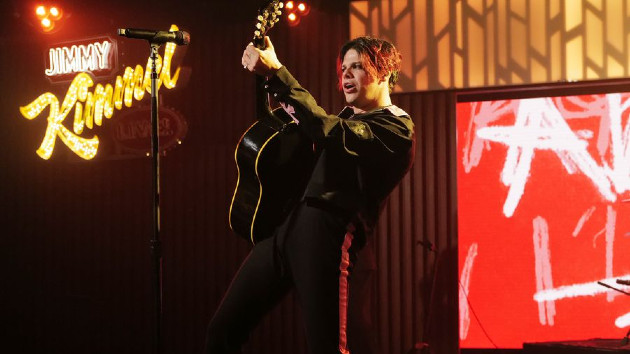
Yungblud and The Who vocalist Roger Daltrey interview each other for the latest installment of Rolling Stone‘s “Musicians on Musicians” series.
During the conversation, Yungblud reveals that before his career took off, he was approached by a label who wanted to have him compete on The Voice.
“I was like, ‘No f***ing way,'” “The Funeral” rocker says.
“I remember them saying, ‘We’ll put you on The Voice, and if you win it, we’ll sign you. But you can’t sing about politics,'” he continues. “I was starting to write about sexuality, fashion, gender…And I just said no.”
Daltrey also shares that he was asked to be a judge on the reality singing competition — presumably the U.K. version — but he declined, as well.
“I’m not gonna judge anyone’s singing,” Daltrey says. “You’re only gonna squash their spirit, whatever you say.”
Elsewhere in the interview, Yungblud and Daltrey talk about social media and their mutual love of Oasis.
“I wish [Oasis] would just get back together,” Daltrey says.
The Who‘s Roger Daltrey and contemporary British rocker Yungblud interview each other for the latest installment of Rolling Stone‘s “Musicians on Musicians” series.
During the conversation, Daltrey, 78, tells Yungblud he thought the 25-year-old singer’s latest album was “uplifting” and praises the way he uses “the crowd-singing sound” in his mixing.
Roger goes on to complain that a lot of popular music in recent years has lacked strong vocals and harmonies, then discusses why he loves The Beach Boys.
“When you listen to the songs of the Beach Boys and the harmonies and all that stuff, it truly lifts your spirits,” Daltrey notes. “We really need it these days. Too many solo voices singing mediocre lyrics.”
The rockers also share negative opinions about the reality singing competition The Voice.
Daltrey says he was asked to be a judge on show — presumably the U.K. version — but he declined.
“I’m not gonna judge anyone’s singing,” Daltrey insists. “You’re only gonna squash their spirit, whatever you say.”
Yungblud, meanwhile, reveals that before his career took off, he was approached by a label that wanted to have him compete on The Voice.
“I was like, ‘No f***ing way,'” he recalls.
“I remember them saying, ‘We’ll put you on The Voice, and if you win it, we’ll sign you. But you can’t sing about politics,'” he continues. “I was starting to write about sexuality, fashion, gender … And I just said no.”
Elsewhere in the interview, Daltrey and Yungblud talk about The Who’s influence on fashion during the 1960s, the way social media affects today’s artists and their mutual love of Oasis.
“I wish [Oasis] would just get back together,” Daltrey says.
(WASHINGTON) — The House Jan. 6 committee, in its last scheduled hearing, warned that those involved in what they called the attempted coup must be held accountable or history could repeat itself.
“With every effort to excuse or justify the conduct of the former president, we chip away at the foundation of our republic. Indefensible conduct is defended,” chair Bennie Thompson, D-Miss., said as the panel gaveled in on Oct. 13. “Inexcusable conduct is excused. Without accountability, it all becomes normal and it will recur.”
But has the committee succeeded in swaying public opinion? And will that be a factor in the midterm elections?
Polling indicates overall views have not changed much even after 10 public hearings — nine since June — in which the committee presented damning evidence about a plot to overturn the 2020 election.
Rep. Liz Cheney, R-Wyo., the vice chair of the committee, has told ABC News she’s working to “ensure that we do everything we can not to elect election deniers.”
But more than one-third of Americans said it would make no difference in their vote if a candidate said they believed the election was stolen from Donald Trump, an October ABC News/Ipsos poll found. A narrow majority of Americans said it would make them less likely to vote for that candidate, but just 3% said it would cause them not to vote in November.
At the center of the plot, committee members said, was former President Donald Trump. Trump was subpoenaed by the committee last week to produce documents and appear for testimony next month.
“That kind of drama is the stuff of history,” Ray Smock, a former historian of the U.S. House of Representatives, told ABC News.
Despite the made-for-television hearings, views on the Capitol attack and on Trump have remained consistent over the past several months.
A poll conducted by ABC News/Ipsos in mid-June, after three of the committee’s hearings, found 58% of Americans believed Trump bore a good or great deal of responsibility for the Jan. 6 attack. That number was unchanged from a poll ABC News and Ipsos conducted in January, well before the hearings began.
Just 9% of Americans said they were watching the hearings “very closely” while 36% said they weren’t following the events closely at all, the June survey showed. This was despite most Americans saying the committee was doing a fair and impartial job.
Monmouth University polling from June showed 65% of Americans considered the Jan. 6 attack on the Capitol a riot, 50% said it was an insurrection and 34% said it was legitimate protest. By the end of July, after eight hearings, those numbers were practically the same: 64% said Jan. 6 was a riot, 52% said it was an insurrection, and 35% said it was legitimate protest.
And while Trump undoubtedly has been the focus of the Jan. 6 hearings, he remains a top figure in the Republican Party. An October ABC News/Ipsos poll found 64% of registered Republican voters think Trump should have a great deal or good amount of influence on the future direction of the party.
Republicans in Congress — besides the two members of the committee — Cheney and Adam Kinzinger — have also largely brushed off the panel’s work as a partisan exercise.
Trump acolytes, including candidates who support and spread his election lies, have succeeded up and down the ballot this November. According to FiveThirtyEighty, 199 Republican nominees running for office have fully denied the legitimacy of the 2020 election despite no evidence of fraud.
At the. same time, the ABC News/Ipsos poll shows 58% of independent voters say that if a candidate says they believe that the 2020 presidential election was stolen from Trump, they are less likely to vote for that candidate.
While Democrats have tried to make the threat to democracy a focus of the midterms, with President Joe Biden framing the 2022 midterms as a referendum on extremist MAGA Republicans, surveys show the economy, abortion and crime are the top issues for voters. A New York Times/Sienna College poll found that while voters overwhelmingly believe American democracy is under threat, few call it the nation’s most pressing problem.
The House Jan. 6 committee has more work to do, including releasing a final report on its findings and recommendations. The panel is expected to complete the report by the end of the year.
There’s also the overarching question of whether the Justice Department will take action after the committee wraps up its investigation.
It’ll be up to Attorney General Merrick Garland to decide whether to take legal action against Trump. Garland has vowed to pursue charges for anyone criminally responsible for Jan. 6 and the department’s made more than 880 arrests so far in connection with its investigation, but hasn’t made any public indications about Trump’s fate.
A prosecution could affect public opinion about Jan. 6, Smock said.
“The full verdict on the impact of this committee is yet to be felt,” he told ABC News.
“They made the case but their work stops at the water’s edge and it now becomes the executive branch, through the Department of Justice, that has to take this up. If the Department of Justice does not take it up sufficiently or adequately, then this hearing will have a different view in history — that whatever the committee did, it didn’t resonate,” he added.
(PHOENIX) — The campaign headquarters of Arizona’s Democratic candidate for governor and current Secretary of State Katie Hobbs was burglarized earlier this week, according to her campaign manager and local police.
The Phoenix Police Department said it received a 911 call about a break-in at Hobbs’ downtown office in Arizona’s capital city on Tuesday afternoon at around 2 p.m. local time. Officers responded to the scene and learned that several items had been taken from the property the night before. Police did not specify what those items were, citing an “active investigation.” Investigators are reviewing footage from surveillance cameras in the area to try to identify suspects, police said.
Hobbs’ campaign manager, Nicole DeMont, said they “continue to cooperate with law enforcement as they investigate” the burglary and that they “are thankful to the men and women of the Phoenix Police Department for their work to keep us safe.”
“Secretary Hobbs and her staff have faced hundreds of death threats and threats of violence over the course of this campaign,” DeMont said in a statement Wednesday. “Throughout this race, we have been clear that the safety of our staff and of the Secretary is our number one priority.”
“Let’s be clear,” she added, “for nearly two years Kari Lake and her allies have been spreading dangerous misinformation and inciting threats against anyone they see fit. The threats against Arizonans attempting to exercise their constitutional rights and their attacks on elected officials are the direct result of a concerted campaign of lies and intimidation.”
With less than two weeks until midterm Election Day and early voting underway, Hobbs and Republican candidate Kari Lake are in a close and combative contest for Arizona’s governorship. Lake, 53, is a conservative former television news anchor with no political experience whose gubernatorial candidacy has been endorsed by former President Donald Trump. Lake has fervently echoed Trump’s false claims that the 2020 presidential election was rigged.
Hobbs, 52, has declined to debate her Republican opponent, saying she feels it wouldn’t be worthwhile. In response, Lake has taunted Hobbs to face her in a series of videos, painting the Democratic rival as having something to hide for refusing to debate.
DeMont said the intimidation “won’t work” and that Hobbs “will win this race.”
The Arizona Democratic Party was also quick to point the finger at Lake.
“Make no mistake — this is a direct result of Kari Lake and fringe Republicans spreading lies and hate and inciting violence — and it is despicable,” the party said in a Twitter post on Wednesday.
When asked for comment, Lake told reporters after a campaign event in Scottsdale on Wednesday that she bears no responsibility for the burglary and said it “sounds like a Jussie Smollett part two,” referring to a hoax the actor was implicated in.
“I can’t believe that she would blame my amazing people or blame me for something like that,” Lake added. “I don’t even know where her campaign office is. I’m assuming it’s in a basement somewhere because that’s where she’s been campaigning.”
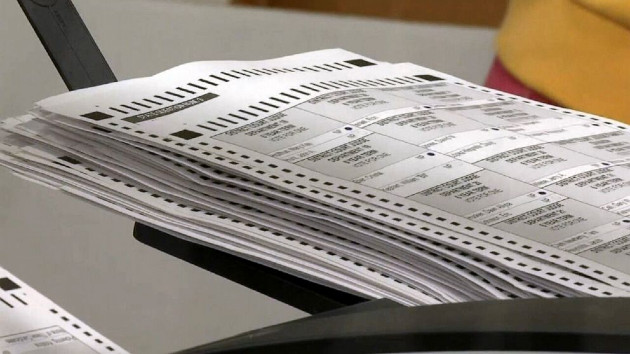
(PHOENIX) — A paper supply crunch is testing the preparedness of U.S. election officials and exposing a key vulnerability in America’s democratic process as midterm voting gets underway.
The 2022 election cycle will use an estimated 30 million pounds of paper, according to industry experts. Soaring demand and a shortage of manufacturers during the pandemic have pinched national stockpiles, leaving little room for error.
“We’re all just collectively crossing our fingers and hoping that the supply chain works just fine,” said Ricky Hatch, county clerk and election administrator for Weber County, Utah.
The biggest concern is editing mistakes or last-minute changes to a local ballot requiring a large-scale reprint.
“That’s when the [shortage] could manifest itself,” Hatch said.
ABC News got an inside look at one of the nation’s largest ballot producers, Runbeck Election Systems in Phoenix, Arizona, which will deliver 50 million midterm ballots across 10 states — consuming more than 5 million pounds of paper, according to the company.
Runbeck CEO Jeff Ellington said Defense Production Authorization was granted with help from the Department of Homeland Security, Cybersecurity and Infrastructure Security Agency, and the Commerce Department has prioritized paper supply for the election.
“If we put an order in for paper and Amazon put an order in for paper, we’re going to take precedence,” Ellington said. “And that has helped just to make sure we would have what we need.”
The global transition to digital and virtual work has led to plunging demand for white paper, forcing many paper mills across North America to shut down or convert to more profitable products, such as cardboard.
“I don’t blame them for converting over, but it’s a very real threat,” Ellington said.
During the pandemic, many surviving paper mills stopped producing new paper and relied on their stockpiles to fulfill orders, experts said. Those have since dwindled. Mill workers and truck drivers have also been in short supply, adding strain on the paper supply chain.
Industry groups say paper production capacities are expected to remain tight potentially into 2023.
In a nationwide alert issued in January, the U.S. Election Assistance Commission warned state election officials of “unprecedented demand” for ballot paper, with “very long order lead times,” and a risk that some “urgent last-minute orders” this year may not be fulfilled.
“We need to make sure that we’re paying extra close attention to proofing of all materials, because if there was a typo or is a typo, your vendor might not be able to fill an emergency order in that way,” said Amy Cohen, executive director of the National Association of State Election Directors.
With early voting underway in at least 34 states, so far there have only been isolated reports of trouble. In Arizona last week, the secretary of state discovered that 6,000 mail-in ballots that had been sent out were printed with major errors, requiring a second print — and more paper.
In January, the paper shortage forced Texas officials to strictly limit printing of voter registration forms. And during Pennsylvania’s May primary, two thirds of mail in ballots in Lancaster County were unreadable by scanner machines because of a printing mistake and had to be processed by hand.
The Election Assistance Commission told ABC News in a statement this month that the paper crunch “should not impact voting in the general election,” so far.
“This is actually a good example of a success story,” said Amber McReynolds, former director of elections in Denver, Colorado. “Largely there has been avoidance of a major crisis because of that coordination and that communication.”
But experts caution, Election Day could still bring surprises, which may be especially consequential at a time when election integrity is already in the spotlight.
Hatch said “a definite risk” is underestimating voter turnout for mail-in and in-person voting when placing a ballot order.
“Trying to gauge turnout is actually quite difficult,” he said.
For states where voters have to file a request to get an absentee ballot, “election officials really don’t know until within 60 days of the election how many people are going to sign up to get that ballot,” McReynolds said.
“The operational predictability is not as good,” she continued.
Election officials really “have to kind of guess really at how many voters might vote that way, and then they have to place orders,” she said.
Although rare, underestimates have happened. During the 2022 Massachusetts primary, a town-wide ballot shortage in Marblehead forced election officials to photocopy ballots, which could not be run through voting machines and had to be counted by hand.
“It’s not realistic to think that the problem is solved. It’s not,” Cohen said. “The ballot printing vendors have already made it clear to us that this is going to be a persistent problem and something that we need to be thinking about for 2024.”
(NEW YORK) — With the midterms just 13 days away, the New York City Police Department is warning that amid a “complex” threat environment, both racially motivated and anti-government extremists could target poll workers, political rallies, political officials and voting sites, according to a Wednesday intelligence bulletin obtained by ABC News.
The bulletin urges that this assessment requires “elevated vigilance as the US midterm elections begin.”
The NYPD is not aware of any credible threats to polling sites in New York City or any candidates.
“However, hostile rhetoric and an abundance of generalized threats from likeminded [extremists] and malicious actors in chat groups, encrypted messaging channels, and other online forums may effectively create echo chambers that circulate and reinforce false narratives and establish a permissive environment for violent action against election-related infrastructure and personnel,” the bulletin states.
In one example of the rhetoric outlined in the document, the NYPD described how a user in an online community asked if there would be “gallows” for Senate Minority Leader Mitch McConnell.
And on Aug. 26, the bulletin states, a user on a pro-Donald Trump message board “encouraged individuals to ‘show up’ in ‘disguise’ at ‘one of these political rallies with a ghost gun and shoot your shot.'”
Two weeks earlier, according to the bulletin, an online user targeted the elections department in Arizona’s Maricopa County, writing in one message: “Fire the building. Execute the traitors trying to leave it.”
The NYPD also said that “recent online calls for violence have led to specific and credible threats, and at least one violent incident, resulting in the arrests and prosecutions of individuals who planned to or did target election officials and political figures.”
Due to a “smaller security footprint,” some local candidates might be easier to target, the bulletin advised, citing the attack this summer against Republican gubernatorial candidate Lee Zeldin.
(WASHINGTON) — Amid a disturbing uptick in gun violence across the country, the political power of gun reform will be put to the test this election cycle.
There have been more than 500 mass shootings in the U.S. so far this year, according to a tracker from the Gun Violence Archive. Two of those shootings — one at a grocery store in Buffalo, New York and the other at an elementary school in Uvalde, Texas — sparked nationwide outrage and debate about gun violence.
In fact, the tragedies prompted a response from Congress for the first time in decades. Lawmakers this summer passed a bipartisan gun safety package to fund the implementation of red flag laws, close the “boyfriend loophole” and enhance background checks for potential gun buyers under the age of 21.
But the legislation didn’t go as far as many gun control advocates wanted, and now some citizens are using the midterm elections as an opportunity to make more progress on the issue at the state level.
Take Oregon, for example, where voters will consider the country’s most comprehensive gun reform measure on the ballot this November.
“Everybody in the nation has been throwing their hands up saying, ‘Enough is enough. What can we do?’ And this is the one state in the country right now where real action can be taken,” said Rev. Mark Knutson, one of the chief petitioners behind Measure 114 and chair of the group Lift Every Voice.
“It’s been called the Oregon model,” Knutson said, adding, “I think it’ll give a lot of courage to state legislatures, if they can see a major victory come out of Oregon.”
The ballot measure, developed by a coalition of faith leaders, gun control advocates and others, would require permits to buy firearms and prohibit ammunition magazines capable of holding more than 10 rounds. It would also require those applying for a firearm permit to pass a criminal background check, attend safety training and pay a fee.
Knutson’s group started preparing for the ballot measure after the shooting at a high school in Parkland, Florida, in 2018. But he said the shootings in Uvalde and Buffalo prompted a “wave” of new volunteers to help gather signatures for the measure to be included on the ballot.
After Uvalde, where 19 children and two teachers were killed, one Oregon resident decided to turn in his AR-15 rifle and a 9mm handgun to local police.
Ben Beers went viral on TikTok for the move — which he said was emotional but also relieving.
“It’s like, why is this weapon, that’s [a] lethal weapon, here — that I’m seeing throughout these horrible tragedies,” Beers told ABC News. “Why is it in my house?”
Beers described the transformation of once being excited to customize an AR-15 after leaving the military to being horrified when that style weaponry was used to kill young children.
“I have personally done what I can as a U.S. citizen, as a former Marine,” he said. “I have a strong opinion on this. We need to do whatever we can do as citizens to change legislations for our future.”
A second state is also considering a ballot measure related to guns, but on the opposite spectrum. Iowa residents this election cycle will consider adding a gun rights amendment to the state constitution, which would further protect gun ownership.
But polling shows the issue of gun reform has dropped somewhat on voters’ list of concerns as the midterms draw closer, with the economy and abortion rights becoming the hot-button topics this cycle. One poll from Quinnipiac University conducted in June found 17% of Americans thought gun violence was the most urgent issue facing the nation, but as of late August that number dropped to 9%.
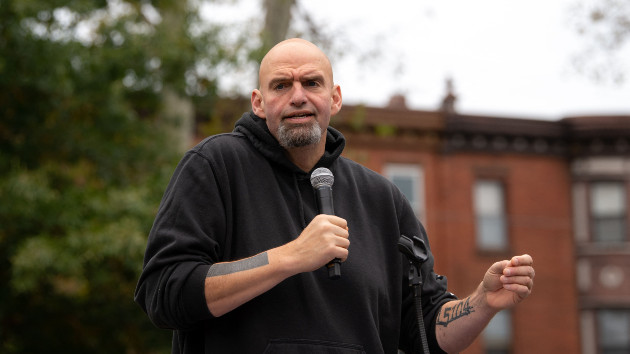
(WASHINGTON) — Republicans and Democrats are sifting through the aftermath of the first and only debate in Pennsylvania’s marquee Senate race to determine if Democrat John Fetterman’s performance — on his biggest stage some five months into his recovery from a stroke — will move the needle against him in an era when candidate faceoffs are becoming a moribund exercise.
A final answer will come soon enough, with Election Day less than two weeks out and more than 600,000 people having already cast early ballots.
But, operatives said, a widely seen development such as a poor debate performance can change race dynamics even in the closing stretch of a campaign: fueling new ads, driving up fundraising, drawing headlines and more.
Fetterman, Pennsylvania’s lieutenant governor, joined Republican Mehmet Oz, a cardiothoracic surgeon and former TV host, on Tuesday night in Harrisburg for the debate, which opened with heightened media attention because of Fetterman’s stroke in May.
Above the moderators hung two monitors to transcribe the questions and Oz’s answers in real time, to aid Fetterman. He has said the stroke affected his speech and ability to process spoken language — symptoms that outside neurologists said do not indicate cognitive issues for stroke survivors.
The two contenders, running in a race that could decide party control of the currently 50-50 upper chamber, fielded questions on policies ranging from fracking to abortion to crime during the hourlong debate.
On stage Fetterman was quick to acknowledge the “elephant in the room” — his stroke, which he said caused him to miss and sometimes “mush” words — and he said that overcoming a health challenge made him like so many other Pennsylvanians.
But while he touted his recovery and his resiliency, his halting, repetitive speech and auditory symptoms seemingly made it difficult for him to articulate his views and proposals, including on inflation, and he stumbled in responding to a follow-up question on fracking, for example.
Party experts split by partisanship on whether or not the public would be swayed, though.
“Never seen a more painful debate,” veteran Pennsylvania GOP strategist Chris Nicholas bluntly said. “It’s hard to imagine an undecided voter here moving toward Fetterman after that performance last night.”
“There’s no doubt that Fetterman struggled with his words at times, but I don’t think that’s what will move undecided voters,” Pennsylvania Democratic strategist Mike Mikus countered. “Undecided voters already had plenty of time to weigh whether he was capable to do the job. It’s going to come down to the issues they care about, and I still think Fetterman wins on November 8.”
The debate over the debate was sparked when Fetterman fumbled while answering several questions, including about his record on crime as mayor of Braddock and his reversal on fracking, a core if environmentally controversial part of Pennsylvania’s economy for which he once backed a moratorium.
“I was able to stop gun violence for five and a half years as mayor — ever accomplished before since my time as mayor because I’m the only person on this stage right now that is — can successful about pushing back against gun violence and being the community more safe,” Fetterman said.
“I do support fracking and I don’t, I don’t — I support fracking, and I stand, and I do support fracking,” he added in another remark that Republicans seized on.
Other comments were more fluid, but Fetterman consistently dropped words or spoke in a choppy cadence — leaving Republicans to pounce and Democrats to spin.
“It was really bad for Fetterman. Worse than I thought,” said Pennsylvania GOP consultant Josh Novotney.
“I watched the debate last night. It was hard to watch, frankly,” Sen. Chris Coons, D-Del., said on CNN Wednesday. “At the end of the day, they’ve got a pretty stark choice between John Fetterman, who looked uncomfortable in a suit and tie, whose answers were at times halting, but who is authentic and will fight for working families in Pennsylvania and who’s got a real and strong record as lieutenant governor and mayor to run on. And they will contrast that with Mehmet Oz, who looked very comfortable in a tailored suit, who’s very good on television.”
In a sign that Republicans smell blood in the water after the debate, Make America Great Again Inc., former President Donald Trump’s super PAC, rolled out a $870,000 ad buy in Pennsylvania highlighting worries around immigration and crime raising questions of Fetterman and President Joe Biden’s fitness for office.
“Biden is stumbling around, and Fetterman just isn’t right,” the narrator says in the ad, which was first reported by Fox News.
Among Democrats, the aftermath sparked questions over whether Fetterman should have even agreed to debate Oz in the first place.
“No,” one Pennsylvania party strategist, granted anonymity to discuss the race frankly, said when asked if Fetterman should have appeared. “No upside.”
“I think you have to put him out there and have him answer some questions,” Pennsylvania Democratic consultant Mustafa Rashed said, referencing concerns over Fetterman’s health after the stroke.
After the debate, his campaign almost immediately and forcefully insisted on their victory.
“For a guy who’s just been in the hospital months ago, he took it to Dr. Oz pretty f—— hard tonight,” Fetterman spokesperson Joe Calvello said Tuesday before later announcing that the campaign had raised more than $2 million in the day after the debate.
And Democrats were able to knock Oz on abortion after he said Tuesday that while the federal government shouldn’t have a role in restricting the procedure, “I want women, doctors, local political leaders, letting the democracy that’s always allowed our nation to thrive to put the best ideas forward so states can decide for themselves.”
Fetterman’s team swiftly cut video of the comment into an ad, which Biden later shared.
“If Dr. Oz gets his way, where does this end? Would he recommend local officials make decisions about cancer treatments? Colonoscopies? Or is this kind of scrutiny reserved just for women?” Biden tweeted.
Later Wednesday, when ABC News’ Cecilia Vega asked press secretary Karine Jean-Pierre if Biden had ever raised health concerns about Fetterman, Jean-Pierre said: “The president, in his personal conversations with the lieutenant governor, finds him to be an authentic, really brave individual.”
Outside disability advocates also described the scrutiny of Fetterman’s performance as ableism, a form of prejudice.
“Equating an auditory processing disorder, or what others might describe as aphasia, with a lack of intelligence or cognition is commonplace and bigotry,” said Luke Visconti, chairman of the National Organization on Disability. “This bullying is a key factor in preventing roughly half of the almost 200,000 Americans under 65 who have a stroke from returning to work.”
How permanently the debate may shift voter attitudes remains unclear.
Such events are becoming a vanishing breed, with candidates in states across the country increasingly opting out of something that can be hard to win but easy to lose, operatives said.
“It’s high risk, low reward. You spend a lot of time preparing for it, the [return on investment] isn’t really there,” Rashed, the Democratic consultant, said. “The high risk is that you make a gaffe and it turns into a social media meme or something else that’s untoward. And … I think candidates are viewing it as there’s just not a lot of upside in doing these things.”
The race between Fetterman and Oz was already tightening, with FiveThirtyEight’s polling average showing Fetterman’s lead dropping from 7 points a month ago to about 2.3 points as of Wednesday.
Democrats who spoke to ABC News disagreed on whether the debate would have an impact, with many saying not enough people would care or some suggesting Oz’s abortion remarks could turn voters off.
“Regular partisans will stay in their corners, as the reactions make clear,” the anonymous Democrat said.
Republicans, meanwhile, were bullish the sliver of undecided voters remaining would find Fetterman unappealing.
“In a close race,” said Keith Naughton, a GOP strategist with extensive experience in Pennsylvania politics, “a disastrous debate performance like John Fetterman had is enough to tip the scales against him and probably will.”
When asked about the debate, voters were torn.
“I’m not sure if Mr. Fetterman’s people should have him in this race. I feel bad for him,” said Tom Lawlor, a lawyer and a Democrat who said he’s still undecided on who to back. “If my decision had to be made today, I think I would lean for Dr. Oz.”
“Okay, he has a little bit of trouble talking. His mind is okay. I mean, if it affected his mind in some way, I could say okay, but he’s still a smart guy. Has nothing to do with his speech,” Richard Ferro, a retiree from Pittsburgh said of Fetterman’s performance.