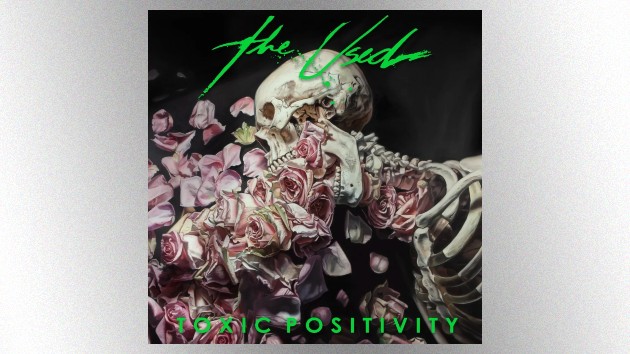
The Used has shared a new song called “Giving Up,” a track off the band’s upcoming album, Toxic Positivity.
In describing “Giving Up,” frontman Bert McCracken recites the William Shakespeare quote, “It is not in the stars to hold our destiny but in ourselves.”
Toxic Positivity arrives Friday, May 19. It also includes the previously released single “Numb.”
The Used will hit the road in support of Toxic Positivity on the Creative Control tour alongside Pierce the Veil, launching May 23 in Austin, Texas. They’re also playing an album release show on May 20 in Los Angeles.
(NEW ORLEANS) — A federal appeals court in New Orleans on Wednesday heard arguments in a high-stakes bid to invalidate FDA approval of the most widely used abortion medication in the country more than two decades after it hit the market and despite its safe use by millions of women.
Three judges on the Fifth Circuit Court of Appeals — one of the most conservative courts in the country — appeared open to limiting access to the medication as they questioned a Biden administration attorney about FDA’s assessment of the drug mifepristone’s safety and effectiveness.
A federal judge in Texas last month concluded the agency’s process was deeply flawed and illegal from the start. That decision remains on hold for the duration of the legal challenge, which is expected to ultimately reach the U.S. Supreme Court, possibly next year. Mifepristone continues to be widely available under longstanding FDA guidelines.
The coalition of anti-abortion doctors and associations, represented by the conservative legal group Alliance Defending Freedom, which brought the case is seeking to remove the drug from use, even in states where abortion is currently legal.
For two hours, the appeals court panel peppered attorneys on both sides with questions on the issue of legal standing: whether the doctor plaintiffs in the case suffer a specific and direct injury from the availability of the abortion pill sufficient to allow them to bring a lawsuit.
The government argued that none of the doctors involved has been directly impacted by FDA’s regulations of Mifepristone and that the entire challenge should be tossed out.
“Seeing and treating patients isn’t an injury,” said Deputy Assistant Attorney General Sarah Harrington. “These are not directly regulated parties.”
The government attempted to discredit the doctors, who have claimed in court filings that their religious conscience rights were violated by having to treat patients who had alleged complications from taking Mifepristone. None of the doctors in the case had raised objections at the time of providing care, and some of the patients they treated could not confirm that mifepristone was involved, according to court records.
An attorney for Danco Laboratories, which manufacturers mifepristone, also hammered the standing argument hard in defending the FDA.
“There must be a specific doctor with a specific injury from the regulation,” the company’s attorney Jessica Ellsworth said. “There’s no link to these doctors.”
Moreover, the drug maker’s attorney noted, Texas and Indiana — home states of the doctors involved in the case — have largely outlawed abortion, including mifepristone, minimizing the prospect that they could suffer any “injury” in the future.
“These declarations offer generalized statements and no acknowledgment of the changed laws,” Ellsworth said.
Attorney Erin Hawley, representing the doctors, forcefully pushed back, insisting that a doctor’s involvement in removing a fetus after a “failed” chemical abortion could compromise conscience rights and that the risk remains real for many providers nationwide.
Judge James C. Ho, a Trump appointee, seemed to agree that conscience rights are recognized as sufficient to establish standing.
But Judge Cory Wilson, also a Trump appointee, voiced some skepticism, asking Hawley why doctors with conscience concerns didn’t object at the time of treating a patient with abortion complications. “What about handing it off to another doctor who doesn’t have an objection?” he said.
Wilson also raised concerns about broader implications. “Does approval of any drug that a doctor has a conscious objection to give standing? Where do you draw the line?” he said.
Hawley countered that, If abortion clinics have standing to challenge state restrictions meant to protect women, then their doctors should have standing as well.
The panel also zeroed in on the FDA’s drug-approval process and whether the agency adequately examined potential risks to women when drafting regulations for the drug in 2000 and revising them in subsequent years.
After initially approving mifepristone, the FDA retooled its guidelines in 2016 — reducing the recommended dose, allowing use of the drug up to 10 weeks of pregnancy (from 7), eliminating in-person doctor visits to receive it, among other measures.
Did the agency conduct any studies before 2016 looking at safety of the changes in total? Judge Wilson asked. The government conceded one had not been done.
Judge Jennifer Walker Elrod, a George W. Bush appointee, wondered whether the FDA had properly considered safety risks of allowing the pill’s prescription via telemedicine. “Did the FDA consider safety of the drug with a mail-order regime?” she asked of the agency’s recent approval of distribution by mail.
The government also argued that the challenge to FDA approval of mifepristone is beyond the statute of limitations — coming more than a decade out of time.
At least one judge, Judge Elrod, suggested she may agree with the time-cap, but that some of the FDA’s subsequent revisions to the regulations might be fair game.
The revisions in 2016 “stripped away every safeguard,” argued Hawley.
“This case isn’t about ending abortion, it’s about challenging a particularly dangerous type of abortion,” she said. (Her claim is not supported by scientific evidence endorsed by the FDA or dozens of health and medical associations.)
The government and drug maker attorneys warned the judges against taking a middle ground approach – upholding approval of mifepristone but invalidating some FDA restrictions of it – saying that would create massive upheaval.
Among other things, they said, manufacturers would effectively have to halt production for “months” to retool their guidance and labeling for the drug. They also said reverting to the old guidelines prior to 2016, for example, would tell women to take a higher dose than has now been deemed necessary.
“It doesn’t make sense,” Danco’s attorney said. “It’s a strange remedy to have women take four times as much.”
None of the panelists appeared entirely persuaded by the government’s argument that a rollback of regulations would be harmful.
The judges, who each have previously voted to uphold restrictions on abortion, voiced frustration with not having thousands of pages of the FDA’s administrative record from decades ago detailing the steps and procedures. The government says it is working to provide those documents.
The panel also bristled at the government and drug maker’s assertion that it would be unprecedented for a court to overrule an FDA determination of drug safety.
“We’re allowed to look at the FDA just like any other agency,” declared Judge Ho.
The appeals court is expected to deliver a decision in the case in the coming months but is not on a fixed timeline. Regardless of the outcome, a Supreme Court order has preserved status quo around mifepristone until such time that it rules on the case.
(NEW YORK) — Police sources are countering a claim by Harry and Meghan, the Duke and Duchess of Sussex, that they were involved in a “near catastrophic car chase” while being pursued by paparazzi in Manhattan on Tuesday night.
A spokesperson for the couple, who were returning from an event along with Meghan’s mother, Doria Ragland, accused paparazzi of being “highly aggressive” and driving on the sidewalk and running red lights during a two-hour “relentless pursuit” of the famous pair. Police sources, however, are saying the whole episode only took about 20 minutes and did not involve the amount of paparazzi the spokesperson claimed.
“While being a public figure comes with a level of interest from the public, it should never come at the cost of anyone’s safety,” the spokesperson said.
Harry and Meghan appeared Tuesday night at the Ziegfeld Ballroom as Meghan received the Ms. Foundation’s Women of Vision Award at the foundation’s annual gala.
The foundation was co-founded by feminist icon and activist Gloria Steinem, a friend of Meghan’s, who presented her with the award.
Police sources described to ABC News a different version of events from the one described by Harry and Meghan’s spokesperson.
Two New York Police Department detectives were present at the Ziegfeld when Harry and Meghan emerged from the event and drove alongside the couple’s private vehicle to get them home. Harry and Meghan were home no more than 20 minutes after their departure from the event, according to police sources.
Along the way, police sources said photographers on bicycles are visible on security cameras but not the kind of caravan described by sources close to Harry and Meghan.
The NYPD said in a statement: “On Wednesday evening, May 16, the NYPD assisted the private security team protecting the Duke and Duchess of Sussex. There were numerous photographers that made their transport challenging. The Duke and Duchess of Sussex arrived at their destination and there were no reported collisions, summonses, injuries, or arrests in regard.”
The NYPD is running down reports that members of the paparazzi had license plates covered on their motorcycles, scooters and cars, and that they were driving on sidewalks and backward on streets.
At one point, Harry and Meghan’s private security detail believed there was a car following them, so they drove toward the 19th Precinct, which is close to where the couple is staying, and pull into a driveway, according to sources.
Private security flagged a yellow cab and Harry, Meghan and a security guard climbed in. The cab circled the block and returned to the precinct, unable to shake the photographers, according to sources.
At no time did Harry and Meghan enter the police precinct, the sources said.
Celebrity news agency Backgrid USA said it received photos and videos from four freelance photographers — three who were in cars and one on a bike — who were covering Harry and Meghan’s stay Tuesday night, and it also refuted claims of a “near catastrophic car chase.”
According to the photographers, “there were no near-collisions or near-crashes during this incident,” Backgrid USA said in a statement. “The photographers have reported feeling that the couple was not in immediate danger at any point.”
Some of the photos “even show Meghan Markle smiling inside a cab,” the statement said.
The photographers claimed that one of the four SUVs in Harry’s security escort “was driving in a manner that could be perceived as reckless,” including blocking off streets, according to Backgrid.
The couple warned in their statement that people should not share photos of the incident.
“Dissemination of these images, given the ways in which they were obtained, encourages a highly intrusive practice that is dangerous to all in involved,” the spokesperson said.
The couple has widely criticized the press and paparazzi and asked for privacy in the past.
Prince Harry’s mother, Princess Diana of Wales, was killed in a car crash in Paris in 1997 while being pursued by paparazzi.
New York City Mayor Eric Adams said it was “a bit reckless and irresponsible” for paparazzi to chase Harry and Meghan and he noted echoes of Princess Diana’s death as he took questions from reporters during an unrelated event.
“I don’t think there are many of us who don’t recall how his mom died,” Adams said. “I thought that was a bit reckless and irresponsible.”
The mayor, however, expressed skepticism the chase lasted two hours.
“I would find it hard to believe there was a two-hour high-speed chase,” the mayor said. “But if it’s 10 minutes, a 10-minute chase is extremely dangerous.”
Duchess of Sussex Meghan Markle and Duke of Sussex Prince Harry attend the ceremony, which benefits the Ms. Foundation for Women and feminist movements, in New York, May 16, 2023.
In his first statement confirming their relationship in 2016, Prince Harry called out the “abuse and harassment” Meghan Markle faced from the press amid speculation that the couple were dating.
In a statement issued by Kensington Palace at the time , Prince Harry said he “has never been comfortable” with the significant curiosity surrounding his private life, rarely taking “formal action” on the “very regular publication of fictional stories that are written about him.”
“Prince Harry is worried about Ms. Markle’s safety and is deeply disappointed that he has not been able to protect her,” the statement read. “It is not right that a few months into a relationship with him that Ms. Markle should be subjected to such a storm.”
The royal couple stepped down from their role as senior members of the royal family in 2018. In a docuseries released since, the couple has said they are prioritizing privacy for their children , with Harry saying the constant harassment from paparazzi and press that he endured throughout his childhood was never fair.
ABC News’ Mark Osborne and Nadine El-Bawab contributed to this report.
(TALLAHASSEE, Fla.) — Florida Gov. Ron DeSantis signed a slate of legislation Wednesday targeting the LGBTQ community, including restrictions on transgender health care, content on LGBTQ identities in schools, transgender bathroom use and drag performances in the state.
The news comes on the International Day against Homophobia, Transphobia, and Biphobia, May 17.
What the new laws say
Florida state bill DB 254 will restrict gender-affirming healthcare for transgender people under the age of 18, allowing the state to take temporary custody over any child who receives such treatment.
“Sex-reassignment prescriptions and procedures are prohibited for patients younger than 18 years of age,” the legislation reads.
Gender-affirming care has been found to be associated with improved mental health of transgender adolescents and teenagers, according to research in the New England Journal of Medicine and JAMA Pediatrics.
House Bill 1069 will expand the Parental Rights in Education law, dubbed the “Don’t Say Gay” law by critics. The new measure will restrict classroom instruction on gender identity or sexual orientation from prekindergarten through grade 8. From grades 9 through 12, such content must be “age-appropriate or developmentally appropriate for students in accordance with state standards.” However, the Florida Board of Education had already voted to expand the restriction from kindergarten through 12th grade.
House Bill 1521 will require transgender people to use the bathrooms that correspond with their gender assigned at birth.
A 2018 study from the Williams Institute at UCLA School of Law found no evidence that laws requiring transgender people to use the bathroom of their gender at birth lead to decreases in safety or privacy violations.
Senate Bill 1438 prohibits minors from attending any “adult live performances,” which may impact drag performances.
The legislation defines “adult live performance” as “any show, exhibition, or other presentation in front of a live audience which … depicts or simulates nudity, sexual conduct, sexual excitement, or specific sexual activities … lewd conduct, or the lewd exposure of prosthetic or imitation genitals or breasts,” as well as other stipulations concerning the interest, conduct and value of the performance.
The debate over LGBTQ rights
Advocates and allies criticized the legislation, arguing that the bills will harm the LGBTQ community which already faces higher rates of discrimination and violence.
Nadine Smith, of Equality Florida, said the legislation uses vague language “to inflict maximum harm.”
“They use the vagueness as a shield so they can, in court, feign innocent and political accountability for the harm — the very real harm that they’re inflicting,” Smith said in a press conference following the legislation. “The harm DeSantis is inflicting on Florida is real and it will outlast his time in office. Florida has become synonymous with book bans, whitewashing history, anti-LGBTQ attacks, radicalized right wing groups often armed, menacing our families.”
DeSantis applauded the legislation, saying that the new restrictions allow “kids to be kids.”
“I feel very strongly as governor but also just as a dad of a six, a five, and a three year old that we need to let our kids just be kids and we have a very crazy age that we live in — there’s a lot of nonsense that gets floated around. And what we’ve said in Florida is, we are going to remain a refuge of sanity and a citadel of normalcy,” DeSantis said.
This new slate of bills is the latest move in DeSantis’ self-proclaimed war against “woke” beliefs, restricting education and content on marginalized identities.
‘Woke’ is defined by the DeSantis administration as “the belief there are systemic injustices in American society and the need to address them,” according to DeSantis’ general counsel, as reported by The Washington Post.
(BOSTON) — The U.S. attorney for Massachusetts leaked information to help her preferred candidate for the Suffolk County, Massachusetts, district attorney, among other “egregious” violations of DOJ policy, two government watchdogs announced Wednesday.
Rachael Rollins, the first African American U.S. Attorney for Massachusetts, announced her resignation Tuesday after being informed of the details that would be included in the Justice Department’s Inspector General report. The investigation began amid reports she may have violated the Hatch Act by attending a political fundraiser with the first lady in July of last year.
She did violate the Hatch Act, the Inspector General found, but that merely scratches the surface of Rollins’ alleged abuse of her position, according to the report. The Office of Special Counsel, which investigates Hatch Act violations called it “one of the most egregious Hatch Act violations that OSC has investigated.”
Prior to being nominated to be U.S. Attorney, Rollins served as District Attorney for Suffolk County, which in Massachusetts is an elected position. She took extraordinary steps to ensure her preferred candidate to replace her would be elected, the IG found.
“Our investigation determined that Rollins, while serving as U.S. Attorney, assisted Ricardo Arroyo with his Democratic primary campaign for Suffolk D.A., providing him campaign advice and direction and coordinating with Arroyo on activities to help his campaign,” the 161-page report says. “The evidence demonstrated that at a critical stage of the primary race, Rollins brought her efforts to advance Arroyo’s candidacy to the [Massachusetts U.S. Attorney’s Office], when she used her position as U.S. Attorney, and information available to her as U.S. Attorney, in an ultimately unsuccessful effort to create the impression publicly, before the primary election, that DOJ was or would be investigating [Arroyo’s opponent, Kevin] Hayden for public corruption.”
The former U.S. attorney tried to give non-public sensitive DOJ information to a Boston Herald reporter to further influence the election, and she talked extensively to a Boston Globe reporter about Arroyo’s opponent and gave “off the record” tips to the reporter, who then wrote three critical stories about the opponent, the IG found.
Rollins not only violated department policy, but also potentially broke the law when misleading investigators about providing false statements to the IG about leaking the information to the Boston Herald reporter. The Inspector General made a referral of Rollins’ misstatements to the department in December, but officials declined to prosecute only three weeks later. She communicated information to reporters using her personal phone — also a violation of DOJ policy, per the report.
Rollins advised Arroyo on a myriad of issues and coordinated in some instances with Arroyo on certain campaign activities, even coordinating some U.S. attorney events to coincide with Arroyo’s campaign events and Rollins, text messages purportedly show. More specifically, the IG found that Rollins tried “unsuccessfully to convince her First Assistant U.S. Attorney to issue a letter that would have created the impression that DOJ was investigating Hayden and, when that effort failed, disclosed non-public, sensitive DOJ information directly to a Herald reporter before the primary election.” She lied when asked about it by investigators, according to the IG.
When Rollins sought the advice of the general counsel for the Executive Office for United States Attorneys on recusal because she recognized the appearance of a potential conflict of interest, she seemingly reluctantly agreed with his recommendation that she recuse herself.
“I don’t like being recused from things, but … if you think I need to be, I understand that,” Rollins said she told the EOUSA general counsel, per the report.
Eventually, the Office of the Deputy Attorney General sent her a recusal memo which she then shared with the Boston Herald reporter as evidence there was a federal investigation into Hayden, the report said. Then, after the article came out on Sept. 11, 2022, Rollins allegedly texted her staff from her personal phone expressing apparent shock about the article, asking the questions, “Wtf!?!” and “When was the office contacted about this? And why wasn’t I called? How are they quoting things?”
“Based upon the facts described above, the OIG concluded that U.S. Attorney Rachael Rollins used her position as U.S. Attorney in an effort to influence the outcome of a partisan political election, namely the September 6, 2022 Democratic primary election that would select her likely successor as Suffolk D.A,” the IG concluded. “Additionally, we determined that days after Hayden prevailed in the September 6 primary election, Rollins sought to damage Hayden’s reputation by leaking to the Herald Reporter non-public and sensitive DOJ information that suggested the possibility of a federal criminal investigation into Hayden, a matter from which Rollins was recused.”
Regarding the political fundraiser, Rollins went without the approval of the deputy attorney general and against the ethics advice she had received, the IG said. Initially, Rollins was supposed to leave the event with first lady Jill Biden once they had a brief meet and greet outside of the event, but that is not what happened, the IG found.
“Rollins went inside the home, mingled with the guests, and stood in the same receiving line as the other fundraiser guests to meet Dr. Biden,” the report says. “Rollins’s interaction with Dr. Biden was identical to those of the other fundraiser guests whose primary purpose for being at the event was to get in line and meet Dr. Biden. She also posed for photos with the event hosts and guests, as well as a U.S. Senator, after meeting Dr. Biden and before leaving the event.”
Other alleged violations included improperly using the office to obtain tickets to a Boston Celtics game for 30 children which she also attended and improperly used office resources for, according to the report. She also made improper statements about the leaked Dobbs vs. Jackson Women’s Health Organization ruling without getting approval from the Justice Department, and she continued to accept campaign contributions while serving as the U.S. Attorney in violation of department policy, the IG said.
Rollins’ resignation will take effect at the end of the week.
(WASHINGTON) — Amid intensifying pressure from House Republicans, the State Department said Wednesday it will allow select members of Congress to review a classified communication sent by American diplomats during the final days of the U.S. occupation of Afghanistan, marking a significant reversal in the Biden administration’s position.
House Foreign Affairs Committee Chairman Mike McCaul, R-Texas, and other Republicans on the panel have been engaged in a monthslong pursuit of the document that sources say was sent in July 2021 and warned Secretary of State Antony Blinken that the government of Afghanistan was at risk of collapse at the hands of the Taliban.
McCaul initially issued several requests for the document, and then a subpoena in March. When the State Department refused to comply, he threatened to hold Blinken in contempt of Congress, going as far as to schedule a hearing on the matter in the coming days.
On Wednesday, State Department Principal Deputy Spokesperson Vedant Patel said the department would send a letter on Monday offering McCaul and the committee’s top Democrat, Rep. Gregory Meeks, D-N.Y., an opportunity to privately review the document, known as a “dissent cable,” and that only identifying information of department personnel involved would be redacted.
“Chairman McCaul himself has said this is what he is interested in,” Patel said.
The State Department repeatedly declined to produce the cable, arguing the dissent channel needed to be protected to preserve its integrity and offering McCaul and other members of the committee a closed door briefing and a summary of the document instead.
Despite the administration’s concession, Patel made it clear that the State Department still saw its previous disclosures as adequately meeting the department’s needs.
“We believe that we have provided sufficient information through our classified briefing, through the written summary, and we believe these efforts already should have and would satisfied their request for information,” he said.
ABC News reached out to the House Foreign Affairs Committee but did not immediately receive a response.
(WASHINGTON) — The Army National Guardsman charged with leaking a trove of military secrets was twice admonished by his superiors last year over “concerning actions” he took with regards to classified information, federal prosecutors said in a court filing on Wednesday.
Jack Teixeira, who is set to appear in court on Friday afternoon where a judge will determine if he should remain detained pending trial, was told by superiors in September and October “to no longer take notes in any form on classified intelligence information and to “cease-and-desist on any deep dives into classified intelligence information,” prosecutors wrote in the filing.
Teixeira has not yet pleaded to his charges.
This is a developing story. Please check back for updates.
(WASHINGTON) — The Kremlin has responded forcefully to the CIA launching an official channel on Telegram, the encrypted messaging app favored by Russians, featuring a dramatized video aimed at recruiting frustrated Russian civilians as spies.
The video invites them to engage with the agency on Telegram and share information it says could be critical to United States intelligence efforts.
The recruitment pitch is geared toward those whose knowledge of industry, science, technology or diplomacy, could be useful to the CIA — communicated by using a secure conduit on the internet.
“Contact us. Perhaps the people around you don’t want to hear the truth. We want to,” says text of the Russian-language video, which shows actors depicting Russians at home and at work, living quietly, as the voiceover of a Russian man contemplates telling truths the video suggests have been suppressed by the state.
“The CIA wants to know the truth about #Russia, and we are looking for reliable people who know and can tell us this truth,” the text of the video says. “Your information may be more valuable than you think.”
The Russian narrator acknowledges the “reality we speak about in a whisper” and laments “why the lives of some are worth more than others.” At the conclusion of the video, he’s decides to speak up: “This is my Russia. This will always be my Russia. I will endure. My family will endure. We will live with dignity because of my actions.”
The Kremlin has accused the U.S. of “attempts to interfere in our internal affairs, and attempts to destabilize the situation in our country.”
Foreign Ministry spokesperson Maria Zakharova warned Tuesday that “such malicious activity, including the distribution of inflammatory materials, will not remain without a proper effective response.”
A CIA official told ABC News the Telegram channel and the accompanying video production could draw Russian nationals to communicate with the U.S. by appealing to their sense of wanting to do the right thing.
“They’re feeling compelled by the Russian government’s unjust war right now to reach us, but we just want them to do so as securely as possible…[The video] is meant to convey more emotion,” the official said on condition of not being named.
The character’s voiceover, however, says clearly in Russian, “I don’t believe in revolution.” The CIA official said the video’s intention is to connect with Russians who are willing to speak but not to ignite political change on the ground.
“Many Russians may be ready to [contact us],” the official said. “They just need direction on how to do it.”
Darrell Blocker, a former CIA deputy director of its counterterrorism unit and ABC News contributor, called the agency’s outreach on Telegram “a stroke of genius.” In intelligence circles, this mode by which citizens can come forward to share what they know with foreign officials is known as a “walk-in” program – essentially an open door.
“Walk-ins are absolutely some of the most lucrative intelligence cases in the history of the agency. It’s one of those quiet success stories that no one on the outside ever really knows about,” Blocker said.
The CIA had already released instructions on social media for contacting the agency via the Dark Web. The Telegram video launch, which comes a year later, represents the agency’s expanding toolkit that includes open-source analysis.
“So, this is just the CIA, the modern CIA, so to speak, using long established and successful programs and in a different way,” Blocker said.
But the war in Ukraine is not specifically referred to in the CIA video. “I think mentioning it specifically in a video coming from CIA could be seen as a provocation,” Blocker said.
The video is a more tactical approach to build intelligence over time. “There’s always an audience for information, whether it’s going to be applicable a week from now or 10 years from now, you just never know.”
The vetting process is intense and continuous, Blocker says, and the CIA’s expertise and process, which the agency couldn’t discuss publicly, serve to root out people who might look to exploit the channel by providing a false identity or information.
The CIA official said the program has already yielded results, receiving contacts from the broad set of people in industries from which it solicited information. It launched the program after Russians expressed interest in coming forward, the official said.
Inside and outside of the country, Blocker said Russians would likely have interest in sharing what they know but are unaware of a secure way to do so. It’s often these ordinary people that initiate major intelligence gathering.
“It’s said in the CIA that CIA officers don’t recruit the Russians, the Russians recruit the CIA officer,” he said.
ABC News’ Tayna Stukalova contributed to this report.
Get your cosmos ready, because Max has revealed its Sex and the City spinoff And Just Like That… will be launching its second season with two episodes on June 22.
The streaming service announced that the sophomore frame of the continuing adventures of Sarah Jessica Parker‘s Carrie Bradshaw and her friends will contain 11 episodes.
After the double-shot on debut day, the remaining nine episodes will drop one at a time on Max each subsequent Thursday.
Joining SJP will be her co-stars and co-executive producers Cynthia Nixon and Kristin Davis;SATC vets Evan Handler, Mario Cantone, David Eigenberg and John Corbett; and returning AJLT leads Sara Ramírez, Sarita Choudhury, Nicole Ari Parker, Karen Pittman, Christopher Jackson, Niall Cunningham, Cathy Ang and Alexa Swinton.
Quinta Brunson used the internet to help build her platform, but with her goals as a storyteller, she knew it was time to give it up.
“I didn’t feel I could tell a cohesive story on the internet. I didn’t feel like I could really target an audience,” she tells Deadline. “I wanted to tell long-form stories, like Abbott, and, as we know, that’s just not what the internet is built for anymore. As a storyteller, I just had to honor the fact that that was not my ministry anymore. The internet was not my preferred platform.”
Quinta particularly appreciates “the access of network comedy,” noting ABC felt like “a very safe place to go” considering people know how to get to the channel and watch it. She says appointment television allows her to build a relationship with the audience, which she finds difficult to do online.
“It’s kind of like when you go to the theater, you’re making a commitment to sit in that seat until intermission and watch that,” she explains. “I’m entering a deal with you as an audience member that you’re going to watch this and respect it. That’s what’s hard on the internet. That relationship isn’t there. I have a deal with the audience members, and I don’t want to make something without that deal anymore.”
Quinta’s relationship with her viewers won Abbott Elementary three Emmys for its first season. She already has season 3 planned out and, beyond that, knows how the show will end when the time comes.
Until then, she’s embracing all the accolades and praise coming her way. “I have no reason to think that I’m not good at what I do, or that I don’t deserve to be in the position that I’m in,” the actress says.