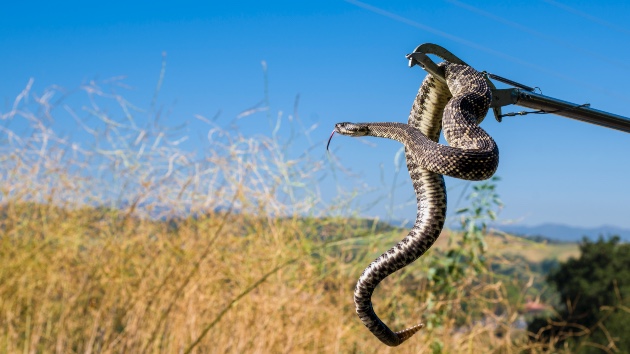
A captured rattlesnake is held with snake tongs by Jason Magee of OC Snake Removal in Mission Viejo on Tuesday, March 24, 2026. (Photo by Leonard Ortiz/MediaNews Group/Orange County Register via Getty Images)
(MENDOCINO, Calif) — A 78-year-old woman has died from snake bites in Northern California, marking the third deadly snake bite victim in the state this year.
The woman was walking in a rural area in Redwood Valley on April 8 when she suffered three venomous snake bites, the Mendocino County Sheriff’s Office said.
She was treated at a hospital but died on April 10, the sheriff’s office said.
While about 7,000 to 8,000 people are bitten by venomous snakes each year in the U.S., only about five of those people die from the bites, according to the Centers for Disease Control and Prevention.
But this already marks the third deadly snake bite in California this year.
A 25-year-old man died after he was bitten by a rattlesnake while mountain biking in Irvine in Southern California in February, according to ABC Los Angeles station KABC. In March, a 46-year-old woman died after she was bitten by a rattlesnake while hiking at Southern California’s Wildwood Regional Park, KABC reported.
Peak rattlesnake season is just getting underway. The California Department of Fish and Wildlife said bites are most common between April and October.
Nick Jonas, A Night With Nick tour (Courtesy Live Nation)
Jonas Brothers have quite a few tour dates booked this summer, but in between, Nick Jonas is stepping out solo for a brief tour on his own.
A Night With Nick will visit six East Coast cities this June and will feature the singer playing songs from his latest album, Sunday Best, as well as other songs from his discography.
On Instagram, Nick wrote, “I’ve been wanting to do a run like this for a while. Something that feels a little closer, playing through different releases from over the years. A few of my favorites, a lot of your favorites and sharing the stories behind them as we go.”
The tour dates include June 4 in Niagara Falls, NY; June 6 in Hanover, Maryland; June 7 in Charlotte, North Carolina; June 10 in Atlanta; June 11 in Danville, Virginia and June 13 in Atlantic City, New Jersey.
A presale starts Thursday at 10 a.m. ET, and tickets go on sale to the general public Friday at 10 a.m. ET.
In addition to the solo tour, Nick has multiple movies in the works, with the first, Power Ballad, set to arrive in theaters June 5.
Meanwhile, Jonas Brothers’ tour in South America starts May 5, followed by a run of shows at Dolby Live at Park MGM in Las Vegas starting May 20. They have a few more dates in August on their calendar following Nick’s solo shows.
Lee Brice’s new album, Sunriser, won’t come out June 5 as planned, he explains in a statement.
“Y’all, I’ve got some good news and some bad news,” he says. “The good news is, even after finishing Sunriser, I just kept writing and now I’ve got a whole lot more songs I can’t wait to share with you. The bad news is, we’re gonna have to push the album release back so we can finish it the right way including a Sunriser (All Nighter) deluxe.”
“New date for both albums is October 2nd,” he continues. “I appreciate y’all being patient with me and we’re not gonna leave you hanging – more new music is coming your way this summer! Can’t wait for y’all to hear all these songs!”
Lee’s next piece of new music, “Truck Bed Mixtape,” will arrive May 1.
The regular edition of Sunriser features 16 tracks, while Sunriser (All Nighter) doubles that number to a mammoth 32 songs.
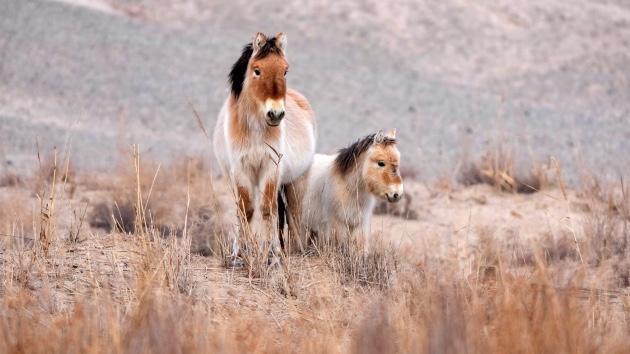
A Przewalski’s horse stands with a foal at the Dunhuang West Lake National Nature Reserve in Dunhuang, northwest China’s Gansu Province, on Feb. 5, 2026. (Lang Bingbing/Xinhua News Agency via Getty Images)
(NEW YORK) — There is evidence that the planet is healing amid massive efforts to mitigate climate change and fight biodiversity loss.
Once-threatened species are rebounding, lawmakers are making policy changes that increase protections against harmful practices and preservation of ecosystems has come to the forefront, according to recent events.
The wins, however, don’t cancel out the realities that the planet continues to be on a tipping point. The world is currently off track to meet the goal outlined in the 2015 Paris Agreement to limit global warming to 1.5 degrees Celsius, according to the United Nations.
The planet has entered an era of “water bankruptcy,” due to irreversible damage to water systems, according to the U.N.’s University Institute for Water, Environment and Health. Deforestation is continuing to occur at a rapid rate, including 16.6 million acres of tropical primary forests lost in 2024 – equivalent to 18 soccer fields per minute, according to the World Wildlife Fund.
Despite the losses, recent environmental wins prove that efforts to protect the planet and its inhabitants are working.
Threatened species are recovering
Most sea turtles are rebounding worldwide as a result of conservation, according to the National Oceanic and Atmospheric Administration.
Green turtles made an especially notable recovery. Once hunted to near-extinction for their eggs – used to make turtle soup – green turtle populations have risen significantly since the 1970s, according to the International Union for Conservation of Nature’s 2025 update to its Red List of Threatened Species. Their status was downgraded from endangered to least concern.
Global conservation efforts included protecting eggs, releasing hatchlings on beaches and reducing capture in fishing nets, according to the IUCN.
Endangered Central California coast coho salmon are returning to Central California’s Russian River after decades of absence – an indicator of river restoration. During the 2024 to 2025 spawning season, more than 30,000 adult coho salmon migrated to the rivers along the Mendocino Coasts – double the record-breaking number of 15,000 seen in the previous season, according to NOAA Fisheries.
A group of wild horses known as Przewalski’s horses has returned to Central Asia after being driven to near-extinction in the 1960s.
In 2024, several zoos took part in the first stages of the reintroduction of the horses to their native Kazakhstan.
Subsequent efforts brought the Przewalski’s horses to neighboring Mongolia.
Przewalski’s horses are known as the last surviving lineage of true wild horses. Their populations declined as a result of habitat loss, overhunting and hybridization with domestic horses, according to the WWF’s Natural Habitat Adventures.
Countries taking action to protect natural resources
In the U.S., the federal government under the Trump administration has taken several actions that could potentially harm the environment, including granting fossil fuel operations in the Gulf exemption from Endangered Species Act protections; the Senate voted to overturn Biden-era Arctic protections; and the U.S. Department of the Interior reached a nearly $1 billion deal with French energy company, TotalEnergies, to end the company’s offshore wind development.
But other countries are making strides in protecting vast amounts of land and water.
Earlier this year, the High Seas Biodiversity Treaty – aimed to protect 60% of the global ocean that is beyond national jurisdiction – entered into force globally.
Adopted under the United Nations Convention on the Law of the Sea (UNCLOS), the treaty opened for signature in September 2023 and could safeguard marine ecosystems beyond national borders.
In July 2026, Ethiopia launched a national campaign to plant 700 million trees a day, aiming to plant 50 billion trees by the end of 2026.
The I-25 Greenland wildlife overpass near Larkspur in Colorado opened in December 2025. The overpass is the largest in the U.S. and will allow elk, pronghorn, mule deer, black bears, mountain lions and a variety of other species to cross, according to the Colorado Department of Transportation.
Italy will ban the killing of male chicks starting in 2027, ending the deaths of 34 million birds every year. Male chicks are often killed because they cannot produce eggs.
Poland, once the largest fur-producing country in Europe with mink, fox, chinchilla and raccoon dog farms housing around 3.4 million animals, has banned fur farming. The European Union is considering a union-wide ban on fur production.
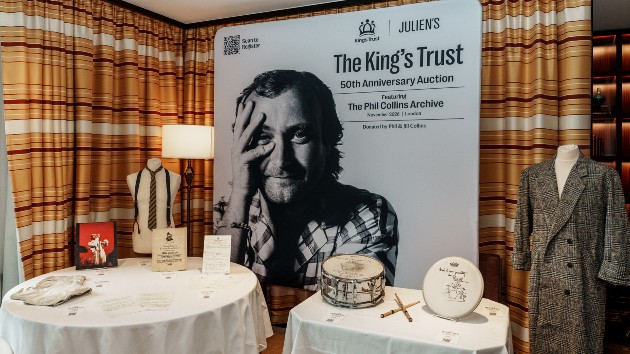
‘The King’s Trust 50thAnniversary Auction Featuring The Phil Collins Archive’ press preview (Courtesy Soul Capture Studio)
Want to own some memorabilia from a newly-minted Rock & Roll Hall of Famer? You’ll get the chance when Phil Collins auctions off his personal archive this November in London for a good cause.
The archive has been donated by Phil and his ex-wife Jill Tavelman; the two share daughter Lily Collins of Emily In Paris fame. Proceeds will go to The King’s Trust, a charity founded by King Charles III in 1976. Phil has been a supporter for years, back when it was known as The Prince’s Trust.
Among the items on offer at The King’s Trust 50thAnniversary Auction Featuring The Phil Collins Archive are: the outfit Phil wore onstage during Live Aid in 1985, when he became the only artist to perform at both the London and Philadelphia shows on the same day; the handwritten working lyrics for the Genesis hit “That’s All;” the pinstripe suit he wore on Miami Vice in 1985; clothing worn during photo shoots, music videos and onstage; autographed drums and more more.
In a statement, Phil says, “I’m very proud to have been involved closely with The King’s Trust for over 40 years and I hope we can raise a lot of money for the cause.”
Jill adds, “Phil and I realized we had a treasure trove of items spanning the years 1980 to 1995, and that this would be the ideal opportunity to share them with fans who will become the caretakers of Phil’s memorabilia while helping support such a worthwhile cause.”
Rock & Roll Hall of Famer Peter Frampton was born in Beckenham, Kent, England.
Frampton rose to fame as a member of The Herd, before forming Humble Pie in 1969 with Small Faces band member Steve Marriott.
After releasing four studio albums, Frampton left Humble Pie in 1971 to launch a solo career, releasing his debut solo album, Wind of Change, in 1972.
Frampton’s solo career really took off following the release of Frampton Comes Alive! in 1976. The double LP became one of the bestselling live albums of all time and was Frampton’s only #1 record, spending 10 nonconsecutive weeks in the top spot. It featured live performances of now-iconic Frampton tunes like “Show Me the Way,” “Baby, I Love Your Way” and “Do You Feel Like We Do,” which all became top-15 hits.
After being eligible for over 25 years, Frampton was inducted into the Rock & Roll Hall of Fame in 2024.
Despite being diagnosed with the muscle disease inclusion body myositis in 2019, Frampton has continued to make music and tour. He’s set to release the new album, Carry the Light, on May 15 and has a new documentary, Frampton, debuting at the Tribeca Festival on June 4.
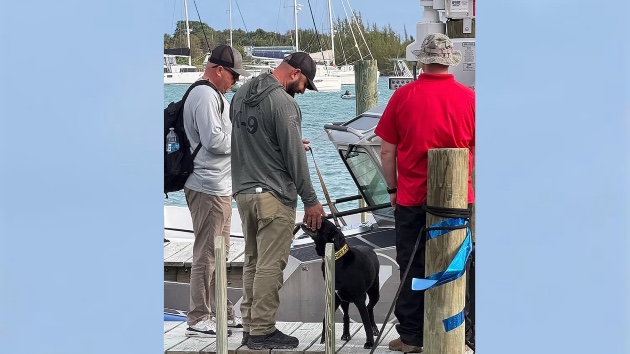
Cadaver dogs in the Bahamas to help search for missing American Lynette Hooker, April 16, 2026. (ABC News)
(NEW YORK) — Nearly three weeks after American Lynette Hooker went overboard and disappeared in the Bahamas, an attorney for her husband Brian Hooker is asking the public “to give him the benefit of the doubt.”
Michigan-based attorney Crystal Marie Hauser told ABC News that Brian Hooker never would have harmed his wife of 25 years.
Lynette Hooker has been missing since April 4. That evening, after the couple departed Hope Town for their yacht, Soulmate, in Elbow Cay, bad weather caused Lynette Hooker to fall off their dinghy and go overboard, Brian Hooker told authorities.
Brian Hooker was arrested on April 8 and questioned by police. He was released on April 13 without charges.
On April 14, Brian Hooker told ABC News that he was staying in the Bahamas with a “sole focus” of finding his wife, “no matter how likely or unlikely that is.”
“My only focus is to go back to the boat and then hire or beg people to help me go find some areas to search,” he said.
But hours after that interview, Brian Hooker left the Bahamas, with his Bahamian attorney saying he wanted to be with his terminally ill mother.
Asked if Brian Hooker plans to return to the Bahamas to help with the search, Hauser said, “I imagine that is where his heart is, but I can’t speak on whether or not that’s what he would be doing.”
Karli Aylesworth, Lynette Hooker’s daughter and Brian Hooker’s stepdaughter, has traveled to the Bahamas and told ABC News she doubted Brian Hooker’s story.
“I don’t understand how she drowned or got floated away,” Aylesworth said. “It just made me be more, ‘Why didn’t he do this? Why didn’t you do that? Why did that happen?'”
Lynette Hooker’s mother, Darlene Hamlett, told ABC News the couple had a volatile relationship.
“We all handle things in different ways,” Hauser said. “Be open-minded to the fact that just because Karli and Darlene are making these claims, there’s absolutely no evidence to support any of the allegations — absolutely none.”
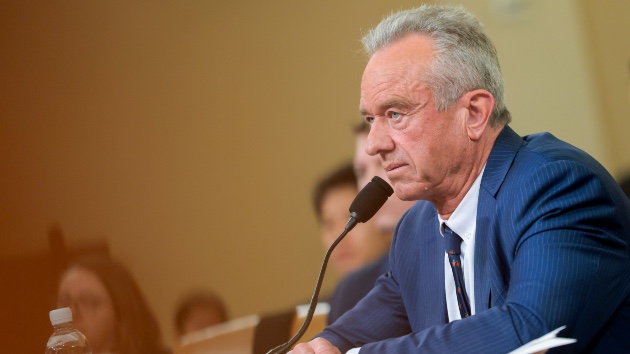
U.S. Health and Human Services Secretary Robert F. Kennedy Jr. testifies during a hearing of the House Committee on Ways and Means on Capitol Hill on April 16, 2026 in Washington, DC. (Photo by Heather Diehl/Getty Images)
(WASHINGTON) — Health and Human Services Secretary Robert F. Kennedy Jr. was pressed on cuts to the National Institutes of Health (NIH), vaccine messaging and the firing of the former director of the Centers for Disease Control and Prevention (CDC) during a hearing on Tuesday.
The hearing before the House Committee on Energy and Commerce Subcommittee on Health marked the final session of four budget hearings before House lawmakers.
Research cuts
Rep. Lizzie Fletcher, D-Tex., said she was concerned about the loss of federal aid for health research in the Trump administration’s budget request for fiscal year 2027.
“Secretary Kennedy, do you understand that cutting federally funded research as this budget does, will cede U.S. leadership on biomedical research to China and create national security and global competitiveness challenges for the United States?” Fletcher asked Kennedy.
Kennedy acknowledged that he shared Fletcher’s concerns, as the biggest proposed cuts are to NIH and Administration for a Healthy America (AHA) programs.
“I don’t want to cut NIH programs, [Office of Management and Budget Director] Russ Vought doesn’t want to cut NIH programs, but we have a $35 trillion debt,” Kennedy said.
“We have been asked to cut across the board at HHS, 12% of our $100 million budget and so we’re making cuts that are painful,” he told Fletcher.
Vaccine messaging
Rep. Marc Veasey, D-Tex., described Kennedy as the most “anti-vax” figure in his lifetime. He suggested that Kennedy’s history of rhetoric denouncing vaccines is correlated with an uptick in measles cases.
Two unvaccinated school-aged children died last year from measles — the first U.S. deaths from measles in a decade.
Kennedy has long sown doubt in the safety and effectiveness of the measles, mumps, rubella (MMR) vaccine. Despite being a required vaccine in all states to attend public school, rates have been steadily decreasing over the last decade, CDC data shows.
It comes as vaccine exemptions have risen sharply, with at least 138,000 kindergarteners exempt from one or more vaccines during the most recent school year, CDC data shows.
However, in recent weeks, some reports have suggested Kennedy is staying away from vaccine-skeptic rhetoric ahead of the midterm elections.
Veasey and others pressed Kennedy on whether the alleged messaging strategy was directed by the White House. Kennedy denied that it was.
“Is Susie Wiles or anyone in the White House instructing you or suggesting that you stop talking about your controversial vaccine skepticism?” Veasey asked.
“No,” Kennedy replied.
CDC leadership
Kennedy defended firing former CDC director Susan Monarez in a lengthy exchange with Rep. Raul Ruiz, D-Calif.
Ruiz criticized Kennedy for ousting Monarez because she allegedly “refused” to approve what Ruiz called the dismantling of the childhood vaccination schedule.
Kennedy aggressively pushed back on the congressman’s characterization.
“That’s not true,” Kennedy said. “What she testified to wasn’t true.”
Kennedy and Monarez both appeared in front of Senate committees last year to address the ousting.
At a Senate hearing in September 2025, Monarez said she was fired by Trump and Kennedy for “holding the line on scientific integrity.”
Kennedy, in a hearing before a different Senate panel earlier that month, disputed Monarez’s version of events. He denied telling Monarez to accept vaccine recommendations without scientific evidence, and claimed she was fired in part because she told him she was untrustworthy.
During Monday’s hearing, Kennedy claimed that his reasoning for the firing had nothing to do with vaccines and that his department is committing $1 billion to vaccine research through the National Institutes of Health and the National Cancer Institute.
Ruiz claimed Kennedy’s vaccine-skeptic views run contrary to the view of President Donald Trump’s new CDC director nominee, Dr. Erica Schwartz.
During her time with the Coast Guard, Schwartz instituted a disease surveillance program and vaccination programs and wrote the first health protection policies for the force, including anthrax and smallpox vaccination policies.
Kennedy said he vetted Schwartz’s position on vaccines before she was nominated by Trump to lead the CDC. However, Kennedy said he did not speak “to the president directly” before Trump made the nomination.
Kennedy rejected the claim that his and Schwartz’s views were not aligned, but would not commit to following all recommendations of the new CDC director nominee.
“Mr. Secretary, if Dr. Schwartz is confirmed, will you commit on the record today to implement whatever vaccine guidance she issues without interference?” Ruiz asked.
“I’m not going to make that kind of commitment,” Kennedy replied.
Kennedy later repeated, as he has in his previous budget hearings, that he had a “good reason” for firing Monarez.
“I fired Susan Monarez because I asked her an outright question, ‘Are you trustworthy?’ and she said, ‘No,’ and I said, ‘Can I trust you?’ and she said, ‘No,'” Kennedy said. “That’s why she got fired, not because of her vaccine issues.”
ABC News’ Mary Kekatos contributed to this report.
Shania Twain will host the upcoming Academy of Country Music Awards, as the show returns to MGM Grand Garden Arena in Las Vegas on Sunday, May 17.
“I’m thrilled to be hosting the 61st ACM Awards in Las Vegas, a place that feels like home,” Shania says. “It’s such an honor to be part of this incredible night celebrating country music’s biggest stars, especially with so many talented women leading nominations this year. I can’t wait to welcome all of the fans and artists out for this unforgettable night.”
The Canadian pop/country superstar took home the coveted entertainer of the year trophy at the 35th ACMs, later picking up the ACM poet’s award for her songwriting, as well.
Cody Johnson, Kacey Musgraves, Lainey Wilson, Little Big Town, Miranda Lambert and Riley Green are already set to perform on the show, which will stream live on Prime Video.
Look for more performers to be added in the days to come.
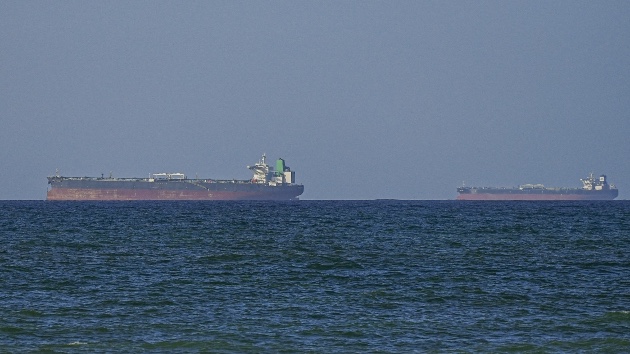
A view of the vessels heading towards the Strait of Hormuz following the two-week temporary ceasefire reached between the United States and Iran on the condition that the strait be reopened, seen in Oman on April 08, 2026. (Photo by Shady Alassar/Anadolu via Getty Images)
(LONDON) — As the world awaits a resolution on the fate of the Strait of Hormuz — one of the most vital global trade routes — the seafarers who have been stranded for weeks aboard ships and tankers on either side of the waterway are desperate for answers.
Nearly 20,000 people on some 2,000 vessels are currently trapped in the Persian Gulf, waiting for a passage that may not come anytime soon, according to the International Maritime Organization.
“It’s been almost 50 days since the war started, and uncertainty is our biggest fear,” one seafarer told ABC News, speaking anonymously for their safety. “Not knowing if we are going to get out of this situation alive is our main concern — because it doesn’t matter where you are in the Gulf, there is no safe place here.”
The seafarer said they have been waiting to cross since Feb. 28, the day the U.S.-Israeli war on Iran started and the moment vessel owners effectively halted traffic through the strait. Insurance companies stopped covering ships in the region almost immediately, bringing maritime traffic to a standstill on a waterway that normally carries as much as 20% of the world’s crude oil and refined petroleum products.
“There are several different dangers here,” the seafarer explained. “This is a very narrow, enclosed strait. There are reports of sea mines — we don’t know if they’re real or not, but it doesn’t really matter. Once the idea takes hold that mines might be there, no ship wants to pass. That’s the first issue. The second is that in such a confined space, we’re talking about the possibility of drones, unmanned vehicles, ballistic missiles — there are so many ways we could be attacked that I don’t think the U.S. military or any other military can realistically protect us.”
The fallout on global markets has been severe. The longer the strait remains closed, the deeper the energy crisis will cut, particularly across Asia, which depends heavily on Gulf oil exports.
High-stakes negotiations between Iran and the United States continue, with both sides debating the waterway’s reopening, but the only fact that matters to those waiting is that the Strait of Hormuz is still closed, and the threat of attack is likely to keep it that way.
“I’ve seen missiles passing over our heads,” the seafarer said. “I’ve seen drones and planes fly by every day, and we never know their intentions. I’ve watched vessels get hit with my own eyes.”
The seafarer’s experience has been echoed by others in the shipping industry.
“I gave my notice exactly one month ago,” another seafarer recently told The Guardian. “I’ve informed the master, I’m not willing to sail through the strait. It’s about safety, it’s all about safety.”
“I think a vessel owner or operator is going to feel extremely vulnerable considering the disconnect between diplomatic communication and military actions,” Joshua Hutchinson, chief commercial officer at maritime risk agency Ambrey, told ABC News.
He said the industry expects the strait to remain under the control of Iranian authorities while the United States intensifies operations against Iranian vessels. “This will put continued strains on new ceasefire and peace talks,” Hutchinson said.
Hutchinson said the industry needs “clear communication” in order for vessels to safely leave the Persian Gulf and clear the backlog. He forecasts it could take three weeks for all vessels to clear the strait.
The seafarer who spoke to ABC News described a grim scene currently of ships drifting with little direction, and listening on the ship-to-ship communication systems called the VHF line — accounts of crews growing desperate for basic provisions, and some begging to go home.
“There are vessels in this area right now rationing food and water. Crews aren’t getting paid properly, and crew changes are still extremely difficult to arrange,” the seafarer said. “You can hear other crew members talking about their situations — people saying they haven’t been paid, that food is running out. The worst part, for me, is hearing someone say they have no water.”
Since the conflict began, the International Transport Workers’ Federation (ITF) said it has received roughly 1,900 inquiries from seafarers across hundreds of vessels. About 20% were requests for repatriation; others raised concerns about dwindling supplies of fuel, food, and water.
“Civilian seafarers have already lost their lives, and tens of thousands more trapped near the Strait of Hormuz are spending every waking moment consumed by anxiety about how — or whether — they will make it home,” ITF Maritime Operations Coordinator John Canias said. “While many watching from afar see this through the lens of an energy or economic crisis, make no mistake: this is also a humanitarian crisis. Seafarers transport 90% of everything we rely on in our daily lives — food, medicine, fuel. They deserve far better than this.”
So far, the ITF says it has helped repatriate 450 seafarers from the region. For the thousands still waiting, relief has not come.
“We feel trapped — like we’re in a prison,” the seafarer who spoke to ABC News said. “The only way out is through the Strait of Hormuz, and right now, that’s not possible.”