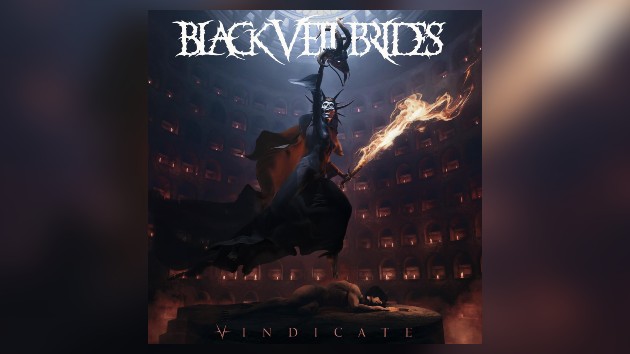
Black Veil Brides have premiered a new song called “Cut,” a track off the band’s upcoming album, VINDICATE.
“Cut” features Lilith Czar, who’s married to BVB frontman Andy Biersack. Both are featured in the song’s accompanying video, which is described as a “live-action retelling” of the movie Corpse Bride.
“‘Cut’ is a song that for me, is one of those songs in your catalog that feels like you were able to achieve exactly what you wanted to achieve when making it,” Biersack says in a statement. “I feel like Lillith’s voice and presence on this song is absolutely perfect.”
He continues, “On the lyrical side, just knowing how much the concepts resonate with both me and Lilith makes it all the more special and then to get to shoot this incredible video together it just feels like a career highlight all around. It’s one of my favorite songs we’ve ever done.”
VINDICATE, the seventh Black Veil album and the follow-up to 2021’s The Phantom Tomorrow, drops Friday. It also includes the previously released songs “Certainty,” “Bleeders,” “Hallelujah,” “Revenger” and the title track.
Ed, James and Henry in ‘Minions & Monsters.’ (Illumination, Universal Pictures)
The final trailer for Minions & Monsters has arrived.
Universal Pictures and Illumination have released a new trailer for the upcoming animated family film set in the Despicable Me universe.
This new film follows “the rambunctious, ridiculous and totally true story of how the Minions conquered Hollywood, became movie stars, lost everything, unleashed monsters onto the world and then banded together to try and save the planet from the mayhem they had just created,” according to an official description.
The trailer starts with the minions arriving in Hollywood. A classic movie trailer voice narrates through voice-over.
“In Hollywood, the new stars of the silver screen changed the face of the motion picture industry forever. The Minions are back with a touch of mystery,” the voice says.
The film’s voice cast includes Allison Janney, Christoph Waltz, Jeff Bridges, Jesse Eisenberg, Zoey Deutch, Trey Parker, Bobby Moynihan and Phil LaMarr.
Pierre Coffin, a director on the first three Despicable Me movies, as well as the first Minions film, helmed Minions & Monsters. Additionally, he provides the voice to all of the Minions, as he has done since their film debut back in 2010.
Minions and The Secret Life of Pets writer Brian Lynch penned the script and also serves as an executive producer on the project.
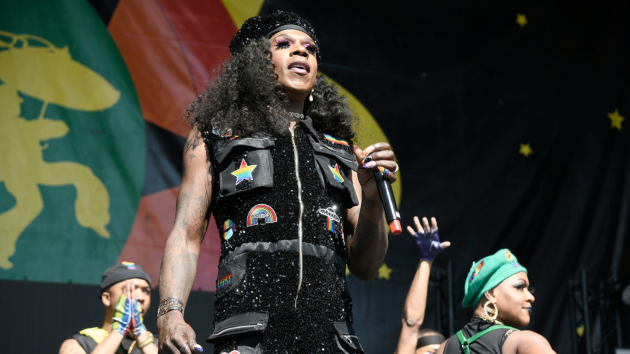
Big Freedia performs during the 55th Annual New Orleans Jazz & Heritage Festival at Fair Grounds Race Course on May 02, 2026, in New Orleans, Louisiana. (Photo by Tim Mosenfelder/WireImage)
Big Freedia has announced an EP with the late British producer, DJ, songwriter and trans rights activist SOPHIE. The untitled project will feature three songs created at SOPHIE’s home studio in LA, with Freedia writing the lyrics and SOPHIE handling production. The tracks were largely completed in one single afternoon back in 2016 and will be released to the world on June 19.
“Recording with SOPHIE is something I hold even closer to my heart now, especially after her passing,” Freedia said in a statement about the British star, who passed in January 2021 following an accidental fall in Athens. “She was an artist who showed the world that living boldly is your greatest power. With this EP, I want to show the world how loved she was and still is!”
The lead single, “Blaze That A**,” is set for release on May 22.
Big Freedia will then hit the road for her Big Freedom tour, which kicks off June 4 in Dallas and wraps on July 18 in St. Louis, Missouri. One dollar from every ticket sold will be donated to the Center for Working Families Fund.
Harry Styles, ‘Dance No More’ video still (Columbia Records)
Harry Styles leads a massive dance party in the new video for his song “Dance No More.”
The clip starts with Harry, who’s wearing red satin gym shorts, a shirt, tie, hoodie, blazer and sneakers, walking into a large empty space and starting to sing with his band in front of rows of empty chairs. Soon, a bunch of spectators appear and watch the performance.
Harry then starts thrusting, bumping, grinding and shaking his butt while shedding layers of clothing. The spectators start to mimic his movements, until they’re all magnetically pulled toward him, sliding and crawling on the floor just to get to him. From then on, everyone dances as one, with Harry, who eventually strips down to a tank top, seemingly controlling everyone’s movements.
And fun facts about the lyrics: When Harry sings “Keep your customer satisfied and live your life,” he’s quoting the 1970 song “Keep the Customer Satisfied” by Simon & Garfunkel. That song was the B-side to the duo’s classic tune “Bridge Over Troubled Water,” which inspired another track on Harry’s album, “Carla’s Song.”
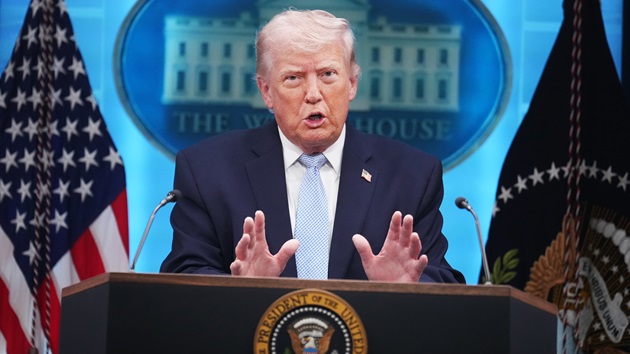
President Donald Trump conducts a news conference in the White House briefing room about the war in Iran on Monday, April 6, 2026. (Tom Williams/CQ-Roll Call, Inc via Getty Images)
(LONDON) — With the war in Iran still unresolved and an energy crisis linked to it battering the global economy, here’s a timeline of the key phases of the conflict, from the start of “Operation Epic Fury” to “Project Freedom,” intended to reopen the critical Strait of Hormuz.
Phase 1: Trump announces the start of combat operations in Iran
In a late-night video statement released to the nation on Feb. 28, just hours after U.S. and Israeli forces launched attacks on Iran, President Donald Trump announced that major combat operations were underway.
“Our objective is to defend the American people by eliminating imminent threats from the Iranian regime, a vicious group of very hard, terrible people,” Trump said.
He said that chief among the goals of the joint U.S.-Israel operations was to eliminate once and for all Iran’s ambitions to obtain a nuclear weapon.
“They’ve rejected every opportunity to renounce their nuclear ambitions, and we can’t take it anymore,” said Trump, adding that after the U.S. “obliterated” Iran’s nuclear facilities in June 2025, the regime began rebuilding its nuclear program and developing long-range missiles.
In his first press briefing four days after the start of combat operations, Secretary of Defense Pete Hegseth said, “I stand before you today with one unmistakable message about Operation Epic Fury: America is winning decisively, devastatingly and without mercy.”
U.S. military officials said top government and military leaders of the Iranian regime were killed in the opening salvos of the conflict, including Supreme Leader Ayatollah Ali Khamenei and the commander-in-chief of the Islamic Revolutionary Guard Corps (IRGC).
Hegseth said the hundreds of military targets were hit in the first hours of the operation, knocking out the IRGC’s ability to effectively communicate.
Iran retaliated by firing missiles at seven Gulf states, hitting civilian infrastructure and airports in the United Arab Emirates, residential areas in Qatar and an apartment building in Bahrain.
During the briefing, Joint Chiefs of Staff Chairman Gen. Dan Caine released the names of six U.S. service members killed in an Iranian drone strike on Port Shuaiba, Kuwait.
Phase 2: Strait of Hormuz becomes focal point of the war
As the fighting progressed, Mojtaba Khamenei, the son of Ayatollah Ali Khamenei, was named the country’s new supreme leader on March 8, despite reports that he was badly injured in the attack that killed his father.
In his purported first written statement, Mojtaba Khamenei directed the IRGC to continue to limit traffic through the Strait of Hormuz, the maritime channel linking the Persian Gulf with the Gulf of Oman, through which 20% of the world’s oil and liquefied natural gas passed in 2024.
Tensions immediately escalated in the Strait of Hormuz following Mojtaba Khamenei’s directive to the IRGC. The Iranian military claimed on March 12 that it struck an oil tanker in the Persian Gulf, one of three commercial ships attacked that day near the Strait of Hormuz.
The attacks came just days after President Trump posted a message on his social media platform, saying if Iran attempted to stop the flow of oil in the strait, “They will be hit by the United States of America TWENTY TIMES HARDER than they have been hit thus far.”
On March 21, Trump gave Iran an ultimatum to reopen the Strait of Hormuz to all commercial vessels in 48 hours. The president posted on his social media platform that if Iran didn’t comply, “The United States will hit and obliterate their various POWER PLANTS, STARTING WITH THE BIGGEST ONE FIRST.”
The following day, Iran’s Ministry of Foreign Affairs sent a letter to the U.N. International Maritime Organization, saying the strait was open to “non-hostile” vessels.
Iranian Foreign Minister Abbas Araghchi said on state TV on March 25 that “Iran’s power is the Hormuz Strait.”
Phase 3: US Naval blockade and ceasefire
Trump announced on March 23 that the U.S. and Iran were discussing an end to the war, giving the first indication of diplomatic talks since the start of the war. He gave Iran a five-day extension to reopen the strait, citing progress in ongoing peace negotiations.
The next day, the Trump administration offered Iran, through intermediaries in Pakistan, a 15-point plan to end the war.
Israeli Defense Forces announced on March 26 that Alireza Tangsiri, commander of the IRGC’s navy, was “eliminated” in a strike. The IDF also claimed the strike killed the head of Iran’s naval intelligence, Behnam Rezaei.
On March 26, Trump announced that he was pausing the attack on Iran’s energy plants for 10 days until April 6 at 8 p.m. ET., saying in a social media post, “Talks are ongoing and, despite erroneous statements to the contrary by the Fake News Media, and others, they are going very well.”
Trump extended Iran’s deadline again on April 5, giving Iran until April 7 to make a deal. Iran responded to Trump’s 15-point peace plan with a 10-point proposal for ending the war, but the strait remained on lockdown.
Just hours ahead of the April 7 deadline, Trump again took to social media, writing, “A whole civilization will die tonight, never to be brought back again. I don’t want that to happen, but it probably will.”
That same day, Iran and the United States announced they had agreed to a two-week ceasefire that would include reopening the Strait of Hormuz.
But on April 8, Israel launched a heavy bombing attack against Hezbollah in Lebanon, prompting Iran to complain that Israel broke the ceasefire agreement and closed the strait again.
Vice President JD Vance then traveled to Islamabad, Pakistan, for peace talks with Iran, brokered by Pakistan. Trump’s special envoy to the Middle East, Steve Witkoff, and Trump’s son-in-law, Jared Kushner, also participated in the talks, but Vance announced on April 11 that no agreement had been reached.
With the strait still closed, President Trump on April 13 announced a U.S. naval blockade of Iranian ports along the strait. “We can’t let a country blackmail or extort the world, because that’s what they’re doing,” Trump said.
Trump said on April 21 that the ceasefire was being extended indefinitely at the request of Pakistan, but that the naval blockade would stay in place.
Phase 4: ‘Project Freedom’
As the war dragged into May, Trump announced that the U.S. Central Command was launching “Project Freedom,” in which U.S. military ships would escort commercial vessels through the Strait of Hormuz.
But the launch of Project Freedom on May 3 caused an escalation of tensions in the strait.
On May 4, Adm. Brad Cooper, head of the U.S. Central Command, said the IRGC had launched missiles, drones, and small boats toward ships the U.S. was protecting in the Strait of Hormuz. Cooper said the U.S. “defeated each and every one of those threats,” and that U.S. AH-64 Apache attack helicopters and others were used to “eliminate” the Iranian attack boats.
On May 5, Trump announced a temporary pause in Project Freedom at the request of Pakistan.
In a statement on social media on May 6, Pakistan Prime Minister Shehbaz Sharif said the pause “will go a long way towards advancing regional peace, stability and reconciliation during this sensitive period.”
Trump said that while Project Freedom is paused, the U.S. naval blockade is still in effect.
Kenny Chesney was looking for a very specific kind of song to put out as his first new music in two years.
Then he realized he’d had it all along, though he was saving it for his “next songwriter-driven island project.”
“Once I realized what ‘Carry On’ could be, the song fell into place,” he explains. “Some songs are just fun to cut. As much as I loved what it was, when we started tracking, I realized this was the song I’d been looking for, the one that captures everything about how I try to live my life – and the way I think all the people who love these songs live their lives, too.”
“Carry On” drops Friday and is the first release on Kenny’s new HEY NOW Records partnership.
Papa Roach has premiered a new song called “See U in Hell.”
The track features Indian rapper Hanumankind, and was recorded for the upcoming second season of the Netflix animated show Devil May Cry, which is based on the video game series of the same name.
You can watch the “See U in Hell” video, featuring Devil May Cry footage, on YouTube.
Devil May Cry season 2 premieres May 12. Its soundtrack also includes songs by Evanescence, Korn, Drowning Pool and Avril Lavigne.
A trailer for the first season of Devil May Cry was soundtracked by Papa Roach’s “Last Resort.” Season 1 also featured the Evanescence song “Afterlife,” which hit #1 on the Billboard Mainstream Rock Airplay chart.
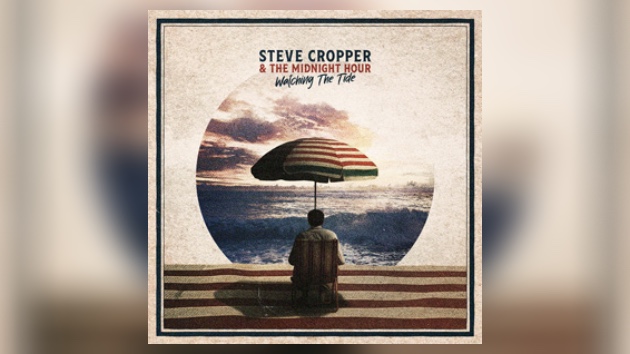
Steve Cropper’s ‘Watching the Tide’ (Provogue/Artone Label Group)
Steve Cropper passed away in December, but fans will be getting new music from the late Booker T. and the M.G.’s guitarist this summer.
Watching the Tide, the album Cropper and his band The Midnight Hour were working on prior to his death, will be posthumously released on Aug. 28. It will feature guest appearances by Eric Clapton, Queen’s Brian May, ZZ Top’s Billy F Gibbons and The Rolling Stones’ Ronnie Wood.
“Making music was Steve’s greatest joy,” says songwriter/producer Jon Tiven, a close friend of Cropper’s. He adds that Cropper was “so encouraged” by his 2024 album, Friendlytown, “He was adamant he wanted to do another record.”
Tiven says 10 of the 11 tracks on Watching the Tide were finished before Cropper’s death, and he got to hear them before he passed.
“I finished the mixes about a week-and-a-half before Steve passed and we brought a CD to him at the medical facility,” he says. “He called me the night before he passed to tell me how much he loved it. He was playing it for everyone who came to visit him, telling them it was the best record he’d ever made.”
Watching the Tide, the title a nod to the Otis Redding classic “(Sittin’ on) The Dock of the Bay,” which Cropper co-wrote, is available for preorder now.
Here is the track list: “Tandoori Chicken” “Ticket First” (feat. Eric Clapton) “My Angels Are Calling” (feat. Brian May & Billy F. Gibbons) “Until Now” (feat. Ronnie Wood) “Blood From A Stone” “Here & Gone” (feat. Ana Grosh) “It’s Gonna Get Worse” “Down & Out” “Stand Right Here” (feat. Billy F. Gibbons & Ana Grosh) “Tipoff To The Ripoff” “House Of Cards” “Tandoori Chicken Part 2”
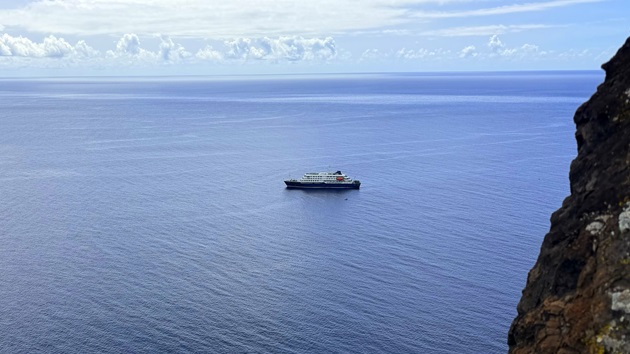
A view of the Dutch-flagged vessel MV Hondius is seen navigating the Atlantic Ocean near Saint Helena Island on April 24, 2026. (Emin Yogurtcuoglu/Anadolu via Getty Images)
(LONDON) — An epidemiologist from the World Health Organization (WHO) said Thursday that the suspected hantavirus cluster aboard a cruise ship is not the beginning of another COVID-19 pandemic.
Eight cases are currently being reported by the WHO, including five laboratory-confirmed cases and three suspected cases. Of those eight cases, three have died.
Dr. Maria Van Kerkhove, an infectious disease epidemiologist and acting director of epidemic and pandemic management at the WHO, was asked during a press conference what the difference was between this cluster and the early days of the COVID pandemic.
“I want to be unequivocal here. This is not SARS-CoV-2. This is not the start of a COVID pandemic. This is an outbreak that we see on a ship,” Van Kerkhove said.
Van Kerkhove explained that hantavirus doesn’t spread in the same way that coronaviruses do, but rather through “close, intimate contact.” Most hantaviruses don’t transmit from person to person.
“The actions that are being taken on board [the ship] are precautionary to prevent any onward spread,” she added.
There appears to be one confirmed case and two suspected cases that have not been added to the WHO’s official count yet.
Officials told ABC News a female individual, who was on a KLM flight with the Dutch female patient who later died, developed symptoms and was admitted to a hospital. Leiden University Medical Centre in the Netherlands confirmed on Thursday that the female patient has hantavirus and is receiving care.
Additionally, two Singapore residents who were on board the ship are currently being monitored. Singapore’s Communicable Diseases Agency said it was notified of the individuals on May 4 and May 5.
“They have been isolated at the National Centre for Infectious Diseases, where they are being tested for hantavirus. The risk to the general public in Singapore is currently low,” the agency said.
The agency added that test results are pending, with one resident having a runny nose and the other is asymptomatic.
Three deaths have been recorded so far, including a married Dutch couple. The 70-year-old male patient died on April 11, and his body was taken off the ship on the island of St. Helena on April 24. His 69-year-old wife disembarked on the same day, and her health rapidly deteriorated. She died at an emergency department in South Africa on April 26.
A third passenger, a German woman, presented with pneumonia symptoms starting on April 28, according to the WHO. The woman died on May 2 from causes not yet known, according to Oceanwide Expeditions, which operates the cruise ship.
The WHO said 29 people disembarked on St. Helena on the same day that the body of the Dutch male patient and his wife disembarked.
They traveled to 12 countries: Canada, Switzerland, Germany, Denmark, Great Britain, St. Kitts and Nevis, Netherlands, New Zealand, Singapore, Sweden, Turkey and the United States.
The disembarked guests have all been contacted by Oceanwide Expeditions. In the U.S., local authorities in three states — Arizona, Georgia and California — are monitoring the disembarked passengers and are conducting contact tracing, None have shown signs of illness at this time.
Anais Legend, technical lead for viral hemorrhagic fevers at WHO, said during the press conference on Thursday that “step-by-step guidance is being developed” for the disembarked passengers and that the WHO is coordinating with national authorities.
Anyone with any signs of symptoms will be isolated while other passengers have their risk exposure evaluated.
Public health experts said they expected a more robust response from the Centers for Disease Control and Prevention (DC) and the National Institutes of Health.
“The CDC would typically be asked by WHO or by a country to help in technical assistance,” Dr. Carlos del Rio, an H. Cliff Sauls distinguished professor of medicine at the Emory University School of Medicine, told reporters on Thursday.
Typically, CDC teams would be deployed to an area, he said, and the teams would perform contact tracing and interviews and conduct an outbreak investigation.
“I would envision by now, many, many days ago, we would have seen a team from CDC deployed to the area,” he added.
Dr. Jeanna Marrazzo, CEO of the IDSA, added that she would have expected a CDC press briefing, an alert from the agency’s Health Alert Network or information from the NIH on potential treatments in the pipeline that could receive emergency use authorization to help treat hantavirus patients.
Marrazzo said she is not aware that conservations about potential therpaies at NIH aren’t happening but that it “doesn’t give me a lot of assurance or reassurance that we are not hearing any of that.”
The WHO said during Thursday’s press briefing that the U.S. is coordinating with the global health agency in a technical capacity.
Because the cluster is limited and confined to a cruise ship, the “idea of sending messages across the world and panicking everyone is not required,” said Dr. Abdirahman Mahmoud, director of the WHO’s health emergency alert and response operations.
He added that the WHO is “informally” aware that contact tracing has been done of the U.S. passengers who disembarked last month and are back home.
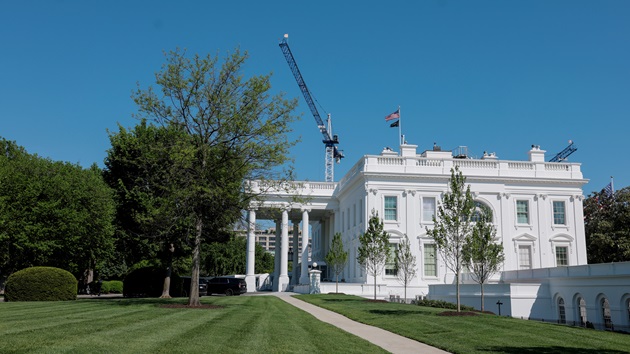
Construction cranes are seen the White House on April 16, 2026 in Washington, DC. (Anna Moneymaker/Getty Images)
(WASHINGTON) — Amid intensifying scrutiny of the Senate Republican proposal to spend up to $1 billion on security for the new White House ballroom, top Department of Homeland Security and U.S. Secret Service officials say the money would also be spent on “other critical missions.”
Those missions, they said, would include securing “frequently visited venues” outside of the White House.
In a letter to congressional leaders obtained by ABC News, Homeland Security Secretary Markwayne Mullin and Secret Service Director Sean Curran described the proposed billion-dollar package as “critical funding to address urgent needs in response to the unprecedented increase in threats against the President and other public officials.”
The letter said the security upgrades to the “East Wing Modernization Project” will “afford needed protection for the President, his family, and visitors, along with the below-ground security functions.”
The officials noted that, per the text of the Senate reconciliation bill, “none of these funds will be used to support non-security improvements at the White House.”
The Senate proposal, released earlier this week, would provide $1 billion for the Secret Service “for the purposes of security adjustments and upgrades, including within the perimeter fence of the White House Compound to support enhancements by the United States Secret Service relating to the East Wing Modernization Project.”
Without spelling out how much of the billion dollars would be spent on the ballroom construction project specifically, the officials said the funding would also be directed toward other locations, including “frequently visited venues facing heightened risk due to their public visibility and static nature.”
The text of the Senate’s bill makes no reference to “frequently visited venues” outside of the White House that Mullin and Curran mentioned in their letter.
Also, Mullin and Curran said the additional money would also go toward training USSS agents, USSS training facilities, the Secret Service’s Special Operations Division’s work on drones and biological and “other emerging threats,” as well as securing “high profile national events that require significant planning.”
Overall, the $1 billion package is described in the letter as a “critical infusion to ensure the safety of the current President and future Presidents.”
By comparison, to fund all of its operations, USSS receives more than $3 billion a year from Congress via the regular appropriations process.