(ROME) — Pope Francis “had a tranquil night and woke shortly after 8 a.m.” on Friday morning, the Vatican said, coming a day after he made his first public comments since being hospitalized on Feb. 14.
The 88-year-old pope “remained stable compared to previous days” and did not have “episodes of respiratory insufficiency” on Thursday, his 21st day in the hospital, the Vatican in its evening update.
While Friday marks his 22nd consecutive day in hospital, the pontiff offered up hope on Thursday in the form of his first public comments since being hospitalized.
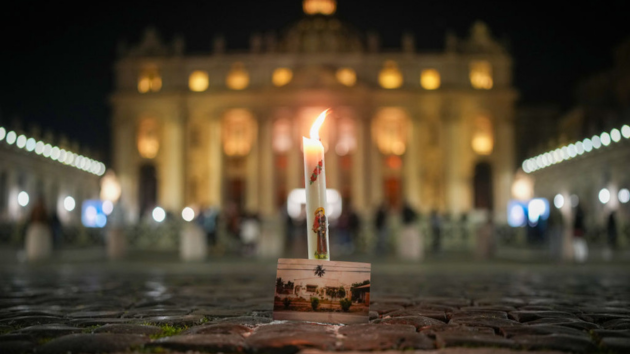
“I thank you from the bottom of my heart for your prayers for my health from the Square, I accompany you from here. May God bless you and the Virgin protect you. Thank you,” the pope said in a recorded statement made in Spanish. The statement was played at the start of the rosary in St. Peter’s Square.”
The pope “continued with respiratory and motor physiotherapy with benefit,” the Vatican press office, the Holy See, said Thursday in its evening update. “Hemodynamic parameters and blood tests remained stable. He did not present fever.”
“The doctors are still maintaining the prognosis as reserved,” the Vatican said.
The Vatican said that, “in view of the stability of the clinical picture,” it won’t provide another medical update on the pope until Saturday.
Francis, who has led the Catholic Church since 2013, was admitted to Rome’s Gemelli Hospital on Feb. 14 and was diagnosed with bilateral pneumonia.
(JERUSALEM) — Two Palestinian men found themselves handcuffed and in shackles, detained by Israeli police in a Jerusalem courtroom. To an outside observer, they may have appeared to be criminals; however, the reality of their situation was far more troubling. Their so-called “crime”? Simply selling books.
Mahmoud Muna and his nephew Ahmad were arrested after Israeli police raided their family-owned Educational Bookshop in East Jerusalem and confiscated books.
“Jerusalem District police officers have arrested two residents of East Jerusalem suspected of selling books containing incitement and support for terrorism at bookstores in Jerusalem,” Israeli police said in a statement.
The statement continued: “During a focused operation by detectives from the David subdistrict, searches were conducted at two bookstores suspected of selling books with inciting content. The suspects who allegedly sold the books were taken into custody by police detectives. As part of the investigation, detectives discovered numerous books containing inciteful material with nationalist Palestinian themes, including a children’s coloring book titled ‘From the River to the Sea.'”
Ahmad and Mahmoud are both in their 30s. While they are no longer under house arrest, they are still banned from entering the bookstores they know and love, despite not being charged with any crimes.
“It was heartbreaking for me,” Ahmad said. “And I mean, I really mean it, every time he chucks the books out, I was like, ‘for God’s sake, like, why are you doing this?'”
Security footage from the store shows the moment when plainclothes officers raided the men’s well-known bookstore in predominantly Muslim East Jerusalem. The officers sifted through the shelves, took photos, and stuffed some books into plastic bags.
Ahmad and Mahmoud were placed under house arrest for five days, following approximately 48 hours in police custody.
“Google Translate became handy,” Ahmad said. “Each of them opened their phone and started taking photos of the books and trying to Google translate it. Does it have the Palestinian flag? Does it have a drawing, does it have the image of the [West Bank] wall? Then the search became about the contents. But the decision was made according to the cover and the design of the book rather than what’s inside it.”
The children’s coloring book titled “From the River to the Sea,” cited in the police statement, serves as a rallying cry for some activists advocating for the liberation of Palestinians from the Mediterranean to the Jordan River, an area that includes modern-day Israel. Many consider it offensive code for wiping Israel off the map, as Hamas has vowed to do.
The owners claim that the book was not on display; it was in the back where they review all submitted books before putting them up for sale.
“Nothing has changed about the books,” Ahmad said. “Nothing has changed about the bookshop. But what has changed is the place that we live in. That’s what have changed. We live in a place that in the last few years have become more radical.”
Ahmed and Mahmoud are only one floor apart, but for a period were not allowed to interact due to the terms of their arrests. Their bookshops, which have been operating for more than 40 years, have become vital hubs for the community.
People gather at their local bookshop, including residents, foreigners, journalists and diplomats, to learn more about this region and beyond.
While there are many books about the Israeli-Palestinian conflict, the shop also offers a diverse selection of literature from around the world, including classics, encyclopedias, cookbooks and books on architecture.
“The bookshop represents success, lights, (and) beauty,” Mahmoud said. “Some sort of happiness in the midst of bleakness. And once you step into the bookshop, it’s very colorful, it’s very bright, there’s lots of light, there’s lots of knowledge, there’s lots of good conversations. So for the community, the way they describe it often is that this is almost a refuge. This is a place to escape to.”
Family member Murad Muna is now running the store after it was briefly closed. He says the Israeli police took a lot of merchandise, about 100 books.
“They try to shut down the Palestinian voices,” Murad Muna said. Regarding some of the confiscated books, he said, “You can find them at the library of the Hebrew University. You can find them at the bookshops on the other side of the city. So they just target the Palestinian culture and try to shut it down.”
(ROME) — Pope Francis “remained stationary” on Wednesday, “without showing any episodes of respiratory failure,” but rested peacefully overnight into Thursday, the Vatican said.
The pope, 88, received “high-flow oxygen therapy during the day, and noninvasive mechanical ventilation will be resumed during the night,” the Vatican’s press office said in its evening update.
“The Holy Father increased his respiratory physiotherapy and active motor therapy,” the Vatican’s press office, the Holy See, said. Pope Francis spent his 20th day in hospital on Wednesday in an armchair, participated in the “ritual blessing of the Holy Ashes that were imposed on him by the celebrant” and received the Eucharist, the Vatican said.
“During the morning he also called Father Gabriel Romanelli, parish priest of the Holy Family in Gaza. In the afternoon he alternated rest with work,” the Vatican said.
LONDON — Ukrainian President Volodymyr Zelenskyy traveled to Brussels, Belgium, on Thursday to meet with European leaders as his nation seeks to weather continued attacks from Russia and growing political pressure from President Donald Trump’s administration in the U.S.
The Ukrainian president’s latest visit to Brussels comes at a difficult moment for his nation, the White House having announced an open-ended pause on all military aid and intelligence sharing in a bid to force Kyiv into negotiating a peace deal with Russia to end Moscow’s three-year-old invasion.
The freeze came after a tumultuous meeting between Zelenskyy and Trump in the Oval Office last week, which descended into a shouting match and ended with the Ukrainian president’s team being asked to leave.
Zelenskyy this week released a statement calling the meeting “regrettable,” saying he is ready to engage in the U.S.-facilitated peace process and sign a controversial minerals sharing deal with the U.S.
Zelenskyy was welcomed to the European Council building in the Belgian capital on Thursday by European Commission President Ursula von der Leyen and European Council President Antonio Costa.
“Europe faces a clear and present danger,” von der Leyen said in a post to X as Zelenskyy arrived. “We must be able to defend ourselves and put Ukraine in a position of strength.”
Zelenskyy will speak at a special meeting of the European Council and is expected to hold meetings with European leaders on defense matters.
European leaders have rallied to Zelenskyy’s defense in the face of U.S. pressure, while simultaneously warning that peace in Ukraine is not possible without American backing. The U.K. and France have said they will work with Kyiv to present a peace deal to Trump.
European allies have been rattled by the opening months of Trump’s second term, which have been characterized by efforts to undermine Zelenskyy’s legitimacy, alignment with Russian narratives about the war and criticism of Europe’s ability to ensure security on the continent.
Trump and his officials have been reluctant to offer any security guarantees to Kyiv as part of a peace deal with Russia — an element Zelenskyy and his European partners say is vital to the success of any accord.
European nations announced fresh tranches of assistance for Ukraine ahead of Zelenskyy’s arrival in Brussels.
Dutch Prime Minister Dick Schoof announced that his nation would provide $3.8 billion in funding in 2026, $700 million of which is earmarked for drone development.
Norwegian Prime Minister Jonas Gahr Store said his nation would ensure a “significant increase” in aid for Ukraine, while Polish Defense Minister Wladyslaw Kosiniak-Kamysz announced another $215 million in aid from Warsaw.
French Defense Minister Sebastien Lecornu, meanwhile, said on France Inter that his nation was sharing intelligence resources with Ukraine following the U.S. freeze.
ABC News’ Guy Davies and Oleksiy Pshemyskiy contributed to this report.
LONDON — Ukrainian President Volodymyr Zelenskyy said there can be “no pause” in pressure on Russia after another night of missile and drone strikes across Ukraine, the latest barrage coming the day after the U.S. confirmed it had stopped sharing intelligence with Kyiv.
President Donald Trump’s decision to pause all U.S. military aid and intelligence sharing has raised concerns that Ukraine’s air defenses will become less effective in the days, weeks and months to come.
The pause followed last week’s explosive Oval Office meeting between Zelenskyy and Trump. White House officials have suggested the freeze may be lifted if Ukraine takes concrete steps towards a peace deal with Russia to end Moscow’s 3-year-old invasion.
Ukraine’s air force reported 112 drones and two missiles launched into the country overnight, with 68 drones shot down and 43 lost in flight.
The air force reported damage in the Kharkiv, Sumy, Odesa and Dnipropetrovsk regions.
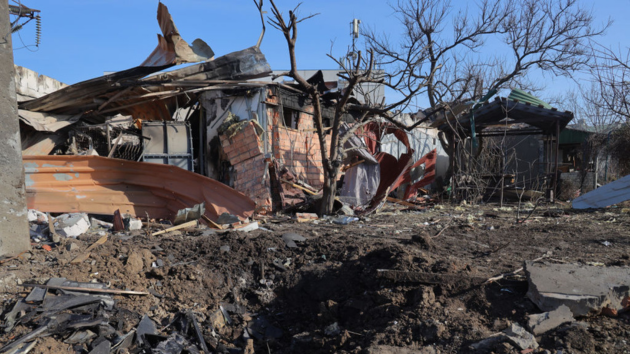
In Dnipropetrovsk, a ballistic missile hit a hotel in the city of Kryvyi Rih — Zelenskyy’s hometown.
“A ballistic missile struck an ordinary hotel,” the president wrote on social media. Four people were killed with more than 30 others injured, he added. The attack came shortly after a group of foreign humanitarian volunteers checked into the hotel, Zelenskyy said. None were hurt.
Sources told ABC News that two U.S. citizens were among the volunteers who survived the strike, working for the Charity fund Freedom Trust and Ukraine Relief organization.
“There must be no pause in the pressure on Russia to stop this war and terror against life,” Zelenskyy wrote.
Russian missiles and drone attacks are a nightly occurrence in Ukraine. The country has become largely reliant on Western anti-air weapons to defeat incoming projectiles.
U.S. intelligence sharing with Ukraine had allowed Kyiv to give warnings to targeted areas ahead of Russian drone and missile strikes, tracking Russian aircraft taking off, drones being launched and missiles being fired.
A Ukrainian intelligence official told ABC News on Wednesday that the intelligence sharing pause included a halt in sharing U.S. satellite imagery through the Defense Intelligence Agency.
Zelenskyy is expected to travel to Brussels, Belgium, to meet with European leaders on Thursday, as he seeks further Western military and political support. The president has consistently requested more air defenses, an issue now more pressing amid the U.S. aid freeze.
CIA Director John Ratcliffe said Wednesday that Trump had asked for a “pause” and is committed to peace. The pause, Ratcliffe suggested, prompted Zelenskyy’s statement that he was ready to revive talks over a potential peace deal.
“And so I think on the military front and the intelligence front, the pause that allowed that to happen, I think will go away,” he added.
Trump has repeatedly — and falsely — blamed Ukraine for starting the war with Russia while seeking to undermine Zelenskyy’s legitimacy as president. The White House is pushing Kyiv to accept a deal to end the fighting and to sign an agreement giving the U.S. access to Ukrainian mineral resources.
In a Tuesday statement, Zelenskyy said the disastrous White House meeting was “regrettable.”
“Ukraine is ready to come to the negotiating table as soon as possible to bring lasting peace closer,” the president said. “Nobody wants peace more than the Ukrainians. My team and I stand ready to work under President Trump’s strong leadership to get a peace that lasts.”
ABC News’ Fidel Pavlenko, Nataliia Popova, Ellie Kaufman and Guy Davies contributed to this report.
(LONDON and ROME) — Pope Francis “remained stationary” on Wednesday, “without showing any episodes of respiratory failure,” according to the Vatican.
The pope received “high-flow oxygen therapy during the day, and noninvasive mechanical ventilation will be resumed during the night,” the Vatican said in its evening update.
Pope Francis spent the day in an armchair, participated in the “ritual blessing of the Holy Ashes that were imposed on him by the celebrant” and received the Eucharist, the Vatican said.
“During the morning he also called Father Gabriel Romanelli, parish priest of the Holy Family in Gaza. In the afternoon he alternated rest with work,” the Vatican said.
The pope “rested well during the night” and woke shortly after 8 a.m. Wednesday morning, his 20th day in hospital, as his condition remains stable and his prognosis remains reserved, according to the Vatican.
The pontiff had needed medical intervention amid two episodes of “acute respiratory failure” on Monday, Vatican sources told ABC News.
The pope did not have any episodes of respiratory failure or bronchospasm on Tuesday, according to the Vatican.
Pope Francis has remained “alert, cooperating with therapy and oriented,” the Vatican’s press office, the Holy See, said. He underwent “high-flow oxygen therapy and respiratory physiotherapy” on Tuesday, the Vatican said.
He resumed noninvasive mechanical ventilation overnight into Wednesday morning “as planned,” according to the Vatican.
The pope, 88, was taken off noninvasive mechanical ventilation and resumed receiving supplemental oxygen through a nasal tube, Vatican sources said Tuesday. He was no longer wearing a mechanical ventilation mask, a device that pumped oxygen into his lungs, the sources said.
Wednesday marks Ash Wednesday, the first day of Lent, which is a 40-day season of prayer, fasting and giving. It concludes with Holy Week, which leads to Easter Sunday, the most important day in the Christian calendar.
The Vatican said last week that Cardinal Angelo De Donatis, major penitentiary and delegate of the pope, will replace Pope Francis at Wednesday’s liturgical celebration for Ash Wednesday in Rome.
The Cardinal will read the Homily prepared by the Pope and the text will be released later today, the Vatican said.
Francis, who has led the Catholic Church since 2013, was admitted to Rome’s Gemelli Hospital on Feb. 14 and was diagnosed with bilateral pneumonia. The pontiff had a bronchospasm attack on Friday, church officials said.
(LONDON) — The prime minister of Greenland warned President Donald Trump off his controversial ambition to acquire the territory, writing on social media Wednesday, “Greenland is ours.”
Trump again expressed his desire to take control of the Arctic island — which is a semiautonomous territory within Denmark — in his speech to a joint session of Congress on Tuesday. America, he said, would acquire the strategic territory “one way or the other.”
Prime Minister Mute Bourup Egede dismissed Trump’s remarks in a post to Facebook.
“Greenland belongs to the Greenlanders,” he wrote. “We are not Americans, we are not Danes because we are Greenlanders. This is what the Americans and their leaders need to understand, we cannot be bought and we cannot be ignored.”
“The future of the country will be determined by us in our country, of course,” Egede added. “Greenland is ours. We do not want to be Americans, nor Danes, we are Kalaallit. The Americans and their leaders must understand that.”
“We are not for sale and cannot be taken,” Egede said. “The future is decided by us in Greenland.”
Trump has expressed ambition to acquire Greenland since his first term. The mineral-rich island sits in the Arctic Circle along two potential shipping routes through the Arctic — the Northwest Passage and the Transpolar Sea Route — which are expected to become more navigable as climate change and warmer waters causes the retreat of Arctic sea ice.
During his address to Congress on Tuesday, Greenland was central to Trump’s foreign policy remarks.
“We strongly support your right to determine your own future, and if you choose, we welcome you into the United States of America,” Trump said. “We will keep you safe. We will make you rich. And together we will take Greenland to heights like you have never thought possible before.”
The president said his administration was “working with everybody involved to try to get it.”
“We need it really for international world security,” he said. “And I think we’re going to get it. One way or the other, we’re going to get it.”
Denmark has also dismissed any suggestion of transferring Greenland’s sovereignty to the U.S.
In February, Prime Minister Mette Frederiksen said, “Greenland is today a part of the kingdom of Denmark. It is part of our territory, and it’s not for sale.”
Frederiksen and officials in Greenland have suggested negotiations on an expanded U.S. military footprint on the island in response to Trump’s bid to acquire the territory outright.
ABC News’ Morgan Winsor contributed to this report.
(LONDON) — Ukrainian authorities reported a major Russian missile and drone strike on targets across the country on Tuesday night, with a top aide to President Volodymyr Zelenskyy demanding an immediate end to Moscow’s barrages as a condition for any peace deal to end Russia’s three-year-old invasion.
Ukraine’s air force said Russia launched 181 strike drones and three missiles into the country in the latest attack. The air force said 115 drones were shot down and 55 lost in location without causing damage.
The barrage coincided with President Donald Trump’s address to a joint session of Congress, in which he said a potential peace between the two nations would be “beautiful.” The strikes began before Trump entered Congress and continued into the morning, indicated by Ukrainian air force alerts.
“Russia must stop the daily shelling of Ukraine immediately if it truly wants the war to end,” Andriy Yermak — the head of Zelenskyy’s office — wrote on Telegram.
Meanwhile, Dmitry Medvedev — the former Russian president and prime minister now serving as the deputy chairman of the country’s Security Council — wrote on social media that “inflicting maximum defeat on the enemy” remains Moscow’s “main task.”
Authorities in the southern port city of Odesa reported a “massive” strike, with at least one person killed by drone shrapnel and parts of the city cut off from utilities.
“As a result of the attack in Odesa, critical infrastructure has been damaged and part of the city has been left without electricity, water and heat,” the city’s military administration wrote on Telegram.
“Private houses in the suburbs of Odessa were damaged by debris from downed enemy drones,” the statement said. Fires broke out and a missile hit “an empty sanatorium,” the administration said.
Russia’s Defense Ministry said its forces “hit the infrastructure of military airfields, an oil depot providing fuel to [Ukrainian military] units, production workshops and control points for unmanned aerial vehicles, the location of [Ukrainian] special operations forces’ boats.
The ministry said it also shot down eight Ukrainian drones over Russian territory overnight.
Russian and Ukrainian drone strikes have continued as both sides jostle for advantage in renewed peace talks being facilitated by President Donald Trump’s administration. Last month, the effort began with a meeting between American and Russian delegations in Saudi Arabia without any Ukrainian involvement. The two sides expressed their intentions to revive bilateral ties and explore areas for future economic cooperation.
U.S.-Ukrainian ties have frayed badly since Trump returned to office with a vow to rapidly end the war. Tensions came to a head in last week’s explosive Oval Office meeting between the two presidents and with Vice President JD Vance in attendance. The meeting devolved into a shouting match with Zelenskyy’s team being asked to leave the White House afterwards.
As European allies mobilized to back Zelenskyy and urge reconciliation, Trump announced a freeze on all U.S. aid to Ukraine. Administration officials demanded an apology from Zelenskyy and assent for a controversial deal to give the U.S. access to valuable Ukrainian natural resources.
During his address to a joint session of Congress on Tuesday night, Trump said he received a letter from Zelenskyy, reading part of it aloud and suggesting that tensions between the two camps had cooled.
“I appreciate that he sent this letter, just got it a little while ago,” Trump said. “Simultaneously, we’ve had serious discussions with Russia and have received strong signals that they are ready for peace. Wouldn’t that be beautiful?”
In his first comments after the U.S. aid freeze was announced, Zelenskyy said Tuesday that Ukraine is ready to sign the minerals deal “in any time and in any convenient format.”
“None of us wants an endless war. Ukraine is ready to come to the negotiating table as soon as possible to bring lasting peace closer,” Zelenskyy said in a statement. “Nobody wants peace more than Ukrainians. My team and I stand ready to work under President Trump’s strong leadership to get a peace that lasts.”
“We do really value how much America has done to help Ukraine maintain its sovereignty and independence. And we remember the moment when things changed when President Trump provided Ukraine with Javelins. We are grateful for this,” Zelenskyy continued.
Referring to the disastrous Oval Office meeting, the Ukrainian leader said it “did not go the way it was supposed to be. It is regrettable that it happened this way. It is time to make things right. We would like future cooperation and communication to be constructive.”
ABC News’ Alexandra Hutzler contributed to this report.
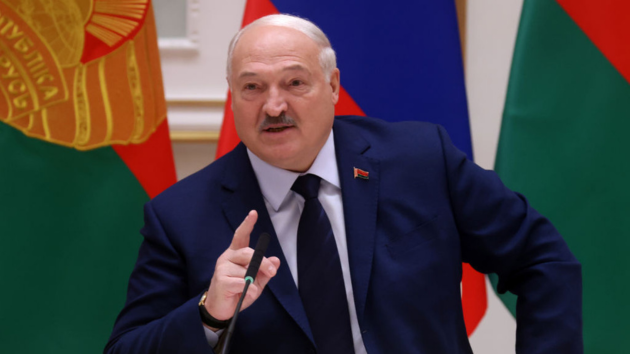
Belarusian President Alexander Lukashenko speaks during a signing ceremony at the Supreme Council of Russia and Belarus, December 6, 2024, in Minsk, Belarus. President Putin is having a one-day trip to Belarus. (Photo by Contributor/Getty Images)
(LONDON) — Belarusian President Alexander Lukashenko — a close ally of President Vladimir Putin — warned that the Kremlin “will never” accept a European troop deployment to Ukraine, as Moscow and Kyiv continue to maneuver for advantage in U.S.-sponsored peace negotiations.
In a wide-ranging interview with blogger Mario Naufal published late Tuesday, Lukashenko praised President Donald Trump’s forthright approach to Russia’s war on Ukraine and suggested Putin was ready to make peace.
Any proposal is unlikely to win Russian support if it includes the deployment of European forces into Ukraine, Lukashenko said.
“Russia will never agree to this,” he said. “At least, this is Russia’s position today. Especially since the leadership of the European Union, primarily in the person of Germany and France, is taking a very aggressive position at the moment.”
But the Belarusian leader also countered attacks by Trump and Putin on the legitimacy of Ukrainian President Volodymyr Zelenskyy, while offering Belarus as a location for peace negotiations. Unsuccessful ceasefire talks were held in Belarus in the hours and days after Russia launched its invasion in February 2022.
“There is no need to push Zelenskyy now,” Lukashenko said, as quoted by the Belta state-owned news agency. “We need to convince and come to an agreement with Zelenskyy, because a large part of Ukrainian society is behind Zelenskyy.”
“If you want, come. Here, it is nearby — 200 kilometers from the Belarusian border to Kyiv,” Lukashenko added. “We will come to an agreement calmly, without noise, without shouting.”
“Tell Trump: I am waiting for him here together with Putin and Zelenskyy. We will sit down and come to an agreement calmly,” he said. “If you want to come to an agreement.”
Kremlin spokesperson Dmitry Peskov responded positively to the offer of talks in Minsk. “This issue has not been brought up or discussed in any way,” Peskov told reporters Wednesday, as quoted by the state-run Tass news agency. “This is our main ally. Therefore, for us it is the best place for negotiations.”
Moscow has repeatedly accused NATO and its members of seeking to use Ukraine as a launching pad for aggression against Russia. Putin cited NATO expansion since the collapse of the Soviet Union as a key Russian grievance in the run up to his full-scale invasion of Ukraine.
Lukashenko appeared to play down that issue. “It is not so much about NATO expansion to the east, but about the threats that were created in Ukraine,” he said of Putin’s decision to launch the 2022 attack.
Leaders in Kyiv have framed the proposed and contentious U.S.-Ukraine minerals deal as a means to securing long-term American backing, and as a possible bridge to lasting U.S. security guarantees. Lukashenko suggested that the deal, which seems to have become a cornerstone of Trump’s Ukraine strategy, may unsettle the Kremlin.
“I have not discussed these issues with Russia and Putin,” he said. “But, most likely, this could be alarming if Russia feels that these agreements will go beyond the framework of economic relations.”
Lukashenko repeatedly appealed directly to Trump, who he described as an “incredible person” and a political “bulldozer.”
The Belarusian leader also encouraged the U.S. to align closer with Russia — a prospect that has unsettled European and Ukrainian leaders since Trump’s return to the White House. Indeed, Trump’s decision this week to freeze all U.S. military aid to Ukraine left officials in Kyiv and across Europe reeling.
“The U.S. is the first country in the world, high-tech, rich,” Lukashenko said. “They are capable of many things. Russia understands this. And Russia will strive to establish very good relations with the United States of America.”
“In order for the planet to be in balance, so that there are no incomprehensible wars, like in the Middle East or in Ukraine, so that there are no conflicts, an alliance between Russia and the United States is possible and very important,” he added. “An alliance for economic development. It is possible and important. It will last a long time.”
The Belarusian leader appeared to chastise Trump for his unique political style, warning that the president must deliver on his promises.
“There are too many statements that should not have been made at all,” Lukashenko said. “You need to cool down after the elections. And you need to take steps in the interests of U.S. voters, first of all, and, secondly, the entire world community.”
“You don’t have much time to prove to American society that you are capable of something,” he continued. “If you don’t do this, the Republicans will suffer a crushing defeat in the next elections. And it will be justified.”
(ROME) — The pope “rested well during the night” and woke shortly after 8 a.m. this morning, his 20th day in hospital, as his condition remains stable and his prognosis remains reserved, according to the Vatican.
The pontiff had needed medical intervention amid two episodes of “acute respiratory failure” on Monday, Vatican sources told ABC News.
The pope did not have any episodes of respiratory failure or bronchospasm on Tuesday, according to the Vatican.
Pope Francis has remained “alert, cooperating with therapy and oriented,” the Vatican’s press office, the Holy See, said. He underwent “high-flow oxygen therapy and respiratory physiotherapy” on Tuesday, the Vatican said.
He resumed noninvasive mechanical ventilation overnight into Wednesday morning “as planned,” according to the Vatican.
The pope, 88, was taken off noninvasive mechanical ventilation and resumed receiving supplemental oxygen through a nasal tube, Vatican sources said Tuesday. He was no longer wearing a mechanical ventilation mask, a device that pumped oxygen into his lungs, the sources said.
Wednesday marks Ash Wednesday, the first day of Lent, which is a 40-day season of prayer, fasting and giving. It concludes with Holy Week, which leads to Easter Sunday, the most important day in the Christian calendar.
The Vatican said last week that Cardinal Angelo De Donatis, major penitentiary and delegate of the pope, will replace Pope Francis at Wednesday’s liturgical celebration for Ash Wednesday in Rome.
The Cardinal will read the Homily prepared by the Pope and the text will be released later today, the Vatican said.
Francis, who has led the Catholic Church since 2013, was admitted to Rome’s Gemelli Hospital on Feb. 14 and was diagnosed with bilateral pneumonia. The pontiff had a bronchospasm attack on Friday, church officials said.