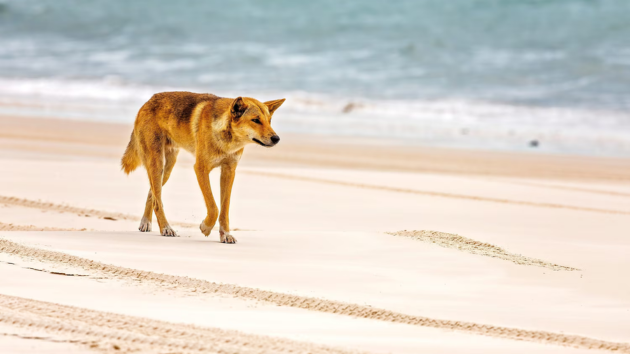
A dingo walks on the beach, Fraser Island, also known as K’gari, in Queensland, Australia (STOCK PHOTO/Getty Images)
(K’GARI, Australia) — A 19-year-old Canadian woman was found dead on an Australian beach surrounded by a pack of dingoes, according to police.
The cause of death remains under investigation in the “shocking” incident, according to Queensland Police.
Two passersby found the teen’s body on Monday morning local time on the island of K’gari, located off the coast of Queensland, police said. There was a small pack of dingoes around her body at the time, according to Queensland Police Inspector Paul Algie, calling it a “traumatic and horrific scene.”
“I can confirm there was marking on her body consistent with having been touched and interfered with by the dingoes,” Algie said during a press briefing on Monday, though he noted it was too early to speculate on the cause of death, pending the autopsy report.
Algie said police are investigating all possibilities in the death.
“We simply can’t confirm whether this young lady drowned or died as a result of being attacked by dingoes,” he said.
The woman had been working for the past several weeks at a backpackers’ hostel on K’gari, formerly known as Fraser Island, police said.
Police said she is believed to have gone for a swim alone on the beach, near a popular shipwreck, around 5 a.m. local time Monday and was found dead over an hour later.
An autopsy is expected to be conducted on Wednesday, police said.
K’gari, a UNESCO World Heritage Site, is a popular tourist destination. Dingoes are protected on the island as a native species.
The last fatal dingo attack on K’gari was 25 years ago, according to Fraser Coast Mayor George Seymour. In that incident, a 9-year-old boy died.
“This is a shocking tragedy that has really affected our community,” Seymour told the Australian network 9News amid the investigation into the 19-year-old’s death.
“Dingoes are an essential part of this wilderness on K’gari, it’s part of why people go there — to escape, be part of a World Heritage wilderness,” he said. “There are dangers there.”
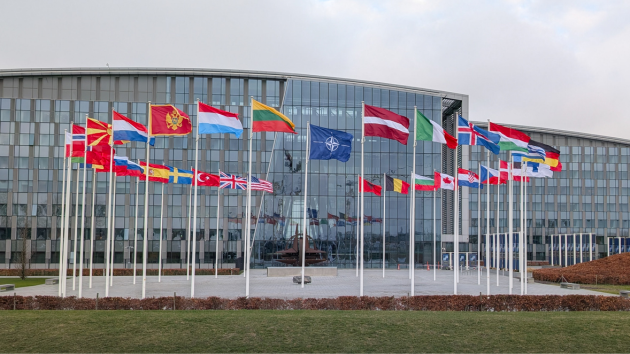
NATO headquarters in Haren, Brussels, Belgium. (Michael Nguyen/NurPhoto via Getty Images)
(LONDON) — The escalating showdown between the U.S. and its NATO allies over the fate of Greenland looks set to be a dominant topic of conversation as leaders gather at this week’s World Economic Forum event in Davos, with U.S. President Donald Trump again declaring on Monday that American ownership of the Arctic island is “imperative.”
Trump said in a post to social media that, following a phone call with NATO Secretary-General Mark Rutte, “I agreed to a meeting of the various parties in Davos, Switzerland. As I expressed to everyone, very plainly, Greenland is imperative for National and World Security. There can be no going back — On that, everyone agrees!”
Greenland is a self-governing territory of the Kingdom of Denmark. Trump first raised the prospect of acquiring the minerals-rich island in his first term. Danish and Greenlandic politicians have repeatedly rebuffed such proposals.
European leaders, meanwhile, continued to push back on Trump’s ambitions and publicize their coordination efforts on the issue.
European Commission President Ursula von der Leyen said in a post to X that she met with a bipartisan congressional delegation to discuss both Russia’s war in Ukraine and recent tensions around Greenland.
Von der Leyen said she “addressed the need to unequivocally respect the sovereignty of Greenland and of the Kingdom of Denmark. This is of utmost importance to our transatlantic relationship.”
The European Union, she said, “remains ready to continue working closely with the United States, NATO, and other allies, in close cooperation with Denmark, to advance our shared security interests.”
“We also discussed transatlantic trade and investment. They are a major asset for both the EU and US economies. Tariffs run counter to these shared interests,” von der Leyen wrote.
Danish and Greenlandic ministers traveled on Monday to Brussels to meet with NATO chief Rutte.
Danish Defense Minister Troels Lund Poulsen said afterward that the Greenland issue poses challenges “fundamentally to Europe and, for that matter, also the future of NATO.” Poulsen said Rutte is “very aware of the difficult situation.”
Greenlandic Foreign Minister Vivian Motzfeldt said the meeting “achieved some important things with regard to security in the Arctic.” She added, “It is important to know how to work with security in the Arctic. That is why we are now carrying out various exercises.”
Denmark’s Foreign Minister Lars Lokke Rasmussen, meanwhile, was in the U.K. on Monday to meet with his counterpart in London. “In turbulent times, close allies are crucial — Denmark and the UK stand close together,” Rasmussen wrote on X. “We agree on the need for stronger NATO engagement in the Arctic and closer security cooperation.”
Trump has suggested that U.S. sovereignty over Greenland is necessary to ensure American security and blunt Chinese and Russian influence in the Arctic region. A 1951 defense agreement already grants the U.S. military access to Greenland, but Trump has suggested the deal is inadequate.
Denmark and its European allies have sought to ease concerns about the supposed vulnerability of the Arctic through more military spending and by sending small contingents of troops to Greenland last week.
But Trump interpreted the deployments as a provocation, and announced new 10% tariffs on all goods from the eight nations — Denmark, Norway, Sweden, France, Germany, the U.K., the Netherlands and Finland — that sent troops.
European leaders hit back at Trump’s decision and said the move threatened a new transatlantic trade war.
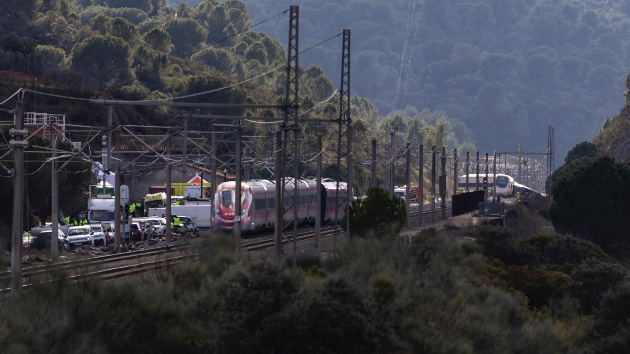
Emergency services work at the site of a train collision on January 19, 2026 after yesterday’s train collision in Adamuz, Spain. Authorities say at least 39 were killed and more than 150 were injured when a train collided with a derailed train on the evening of Sunday, Jan. 18. (Photo by Pablo Blazquez Dominguez/Getty Images)
(ADAMUZ, Spain) — At least 40 people have been killed and more than 100 others were injured after two high-speed trains collided in southern Spain, according to emergency officials.
A train traveling from Málaga to Madrid on Sunday derailed near Adamuz, crossing over to the adjacent track where it hit another train coming from Madrid to Huelva, according to the Spanish Interior Minister.
Eighty-one of the injured have been discharged and 41 remain hospitalized, emergency officials said on Monday. Twelve of the hospitalized victims are in the intensive care unit, officials said.
An unknown number of people remained unaccounted for on Monday as rescue crews continued to work at the scene, according to a Spanish official.
Regional President of Andalusia Juan Manuel Moreno said rescue crews are working through difficult conditions to try to reach the train carriages, where more victims could be inside.
About 400 people were on board both trains, officials said.
Oscar Puente, the Spanish transport minister, said in a statement early on Monday that the death toll was “not final.”
“I want to express all my gratitude for the huge effort of the rescue teams during the night, under very difficult circumstances, and my condolences to the victims and their families in these terribly painful moments,” he said in Spanish on social media.
The cause of the train derailment has not been released.
Iryo, the company operating the train that initially derailed, released a statement, saying the company “deeply regrets what has happened and has activated all emergency protocols, working closely with the competent authorities to manage the situation.”
Puente, the transport minister, said the high-speed Iryo train was “relatively new.”
Puente said the derailment of the Iryo train bound for Madrid and its subsequent collision with the second train happened on a straight stretch of track, which had undergone extensive renovation work that was only finished in May.
The Spanish minister called the accident “extremely strange.”
“It’s very difficult at this moment to explain,” Puente added, and said he hoped the investigation would help clear up what has happened.
ABC News’ Joe Simonetti contributed to this report.
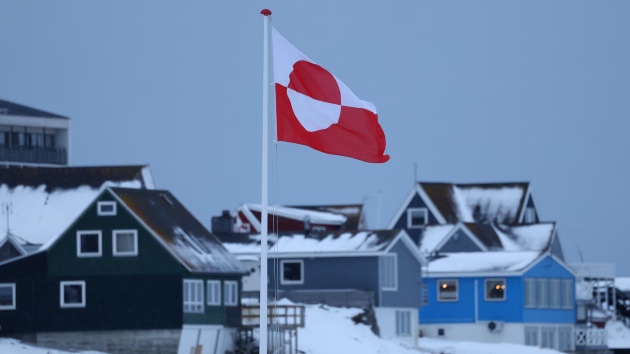
The Greenlandic flag flies over houses, Jan. 17, 2026, in Nuuk, Greenland. (Sean Gallup/Getty Images)
(LONDON) — The leaders of all 27 European Union nations will meet for an “extraordinary meeting” later this week, European Council President Antonio Costa said on Sunday, in response to U.S. President Donald Trump’s escalating pressure campaign to acquire Greenland.
European leaders are mobilizing after Trump on Saturday announced a 10% tariff to be imposed on all goods sent to the U.S. from eight NATO nations — Denmark, Norway, Sweden, France, Germany, the U.K., the Netherlands and Finland — that recently sent small contingents of troops to Greenland to take part in military exercises there.
On Sunday, Trump sent a letter to Norwegian Prime Minister Jonas Gahr Store in which the president again expressed his desire to take control of Greenland. Store’s office confirmed to ABC News on Monday that Oslo received the message from Trump. The details of the letter were first reported by PBS.
“Considering your Country decided not to give me the Nobel Peace Prize for having stopped 8 Wars PLUS, I no longer feel an obligation to think purely of Peace, although it will always be predominant, but can now think about what is good and proper for the United States of America,” Trump wrote.
“Denmark cannot protect that land from Russia or China, and why do they have a ‘right of ownership’ anyway? There are no written documents, it’s only that a boat landed there hundreds of years ago, but we had boats landing there, also,” the president continued. “I have done more for NATO than any other person since its founding, and now, NATO should do something for the United States. The World is not secure unless we have Complete and Total Control of Greenland.”
Costa said he had called the meeting due to the “significance of recent developments.”
European leaders are mobilizing after Trump on Saturday announced a 10% tariff to be imposed on all goods sent to the U.S. from eight NATO nations — Denmark, Norway, Sweden, France, Germany, the U.K., the Netherlands and Finland — that recently sent small contingents of troops to Greenland to take part in military exercises there.
Costa said recent conversations with European leaders had reconfirmed their “strong commitment” to international law, Arctic security through NATO and solidarity with Denmark and Greenland in the face of Trump’s continued effort to acquire the Arctic island.
European leaders also agreed that “tariffs would undermine transatlantic relations and are incompatible with the EU-U.S. trade agreement,” Costa said, noting the bloc’s “readiness to defend ourselves against any form of coercion” and to engage “constructively with the US on all issues of common interest.”
An EU Council spokesperson confirmed to ABC News that the summit would be an in-person meeting in Brussels.
Trump said the new tariffs will come into force on Feb. 1 and will increase to 25% on June 1. The president said the measures would remain in place until the U.S. is able to purchase Greenland.
Greenland is a self-governing territory of the Kingdom of Denmark. Trump first raised the prospect of acquiring the minerals-rich island in his first term. Danish and Greenlandic politicians have repeatedly rebuffed such proposals.
Trump’s new tariffs raise the risk of a fresh transatlantic trade war. A French official confirmed to ABC News on Monday that French President Emmanuel Macron “will request the activation of the EU’s anti-coercion instrument in the event of new U.S. tariffs.”
That mechanism, colloquially known as the bloc’s “trade bazooka,” would allow the EU to impose severe restrictions on U.S. goods and services. Among the available measures would be restrictions on U.S. investment in EU nations, blocks on access to public procurement schemes and limits on intellectual property protections.
Trump has repeatedly suggested that U.S. sovereignty over the world’s largest island is necessary to ensure American security and blunt Chinese and Russian influence in the Arctic region. On Sunday, the president again claimed that only the U.S. can ensure the security of Greenland.
A 1951 defense agreement grants the U.S. military access to Greenland. Danish politicians have repeatedly expressed willingness to work with Washington to expand the American and NATO presence there.
Danish officials have also sought to head off concerns about the supposed vulnerability of the Arctic. Last year, Copenhagen announced a $6.5 billion Arctic defense package in response to U.S. criticism that it had failed to adequately protect Greenland.
But such steps do not appear to have deterred Trump, who has said he would consider taking Greenland by force if other means to acquire the land fail.
Indeed, it was the recent deployment of more NATO forces to the Arctic territory that prompted Trump to threaten a new raft of tariffs. The troops traveled to Greenland to take part in the Danish-led Operation Arctic Endurance.
Danish Defense Minister Troels Lund Poulsen and Greenlandic Foreign Minister Vivian Motzfeldt are scheduled to visit NATO’s headquarters in Brussels on Monday for a previously planned meeting with the alliance’s Secretary General Mark Rutte, NATO said in a press release.
On Monday, British Prime Minister Keir Starmer urged “calm discussion” between allies. “The security of Greenland matters and it will matter more as climate change reshapes the Arctic,” he said, noting the need for “greater attention, greater investment and stronger collective defense.”
“The United States will be central to that effort, and the U.K. stands ready to contribute fully alongside our allies through NATO,” Starmer said, adding that any decisions about the territory’s future should be left to Greenlanders and Danes.
Trump’s use of tariffs against allies, Starmer continued, “is completely wrong. It is not the right way to resolve differences within an alliance. Nor is it helpful to frame efforts to strengthen Greenland’s security as a justification for economic pressure.”
ABC News’ Victoria Beaule, Tom Soufi Burridge and Kevin Shalvey contributed to this report.
Emergency services work at the site of a train collision on January 19, 2026 after yesterday’s train collision in Adamuz, Spain. Authorities say at least 39 were killed and more than 150 were injured when a train collided with a derailed train on the evening of Sunday, Jan. 18. (Photo by Pablo Blazquez Dominguez/Getty Images)
(ADAMUZ, Spain) — At least 39 people were killed and about 152 others were injured after two high-speed trains collided in southern Spain on Sunday, according to officials.
A train traveling from Málaga to Madrid derailed near Adamuz, crossing over to the adjacent track where it hit another train coming from Madrid to Huelva, according to the Spanish Interior Minister.
The number of confirmed dead rose to 39 from the previously reported 21 and was “not final,” Oscar Puente, the Spanish transport minister, said in a statement early on Monday.
“I want to express all my gratitude for the huge effort of the rescue teams during the night, under very difficult circumstances, and my condolences to the victims and their families in these terribly painful moments,” he said in Spanish on social media.
Spain’s prime minister is expected to visit the crash site this morning.
Officials had earlier said that of those injured, 75 were hospitalized, with 15 in very serious condition and five in life-threatening condition.
Rescue crews are on the scene, and all trains between Madrid and the Andalusia region are suspended, according to officials.
The cause of the train derailment has not yet been released.
Iryo, the company operating the train that initially derailed, released a statement, saying the company “deeply regrets what has happened and has activated all emergency protocols, working closely with the competent authorities to manage the situation.”
The company said there were 300 passengers on the train at the time.
Puente, the transport minister, spoke to reporters late Sunday night and the high-speed Iryo train was “relatively new.”
Puente said the derailment of the Iryo train bound for Madrid and its subsequent collision with the second train happened on a straight stretch of track, which had undergone extensive renovation work that was only finished in May.
The Spanish minister called the accident “extremely strange.”
“It’s very difficult at this moment to explain,” Puente added, and said he hoped the investigation would help clear up what has happened.
ABC News’ Joe Simonetti contributed to this report.
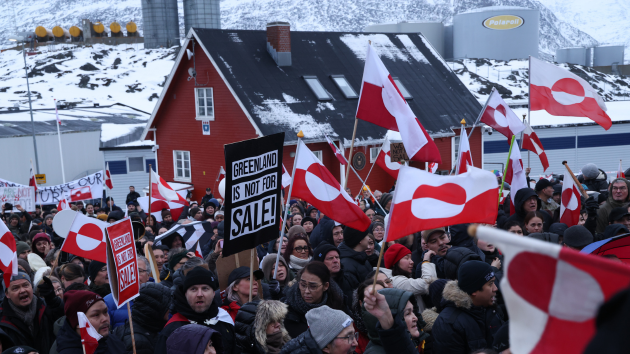
People bear Greenlandic flags as they gather in front of the U.S. consulate protest against U.S. President Donald Trump and his announced intent to acquire Greenland on January 17, 2026 in Nuuk, Greenland.(Sean Gallup/Getty Images)
(LONDON) — European leaders hit back at U.S. President Donald Trump’s announcement that he would impose sanctions on nations that deployed small numbers of military forces to Greenland last week, as the president continues his push to acquire the Arctic territory.
Trump said Saturday that a 10% tariff would be imposed on all goods sent to the U.S. from Denmark, Norway, Sweden, France, Germany, the U.K., the Netherlands and Finland.
Trump said the new tariffs will come into force on Feb. 1, and will increase to 25% on June 1. The president said the measures would remain in place until the U.S. is able to purchase Greenland.
Greenland is a self-governing territory of the Kingdom of Denmark. Trump first raised the prospect of acquiring the minerals-rich island in his first term. Danish and Greenlandic politicians have repeatedly rebuffed such proposals.
European Commission President Ursula von der Leyen on Saturday said the bloc’s members will meet Trump’s pressure as a united front.
“We have consistently underlined our shared transatlantic interest in peace and security in the Arctic, including through NATO,” she wrote in a post to X. “The pre-coordinated Danish exercise, conducted with allies, responds to the need to strengthen Arctic security and poses no threat to anyone.”
“Tariffs would undermine transatlantic relations and risk a dangerous downward spiral. Europe will remain united, coordinated and committed to upholding its sovereignty,” von der Leyen said.
Kaja Kallas, the EU’s foreign affairs chief, suggested in a post to X that the escalating tensions between the U.S. and its European allies is a boon for Moscow and Beijing.
“China and Russia must be having a field day,” she wrote. “They are the ones who benefit from divisions among allies. If Greenland’s security is at risk, we can address this inside NATO.”
“Tariffs risk making Europe and the United States poorer and undermine our shared prosperity,” Kallas wrote, suggesting the furor was distracting from allied efforts to support Ukraine against Russia’s ongoing full-scale invasion.
The eight countries — all NATO members — threatened with the tariffs issued a joint statement on Sunday saying they “stand in full solidarity with the Kingdom of Denmark and the people of Greenland.”
The statement says tariffs “undermine transatlantic relations and carry the risk of a dangerous downward spiral.” The signatories added that they are “committed to strengthening security in the Arctic region as a shared transatlantic interest,” and in this context, the planned military exercise in Greenland, “poses a threat to no one.”
EU pushback against Trump came alongside criticism from national leaders.
“France is committed to the sovereignty and independence of nations,” French President Emmanuel Macron said in a statement Saturday, adding that “no intimidation nor threat will influence us, neither in Ukraine, nor in Greenland, nor anywhere else in the world when we are confronted with such situations.”
“Tariff threats are unacceptable and have no place in this context. Europeans will respond to them in a united and coordinated manner if they were to be confirmed. We will know how to uphold European sovereignty,” Macron said.
British Prime Minister Keir Starmer said, “Applying tariffs on allies for pursuing the collective security of NATO allies is completely wrong.”
“Our position on Greenland is very clear — it is part of the Kingdom of Denmark and its future is a matter for the Greenlanders and the Danes,” he said.
Swedish Prime Minister Ulf Kristersson said discussions are ongoing between the affected nations to build a coordinated response.
“We will not let ourselves be blackmailed. Only Denmark and Greenland decide on issues concerning Denmark and Greenland,” he said.
Italian Prime Minister Giorgia Meloni said on Sunday that Trump’s decision to impose new tariffs was “a mistake and I do not agree with it.”
“The intention of some European countries to send troops, to take part in greater security, should have been understood not as an initiative directed against the United States but rather against other actors,” Meloni said.
Meloni said she spoke with Trump “a few hours ago” and “told him what I think.”
“A core meeting of the European Union has been organized but I believe that at this stage it is very important to talk to one another and that it is very important to avoid an escalation,” she added.
Trump has repeatedly suggested that U.S. sovereignty over the world’s largest island is necessary to ensure American security and blunt Chinese and Russian influence in the Arctic region.
“This is a very dangerous situation for the Safety, Security, and Survival of our Planet. These Countries, who are playing this very dangerous game, have put a level of risk in play that is not tenable or sustainable,” Trump posted on social media on Saturday, referring to deployment of small contingents of troops by European allies.
“Only the United States of America, under PRESIDENT DONALD J. TRUMP, can play in this game, and very successfully, at that!” he said in the post.
As a part of the Kingdom of Denmark, Greenland is covered by NATO’s collective defense clause. Greenland hosts the U.S. Pituffik Space Base and around 150 American troops, the U.S. having significantly downgraded its footprint from its high point during the Cold War.
A 1951 defense agreement grants the U.S. military access to Greenland. Danish politicians have repeatedly expressed willingness to work with Washington to expand the American and NATO presence there.
Danish officials have also sought to head off concerns about the supposed vulnerability of the Arctic. Last year, Copenhagen announced a $6.5 billion Arctic defense package in response to U.S. criticism that it had failed to adequately protect Greenland.
But such steps do not appear to have deterred Trump, who has said he would consider taking Greenland by force if other means to acquire the land fail.
A meeting in Washington, D.C., last week between U.S., Danish and Greenlandic representatives seemingly failed to de-escalate the standoff.
“It’s clear that the president has this wish of conquering over Greenland,” Danish Foreign Minister Lars Løkke Rasmussen told reporters after meeting with Vice President JD Vance and Secretary of State Marco Rubio. Rasmussen said that outcome was “totally unacceptable.”
Rasmussen said Saturday that the president’s threat came as a surprise, citing his “constructive meeting” with Vance and Rubio last week.
Rasmussen said in a statement that the purpose of last week’s military deployments to Greenland “is to enhance security in the Arctic.”
The continued U.S. focus on Greenland prompted protests there this weekend, with crowds of people turning out for a “Stop Trump” march through the capital Nuuk. Greenlandic politicians have collectively and repeatedly said they do not wish to join the U.S.
Trump’s efforts have also prompted congressional resistance. On Friday, a bipartisan group of House members and senators traveled to Greenland and said they had “constructive” conversations with members of Denmark’s parliament.
U.S. Sens. Jeanne Shaheen, D-N.H., and Thom Tillis, R-N.C., who were part of the delegation, released a statement Saturday warning that the tariff threat will hurt the U.S.’s relationships with its European counterparts.
“There is no need, or desire, for a costly acquisition or hostile military takeover of Greenland when our Danish and Greenlandic allies are eager to work with us on Arctic security, critical minerals and other priorities under the framework of long-standing treaties,” the lawmakers said in the statement.
Senate Minority Leader Chuck Schumer said on Saturday that Democrats will introduce legislation to block tariffs against countries who oppose a takeover of Greenland.
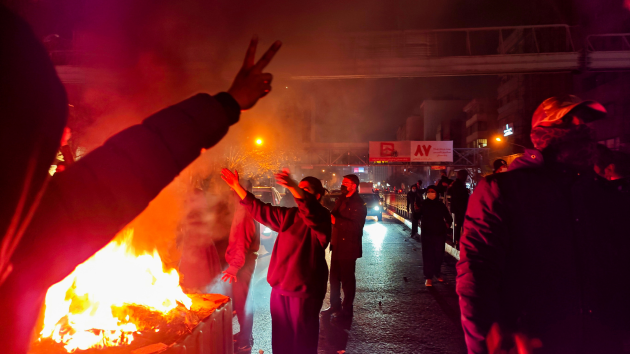
Fires are lit as protesters rally on January 8, 2026 in Tehran, Iran. (Anonymous/Getty Images)
(NEW YORK) — An extraordinarily violent crackdown by Iranian security forces appears to have succeeded for now in driving protesters from the streets, according to activists and analysts who managed to speak with people inside the country despite the information blackout.
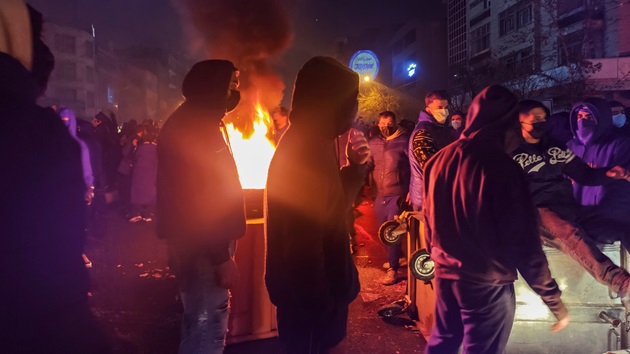
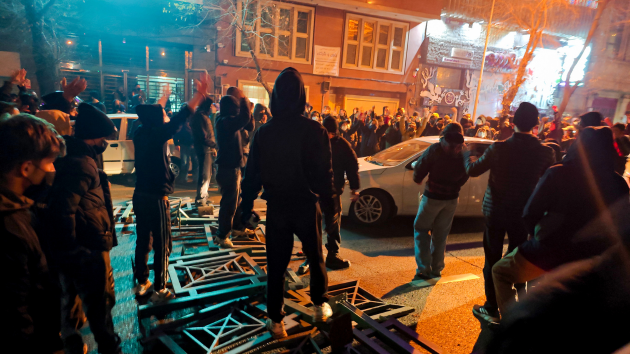
Demonstrations began in late December with protesters chanting in Tehran against rising inflation and the falling value of the national currency before spreading across Iran and becoming more explicitly anti-government. Authorities have shut down the internet in Iran for more than a week as security forces moved to crush the protests.
The internet blackout in Iran continues to make it very difficult to get a clear picture from the ground, but accounts are emerging from people now able to use phone lines, those few with access to working Starlink satellite terminals and Iranians who have recently left the country.
These people describe an eerie calm over Iran’s cities, where heavily armed security forces are deployed on the streets enforcing what many are describing as a de-facto curfew.
Mehdi Yahyanejad, an Iranian activist based in Washington, D.C., says he has helped send in hundreds of Starlink terminals to citizen journalists and others in Iran to help get around the government blackout.
“Unfortunately, the crackdown has been so severe the protests have pretty much come to a halt,” he said told ABC News on Thursday.
“There are security forces everywhere — there is a state of fear,” said Yahyanejad, who co-founded Net Freedom Pioneers, an anti-censorship group.
The smothering of the protests would seem to make U.S. military intervention less likely. President Donald Trump initially signaled there could be possible U.S. military action in support of protesters.
Yahyanejad said in the past few days there are still signs of dissent — people were heard chanting anti-regime slogans from windows. In some neighborhoods groups of youths have also gathered and shouted slogans, before quickly fleeing when security forces arrive.
The death toll from the crackdown continues to grow as more information comes out. The D.C.-based Human Rights Activists News Agency, HRANA, now puts it at more than 3,308 protesters killed since Dec. 28.
A total of 24,266 people have been arrested in the protests since they began, including 2,107 injured protesters with serious wounds, according to HRANA.
ABC News cannot independently verify these numbers. Although there have not been signs of major demonstrations in recent days, human rights groups are continuing to verify the identities of those killed over the weeks of unrest.
The Islamic Republic has not released a death toll, but Ayatollah Ali Khamenei said Saturday that thousands have been killed. Other Iranian authorities have said before that two-thirds of those dead are “martyrs” killed by protesters that they describe as “terrorists” and “mercenary agents of Israel and the U.S.”
Yahyanejad said while there was intense anger under the surface still, he doubted the protests would restart unless the U.S. launched strikes.
“I think if there is no action from the U.S., I don’t think they are going to come back that soon,” he said.
Regarding a possible U.S. response, President Donald Trump told reporters Friday afternoon that it was not Arab and Israeli officials who convinced him not to strike Iran, but that he made the decision himself not to strike the country.
“Nobody convinced me. I convinced myself,” Trump said.
Trump applauded the Iranian regime for what he claims is the cancellation of over 800 scheduled hangings on Thursday, according to what he said “are very important sources on the other side.”
“I greatly respect the fact that all scheduled hangings, which were to take place yesterday (Over 800 of them), have been cancelled by the leadership of Iran,” Trump said on his social media platform Friday.
The head of Iran’s judiciary, Gholamhossein Mohseni-Ejei, had suggested Wednesday that there would be expedited trials and executions for those who have been arrested in the nationwide protests. The Iranian government has yet to comment on Trump’s claim that the scheduled hangings have been halted.
Concerns about the safety of injured protesters There are fears the arrests are just beginning as the regime moves to round up protesters, activists and independent analysts told ABC News.
Injured people are frightened to visit hospitals or clinics because security officers are waiting for them there, according to Yahyanejad.
There are also allegations that during the mass killing, some severely injured protesters were removed from hospitals and executed, according to activists and analysts. The accusations are based on videos that show bodies still intubated or with catheters, but with bullet wounds to the head.
Reviewing the pictures of the bodies, Yasser Ghorashi, an Iranian doctor, told ABC News that hospitals in Iran never send a body to the morgue without removing all medical tools and devices.
The Toronto-based Iranian doctor said that he had been in touch with doctors inside the country who reported security forces had raided hospitals and taken injured protesters.
Their accounts match videos verified by ABC News that shows security forces raiding hospitals in Ilam, a city in west Iran, during the early days of the protests.
Protesters rally on January 8, 2026 in Tehran, Iran. Anonymous/Getty Images
(LONDON) — Erfan Soltani is one of thousands of Iranian protesters who have been arrested amid deadly anti-government protests nationwide, according to his family and human rights organizations.
Days after his arrest last week in Fardis — near the capital of Tehran — the 26-year-old was sentenced to death following an expedited trial, according to his second cousin, Somayeh, who has drawn attention to his case as ongoing internet and communication blockages limit information coming out of Iran about the protests.
“As someone who is an activist myself and who has fought this regime for many years, I felt it was my right — and my duty — to be Erfan’s voice outside the country, despite all the pressure and sanctions that fall on families,” Somayeh, who is based in Germany, told ABC News in an interview in Persian on Wednesday.
Somayeh, who did not want to share her last name, said Soltani’s family members had been told that he would be executed on Wednesday.
She was informed through the family that he had not been executed that day, she told ABC News. Somayeh added that the family said they had not seen her cousin in person yet.
President Donald Trump said on Wednesday that he had been told by “very important sources on the other side” that the executions are not happening.
“It was supposed to be a lot of executions today, and the executions won’t take place,” Trump said during remarks from the Oval Office on Wednesday.
Following President Trump’s remarks, the Islamic Republic judiciary media center announced Thursday that Soltani was not sentenced to death.
The judiciary, as quoted by the Islamic Republic of Iran Broadcasting (IRIB), said Soltani was currently being held at the central penitentiary in the city of Karaj on charges of “gathering and colluding against the country’s internal security and propaganda activities against the regime.” If convicted, the judiciary said, Soltani would be imprisoned but not executed, as “the death penalty does not exist in the law for such charges,” according to IRIB.
Reacting to the latest Islamic Republic judiciary’s announcement, Somayeh, said she is “happy to hear the news” but is still “concerned.”
“I am happy to hear this news from the media, but there is still concern because as far as we know, no contact has been made and Erfan is still in prison. We hope that his sentence will be completely overturned and he will be released,” Somayeh told ABC News Thursday morning.
In an interview with Fox on Wednesday, the Iranian foreign minister said there were no hangings on Wednesday, and that there won’t be for the rest of the week.
Somayeh said she is speaking out about her cousin, whom she described as a “kind soul” who is “so compassionate to people,” in hopes of having his sentence overturned.
“I felt responsible to make sure his voice was heard, so that maybe this sentence could be overturned — and beyond Erfan,” she said. “He is not the first and he will not be the last person to receive a death sentence overnight.”
According to the Human Rights Activists News Agency (HRANA), Iran carried out an “unprecedented” number of executions last year. In 2025, there were 2,063 recorded executions, the highest annual figure over the past 11 years, according to the report from the group.
Soltani’s case has been highlighted by international human rights groups such as the Hengaw Organization for Human Rights and Amnesty International, which said the international community must call on Iranian authorities to “immediately halt all executions.”
“Amid the Iranian authorities’ unprecedented crackdown on ongoing nationwide protests, marked by mass killings and sweeping arrests, concerns are mounting that authorities will once again resort to swift trials and arbitrary executions to crush and deter dissent,” Amnesty International said in a statement on Monday that highlighted Soltani’s case. “Iran’s head of judiciary ordered prosecutors to ‘act without leniency’ against protesters heightening fears for the lives of detained protesters and other dissidents.”
The first marches took place in late December in downtown Tehran, with participants demonstrating against rising inflation and the falling value of the national currency, the rial. As the protests spread, they have taken on a more explicitly anti-government tone.
More than 2,500 people have died during nationwide protests in Iran since Dec. 28, HRANA said Wednesday. The HRANA data relies on the work of activists inside and outside the country. ABC News cannot independently verify these numbers.
The Iranian foreign minister told Fox News on Wednesday that “hundreds” are dead.
Iranian Supreme Leader Ayatollah Ali Khamenei and top Iranian officials have said they are willing to engage with the economic grievances of protesters, though have also framed the unrest as driven by “rioters” and sponsored by foreign nations, prime among them the U.S. and Israel.
ABC News’ David Brennan contributed to this report.
People gather during protest on January 8, 2026 in Tehran, Iran. Demonstrations have been ongoing since December, triggered by soaring inflation and the collapse of the rial, and have expanded into broader demands for political change. (Anonymous/Getty Images)
(LONDON) — The Trump administration said Thursday it is sanctioning five top Iranian officials who they say are responsible for the nation’s “brutal crackdown on peaceful demonstrators.”
“Our message to the Iranian people is clear: Your demands are legitimate,” Treasury Secretary Scott Bessent said in a video on social media about the action. “You are protesting for a noble cause, and the United States supports you and your efforts to peacefully oppose the regime’s mismanagement and brutality.“
The targeted security officials include Ali Larijani, the secretary of Iran’s Supreme Council for National Security, who the Treasury said was “one of the first Iranian leaders to call for violence in response to the legitimate demands of the Iranian people.”
Commanders with the Law Enforcement Forces of the Islamic Republic of Iran and Islamic Revolutionary Guard Corps were also targeted, according to the Treasury Department.
“The officials sanctioned today — and their organizations — bear responsibility for the thousands of deaths and injuries of their fellow citizens as protests erupted in each of these provinces,” the Treasury Department said in a statement.
As part of the sanctions, the State Department said the U.S. is also designating the “notorious” Fardis Prison.
“As the brave people of Iran continue to fight for their basic rights, the Iranian regime has responded with violence and cruel repression against its own people,” State Department spokesperson Tommy Pigott said in a statement, which added, “We will continue to deny the regime access to financial networks and the global banking system while it continues to oppress the Iranian people.”
As of Wednesday, 18 days of protests and a resulting crackdown by security forces had seen 2,615 deaths and 18,470 people arrested, according to the U.S.-based Human Rights Activists News Agency (HRANA). Among the dead were 13 children and 14 non-protesting civilians, HRANA said.
On the government side, HRANA said it had confirmed the deaths of 153 members of the security forces.
Another 882 additional deaths remain under investigation, HRANA said.
The HRANA data relies on the work of activists inside and outside the country. ABC News cannot independently verify its numbers.
Iran briefly issued a notice, known as a NOTAM, closing its airspace to most flights, after U.S. President Donald Trump hinted at possible action against Iran and in support of anti-government protests which have roiled the country in recent weeks.
Iran’s Civil Aviation Organization confirmed on Thursday morning that flights were back in operation over the country, according to a statement carried by Iranian state-aligned media.
Protests have been spreading across the country since late December. The first marches took place in downtown Tehran, with participants demonstrating against rising inflation and the falling value of the national currency, the rial. As the protests spread, they took on a more explicitly anti-government tone.
The subsequent security crackdown has included a sustained national internet blackout, which — according to online monitoring group NetBlocks — had been in place for 156 hours as of Thursday morning.
On Wednesday, Cloudflare’s threat-intelligence unit said in a statement that it had “observed Iranian authorities targeting Instagram accounts with tools that perform bulk extraction of follower lists and account activity.”
Estimates of the death toll from the protests have varied, with the internet and communications blackout making it difficult to establish clear figures.
Stephane Dujarric, the spokesperson for United Nations Secretary-General Antonio Guterres, told reporters at a briefing on Wednesday, “We’ve seen numbers vary from 2,000 to 12,000. All of those numbers are horrendous, but I don’t have a number to share with you.”
Trump has repeatedly threatened military action against the government in Tehran — which is headed by its Supreme Leader Ayatollah Ali Khamenei — in response to violence against protesters.
Trump said Wednesday that he had been informed that the “killing” in Iran had stopped and that anticipated executions of arrested protesters would not take place.
The information was coming from “very important sources on the other side,” Trump said during an event in the Oval Office on Wednesday. “We’ve been told on good authority, and I hope it’s true. Who knows, right?” he added.
Asked by a reporter if this means that military action was now off the table, Trump responded, “We’re going to watch and see what the process is. But we were given a very good statement by people that are aware of what’s going on.”
On Tuesday, Trump had addressed protesters on social media, urging “Iranian Patriots” to “TAKE OVER YOUR INSTITUTIONS!!!” He added, “HELP IS ON ITS WAY.”
Khamenei and top Iranian officials have said they are willing to engage with the economic grievances of protesters, though have framed the unrest as driven by “rioters” and “terrorists” sponsored by foreign nations — prime among them the U.S. and Israel — and supported by foreign infiltrators.
Iranian officials have also threatened retaliatory strikes against U.S. and Israeli targets in the event of any outside intervention.
On Wednesday, a U.S. official confirmed to ABC News that some personnel had been advised to leave al-Udeid Air Base in Qatar due to increased tensions in the region.
Meanwhile, Tehran has signaled an intent to proceed with expedited trials and executions for those arrested during the protests.
The head of Iran’s judiciary, Gholamhossein Mohseni-Ejei, said Wednesday, “If we want to do a job, we should do it now. If we want to do something, we have to do it quickly,” in a video shared online by Iranian state television, according to The Associated Press.
“If it becomes late, two months, three months later, it doesn’t have the same effect,” Mohseni-Ejei said.
Speaking to Fox News on Wednesday, Iranian Foreign Minister Abbas Araghchi acknowledged that “hundreds” of people had been killed and again characterized the protests as an “Israeli plot” and a “terrorist operation.”
Araghchi said that the protests had died down and that the government is “in full control.”
ABC News’ Ayesha Ali, Morgan Winsor, Somayeh Malekian and Michelle Stoddart contributed to this report.
Steve Witkoff, US special envoy, arrives for a meeting at the Elysee Palace in Paris, France, on Tuesday, Jan. 6, 2026. US negotiators will join European leaders in Paris on Tuesday in the latest effort to hash out post-war security guarantees for Ukraine, President Volodymyr Zelenskiy said. Photographer: Benjamin Girette/Bloomberg via Getty Images
(WASHINGTON) — The Trump administration said Wednesday the Gaza peace plan is moving into the next phase, which it said “begins the full demilitarization and reconstruction of Gaza.”
“Today, on behalf of President Trump, we are announcing the launch of Phase Two of the President’s 20-Point Plan to End the Gaza Conflict, moving from ceasefire to demilitarization, technocratic governance, and reconstruction,” U.S. special envoy to the Middle East Steve Witkoff said in a statement on X.
The announcement comes as officials and observers question the stability of the Israel-Hamas ceasefire, which has largely held despite isolated violations.
According to Witkoff, phase two “establishes a transitional technocratic Palestinian administration in Gaza, the National Committee for the Administration of Gaza (NCAG), and begins the full demilitarization and reconstruction of Gaza, primarily the disarmament of all unauthorized personnel.”
Witkoff said the U.S. expects Hamas to “comply fully,” including by immediately returning the final deceased hostage, identified by Israeli officials as Ran Gvili.
“Failure to do so will bring serious consequences,” Witkoff said.
The Israeli Prime Minister’s Office said Wednesday that the return of Gvili “is a top priority.”
“Hamas is required to meet the terms of the agreement to exert 100% effort for the return of the fallen hostages, down to the very last one, Ran Gvili, a hero of Israel,” the office said in a statement on X.
Hamas spokesperson Hazem Qassem called the announcement on the second phase an “important positive development” and said they are “fully prepared to hand over the administration of the Gaza Strip” to the NCAG.
Qassem said they demand that the U.S. “compel” Israel to “fulfill the requirements of the first phase of the ceasefire agreement and move towards the second phase.”
The NCAG is a body of an expected 15 Palestinian leaders tasked with the monumental challenge of governing Gaza. The committee would be responsible for Gaza’s day-to-day management, including sanitation, infrastructure and education.
The NCAG will ultimately be run by a “Board of Peace,” which is expected to be made up of 12 as-yet-unannounced leaders. Trump and other European leaders are expected to lead the Board of Peace and oversee this newly formed committee. The announcement is expected in the coming days.
Speaking aboard Air Force One Sunday, Trump said the Board of Peace council would be made up of “the most important leaders of the most important countries,” though he did not name them.
U.S. officials confirmed Nickolay Mladenov, the former United Nations special coordinator for Middle East peace and a former Bulgarian foreign minister, will be appointed as the new senior representative for the Board of Peace and will oversee implementation of the plan. Mladenov is expected to serve as a liaison between the NCAG and the peace council.
American officials have said they hope that establishing the committee will help loosen Hamas’ grip on Gaza.
Witkoff on Wednesday thanked Egypt, Turkey and Qatar “for their indispensable mediation efforts that made all progress to date possible.”
In a joint statement, the three Middle Eastern countries said they “welcome the formation” of the NCAG, saying it is an “important development that will contribute to strengthening efforts aimed at consolidating stability and improving the humanitarian situation in the Gaza Strip.”
The initial phase of the peace plan, which launched in October 2025, saw the release of the remaining living hostages and the return of the remains of 27 deceased hostages in Gaza, as well as the release of more than 1,900 Palestinian prisoners that had been held by Israel. The first phase also entailed that the Israel Defense Forces pull back to the so-called “yellow line” in Gaza, intended as the first of three demarcation lines, and saw restrictions on humanitarian aid going into Gaza lifted.