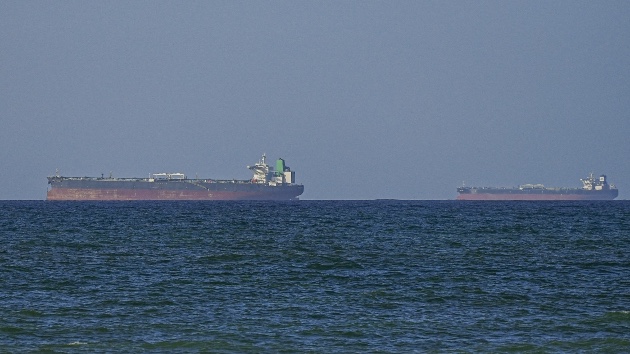
A view of the vessels heading towards the Strait of Hormuz following the two-week temporary ceasefire reached between the United States and Iran on the condition that the strait be reopened, seen in Oman on April 08, 2026. (Photo by Shady Alassar/Anadolu via Getty Images)
(LONDON) — As the world awaits a resolution on the fate of the Strait of Hormuz — one of the most vital global trade routes — the seafarers who have been stranded for weeks aboard ships and tankers on either side of the waterway are desperate for answers.
Nearly 20,000 people on some 2,000 vessels are currently trapped in the Persian Gulf, waiting for a passage that may not come anytime soon, according to the International Maritime Organization.
“It’s been almost 50 days since the war started, and uncertainty is our biggest fear,” one seafarer told ABC News, speaking anonymously for their safety. “Not knowing if we are going to get out of this situation alive is our main concern — because it doesn’t matter where you are in the Gulf, there is no safe place here.”
The seafarer said they have been waiting to cross since Feb. 28, the day the U.S.-Israeli war on Iran started and the moment vessel owners effectively halted traffic through the strait. Insurance companies stopped covering ships in the region almost immediately, bringing maritime traffic to a standstill on a waterway that normally carries as much as 20% of the world’s crude oil and refined petroleum products.
“There are several different dangers here,” the seafarer explained. “This is a very narrow, enclosed strait. There are reports of sea mines — we don’t know if they’re real or not, but it doesn’t really matter. Once the idea takes hold that mines might be there, no ship wants to pass. That’s the first issue. The second is that in such a confined space, we’re talking about the possibility of drones, unmanned vehicles, ballistic missiles — there are so many ways we could be attacked that I don’t think the U.S. military or any other military can realistically protect us.”
The fallout on global markets has been severe. The longer the strait remains closed, the deeper the energy crisis will cut, particularly across Asia, which depends heavily on Gulf oil exports.
High-stakes negotiations between Iran and the United States continue, with both sides debating the waterway’s reopening, but the only fact that matters to those waiting is that the Strait of Hormuz is still closed, and the threat of attack is likely to keep it that way.
“I’ve seen missiles passing over our heads,” the seafarer said. “I’ve seen drones and planes fly by every day, and we never know their intentions. I’ve watched vessels get hit with my own eyes.”
The seafarer’s experience has been echoed by others in the shipping industry.
“I gave my notice exactly one month ago,” another seafarer recently told The Guardian. “I’ve informed the master, I’m not willing to sail through the strait. It’s about safety, it’s all about safety.”
“I think a vessel owner or operator is going to feel extremely vulnerable considering the disconnect between diplomatic communication and military actions,” Joshua Hutchinson, chief commercial officer at maritime risk agency Ambrey, told ABC News.
He said the industry expects the strait to remain under the control of Iranian authorities while the United States intensifies operations against Iranian vessels. “This will put continued strains on new ceasefire and peace talks,” Hutchinson said.
Hutchinson said the industry needs “clear communication” in order for vessels to safely leave the Persian Gulf and clear the backlog. He forecasts it could take three weeks for all vessels to clear the strait.
The seafarer who spoke to ABC News described a grim scene currently of ships drifting with little direction, and listening on the ship-to-ship communication systems called the VHF line — accounts of crews growing desperate for basic provisions, and some begging to go home.
“There are vessels in this area right now rationing food and water. Crews aren’t getting paid properly, and crew changes are still extremely difficult to arrange,” the seafarer said. “You can hear other crew members talking about their situations — people saying they haven’t been paid, that food is running out. The worst part, for me, is hearing someone say they have no water.”
Since the conflict began, the International Transport Workers’ Federation (ITF) said it has received roughly 1,900 inquiries from seafarers across hundreds of vessels. About 20% were requests for repatriation; others raised concerns about dwindling supplies of fuel, food, and water.
“Civilian seafarers have already lost their lives, and tens of thousands more trapped near the Strait of Hormuz are spending every waking moment consumed by anxiety about how — or whether — they will make it home,” ITF Maritime Operations Coordinator John Canias said. “While many watching from afar see this through the lens of an energy or economic crisis, make no mistake: this is also a humanitarian crisis. Seafarers transport 90% of everything we rely on in our daily lives — food, medicine, fuel. They deserve far better than this.”
So far, the ITF says it has helped repatriate 450 seafarers from the region. For the thousands still waiting, relief has not come.
“We feel trapped — like we’re in a prison,” the seafarer who spoke to ABC News said. “The only way out is through the Strait of Hormuz, and right now, that’s not possible.”
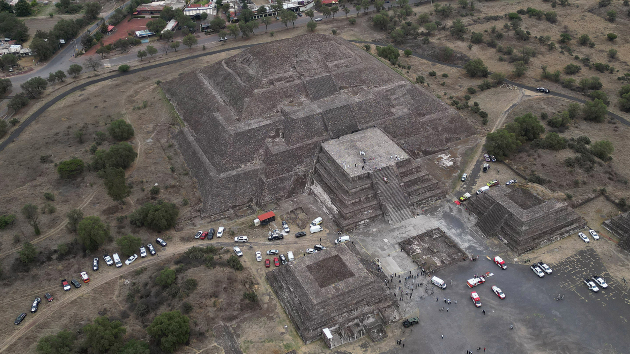
An aerial view of the Pyramid of the Moon following a shooting that left at least one person dead, at the Teotihuacan archaeological site, in Teotihuacan, Mexico on April 20, 2026. (Daniel Cardenas/Anadolu via Getty Images)
(NEW YORK) — The man who opened fire at one of Mexico’s busiest tourist sites was allegedly influenced by violent acts in the United States, Mexican officials said Tuesday.
The deadly mass shooting occurred during the late morning Monday at the Teotihuacan pyramids, an archaeological site outside of Mexico City. The shooter fired upon tourists from atop one of the pyramids while armed with a revolver that he reloaded at least twice before dying by suicide, according to José Luis Cervantes Martínez, the attorney general of the state of Mexico.
One person was killed and seven others wounded by gunfire, officials said. Several people also suffered injuries in the ensuing panic.
“We all know that we had not seen anything like this in Mexico before,” Mexican President Claudia Sheinbaum told reporters at a press briefing on Tuesday. “Based on information from the authorities, the individual showed signs of psychological issues and was influenced by incidents that occurred abroad.”
The gunman held a plastic bag containing 52 rounds of ammunition during the attack, according to Cervantes Martínez. The shooter also had a bladed weapon on him and handwritten materials reportedly related to violent incidents believed to have occurred in the U.S. in April 1999, the attorney general said.
The shooting occurred on the same day as the 1999 Columbine High School massacre.
“Evidence collected so far suggests a psychopathic profile of the attacker, characterized by a tendency to imitate violent acts that occurred in other places and at other times,” Cervantes Martínez said at Tuesday’s press briefing. “This phenomenon, known as a ‘copycat’ effect, is one of the lines of investigation in this case, as materials referencing violent acts and figures associated with such behavior were found.”
The gunman, identified as Julio César Jaso Ramírez, is not linked to organized crime and appears to have acted alone in a premeditated act, officials said.
“Investigative findings indicate that the attack was not spontaneous. The attacker had previously visited the archaeological site on several occasions, stayed in nearby hotels, and from there planned and carried out his actions,” Cervantes Martinez said.
The first report of an armed individual at the tourist site came at 11:20 a.m., officials said. State police and the Mexican National Guard responded and were also attacked. While returning fire, the gunman was shot in the leg by the National Guard, officials said. He shot himself while being subdued and died from a self-inflicted gunshot wound, officials said.
One person — a Canadian woman — was fatally shot and seven others suffered gunshot wounds during the attack, authorities said. Six others were also injured, such as from falls, in the incident, authorities said. Those injured were from Brazil, Canada, Colombia, the Netherlands, Russia and the U.S., officials said.
Sheinbaum said authorities are investigating how the attacker was able to enter the site with a weapon.
In the wake of the deadly shooting, Mexico will be increasing security at archaeological sites and other public locations across the country by increasing the presence of the Mexican National Guard and installing screening equipment, the president said.
“In light of this event, it is necessary to strengthen inspections to prevent anyone from entering an archaeological site or public space with a firearm,” Sheinbaum said.
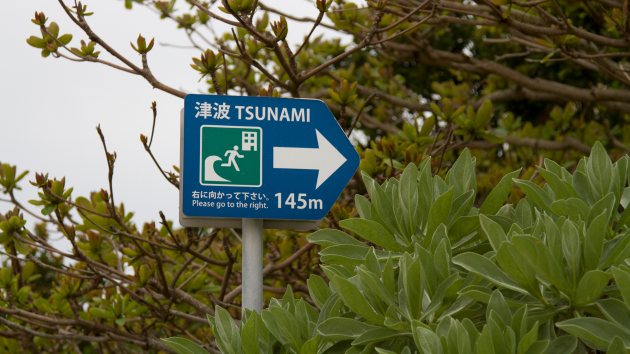
Table indicating the escape route in the case of tsunamis. (Getty stock photo)
(TOKYO) — A 7.4 magnitude earthquake struck on Monday off Japan’s northeastern coast, the U.S. Geological Survey said, prompting authorities to issue tsunami warnings and advisories along parts of the coast that were later downgraded to advisories and then cancelled.
“Based on the preliminary earthquake parameters, hazardous tsunami waves are possible for coasts located within 300 km of the earthquake epicenter,” USGS said after the quake was detected.
The Japan Meteorological Agency initially said tsunami warnings were in place for some of the coast along the Pacific, along with lesser advisories and forecasts farther away from the quake’s center.
“Residents in areas where tsunami warnings have been issued should immediately evacuate to higher ground or evacuation buildings and other higher, safer locations,” Prime Minister Sanae Takaichi said.
The tsunami waves that were expected to have been the highest struck the coast within hours, with the largest one registering about 80 cm, or about 2.5 feet, but officials said they had not ruled out further waves. Official warnings were still in place, although the U.S. weather officials said in an update that, based on available data, “the tsunami threat from this earthquake has now passed.”
Preliminary U.S. data pinpointed the quake about 100 km, or about 62 miles, off the eastern coast of Miyako, USGS said. Light rumbling could be felt as far away as Tokyo. A 5.6 magnitude earthquake struck nearby about 40 minutes afterward, according to USGS data.
The Japanese agency held a press conference on Monday, during which it identified the quake as having been a 7.5 magnitude one. The depth was 10 km, or about 6.2 miles. It occurred at 4:53 p.m. local time, the agency said.
A tsunami warning was issued under twenty seconds after the initial earthquake, an official said. Officials warned people to stay on the alert for about week, as an equal or lesser than quake may occur. The risk was especially elevated for the next two or three days, officials said.
The U.S. Tsunami Warning System said a “destructive” Pacific-wide tsunami was not expected “and there is no threat to Hawaii.”
ABC News’ Joe Simonetti and Victoria Beaule contributed to this report.
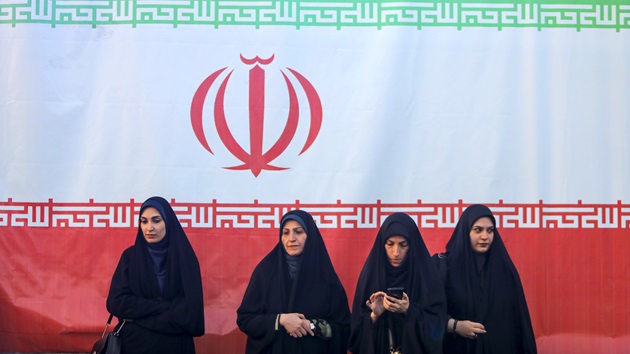
Women seen in front of an Iranian flag during a pro-government National Army Day demonstration on April 17, 2026 in Tehran, Iran. (Majid Saeedi/Getty Images)
(LONDON) — Even as a fragile two-week ceasefire between Iran and the U.S. holds – sparing about 90 million Iranians from the immediate threat of bombardment – many Iranians at home and abroad say they still face an intensifying wave of threats from the Islamic Republic regime as it continues cracking down on dissent.
The leaders of the Iranian regime have escalated measures to silence any kind of protests and criticisms against their policies both inside the country and across its diaspora, Iranians and observers inside the country and abroad told ABC News.
Shiva, a London-based Iranian journalist, says she has received direct threats from Iranian security forces, been labelled a “traitor” and had her assets in Iran confiscated. Shiva and other Iranians who spoke with ABC News in recent days asked not to be identified by their real names because of security concerns.
She is one of more than 400 Iranian journalists and artists abroad whose assets in Iran have been seized by the Islamic Republic for allegedly supporting what authorities describe as “hostile foreign actors,” according to a judiciary statement issued on April 11.
Since the beginning of the U.S.-Israeli war on Iran, the Islamic Republic judicial authorities have repeatedly said that they would adopt extreme measures against those who “collaborate with the enemy” – a broad accusation that they usually use against protesters.
The measures range from harsh sentences by the judiciary including death sentence and lengthy prison terms on protesters at home, to seizing local assets belonging to dissidents abroad.
Despite the threats against her, Shiva says she is most concerned about her family who live in Iran and could face harassment by authorities because of her reporting, she told ABC News on Wednesday.
Having covered the situation of human rights violations in Iran, she added that she is “extremely worried” about the situation of the imprisoned protesters in the country.
“What worries me is my family, and the people inside Iran,” Shiva said, “the voices of people inside the country are not being heard – those who are at risk of execution, those who are being silenced.”
A judicial authority told the state media on Tuesday that such moves are aligned with the new legislation of the country made to intensify penalties for espionage and cooperation with countries that are deemed as “hostile” to Iran including Israel and the United States.
Arrests, prison situation and executions
In the months before the war with the U.S. and Israel began in late February, the Iranian regime committed massacres to suppress a series of nationwide protests in the country while imposing an internet blackout to prevent voices of protesters and families of the victims from being heard by the world, and to disrupt their communication with one another, according to the U.S. and international observers.
According to the U.S.-based Human Rights News Agency (HRANA), over 7,000 people – including at least 6,488 protesters – were killed in the protests which had been ignited over the severe economic hardships with dramatic fall of the country’s currency in the last days of December 2025. ABC News could not independently verify those figures.
Security forces arrested more than 50,000 people across the country, HRANA reported. Two Iranian lawyers and several human rights activists told ABC News at the time that those behind the bars did not have access to basic rights including having access to a lawyer or a fair transparent trial.
Rule of fear
The situation got even worse for dissidents in Iran after the U.S. and Israel started the war on the country, Iranians told ABC News, following President Donald Trump’s Feb. 28 address to Iranians, in which he said that they can “take over” their government once the U.S. and Israel are finished.
“The hour of your freedom is at hand. Stay sheltered. Don’t leave your home. It’s very dangerous outside. Bombs will be dropping everywhere. When we are finished, take over your government. It will be yours to take,” Trump said in that address as the war began.
Iran’s police chief, Gen. Ahmad-Reza Radan warned Iranians in a March 11 interview on state TV that they would be shot dead if they came to streets to protest. “If people take to the streets to protest, we will do what we did to the enemy. Our hand is on the trigger,” Radan said.
During the war, main squares and streets of cities were again taken over by the police, armed forces and plain clothes security agents of the regime as several Iranians from Tehran, Isfahan, Rasht and other cities of the country told ABC News. The forces would not only control the streets on checkpoints, but would use loudspeakers to play religious and revolutionary propaganda songs.
“At night, I see the regime forces marching on the streets of my neighborhood,” Saghar, a resident of west Tehran, told ABC News after the war began.
“When I hear their voices, I feel like I want to scream,” she said. “I see them from the window and I get so angry that I like to throw everything I can at them. Why don’t I have a share of the streets of my city? Everywhere is under their control.”
Behind bars in an unknown location
The anger is even more fierce for many families of victims and prisoners of the protests.
Shailin Asadollahi, sister of an Iranian prisoner, told ABC News during the war that her family had no information at the time about the whereabouts of her brother Ali Asadollahi, a dissident poet, who was jailed by the regime. Asadollahi and many other prisoners had been transferred to locations unknown to their families after the war began, she said, creating a dire fear among families about their loved ones’ safety and wellbeing.
“I am so distressed and worried. I feel I struggle to even breathe when I think about where my brother is when bombs constantly fall over the city,” she told ABC News. “But Ali told us upon his arrest that no matter what happens to him we need to be the voice for all prisoners, not just him.”
“It is not just about us knowing where they are,” Shailin said. “Even a few prisoners who have called their families have said that they hear the bombs but don’t know where they are,” she added.
Following the destruction of some of the main judicial facilities of the country in the U.S.-Israeli attacks and closure of some state organizations, an Iranian lawyer in the country told ABC News that it had become almost impossible to get any update from the status of prisoners.
“Neither families nor us as lawyers know who to call and where to follow up the situation of the prisoners as no one from the judiciary is responsive,” the lawyer told ABC News. She asked not to be named over security concerns.
New arrests
Iranian authorities also appeared to accelerated arrests during the war and the current ceasefire on a range of charges, including espionage and actions against national security. The intelligence ministry and the IRGC intelligence forces publish news of recent arrests in different cities almost every day.
In one of the latest cases, 22 people were arrested in the southwestern province of Khuzestan, the semi-official Tasnim News agency reported, quoting the police.
Collaboration with the “enemy media” is one of the common charges for those who are arrested. The Iranian police chief said in March that 500 people were arrested for sending information to “the enemy and anti-Iranian media.” Hundreds more have been arrested since then according to the daily reports from Iranian authorities.
Record number of executions, observers say
HRANA said on April 2 that the implementation of death sentences in Iran has entered “a new and deeply alarming phase.” During the war, at least 10 political prisoners have been executed, and there is “a noticeable acceleration in executions,” HRANA reported.
Amirhossein Hatami, an 18-year-old protester, was one of those 10 protesters. He was executed on April 2, on charges related to the nationwide protests in the country in January, according to Mizan News Agency, the official news outlet of the country’s judiciary. The report added that Hatami was allegedly involved in burning a government property.
Amnesty International, writing on social media, described Hatami’s trial as “grossly unfair.”
Two other protesters, Mohammadamin Biglari and Shahin Vahedparast, who had been arrested for the same case were later executed three days later, Mizan reported.
A source close to one of the four prisoners’ families told ABC News that that these protesters along with two others arrested on this case had been moved from the prison’s general ward and their lives are under imminent threat of execution.
The recent execution of protesters comes despite Trump’s warnings to Iranian authorities before the war that continuing to execute protesters could trigger a strong response.
“The war was never about Iranian protesters and Iranian people’s rights,” Shadi, an Iranian woman from Rasht posted on her Instagram story in April along with the news of the recent executions.
“If Trump cared about us and our lives, there would be one point about human rights situation in Iran in their 15-point proposal,” she wrote. “But there is no mention of Iranian people in there. It is all about the oil and Iran’s proxies aboard and the Strait of Hormuz.”
At least 1,639 people were executed by the Iranian regime in 2025, which was 68% more than the year before and highest number recorded since 1989, according to a joint report by Norway-based Iran Human Rights (IHR) and Paris-based Together Against the Death Penalty (EPCM), on April 13.
Stifling journalism and activism
While Iranian journalists abroad like Shiva who have tried to do their jobs are now facing growing threats and potential punishment from the regime, journalists and activists inside the country face even harsher restrictions. Many are unable to speak openly about people’s suffering from the scars of war and state repression.
“Tyranny, war, sanctions, executions and imprisonment, all are tools for the destruction of Iran and the annihilation of its people’s lives,” Zia Nabavi, a dissident activist in Iran, wrote on his Instagram story in March.
Nabavi has spent more than a decade in prison for his activism and is one of many dissidents who believe the war will not bring about positive outcomes for Iranians.
Some believe that war against the Islamic Republic could lead to regime change. But Nabavi and others argue it would instead erode the fragile space needed to pursue social freedoms and equal rights, reducing public demands to survival amid the devastation caused by conflict.
Nabavi believes that those who impose executions, sanctions and wars on Iranians are different, but “the arrival of one does not mean the departure of another,” as they are all “life-killing,” he wrote.
“They can walk hand-in-hand to escort us toward the darkest possible fate,” Nabavi added in his Instagram story.
Despite the pressures – from war, censorship and ongoing security threats – journalists like Shiva say they will continue their work, documenting events and sharing stories about Iran.
“The Islamic Republic is trying to extend its censorship and intimidation beyond its borders. But it cannot silence me here,” Shiva said.
“They have already taken away my ability to return home, but they cannot take away my voice,” she said.
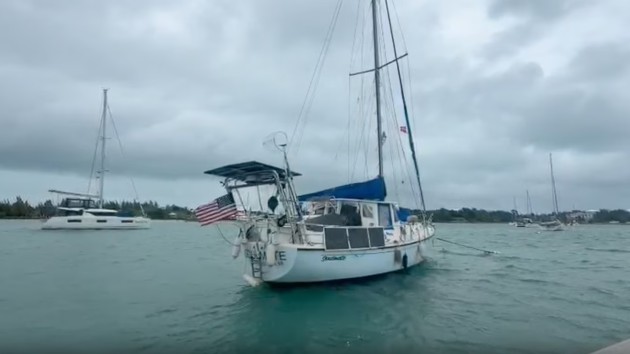
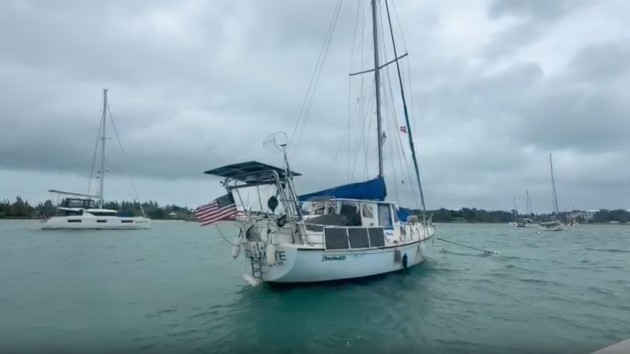
The Hookers’ boat, “Soulmate,” is seen in Marsh Harbor on Great Abaco Island in the Bahamas, April 8, 2026. (ABC News)
(NEW YORK) — More than two weeks after American Lynette Hooker went overboard and disappeared in the Bahamas, her daughter is speaking out to ABC News.
“It still feels surreal,” Karli Aylesworth said. “… This feels like something you just watch in a movie, but it’s my life.”
Aylesworth’s mother, Lynette Hooker, has been missing since the evening of April 4 when Aylesworth’s stepfather, Brian Hooker, said she went overboard. The couple had departed Hope Town for their yacht, Soulmate, in Elbow Cay, when bad weather caused her to fall off their dinghy, Brian Hooker told authorities.
Brian Hooker, 58, was arrested on April 8 and questioned by police. He was released on April 13 without charges.
Brian Hooker told ABC News on April 14 that he was staying in the Bahamas with a “sole focus” of finding his wife, “no matter how likely or unlikely that is.”
But Brian Hooker then left the Bahamas, his attorney said on April 15, noting that his mother is not well.
Aylesworth and her boyfriend said they doubted Brian Hooker’s story from the beginning and are now left with more questions than answers.
“I don’t understand how she drowned or got floated away,” Aylesworth said. “It just made me be more, ‘Why didn’t he do this? Why didn’t you do that? Why did that happen?'”
Aylesworth said she met with the Coast Guard and the Bahamian authorities, who allowed her to visit the sailboat her mother and stepfather called home.
“I went and got some of her belongings, like a headband. I got her ‘L’ necklace that she used to always wear. I got a picture frame I made for her, something that my grandma sewed for her,” she said.
“It was really hard because it was almost eerie, because I felt like she was going to, like, come out of the corner or something,” she said. “… Just knowing that she’ll never, I don’t know, it’s just hit me like a freight train that she’s not there.”
Table indicating the escape route in the case of tsunamis. (Getty stock photo)
(TOKYO) — A 7.4 magnitude earthquake struck on Monday off Japan’s northeastern coast, the U.S. Geological Survey said, prompting authorities to issue tsunami warnings and advisories along parts of the coast.
“Based on the preliminary earthquake parameters,” USGS said, “hazardous tsunami waves are possible for coasts located within 300 km of the earthquake epicenter.”
The Japan Meteorological Agency said tsunami warnings were in place for some of the coast along the Pacific, along with lesser advisories and forecasts farther away from the quake’s center.
“Residents in areas where tsunami warnings have been issued should immediately evacuate to higher ground or evacuation buildings and other higher, safer locations,” Prime Minister Sanae Takaichi said.
The tsunami waves that were expected to have been the highest struck the coast within hours, with the largest one registering about 80 cm, or about 2.5 feet, but officials said they had not ruled out further waves. Official warnings were still in place, although the U.S. weather officials said in an update that, based on available data, “the tsunami threat from this earthquake has now passed.”
Preliminary U.S. data pinpointed the quake about 100 km, or about 62 miles, off the eastern coast of Miyako, USGS said. Light rumbling could be felt as far away as Tokyo. A 5.6 magnitude earthquake struck nearby about 40 minutes afterward, according to USGS data.
The Japanese agency held a press conference on Monday, during which it identified the quake as having been a 7.5 magnitude one. The depth was 10 km, or about 6.2 miles. It occurred at 4:53 p.m. local time, the agency said.
A tsunami warning was issued under twenty seconds after the initial earthquake, an official said. Officials warned people to stay on the alert for about week, as an equal or lesser than quake may occur. The risk was especially elevated for the next two or three days, officials said.
The U.S. Tsunami Warning System said a “destructive” Pacific-wide tsunami was not expected “and there is no threat to Hawaii.”
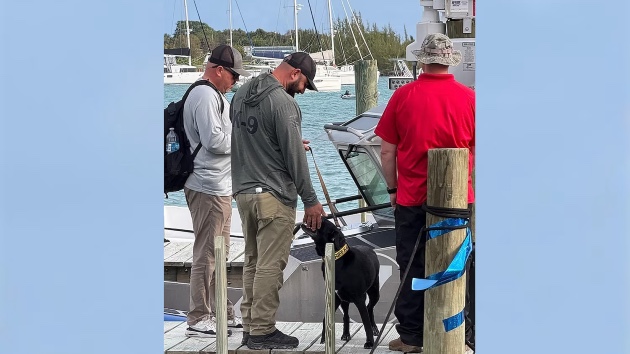
Cadaver dogs in the Bahamas to help search for missing American Lynette Hooker, April 16, 2026. (ABC News)
(NEW YORK) — The daughter of Lynette Hooker, an American woman who is missing in the Bahamas, has arrived on the islands with her boyfriend to help with the search after her stepfather, Brian Hooker, left the country.
Karli Aylesworth and her boyfriend, Steve Hansen, said they gave a statement to Bahamian police and plan on retracing her mother’s last steps.
“They’re just not releasing information because it’s an ongoing investigation, which we understand,” Hansen told ABC News.
“We seem frustrated because of the fact that we haven’t found her yet, and we would hope by now we would have,” he added.
Aylesworth’s mother, Lynette Hooker, has been missing since the evening of April 4 when Brian Hooker said she went overboard. The couple had departed Hope Town on the Abaco Islands for their yacht, Soulmate, in Elbow Cay, when bad weather caused her to fall off their dinghy, Brian Hooker told authorities.
Brian Hooker, 58, was arrested on April 8 and questioned by police. He was released on Monday without charges.
Brian Hooker told ABC News on Tuesday that he was staying in the Bahamas with a “sole focus” of finding his wife, “no matter how likely or unlikely that is.”
He said at the time that he planned “to go back to the boat, and then hire or beg people to help me go find some areas to search.”
But Brian Hooker then left the Bahamas, his attorney said on Wednesday, noting that his mother is not well.
Hansen said he and Aylesworth were surprised to learn her stepfather left.
“We’re not gonna say that he doesn’t deserve to see his mother before she dies, but we’re just saying Karli didn’t get that option. Karli didn’t get the option to see her mother before she died,” Hansen said.
The Royal Bahamas Defence Force said in a statement Thursday that the search and recovery work is ongoing, with operations involving “extensive shoreline patrols, sea patrols, aerial drone surveillance, and submersible drone operations.”
ABC News’ Brian Andrews contributed to this report.
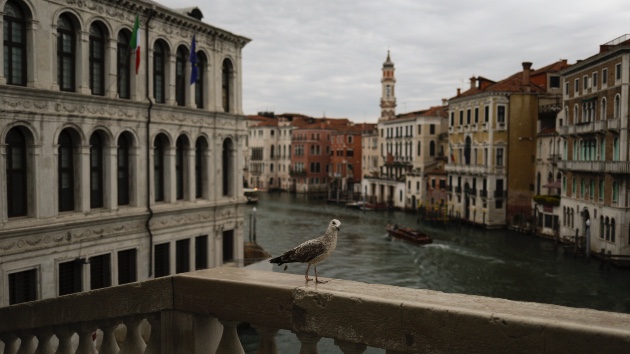
A seagull stands on the 16th-century Rialto Bridge over the Grand Canal in Venice, Italy, Monday, April 13, 2026. (Photo by Danil Shamkin/NurPhoto via Getty Images)
(VENICE, Italy) — One of the world’s most iconic cities could be heavily impacted by climate change and sea level rise in the coming years, leading researchers to search for solutions on how to protect it.
Venice, the historic Italian city known for its canals that serve as water traffic corridors, has been said to be sinking for nearly a century. The site within the vicinity of the Venetian Lagoon has flooded increasingly over the past 150 years, according to a paper published in Scientific Reports on Thursday.
Historically, there have been 28 events in which seawater flooding impacted at least 60% of the city, according to the paper. Eighteen of those events have taken place in the last century.
Piero Lionello, a professor of atmospheric physics and oceanography at the University of Salento in Italy and native Venetian, has noticed an uptick in flooding events throughout his lifetime, he told ABC News.
“The rate has been quite impressive the last three decades,” he said.
Climate experts are now calling for long-term planning to protect the city from rising sea levels over the next several centuries.
The Venetian Lagoon is a “special system” because it is so connected to the Adriatic Sea, said Lionello, the lead author of the paper.
Proposed strategies to prevent flooding as sea levels rise include movable barriers, ring dikes — which are circular or oval-shaped embankments designed to protect localized areas from floodwaters — or even closing the Venetian Lagoon and relocating the city, according to the paper.
Currently, the city is defended by a trio of movable barriers at the edge of the Venetian Lagoon. The MOSE project, installed in the 1990s, is a system of mobile flood barrier shields as tall as a five-story building that can be raised to separate the lagoon from the Adriatic Sea during high tides.
The system allows the waterways of Venice to function normally during high tide and has prevented flood disasters from storm surge. But it won’t be sufficient in the future, Lionello said.
“The present system, it will certainly be become inadequate,” he said.
The existing movable barriers may be effective against sea level rise up to 1.25 meters, or about 4.1 feet, according to the paper. But this benchmark is likely to be exceeded by the year 2300 under a low-emissions scenario due to rising global temperatures and ground subsidence — the gradual sinking of the ground — the researchers said.
Dikes may be necessary to protect Venice’s city center from the rest of the lagoon, according to the paper. The dikes would consist of walls surrounding the city, separating it from the lagoon, Lionello said.
Construction of dikes could cost between $600 million and $5.3 billion, according to the paper.
A “super levee” that could cost more than $35 billion to construct may be needed to close the lagoon and protect the land that is already below sea level.
If sea levels rise enough, it may be necessary for the city’s residents and historic landmarks to be moved inland, the researchers said. Relocating the city could be necessary beyond a 4.5-meter, or nearly 15-foot, sea level rise, which is projected to occur after 2300 under a high emissions scenario, according to the paper. Relocating the city could cost up to $118 billion, according to the researchers.
This solution is the most “provocative” and would involve moving individual buildings and monuments inland, Lionello said.
“You can preserve a building. You can have different solution to keep people living there, but it will be a completely different Venice from the Venice that we have now,” Lionello said.
The system of mobile barriers has been working overtime, according to officials. The MOSE barriers were lifted from the seabed to stop water from the Adriatic Sea from entering the lagoon 31 times during a six-month period between October 2023 and April 2024.
Climate scientists have predicted a steady rise in sea levels in the Adriatic Sea — with the lagoonal ecosystem in Venice experiencing relative sea level rise of about 2.5 millimeters per year, a 2021 study found.
Over the past 60 years, high tides in the Venetian Lagoon have become more frequent.
Between 1870 and 1949, 30 high tides exceeded 1.1 meters — or 3.6 feet — the level above which the MOSE barrier system is activated, according to the Venice Tide Study Center. There were 76 such high tides between 2015 and 2024 alone.
Rapid action to protect the city of Venice from climate change is “essential,” especially since the construction of large-scale interventions could take decades, the researchers said.
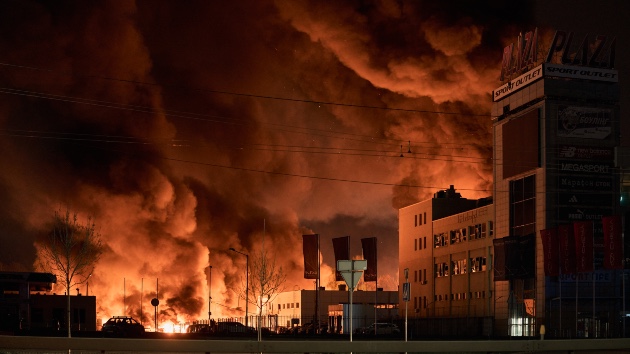
A large fire burns near a shopping center following an overnight Russian missile strike in the Podilskyi, Obolonskyi, Shevchenkivskyi and Desnianskyi districts, on April 16, 2026 in Kyiv, Ukraine. (Photo by Kostiantyn Liberov/Libkos/Getty Images)
(LONDON) — At least 16 people were killed and another 100 were injured in Ukraine as Russia targeted the country with a “massive” drone and missile attack on Wednesday and into Thursday morning, Ukrainian officials said.
Russia launched almost 700 drones and 19 ballistic missiles, along with cruise missiles, President Volodymyr Zelenskyy said. Ukraine shot down about 636 drones and “some” of the missiles, he added, saying, “Unfortunately, not all.”
At least 16 people were killed across Ukraine, officials said. Zelenskyy said at least 100 people had been reported wounded “as of now.”
“Tragically, there are fatalities in Odesa, Kyiv, and Dnipro,” he said in a social media post. “Among those killed is a boy — he was 12 years old. My condolences to the families and loved ones.”
Most of the missiles targeted Kyiv, the capital, the president said, but damage and deaths were also reported across the country. Some missiles or drones that made it through Ukraine’s defenses struck and damaged residential buildings, Zelenskyy said.
“Another night has proven that Russia does not deserve any easing of global policy or lifting of sanctions,” Zelenskyy said. “Russia is betting on war, and the response must be exactly that: we must defend lives with all available means, and we must also apply pressure for the sake of peace with the same full force.”
Russia has chosen to “deliberately terrorise civilians” with its attacks on residential areas, Antonio Costa, the European Council president, said on Thursday. The EU would continue to “increase pressure” on Moscow, he said.
“Russia must stop this war of terror,” Costa said. “A comprehensive, just, and lasting peace for Ukraine based on the principles of the U.N. Charter and international law must be achieved.”
Russian officials said on Thursday that Ukraine launched its own barrage of drones targeting several areas in Russia. Moscow said its military downed more than 200 drones. At least one Ukrainian drone struck a port on Russia’s Black Sea coast, along with other coastal cities, the local governor said.
The Hookers’ boat, “Soulmate,” is seen in Marsh Harbor on Great Abaco Island in the Bahamas, April 8, 2026. (ABC News)
(NEW YORK) — The husband of a woman who was reported missing in the Bahamas after going overboard on a dinghy was questioned again by police on Monday as he awaits any charging decision in connection with her disappearance, according to his attorney.
Lynette Hooker, 55, of Michigan, has been missing for over a week. She and her husband, Brian Hooker, 58, had departed Hope Town on the Abaco Islands for their yacht, Soulmate, in Elbow Cay around 7:30 p.m. on April 4, when bad weather caused Lynette Hooker to fall overboard, her husband told authorities.
Brian Hooker was arrested on Wednesday in connection with his wife’s disappearance and interviewed by Bahamian police for approximately three hours on Friday. Police subsequently requested an extension to give them until Monday evening to make any charging decision, according to his attorney, Terrel Butler.
He was questioned by police again on Monday for about an hour, according to Butler, who said investigators did not present any new evidence. She also said police have not given Brian Hooker any updates on the search for his wife since his arrest.
Police have until 7:20 p.m. ET Monday to charge or release him, according to Butler.
Butler said Brian Hooker is considered a suspect in his wife’s disappearance and denies any wrongdoing.
Following his initial interview on Friday, Butler said Brian Hooker was “questioned in relation to causing harm, which resulted in her death.”
“He definitely denies causing her death and he’s still asking about her and is hopeful that she will be recovered,” she continued, saying they have not been informed of any evidence that her body has been recovered.
The attorney said Brian Hooker is “heartbroken” over the disappearance of his wife of 25 years and that his arrest has been “traumatic.”
His arrest came after multiple sources told ABC News a criminal investigation had been opened into whether there was any wrongdoing in the case. The U.S. Coast Guard is leading the probe, according to a source familiar with the investigation.
In a statement posted to social media last Wednesday, Brian Hooker said “unpredictable seas and high winds” caused his “beloved Lynette to fall from our small dinghy” near Elbow Cay.
“Despite desperate attempts to reach her, the winds and currents drove us further apart. We continue to search for her and that is my sole focus,” he said.
Brian Hooker told police that his wife was holding the boat key when she went overboard, causing the 8-foot hard-bottom dinghy’s engine to shut off, according to the Royal Bahamas Police Force. He subsequently paddled the boat back to shore, arriving at a marina at around 4 a.m. on April 5, and reported his wife overboard, police said.
The Hookers documented their sailing travels on social media under the name “The Sailing Hookers.”
Lynette Hooker’s daughter, Karli Aylesworth, has called for a “full and complete investigation” into her mother’s disappearance.
She told ABC News her stepfather, Brian Hooker, told her that her mom “fell out of the boat and that he threw a life jacket to her or something, and he doesn’t know if she got it or not.”
Lynette Hooker’s mother, Darlene Hamlett, told ABC News she hopes “we find the truth” amid the investigation and alleged the couple have had a volatile relationship.
“I just want the truth to come out and I’m hoping that they can do that, and I hope they find her and that that will help clear up all of this,” she said.