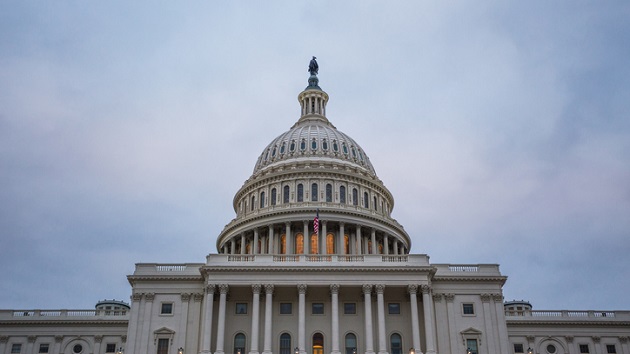
(WASHINGTON) — A bill introduced in Congress Wednesday by Democratic lawmakers seeks to end legacy admissions at many U.S. colleges and universities.
The so-called Fair College Admissions for Students Act would amend the Higher Education Act of 1965 to bar institutions of higher education that participate in federal student aid programs from giving admissions preference to applicants with legacy or donor status, a common practice at elite institutions.
The bill was introduced by Rep. Jamaal Bowman (D-NY) and Sen. Jeff Merkley (D-Oregon) in an attempt to address what they said is an unfair and inequitable admissions process that disproportionately benefits wealthy, white and connected students.
“All students deserve an equitable opportunity to gain admission to institutions of higher education, but students whose parents didn’t attend or donate to a university are often overlooked in the admissions process due to the historically classist and racist legacy and donor admissions practices at many schools across the country,” Bowman said in a statement.
Merkley said the bill would seek to level the playing field for minority and first-generation students especially.
“Children of donors and alumni may be excellent students and well-qualified, but the last people who need extra help in the complicated and competitive college admissions process are those who start with the advantages of family education and money,” he said in a statement.
The bill would allow the education secretary to waive the legacy preference ban for institutions like historically Black colleges and universities, tribal colleges and minority-serving institutions, which admit high levels of underrepresented students already.
Legacy preferences are common among selective colleges; according to the progressive think tank The Century Foundation, three-quarters of the nation’s top 100 national universities in U.S. News & World Report employ them, and nearly all the 100 liberal arts colleges do.
The legacy preference is worth an extra 160 points for children of alumni, researchers from Princeton University found.
Supporters of legacy preferences argue that legacies can help boost an institution’s ability to award financial assistance to low-income students.
Several institutions, including Johns Hopkins University and Amherst College, have ended their practice of legacy admissions in recent years.
Last year, Colorado became the first state to enact a law banning legacy admissions at public colleges and universities. In the wake of the “Varsity Blues” scandal, California didn’t ban legacy admissions but did require institutions whose students receive state financial aid to disclose how many applicants are accepted through the practice.
The Fair College Admissions for Students Act is introduced as the Supreme Court is poised to hear challenges to affirmative action, which also could have implications for many colleges and universities’ admissions policies.
(ARLINGTON COUNTY, Va.) — Former Senate Republican Leader Bob Dole — a decorated World War II veteran and presidential candidate who served in Congress for 36 years — will be laid to rest with military honors on Wednesday at historic Arlington National Cemetery.
Dole died on Dec. 5, 2021, after announcing last February that he’d been diagnosed with stage 4 lung cancer and was starting treatment.
Dole’s wife of 46 years, former Cabinet secretary and North Carolina Sen. Elizabeth Dole, and daughter, Robin, are expected to attend the invitation-only, graveside funeral with family members, close friends and former colleagues. Dole was given the rare honor to lie in state in the U.S. Capitol Rotunda late last year before his body was taken to his home state of Kansas for memorials and then back to Washington, where he’ll be laid to rest Wednesday afternoon alongside American war heroes.
Dole, a native of Russell, Kansas, served as an army officer in World War II and was severely wounded in action at age 21, left with permanent limited mobility in his right arm. Overcoming adversity, Dole went on to graduate law school, serve in the Kansas legislature, and represent his home state for four terms in the House of Representatives and five terms in the Senate, where he led the Republican Conference for more than a decade.
In Congress, he was an advocate for the rights of veterans and Americans with disabilities, spearheading the inclusion of protections against discrimination in employment, education and public services in the Americans with Disabilities Act in 1990. Dole also served as national chairman of the World War II Memorial Campaign which raised funds for the World War II Memorial to be built on the National Mall.
He ran three times for president, ultimately winning the Republican party nomination in 1996 but losing the general election to Bill Clinton, who was seeking a second term. Months later, Clinton presented Dole with the Presidential Medal of Freedom at the White House.
In a USA Today op-ed he finished on pen and paper less than two weeks before his death, Dole wrote Congress needs teamwork now more than ever, writing, “Those who suggest that compromise is a sign of weakness misunderstand the fundamental strength of our democracy.”
(WASHINGTON) — As the federal investigation into possible sex trafficking allegations against Rep. Matt Gaetz continues, his campaign’s fundraising has been dwindling.
In its latest campaign finance disclosure filed on Monday, the Gaetz campaign reported raising $534,000 in the final three months of last year — a major drop from the $1.8 million he raised in the first three months of the year, fresh off the 2020 election.
Overall, Gaetz’s fundraising has been gradually slowing down, dropping to $1.4 million in the second quarter and then to $527,000 in the third quarter.
A dip in fundraising between election years isn’t uncommon, and some of Gaetz’s GOP colleagues, like Rep. Marjorie Taylor Greene, saw a similar slowdown in fundraising from their earlier hauls. A joint fundraising operation between Gaetz and Greene also reported bringing in only $19,000 in the final quarter of 2021, compared to the nearly $360,000 it raised in the second quarter.
Meanwhile, as the sex trafficking investigation unfolded over the past year, disclosure records show that the Gaetz campaign’s legal bills rose significantly.
In total, from July 2020 through the end of December 2021, the Gaetz campaign reported spending nearly $200,000 on legal bills, minus $25,000 that was returned by a firm named Zuckerman Spaeder LLP two months after the Gaetz campaign paid that amount to the firm.
In the first few months of 2021, as news of the investigation into Gaetz and his associates emerged, the campaign also spent more than $800,000 on strategic consulting by PR firm Logan Circle Group — but the campaign’s payments to the firm dropped to under $3,000 in the final three months of 2021.
The latest financial disclosure filing also shows the Gaetz campaign has continued to pay the office of New York criminal defense attorney Marc Fernich, who lists on his website “notable clients” that include convicted sex offender Jeffrey Epstein. Among Fernich’s other clients are Mexican drug lord El Chapo, former mobster John “Junior” Gotti, and “alleged propagandist in Nazi Hungary” Ferenc Koreh, according to his firm’s website.
The Gaetz campaign made a $50,000 payment to Fernich’s firm in October, according to the latest filing — its second payment to the firm after a payment of $25,000 in June of last year.
As his fundraising slowed down last year, Gaetz’s campaign spending also dropped significantly, with disclosures showing most of his money going to direct mail messaging and fundraising.
“I’m the only Republican in Congress who doesn’t take lobbyist or PAC money. I rely exclusively on donations that average around $38,” Gaetz said in a statement to ABC News. “HBO made a movie about it called The Swamp.”
The financial disclosures come as the federal probe into possible sex trafficking allegations against Gaetz continues.
Earlier this month Gaetz’s ex-girlfriend, a one-time Capitol Hill staffer, testified in front of a federal grand jury that’s hearing evidence in the investigation, according to multiple sources. The ex-girlfriend, who ABC News is not naming, was one of the women allegedly on a 2018 trip to the Bahamas with Gaetz and others that prosecutors are investigating.
Sources familiar with the grand jury proceedings said the woman provided information regarding a phone call that prosecutors say occurred between her, Gaetz, and another woman who is also a witness in the sex-crimes probe and who met the congressman through his one-time friend, former Florida tax collector Joel Greenberg.
A week after Gaetz’s ex-girlfriend testified in front of the grand jury, Joe Ellicott, a close friend of Greenberg — who himself pled guilty last year to multiple charges including sex trafficking a minor — also agreed to plead guilty to fraud and drug charges. Ellicott, like Greenberg, allegedly attended multiple gatherings that involved drugs and young women who were paid for sex, sources told ABC News.
Ellicott also allegedly knows the one-time minor at the center of the sex trafficking investigation into Gaetz, as well as another woman who is involved, sources said. ABC News previously reported that in a private text exchange over the encrypted messaging app Signal, Ellicott allegedly told Greenberg in August 2020 that a mutual friend was worried she could be implicated in the investigation into the sex ring involving a minor.
The attorney for Gaetz’s ex-girlfriend, Tim Jansen, declined to comment when reached by ABC News.
The latest developments come after Greenberg, as part of a plea deal, had been steadily providing prosecutors with information that allegedly included years of Venmo and Cash App transactions and thousands of photos and videos, as well as access to personal social media accounts, ABC News previously reported.
Gaetz has denied all wrongdoing and has not been charged with any crimes. In a statement to ABC News responding to Ellicott’s guilty plea agreement, Gaetz’s chief of staff Jillian Lane Wyant, said, “After nearly a year of false rumors, not a shred of evidence has implicated Congressman Gaetz in wrongdoing. We remain focused on our work representing Floridians.”
Ellicott’s guilty plea hearing is set for Feb. 9, while Greenberg’s sentencing is slated for the end of March after being pushed back multiple times amid the ongoing investigation.
(WASHINGTON) — President Joe Biden began what he has said would be a bipartisan process to pick his Supreme Court nominee, hosting meetings at the White House on Tuesday amid Republican criticism of his history-making move to nominate the first Black woman to the bench.
Biden met with Senate Judiciary Chairman Dick Durbin, D-Ill., and the committee’s top Republican Chuck Grassley, R-Iowa, on Tuesday afternoon to consult with them on the nomination and confirmation process. Vice President Kamala Harris, who Biden has said will advise him on his selection, was also on hand for the Oval Office event.
“The Constitution says ‘advise and consent, advise and consent,’ and I’m serious when I say I want the advice of the Senate as well as the consent,” Biden told reporters at the top of the meeting.
“I’m looking for a candidate with character, with the qualities of … a judge in terms of being courteous to the folks before them and treating people with respect. As well as a judicial philosophy that is more one that suggests that there are unenumerated rights to the Constitution and all new members mean something including the Ninth Amendment,” Biden said.
He also reiterated his intention to announce his nominee by the end of the month.
“I think I’ll be courteous to the president and try to answer his questions,” Grassley told reporters on the Hill earlier Tuesday morning. “I don’t know what those questions are going to be, but I’m going to take the approach that we need somebody that’s going to interpret the law and not make a law because that’s Congress’s job.”
While some in the GOP have criticized Biden’s campaign pledge to nominate the first Black woman to the court, arguing all nominees should be considered for their qualifications, Grassley said he wouldn’t enter that debate until he sees the nominee.
“The president makes a nomination. That’s his privilege,” Grassley said.
Sen. Ted Cruz, R-Texas, meanwhile, doubled down on his belief to reporters that Biden’s pledge is “offensive” to Black women and claimed Tuesday that Democrats are “very comfortable discriminating based on race.”
“When Joe Biden throws out a quota that the only people he will consider for this nomination are African American women. He is number one rejecting regardless of merits everybody else, whether they are white or Black or Hispanic or Native American,” Cruz said.
Despite some Republican opposition, the White House has dug into the commitment, pushing back on the idea of Biden choosing a candidate just to get bipartisan support.
“The president is going to select a woman, a Black woman, who is qualified, who is prepared, who has impeccable experience to serve on the court,” White House press secretary Jen Psaki said Monday. He’s going to do that based on her credentials, of course having a discussion with her and not through gaming out the system.”
Psaki said Biden will also begin consulting with legal experts and scholars on the decision this week.
Senate Majority Leader Chuck Schumer applauded the president for his commitment to nominating a Black woman to the high court in an earlier floor speech and called on members from both sides of the aisle to embrace his efforts to diversify the court.
“Every single member of this chamber regardless of party should embrace the president’s commitment to make sure that our courts and especially the Supreme Court better reflect our countries diversity. And nominating a Black woman as justice is a long-overdue step to achieving that goal,” Schumer said.
“The more our judges reflect our nation’s vibrancy and diversity, the more effectively they will be able to administer equal justice,” he added.
Biden has not yet named a nominee but said he anticipates making a formal nomination before the end of February. Supreme Court nominees only require a simple majority of senators to vote for confirmation, which means there is little Republicans can do to block a Biden nominee if all Democrats — holding 50 seats in the Senate, and Vice President Kamala Harris acting as a tie-breaking vote — stick together.
No Black woman has ever been nominated or served on the U.S. Supreme Court. Two Black men and five women, in total, have served on the bench. There have been 115 justices.
ABC News’ Allison Pecorin contributed to this report.
(NEW YORK) — Former President Donald Trump announced Monday night that his political committees raised more than $51 million over the second half of last year, to buttress what is now a massive $122 million war chest.
Trump’s latest fundraising haul is a drop from the first half of last year, when his various committees together raised a total of $82 million from January through June of 2021.
It is possible that the $82 million sum Trump’s team announced for the first half of last year included transferred money raised in the final weeks of 2020, though the exact amount transferred from the previous year is unclear.
Trump’s war chest puts him in a uniquely strong position heading into the 2022 midterms and ahead of a potential 2024 presidential run.
The Republican National Committee also reported having $56.3 million cash in hand at the end of December 2021.
In a press release Monday, Trump’s Save America political action committee said that the $51 million was raised by the former president’s multiple committees from July 1 through Dec. 31, 2021.
The average donation Trump received between his committees was $31, with a total of 1,631,648 donations, the release said.
Notably, Trump doesn’t appear to be sharing many of his donations yet. With over $122 million in cash on hand, Trump says his PACs have only donated $1.35 million to “to like-minded causes and endorsed candidates.”
Save America’s filing shows that $1 million of that contribution went to the nonprofit Conservative Partnership Institute, which is led by a slew of Trump’s close allies, including Mark Meadows, Jim DeMint and Ed Corrigan.
Much of Save America’s money in the latter half of 2021 was spent on Facebook ads, payroll, and consulting fees for various firms, including $1.5 million paid to Tim Unes’ firm Event Strategies and $60,000 paid to former Trump campaign manager Brad Parscale’s firm Parscale Strategy, according to the filing. More than $240,000 also went to legal spending, the filing shows.
Over the past year, Trump has been fundraising with numerous allies through various vehicles, including his Save America PAC and his presidential campaign committee-turned PAC, Make America Great Again PAC.
Save America, in particular, was set up as a leadership PAC, which is designed to allow former and current lawmakers or prominent political figures to raise money and boost their allies, often with the purpose of advancing their political influence.
Last year, Save America raised $700,000 in a joint fundraising operation with Sen. Lindsey Graham, R-S.C. More recently, the PAC raised roughly $202,000 with Trump-endorsed Florida House hopeful Anna Paulina Luna, new disclosure filings show.
Save America had also raised massive sums with the Republican National Committee in the weeks following the 2020 election, but the two have since stopped officially fundraising together. The RNC and other GOP party committees, however, continue to frequently appeal to donors by using Trump’s name in fundraising emails and messages.
The RNC has also continued to help cover Trump’s legal bills over the past few months. As previously reported by ABC News, the national party committee has paid at least $720,000 to law firms representing the former president in various legal challenges, including criminal investigations into his businesses in New York, according to campaign finance records.
In the past few months the RNC’s fundraising has dipped in comparison to the substantially larger amounts it used to report every month while it was fundraising with Trump during the 2020 election cycle. However, the RNC’s fundraising still topped the DNC’s in the second half of 2021.
Between July and December 2021, the GOP national committee reported raising a total of $74 million, while the Democratic National Committee reported raising $65 million during the same period, disclosure filings show.
In all of 2021, the RNC raised $159 million while the DNC raised $151 million.
Jonathan Karl, Benjamin Siegel and Will Steakin, ABC News
(WASHINGTON) — Former White House Press Secretary Kayleigh McEnany turned over text messages to the House select committee investigating the Jan. 6 attack on the U.S. Capitol, according to a source familiar with the investigation — the latest indication of the extensive level of cooperation the committee has received from many witnesses.
McEnany, who was at work in the White House and around then-President Donald Trump before and during the Capitol attack, was subpoenaed by the panel for records and testimony in November, and turned over text messages to committee investigators.
A source familiar with her interactions with the committee has told ABC News that text messages from McEnany’s phone were quoted in a recent letter the committee sent to Ivanka Trump. The texts came directly from documents turned over by McEnany, said the source.
“1 – no more stolen election talk,” Fox News host Sean Hannity texted McEnany, according to the records. “2- Yes, impeachment and the 25th amendment are real and many people will quit.”
“Love that. Thank you. That is the playbook. I will help reinforce….,” McEnany replied, per the documents.
McEnany did not respond to calls and messages from ABC News seeking comment or to an email sent to a spokesperson for Fox News, where McEnany currently co-hosts the show “Outnumbered.”
A committee spokesman declined to comment and would not provide details on other text messages and documents turned over by McEnany.
McEnany appeared virtually before investigators for several hours on Jan. 13, according to a source familiar with her testimony, and did not appear that day on her midday Fox News program.
The committee was interested in her repeated false claims of widespread voter fraud from the White House Briefing Room podium, and in her interactions with Trump on Jan. 6, according to a letter the committee sent to McEnany along with the subpoena.
In addition to text messages and any other materials McEnany turned over to the committee, investigators are expected to receive her White House files from the National Archives, some of the many White House records Trump unsuccessfully tried to prevent the Archives from sharing with Congress.
The House select committee has interviewed more than 400 people as part of its investigation, and committee leaders say that most witnesses have cooperated with the panel’s requests and subpoenas.
“In general, people have been extremely cooperative. The closer we get to Trump, the more difficult it becomes,” Rep. Jamie Raskin, D-Md., recently told ABC News about the panel’s progress.
Former New York City Police Commissioner Bernie Kerik, who worked closely with Trump attorney Rudy Giuliani to seek out evidence of voter fraud, recently complied with the panel’s subpoena for records and testimony, as did former Trump campaign spokesperson Jason Miller.
However Trump ally Steve Bannon and former White House chief of staff Mark Meadows have openly challenged the committee’s subpoenas, leading Congress to hold both men in contempt and issue criminal referrals to the Justice Department.
The department has not acted on the Meadows referral, but Bannon was indicted by a federal grand jury on two counts of contempt of Congress in November. He has pleaded not guilty, and his trial is set to begin in July.
Meadows challenged the committee’s requests only after voluntarily turning over thousands of documents to the panel, a tranche that included emails and text messages that committee members say have helped them piece together conversations around Trump and the White House as the Jan. 6 attack unfolded.
Senate pages carry the Electoral College ballot boxes on Jan. 7, 2021 at the Capitol, in Washington. – Caroline Brehman/CQ-Roll Call, Inc via Getty Images
(WASHINGTON) — With voting rights legislation all but dead in the Senate, and the former president now openly suggesting he tried to use a vaguely-worded 19th-century law to try to manipulate the last presidential election, a growing group of bipartisan lawmakers is backing the idea of changing how Congress tallies presidential election results by reforming the 1887 Electoral Count Act.
The law was intended to set up a peaceful transfer of power after an election dispute, but it’s one former President Donald Trump and his allies sought to exploit in a scheme to overturn the 2020 election.
Trump made his clearest statement yet this week that he believed Pence could and should have simply overturned the results himself, responding to Sen. Susan Collins, R-Maine, who was asked about efforts to reform the law on ABC’s This Week With George Stephanopoulos.
He said, “…how come the Democrats and RINO Republicans, like Wacky Susan Collins, are desperately trying to pass legislation that will not allow the Vice President to change the results of the election?”
“Actually, what they are saying, is that Mike Pence did have the right to change the outcome, and they now want to take that right away. Unfortunately, he didn’t exercise that power. He could have overturned the Election!” Trump falsely claimed in a statement late Sunday.
By pressing then-Vice President Mike Pence to interfere with the ceremonial counting of electoral votes on Jan. 6, as well as outlining how states could — and several would — send conflicting slates of electors to Congress, and urging lawmakers to object to results, to which 147 Republicans followed, Trump took advantage of ambiguities in the law’s language.
Republican leaders have signaled an openness to amending the text, but Democrats argue the effort, while potentially bipartisan, does not address what they call state voter suppression tactics they say will be felt in the midterms and could be a distraction from larger voting reform.
Addressing reforms to the law, White House press secretary Jen Psaki said the White House has “been open to and a part of conversations about the Electoral Count Act,” but that it shouldn’t be a “replacement” for larger voting reforms. She also called attention to Trump’s statement as representing a “unique and existential threat to our democracy.”
Some scholars warn that if lawmakers don’t join together to reform the process, it will be weaponized again.
“There’s enough focus now on the ambiguities of this statute that if it isn’t Donald Trump in 2024, you could easily imagine a number of other actors taking a page from his playbook,” Rebecca Green, co-director of the election law program at William and Mary Law School, told ABC News. “But the ECA is not just specific to one presidential election or one person. It’s just become a more apparent problem to address after Jan 6.”
Here’s a look at the Electoral Count Act and why people are calling for it to be reformed:
What is the Electoral Count Act?
The Electoral Count Act is the law that governs how Congress counts electoral votes following a presidential election.
It essentially sets up a timetable for when different parts of the counting process must take place and sets up a dispute resolution process for how Congress will resolve irregularities in accepting electoral slates from states.
How did the law come about?
The law was crafted in response to a contested presidential election in 1876, when several states under the control of Reconstruction governments sent multiple slates of electors to Congress post-Civil War.
Samuel Tilden, a Democrat, had won the popular vote, but after Congress created an ad hoc commission to deal with the dispute, Republican Rutherford B. Hayes was ultimately declared the winner.
Democrats refused to accept the results until the Compromise of 1877, which called for an end to Reconstruction and the withdrawal of federal troops from former Confederate states. A decade later, Congress passed a law that lawmakers hoped would prevent a future process from being upended.
But it has presented problems.
What problems does it present?
While there are several proposals for ways to reform the law, such as changing the timeline for “safe harbor” status — when electoral votes are considered “conclusive” — or resolving questions around judicial review following election disputes, there are two glaring areas that Green told ABC News lawmakers need to address.
The role of the vice president is unclear
The vice president’s role in what usually is a ministerial proceeding — simply counting and announcing the votes — is extremely unclear.
The Constitution dictates that the president of the Senate, or the vice president, open the certificates of electoral votes from each state. Additionally, under the current Electoral Count Act, the president of the Senate carries over the proceedings and calls for objections.
The act says, in long, convoluted language, the each state’s slates or “all such returns and papers shall be opened by him” — the vice president, or president of the Senate — “in the presence of the two houses when met as aforesaid, and read by the tellers, and all such returns and papers shall thereupon be submitted to the judgment and decision…”
“Does this run-on sentence mean that Mike Pence shall open only the ballots that he wants? Or does he have to open if there’s more than one slate from a state — how does he know which ones to open?” Green posed. “None of those questions are answered by the face of the statute.”
She added, “Those vagaries produced the mischief that we saw in the 2020 election,” she added.
ABC News Senior Washington Correspondent Jonathan Karl reported in his book Betrayal: The Final Act of the Trump Show that then-White House chief of staff Mark Meadows emailed to Pence’s top aide a detailed plan penned by Trump’s campaign lawyer Jenna Ellis outlining how Pence was to send back the electoral votes from six battleground states that Trump falsely claimed he had won.
Washington Post journalists Bob Woodward and Robert Costa also revealed in their book, Peril, a memo written by John Eastman, whom Trump introduced at the Jan. 6 rally as “one of the most brilliant lawyers in the country,” outlined another plan for how Pence would hand the election back to Trump on Jan. 6.
According to their reporting, Eastman instructed Pence to say, at the conclusion of counting, “because of the ongoing disputes in the 7 States, there are no electors that can be deemed validly appointed in those States.” Then, Pence “gavels President Trump as reelected.”
Pence would have declared the seven states that submitted the alternate slates of electors as being in dispute, and ultimately hand the election to Trump in the alleged plot. However, Pence rejected the pressure to do so, sticking to his strictly ceremonial role, and the National Archives never accepted the uncertified documents for congressional counting.
Despite all the manipulation, scholars argue it isn’t reasonable to suggest the vice president would have been granted such interference.
“There has never been the kind of pressure that Mike Pence experienced on Jan. 6, 2021, before,” Green said, “but it would be extremely illogical for the system to instill that much power in sitting vice presidents, particularly since sitting vice presidents are so regularly on the presidential ballot.”
Additionally, the Justice Department and lawmakers on the House select committee investigating Jan. 6 are looking into those individuals who falsely signed on as alternate electors to declare Trump the winner in states he actually lost to Biden.
It’s ‘too easy’ for lawmakers to object to a state’s slate.
The law allows one congressman paired with one senator to object to the results submitted by each state — which last year, made way for a long, drawn-out process as Republican after Republican, including several freshmen, contested results. Eight senators and 139 representatives, all Republicans, voted to sustain one or both objections to electoral votes in Arizona and Pennsylvania.
If a congressman finds a senator to join in their objection, both the House and Senate chambers are forced back to their chambers for two hours of debate and a vote, which some argue is an invitation for political grandstanding.
The objection tool was used only once in its first 100 years. In all three recent cases, the attempts have failed.
In 2001 and 2017, no senator would join with a representative to object. (Biden, then serving as vice president, was the one to gavel out a handful of Democrats’ challenging Trump’s electors.) In 2005, a representative and a senator objected to counting Ohio’s electoral votes cast for George W. Bush, but the challenge was not successful.
Some lawmakers are now coalescing around the idea of raising the threshold for objections beyond just a single senator and representative — or to creating a list of valid ground for objecting results.
One proposal raises that at least one-third of each chamber would be needed for an objection to be heard — or more than 30 senators and 140 House members.
“The idea is that the current process is too easy and that perhaps it should be made a little bit harder to object, so that there’s more consensus required and a couple of people can’t kind of gum up the works as easily,” Green said.
Collins, who is leading discussions with a group of 16 senators to reform the law, said she’s hopeful it can be done on an “overwhelming” bipartisan basis.
“I’m hopeful that we can come up with a bipartisan bill that will make very clear that the vice president’s role is simply ministerial, that he has no ability to halt the count, and that we’ll raise the threshold from one House member, one senator, for triggering a challenge to a vote count submitted by the states,” she told ABC’s This Week With George Stephanopoulos. “This is no small thing. I think it is really important that we do this reform.”
Why act now?
Earlier this month, a Democratic-led committee released a 31-page report on potential reforms to the Electoral Count Act.
“As the events leading up to the violent attack on the United States Capitol on January 6, 2021, demonstrated, the Electoral Count Act of 1887 is in dire need of reform. It is antiquated, incomplete, vague, and open to exploitation,” Rep. Zoe Lofgren, D-Calif., chairperson of the Committee on House Administration. “But to be clear — reforming the Electoral Count Act, necessary as it is, would not restrain the erosion of democracy or the dishonest efforts across the nation to diminish and impede the equal freedom to vote.”
Key Republicans including Senate Minority Leader Mitch McConnell have expressed a willingness to back reforms, but Majority Leader Chuck Schumer has argued the reforms don’t go far enough in addressing threats to democracy and restrictions to the vote in elections beyond the race for president.
As the movement gains new bipartisan traction, election experts are calling for lawmakers to keep the momentum up.
“If these disputes aren’t resolved, then partisan actors are going to act a certain way and try to exploit ambiguities to their favor whereas if you sort of close those gaps prior to the election, then you’re more likely to have a fair process that produces an outcome without dispute that it’s legitimate,” Green said.
(WASHINGTON) — The Democratic National Committee announced it hit new fundraising highs, raking in $10.7 million in December and $157 million in 2021. Both figures are records for the committee in a non-presidential election year.
The haul by the DNC and its joint fundraising arm, first published by ABC News, provide a war chest to a party that’s set to face tough midterm election races across the country as the Biden administration sees poor polling numbers across a wide range of issues.
A new ABC/Ipsos poll finds troubling disapproval numbers for the administration’s handling of inflation, the economy, crime, among other issues. Only 1% of Americans believe the state of the economy to be “excellent,” according to the polling data, a clear series of hurdles the campaign arm of the Democratic Party must overcome if it wishes to maintain its razor-thin majority on Capitol Hill. Republicans only need to flip five House seats and one Senate seat currently held by Democrats to take both chambers of Congress.
The DNC, helmed by former Senate candidate turned Biden ally Jaime Harrison, was able to rake in large sums of cash, but recent reports allege fissures between Harrison and the White House, according to a report from NBC News.
Neither Harrison nor the White House reportedly have a clear strategy on how to rebound Biden’s struggling reputation, either, according to the report. Questions remain if those are obstacles the DNC — and Harrison — will navigate alone.
Without mentioning the report by name, Harrison took to Twitter Sunday to defend himself and his work.
“Only in DC … can you break a fundraising record & have folks complain it isn’t enough. That’s what the DNC did in ’21! The DNC work isn’t always easy & covid has created its own challenges. Our offices have been closed since 2020, but despite barriers we are making a difference,” Harrison tweeted as part of a longer thread.
“To unnamed sources … if you expect me to go away or roll into a ball and whimper… you picked the wrong one. The focus is upending the party of fraud, fear and fascism. You have the mission, now get with the program,” Harrison continued.
An advisor to President Joe Biden told ABC News Sunday that it has full confidence in Harrison’s leadership at the DNC.
“President Biden and Democrats are united – we’re focused on lowering costs for the American people while talking to the American people about our accomplishments – we created more jobs than in any one year in the history of the country and passed a historic Bipartisan Infrastructure Law,” the advisor said. “Jaime Harrison has been a critical partner in this effort, helping share our message with the American people, while working to put Democrats in the best position to win in 2022 and 2024.”
Democratic South Carolina Rep. Jim Clyburn, D-S.C., defended Harrison’s leadership in an interview with CBS’ “Face the Nation” Sunday morning, saying that the DNC leader believes in “fighting rather than switching.”
“He knows what it is to run. He knows what it is to lose,” said Clyburn. “Jaime Harrison is just what we need.”
And despite potential tumult between leadership and the White House, the DNC saw particular gains in its grassroots fundraising program, which also saw its best off-year pull. The grassroots team brought in $6.1 million in December, while the group’s major donor team raised $2.5 million over the last December averages.
One million people donated to the committee in 2021, beating out the previous record set in 2009 by at least 200,000 donors. Its end-of-year push surpassed the group’s $9.1 million haul in November.
The DNC now has $65 million cash on hand, a spokesperson told ABC News, which puts the group near even with late winter totals from the Republican National Committee, who ended November 2021 with more $65 million cash on hand. More recent RNC disclosures are not yet public.
Back in April, the group announced at least a $20 million investment in midterm battlegrounds, sending resources, such as increasing staffing, to key states such as Georgia, Florida, Arizona, Michigan, North Carolina, Wisconsin, hoping to replicate the successes in the Georgia runoff elections for this upcoming cycle, Harrison said at the time.
“We’re going to start our coalition-building earlier,” Harrison said in April, during the announcement of the multi-million dollar investment. “You’ve heard the criticism of the Democratic Party, ‘Why are they just sending people to our community three months before the election?’ Well, folks, we are going to end that right now. We are going to start sending people to your community now.”
(PITTSBURGH) — Just hours ahead of President Joe Biden traveling to Pittsburgh to stress improvements needed for the nation’s infrastructure, a bridge in the area collapsed on Friday morning, coincidentally providing Biden an opportunity to tout how his bipartisan infrastructure law provides funding for badly needed repairs.
Biden was scheduled to make 2 p.m. ET remarks on Friday at Carnegie Mellon University, a few miles away from the collapsed bridge near Pittsburg’s Frick’s Park. Ten people were reported injured, according to local authorities.
The White House said not said whether Biden will visit the collapsed bridge, but he has been briefed on the situation.
“The President has been told of the bridge collapse in Pittsburgh. Our team is in touch with state and local officials on the ground as they continue to gather information about the cause of the collapse. The President is grateful to the first responders who rushed to assist the drivers who were on the bridge at the time. The President will proceed with trip planned for today and will stay in touch with officials on the ground about additional assistance we can provide,” the White House said in a statement.
While the president’s domestic agenda has taken the back burner over the past week in the face of threats from Russia on the Ukrainian border and major Supreme Court news, Biden’s appearance puts the spotlight back on his victory in getting the bipartisan infrastructure law passed.
The legislation would provide $1.63 billion to Pennsylvania in federal funding for bridges alone, the third-highest figure for any state. Pennsylvania has 3,353 bridges in poor condition, the second most after Iowa, according to administration data. The bridge program will provide $27 billion across the country.
Pennsylvania, Biden’s home state, has long been a politically symbolic state for him.
Pittsburgh was where he kicked off his 2020 candidacy, and the Keystone State ultimately cinched his presidency. He also unveiled what became the bipartisan infrastructure law there last March.
But several of Pennsylvania’s high-profile Democratic candidates told ABC News, while they support the president and his policy efforts, they also won’t be in attendance for Friday’s event in Pittsburgh, citing “scheduling conflicts.”
A campaign spokesperson for Attorney General Josh Shapiro — who is likely to become the Democratic gubernatorial nominee — tells ABC News the Attorney General is “focused on the issues that matter to Pennsylvania families” but won’t be in Pittsburgh on Friday.
“Like every American should, Josh wants our president to be successful and we’ll continue welcoming President Biden to his home state of Pennsylvania as he touts small businesses and jobs that have been saved by the bipartisan American Rescue Plan and the tens of thousands of Pennsylvania jobs that will be created by the Bipartisan Infrastructure Law,” the campaign spokesperson said.
Lt. Gov. John Fetterman, a leading candidate in the Democratic Senate primary, told ABC News, “It’s great that President Biden is coming to Pittsburgh to talk about infrastructure. If infrastructure is Elvis, then Pittsburgh is Graceland. It’s great to come to the city that helped build America to talk about rebuilding America. I’ll be in Harrisburg on Friday meeting with Democrats from across the commonwealth at State Committee and talking about the 2022 midterm election.”
Rep. Conor Lamb, D-Penn., running for Senate in the state, will meet with Biden.
With Pennsylvania’s primary elections are still months away, the unfavorable poll numbers looming over the Biden administration could factor into how Democrats interact with the president on the campaign trail.
(WASHINGTON) — When word came that Supreme Court Justice Stephen Breyer was retiring, the spotlight almost immediately shifted to who might replace him — and getting a lot of attention has been Ketanji Brown Jackson, who clerked for Breyer about 20 years ago.
A Harvard Law School graduate, and now a federal appeals court judge, Jackson, despite her professional and academic accolades, considers hard work to be one of the most important factors, throughout her life, that got her where she is today.
She was born 51 years ago, in 1970, in Washington, D.C. Her parents, both public school teachers, had moved to Washington from Miami in the post-civil rights era.
She has recounted in a 2017 speech that her parents, wanting to show pride in their African ancestry, asked her aunt, who was then in the Peace Corps in Africa, for a list of African girl names.
Taking one of her suggestions, Jackson’s parents named her Ketanji Onyika, which she said they were told translates to “lovely one.”
In 2017, Jackson, in a lecture at the University of Georgia School of Law, revealed more of her personal side, reflecting not just on her legal career — but on dealing with motherhood at the same time.
“Right now, in fact, I’m in that peculiar stage of life when I experience near-daily whiplash from the jarring juxtaposition of my two most significant roles: U.S. district judge on the one hand and mother of teenage daughters on the other,” she said.
Jackson and her husband Patrick, a doctor, have two daughters, Talia who was 16 and Leila who was 12 years old at the time she told that story. During that same talk, Jackson said her family values include respecting everyone and making your best effort in everything you do.
“In our family, we have a mantra that emphasizes prioritization on work over play as one of our first principles,” Jackson said. “As the girls would testify, ‘do what you need to do before what you want to do’ is a constant refrain in our house.”
Jackson is currently serving on the Court of Appeals for the D.C. Circuit, considered the most important federal court next to the Supreme Court. It has jurisdiction over cases involving Congress and the executive branch agencies.
During her confirmation hearing for her current position, Republican senators grilled her on whether she thought race would play a factor in her decision-making.
Jackson said when she considers cases, she is looking at the facts and the law.
“I’m methodically and intentionally setting aside personal views, any other inappropriate considerations,” she said. “I would think that race would be the kind of thing that would be inappropriate to inject in an evaluation of a case.”
The Senate eventually made her the first Black woman confirmed to an appellate court in a decade. Right now, there are only six Black women serving as judges on federal appeals courts.
President Joe Biden said Thursday he is committed to keeping his campaign promise to nominate the first Black woman to the Supreme Court — and that pledge is bound to come up at confirmation hearings if he picks her.
She has noted she is “fairly certain” her ancestors were slaves on both sides of her family.
“It is the beauty and the majesty of this country, that someone who comes from a background like mine could find herself in this position,” Jackson said during her Senate confirmation hearing last year. “I’m just enormously grateful to have this opportunity to be a part of the law in this way, and I’m truly thankful for the president giving me the honor of this nomination.”
Former President Barack Obama interviewed Jackson in 2016 for the Supreme Court to fill Justice Antonin Scalia’s seat after his death.
Before that, Jackson said during her speech at the University of Georgia, her youngest daughter, Leila, came to her and her husband and asked if they knew Justice Scalia had died, leading to a vacancy on the nation’s highest court. Jackson said Leila’s middle school friends decided she should apply.
“Getting to be on the Supreme Court isn’t really a job you apply for,” Jackson said she explained to Leila. “You just have to be lucky enough to have the president find you among the thousands of people who might want to do that job.”
Jackson then shared how her daughter decided to write President Obama, telling him to consider her mom for the Supreme Court.
She said her daughter’s handwritten note read, “she is determined, honest and never breaks a promise to anyone, even if there are other things she’d rather do. She can demonstrate commitment and is loyal and never brags.”
Maybe true to form, Jackson has had no public comment since the news broke about her old boss, Justice Breyer, and whether she might soon replace him — and make history.