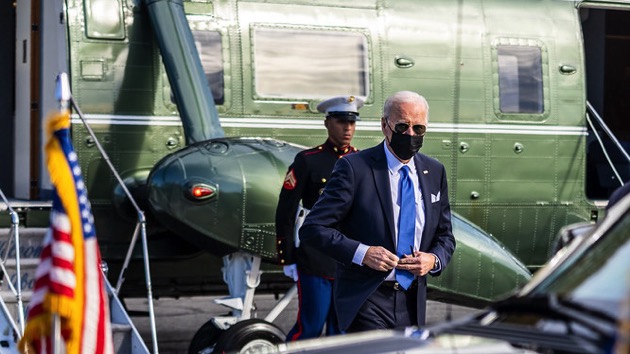
(WASHINGTON) — Second gentleman Doug Emhoff, the husband of Kamala Harris, has tested positive for COVID-19, according to the vice president’s office.
“Earlier today, the Second Gentleman tested positive for COVID-19,” Sabrina Singh, deputy press secretary for the vice president, said in a statement. “Out of an abundance of caution, the Vice President will not participate in tonight’s event [on Equal Pay Day]. The Vice President tested negative for COVID-19 today and will continue to test.”
Asked if Biden is being tested again this evening given his proximity to Harris earlier, the White House pointed out that isn’t required by COVID protocols.
Biden, as far as we know, was last tested on Sunday, and was negative.
This is a developing story. Check back for updates.
(BOISE, Idaho) — A bill that seeks to prevent most abortions from occurring in Idaho has just passed in the state legislature and is heading to the governor’s desk.
The bill is the first in the country to be modeled after the recent law passed in Texas that bans abortions after six weeks, before many women know they’re pregnant.
Idaho’s bill prohibits abortions after six weeks and allows the father, grandparents, siblings, uncles or aunts of the fetus to sue a medical provider who performs the procedure.
Family members can sue for a minimum of $20,000 within four years of an abortion. While a rapist wouldn’t be allowed to sue, their family members could.
The state House of Representatives passed the bill Monday night 51-14, almost exclusively along party lines, after the state Senate passed the bill earlier this month.
“This bill makes sure that the people of Idaho can stand up for our values and do everything in our power to prevent the wanton destruction of innocent human life,” state Rep. Steven Harris, a Republican and the bill’s sponsor, said in a statement following the vote.
The bill is now heading to Republican Gov. Brad Little’s desk to await his signature.
Little signed a similar “fetal heartbeat” bill into law last year that bans abortions after a fetus’ heartbeat is detected, and he is expected to sign this one as well.
The governor’s office did not reply to ABC News’ request for comment.
There are a few differences between the Idaho bill and the Texas law.
Both allow for exceptions in the case of a medical emergency, but the Texas law does not allow for exceptions in cases of rape or incest whereas the Idaho bill does allow for such exceptions.
However, women who want an abortion under those exceptions are required to file a police report and show it to the medical provider before the abortion.
Another difference between the two pieces of legislation is that the Idaho bill only allows for certain family members of the fetus to sue the medical provider who performed the abortion, but the Texas law allows almost any private citizen to sue any Texas doctor who performs an abortion, intends to perform an abortion or helps a woman receive an abortion.
Kim Clark, senior attorney at Legal Voice — a non-profit organization advocating for the legal rights of women, girls and LGBTQ people in the Northwest — said this could lead to women in abusive relationships being further harassed by their partners.
“This essentially makes the state complicit in intimate partner violence,” Clark told ABC News. “Allowing a member of the person’s family to bring a claim, that could include an abuser where the survivor hasn’t reported the assault.”
She continued, “When women are unable to access abortion care, rates of homicide or harm to other children can skyrocket.”
A November 2021 study from Tulane University in New Orleans found more pregnant women die by homicide every year than other pregnancy-related causes.
Compared to non-pregnant women of the same age, pregnant women were 16% more likely to die by homicide, the study found.
Chelsea Gaona-Lincoln, the Idaho programs manager for Legal Voice, said she doesn’t think lawmakers are trying to prevent unwanted pregnancies, pointing out that the Idaho House on Monday night also voted down a bill that would allow women to receive a six-month maximum supply of contraceptive prescriptions, up from three months.
“The same body voted down a contraception bill that would allow women to get birth control for up to six months,” she told ABC News. “They don’t really care about preventing unwanted pregnancies. This is about political control.”
(WASHINGTON) — President Joe Biden will to travel to Brussels next week to meet with NATO leaders in his first visit to Europe since Russian President Vladimir Putin began his violent invasion of Ukraine, the White House announced Tuesday.
At the show of unity on March 24, White House press secretary Jen Psaki said, Biden will “reaffirm our ironclad commitment to our NATO allies.”
His trip follows the prime ministers of Poland, Slovenia and the Czech Republic heading to Kyiv on Tuesday, as shelling continues there, in a show of support to Ukrainian President Volodymyr Zelenskyy despite the danger on the ground.
Just before the White House announcement, NATO Secretary-General Jens Stoltenberg tweeted, “I have convened an extraordinary Summit on 24 March at #NATO HQ. We will address #Russia’s invasion of #Ukraine, our strong support for Ukraine, and further strengthening NATO’s deterrence & defence. At this critical time, North America & Europe must continue to stand together.”
Biden will also join a scheduled European Council summit “to discuss our shared concerns about Ukraine, including transatlantic efforts to impose economic costs on Russia, provide humanitarian support to those affected by the violence and address other challenges related to the conflict,” Psaki said.
The goal of Biden’s trip to Brussels will be to meet “face-to-face” with his European counterparts to assess Russia’s invasion of Ukraine, she said.
“We’ve been incredibly aligned to date. That doesn’t happen by accident,” she said. “The president’s a big believer in face-to-face diplomacy. So, it’s an opportunity to do exactly that.”
She added that the NATO meeting is the “real focus right now,” and wouldn’t say if Biden will be making additional stops in Poland or to meet with refugees.
This is a developing story. Please check back for updates.
(WASHINGTON) — Americans will feel the impact of funding cuts to U.S. COVID response next week, senior administration officials said on Tuesday, as efforts to get more money from Congress sit stalled.
The first impacts will be felt by uninsured Americans, who will no longer be able to submit claims for tests or COVID treatments starting next week, they said. In two weeks, claims to cover vaccinations will no longer be accepted — meaning the program that has been covering people without insurance throughout the pandemic will effectively end.
Anyone seeking monoclonal antibody treatment for COVID will also face a tougher battle starting next week, officials said, when the government plans to cut supplies to states by 30%.
And a new purchase for hundreds of thousands more monoclonal antibody treatments, planned for March 25, will be canceled, senior officials said.
Making those cuts now will keep the U.S. monoclonal antibody supply on-hand until late May, officials said, when they predict the U.S. will fully run out of antibody treatments.
“These are immediate, near-term consequences, some of which we’re having to act on this week, next week, and the first week of April. So time is not on our side. We need the funding immediately,” one senior administration official told reporters.
Biden and his administration have warned for weeks that there was not enough money left to support critical COVID-19 response efforts, including testing at the current pace, purchasing more COVID-19 treatments and acquiring more booster shots.
But pleas for Congress to allot billions more in its latest funding bill fell short last week, leaving government relief efforts strained.
The White House is expected to lay out more details of the cuts in a letter to congressional leadership later Tuesday, senior officials said, and have held meetings on Capitol Hill since February briefing members of Congress on the funding shortfalls.
In a statement highlighting what it said would be the impact, the White House said, “The federal government does not have adequate resources to purchase enough booster vaccine doses for all Americans, if additional doses are needed.
The administration officially requested $22.5 billion earlier this month.
Officials also warned about a faltering defense against any new variants, if more funding isn’t granted by Congress.
“We want to be clear, waiting to provide funding until we’re in a worse spot with the virus will be too late,” an administration official said.
Lack of funding will hamper USAID efforts to vaccinate people abroad, officials said, meaning that “large unvaccinated populations worldwide will increase the risk of new deadly emerging variants emerging that could evade our current vaccines and treatments.”
And in the instance of a new variant, the U.S. would not have the money to buy new variant-specific vaccines for all Americans to get vaccinated, if that becomes necessary, officials warned.
Research on new vaccines and treatments will also be affected by cuts, officials said, including progress on a pan-coronavirus vaccine, which could protect against a range of variants.
On testing capacity, the administration said that current domestic supply will get Americans through June, despite earlier warnings that Americans would see less testing availability starting this month.
“Without additional funding, we do not have the ability to maintain our domestic testing capacity beyond June,” a senior administration official said.
“And because it takes months of ramp up to rebuild capacity, failure to invest now will leave us less prepared for any potential future surges. So, providing funding only when cases rise is far too late to make a difference,” the official said, noting that the U.S. felt the impact of that mistake firsthand during the omicron surge.
Preparing for future surges is becoming increasingly relevant again as cases rise in the U.K. and China due to the BA.2 variant, which is a more transmissible strain of omicron.
But for now, the path forward for COVID-19 relief is murky.
The White House’s request was chiseled down to less than half as much in Congress last week, before it was later cut from the larger spending bill entirely.
Approval for more funding hinges on agreement from Republicans in the Senate, who oppose more spending and say they weren’t given clear warning on the need for more money until too recently.
“Before we would consider supporting an additional $30 billion for COVID-19 relief, Congress must receive a full accounting of how the government has already spent the first $6 trillion,” a group of 25 Republican senators wrote in a letter to the White House in early March.
But Democrats in the House were also splintered last week after leadership agreed to dip into funding that was already allotted to state governments to cover the latest request.
On Tuesday, a senior administration official steered clear of any specific advice for Congress to get the funding approved, but said there is “precedent” for bipartisan support for COVID relief under the previous administration.
(WASHINGTON) — The White House is preparing to “stop critical COVID response efforts” as additional funding for COVID-19 relief sits stalled in Congress, a person familiar with the plan told ABC News.
Biden and his administration have warned for weeks that there was not enough money left to support critical COVID-19 response efforts, including testing at the current pace, purchasing more COVID-19 treatments and acquiring more booster shots.
But pleas for Congress to allot billions more in its latest funding bill fell short last week, leaving government relief efforts in a “dire” place, the White House said.
While it’s not yet clear which response efforts will get cut back, the White House is expected to lay that out in a letter to congressional leadership later Tuesday, according to the person familiar with the White House’s plans.
White House press secretary Jen Psaki previewed the cuts on Monday, warning reporters that “some programs, if we don’t get funding, could abruptly end or need to be pared back.”
She also stressed that the U.S. needs to be ready to respond to a potential increase in cases like the upticks currently happening in the U.K. and China due to the BA.2 variant, which is a more transmissible strain of omicron, and said that any reduction in the United States’ COVID-19 response could hamper the country’s ability to fight back this variant or future ones.
The White House had previously requested around $30 billion in additional COVID-19 funding — a request that was chiseled down to less than half as much in Congress before it was later cut from the larger spending bill entirely last week.
The path forward on a spending bill solely for COVID-19 relief, the only other option, is murky.
In the meantime, the White House has estimated that without more funding, testing capacity will become strained this month, while in April, coverage for testing and treatment of uninsured people will run out, and in May, the U.S. will run out of monoclonal antibodies.
The U.S. supply of COVID-19 treatment pills that significantly reduce the risk of hospitalization, such as those made by Pfizer and Merck, will run out in September if the government doesn’t soon place more orders, the White House said.
On Monday, a White House official said they were still “assessing the impact that a continued lack of funds will have on all elements of our pandemic response, including where programs may need to abruptly end or be pared back and what gaps this will leave in our ability to provide protections.”
In Congress, approval for more funding hinges on agreement from Republicans in the Senate, who oppose more spending.
“Before we would consider supporting an additional $30 billion for COVID-19 relief, Congress must receive a full accounting of how the government has already spent the first $6 trillion,” a group of 25 Republican senators wrote in a letter to the White House in early March.
But Democrats in the House were also splintered last week after leadership agreed to dip into funding that was already allotted to state governments to cover the latest request.
The White House said it’s been briefing members of Congress and answering questions since mid-January on the need for more funding and detailing the consequences if funding runs out.
(WASHINGTON) — The Pentagon has been providing daily updates on the Russian invasion of Ukraine and Ukraine’s efforts to resist.
Here are highlights of what a senior U.S. defense official told reporters on Monday:
Fallout from deadly airstrike near Polish border
On Sunday, Russian long-range bombers launched “more than a couple dozen” cruise missiles at a western Ukrainian training facility near Yavoriv, about 10 miles from the Polish border. All of the missiles were launched from Russian airspace, damaging at least seven buildings, according to the official.
The attack left at least 35 dead and 134 wounded, according to Ukrainian officials.
Russia also hit two airfields in western Ukraine on Friday in the towns of Lutsk and Ivano-Frankovsk.
During a Monday press briefing at the Pentagon, press secretary John Kirby said the strikes in western Ukraine are part of a broadening Russian assault across Ukraine.
“I wouldn’t think that that we would consider this or the other strikes in western Ukraine as some sort of turning point,” Kirby said, but adding, “The Russians clearly are expanding some of their targets sets.”
“If Mr. Putin was trying to signal his displeasure about a strong, united NATO with this war of his then he’s failed, because he’s getting exactly what he says he doesn’t want — a strong, united NATO on his Western flank,” Kirby said.
While there were 150 Florida National Guardsmen training Ukrainians on part of the base as recently as February, all U.S. troops and contractors were pulled from the country before the beginning of the invasion.
The strike occurred after the Kremlin claimed arms shipments to Ukraine are “legitimate targets,” but the U.S. official said no security assistance sites were hit in this case.
Kirby confirmed the training center was not being used to funnel U.S. weapons to Ukrainian forces.
“I would just tell you that we have multiple routes to get security assistance into the hands of the Ukrainians,” Kirby said.
In total, Russia has now launched more than 900 missiles against Ukraine, according to the senior U.S. defense official. This estimate is up from 810 on Friday.
Reports of Russia seeking military supplies from China
“I would just say that we’re going to watch that very, very closely. And as others in the administration have said, if China does choose to materially support Russia in this war, there will likely be consequences for China,” the official said.
Cease-fire talks
“We want to see the violence stop,” the official said. “All I can do is tell you what we’re seeing on the ground, and what we’re seeing on the ground is a continued military effort to subdue these population centers and to do it now with ever more violence using more and more long-range fires, which are increasingly indiscriminate in terms of what they’re hitting.”
Russian advance mostly stalled
“Almost all of Russia’s advances remain stalled,” the official said.
Kyiv: The Russians closest to Kyiv are still near Hostomel Airport to the northwest, about 9 miles (15km) from city center. Some troops are moving in behind those advance forces, “but not at a great pace,” the official said.
The forces approaching from the east are still about 12-19 miles from the heart of Kyiv, according to the official. This was the same estimate given by the official on Friday.
“No real progress to speak to,” the official said of these forces.
They’re facing heavy resistance from the Ukrainians. The U.S. assesses the defenders still have control of Brovary, just east of the capital, where in videos published last week we saw a column of Russian tanks hit.
Kharkiv: Significant fighting continues over Kharkiv, with Russians relying more and more on long-range missile attacks.
The U.S. sees a new line of advance with 50 to 60 vehicles moving from the southwest of Kharkiv down toward the town of Izyum.
“The assessment is that they are trying to block off the Donbass area and to prevent the flow westward of any Ukrainian armed forces that would be in the in the eastern part of the country, prevent them from coming to the assistance of other Ukrainian defenders near Kyiv,” the official said.
Mariupol: The city remains isolated and under heavy bombardment, with Russian forces to the north and east. Ukrainians continue to fight back, the official said.
Mykolayiv: Russian forces remain roughly where they were Friday, about six to nine miles northeast of the city. Ukrainians continue to resist.
It is unclear what the Russian plan is for Mykolayiv.
“It could be a left turn to move on Odessa from the ground or it could be they go north up towards Kiev,” the official said.
Odessa: The Pentagon still sees no sign of any looming amphibious assault on Odessa, according to the official.
Ukrainians going after Russian supplies
“The Ukrainians, as we’ve said all along, they’ve been quite creative here. They’re not simply going after combat capability — tanks and armored vehicles and shooting down aircraft — although they’re doing all that. They are also deliberately trying to impede and prevent the Russians’ ability to sustain themselves,” the official said, citing the long Russian convoy as one example.
(WASHINGTON) — President Joe Biden’s dual promises to consider NATO’s Article 5 a “sacred obligation” but also not to have U.S. forces engage with Russia in Ukraine may be increasingly difficult as Russian President Vladimir Putin expands the scope of his attack — with a barrage of missiles striking near Ukraine’s border with NATO ally Poland over the weekend, along with intense shelling in Kyiv overnight.
The U.S. has also warned about a possible chemical weapons attack and a senior administration official told ABC News earlier Monday that Russia is “desperately” asking for Chinese help — with China “considering” giving the Russians “airstrike capabilities.”
But amid signs that Putin is escalating, it remains unclear what consequences Russia would face from the U.S.
Russian forces targeted a military training site over the weekend in western Ukraine that had housed Western volunteers and members of the Florida National Guard training Ukrainian counterparts before the invasion. At least 35 people were killed and 134 injured, according to Ukrainian officials. There were “no Americans at all working there,” Pentagon press secretary John Kirby said Sunday.
In what some are considering a provocative message to the West, the attack — just 10 miles from Ukraine’s border with Poland — has raised the prospect of the Kremlin being increasingly likely to target Poland or other NATO allies helping to supply Ukraine. That comes on top of concerns that Russia is laying the propaganda groundwork to use chemical weapons in Ukraine and falsely accuse the Ukrainian military of doing so first.
“They are clearly expanding some of their target sets here,” Kirby said at a Pentagon briefing Monday. “I want to be careful here that we’re not reducing the kind of damage and death he’s causing to some sort of message signaling. I think that’s being way too generous to what the Kremlin is trying to do inside Ukraine.”
At Monday afternoon’s White House press briefing, a reporter presented press secretary Jen Psaki with a list of horrors witnesses in Ukraine — “maternity wards being bombed, illegal weapons being used, pediatric hospitals being targeted” — and asked where Biden draws the line on military intervention, noting former President Barack Obama drew a red line for Syria with chemical weapons.
“You have to weigh how you can lead the world, how you can make very clear that actions are horrific, that they are not acceptable, they’re not aligned with global norms — while also thinking about our own national security interests,” Psaki said. “And starting World War III is certainly not in our national security interests. Putting U.S. troops on the ground in Ukraine to fight a war with Russia is not in our set national security interests.”
Pressed again later, Psaki repeated that Biden does not intend to send U.S. troops to Ukraine and would not specify what “severe consequences” Russia would face if it uses biochemical weapons. Asked then if it’s possible the White House has no consequences left to inflict on Russia, with severe actions like a no-fly zone, transporting jets and putting U.S. troops on the ground currently off the table, Psaki called that characterization “inaccurate.”
“Those are conversations that will happen continue to happen with our national security team and with our partners and allies around the world,” Psaki said.
Meanwhile Russia has repeatedly threatened to target other countries working to resupply Ukraine, declaring them parties to the conflict — and raising fears that an attack could trickle into Poland, a NATO nation, potentially prompting NATO allies to enter the war.
After the strike near the polish border over the weekend ABC News Chief Global Affairs Correspondent Martha Raddatz asked Pentagon press secretary John Kirby on “This Week,” “If they strike in Poland, what happens?”
“We take our Article 5 commitment very seriously,” Kirby said. “An armed attack against one is considered an armed attack against all. That is why, Martha, we continue to flow and to move and to reposition forces and capabilities along NATO’s eastern flank to make sure that we can defend every inch of NATO territory if we need to.”
“Now, there’s no reason we should need to because there’s no reason that there should be war in Ukraine as it is, and we’ve made it very clear to Russia that NATO territory will be defended not just by the United States, but by our allies,” he later added.
Republican Sen. Lindsey Graham, at a roundtable at Columbia Law School on Monday, said while he is against a no-fly zone over Ukraine, he would support one if Russia used chemical weapons — which the senator called “a war crime of monumental proportion.”
“If there’s a chemical attack by the Russians in Ukraine, that would be a war crime of monumental proportion and all the treaties we’ve tried to construct around the use of chemical weapons will be considered a joke if he doesn’t pay a price. So, I would be for a no-fly zone then,” Graham said
Negotiators from Russia and Ukraine met Monday to see if they could broker a ceasefire and a potential peace deal, but the virtual meeting was stopped due to what Ukraine’s presidential adviser called a “technical pause.” The talks are scheduled to continue Tuesday.
The fourth round of talks come as a senior U.S. official told Raddatz on Monday that Russian attacks on Ukraine will increase, with the western city of Lviv, a highly-populated area, among potential targets. Russia may target the city because “they want to create more terror,” the official said.
Over the weekend, Biden approved the shipment of $200 million in additional lethal aid to Ukraine, including antitank and antiaircraft weapons, after Congress approved a new aid package, with those materials expected to arrive in Ukraine from prepositioned U.S. military stations in Europe and the U.S.
Largely unified on the issue, Congress this week will also vote to codify Biden’s executive action taken Friday, which downgraded normal trade relations with Russia — the latest example of how lawmakers have pushed the White House to take forceful steps against Russia.
And amid fears China could supply ally Russia with weapons, national security adviser Jake Sullivan met in Rome on Monday with China’s top diplomat, Yang Jiechi, in the first high-level, in-person meeting since Russia’s invasion of Ukraine.
ABC News’ Luis Martinez, Conor Finnegan, Matt Seyler, Shannon Crawford and Benjamin Siegel contributed to this report.
(NEW YORK) — Americans overwhelmingly support the White House’s proposed ban on Russian oil, though they remain very critical of President Joe Biden’s handling of the economy, in general, and inflation, in particular, according to a new ABC News/Ipsos poll.
Over the past several months, Americans’ wallets have been hit by skyrocketing inflation, and now, Biden is feeling that crunch in his approval numbers. Seventy percent of Americans disapprove of his handling of inflation.
The White House faces similarly concerning numbers related to economic recovery, with 58% disapproving, a 12-month high, per the ABC News/Ipsos poll conducted using Ipsos’ KnowledgePanel. This presents a political problem for Biden, who must navigate an electorate growing more frustrated across several sectors, while attempting to manage an exploding war in Europe with firmness and authority.
The numbers for Biden’s handling of Ukraine are slightly better, with a 48%-51% approval-disapproval split. When it comes to who is responsible for the hostilities, 4 out of 5 Americans pin “a great deal” of blame for the war on Russian President Vladimir Putin, according to ABC News/Ipsos data. Fewer assign “a great deal” of blame to Biden (16%) or former President Donald Trump (13%). Even fewer — only 6% — put a “great deal” of responsibility on Ukrainian President Volodymyr Zelenskyy.
With Putin’s ownership of the war, Biden has tried to cast the Russian leader as responsible for the challenges Americans are facing at the gas pump and in the grocery store, drawing ire from Republicans who pin the fault for these ills squarely on the White House.
“Make no mistake, inflation’s largely the fault of Putin,” Biden said Friday at a meeting of House Democrats in Philadelphia.
White House press secretary Jen Psaki said at a briefing earlier this month: “The reason why the price of gas is going up is not because of steps the president has taken, they are because President Putin is invading Ukraine, and that is creating a great deal of instability in the global marketplace.”
But many senior members of the GOP, despite their commitments to back a White House ban of Russian oil, simply aren’t buying the administration’s inflation rational, and instead blame Biden and his administration for an “over reliance” on foreign energy sources and early administrative climate change measures like the shuttering of the Keystone Pipeline coupled with stopping new oil and gas leases on federal property.
“These are not Putin gas prices. They are President Biden gas prices,” House Minority Leader Kevin McCarthy tweeted Friday.
Still, Biden’s defense may face challenges with the American people. According to ABC News/Ipsos data, 70% of Americans disapprove of Biden’s handling of gas prices, though even more respondents — 77% — support his proposal to ban Russian oil, even if it means paying more at the pump.
The public is divided on a hypothetical no-fly zone over Ukraine, a provocation toward Russia that White House officials signaled they are not considering at this time. Thirty-one percent support a no-fly zone, while 34% oppose it and another 34% do not know their stance on such an action.
Both this and the question on banning Russian oil imports yielded rare partisan unity, with similar levels of support, opposition and uncertainty among self-described Republicans, Democrats and independents. Regarding banning oil imports, 88% of Democrats, 72% of Republicans and 78% of independents supported the notion, while 12% of Democrats, 27% of Republicans, and 22% of independents oppose.
Meanwhile, Americans are warming to Biden’s handling of other issues that have faded from the news cycle due to the escalating war. As mask and vaccine mandates wane across every state, regardless of political leanings, Biden is seeing an uptick in approval of his handling of COVID-19 to 56%, up six points from January. He’s also seen a similar bump in his handling of crime, which now stands at 40% approval.
This ABC News/Ipsos poll was conducted using Ipsos Public Affairs’ KnowledgePanel® March 11-12, 2022, in English and Spanish, among a random national sample of 622 adults with an oversample of LGBTQ+ respondents weighted to their correct proportion in the general population. Results have a margin of sampling error of 4.4 points, including the design effect. Partisan divisions are 27-26-40%, Democrats-Republicans-independents. See the poll’s topline results and details on the methodology here.
ABC News’ Dan Merkle and Ken Goldstein contributed to this report.
(NEW YORK) — More than 6 in 10 Americans oppose legislation that would prohibit classroom lessons about sexual orientation or gender identity in elementary school, a new ABC News/Ipsos poll finds.
The ABC News/Ipsos poll, which was conducted by Ipsos in partnership with ABC News using Ipsos’ KnowledgePanel, found that 62% of Americans oppose such legislation, while 37% support it.
The results show lopsided disapproval for laws like the one that recently passed in Florida that limits what elementary school classrooms can teach about sexual orientation and gender identity. Republican Gov. Ron DeSantis has expressed support for the bill, which awaits his signature or veto.
The ABC News/Ipsos poll found that Republicans are more likely to support legislation that would prohibit classroom lessons about sexual orientation or gender identity in elementary school, with 61% of GOP identifiers supporting it compared to only 20% of Democrats and 35% of independents.
Support for this type of legislation increases with age, but doesn’t reach majority support in any age group. Among those 65 and older, 43% support the ban, while it falls to about a third among those under the age of 50.
Results were not significantly different by education level. Sixty-five percent of respondents with a college degree oppose such legislation, while 60% of those with a high school education or less also oppose it.
Not surprisingly, respondents who identify as LGBTQ overwhelmingly oppose this type of legislation, at 87%. The ABC News/Ipsos poll oversampled people who identify as LGBTQ, with their responses then weighted to match their correct proportion in the general population. Among those who do not identify as LGBTQ, a majority (59%) also oppose the legislation.
The poll was conducted days after Florida’s state legislature passed the Parental Rights in Education bill. Under the legislation, dubbed the “Don’t Say Gay” bill by LGBTQ activists, lessons “may not occur in kindergarten through grade 3 or in a manner that is not age-appropriate or developmentally appropriate for students in accordance with state standards.”
Parents would be able to sue schools or teachers they allege to have discussed these topics under the bill, which would go into effect on July 1 if enacted.
The bill has drawn national attention, with President Joe Biden, a Democrat, calling it “hateful.” LGBTQ activists and advocates have harshly criticized the measure, saying it would harm queer youth by shunning representation and inclusion from classrooms and erase the presence of the LGBTQ community. Proponents of the bill say such discussions should be left to parents.
Similar measures are being considered in several other states this year.
In Georgia, the Common Humanity in Private Education Act, introduced last week, would prohibit private school classrooms from discussing sexual orientation or gender identity in primary grade levels “or in a manner that is not appropriate for the age and developmental stage of the student.”
A Tennessee bill would prohibit public schools from using instructional materials that “promote, normalize, support, or address lesbian, gay, bisexual, or transgender issues or lifestyles.”
In Indiana, a bill introduced earlier this year would require teachers to obtain parental consent before teaching human sexuality — including sexual identity, sexual orientation and “transgenderism” — to students under the age of 18.
An Oklahoma bill advancing through the state Senate would ban public schools and school libraries from stocking books that are about “the study of sex, sexual lifestyles, or sexual activity.”
This ABC News/Ipsos poll was conducted using Ipsos Public Affairs‘ KnowledgePanel® March 11-12, 2022, in English and Spanish, among a random national sample of 622 adults with an oversample of LGBTQ+ respondents weighted to their correct proportion in the general population. Results have a margin of sampling error of 4.4 points, including the design effect. Partisan divisions are 27-26-40%, Democrats-Republicans-independents. See the poll’s topline results and details on the methodology here.
ABC News’ Dan Merkle and Ken Goldstein contributed to this report.
(WASHINGTON) — As the war in Ukraine continues, one office inside the Commerce Department in Washington is at the crossroads of innovation and national security when it comes to sanctions on Russia.
The Bureau of Industry and Security (BIS) has been controlling and enforcing export and imports from the United States, and when Russia invaded Ukraine, the bureau jumped in.
Export controls, according to Thea D. Rozman Kendler, assistant secretary of commerce for export administration, are a “national security tool” to keep “sensitive American technology” from countries that would otherwise use it maliciously. Some examples, she said, are goods, technology and software.
“Russia relies on foreign technology for most of its high-technology production,” she explained. “They need our parts and components, our technologies to make and repair weapons, planes, tanks, communications equipment, whatever they need to wage war when Russia attacks Ukraine we were ready with our allies and partners to impose tough restrictions on what could be sold to Russia. With a common goal of degrading Russia’s military capabilities.”
Kendler said as Russia’s military equipment runs out, it will need software updates and won’t get them due to the export and import controls the BIS placed on goods.
“Russia cannot make those weapons of war without us and partner country technology,” she explained. “And if we cut off that technologies, which is what we have tried to do in the last two weeks, we are directly limiting their ability to wage war.”
Matthew Axelrod, assistant secretary for export enforcement, said that China will not be an option for Russia because of the U.S. strict ban on goods to Russia.
“If there is a plant in China that’s making semiconductors and sending them to Russia, that in some type of semiconductors that aren’t allowed, they’re not able to do that without us, technological help, including software updates, including like on site teams that will help with the software and the tooling,” he explained.
Axlerod said that if U.S. companies willfully violate some of the export and import bans placed on Russia there could be serious consequences, even jail time.
“If we find that people are willfully violating a law and shipping items to Russia that are prohibited by the rules, that’s a criminal violation. And people I work with every day our federal criminal law enforcement agents, right like so,” he said. “We bring cases in connection with the Justice Department … across the country against companies that that criminally violate the export control rules.”
Both Axelrod and Kendler served as prosecutors in the National Security Division at the Justice Department and they say that experience has aided them in this job.
“I prosecuted export controls cases, I looked at how we can take regulations and support them through enforcement if you have willful violators,” Kendler said. “So I certainly take that into account as I craft regulations. I think about the enforceability and the clarity of rules for industry, also, so that industry doesn’t inadvertently stumble into a violation. I think we have excellent partnerships with industry who want to comply with the rules and who want to be on the side of democratic values, particularly during the situation we’re facing in the world right now.”