(NEW ORLEANS) — The legal battle over Louisiana’s statewide abortion ban rages on with a court hearing slated for Monday.
Since the United States Supreme Court overturned Roe v. Wade on June 24, declaring there’s no federal constitutional right to end a pregnancy, Louisiana’s abortion “trigger laws” arguably went into automatic effect, meaning the procedure immediately became illegal in the state. However, a lawsuit led by the Center for Reproductive Rights and the Boies Schiller law firm on behalf of Hope Medical Group for Women — a Louisiana abortion provider — has challenged the state’s three abortion trigger laws.
A New Orleans judge issued a temporary order blocking enforcement of the state ban on June 27. Less than two weeks later, on July 8, another New Orleans judge decided not to extend the temporary order allowing for abortions and transferred the case to Baton Rouge, saying it had been filed in the wrong jurisdiction and that state law required it to be heard in the capital.
However, three days later, Judge Donald Johnson of Louisiana’s 19th Judicial District Court in East Baton Rouge Parish issued a temporary order blocking the trigger laws pending a preliminary injunction hearing, which was scheduled to begin Monday morning. Louisiana’s three abortion clinics — in Shreveport, Baton Rouge and New Orleans — were allowed to resume operations until the court decides on whether to issue a preliminary injunction.
Following the historic ruling by the U.S. Supreme Court, Louisiana was one of just three states to have immediate trigger laws restricting abortions, including a ban on abortion after six weeks of pregnancy. These laws include “trigger language” designed to make them effective when federal abortion rights were reversed.
The first of Louisiana’s trigger laws was passed in 2006, stating that abortion under all circumstances except due to certain medical circumstances would become criminal offenses. However, there were no clear guidelines on how the ban would be enforced or exactly when it would become effective.
In June, in anticipation of the U.S. Supreme Court ruling, a second trigger law was signed, adding a statement directly relating to the overturning of Roe v. Wade.
A third trigger law was enacted just days later, stating that it will ban abortion after 15 weeks of gestation, as opposed to the first and second bans on abortion at any point. The three bans also all differ on their penalty provisions. There are no exceptions for victims of rape and incest.
In the lawsuit, plaintiffs don’t deny that Louisiana can now outlaw abortion, but they claim that the state ban is unconstitutionally vague due to multiple, conflicting trigger mechanisms. They also contend that state law is unclear on whether it bans an abortion prior to a fertilized egg implanting in the uterus. Attorneys for the plaintiffs want the judge to keep blocking enforcement as their suit is litigated.
Meanwhile, Louisiana Attorney General Jeff Landry’s office will argue that the state ban is constitutional and should no longer be blocked. Last month, Landry lauded the U.S. Supreme Court overturning Roe v. Wade and warned that anyone wanting to fight abortion laws in his state is “in for a rough fight.”
ABC News’ Ely Brown, Kyla Guilfoil, Mary Kekatos and Briana Stewart contributed to this report.
(WASHINGTON) — Jury selection is set to begin Monday in the trial of former President Donald Trump’s ally Steve Bannon over his defiance of a subpoena from the House select committee investigating the Jan. 6 attack on the U.S. Capitol.
Bannon, who previously served as Trump’s White House chief strategist but departed in August of 2017, was first subpoenaed by the Jan. 6 committee for records and testimony in September of last year. The committee told Bannon at the time it had “reason to believe that you have information relevant to understanding activities that led to and informed the events at the Capitol on January 6, 2021.”
Last week, the committee revealed that it had obtained records showing Bannon twice spoke with Trump over the phone on the day before Capitol attack, with one call taking place before Bannon made comments on his podcast predicting “all hell is going to break loose tomorrow.”
At the time of the Capitol riot, Bannon was already facing federal charges related to an alleged conspiracy to commit wire fraud and money laundering over his involvement in a crowdfunding effort to build a wall along the U.S.-Mexico border, to which he had pleaded not guilty. Trump pardoned Bannon on his final night in office, but declined to pardon two other men Bannon was initially charged with, both of whom recently pleaded guilty. A judge declared a mistrial in the case of another defendant after one juror refused to join in deliberations. The Justice Department has said it will seek to retry that case.
The Justice Department indicted Bannon last November on two counts of criminal contempt of Congress, roughly 20 days after the full House of Representatives voted to hold him in contempt over his defiance of the Jan. 6 subpoena.
Bannon’s attorneys have repeatedly claimed that Trump had invoked executive privilege over Bannon’s testimony, which prevented him from cooperating — despite Trump’s status as a former president and the fact that Bannon was not a White House adviser at the time of their alleged communications about Jan. 6.
But the Justice Department revealed last week that in a recent interview with federal investigators, former President Trump’s current lawyer, Justin Clark, said that at no point did Trump actually invoke executive privilege over Bannon’s testimony.
Clark also told investigators that he had made clear to Bannon’s attorney Robert Costello, prior to Bannon’s indictment, that Trump was not instructing Bannon to refuse cooperation with the committee altogether.
As his trial date was nearing, Bannon signaled to the committee last week that he was prepared to testify before the committee in a “public hearing,” and provided a letter from Trump in which Trump claimed to have previously invoked executive privilege and said he would now waive it. However, members of the committee have said they won’t consider Bannon’s offer to testify until he first complies with their subpoena’s demand for documents.
Prosecutors questioned the timing of Bannon’s last-minute offer and suggested in a filing that his efforts in conjunction with Trump to offer to finally testify before the committee were no more than a stunt to try and make him more a sympathetic figure to the jury.
“[Bannon’s] continued failure to comply with the subpoena’s document demand while claiming he now will testify suggests his actions are little more than an attempt to change the optics of his contempt on the eve of trial, not an actual effort at compliance,” investigators said in the filing. “[Bannon’s] timing suggests that the only thing that has really changed since he refused to comply with the subpoena in October 2021 is that he is finally about to face the consequences of his decision to default.”
Ahead of the trial, Bannon unloaded on the committee during an episode of his “War Room” podcast last week, vowing to go “medieval on these people.”
“Pray for our enemies, OK? Because we’re going medieval on these people. We’re going to savage our enemies,” Bannon said. “So pray for them. Who needs prayers? Not MAGA, not War Room, and certainly not Stephen K Bannon.”
It’s unclear whether Bannon’s actions leading up to Jan. 6 will factor into his trial, as prosecutors focus on proving their relatively narrow case involving his defiance of the committee’s subpoena.
In a pretrial hearing last week, the judge overseeing Bannon’s case, Carl Nichols, entered a series of rulings that will significantly limit the lines of defense Bannon’s attorneys will be able to present to the jury.
Nichols said Bannon won’t be able to claim he defied the subpoena because Trump asserted executive privilege over his testimony, nor can Bannon claim he relied on the advice of his lawyer, or that he was “tricked” into believing he could ignore the subpoena due to internal DOJ opinions from previous administrations about executive branch officials’ immunity from complying with congressional subpoenas.
Nichols also rejected Bannon’s defense that prosecutors would need to show that he knew his conduct was unlawful, saying that prosecutors only need to prove that Bannon acted “deliberately” and “intentionally” to defy the Jan. 6 panel.
Bannon’s attorney, David Schoen, questioned the judge’s rulings, asking the judge at one point, “What’s the point in going to trial here if there are no defenses?”
In a separate hearing on Thursday, Nichols left open the possibility that Bannon’s recent offer to testify before the committee could be presented at trial, noting that it could be relevant to a line of defense regarding whether Bannon believed the deadline for his compliance with the subpoena was flexible. But Nichols also publicly questioned the strength of putting forward such a defense.
Bannon’s attorneys are likely to fight vigorously to ensure that nobody seated on the jury has leanings that would make them critical or even aware of Bannon’s political activities.
Bannon’s attorneys have argued that widespread negative media coverage of Bannon, including the mention of him at last week’s Jan. 6 committee hearing, will effectively taint any jury pool — though assistant U.S. attorney Molly Gaston expressed confidence last week that they could seat a full jury that would potentially have no idea who Bannon is.
If convicted, Bannon would face a maximum sentence of up to two years in prison plus fines — though such sentences are rare and Bannon would likely appeal any conviction.
Prior to Bannon, the last time a criminal contempt case was brought by the Justice Department was in 1983 during the Reagan administration, against an EPA official who was eventually found not guilty by a jury at trial.
Last month, the Justice Department indicted former Trump White House adviser Peter Navarro on two counts of contempt of Congress, over his similar defiance of a subpoena from the Jan.6. committee. Navarro has pleaded not guilty and is scheduled to go to trial in November.
The same day Navarro was taken into custody, the DOJ informed the Jan. 6 committee it was declining to prosecute former White House chief of staff Mark Meadows and former top Trump adviser Dan Scavino, both of whom had provided some cooperation with the committee but were held in contempt by the full House over their refusal to testify.
(WASHINGTON) — Sen. Bernie Sanders on Sunday castigated Sen. Joe Manchin after the West Virginia Democrat said he wouldn’t support legislation focused on climate change and tax changes, citing his concerns over high inflation.
Manchin is “intentionally sabotaging the president’s agenda, what the American people want, what a majority of us in the Democratic caucus want. Nothing new about this,” Sanders, I-Vt., told ABC “This Week” co-anchor Martha Raddatz. “And the problem was that we continue to talk to Manchin like he was serious. He was not.”
“When Manchin sabotages climate change, this is the future generations what’s going on right now,” Sanders said. “In the West, all over the world, we’re looking at significantly increased — more and more heat waves. You’d have to look at more flooding. This is an existential threat to humanity.”
The rebuke comes after Manchin told fellow Democrats that he wouldn’t vote — at least not right away — for a party-line proposal to address climate change that some lawmakers had been hopeful to pass with their fragile congressional majority.
Instead, Manchin said, he would back a bill that focused solely on health care measures like prescription drug prices.
Since retaking Congress in 2020, Democrats have been trying to pass major legislation on a slate of social issues to make good on President Joe Biden’s campaign promises and give themselves a boost before the November midterms. But Manchin — and Arizona’s Kyrsten Sinema — have repeatedly broken with the rest of the caucus because of political objections, largely derailing those efforts in the 50-50 Senate.
On “This Week,” Sanders vented that the latest development echoed negotiations last year when Manchin also walked away from a broader social spending bill.
“Same nonsense that Manchin has been talking about for a year,” Sanders told Raddatz when asked about Manchin’s worries over inflation, which hit an annual pace of 9.1 percent last month, a 40-year high. “In my humble opinion, Manchin represents the very wealthiest people in this country, not working families of West Virginia or America.”
In a statement last week, Manchin said he was thinking of everyday costs in opposing the climate and tax proposal.
“Items like chicken, eggs and lunchmeat have increased to new highs, while energy costs rose more than 40% in June with those that can least afford it suffering the most. It is past time we put our country first and end this inflation crisis,” he said.
During his appearance Sunday, Sanders also lamented Biden’s recent trip to Saudi Arabia, saying the president shouldn’t have gone because of Riyadh’s human rights record, including the murder of dissident Jamal Khashoggi, a Washington Post columnist and U.S. permanent resident.
U.S. intelligence has assessed that Khashoggi’s killing was approved by Saudi Arabia’s crown prince, Mohammed bin Salman, which Saudi Arabia vehemently denies.
“Should Biden have gone?” Raddatz asked.
“You have a leader of a country who was involved in the murder of a Washington Post journalist. I don’t think that type of government should be rewarded with a visit by the president of the United States,” Sanders said. (The White House says Biden immediately raised Khashoggi’s killing when he met with bin Salman last week.)
“If this country believes in anything, we believe in human rights, we believe in democracy,” Sanders said. “And I just don’t believe that we should be maintaining a warm relationship with a dictatorship like that.”
Raddatz pressed Sanders on whether Biden’s discussions with bin Salman made sense in light of high gas prices, but Sanders argued that action around what he called corporate greed could make a bigger difference at the pump.
“At the heart of the discussions was oil, and President Biden said the Saudis would take action in the coming weeks. Could that make a difference, and doesn’t that explain why he went? What would you have done?” Raddatz asked.
“One of the things we’ve got to look at is the fact that while Americans are paying $4.50, $4.80 for a gallon of gas, the oil company profits in the last quarter have been extraordinarily high,” he said. “And I happen to believe that we’ve got to tell the oil companies to stop ripping off the American people. And if they don’t, we should impose a windfall profits tax on them.”
(WASHINGTON) — Ahead of Thursday’s hearing by the House’s Jan. 6 committee, investigators anticipate receiving more information from the Secret Service “to get the full picture” of what occurred before and during the Capitol insurrection last year, including as it related to text messages agents sent in that period of time, Rep. Zoe Lofgren said Sunday.
“We expect to get them by this Tuesday,” Lofgren, a California Democrat and member of the House committee, told ABC “This Week” co-anchor Martha Raddatz. Lofgren was referring to “pertinent texts” the agency said they had in the wake of a complaint last week from an internal watchdog that the Secret Service had deleted texts from Jan. 5 and Jan. 6, 2021, after the watchdog sought those records.
“We need all of the texts from the fifth and sixth of January. I was shocked to hear that they didn’t back up their data before they reset their iPhones. That’s crazy, and I don’t know why that would be,” Lofgren told Raddatz, “but we need to get this information to get the full picture.”
In a previous statement, the Secret Service — which was subpoenaed by the committee on Friday — said any “insinuation” that they intentionally deleted texts was false and that the committee had their “full and unwavering cooperation.”
On “This Week,” Raddatz asked Lofgren about what evidence the public could expect at Thursday’s hearing, which the committee has said will detail the Trump White House’s reaction to the unfolding riot.
“I’m going to let the hearings speak for itself, but we hope to go through minute by minute what happened, what didn’t happen on that day and people can make their own judgment,” Lofgren said.
She said the hearing would not touch on the allegation of witness tampering that Wyoming Republican Rep. Liz Cheney, the committee’s vice-chair, raised during the last hearing — saying that Trump had attempted to contact an unnamed witness who hasn’t appeared publicly. (Trump’s spokesman called Cheney a liar.)
Raddatz noted that while some in the public have been influenced by the committee’s evidence during the hearings, “a recent Monmouth poll [from late June] found less than a quarter of Americans are paying attention and 90% of those say the hearings have not changed their minds.”
“I think some people have heard us. More than 55 million people have watched some part of the committee proceedings,” Lofgren said.
Meanwhile, she said, “This investigation is very much ongoing. The fact that series of hearings is going to be concluded this Thursday doesn’t mean that our investigation is over. It’s very active, new witnesses are coming forward, additional information is coming forward.”
The committee is also weighing seeking interviews with Trump and Trump’s vice president, Mike Pence, as was first reported by The Wall Street Journal.
“Everything is on the table,” Lofgren said — including a possible criminal referral, which committee members have repeatedly said they are considering but which amounts to a symbolic gesture rather than a legal directive. The decision is ultimately up to prosecutors.
As for the Department of Justice’s cases related to Jan. 6, Lofgren said she believed the wrongdoing went beyond the false electors scheme the committee had detailed — evidence the committee said the DOJ has now requested.
“I do think that there’s a much broader plot here. I think that’s pretty obvious,” Lofgren said. “I would not want to tell the attorney general how to conduct his investigations. But I will say this, they have subpoena power and they have a lot easier way to enforce their subpoenas than the Congress does.”
(JEDDAH, Saudi Arabia) — President Joe Biden wrapped up his first trip to the Middle East on Saturday by pledging that the United States will continue to be an engaged partner in the region.
Speaking at the Gulf Cooperation Council in Jeddah, Saudi Arabia, Biden said his administration will support relationships with nations that “subscribe to the rules-based international order.”
“As the world grows more competitive, and the challenges we face more complex, it is only becoming clearer to me how closely interwoven our interests are with the successes of the Middle East,” Biden said. “We will not walk away and leave a vacuum to be filled by China, Russia or Iran.”
The U.S., he said, “is not going anywhere.”
Biden on Saturday announced $1B to fight food insecurity in the region, and said the nations present at the summit were collectively contributing billions of dollars on clean energy initiatives.
Biden’s four-day international trip came as the U.S. remains focused on countering China’s rise in the region and uniting global partners against Russia’s invasion of Ukraine.
It also occurred as Biden seeks to lower sky-high gas prices at home. Biden said Saturday the leaders agreed on the need to ensure “adequate supplies” to meet global demand.
After meeting with Saudi Crown Prince Mohammed bin Salman on Friday, Biden said the Saudis “share that urgency” and that he expects to see further action in the coming weeks. But when asked when Americans can see the impacts of that visit, he acknowledged it wouldn’t be immediate.
“I suspect you won’t see that for another couple of weeks,” he said.
Biden faced some criticism for his meeting with Mohammed bin Salman — the man the U.S. believes is responsible for the 2018 murder of journalist Jamal Khashoggi at the Saudi embassy.
Biden and Mohammed bin Salman were photographed fist-bumping each other outside the Al-Salam Royal Palace, three years after Biden vowed as a presidential candidate to make the nation a “pariah” over Khashoggi’s murder.
Hatice Cengiz, Khashoggi’s fiancee, said Khashoggi would have responded to the fist bump by asking the president “is this the accountability you promised for my murder? The blood of MBS’s next victim is on your hands.”
Biden told reporters he raised Khashoggi at the top of their meeting, and continued to condemn his killing as “outrageous.”
Sitting next to Mohammed bin Salman at Saturday’s summit, Biden also touched on the issue of human rights as he laid out his five-point vision for U.S. policy for the region.
“Foundational freedoms are foundational to who we are as Americans,” he said. “It’s in our DNA. But it’s also because we know that the future will be won by the countries that unleash the full potential of their populations, where women can exercise equal rights and contribute to building stronger economies, resilient societies, and more modern and capable militaries; where citizens can question and criticize their leaders without fear of reprisal.”
ABC News’ Molly Nagle and Benjamin Siegel contributed to this report.
(WASHINGTON) — President Joe Biden has said he is looking into declaring a public health emergency over abortion, nearly a month after the Supreme Court majority voted to overturn Roe v. Wade — landmark legislation that established federal protections for a woman’s right to abortion.
The Center for Reproductive Rights told ABC News that implementing a public health emergency over abortion would be crucial for the secretary of Health and Human Services to include in the plan Biden directed the department to create.
The CFRR said the emergency declaration would narrowly focus on abortion medication, which is approved at the federal level for pregnancies up to 10 weeks, allowing people to not have to travel across state lines to get access to abortions.
Experts told ABC News it is unclear how the Biden administration plans on using a public health emergency or whether they would be able to use it to increase access to abortion or abortion services.
Experts and the CFRR agree that there are a lot of potential legal challenges the Biden administration could face in taking this action.
“It’s clear to me and to a lot of experts, that what we are facing here is a true public health emergency. So I’m not worried about the ability of the administration to declare a public health emergency here and use authority,” Katherine Gillespie, acting director of the Senior Federal Policy Counsel at the CFRR told ABC News in an interview.
Gillespie added: “I think, unfortunately, we are we are in a situation where any option that the administration, or even Congress for that matter, would take will be subject to some legal challenge. But I think that there, the fact that there’s some legal risk, it doesn’t mean that the administration shouldn’t take this important action.”
In a statement to ABC News, the White House said the Biden-Harris administration will never stop fighting to protect access to abortion care.
What can a public health emergency do?
Declaring a public health emergency does two things: It frees up money from a range of funds appropriated specifically for health emergencies and it gives the administration, particularly the secretary of Health and Human Services, a fair amount of authority to shorten and wave rules or regulations that exist under federal law, according to Georges Benjamin, executive director of the American Public Health Association.
But, public health emergencies are temporary, lasting just 90 days. After that period is over, the administration could choose to renew.
The status of how many dollars are currently in those funds is unclear, according to several experts.
“We have been using all those dollars already for COVID and those are the same pots of money that one would use, should a hurricane or tornado hit a community and you had to respond for other health emergencies,” Benjamin said.
“The administration has been actively trying to find money for the next generation COVID vaccines and next generation medications for COVID. So, my understanding is that they pretty much have scoured almost all that money that they had that they can move around,” he said.
Lawrence Gostin, the faculty director of the O’Neil Institute for National and Global Health Law at Georgetown Law, told ABC News that, on the margins, under one emergency statute, Health and Human Services could provide immunity to people who provide abortion services or abortion medications.
However, this would likely face many legal challenges as the authority to decide who is licensed to practice medicine lies with states, not the federal government.
“It would be very, very hard to win that kind of case in court,” he said.
Gostin warned that the declaration would “utterly politicize public health.”
“The CDC and other public health agencies have already been battered and bruised from the COVID 19 pandemic and this would utterly make them political bodies and public trust in the CDC would go even lower,” Gostin added.
Even though he agrees that abortion has become a medical emergency, and the avalanche of state laws limiting or banning abortions will result in hundreds of thousands of women dying every year, Gostin said it is unlikely the declaration would do much.
“Emergency powers would do very little to help ordinary women in red states, it would unleash very low amounts of funding and powers. And the downsides of litigation and of loss of public trust and politicizing public health is, I believe, a step too far,” Gostin said.
“And you can be sure that if President Biden declares an emergency over abortion access, then the next Republican incumbent the Oval Office, will declare an emergency for fetuses and the right to life and the politicization of public health will be endless,” he added.
Legal Challenges
Gostin said Biden would face rapid and multiple legal challenges that could end up before the same conservative supermajority that overturned Roe.
There are three or four different statutes that Biden could use to declare a public health emergency, all of which would be “on very vulnerable legal ground,” Gostin said.
Despite supporting any action that would expand access to abortion, Benjamin said there are a lot of legal issues that the administration would need to address before they make this move.
Medication-prescribing physician practices are regulated at the state level, but the federal government has, in the past, given physicians the authority to practice medicine across state lines under a federal umbrella. But states still have to validate that physicians are authorized providers under that umbrella, Benjamin said.
Benjamin said this could come to the forefront of abortion when it comes to telemedicine appointments across state lines.
“If I’m up here in a state where abortion is legal, I do a telemedicine visit with a patient in a state that were there as abortion restriction. Am I practicing across state lines? Is it legal? Does that still relieve the patient of their legal liability?” Benjamin said.
Benjamin also said there is a risk of attorneys general taking that administration to court, as they have done for mask and vaccine mandates, which could deal federal agencies losses.
He also highlighted that a judge has already said that the CDC does not have the authority to require people to wear masks, which he thinks the agency has very clear authority to do.
“The courts are a real wildcard here,” he said.
Benjamin said the administration could take action to make sure that insurance plans cannot deny patients coverage for abortions. Biden could also make sure that adequate coverage is available and that there is reimbursement for providers.
The administration could also make sure that providers under the federal umbrella, like military providers, allow for a full range of reproductive services.
(WASHINGTON) — In a House hearing on Capitol Hill this week, an anti-abortion rights advocate said ending a pregnancy isn’t an abortion when it involves a 10-year-old rape victim.
The comment stunned the Democratic lawmaker questioning her.
The American College of Obstetricians and Gynecologists defines abortion as a “medical intervention provided to individuals who need to end the medical condition of pregnancy.”
“Wait, it would not be an abortion?” said Rep. Eric Swalwell, D-Calif.
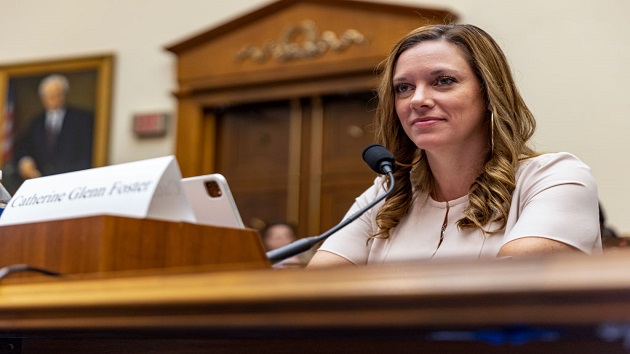
Catherine Glenn Foster, head of the anti-abortion group Americans United for Life, told Swalwell she didn’t think it was.
“If a 10-year-old with her parents made the decision not to have a baby that was a result of a rape, if a 10-year-old became pregnant as a result of rape, and it was threatening her life then that’s not an abortion,” Foster told the House Judiciary Committee on Thursday.
Around the same time as Foster’s testimony, the top lawyer for the National Right to Life Committee, had a decidedly different take.
In a phone interview with Politico, James Bopp said the girl should have been forced to carry the pregnancy to term under model legislation he wrote last June as NRLC’s general counsel. That legislation is being used by states to adopt abortion restrictions.
“She would have had the baby, and as many women who have had babies as a result of rape, we would hope that she would understand the reason and ultimately the benefit of having the child,” Bopp is quoted as saying.
Bopp did not respond to requests for an interview.
After spending decades united in a quest to overturn Roe v. Wade, the conservative movement is facing tough questions about what it means to oppose abortion.
Should there be exemptions for rape and incest? Does the age of the victim matter? What does it mean to protect the “life of the mother”? How imminent should death be before a doctor can legally intervene?
Other questions: Should states enact laws preventing women from traveling out of state for abortions? Should they ban IUDs and the emergency contraceptives like Plan B?
Conservatives praising the Supreme Court ruling say those details should be decided by voters in states. Abortion rights proponents say rights to liberty and privacy should not be up to voters to decide, but are guaranteed in the Constitution.
“In case we’ve forgotten, this is what democracy looks like,” said Rep. Michelle Fischbach, R-Minn,, in defending the Supreme Court’s decision.
But no case has challenged the anti-abortion rights movement more than the rape of a 10-year-old Ohio girl.
Following the arrest of a 27-year-old man in her case, a detective testified in a court hearing this week that the girl became pregnant as a result of the rape and traveled to Indianapolis to undergo an abortion. Ohio has banned abortion after cardiac activity is detected, which is at about six weeks into pregnancy. The state does not provide exceptions in cases of rape or incest.
Indiana’s Republican attorney general said he planned to investigate the doctor who helped the girl get an abortion. An attorney representing Dr. Caitlin Bernard said she followed reporting procedures, and Indiana University Health said an investigation found that she was in compliance with privacy laws.
Several Republican politicians, including Rep. Jim Jordan, a House Judiciary Committee member, had questioned whether the case had been fabricated for political reasons. Jordan did not reference the case in his questioning at the hearing on Thursday, instead speaking about violent attacks against anti-abortion pregnancy centers.
Jennifer Holland, a history professor at the University of Oklahoma, said she thinks conservatives are struggling to talk about the rape case of such a young victim because they never had to before.
“For 50 years, the focus has been as much as possible on the fetus,” she said. “They chose never to reckon with hard cases. Now that they have the power of the state, that’s very different.”
Daniel Williams, a history professor at the University of West Georgia who studies politics and religion, said support among conservatives for exceptions to rape and incest have changed over time. In this case, leaders in the anti-abortion rights movement probably weren’t prepared for such a case to confront them so soon after the reversal of Roe vs. Wade, he said.
“I doubt, though, that this will be a substantial setback for the movement,” said Williams. “At most, it may make some conservative states that are considering an abortion ban to think about including a rape (or) incest exception clause, but even that is uncertain. But we’re in uncharted territory here, so predictions about future developments are difficult to make.”
Sarah Warbelow, the legal director of the Human Rights Campaign, said it’s disinformation to suggest an abortion wouldn’t be an abortion for a 10-year-old rape victim.
“Abortion is a medical procedure. It’s a medical procedure that individuals undergo for a wide range of circumstances, including because they have been sexually assaulted, raped in the case of the 10-year-old,” she said.
Dr. Rachel Boren, a member of the ABC News Medical Unit, contributed to this report.
(WASHINGTON) — The House select committee investigating the Jan. 6 attack on the Capitol announced on Friday that it had issued a subpoena for records from the United States Secret Service over deleted text messages.
Chairman Bennie Thompson sought information about Secret Service text messages from January 5 and 6, 2021 that were reportedly erased and reiterated three previous requests from congressional committees for information.
Chairman Thompson wrote, “The Select Committee has been informed that the USSS erased text messages from January 5 and 6, 2021 as part of a ‘device-replacement program.’ In a statement issued July 14, 2022, the USSS stated that it ‘began to reset its mobile phones to factory settings as part of a pre-planned, three-month system migration. In that process, data resident on some phones was lost.’ However, according to that USSS statement, ‘none of the texts it [DHS Office of Inspector General] was seeking had been lost in the migration.’
“Accordingly, the Select Committee seeks the relevant text messages, as well as any after action reports that have been issued in any and all divisions of the USSS pertaining or relating in any way to the events of January 6, 2021.”
This week, Department of Homeland Security Inspector General Joseph V. Cuffari offered a briefing to the House Committee on Homeland Security and the Senate Committee on Homeland Security and Government Affairs about “ongoing access issues” with the Department of Homeland Security, specifically that “many U.S. Secret Service (USSS) text messages, from January 5 and 6, 2021, were erased as part of a device-replacement program.”
Friday, Inspector General Cuffari briefed the Select Committee on this and other matters.
ABC News has reached out to USSS for comment on the subpoena.
Please check back for updates. This is a developing story.
(WASHINGTON) — The Department of Homeland Security inspector general met with members of the Jan. 6 committee behind closed doors on Friday amid revelations about deleted Secret Service texts from the day before and the day of the attack on the U.S. Capitol.
The meeting comes after Inspector General Joseph Cuffari earlier this week sent a memo to the committee notifying them the Secret Service had deleted text messages from Jan. 5 and 6, 2021.
After Friday’s meeting, members called for transparency, with Rep. Jamie Raskin, D-Md., telling ABC News Congressional Correspondent Rachel Scott, “We need to get to the bottom of it, but if those texts are gone, we are determined to find them.
“We just don’t know where the texts are. We don’t know whether the texts have vanished or not vanished. We don’t know what the context was for their vanishing if they did vanish — we just don’t know,” he said. “But we’re going to get to the bottom of it and we’re going to make a full report to the American people.”
Committee chair Rep. Bennie Thompson, D-Miss., said lawmakers still don’t know if there are more messages missing beyond those from Jan 5 and 6.
“We’re not sure. The IG indicated that they had made a significant request for information. And obviously, since he was not able to get it — we just really don’t know,” Thompson said.
Thompson said it’s “obvious” the Secret Service is not being cooperative.
In earlier testimony, former Trump White House aide Cassidy Hutchinson alleged she was told then-President Donald Trump physically assaulted members of his Secret Service detail when they declined to take him to the Capitol on Jan. 6.
A source close to the Secret Service does not dispute the former president demanded to go to the Capitol just after his rally on the Ellipse that day.
The Secret Service, in a lengthy statement on Thursday night, blasted the inspector general’s letter to the committee.
“The insinuation that the Secret Service maliciously deleted text messages following a request is false,” Anthony Gugliemi, the agency’s chief of communications, said in a statement. “In fact, the Secret Service has been fully cooperating with the Department of Homeland Security Office of Inspector General (DHS OIG) in every respect — whether it be interviews, documents, emails, or texts.”
Gugliemi said that in February 2021, the Secret Service began to reset its mobile phones to factory settings as part of a previously planned, three-month system migration. In that process, data resident on some phones was lost, he said.
The DHS inspector general did not immediately respond to an ABC News request for comment.
ABC News’ Katherine Faulders, Rachel Scott and Allison Pecorin contributed to this report.
Kent Nishimura / Los Angeles Times via Getty Images
(WASHINGTON) — The House of Representatives on Friday passed two measures to restore abortion rights after the Supreme Court’s overturning of Roe v. Wade.
The action comes as Democrats ramp up their political messaging on abortion ahead of the November midterm elections, hoping the issue will drive voters to the ballot box to preserve the party’s majorities in Congress.
“It’s outrageous that 50 years later, women must again fight for our most basic rights against an extremist court and Republican Party,” House Speaker Nancy Pelosi, D-Calif., said Friday in a press conference on the U.S. Capitol steps ahead of the vote.
“Democrats are honoring the basic truth: women’s most intimate health decisions are her own,” Pelosi added.
The first bill, titled the Women’s Health Protection Act, would establish a statutory right for health care providers to provide, and patients to receive, abortion services. It would also prohibit states from imposing restrictions on abortion care.
The measure passed in a 219-to-210 vote. No Republicans voted in favor of the bill.
The Women’s Health Protection Act now goes to the Senate, where it previously failed to move forward after the House first passed it in September 2021.
Any abortion-related legislation will likely meet a similar fate in the upper chamber, where Democrats need 10 Republican votes to overcome the 60-vote filibuster.
“We must ensure that the American people remember in November, because with two more Democratic senators, we will be able to eliminate the filibuster when it comes to a woman’s right to choose and to make reproductive freedom the law of the land,” Pelosi said Friday.
The second bill to pass the House, known as the Ensuring Access to Abortion Act, addresses recent efforts by state legislatures to punish Americans traveling for reproductive health care. The bill would would ensure no person acting under state law could prevent, restrict, or otherwise retaliate against a person traveling across state lines for lawful abortion services.
Senate Republicans on Thursday blocked a bill that would have both legally shielded the people who travel across states lines to receive an abortion and the providers who care for those patients.
At least 13 states have ceased nearly all abortion services after the high court’s June 24 decision ending Roe, and several Republican-controlled states are already considering legislation to bar women from seeking services out-of-state.
“Are we going to allow these lawmakers to hold American citizens hostage in their own states, forcing them to give birth?” Senate Majority Whip Dick Durbin, D-Ill., said in a floor speech on Thursday. “Does that sound like the America that we know? No it doesn’t, and we need to draw the line here and now.”
Just last week, hundreds of abortion rights activists protested outside the White House calling on President Joe Biden to do more to ensure abortion rights. Biden signed an executive order on July 8 aimed at protecting access, but said it’s ultimately up to Congress to codify Roe.
Biden’s message to the demonstrators was to “keep protesting.”
“Keep making your point. It’s critically important,” he said.