(WASHINGTON) — After trying for weeks to hammer out a compromise to codify gay and interracial marriage, Senate negotiators announced Thursday they will delay a vote on their legislation until after the November election while expressing confidence it will eventually pass.
“Through bipartisan collaboration, we’ve crafted commonsense language that respects religious liberty and Americans’ diverse beliefs, while upholding our view that marriage embodies the highest ideals of love, devotion, and family. We’ve asked Leader Schumer for additional time and we appreciate he has agreed. We are confident that when our legislation comes to the Senate floor for a vote, we will have the bipartisan support to pass the bill,” the group said in a statement.
“It takes a lot of the political sting out of it to say this is not about the midterm election,” said GOP negotiator Sen. Rob Portman of Ohio whose own son came out as gay several years ago.
“This is about getting a result that helps a million families across America who are concerned about what might happen,” Portman added.
When asked if she was disappointed in the delay, lead GOP sponsor Sen. Susan Collins of Maine told ABC, “No. I think we’re in very good shape, very good shape, and I think this bill is going to pass.”
“I think we managed to thread the needle on the religious liberty concerns,” added Collins, referencing a primary concern of would-be GOP supporters.
Supporters had hoped to kick off consideration of their bill, the Respect for Marriage Act, as early as Thursday, but the GOP concerns — including a last-minute issue with potentially jeopardizing the tax exempt status of churches and non-profit schools with policies perceived as anti-gay — mounted as negotiators tried to find the requisite 10 GOP Republican votes to get by a filibuster by others in their conference.
“We have just put together language that is finalized. That has tremendous, I think, respect for the input that we’ve received on religious freedom. But the fact of the matter is it’s only about 18 hours old –– less than that, and we think that it’s fair for the members who are interested, who have worked with us, to give them an opportunity to do that,” said Sen Thom Tillis, R-N.C., who helped rally GOP support.
“And, you know, there have been some that said the timing of the vote was political. This is clearly, I think, a situation where we want to make our members feel comfortable with it. And I’m confident that we’ll ultimately pass it,” said Tillis.
“I think that’s a wise decision,” GOP Sen. Roy Blunt of Missouri told reporters of the pushed-back vote, adding, “It will get more votes.”
When asked why it was wise, Blunt, a respected, longtime member of the “whip” teams in both chambers of Congress who corral votes and is retiring at year’s end, said, “I think if you do it after the election, it’s clearly not something that you’re doing just for political purpose. And I think people will think about it more thoughtfully because of that, and a handful of them likely to decide to be somewhere after the election that they wouldn’t have been with a vote that was purely – at least likely – a political ploy.”
Sen Mitt Romney, R-Utah, a devout Mormon who has worked with negotiators on religious liberty concerns said those had been addressed, but he praised the delay, regardless.
“It’s, in my opinion, an indication they want to see something become law, not just a message, which is good news,” said Romney.
Negotiators worked throughout Thursday with the primary Democratic sponsors, Sen. Tammy Baldwin of Wisconsin and Arizona’s Kyrsten Sinema, buttonholing Republicans as they passed in the chamber earlier for an unrelated vote, showing them bill text.
Sinema joking that her silver-spiked tennis shoes were for getting members going and coming in the chamber.
Portman could be seen going through the group’s latest bill changes line by line with Blunt.
Not everyone was happy with the delay, though.
“If there are Republicans who don’t want to vote on that before the election, I assume it is because they are in the wrong side of history,” said a visibly irritated Sen. Elizabeth Warren, D-Mass. “Equal marriage has been a part of who we are as a nation. We’ve lived with it for years now. And protecting it by statute is something every single senator and every single member of Congress should be willing to vote for. And if they’re not, they need to go on the record and say so.”
The Respect for Marriage Act passed the House in mid-July with a surprising 47 Republicans voting for it.
That measure is expected to be amended in the Senate, forcing it back to the House for reconsideration. That could prove awkward in a lame duck session if Republicans retake that chamber in the midterms. Speaker Pelosi and her team would be shepherding that bill back through before the GOP takes control in January.
(WASHINGTON) — U.S. District Judge Aileen Cannon on Thursday denied the Department of Justice’s request for a partial stay of her ruling that enjoined the FBI from using roughly 100 documents seized from Mar-a-Lago with classification markings in its ongoing criminal investigation of Donald Trump — and mandated they be handed over to a special master for review.
Cannon has also appointed Raymond Dearie, senior district judge for the Eastern District of New York, as special master.
In a filing last week that amounted to a line-by-line rebuke of Cannon’s ruling, DOJ prosecutors wrote that they would seek intervention by the 11th Circuit Court of Appeals if she declined to act on their request for a partial stay by the end of Thursday.
Prosecutors cited the potential for “irreparable harm” to national security — not just from the FBI having to halt their criminal investigation of the recovered records but from the uncertainty her ruling had separately caused, leading the intelligence community to pause its own separate review of whether the classified records, or any intel sources or methods, have been compromised.
“In order to assess the full scope of potential harms to national security resulting from the improper retention of the classified records, the government must assess the likelihood that improperly stored classified information may have been accessed by others and compromised,” the DOJ counterintelligence chief, Jay Bratt, wrote in the filing, specifically referencing the dozens of empty folders with classified banners on them taken from Trump’s estate and the need to assess whether documents that were previously in them were compromised or remain missing.
This is a developing story. Please return for updates.
(WASHINGTON) — The Biden White House on Thursday condemned Republican governors who this week escalated their strategy of busing — and now flying — migrants to Democratic cities in protest of the administration’s border policies.
Florida GOP Gov. Ron DeSantis sent two planes of migrants to Martha’s Vineyard late Wednesday evening, surprising state and local officials. Two buses sent by Texas Gov. Greg Abbott carrying roughly 100 migrants were dropped off in front of Vice President Kamala Harris’s Naval Observatory residence early Thursday morning.
DeSantis said the confrontational moves were a message to President Joe Biden and Harris to do their “damn job” and secure the border.
The White House and Democrats are calling the moves cruel, accusing the GOP leaders of creating “chaos.”
“There’s a legal way of doing this — for managing migrants,” White House press secretary Karine Jean-Pierre said during Thursday’s briefing with reporters. “Republican governors interfering in that process and using migrants as political pawns is shameful, is reckless, and just plain wrong.”
Jean-Pierre criticized the governors for appearing to give no notice to leaders on the ground.
“The fact that Fox News and not the Department of Homeland Security, the city or local NGOs (non-governmental organizations) were alerted about a plan to leave migrants, including children, on the side of a busy D.C. street makes clear that this is just a cruel premeditated political stunt,” Jean-Pierre said.
Two buses carrying roughly 100 migrants were dropped off in front of Harris’ official Naval Observatory residence early Thursday morning. They were met by immigration advocates from the SAMU First Response, a humanitarian nonprofit foundation in Washington, which said the migrants are receiving food, clothing and hygiene care.
Tatiana Laborde, the managing director of SAMU, told ABC News the migrants were “extremely confused and disoriented ” when they landed on the sidewalk of the residential drop-off location.
Geoff Freeman, the director of Martha’s Vineyard airport, told ABC News in a phone call “nobody on the island was informed” of the planes’ arrivals.
“No local officials knew of this event until after it happened,” Freeman said.
Lack of coordination between communities regarding bussing of migrants “can wreak havoc and do harm, to individuals and those communities” said a Homeland Security spokesperson.
“That is the case here,” the spokesperson said.
The spokesperson explained migrants encountered at the U.S.-Mexico border continue to be expelled under Title 42. Anyone not expelled under Title 42 are either given expedited removal proceedings or are issued a notice to appear before an immigration judge and monitored through ICE alternatives to detention. DHS continues to work closely with nonprofit organizations and local governments on efforts to facilitate voluntary migrant transportation, the spokesperson said.
“Failure to coordinate is irresponsible and creates unsafe conditions for vulnerable migrants as well as the receiving jurisdictions,” they added.
DeSantis said sending migrants to Democrat-led states was a response to their previous “virtue signaling” by declaring themselves sanctuary jurisdictions during former President Donald Trump’s years in office.
“We’re not a sanctuary state,” he said at Florida at a news conference.
Border state Republicans praised the migrant vans, arguing the crisis at the border is a problem that should be shouldered by the entire country.
“This is a national responsibility, it should be a national burden,” said Florida Sen. Marco Rubio.
Border crossings reached a peak in May as U.S. Customs and Border Protection encountered 239,416 migrants along the southern border — the largest number of migrants ever.
Encounters dropped slightly in June and July, but experts estimate the agency will cross 2 million apprehensions by the end of the fiscal year ending this month.
Harris was tapped by President Joe Biden last year to lead the administration’s effort to tackle challenges at the border and work with Central American countries to address the root causes of the problem. Republicans have long criticized Harris’s absence at the southern border since taking on the role.
Rep. August Pfluger, R-Texas, tweeted: “If our “Border Czar” won’t visit the border, the border will visit her.” Several GOP members of Congress on Thursday posted similar sentiments on social media Thursday.
Harris declined to comment when asked by ABC News’ Justin Gomez if she had any reaction to the migrants that were dropped off in front of her residence.
The White House defended its immigration policies on Thursday while also acknowledging there’s more work to be done.
Jean-Pierre pointed to steps to advance border technology, add more immigration judges and provide record funding to the Department of Homeland Security as proof the administration is committed to fixing what she described as a “decimated” immigration system left behind by the Trump administration.
“We are fixing a broken system,” she told ABC News Senior White House Correspondent Mary Bruce when asked about the influx of migrants at the border. “It is not like turning the light switch on. It is going to take some time.”
Jean-Pierre said Republicans in Congress should instead focus on passing a long-term, comprehensive legislation to reform the immigration system.
“They deserve better than being left on the streets of D.C. or being left in Martha’s Vineyard,” the press secretary said of the migrants who’ve been transported. “They deserve a lot better than that.”
ABC News’ Allison Pecorin, Briana Stewart, Miles Cohen and Luke Barr contributed to this report.
(NEW YORK) — The New York City Parks Department has again rejected calls by members of the city council to terminate the Trump Organization’s license to operate a city-owned golf course in the Bronx.
Council members on Thursday called for the “immediate termination” of the Trump Organization’s license to operate the golf course at Ferry Point Park, a month before it’s scheduled to host a women’s tournament underwritten by Saudi Arabia.
City officials previously said they could not “unreasonably withhold approval” for the course to host the October event.
“The Trump-operated golf course hosting a golf tournament sponsored by the Saudi government just weeks after the 21st anniversary of this country’s most devastating event ever is insensitive to say the least,” Council Speaker Adrienne Adams said Thursday.
The tournament, part of the women’s Aramco Team Series, has close ties to the Saudi government but is separate from the LIV Golf tour that has poached players from the PGA Tour.
Council member Shekar Krishnan called the tournament “so offensive to the families of 9/11.”
But a New York City Parks Department representative said the city would continue to honor its contract with former President Donald Trump’s namesake company.
“As we’ve told Chair Krishnan and his colleagues in the City Council, ending the contract we inherited would require the city to pay up to tens of millions of dollars to the Trump Organization, an outcome no one wants,” a department spokesperson said in a statement. “We agree with the chairman on the desired outcome to cancel both this tournament and the overarching license agreement, and hope in the future he seeks a productive partnership on the issue.”
In April, a New York state judge upheld Trump’s right to continue to operate the course after former Mayor Bill de Blasio attempted to terminate Trump’s operating license following the Jan. 6 attack on the U.S. Capitol.
The Trump Organization called the effort to terminate the company’s operating license “nothing more than a political vendetta.”
(WASHINGTON) — President Joe Biden will meet Friday at the White House with the families of Brittney Griner and Paul Whelan, two American citizens who remain detained in Russia.
“The president wants to make sure their families know they remain front of mind and that his team is working on this every day,” said a senior administration official, who confirmed the meeting to ABC News.
The president will meet with Griner’s wife, Cherelle, and with Whelan’s sister, Elizabeth, who both spoke with Biden in July, White House press secretary Karine Jean-Pierre detailed at a later briefing with reporters.
The Biden administration said in July that it had made a “substantial proposal” to Russia to have Brittney Griner and Paul Whelan returned to the U.S. but Jean-Pierre said no breakthroughs were expected at Biden’s meeting.
“So, while I would love to say that the purpose of this meeting is to inform the families that the Russians have accepted our offer, and we are bringing their loved ones home, that is not what we’re seeing in these negotiations at this time,” she said.
“Look, as we have said, the Russians should accept our offer. They should accept our offer today. We will keep working diligently until the day we get to share that good news,” she added.
Still Jean-Pierre said Biden wanted to let the families know they remain “front of mind” for the administration.
“So one of the things that the president wanted to — to make clear is and one of the reasons he’s — he is meeting with families is that he wanted to let them know that they remain front of mind and that his team is working on this every day on making sure that Brittney and Paul return home safely. One family member was already scheduled to be in town and the president wanted to meet with both of the families on the same day,” Jean-Pierre said.
Griner, the famous WNBA player, was arrested in February on drug charges and sentences to nine years in prison. Whelan, a corporate security executive, is currently serving a 16-year sentence for espionage charges that his family says are trumped up. The U.S. declared both to be wrongfully detained, a legal clarification that mobilizes federal resources to free Americans imprisoned abroad.
The talks between Washington and Moscow have been complicated by Russia’s invasion of Ukraine.
There have been few public signs of progress since Secretary of State Antony Blinken, in a rare announcement in late July, revealed the U.S. had made the “substantial proposal” to secure the release of both Americans.
Sources told ABC News that offer included a prisoner swap that would exchange Viktor Bout — a convicted Russian arms dealer currently serving a 25-year sentence in a federal penitentiary in Illinois — for Griner and Whelan.
While U.S. officials say direct communication with the Kremlin continues at a regular clip, they acknowledge the slow pace is frustrating.
“Why this process has taken so long is a better question for Moscow,” State Department spokesperson Ned Price said Thursday.
“I wouldn’t characterize the process as stalled, he said. “It certainly hasn’t moved with the speed we would like.”
Some observers speculate Russia will demand parity, demanding two prisoners for the American detainees. Others within the State Department have questioned whether the Kremlin is negotiating in good faith and genuinely interested in reaching an agreement.
As talks continue behind the scenes, the Biden administration has bristled at any outside influence. After former New Mexico governor and hostage negotiator Bill Richardson traveled to Moscow this week, officials warned such interference could jeopardize the delicate diplomacy underway.
“Our message is that private citizens should not be in Moscow at all right now and that private citizens cannot negotiate on behalf of the United States government,” National Security Council spokesperson John Kirby said on Wednesday.
Richardson became involved in Griner’s case at her family’s request back in May and over many years has been involved in multiple successful efforts to free detained Americans.
“Of course, families are perfectly free to engage in to consult with outside voices, with outside entities,” Price said Wednesday. “But again, we want to make sure that any outside effort is fully and transparently coordinated with us.”
Price said the U.S. embassy is Moscow had not been involved in Richardson’s trip.
ABC News reached out to the Richardson Center for Global Engagement, but a spokesperson declined to comment or answer questions.
(BISMARCK, ND) — In November, there won’t be a Democrat running against incumbent GOP Rep. Kelly Armstrong for North Dakota’s sole congressional seat. The former nominee, Mark Haugen, announced earlier this month that he would drop out of the race due to what he called pressure from top members of his party to make room for Cara Mund, a 28-year-old former Republican congressional intern and 2018 Miss America who last week officially qualified for the race as a pro-abortion access independent.
The details of Mund’s late bid were surprising for political observers, especially when big-name North Dakota Democrats suggested their candidate leave the race as she jumped in.
But it’s her candidacy, some of those same state Democrats say, that reflects a more important reality: After the overturning of Roe v. Wade, the politics of abortion access have roiled races even in deeply conservative parts of the country — and abortion supporters appear increasingly galvanized while abortion opponents have seen some of their potential electoral victories, in Kansas and elsewhere, limited.
The big question is what will happen in November, when Democrats hope to protect their fragile majorities in the House and Senate from a resurgent GOP.
A victory for political newcomer Mund against the well-funded, two-term Armstrong — switching the seat from a Republican lawmaker to an independent — would be seen as a win, even as state Democrats insist they will have no role supporting her.
Armstrong, who opposes abortion, last won his seat with 69% of the vote.
“This cycle isn’t really the cycle for pro-life Democrats,” the state’s party chairman, Patrick Hart, told ABC News. “We had a long talk about viability, and in the end, Mark decided to drop out of the race.”
In early August, 59% of voters in historically Republican Kansas voted against an amendment that would strip abortion rights from the state constitution. And in Alaska, Mary Peltola — after also campaigning on abortion access — became the first Democrat in decades to win the state’s House seat over former governor and Republican vice-presidential nominee Sarah Palin.
Then, in another special election — this one for New York’s 19th District, a longtime swing seat — Democrat Pat Ryan won after largely campaigning on a pro-abortion rights message against Republican Marc Molinaro.
“Really, as we look what happened in Kansas and Alaska — there is a lot of energy for women’s health,” Hart said. “And we’ll see what happens in North Dakota at the ballot box this fall.”
On Sept. 3, two months ahead of November’s midterms, Haugen had a jarring Saturday morning breakfast meeting with Hart.
A few hours later, Haugen said that he received a call from North Dakota’s former Democratic Rep. Earl Pomeroy. Shortly after that, he said, he was contacted by the state’s former Democratic Sen. Kent Conrad.
According to Haugen, all three suggested that he should drop out of the race. Pomeroy later told the Forum of Fargo-Moorhead that he “didn’t lean on him [Haugen]” to drop out, but noted that in their conversation, he wanted to “maximize the contrast with the incumbent.” (Conrad’s office did not respond to a request for comment.)
Haugen announced the next day that he would quit. Last week, Mund qualified to appear on the November ballot against Armstrong.
“They want to give a clear shot for Cara Mund to be able to go up against Kelly Armstrong in the race,” Haugen said in an interview with ABC News. “I could have stayed in the race, but I just didn’t see a viable path to victory now with much of my base kind of not there.”
Mund, with a nominal war chest and no party backing, would need to earn a wild-card victory.
She told ABC News that she’s never been contacted by leading state Democrats like Conrad, Hart or Pomeroy, and she has no expectations of an endorsement or financial backing from the state party.
Hart said Democrats do not plan on supporting Mund and do not plan on putting up another candidate in the race.
Other North Dakota Democrats are watching Mund with interest — but not yet open arms.
“I’m saddened because there will not be a Democratic-NPL (North Dakota Democratic-Nonpartisan League Party) candidate on the ballot. If we are going to rebuild the two party system in Red States like North Dakota we need to run Democratic-NPL candidates. Plus, Mark has been a warrior for the Democratic-NPL brand and his willingness to take on a tough ‘red state’ race cannot be under appreciated,” former North Dakota Democratic Sen. Heidi Heitkamp, who has not endorsed Mund, said in a statement to ABC News.
But Heitkamp said that Mund “represents a new generation of leaders who do not want to be defined by allegiance to the two party system. This is ‘new generational energy” not only in North Dakota but nationwide.”
“Where I appreciate her position on reproductive health care, I will need to learn more about her position on Native American Rights, income and wealth disparity, health care and investment in education before I consider an endorsement.” Heitkamp said.
Haugen said his own conversations with some of North Dakota’s top Democrats featured mentions of Alaska and Kansas, where the party saw persuasive signs of how the issue of abortion was motivating voters even in deep-red states.
Haugen also said there was talk of Evan McMullin, a former GOP congressional staffer and supporter of abortion access running as an independent Senate candidate in Utah against Republican incumbent Mike Lee.
Utah Democrats have endorsed McMullin instead of putting up their own candidate.
In his conversations with others in his party, Haugen said, “They brought up the [Supreme Court’s] Dobbs decision, because I’m pro-life and what’s happened across the vote in Kansas recently.” Raising that issue surprised him, he said.
In July, the policy committee of the North Dakota Democratic-Nonpartisan League Party voted down a resolution calling for the party to pull support from Haugen’s candidacy over his anti-abortion stance.
“It failed and failed miserably. So I thought this was over,” Haugen said.
Hart, though, said the party kept hearing about abortion from residents.
In traveling as the party chair over the past few months, Hart told ABC News, many constituents brought up Haugen’s support of the Supreme Court overturning Roe and North Dakota’s resulting “trigger” law, which would ban nearly all abortions in the state. (It’s currently being challenged in court.)
“I’ve been hearing a lot of questions about Mark’s viewpoint and really about the state party being a part of that,” Hart acknowledged.
In deeply conservative North Dakota, where the GOP has held the at-large House seat since 2011, Mund told ABC she sees a certain legislative data point as an inroad for her potential victory: on the ballot in 2014 was a constitutional amendment on personhood, defining it as at the time of conception.
That proposal was defeated by 64% of voters.
“I think there’s the silent majority that just didn’t feel empowered, it didn’t feel like we’ll be represented,” Mund said. “It’s still an uphill battle. But it’s not an impossible battle. And especially after Kansas, after Alaska, don’t be surprised if there’s a big ‘Roe-vember.'”
“At this point in time, there has to be someone on the ballot who who identifies with a woman’s right to choose,” Mund said. “And especially after Dobbs, it just felt like there was really no hope, when you have both the Democratic candidate and the GOP candidate as pro-life.”
Mund said she remembers where she was when the Dobbs v. Jackson Women’s Health Organization decision came out that reversed Roe after some five decades.
The Harvard Law School graduate — who met the 1,000-signature threshold for listing on the ballot on Sept. 8, two days after she turned in more than 2,600 signatures to the North Dakota secretary of state — was preparing for the bar exam at home in Bismarck.
“I think like a lot of us that were studying thought … now what happens on the bar exam when the Supreme Court has overturned precedent and everything we’ve studied for?” she said.
Mund took the North Dakota bar in July but said she had begun thinking about her bid for the House seat months earlier. Her aspirations of running for office began as she took a class in law school on campaigns and elections — but she never thought she’d jump in this cycle.
When the draft opinion of Dobbs was leaked in May, however, she started moving forward on her campaign.
Mund said she has identified as a Republican for most of her life. After attending Brown University as an undergraduate, she interned for GOP Sen. John Hoeven in 2016 — she said the longtime North Dakota Republican is still one of her political heroes. (Hoeven did not respond to a request for comment.)
Mund said she was mulling a staff job with Hoeven before she jumped into the Miss America pageant — another dream. She attended the 2018 State of the Union address as Hoeven’s guest, following her Miss America victory.
“Coming from a state like North Dakota that had never won, people were constantly underestimating me. And here we are in 2022 and they’re still underestimating me,” Mund said.
If elected, she’d be North Dakota’s first woman in the House.
When she entered the race, Mund said she’d initially thought she would caucus with Republicans. She now says that while she could still vote with the GOP, she isn’t sure she would be embraced by the party — referring to a state Republican rule which bars candidates who have run as independents from seeking the party’s endorsement for six years.
Mund also stressed that her abortion politics set her apart from Republicans.
“I worked for a Republican senator, I grew up with a lot of conservative values,” she said. “But being pro-choice, I knew that there was no way that the party would ever endorse me.”
But Mund’s opponent has hesitations about the independent’s sometimes cloudy ideological stances.
“Running as an independent is not the same as being moderate. The democratic leadership in North Dakota did not chase out their moderate candidate for a more moderate candidate,” Armstrong said in a statement to ABC News.
She said she admires outgoing Wyoming Rep. Liz Cheney’s courage to challenge former President Donald Trump because “he’s not above the law.”
Mund, who is her own campaign manager, lacks robust fundraising mechanisms. “It would have been so much easier to go with a party. But I did not want a party to tell me what’s best for our people,” she said.
Heitkamp, the former senator, applauded her ambition despite their other differences. “Cara Mund is taking on the ‘Good Old Boys’ political establishment in North Dakota,” Heitkamp said in her statement. “She has proven herself to be someone who will call out the unfairness of institutions, whether it is in the political system or the Miss America world. She is very smart and very consistent in her beliefs.”
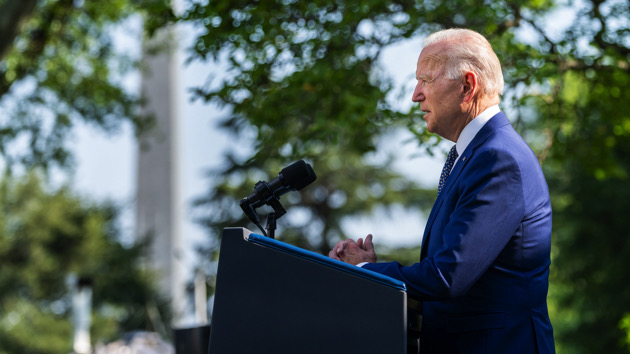
(WASHINGTON) — President Joe Biden on Thursday took a political victory lap after railway companies and unions reached a tentative labor agreement overnight — averting a strike that threatened to paralyze the nation’s supply chain and transportation rail service.
Speaking from the White House Rose Garden, Biden called the agreement a “big win for America” as the White House highlighted how he used his influence to avoid a crisis less than two months before the midterm elections.
“To the American people, this agreement can avert a significant damage that any shutdown would have brought,” Biden said. “Our nation’s rail system is the backbone of our supply chain.”
Biden said “every good you need” from clean water to food to liquefied natural gas gets delivered via rail.
“This agreement allows us to continue to rebuild a better America with an economy that truly works for working people and their families,” he said.
Before delivering remarks, Biden met with the negotiators who brokered the railway labor agreement in the Oval Office.
Administration officials hosted contract talks all day Wednesday hoping to broker a deal, negotiating for more than 20 consecutive hours, Secretary of Labor Marty Walsh said on Thursday. He described the deal as “hard-fought” and “mutually-beneficial.”
A White House official told reporters on Thursday that Biden called into Labor Department-led talks around 9 p.m. on Thursday to say a shutdown of railways was unacceptable and underscored the far-reaching economic consequences a strike would have. At 2 a.m., the official said, Walsh called the White House and said things were coming together. One union had to wake up their board to get sign off, the official added.
Biden thanked both sides for working in “good faith” to reach an agreement.
“In fact, the negotiators here today, I don’t think they’ve been to bed yet,” Biden said.
Unions will now vote on the agreement.
The Brotherhood of Locomotive Engineers Trainmen (BLET) and the SMART Transportation Division (SMART-TD) — the two largest rail unions and the final remaining union holdouts — confirmed the tentative agreement in a statement on Thursday.
The agreement includes one key sticking point throughout the negotiations: policies that allow workers to take a sick day or attend to a doctor’s appointment without being penalized.
“We listened when our members told us that a final agreement would require improvements to their quality of life as well as economic gains,” BELT and SMART-TD said in their joint statement.
Biden said on Thursday the workers “earned and deserved these benefits.”
“This agreement is validation of what I’ve always believed: unions and management can work together, can work together for the benefit of everyone,” he said.
Congress debated stepping into the fray to avoid the strike this week. Republican Sens. Wicker and Burr on Thursday attempted to push through a resolution that would have forced unions to accept the deal. Sen. Bernie Sanders, I-Vt., blocked the measure, arguing workers have the right to strike over working conditions.
House Speaker Nancy Pelosi applauded the tentative agreement on Thursday morning, stating Congress was ready to step in but “thankfully this action may not be necessary.”
“We congratulate the unions and railroads for coming to an agreement, because it is in the national interest that essential transportation services be maintained,” she said.
(DENVER) — Four years after the U.S. Supreme Court ruled narrowly in favor of a Colorado baker who refused to make a wedding cake for a gay couple, the justices are preparing to take up a potentially more sweeping and consequential question: whether public accommodation laws that require business owners to offer all customers their goods and services infringe on freedom of speech.
Denver wedding website designer Lorie Smith, who opposes same-sex marriage, is asking the high court to strike down Colorado’s Anti-Discrimination Act, which would require her to serve LGBTQ couples or face fines. She says the law, which has no exemptions, forces her to implicitly express support for something that violates her religious beliefs.
“While I’m happy to serve everyone, and I have served everyone, including those who identify as LGBT, there are certain messages I am unable to promote through my business,” Smith told ABC News.
The case, 303 Creative LLC v. Elenis, pits the Free Speech Clause of the First Amendment against legislative efforts to stamp out discrimination against minority groups, particularly the LGBTQ community. Lower federal courts sided with Colorado, saying it has an overriding interest in ensuring equal access to publicly available goods and services.
“If you’re open to the public, you need to accommodate everybody. That’s a core of our civil rights law, and it has deep roots in American law,” said Colorado Attorney General Phillip Weiser.
If the justices were to allow a “free speech exemption” from anti-discrimination protections, Weiser said, the impact could extend far beyond sexual orientation to potentially allow discrimination based on someone’s religion, race or ethnicity.
“If a wedding website designer says I will sell Christian websites that have Biblical verses on it, they can choose to design their websites, design their product as they want,” Weiser said. “What they can’t do is say if you’re a same-sex couple, you can’t have this website.”
In 2018, the Supreme Court sided with Colorado baker Jack Phillips after he was fined by state officials for declining to make a wedding cake for a same-sex couple; but the 7-2 decision focused only on the Colorado Civil Rights Commission’s conduct in the matter, saying the panel had shown undue hostility to Phillips’ religious views during the investigation.
The court at the time did not address the broader question of denying service to certain customers on First Amendment grounds, which it will now consider this fall. Until Smith’s case is resolved, Phillips said he continues to stay out of the lucrative wedding cake business. Smith has also refrained from marketing wedding website services.
“The state doesn’t have a right to tell American citizens what to believe and what to speak and what they cannot speak,” Phillips said in an interview at his Masterpiece Cakeshop. “Lorie Smith’s concern is what the state did to me; it could happen to her, or it could happen to anybody.”
Phillips argues that he and Smith are artists and that each custom-made cake and website are acts of personal expression.
“The cake itself is a message,” he said. “If it’s not something I would say, then it’s not something I’ll write on a cake.”
LGBTQ advocates see things differently. Since the Court has recognized marriage as a civil right, regardless of sexual orientation, the nature of the couple seeking wedding services shouldn’t be a basis to discriminate, they say.
“And it’s not just cakes and flowers: Think about haircuts, think about clothing design, think about landscape design. Any kind of custom good or service can be thought of as having creative or artistic qualities,” said Jennifer Pizer, acting Chief Legal Officer of Lambda Legal, an LGBTQ advocacy group.
“This case has the potential to blow an enormous hole in our nation’s civil rights laws, and the stakes really could not be higher for LGBTQ people,” Pizer said.
Research published last year by the Journal of Legal Studies found that religious exemptions under civil rights law “can have a significant and robust, even if inadvertent, impact” on customers, estimating a 61% to 85% chance that same-sex couples will experience discrimination when planning a wedding.
“I think that what’s really important is that if somebody decides that they do need to speak up about unfair treatment that we have laws that protect them,” said Rex Fuller, CEO of The Center on Colfax, an LGBTQ community center in downtown Denver.
Twenty-six years ago, in the Supreme Court case Romer v. Evans, a 6-3 majority struck down a Colorado amendment that prohibited protections for LGBTQ people. The years since have seen significant expansion of rights and equality, but some fear the Smith case could mark a turn.
“There’s anxiety. We’re watching situations in other states, a lot of sort of more conservative states, like actively legislating against transgender folks and transgender acceptance,” said Sable Schultz, The Center’s manager of transgender programs.
Transgender discrimination is at the heart of Phillips’ latest legal battle involving Colorado’s Anti-Discrimination Act. Autumn Scardina, a transgender Denver woman, is currently suing the baker in state civil court for allegedly refusing to design her a pink and blue cake because of her gender identity.
“As soon as I told him who I was, then it became, I won’t sell it to you,” Scaridna told ABC News. “What I asked for was a pink and blue cake, and he freely admits he makes pink and blue cakes. Even though I was guarded, even though I expected that result and was hoping for the other, it still stung, stung tremendously.”
Phillips maintains he is unable to design a cake celebrating a gender transition because of his religious beliefs.
“We told this person, you know, we serve everybody; will gladly serve you – will make other custom cakes for you. You’re welcome to come in and shop, buy cookies, brownies, anything that I have, but I can’t create that cake because it is a message that I couldn’t create,” he said.
The state civil case, which is still pending on appeal, highlights the stakes in the higher-profile showdown playing out in Lorie Smith’s case at the nation’s highest court.
“I’m hoping the U.S. Supreme Court justices will stand for free speech because no one should live in fear of government punishment simply because the government doesn’t agree with their views on a certain topic,” Smith said.
Attorney General Weiser says he’s optimistic the justices will hold the line.
“The regulation of conduct to prohibit discrimination is protected activity, and it is really critical that we not break from that,” he said.
(WASHINGTON) — South Carolina Republican Sen. Lindsey Graham’s proposal this week of a 15-week national abortion ban — with limited exceptions — has drawn mixed reaction from other conservatives in the final eight weeks before the November midterms, after which Graham hopes to bring his bill up for a vote.
The announcement of the legislation was quickly seized upon by Democrats who see support for abortion access as a motivating issue for voters across the country, even in red states.
The potential ban also inspired a slew of questions for Republicans who had been assailing the Biden administration over high inflation numbers.
Graham defended the move to ABC News.
“I think that’s where the country is at. So, I don’t mind talking about pro-life issues,” he said Wednesday, adding, “I think my proposal over time will be supported by the public at large.”
“You need to stand up for what you believe, right? That’s a good thing,” he said.
With just about two months until the general election that will decide control of Congress, Graham’s proposal has splintered the Republican Party, which had worked to adopt mixed messages for different parts of the country since the Supreme Court overturned Roe v. Wade in June and ruled that abortion should be left up to individual states.
Graham’s proposal is the first GOP effort to ban abortion on a federal level since that decision and contains limited exceptions for cases of rape, incest or when the mother’s life is in danger.
Former Vice President Mike Pence said he supported a national ban, telling Real Clear Politics in a Wednesday interview that he believed “enthusiasm among pro-life Americans in states across the country is equal to, or greater than, any new motivation by people that support abortion rights.”
Pence said that barring access to most abortions after 15 weeks was “profoundly more important than any short-term politics.”
But other Republicans — some in difficult midterm races in battleground states — have distanced themselves from the proposed legislation, saying abortion restrictions should be up to individual states.
Blake Masters, Arizona’s Republican Senate nominee against incumbent Sen. Mark Kelly, avoided discussion of Graham’s abortion ban while at a Yuma border event on Wednesday, following his Tuesday remarks in support of the bill. He said Wednesday if Graham’s bill does not pass, Republicans should take up a “a third-trimester standalone bill.”
“Certainly we can all agree that in America, we shouldn’t tolerate late-term abortion like China and North Korea do,” Masters said in a statement to ABC News.
Masters — under fire in TV ads by Democrats for his anti-abortion stance — already supports a 15-week ban on abortion, with exceptions only for the life of the mother, soon to take effect in Arizona. He did, however, scrub his website of the topic after Roe was overturned, removing language that said “I am 100% pro-life.”
Abortion access has proven to be a driving issue for voters, demonstrated most strongly in Kansas, when the historically conservative state overwhelmingly rejected a referendum that would have stripped away abortion rights from the state constitution.
Abortion access has also been seen as an influencing factor in special elections in New York and Alaska, where Democratic candidates with campaigns focused on abortion won their races. Even Republicans in Graham’s home state of South Carolina are having trouble passing an abortion ban.
In Georgia, Republican Herschel Walker — locked in a tight race against incumbent Rep. Raphael Warnock — said the issue “should be decided at the state level, but I WOULD support” Graham’s proposal in the Senate.
Republican Sen. Ron Johnson, one of the party’s most vulnerable incumbents, up for reelection in Wisconsin, said “nothing is going to pass in Congress” and that the issue should be left up to states.
“It’s got to be decided in the states. I think that is the appropriate place for this to be decided,” Johnson told ABC News on Tuesday.
A spokesperson for Dr. Mehmet Oz, the GOP candidate for Senate in Pennsylvania, made a similar point, suggesting he would not support the Graham bill but not directly commenting.
“Dr. Oz is pro-life with three exceptions: life of the mother, rape and incest. And as a senator, he’d want to make sure that the federal government is not involved in interfering with the state’s decisions on the topic,” his spokesperson said.
Don Bolduc, the Trump-endorsed winner of New Hampshire’s Tuesday GOP primary, said he would not vote for the bill.
“I believe the federal government should stay out of it,” Bolduc, who has campaigned as anti-abortion, told ABC News. “Let the states deal with it. That’s going to be my position in Washington, D.C.”
The Republican Senate candidate in Colorado, Joe O’Dea, said he supported a different position on abortion restrictions — not what Graham called for.
“America wants balance on the abortion issue, not a forever cold war between the far left and the far right. Congress should pass a bill protecting a woman’s right to choose early in pregnancy, whether a woman lives in Mississippi or Massachusetts, and there should be sensible limits on non-medically necessary late term abortion and parental notification for minors. I don’t support Senator Graham’s bill,” O’Dea said in a statement.
“A Republican ban is as reckless and tone deaf as is Joe Biden and Chuck Schumer’s hostility to considering any compromise on late term abortion, parental notification, or conscience protections for religious hospitals,” O’Dea said.
Ohio GOP Senate nominee JD Vance and Nevada GOP Senate nominee Adam Laxalt did not respond to requests for comment.
The candidates’ distance comes as Senate Minority Leader Mitch McConnell on Tuesday threw cold water on Graham’s proposal. When asked if he would bring the measure to the Senate floor should the GOP retake the chamber, McConnell said “most of the members of my conference prefer that this be dealt with at the state level.”
Other Republicans have embraced the legislation.
Florida Sen. Marco Rubio is an original co-sponsor of Graham’s proposed ban. His support comes as his general election opponent, Democratic Rep. Val Demings, has levied campaign attacks on the incumbent’s anti-abortion views.
When asked if his position on the bill would influence support for him in his race against Demings, Rubio told reporters in Washington that he’d “never analyzed this politically” but that’s he’s staunchly “pro-life.”
“That has never been a mystery. I’ve never hidden that. And I’ll vote for any bill that helps it,” he said, noting that the legislation would not likely pass if voted upon.
“No, of course, this is going to be dealt with at the state level … If [Democrats] think this is such a big political winner, then they shouldn’t be worried about states deciding,” Rubio said. “They know it’s not going to pass here.”
A spokesperson for Demings told ABC News in a statement that Floridians will “hold Rubio accountable for his out of touch stance in November,” following news of his co-sponsorship of Graham’s ban.
Rep. Ted Budd, R- N.C., running in a competitive Senate race against Democrat Cheri Beasley, on Wednesday also signed on as co-sponsor of a House version of Graham’s Senate legislation.
Separately, big-name Republicans like Sen. John Cornyn of Texas and Sen. Thom Tillis of North Carolina have backed the idea that states should dictate their position on abortion.
(WASHINGTON) — At a congressional hearing on Wednesday with the nation’s leading public health officials, senators on both sides of the aisle criticized the Biden administration’s monkeypox response.
The strongest rebuke came from North Carolina’s Richard Burr, the ranking Republican member of the Senate Committee on Health, Education, Labor and Pensions (HELP), who labeled the government’s handling of monkeypox a “catastrophic failure” reminiscent of the onset of COVID-19 and implored officials to “do better.”
“You repeated each of the mistakes from the early days of the COVID response, and the cultural arrogance from public health officials who are supposed to be at the forefront of our response let this country down again,” Burr told the officials: Centers for Disease Control and Prevention Director Rochelle Walensky; National Institute of Allergy and Infectious Diseases Director Anthony Fauci; Food and Drug Administration Commissioner Robert Califf and Assistant Secretary for Preparedness and Response Dawn O’Connell.
Burr listed off delays on testing, therapeutics and vaccines — all of which were, and in some cases still are, challenging to access at the beginning of the monkeypox outbreak — and he criticized government health officials for not issuing stronger behavioral guidance during the many Pride parades nationwide for a disease that’s largely infecting the gay and bisexual male community.
“It isn’t a question of money. You’ve been given astonishing amounts of money. It’s a question of leadership. It’s a question of focus. It’s a question of squashing the typical bureaucratic roadblocks, arrogance and ineptitude. You need to do better,” Burr said.
Democratic Sen. Patty Murray, the committee chair, also had criticism of the overall monkeypox response — though she tempered hers with the news that access to vaccines, testing and therapeutics has increased while case growth has decreased.
Still, she called the response “unacceptable.”
“I know each of your agencies have worked relentlessly to respond first to COVID and now monkeypox. But I have to say, frankly, too many missteps were made early on in the response and a couple hundred cases turned into 21,000. It is unacceptable to communities who already experienced barriers to accessing health care, like the LGBTQ+ and the Black and Latino communities that are hardest hit by this outbreak,” Murray said.
For their part, members of the administration’s monkeypox response said that they had worked quickly to focus on key measures like testing and vaccines.
“On May 17, a case was reported in Massachusetts and was confirmed by CDC the following day. CDC immediately began its work searching for additional cases, educating clinicians and the public about this disease and supporting our state and local health public health partners in their response,” Walensky said.
“Over the last several weeks we’ve been pleased to see a decline in the growth of new cases here and abroad, though there are areas in the United States where the rate of rise in new cases is still increasing. We approach this news with cautious optimism, recognizing that we must continue to aggressively respond using our entire toolkit, including vaccination, testing and education about risk, to inform behavior change,” she said.
She said the U.S. has always had more testing capacity than testing being done and to date is still doing 14-20% of its total testing capacity. The underlying issue, she said, has been getting health care providers up to speed on a disease that’s not common domestically so that they quickly prescribe tests.
“There’s never been a shortage of tests, but there’s been a shortage of access to tests because of inefficiencies in the system,” said Califf, the FDA commissioner.
On vaccines, Burr pushed the officials on why vaccination rates aren’t higher — arguing that a lack of information on the new intradermal vaccination method, which is allowing the U.S. to increase its vaccine supply by up to fivefold, could be turning people off of the shots.
“We know that we have 13 to 15 million gay men in this country in the United States. … We have about 1.9 million HIV/AIDS positive gay men. There’s your immunocompromised population, 1.9 million; [and] your at-risk pool for sexually transmitted monkeypox [is] about 13 to 15 million. And somehow we’re cheering the fact that we put out 700,000 vaccines,” Burr said.
The administration has been doing some large-scale pop-up clinics at events like Atlanta Black Pride, Charlotte Pride, Boise Pride and Southern Decadence in New Orleans, Walensky said, and they had vaccinated around 7,200 people between the Atlanta and New Orleans events.
“What we need to do now is do those in smaller scale, and we’re actively doing that scale up … So rather than these big events, we need to meet people where they are with community-based organizations, trusted messengers,” she said.
O’Connell, who oversees the vaccine logistics within the Department of Health and Human Services, said the U.S. would be getting an additional 5.5 million vials of monkeypox vaccine in the coming months — which could be used as some 27 million doses, using the new intradermal approach — on top of the 1.1 million vials that have already been made available.
“Responses cannot be static. They must continue to evolve and calibrate to the current set of circumstances and regularly account for new information and evolving scientific understanding. This has been true of the monkeypox response thus far and will be true as it continues,” O’Connell said, defending the response.
But Walensky pointed out that there are holes in the administration’s work because of data hurdles.
The CDC does not have nearly the amount of information they need to design a more efficient testing and vaccination strategy, she said.
For example, “for monkeypox specifically, I can tell you that I don’t know the total number of people hospitalized with monkeypox,” Walensky said.
“It’s been hard, and it should not be this hard. And if we can’t make informed decisions, based on the best possible data coming into us, we’re not making the best decisions for the American people. The existing patchwork of data systems is not working. It’s not working to the best ability of the American people,” Walensky said.
She also said the CDC doesn’t know which people who are testing positive for monkeypox have been vaccinated or not.
While demographic data, such as race, ethnicity and gender, are reported in 91% of vaccinations, that data is only reported for 27% of tests and 47% of cases.
“We have been working closely, tirelessly, with state and local public health staff who have been doing the same to extract data on this outbreak specifically,” Walensky said.