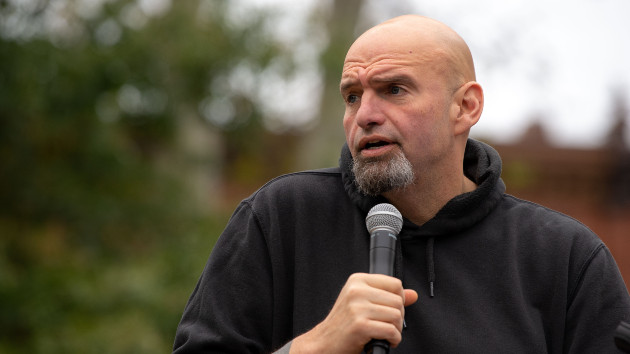
(HARRISBURG, Pa.) — Pennsylvania Senate candidates John Fetterman and Mehmet Oz will debate Tuesday night in Harrisburg, a highly anticipated clash in a race that has seen health challenges and personal attacks, with control of Congress’ evenly divided top chamber on the line.
The debate will be hosted by Nexstar and broadcast across Pennsylvania starting at 8 p.m. ET. It follows a months-long effort by Oz to get Fetterman to agree to share the stage in the wake of Fetterman’s stroke in May, with Oz saying he sympathized with Fetterman but wanted them to face voters.
Oz previously agreed to seven other debates, according to his campaign, none of which Fetterman committed to.
While the candidates are likely to go back and forth over public safety, the economy, health care and more, much of the spotlight will be on Fetterman’s own health. The lieutenant governor’s speech has at times been choppy since he resumed public campaign events following his stroke, which his campaign has said was cause by atrial fibrillation, or irregular heart rhythm, which led to a clot.
On stage, Fetterman will have closed captioning, allowing him a real-time transcript to help with issues he has processing words that are spoken to him.
Two top aides attempted Monday to lower expectations for his performance, writing in a memo to reporters that debating “isn’t John’s format” and that Oz, a former surgeon and TV host, “has a huge built-in advantage.”
Fetterman “is a unique candidate with a strong personal brand that transcends partisanship,” wrote Rebecca Katz, a senior adviser, and Brendan McPhillips, the campaign manager. “That’s what voters are going to see on the debate stage, and it’s why John is going to win this race – even if he doesn’t win the debate.”
“John has had a remarkable recovery, but the ongoing auditory processing challenges are real,” they added. “But he’ll be open and upfront about those challenges, just like he has been in interviews and at rallies for the past few months.”
Fetterman returned gingerly to the campaign trail in August, holding few events and seldom speaking to the media. He has since steadily increased his public presence, at times holding multiple events per day. Along the way, his speech has appeared to improve, becoming smoother.
In a letter released last week, Fetterman’s primary-care physician said the lieutenant governor “can work full duty in public office” and speaks “without cognitive deficits.”
That assessment aligns with what independent neurologists have told ABC News — namely, that for stroke survivors, language issues do not indicate cognitive impairment.
But operatives say that may not stop Fetterman’s opponents from using his appearance on the debate stage to argue to voters that he isn’t up for the job of senator.
“If Fetterman is not just bad but awkward in ways that show impairment, then the Republicans presumably will put out some sort of paid advertising highlighting that, and that presumably will be seen by voters,” Democratic strategist J.J. Balaban told ABC News.
Josh Novotney, a Philadelphia-based Republican consultant, said, “It’s an hour debate. It only takes a couple seconds for them to make it a social media viral moment where it will decide a lot of votes.”
While Fetterman has long led against Oz, according to FiveThirtyEight’s polling average, the surveys have narrowed this fall amid both a crush of Republican-funded ads labeling Fetterman as soft on crime and a national environment that favors the GOP.
Six weeks ago, Fetterman held a nearly 11-point lead in FiveThirtyEight’s average. As of Monday, it was less than three points.
Oz “has been really good at message discipline,” Novotney told ABC News, focusing primarily on crime and inflation, two issues polls have shown are atop voters’ minds.
Oz also criticizes Fetterman’s history leading the state’s parole board, where he has voted to commute the sentences of some convicted murderers serving life sentences. Oz’s campaign has called him “the most pro-murderer candidate in America.”
Fetterman, who bears tattoos in memory of crime victims from the town where he was previously mayor, has said those select cases involved offenders who spent many decades behind bars and were no longer “dangerous.”
Fetterman quipped at one event: “What has Dr. Oz ever known about fighting crime, living in a gated mansion in New Jersey?
Oz’s ties to New Jersey, where he lived for years before moving to Pennsylvania — where he attended medical school — have been a repeated target for Fetterman, who calls Oz a carpet-bagging opportunist out of touch with Pennsylvanians.
Oz brushes off those attacks, recently telling a local outlet, “Pennsylvanians don’t care where you come from; they care what you stand for.”
Some experts believe Tuesday’s debate could be more influential on voters than debates in past cycles.
“I think this debate, more so than any debate probably in the last quarter-century, in Pennsylvania at least, is going to really matter,” said Republican consultant Matt Benyon.
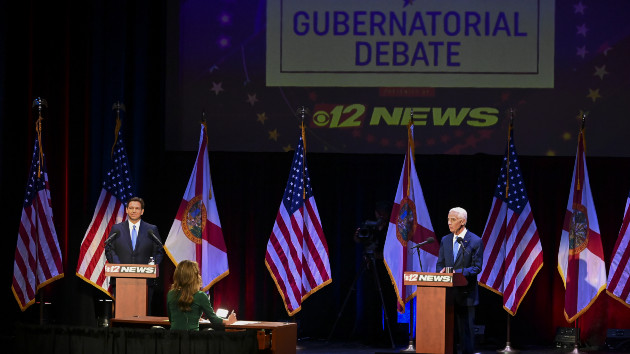
(WASHINGTON) — Monday night’s debate between Florida’s Republican Gov. Ron DeSantis and Democratic challenger Charlie Crist began with a question about the economy, but both politicians began with the answer they had prepared — previewing what was to come.
“DeSantis has signed a bill that would restrict that [abortion] right, even in cases of rape or incest,” Crist said.
With his time, DeSantis said, “Charlie Christ has voted with Joe Biden, 100% of the time.”
The governor sought throughout the debate to compare Crist with President Joe Biden, who is unpopular across the country, while describing himself as an advocate for his state’s interests, such as the economy and education.
DeSantis, seeking reelection four years after evolving from narrow winner to rising GOP star, parried blows from Crist with the stump speech he often gives, not just in Florida but across America: flaunting many of the social issues he has legislated on, such as restricting what is taught in schools.
At the debate, he more often directed his comments to the public than to Crist, whom he rarely mentions on the trail. But he used some chances to sully his rival by saying the former congressman would have made the wrong choices as a leader, weakening businesses during COVID-19 and allowing more abortions.
Crist has aligned himself with Biden throughout the campaign, calling Biden the “best president” and planning to fundraise with him days before the election. But at Monday’s debate he also talked about his own four years as governor, when he was a Republican, and accused DeSantis of being a divisive, fickle figure who would soon abandon Florida for a presidential bid.
Crist — who trails in the polls by some eight points, according to FiveThirtyEight — said he was, by contrast, a “commonsense” uniter of people who wouldn’t take away Floridians’ rights, such as the ability to access abortion. The state’s current law bans the procedure after 15 weeks, even in cases of rape and incest, though there are exceptions for the health of the mother and fetal abnormalities. The ban is being reviewed by the courts.
Again and again on Monday, Crist returned to the issue of abortion access and to his criticism that DeSantis had other career plans. At one point in the debate, he asked DeSantis to “look in the eyes of the people of state of Florida and say to them if you’re reelected you will serve a full four-year term as governor.”
DeSantis paused.
“Yes or no, Ron?” Crist asked.
“It’s my time? DeSantis responded.
“It’s not a tough question. It’s a fair question. He won’t tell you,” Crist said, before the moderator interrupted and clarified that candidates were not supposed to ask each other questions.
DeSantis then shot back: “I know that Charlie is interested in talking about 2024 and Joe Biden, but I just want to make things very, very clear. The only worn-out old donkey I’m looking to put out to pasture is Charlie Crist.”
Throughout the debate, the in-person crowd reacted raucously: yelling, clapping, cheering, jeering. At one point a voice yelled out “liar!” as DeSantis spoke.
Below, more highlights from the night:
Immigration and flying planes to Martha’s Vineyard
Crist called DeSantis’ move to use tax funds to send migrants to Martha’s Vineyard a “stunt,” while the governor defended the move as bringing attention to a serious issue at the southern border.
“We have an immigration problem … but it doesn’t mean that you use Florida taxpayers’ dollars to charter jets to go to Texas, lie to people to get them onto planes, fly them up to the northern part of our country,” Crist said, adding, “It’s not right, and you were inhumane.”
DeSantis responded by saying it was “sad that it comes to this” but that sending the migrants to what he called liberal, elite areas of the country put the issue “front-and-center.” He linked immigration to the flow of deadly narcotics into the U.S.
“I think we need to secure the border, because the fentanyl is absolutely out of control,” he said.
Abortion restrictions
DeSantis and Crist were asked at what point in a pregnancy should abortion become illegal.
“You deserve a better governor who cares about women and your freedom, your freedom and your right to choose and your right to vote,” Crist said.
“I’m proud of the 15 weeks that we did,” DeSantis said, before going on to accuse Crist of supporting a wide range of abortion procedures such as “until the moment of birth.”
Crist called that a lie.
DeSantis then attacked Crist for having switched parties — and political views: “He used to support a federal constitutional amendment that outlawed all abortion regardless of any type of exceptions. Now he’s taken the other extreme position.”
“Is this an honest change of heart?” DeSantis said. “Or is this a guy that’s going to shift with whatever wind he needs to, to try to keep his political career alive? I think we all know the answer to that question.”
The economy
DeSantis largely spoke about his credentials, taking few shots at Crist while touting his own record, particularly in the early months of the COVID-19 pandemic when Florida did not institute some of the restrictions that other states did in an attempt to curb cases and deaths.
DeSantis said that doing so would have ruined the tourism industry that beats at the heart of the state.
“I kept this state open and I kept the state free, and we now have the biggest budget surplus in the history of Florida,” he said, as he often does on the road as he stumps.
On the subject of home insurance — average insurance costs have roughly tripled in Florida since DeSantis’ tenure began — the governor blamed “Biden/Crist” policies and costs of litigation.
Crist laid the blame for some cost-of-living issues with DeSantis.
“Since you’ve been governor, every utility rate increase has been granted for Florida Power and Light … They’ve all gone up and up and up. When I was governor, they went down,” he said.
“We need to have a governor who will do what’s right for the people of Florida, all the time, all year-long, not just when it’s right before a reelection,” he said.
DeSantis hit back on oil and gas prices, which polls show are also top of mind for voters.
“Then why are fuel and natural gas prices up — because of the Biden/Crist energy policies?” he said, which he said were also fueling high inflation.
“He’s locked together with these policies that have hurt so many people,” DeSantis said of Crist, who responded by focusing on other issues.
“I think it’s incredible that we hear this out of Ron DeSantis … everybody watching tonight knows that your property insurance is up under him,” Crist said. “You deserve a governor who has your back. I always did. And I always will.”
Crist said that as a congressman after being governor, he had voted for a major infrastructure bill under Biden “that got the Sanibel bridge built back up as quickly [as] you took credit for.”
Hurricane Ian
Despite Biden’s praise of DeSantis for his handling of Ian — the deadliest storm in the state in at least 60 years — Crist said the governor “failed” by not getting Florida more prepared. He accused DeSantis of attending a high school football game the Friday before the storm.
Crist echoed some criticism that Lee County should have been more forcefully encouraged to evacuate. The area was the epicenter of where Ian made landfall in Florida.
“That’s not a good record. That’s not good leadership,” he said.
DeSantis shot back by citing Crist’s trip to Puerto Rico during the earlier Hurricane Fiona.
“You know what he was doing during this?” DeSantis said. “He was in hiding out in Puerto Rico. He wasn’t helping his community here, and then when he got back what did he do? His campaign was soliciting campaign contributions from storm victims. That is unacceptable, and that’s not what a leader would do in a time of despair.”
Of the local hurricane response for Ian, DeSantis said, “I stand by every one of our local counties. They stood up and learned, and they made the best decisions with the information that they had.”
He and others have previously said the hurricane prediction models limited how quickly officials could respond because the models were inconsistent.
Education
When the debate turned to education and what was appropriate in public schools — particularly on LGBTQ topics and teaching race and American history — DeSantis reiterated that he viewed it as a parental rights issue and a question of what was “appropriate.” He said he didn’t want race to foment hate in classrooms.
Crist challenged him: “Here you go again Ron. It’s all about culture wars, it’s all about dividing us … whether it’s blacks against whites, whether it’s gay and straight, whether it’s young versus old.”
DeSantis responded by pointing to Crist’s own comment earlier in the campaign that DeSantis supporters had “hate in their heart,” which Crist said on his first day of being the Democratic nominee.
“I’m endorsed by every police group in the state of Florida. I’m endorsed by the firefighters, I’m endorsed by the truckers, the nurses, anesthetists, Retail Federation, Farm Bureau, the whole cross-section of the state of Florida is backing me. They do not have hate in their hearts because they reject Charlie Crist,” DeSantis said.
On critical race theory — historically a university-level subject that conservatives argue has started to influence grade schools — DeSantis said that all history should be taught but “what I think is not good is to scapegoat students based on skin color.” The governor this year signed a law to ban certain concepts related to critical race theory from schools.
“The way to stop discrimination on the basis of race is to stop discriminating on the basis of race,” he said.
Crist replied: “He talks about not teaching about the history of our country that might offend some people in our schools. We ought to teach facts in our schools … We shouldn’t have a whitewashed approach to educating our children.”
He then pivoted.
“You’re taking away from all these other issues because you don’t want to talk about taking away a woman’s right to choose. That’s unconscionable,” he said.
COVID closures
Both Crist and DeSantis addressed their decisions during the early months of the pandemic.
Crist said he “would have listened to scientists, unlike the governor” — accusing DeSantis of being “so arrogant that you won’t listen to their advice.”
“Ron, I wouldn’t pat yourself on the back too much about your response to COVID,” he said, invoking the state’s death toll of more than 80,000.
“When you look at the Thanksgiving table, one of those empty seats is probably one of those people for many families watching tonight,” he said.
DeSantis said his policies focused on protecting the vulnerable — like older people — while trying to ensure businesses wouldn’t close under government restrictions to slow infections.
“I can tell you, as Charlie Christ and his friends in Congress were urging you to be locked down, I lifted you up,” DeSantis said.
He also highlighted how he stopped schools from requiring COVID-19 vaccines.
Attacked Walt Disney
Disney — one of the state’s most prominent employers — also came up at the debate
Crist pointed back to how DeSantis and Disney were at odds over a law banning discussion of sexual orientation and gender in some public-school classrooms. Crist also invoked DeSantis’ disagreement with cruise lines over COVID-19 vaccination requirements.
“You’re the most anti-business governor I’ve ever seen,” Crist said.
“Except for all the businesses that are moving down here and leading the nation in net immigration,” DeSantis said back.
Gender transition for minors
Each candidate was asked where they stood on gender confirming procedures and therapies when used by minors.
“When they say ‘gender-affirming care,’ they mean giving puberty blockers to teenage girls and teenage boys,” DeSantis said, arguing that transgender children were seeking out and being given major surgeries like mastectomies.
“It’s inappropriate to be doing that,” he said.
Crist again pivoted to abortion access.
“This reminds me of your position on a woman’s right to choose: You think you know better than any physician or any doctor — or any woman in a position to make decisions about their own personal health. You want to be the judge,” he said.
Local prosecutor suspended
When DeSantis’ suspension of Andrew Warren — a local prosecutor who said he wouldn’t bring charges over abortion — arose, Crist cast the issue in non-legal terms, saying DeSantis was silencing a critic.
“When you start removing people from public office, that’s the job of the people. He was twice elected state attorney in Tampa Bay,” Crist said.
DeSantis said he removed a law enforcement official who had said he could act outside the law: “I acted appropriately and I would do it again.”
(WASHINGTON) — With early voting underway in more than half of Florida’s counties as of Monday — 15 days before Election Day — Gov. Ron DeSantis is urging supporters to cast their ballots sooner rather than later, despite calls from Donald Trump and some other Republicans to wait until Nov. 8.
DeSantis has made election integrity a key issue since Trump began trumpeting false claims of a stolen 2020 election and has supported various measures to that end, including the creation of an election police force which made controversial fraud arrests in August.
But the governor has also repeatedly noted that Florida voters should feel confident in their own elections — and feel confident voting early or by mail, two methods that Trump has baselessly criticized as allowing fraud.
After returning to the trail in the wake of Hurricane Ian, DeSantis split with Trump on this issue. The former president told Nevada rally-goers on Oct. 9 that voting early would make it easier for Democrats to cheat. He didn’t provide evidence.
DeSantis’ message, though, is: Any form of voting will do.
At campaign events, he sometimes takes a tally. “
How many of you are going to do a mail ballot?” he asks.
“Early in person?” he adds.
Silence turns into cheers when he asks about “Election Day.”
On Sunday in Bal Harbour, DeSantis pushed back on that preference, telling a packed Jewish community center to get to the polls as soon as possible to avoid a “mulligan” in two weeks.
“If you wait till Election Day, you get a flat tire, you can’t take a mulligan,” DeSantis said then. “Whereas if you vote early, you do it, you’re in the can. If something happens [while you’re on your way], you got another shot at it.”
“We can’t be complacent about this,” he added then.
Democrats, like DeSantis, have been recommending early voting.
“I encourage you not to wait until Election Day,” Val Demings, the Senate nominee challenging GOP Sen. Marco Rubio, wrote on Twitter on Monday.
Florida, a perennial swing state, is the site of several key races this midterm cycle, though Republicans there are optimistic about their chances given voters’ disapproval of President Joe Biden and concerns over the economy and inflation.
DeSantis, for example, is up by about eight points over Democratic opponent Charlie Crist, according to the FiveThirtyEight polling average. He and Crist, a former Florida governor, debated Monday during their lone face-off, in South Florida.
Though early in-person voting began less than a day ago, nearly 1.2 million Floridians have already sent in their mail ballots, state data shows. Michael McDonald, a political science professor and voter turnout researcher at the University of Florida, told ABC News that turnout for this midterm election is shaping up to be on par with 2018, which had the highest turnout of any midterm since 1914.
Registered Democrats have the edge in mail voting thus far, casting almost 50,000 more votes than their Republican counterparts, according to the state Divisions of Elections.
Yet Republicans, who have requested over 400,000 fewer mail ballots, are returning the ones they have at a higher rate. In Florida, whoever requested a mail ballot in 2020 was automatically sent one in 2022. Due to high Democrat mail turnout during the last presidential cycle, it is likely that the disparity in requests is due to the carryover from 2020 and not simply enthusiasm by Democrats about the voting method in 2022, McDonald said.
Historically, Democrats in Florida have turned out more than Republicans for early in-person voting while the GOP then sees larger numbers on Election Day.
But in 2020, as Democrats increasingly favored mail ballots amid the COVID-19 pandemic, Republicans also began to lead in early in-person voting. McDonald said.
“Republicans in the state of Florida don’t see as much of a threat from allowing those different forms of voting and promoting it, because they know that their campaigns are capable of turning their supporters out,” McDonald said.
“DeSantis has very, very deep pockets for his campaign. So they’ve got a machine that can do the voter mobilization,” he added.
Rubio, who is also seeking reelection, held a rally on Monday to promote early in-person voting. He has echoed some of Trump’s suspicions about other early voting methods. At a debate last week with Demings, Rubio said that “there’s danger involved in drop boxes” because someone could attack them.
Republicans in other states have both criticized early voting periods and encouraged their voters to use “whatever way you want,” as Arizona gubernatorial nominee Kari Lake put it earlier this month.
“If you have a mail-in ballot, I think that you should mail it in. I want people to vote,” Lake said then.
Separately, she recently suggested to ABC News that she didn’t like that “Election Day” had become “election season.”
Demings, for her part, has spent the last two days touring from the Panhandle to the Keys to get out the vote.
Although Democrats have a substantial mail-ballot request lead, many of those votes remain outstanding.
“The challenge is going to be for the Democrats to really motivate their voters. And if they can, we’ll start seeing it in the statistics,” McDonald said.
(ATLANTA) — A two-day trial began in Georgia Monday that will decide whether a six-week abortion ban is legal under the state’s constitution.
The so-called “heartbeat bill” was signed into law in 2019 by Gov. Brian Kemp but was prevented from going into effect following legal challenges.
In July, three weeks after the Supreme Court’s reversal of Roe v. Wade, a federal appeals court ruled the ban could go into effect.
The law prevents abortions from performed once fetal cardiac activity can be defected, which typically occurs at about six weeks’ gestation — before many women know they’re pregnant — and redefines the word “person” in Georgia to include an embryo or fetus at any stage of development.
There are exceptions for rape or incest until 22 weeks of pregnancy as long as the victim has reported the crime to the police. Additionally, a patient can have an abortion past 22 weeks if the fetus has defects and would not be able to survive or if the patient’s life is in danger.
A lawsuit was filed days after the ban went into effect by several groups including the American Civil Liberties Union, ACLU of Georgia, the Center for Reproductive Rights, the Planned Parenthood Federation of America and the SisterSong Women of Color Reproductive Justice Collective.
The groups argue the law violates the right to privacy without political inference protected under the Georgia Constitution.
“For months, countless Georgians have been denied access to the abortion care they need and subjected to the severe, life-altering effects of forced pregnancy and childbirth,” the groups said in a statement Monday. “The impacts have been devastating, especially for Black women in Georgia, who are over two times more likely than white women to die of pregnancy-related causes and face structural racism in our health care system.”
“Georgia’s state constitution clearly prohibits this extreme political interference with people’s bodies, health, and lives. We are asking the court to act quickly to put an end to this crisis, protect bodily autonomy, and restore Georgians’ ability to access this essential health care,” the statement continued.
The governor’s office did not immediately return ABC News’ request for comment.
(WASHINGTON) — Former President Donald Trump on Sunday called Florida GOP Gov. Ron DeSantis’ endorsement and boosting of moderate Republican Colorado Senate nominee Joe O’Dea, Trump’s political foe, “a big mistake.”
In what may be the first public break amid long-brewing speculation that the two GOP leaders have been privately clashing, Trump paired the statement on his social media platform “Truth Social” with a Washington Examiner article that reported DeSantis, a hardline Republican, recorded a robocall for underdog O’Dea in which he placed full support behind the candidate who has openly sparred with the former president.
“Hello, this is Florida Gov. Ron DeSantis. America needs strong leadership and desperately. That’s why I’m endorsing Joe O’Dea for U.S. Senate. Colorado, please vote for Joe O’Dea,” DeSantis says in the robocall obtained by the Washington Examiner from the O’Dea campaign. “I’ve watched Joe from a distance. And I’m impressed.”
O’Dea, who is trailing incumbent Democratic Sen. Michael Bennet in the polls, said he would “actively” campaign against Trump last week in a CNN interview, if the former president were to run in 2024, in favor of candidates like DeSantis.
Trump retaliated last Monday, calling O’Dea a “RINO” (Republican in name only) and wrote in a statement, “Maga Doesn’t vote for stupid people with big mouths.”
The outcry came as O’Dea was fundraising alongside former President George W. Bush, solidifying a place for him on a small but distinct list of current and former Republicans running in competitive races while speaking out publicly against Trump.
Trump and DeSantis, two GOP champions, have avoided close proximity as the Florida Republican’s national star has risen and speculation that the governor, who was once wholly supported by Trump, might challenge the former president for the Republican presidential nomination in 2024.
Trump has been reported to have criticized DeSantis behind closed doors but had not lashed out publicly until Sunday.
For more from ABC News’ team of reporters embedded in battleground states, watch “Power Trip: Those Seeking Power and Those Who Chase Them” on Hulu, with new episodes on Sunday.
DeSantis has shrugged off questions about whether he is considering a 2024 bid, possibly against Donald Trump — “nice try, man,” he said when pressed about it on “Fox and Friends” in June — though many pollsters have included him in their surveys of future primaries, carving out some favorable odds should he decide to run.
A recent ABC/Ipsos poll found that among Republican registered voters, 72% reported they wanted DeSantis to have either a “great deal” or a “good amount” of influence over the future of the party. Compare that to Donald Trump’s 64%.
While out on the trail, DeSantis has rarely mentioned Trump, who endorsed DeSantis in 2018.
“It’s [DeSantis’] prerogative. I think I would win,” Trump told the New Yorker in June of the prospect of the Florida governor challenging him for the 2024 GOP presidential nomination.
Trump later told Newsmax that he and DeSantis get along well but said he is “very responsible” for the ascending Republican’s success.
Miles Cohen is one of seven ABC News campaign reporters embedded in battleground states across the country. Watch all the twists and turns of covering the midterm elections every Sunday on Hulu’s “Power Trip: Those Seeking Power and Those Who Chase Them” with ABC’s George Stephanopoulos.
(WASHINGTON) — Rep. Liz Cheney said Sunday that while the House Jan. 6 committee was “anticipating” that former President Donald Trump would comply with the subpoena the panel issued to him last week, “He’s not going to turn this into a circus.”
That meant that committee members likely weren’t interested in Trump testifying live before the committee in a public setting, as some past witnesses have, Cheney, R-Wyo., said on NBC’s Meet the Press.
“The committee treats this matter with great seriousness,” she said. “And we are going to proceed in terms of the questioning of the former president under oath. It may take multiple days. And it will be done with a level of rigor and discipline and seriousness that it deserves.”
If and when Trump sits for questioning, Cheney said, the format wouldn’t be like “his first debate against Joe Biden and the circus and the food fight that that became. This is far too serious set of issues. And we’ve made clear exactly what his obligations are.”
Should Trump refuse to cooperate or fight the subpoena in court, Cheney said, “We have many, many alternatives that we will consider.” But she noted that Congress’ demands apply to everyone — not just Trump.
“We’ve made clear in the subpoena a number of things, including that if he intends to take the Fifth [Amendment against self-incrimination] that he ought to alert us of that ahead of time,” Cheney said.
The Jan. 6 committee last week formally issued its subpoena to Trump after earlier voting to approve such a move during the last public hearing. Subpoenaing a former president is a rare though not unprecedented step.
The subpoena requires Trump to turn over documents by Nov. 4 and to appear for one or several days of deposition under oath beginning on Nov. 14.
“We recognize that a subpoena to a former President is a significant and historic step,” Rep. Bennie Thompson, D-Miss., and Cheney, the committee chair and vice-chair, respectively, wrote in a letter to Trump on Friday. “We do not take this action lightly.”
In response, an attorney for Trump claimed the committee was “flouting norms.”
“We understand that, once again, flouting norms and appropriate and customary process, the Committee has publicly released a copy of its subpoena. As with any similar matter, we will review and analyze it, and will respond as appropriate to this unprecedented action,” said David Warrington, a partner at Dhillon Law Group.
In a series of hearings this summer and fall, the Jan. 6 committee has cited extensive witness testimony, documents and other materials from Trump’s aides and advisers in building a case that he was aware he had lost to Joe Biden in 2020 but illegally tried to stay in power while urging his supporters — some of whom he knew were armed — to march to the Capitol on Jan. 6, 2021, leading to the riot.
Trump has denied wrongdoing and accused the committee of politically persecuting him while not presenting his defense of his actions.
Only two Republicans sit on the panel: Cheney and Illinois Rep. Adam Kinzinger, both of whom are leaving Congress in January.
Kinzinger said last week on ABC’s This Week that potential live testimony from Trump would require “negotiation.”
“He’s made it clear he has nothing to hide, [that’s] what he said. So he should come in on the day we asked him to come in. If he pushes off beyond that, we’ll figure out what to do next,” Kinzinger said then.
The committee’s work is likely to be walked back and scrutinized should the GOP retake the House in November.
Cheney acknowledged that in her appearance on Meet the Press.
“If we were in a nation where our politics were operating the way they should, the investigation would proceed no matter what,” she said.
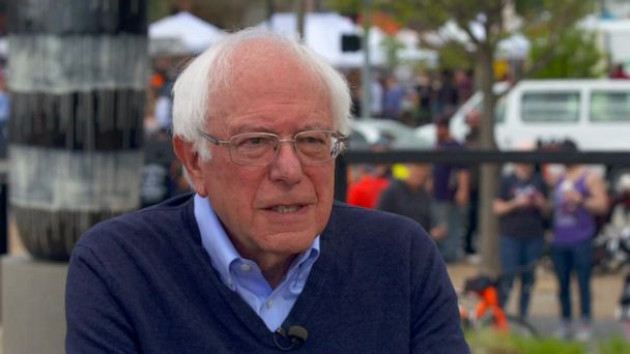
(WASHINGTON) — Senate Budget Committee Chair Bernie Sanders said Sunday that he opposes eliminating the debt ceiling, the financial limit on the federal government that could produce fierce clashes if the GOP wins back one or both chambers of Congress in November’s midterm elections.
“You have to increase the debt ceiling,” Sanders, I-Vt., said on CNN’s State of the Union.
“But you keep it?” anchor Jake Tapper asked him.
“Yes, yes,” Sanders said.
Those remarks come as Republicans forecast that they’ll use negotiations over the debt ceiling to extract concessions from Democrats to cut spending — a repeat of battles over the last decade starting with congressional Republicans and President Barack Obama.
Kevin McCarthy, the current House GOP leader who would likely become speaker if the party retakes the chamber, has been advocating for using the debt ceiling to win leverage over Joe Biden’s administration and Democratic lawmakers, with some House Republicans rallying to his side.
“I support that strategy because look, at the end of the day, when COVID-19 happened you had the federal government and state governments literally shut companies down. Businesses had to make tough decisions about how they were going to keep their doors open. The federal government just kept getting record revenue year over year and hasn’t had to make those tough decisions,” Rep. Nancy Mace, R-S.C., said on CNN on Sunday.
Democrats, meanwhile, accuse Republicans of potentially holding the debt ceiling hostage to win over their spending cuts. Forfeiting on the nation’s debts, they say, would amount to an economic calamity given that the government is already legally required to pay out spending that Congress authorizes — and so the debt ceiling should rise as that spending is passed.
President Joe Biden and others in the Democratic caucus have laid out red lines surrounding what they expect will be Republican offers to cut Social Security and Medicare in exchange for GOP votes to raise the debt ceiling.
“What Republicans are basically doing — and I hope everybody understands this — they are saying, ‘Look, we are prepared to let the United States default on its debt, not raise the debt ceiling, unless you talk about making cuts,'” Sanders said on CNN.
But he, like Biden, disagrees with calls to remove the debt ceiling. The president last week called such a move “irresponsible.”
Sanders used that word in criticizing conservatives.
“You know what they’re talking about? Cuts in Social Security, Medicare and Medicaid. Is that irresponsible? It is absolutely irresponsible,” he said on CNN. “You don’t use the debt ceiling to do that.”
He also argued that the party that has been hammering Democrats over inflation and the economy — as polls show voters trust the GOP more on both issues — has no real economic plan of its own.
“What do they want to do, other than complain?” he said.
McCarthy, the House minority leader, has touted a “Commitment to America,” including strengthening the economy. The platform, however, is light on specifics.
(WASHINGTON) — Americans trust that Republicans would do a better job on a key set of issues, with across-the-board, double-digit edges on inflation, the economy, gas prices and crime, according to a new ABC News/Ipsos poll.
Inflation sees one of the larger gulfs — with 36% of Americans trusting the GOP and 21% trusting Democrats. Similar gaps exist around gas prices, with 36% of Americans trusting Republicans and 22% trusting Democrats, the poll shows.
Broadly considering the state of the economy, 36% of Americans trust Republicans to do a better job while 24% trust Democrats — a potentially grim tell for the left, who currently cling to razor-thin majorities in the House and Senate.
Regarding crime, a key closing issue for the GOP in the campaign cycle, Republicans also enjoy a solid advantage — with 35% of respondents trusting them over the 22% who put faith in the Democrats.
The public is much more evenly split on immigration, with Republicans trusted to do a better job by 35% of Americans compared to 32% who prefer the Democrats, the new poll shows. Americans are also relatively split on taxes, with 30% saying Republicans would do a better job versus 28% for the Democrats.
These leads for Republicans have numerically solidified somewhat since August, per the ABC News/Ipsos poll conducted using Ipsos’ KnowledgePanel, after both parties flooded the market with a barrage of ads, with the right painting President Joe Biden and his party as soft on crime, weak on immigration and squarely responsible for higher prices at the pump and at the grocery store.
Just last week at the White House, Biden acknowledged the price crunch, as he announced the release of 15 million barrels of oil from the Strategic Oil Reserve in hopes to drive down the cost of gas.
“Families are hurting. You’ve heard me say it before, but I get it. I come from a family, if the price of gasoline went up at the gas station, we felt it. Gas prices hit almost every family in this country, and they squeezed their family budgets. When the price of gas goes up, other expenses get cut,” said Biden.
Democrats aren’t entirely underwater, however — seeing leads in voter trust concerning COVID-19, climate change, gun violence and abortion. Access to abortion services has been front-and-center of the Democratic messaging since the fall of Roe v. Wade, as the White House and other party leaders hope to build a blue wall to combat an anticipated “red wave” of Republican wins.
But recent polls including from Pew Research Center, suggest that the key issues their party champions are less likely to be prioritized as voting has begun in midterm races across the country. An overwhelming majority — 79% — told Pew that the economy is “very important” and 61% said violent crime is also “very important.”
One bright spot for Democrats on a different question in the ABC News/Ipsos poll is that 58% of independent voters say that if a candidate says they believe that the 2020 presidential election was stolen from former President Donald Trump, they are less likely to vote for that candidate. Out of 522 Republican nominees for federal and statewide office around the country, 199 question the legitimacy of the last election, according to research compiled by FiveThirtyEight and ABC News.
Regardless of where they fall on the issues, voters seem hungry for new leadership at the top.
As substantial of a grip that Trump has on his own party, 44% of Republicans say that Florida Gov. Ron DeSantis should have “a great deal” of influence on the future of the GOP, according to the ABC News/Ipsos poll. That’s more than Trump, with 34% of Republicans saying they want the former president to have “a great deal” of influence, the poll shows. Texas Sen. Ted Cruz, South Carolina Sen. Tim Scott, and former U.N. ambassador Nikki Haley are among other party leaders some Republicans want to be the voice of their party.
Democrats are shying away from their leader as well, and by even more eye-popping margins. A large plurality (42%) of Democrats would like President Barack Obama to have “a great deal” of influence on the future direction of their party outpacing the sitting president, with only 27% of Democrats wanting Biden to have “a great deal” of influence, the ABC News/Ipsos poll shows.
The sentiment of wanting someone other than Biden is not necessarily a new one, yet the support of Obama aligns with a week of the most substantial midterm campaigning the former president has done this cycle, planning to travel to Michigan, Georgia and Wisconsin at the end of October.
Last week, Obama argued on the “Pod Save America” podcast that Democrats can deliver a winning message to voters: “Across the board what we’ve seen is, when Democrats have even a really slim majority in Congress they can make people’s lives better. If you combine the deep concerns about our democracy with the concrete accomplishments that this administration has been able to deliver – because we had a narrow majority in both the House and the Senate – that should be enough to inspire people to get out.”
That said, in the same interview, Obama also chided his fellow Democrats for being a “buzzkill” on many issues.
And while this election has been framed partly as a referendum on Biden or Trump, a plurality of voters, 48%, say their votes are not really about either.
This ABC News/Ipsos poll was conducted using Ipsos Public Affairs’ KnowledgePanel® October 21-22, 2022, in English and Spanish, among a random national sample of 686 adults. Results have a margin of sampling error of 4.0 points, including the design effect. Partisan divisions are 28-24-41 percent, Democrats-Republicans-independents. See the poll’s topline results and details on the methodology here.
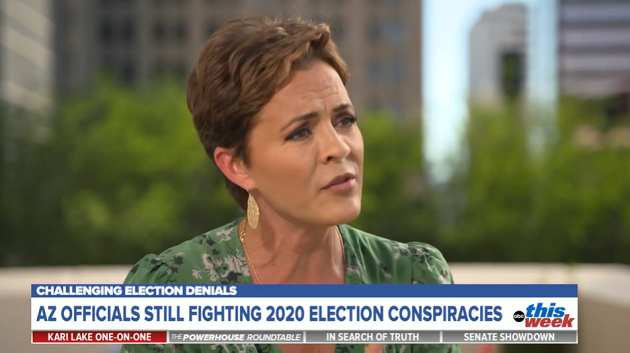
(WASHINGTON) — In an interview on ABC’s “This Week” on Sunday, Arizona Republican gubernatorial nominee Kari Lake would not explicitly commit to accepting the outcome of her upcoming election if she loses to her Democratic opponent.
“Let me ask you why it is that you have not said — or maybe you’ll do it now — you have not said that you will accept the certified results of this election, even if you lose this election?” ABC News Chief Washington Correspondent Jonathan Karl asked Lake in the interview.
“I will accept the results of this election if we have a fair, honest and transparent election. Absolutely, 100%,” said Lake, a former TV anchor who has become one of the Republican Party’s most prominent election deniers this cycle. “As long as it’s fair, honest and transparent.”
In a previous interview with CNN’s Dana Bash, Lake only said she would accept the results if she won, after being asked three times whether she would accept the election’s outcome.
“If you lose, will you accept that?” Bash ultimately asked, to which Lake replied again: “I’m going to win the election, and I will accept that result.”
Lake has frequently campaigned on the false claims that the 2020 presidential race was fraudulent — at times wielding a sledgehammer, claiming it’s for suspect electronic voting machines. She raised the subject of the 2020 race in her interview with Karl, wrongly alleging that “2,000 mail-in ballots were accepted by Maricopa County after Election Day in 2020, after Election Day.”
Maricopa County election officials told ABC News that no ballots were accepted after the deadline on Election Day in 2020. Some ballots that were scanned the next morning — giving them a post-election timestamp — were turned in to the office on Election Day, the officials said.
In her interview, Lake offered other unsubstantiated and disproven claims about Arizona’s 2020 race. At one point Lake said she wanted to discuss other topics, but Karl noted she was the one who raised the previous election.
“We’ve been talking about a whole bunch of other things,” Karl said, later adding: “I didn’t ask you about 2020, you brought it up.”
Despite the litany of allegations, no evidence of widespread fraud was found in the state that now-President Joe Biden won by 10,457 votes.
Biden’s national victory over Donald Trump was likewise confirmed by multiple audits and hand recounts; judges and local officials from both parties said they found no notable issues.
A comprehensive investigation by Maricopa County in Arizona found “100 potentially questionable ballots cast out 2.1 million” — hardly enough to change the results.
“Just to be clear, the Republicans on the Board of Supervisors, the Republican governor, now the Republican candidate for Senate running along with you [Blake Masters], the Republican attorney general under Donald Trump, Bill Barr, all said that … the election was not stolen,” Karl told Lake, who blamed baseless “corruption.”
He pressed her on her attacks on the past ballots, asking if she would take sweeping action to reject voters in her state.
“You said something last week, you said that there were 740,000 ballots with no chain of custody, those ballots shouldn’t have been counted,” Karl said to Lake, asking, “Are you really saying you would throw out the ballots of 740,000 — nearly three-quarter of a million Arizonans?”
“740,000 ballots violated chain of custody requirements in Maricopa County,” Lake answered, repeating a claim made in her interview with CNN.
Maricopa County election officials refuted Lake’s allegations and referred ABC News to a May statement where the office said the county always had control of the ballots, adding they “were sealed in envelopes that, in turn, were sealed in boxes that the couriers were prohibited from opening.”
As Lake has been particularly critical of early mail-in voting, Karl asked if she would seek to change the Arizona election laws, specifically early voting and mail-in voting, if she is elected governor over Democrat Katie Hobbs, who is currently the secretary of state.
Maricopa County Recorder Stephen Richer told ABC News that 85% of voting in the August primary was by early voting and in 2020, it was 91%.
“I don’t know exactly how we’ll do it, but we will secure our elections, restore faith in our elections, make sure our elections are honest and transparent,” Lake answered.
Karl asked again if she would seek to limit early voting. “There’s a lot of it in this state,” he said.
“Going back to when I first started voting back in the ’80s, we had Election Day. Our Constitution says Election Day,” Lake replied. “It doesn’t say election season, election month … And the longer you drag that out, the more fraught with problems there are.”
Hobbs, Lake’s rival, revealed last week that a voter registration error caused up to 6,000 Arizona voters to get mail ballots with only federal races and not local races. In her interview on “This Week,” Lake pivoted to blaming Hobbs for that error, calling her “incompetent.”
“She was the one who pointed this out and said she’s correcting it,” Karl said.
Hobbs’ office is working to address the issue and released a statement Wednesday saying that the problem affected less than a quarter of 1% of voters.
Hobbs will be the one to certify the upcoming elections, given her role as secretary of state. She has not stepped aside from those duties, though Lake has said that she should.
In a separate interview this week, Karl spoke with Hobbs, pressing her on that: “Will you recuse yourself from the certification process?”
Hobbs wouldn’t answer the question directly but said she was “having these discussions right now” and didn’t “want to talk about a hypothetical” with the outcome of the election being unknown.
She diverted to attacking Lake’s election denialism. “What I think is really important here is that Kari Lake has based her whole campaign on these election lies, continues to say that Donald Trump won in 2020,” Hobbs said, adding that her office “is going to be up against a barrage of legal challenges” from Lake should she win the governorship.
Polls show Hobbs and Lake are locked in a tight race, with much of their messages focused on immigration and the southern border; abortion access and extremism; the economy and public safety.
Speaking with Lake, now a rising star in her party, Karl asked if she would consider joining Trump as the running mate on a 2024 presidential ticket. Calling herself “the fake news’ worst nightmare,” Lake vowed to serve two full terms if elected.
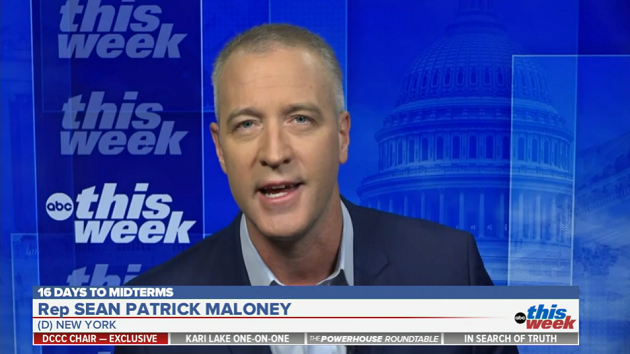
(WASHINGTON) — New York Rep. Sean Patrick Maloney, the chair of House Democrats’ campaign arm, insisted on Sunday that his party will buck both history and the current polling in November’s midterm elections.
In a lively interview with ABC “This Week” co-anchor Jonathan Karl, Maloney pointed to special election wins in Alaska and New York, where Democrats won in tough areas, to suggest that the party remains well situated heading into Election Day.
“You guys have been writing us off for two years, and we just went to work fixing people’s problems,” he said. “We know it’s going to be hard,” he continued. “My mom used to say, ‘Everything good in life is hard. You’ve got to go work.’ That’s what we’re going to do.”
Despite that optimism, the GOP is favored to win control of the House this midterm cycle, according to FiveThirtyEight’s analysis, in part because of voter concerns on the economy, inflation and crime and the edge they give to Republicans on those issues. Also working against them is President Joe Biden’s low approval rating, hovering just above 41%.
But Maloney said on “This Week” that the election wins this summer, Democrats’ legislative successes on health care costs and other issues and the public’s backlash to the overturning of Roe v. Wade showed his party remained competitive.
“What do you say we let the voters speak? Because when they have spoken, it turns out they care that this MAGA crowd has taken away 50 years of reproductive freedom, all of the privacy rights we used to take for granted,” Maloney argued. “It turns out they care that we’re making progress on the problems, and we have a plan to bring down your costs to help our seniors, to help our veterans, to bring jobs back to the United States.”
Karl pressed Maloney on the extent to which Biden hasn’t campaigned for swing-state Democrats, compared to the numerous rallies and trail appearances made by Presidents Barack Obama and Donald Trump in past midterms.
Maloney noted that in those election cycles, in 2010 and 2018, their parties went on to lose dozens of seats in Congress.
“Is that what you’re worried [would] happen?” Karl followed up.
“I guess we’ve got a strategy that might work out better than those,” Maloney said.
Biden has made relatively few trips to battlegrounds this year, though he was in Pennsylvania for Senate nominee John Fetterman last week and will headline a rally with Democratic candidates in South Florida on Nov. 1.
Karl pointed back to Maloney’s vow, in late 2020, that Democrats would pick up seats this cycle. “We’re going to break that curse … Write it down,” Maloney said then.
“As you can see, we wrote it down. You still think you are going to win seats — pick up seats in the House?” Karl asked.
“Well, why not?” Maloney contended. He also projected confidence about his own chances for reelection despite a House GOP-leadership aligned super PAC pouring millions into the race.
“They’re gonna lose this seat and wish they had the $7 million in other races,” Maloney said.
But Democrats are facing serious political headwinds, with surveys repeatedly showing Republicans running ahead of them on some of the key issues that Americans say will decide their vote, such as high inflation.
A new ABC News/Ipsos poll showed conservatives had solidified that advantage on being trusted more — by double digits — on the economy, gas prices and crime. The GOP has blamed Democrats’ control of Washington for such problems.
Maloney pushed back on Sunday.
“They have no plan to fix your economy,” he said. “They have no plan to make our streets safer. We know what they’re going to do to our reproductive freedoms and they look the other way when our democracy, our voting rights, our very Capitol is attacked.”