
Prosecutor sues Florida governor over suspension, says 1st Amendment rights violated

Prosecutor sues Florida governor over suspension, says 1st Amendment rights violated
David Taludkar/Getty Images

(WASHINGTON) — The Florida state attorney who was suspended by Gov. Ron DeSantis this month sued the governor on Wednesday, claiming his removal from office violated his First Amendment rights.

The lawsuit, filed in federal court, alleges the Republican governor retaliated against Andrew Warren, the Hillsborough County state attorney, for siding with progressive prosecutors who vowed not to prosecute crimes related to abortion and gender-transition treatments for children.

Warren, a Democrat, has called the suspension “political theater” and has claimed DeSantis suspended him to advance his own career.

Warren’s legal team filed the suit in the U.S. District Court for the Northern District of Florida. They hope a judge will rule to reinstate the twice-elected state attorney, who is the top prosecutor in the Tampa Bay area.

“I have the same first amendment right that everybody else in Florida does,” Warren said at a press conference in Tallahassee on Wednesday morning, adding that the governor’s decision amounted to an abuse of power.

Jean Jaques Cabou, a lawyer for Warren, said at the press conference that the governor had no grounds to oust Warren. He said DeSantis took his client out of office “because of policy differences [and] because the governor would like to do his job differently than Mr. Warren wants to do his job.”

“Those are not bases for which the governor can suspend Warren,” Cabou added.

DeSantis did not immediately respond to ABC News’ request for comment on the lawsuit. After he suspended Warren on Aug. 4, the governor said in a statement that “state attorneys have a duty to prosecute crimes as defined in Florida law, not to pick and choose which laws to enforce based on his personal agenda.”

The governor also touted his decision to remove Warren from office while on the campaign trail this week.

“Out of 20 elected prosecutors, we found one who decided to put himself above the law, saying he didn’t have to enforce laws that he disagreed with,” he said during a speech in Carlsbad, New Mexico, on Sunday.

Warren has signed two joint statements pledging not to prosecute crimes related to abortion and gender-transition treatments for children. By doing so, DeSantis claims, Warren has neglected his duty and demonstrated incompetence.

DeSantis signed a law in April that bans abortions in Florida after a 15-week gestation period. The law went into effect on July 1, a week after the U.S. Supreme Court overturned Roe v. Wade.

Florida health care providers last week filed a notice of appeal with the state Supreme Court challenging the abortion law. The plaintiffs argue the law violates the state constitution.

There is currently no law in Florida that criminalizes gender-related treatment for minors, although some state legislators have pushed for one. The state’s Agency for Health Care Administration recently passed a rule barring transgender residents from using Medicaid to pay for gender-affirming care.

The governor says Warren’s decision to sign the joint statements, coupled with other decisions Warren has made in his two terms as a state attorney, are sufficient under the Florida Constitution for suspension.

Cabou argues that it’s up to the court to decide whether Warren’s statements meet the criteria for a suspension.

“Just because the governor calls something neglect of duty or the government calls something incompetence doesn’t make it true,” he said.

Scott Stephens, a Florida constitutional law professor and former Hillsborough County circuit judge, told ABC News the court will decide whether Warren’s decision to sign the two letters can be used as evidence that he neglected his duty or is incompetent.

Under Florida law, Warren has the right to a hearing before the state senate to decide whether his suspension was constitutional.

Debbie Brown, the secretary of the Republican-controlled body, sent Warren a letter on Monday to initiate the process for a hearing.

This process is now on hold due to Wednesday’s filing.

Copyright © 2022, ABC Audio. All rights reserved.
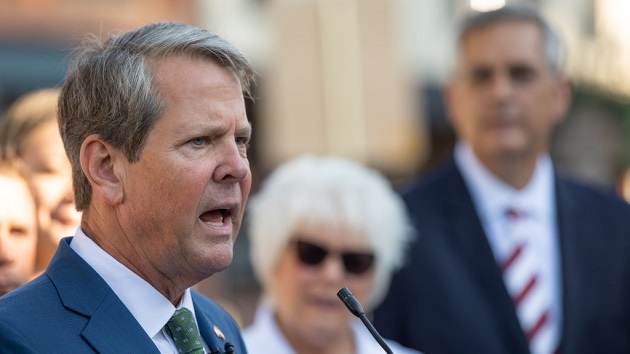
Georgia Gov. Brian Kemp files motion to delay testifying in Fulton County election probe

Georgia Gov. Brian Kemp files motion to delay testifying in Fulton County election probe
Dustin Chambers/Bloomberg via Getty Images

(ATLANTA) — Georgia Gov. Brian Kemp filed a motion on Wednesday looking to delay a subpoena for his testimony in front of the special grand jury as part of the ongoing criminal investigation into efforts to overturn the 2020 election in Fulton County.

In the 121-page motion, Kemp’s legal team pushed back on the subpoena, claiming Fulton County District Attorney Fani Willis “engineered the Governor’s interaction with the investigation to reach a crescendo in the middle of an election cycle.”

In a statement to ABC News, a spokesperson for Kemp noted the proximity to the November midterm elections.

“For more than a year, the Governor’s team has continually expressed his desire to provide a full accounting of his very limited role in the issues being looked at by the special grand jury,” said Katie Byrd, Kemp’s communications director. “We are now just weeks away from the 2022 general election, making it increasingly difficult to dedicate the time necessary to prepare and then appear.”

Kemp’s office said they are asking the judge “to allow the Governor to come in after the November election and direct investigators to work with our legal team to ensure the topics discussed during his appearance remain on his defense of state law and the Constitution in the aftermath of the 2020 election.”

Kemp is currently slated to testify before the special grand jury on Thursday. The Georgia governor is running for reelection against Democratic challenger Stacey Abrams, who lost her bid against Kemp in 2018.

The motion from Kemp follows the news that former President Donald Trump’s personal attorney, Rudy Giuliani, was informed that he is a target of the investigation. Giuliani testified before the special grand jury in Atlanta on Wednesday.

The special grand jury does not have the ability to return an indictment, and can only make recommendations concerning criminal prosecution — a process that’s expected to take months.

Another grand jury would be needed in order to bring any possible charges.

Copyright © 2022, ABC Audio. All rights reserved.

Mike Pence tells Republicans to stop attacking the FBI after Mar-a-Lago search

Mike Pence tells Republicans to stop attacking the FBI after Mar-a-Lago search
Scott Eisen/Getty Images

(WASHINGTON) — Former Vice President Mike Pence on Wednesday castigated Republicans who are attacking the FBI after the agency searched Donald Trump’s residence in Florida.

The Aug. 8 search at Mar-a-Lago, which sources told ABC News is tied to the former president’s alleged mishandling of classified documents and other White House records, has Republicans railing against the federal law enforcement agency as well as the Department of Justice.

Rep. Elise Stefanik, the number 3 House Republican, said the search was “a complete abuse and overreach of its authority.” Rep. Marjorie Taylor Greene, R-Ga., is calling to defund the FBI. Trump himself has consistently assailed the FBI and Department of Justice, calling the raid “an assault on a political opponent at a level never seen before in our Country. Third World!”

The FBI has warned about rising threats against law enforcement since the search. A joint intelligence bulletin obtained by ABC News said there has been an “increase in threats and acts of violence” against law enforcement and government personnel in response to what occurred at Mar-a-Lago.

Last week, a man armed with AR-15 style rifle allegedly tried to break into an FBI field office in Cincinnati and later was shot dead by police. Law enforcement officials said they were investigating the suspect’s social media posts, which included calls for violence in the days after the raid.

Speaking at a political event in Manchester, New Hampshire on Wednesday, Pence said the criticisms coming from members of his own party have to end.

“The Republican Party is the party of law and order,” Pence said. “And these attacks on the FBI must stop; calls to defund the FBI are just as wrong as calls to defund the police.”

Pence said he was “deeply troubled” to learn that a search warrant was executed at Trump’s estate but said the party can still hold Attorney General Merrick Garland accountable “without attacking the rank-and-file law enforcement personnel at the FBI.”

“The truth of the matter is, we need to get to the bottom of what happened,” Pence continued. “We need to let the facts play out, but more than anything else, the American people need to be reassured in the integrity of our justice system and the very appearance of a recurrence of politics playing a role in decisions that the Justice Department demands transparency as never before.”

The vice president said he will continue to urge Attorney General Merrick Garland to make such information available to the public.

Trump and his allies want the search warrant affidavit to be released but the Department of Justice said doing so would jeopardize the integrity of the ongoing investigation.

A hearing is scheduled for Thursday on the request from multiple media outlets, ABC News included, to unseal the affidavit.

Pence also commented on the work of the Jan. 6 committee at the “Politics & Eggs” breakfast at St. Anselm College. The former vice president stating he would consider testifying if asked. Sources have told ABC News that committee investigators have been privately engaging with Pence’s lawyer about securing his potential testimony for months.

“Any formal invitation rendered to us, we’d give it due consideration. But my first obligation is to continue to uphold my oath, continue to uphold this framework of government enshrined in the Constitution, this created the greatest nation in the history of the world,” he said.

Copyright © 2022, ABC Audio. All rights reserved.

Liz Cheney teases presidential run, will form anti-Trump effort

Liz Cheney teases presidential run, will form anti-Trump effort
Alex Wong/Getty Images

(WASHINGTON) — Rep. Liz Cheney is looking to turn her landslide loss in Wyoming’s Republican primary Tuesday night into a nationwide crusade to keep Donald Trump out of the White House — one she said Wednesday could include her running for president herself.

Despite her six-year tenure in Congress now headed to a close, Cheney said her political work isn’t done yet and is previewing what’s to come next — including a potential run for the presidency and an organization aimed at taking down Trump in 2024.

Cheney’s first hint at a presidential campaign came in her concession speech, in which she invoked President Abraham Lincoln as an example of patriotism and a champion of the Republican Party.

“The great and original champion of our party, Abraham Lincoln, was defeated in elections for the Senate and the House before he won the most important election of all,” she told her supporters on Tuesday night. “Lincoln ultimately prevailed, he saved our Union and he defined our obligation as Americans for all of history.”

Cheney, once a rising Republican star, was soundly defeated by Trump-backed Harriet Hageman. Cheney said Tuesday she could have won another term but only if she accepted Trump’s lies about the 2020 election.

As vice-chair of the House select committee investigating the Jan. 6 insurrection at the U.S. Capitol, Cheney has become one of the party’s most outspoken critics of the former president.

“It would have required that I enable his ongoing efforts to unravel our democratic system and attack the foundations of our republic — that was a path I could not and would not take,” she said as she addressed her supporters on Tuesday night.

Cheney made a more direct indication she’s thinking about running for the White House on Wednesday morning.

“I’m not going to make any announcements here this morning, but it is something that I am thinking about and I’ll make a decision in the coming months,” Cheney told NBC’s “Today” program on Wednesday.

In the meantime, her focus will be on stopping Trump.

“In coming weeks, Liz will be launching an organization to educate the American people about the ongoing threat to our Republic, and to mobilize a unified effort to oppose any Donald Trump campaign for president,” Cheney spokesperson Jeremy Adler told ABC News.

The news of the anti-Trump group was first reported by Politico.

Trump has yet to formally announce a campaign but has repeatedly hinted at a comeback since the day he left office. Most recently, he told Fox News at CPAC that the “the time is coming” for a formal announcement.

Trump took a victory lap as Cheney was defeated on Tuesday night, calling Hageman’s win “great and very decisive.”

“This is a wonderful result for America, and a complete rebuke of the Unselect Committee of political Hacks and Thugs,” Trump posted to Truth Social. “Liz Cheney should be ashamed of herself, the way she acted, and her spiteful, sanctimonious words and actions towards others. Now she can finally disappear into the depths of political oblivion where, I am sure, she will be much happier than she is right now.”

His criticism of Cheney continued in another post on Wednesday.

“The Fake News Media is claiming that Liz Cheney has such a ‘wonderful and bright’ political future. Maybe they didn’t notice that she lost by nearly 40 points? She’s too angry and sick to succeed in the future, but who knows!” he wrote on the conservative social media site.

ABC News’ Will Steakin contributed to this report.

Copyright © 2022, ABC Audio. All rights reserved.

Trump-backed election denier wins GOP nod to be Wyoming secretary of state

Trump-backed election denier wins GOP nod to be Wyoming secretary of state
adamkaz/Getty Images

(WASHINGTON) — Wyoming’s Republican voters got one step closer to picking their secretary of state on Tuesday in a primary matchup of candidates with opposing views on the 2020 election.

ABC News reports that state Rep. Chuck Gray is projected to win the Republican nomination for secretary of state.

Gray, who is endorsed by Donald Trump, claimed the 2020 race was “illegitimate.” He faced state Sen. Tara Nethercott, who has said that she believes the 2020 election was secure; and geologist Mark Armstrong.

Gray also supported the former president after the FBI search of Mar-a-Lago, tweeting: “This is political persecution!”

There were no listed Democrats on Tuesday seeking the party’s nomination to be secretary of state, though voters could submit write-ins.

The winner of November’s general election will succeed Ed Buchanan, who is retiring and has himself defended the legitimacy of the 2020 election.

While Wyoming is not a competitive state at the presidential level, the race marks another example of election deniers running for a position that would involve overseeing elections.

The secretary of state is also first in line to the governorship, since Wyoming does not have a lieutenant governor.

ABC News’ Alina Kim contributed to this report.

Copyright © 2022, ABC Audio. All rights reserved.

Despite Trump’s claims, experts say there’s no ‘magic wand’ for a president to declassify documents

Despite Trump’s claims, experts say there’s no ‘magic wand’ for a president to declassify documents
FABRICE COFFRINI/AFP via Getty Images

(NEW YORK) — Former President Donald Trump isn’t the first White House veteran to claim — in the midst of a criminal probe looking at their handling of government secrets — that the president can declassify almost anything he wants, whenever he wants, and however he wants.

“If the president says to talk about [a] document, it is then a declassified document,” the former chief of staff to then-Vice President Dick Cheney, Lewis “Scooter” Libby, told a federal grand jury in 2004. “There’s no … process, according to counsel, that has to be gone through.”

At the time, federal investigators were looking into the leak of the identity of a covert CIA operative — but they were also interested in learning more about how parts of a classified document summarizing Iraq’s purported efforts to obtain weapons of mass destruction in Africa had also become public.

Libby admitted to investigators that he “showed” portions of the Iraq document to a New York Times reporter, but he insisted that then-President George W. Bush “had already declassified” those portions by granting permission for Libby to share them with the press.

When transcripts of Libby’s testimony were later released, it sparked a public debate over how presidents can — and should — wield their declassification authority.

“When the president determines that classified information can be made public … can that supplant the declassification process?” a reporter asked White House spokesperson Scott McClellan on April 7, 2006. “Is it de facto declassified, by that determination?”

“The president is authorized to declassify information as he chooses,” McClellan responded, without offering additional details.

A rigorous review

Nearly two decades later, after FBI agents last week executed a search warrant at Trump’s Mar-a-Lago estate and removed several sets of classified documents, there is still little clarification on what a president must do — if anything — before a government secret he wants to release is no longer deemed classified.

For most government employees who seek to have information declassified, their requests must go through a rigorous review process that can span the entire U.S. intelligence community, in order to ensure that sources, methods and other national security interests are protected. “[But] there’s no formal process that a president is required to follow when declassifying information,” Brian Greer, a former CIA attorney who specialized in classification issues, told ABC News.

Nevertheless, Greer noted, “there has to be evidence that a declassification order occurred.” And in Trump’s case, “the Trump team has yet to produce any credible evidence,” he said.

In January, National Archives officials retrieved 15 boxes of records that had been improperly taken to Mar-a-Lago when Trump left the White House last year — then, two months ago, federal agents visited Mar-a-Lago to retrieve additional materials that they believed Trump had failed to turn over. Shortly after that visit, an attorney for Trump signed a statement saying that all classified documents at Mar-a-Lago had been turned over to federal investigators, sources familiar with the matter told ABC News. But authorities believed Trump continued to possess classified documents, leading to last week’s raid.

It’s unclear exactly what records were recovered from Trump’s residence last week, but court documents filed by the Justice Department indicate that it is investigating, among other things, potential violations of the Espionage Act, which makes it a crime to disclose sensitive national security information that could harm the United States — even if it’s not classified.

After the raid, Trump’s team issued a statement to one media outlet claiming that, while still in office, Trump had issued “a standing order that documents removed from the Oval Office and taken to the residence were deemed to be declassified the moment he removed them.” On social media, Trump himself insisted that the documents at Mar-a-Lago were “all declassified.”

“The president is the ultimate classifier and de-classifier — but he can’t just wave a magic wand, and he can’t do it in secret,” said Douglas London, a 34-year CIA veteran and author of the “The Recruiter: Spying and the Lost Art of American Intelligence.”

“So if [Trump] and his allies are defending his handling of these documents by claiming that they’re no longer classified, they need to show the paper trail,” London said.

‘Nothing short of laughable’

Jeh Johnson, who served as the Defense Department’s top lawyer before becoming Homeland Security secretary under the Obama administration, agreed in a piece he published for Lawfare.

“[P]art and parcel of any act of declassification is communicating that act to all others who possess the same information, across all federal agencies,” Johnson wrote. “This point holds true regardless of whether the information exists in a document, an email, a power point presentation, and even in a government official’s mental awareness. Otherwise, what would be the point of a legitimate declassification?”

Accordingly, Johnson said, the Trump team’s claim of a “standing order” that all documents taken to Trump’s residence were therefore “declassified” is “nothing short of laughable.”

In Libby’s case, no information was publicly released confirming that Bush had given Libby permission to share classified information with a reporter — but at the time, the Bush administration was looking to release the information more broadly, and had initiated an inter-agency review to declassify it.

Amid growing questions over the unfolding war in Iraq, Bush and his allies wanted to bolster their previous claims that Iraq’s regime had looked to acquire weapons of mass destruction in Africa. Those claims had come under intense scrutiny at the time after the former ambassador sent to investigate Iraq’s alleged efforts, Joe Wilson, publicly disclosed that he found no evidence to support the Bush administration’s claims and accused U.S. officials of exaggerating intelligence.

“And so the vice president thought we should get some of these facts out to the press,” Libby testified to the grand jury. “But before it could be done, the document [summarizing the intelligence community’s conclusions] had to be declassified.”

Libby said Vice President Cheney “then undertook to get permission from the president to talk about this to a reporter. He got the permission. Told me to go off and talk to the reporter.”

‘In the public interest’

Ten days after Libby’s meeting with the New York Times reporter, the U.S. government publicly released the document, known as a National Intelligence Estimate.

“What do you say to critics who argue that the president’s decision to disclose this information, to effectively declassify it … [was] a political use of intelligence information?” a reporter asked McClellan, the White House spokesperson, after the document was released.

“It was in the public interest that this information be provided,” McClellan insisted.

Libby was ultimately charged — and convicted — of something else: lying to the grand jury and federal investigators about his role in leaking the identity of Wilson’s wife, Valerie Plame, who was a covert CIA operative. Libby was sentenced to more than two years in federal prison, but his sentence was commuted by Bush in 2007, before Bush left office.

He was then fully pardoned by Trump in 2018.

ABC News’ Alex Mallin and Will Steakin contributed to this report.

Copyright © 2022, ABC Audio. All rights reserved.

Pence says he’d consider testifying before Jan. 6 committee if asked

Pence says he’d consider testifying before Jan. 6 committee if asked
Scott Eisen/Getty Images

(MANCHESTER, N.H.) — Former Vice President Mike Pence said Wednesday he’d consider testifying before the House Jan. 6 committee if asked, in some of his most specific comments yet on the prospect.

Appearing at a “Politics & Eggs” breakfast in Manchester, New Hampshire, where presidential hopefuls often speak since the state holds the nation’s first primary, Pence was asked if he’d be “agreeable” if the committee were to call on him to testify.

“If there was an invitation to participate, I would consider it,” Pence responded.

“But you’ve heard me mention the Constitution a few times this morning. In the Constitution there are three co-equal branches of government, and any invitation that would be directed to me I’d have to reflect on the unique role I served as vice president.”

“Any formal invitation rendered to us, we’d give it due consideration. But my first obligation is to continue to uphold my oath, continue to uphold this framework of government enshrined in the Constitution, this created the greatest nation in the history of the world,” he continued.

Pence’s answer was yet another break from his former boss, Donald Trump, who has repeatedly slammed the committee’s work as politically motivated.

Committee investigators have for months been privately engaging with Pence’s lawyer about securing his potential testimony, sources have told ABC News.

Pence has largely avoided discussing the work of the Jan. 6 committee despite being cheered by the its members for resisting Trump’s demands. In June, he told Fox News Democrats were using the panel to “distract attention from their failed agenda.”

The focus of one of the committee’s hearings zeroed in on the pressure campaign on Pence, waged by Trump and his allies to attempt to get him to support their effort to overturn the election.

Members of the committee have said a subpoena for Pence’s testimony was not off the table, but have also indicated his testimony may not be necessary in filling any gaps given the committee interviewed Pence’s former chief of staff Marc Short and had Pence’s former counsel Greg Jacob testify publicly.

The committee also aired a never-before-seen photograph of a phone call between Trump and Pence on the morning of Jan. 6, 2021, that onlookers, including Ivanka Trump, described as “heated.”

Hours later, when the joint session of Congress resumed after the attack, Pence rejected Trump’s last-ditch demands to unilaterally reject Joe Biden’s electoral victory.

The committee also revealed that the mob came within 40 feet of the vice president, who was ushered to an underground location for hours as the violence unfolded. Jacob said in his appearance before the committee that Pence stayed in the area so as to “not to take any chance that the world would see the vice president of the United States fleeing the United States Capitol.”

Jacob also testified that Trump didn’t check on Pence at all during that time, which he said left Pence frustrated.

Pence and Trump haven’t spoken in over a year, sources familiar with the matter told ABC News in June.

The House Jan. 6 committee, made up of nine Democrats and two Republicans, held eight public hearings this summer to reveal the findings of their year-long probe into the events before, during and after the U.S. Capitol attack.

Trump, they argued, was at the center of the attack. He was well-aware of the fact that he lost the 2020 election, members said, but moved ahead anyway with a pressure campaign against federal and local officials to illegally overturn the results.

“Over the last month and a half, the Select Committee has told the story of a president who did everything in his power to overturn an election,” Chairman Bennie Thompson, D-Miss., said in the last public hearing on July 12. “He lied. He bullied. He betrayed his oath. He tried to destroy our democratic institutions. He summoned a mob to Washington.”

The committee will next reconvene in September.

ABC News’ Hannah Demissie contributed to this report.

Copyright © 2022, ABC Audio. All rights reserved.

Liz Cheney loses primary as Trump topples his most prominent GOP critic

Liz Cheney loses primary as Trump topples his most prominent GOP critic
SAUL LOEB/AFP via Getty Images

(NEW YORK) — Rep. Liz Cheney, R-Wyo., is projected to have lost her primary on Tuesday to Donald Trump-backed Harriet Hageman, ABC News reports, after Cheney built her political profile — and her campaign — around criticizing the former president as an existential threat to American democracy.

Cheney’s defeat was largely expected, given the partisan makeup of her seat and polling that showed her trailing Hageman. Trump won Wyoming in the last presidential election with some 70% of the vote. Still, Cheney’s defeat marks Trump’s biggest win in his revenge tour against intraparty detractors and a warning sign for other anti-Trump Republicans thinking of crossing him.

“Tonight, Harriet Hageman has received the most votes in this primary. She won. I called her to concede the race. This primary election is over,” Cheney said in a speech Tuesday night from a ranch in Jackson, contrasting that call with Trump, who still refuses to concede the 2020 race.

The choice between Cheney and Hageman, both of whom staked out conservative policy platforms, played out largely along national themes and loyalty to Trump.

Cheney focused on criticizing Trump over his role in last year’s deadly Capitol insurrection, casting her reelection bid as a fight to maintain the GOP’s principles.

Hageman, meanwhile, echoed Trump’s unfounded election fraud claims and berated Cheney — whom Hageman had previously advised — as a lawmaker more focused on toppling the de facto GOP leader.

Cheney boasts a famous last name and significantly out-raised Hageman. But over time it became clear that the three-term lawmaker was the underdog as polls showed Wyoming Republicans increasingly favoring her opponent.

In a sign of Cheney’s tenuous footing with members of her own party, her campaign started an outreach effort to voters to explain how they could change their party registration the day of the primary to vote for her — though operatives said there was little hope there were enough Democrats to change Cheney’s fate.

“Two years ago, I won this primary with 73% of the vote. I could easily have done the same again. The path was clear,” Cheney said in her speech Tuesday. “But it would have required that I go along with President Trump’s lie about the 2020 election. It would have required that I enable his ongoing efforts to unravel our democratic system and attack the foundations of our republic — that was a path I could not and would not take.”

“No House seat, no office in this land, is more important than the principles that we are all sworn to protect,” she said. “And I well understood the potential political consequences of abiding by my duty.”

Hageman now is expected to coast in the general election — against projected Democratic opponent Lynnette Grey Bull — in one of the country’s reddest states and be a staunch Trump ally in the House.

“Absolutely the election was rigged. It was rigged to make sure that President Trump could not get reelected,” she said at a campaign event earlier this month indicating her ideological alignment with Trump. “What happened in 2020 is a travesty.”

Hageman on Tuesday touted her win over Cheney, describing it as returning Wyoming’s House seat to the people.

“I will be accountable to the voters and citizens of Wyoming because I am one of you and, just like you, I am sick and tired of having no voice in the U.S. House of Representatives,” she said. “Today we have succeeded at what we set out to do — we have reclaimed Wyoming’s lone congressional seat for Wyoming.”

“Assume that if we put you in power, you will be accountable to us and you will do what is in our best interest. And if you don’t, we will fire you,” she said.

Cheney’s defeat marks a bookend to a meteoric rise and swift fall for an erstwhile GOP star.

She was first elected in 2016 and became the No. 3 Republican in the House in late 2018, a climb that fueled rumors she had an eye on the speakership one day.

However, after last year’s insurrection, she became the highest-ranking House Republican to back impeaching Trump and ultimately became the vice chair of the special committee investigating the Capitol riot.

Her consistent condemnations of Trump infuriated both other House Republicans who accused her of derailing their messaging strategy and some voters in Wyoming who viewed Cheney as an absentee representative more focused on the former president than state issues.

Beyond her tough primary challenge, she also lost her leadership spot in the House and was censured by the Republican National Committee and the Wyoming Republican Party.

Still, Cheney refused to modulate her messaging — given, she said, the danger Trump represented — and indicated that she would continue her focus on combating election conspiracies even after her expected loss.

“Like many candidates across this country, my opponents in Wyoming have said that the 2020 election was rigged and stolen. No one who understands our nation’s laws — no one with an honest, honorable, genuine commitment to our Constitution — would say that. It is a cancer that threatens our great Republic,” she said in her closing ad. “If we do not condemn these lies, if we do not hold those responsible to account, we will be excusing this conduct and it will become a feature of all elections. America will never be the same.”

All eyes now will be on what Cheney plans to do after leaving the House, with her hinting that “now the real work begins.”

Speculation has bubbled that Cheney is eyeing a presidential bid in 2024 to challenge Trump, should he run again in two years, a theory that gained more ground in her concession speech in which she noted Abraham Lincoln’s own failed House and Senate bids before he won the presidency.

“Lincoln ultimately prevailed, he saved our union, and he defined our obligation as Americans for all of history,” she said.

Regardless of what form her advocacy takes, Cheney indicated that she will still hold candidates’ feet to the fire over unproven claims of election fraud.

“Today, as we meet here, there are Republican candidates for governor who do deny the outcome of the 2020 election and who may refuse to certify future elections if they oppose the results,” she said in her concession speech. “We have candidates for secretary of state who may refuse to report the actual results of the popular vote in future elections. And we have candidates for Congress, including here in Wyoming, who refuse to acknowledge that Joe Biden won the 2020 election and suggest that states decertify the result.”

“No American should support election deniers for any position of genuine responsibility where their refusal to follow the rule of law will corrupt our future,” she said.

Cheney’s loss marks the end of a largely successful campaign by Trump to expel his impeachment-backers from the GOP, arguing they were not true Republicans.

Of the 10 House Republicans who voted to impeach Trump last year, four decided to not seek reelection. Of the six who did, four have now lost their primaries. Only two of the 10 have advanced to the general election.

“Liz Cheney should be ashamed of herself, the way she acted, and her spiteful, sanctimonious words and actions towards others,” Trump said on his Truth Social platform. “Now she can finally disappear into the depths of political oblivion where, I am sure, she will be much happier than she is right now.”

ABC News’ Miles Cohen, Lalee Ibssa, Allison Pecorin and Brittany Shepherd contributed to this report.

Copyright © 2022, ABC Audio. All rights reserved.

Committee chairs threaten DHS inspector general with subpoena over missing Secret Service texts

Committee chairs threaten DHS inspector general with subpoena over missing Secret Service texts
Michael M. Santiago/Getty Images, FILE

(WASHINGTON) — The Democratic chairs of the House Homeland Security and House Oversight committees on Tuesday threatened the Department of Homeland Security inspector general with a subpoena, accusing him of delaying responding to the committee’s request for answers regarding missing Secret Service text messages on and around the Jan. 6 attack on the Capitol.

“If you continue to obstruct, we will have no choice but to consider alternate means to ensure compliance,” Rep. Bennie Thompson and Rep. Carolyn Maloney, both Democrats, write to Joseph Cuffari in a letter dated Aug. 16.

This is the second letter they have jointly sent to the DHS IG requesting information, amid new allegations that career staff in Cuffari’s office prepared a notice to Congress earlier this year about their difficulty obtaining Secret Service text messages connected to Jan. 6, but the notice was not included in the government watchdog’s required regular report to lawmakers.

The DHS inspector general has been under scrutiny for his handling of the deleted Secret Service text messages on and around Jan. 6. He previously waited more than a year to notify the committee about the missing texts.

A Secret Service spokesman last month acknowledged text messages from Jan. 5 and Jan. 6, 2021, were deleted after being sought by the DHS inspector general.

A letter Cuffari sent last month to the heads of the House and Senate Homeland Security committees said the messages were deleted “as part of a device-replacement program,” despite the inspector general having requesting such communications.

Guglielmi, the Secret Service spokesman, subsequently dismissed any “insinuation” the agents had “maliciously” deleted the texts.

The agency sent out communications to employees on how to upload digital files on their local devices if they are government records, according to a source familiar with the Secret Service migration process.

The letter sent by the committee chairs lays out how they say the inspector general might have violated the Inspector General Act.

“In response to the Committees’ requests, you have refused to produce responsive documents and blocked employees in your office from appearing for transcribed interviews,” the members write. “Your obstruction of the Committees’ investigations is unacceptable, and your justifications for this noncompliance appear to reflect a fundamental misunderstanding of Congress’s authority and your duties as an Inspector General.”

The DHS IG has instructed the Secret Service to stop its internal investigation because his office has now turned the deleted text message issue into a criminal investigation, according to three sources familiar with the situation.

The congressional committees say Cuffari made no mention of the Secret Service’s retention issues in the semi-annual report to lawmakers, despite knowing about them.

The inspector general’s office has not responded to ABC News request for comment.

Copyright © 2022, ABC Audio. All rights reserved.

Biden signs sweeping health, climate and tax bill, a major win for his domestic agenda

Biden signs sweeping health, climate and tax bill, a major win for his domestic agenda
Chip Somodevilla/Getty Images

(WASHINGTON) — President Joe Biden on Tuesday signed the Democrats’ massive climate, health and tax bill into law, marking a major accomplishment for his domestic agenda less than three months before midterm elections.

Speaking from the White House’s State Dining Room, Biden touted the Inflation Reduction Act as “further proof that the soul of America is vibrant, the future of America is bright and the promise of America is real and just beginning.”

“The American people won and the special interests lost,” he said before swiping at Republicans for their unanimous opposition to the law.

“That’s the choice we face. We can protect the already powerful or show the courage to build a future where everybody has an even shot,” Biden said.

Taking advantage of some political momentum, Biden interrupted his summer vacation for the signing just days after the House approved the measure, following Senate passage by just one vote amid some political drama. He has spent much of the past week in South Carolina. Biden arrived at the ceremony wearing a mask after spending his vacation with first lady Jill Biden, who has tested positive for COVID-19.

In attendance for the ceremony were Sen. Joe Manchin, a key negotiator of the package, and Senate Majority Leader Chuck Schumer.

“I am confident this bill will endure as one of the greatest legislative feats in decades. It’ll lower costs, create millions of good paying jobs and is the boldest climate bill ever,” Schumer said during the event.

A larger celebration for the law is being planned for Sept. 6.

The White House also said that, “in the coming weeks,” Biden will host a Cabinet meeting focused on implementing the new law and will also travel across the U.S. to promote it.

The Biden administration has planned a cross-country rollout campaign for the legislation, which aims to make prescription drugs and health insurance cheaper; invest in clean energy and curb climate change; raise taxes on the wealthy; and cut the deficit.

Starting this week through the end of August, Cabinet members plan to travel to 23 states, on more than 35 trips, to tout the “Inflation Reduction Act,” according to the White House.

The administration also plans to roll out information online and on social media about the legislation’s impact, and to collaborate with members of Congress to host hundreds of events, the White House said.

The blitz will highlight will highlight other major legislative wins as well as part of a “Building a Better America Tour.”

In a memo the White House made public from Senior Adviser Anita Dunn and Deputy Chief of Staff Jen O’Malley Dillon to Chief of Staff Ron Klain, the administration plans to not only tout passage of the IRA, but also the CHIPS Act aimed at boosting the U.S. semi-conductor industry over China’s and easing a pandemic-cause shortage, the bipartisan gun control bill and the bipartisan infrastructure bill.

Ahead of Tuesday’s signing, the White House on Monday put out what it said would be the Inflation Reduction Act’s impact.

According to the White House, about 1.4 million Americans who are on Medicare who usually spending more than $2000 per year on prescription drugs will see their costs capped at that amount. Overall, it says, there are about 50 million Americans on Medicare Part D who are eligible for that cost cap.

The White House said there are about 3.3 million Americans on Medicare who use insulin, who will benefit from the new $35 monthly price cap.

The White House also estimates about 5-7 million Americans could see their prescription drug costs decrease once Medicare begins negotiating costs.

Lower Obamacare premiums will be extended for the 13 million Americans insured under that program, the White House said.

And the White House also claims greenhouse gas emissions will be reduced by a billion metric tons in 2030 thanks to the Inflation Reduction Act.

ABC News’ Sarah Kolinovsky and Justin Gomez contributed to this report.

Copyright © 2022, ABC Audio. All rights reserved.