(WASHINGTON) — The Supreme Court on Monday will revisit the question of affirmative action in higher education.
Justices are hearing oral arguments in two major cases challenging race-conscious admissions programs at Harvard University and University of North Carolina. It’s the first test for affirmative action before the current court, which has a six-justice conservative majority and three justices of color, including the first-ever Black woman justice, Ketanji Brown Jackson.
The court’s decision, due out next year, could end the policy that’s shaped the college admissions process for the past half-century.
Please check back for updates. All times Eastern:
Oct 31, 10:04 AM EDT
Trump attorneys will make case against affirmative action
Two attorneys who have represented former President Donald Trump will make the case against affirmative action at the Supreme Court.
Patrick Strawbridge will argue on behalf of Students for Fair Admissions in the University on North Carolina case. Strawbridge has represented Trump in Jan. 6 matters, challenges to 2020 election results in key states and in a bid to shield his tax returns from House investigators.
Cameron T. Norris, who has also represented Trump, will represent Students for Fair Admissions in the Harvard case.
Both men are partners at Consovoy McCarthy PLLC — and both are former clerks to Supreme Court Justice Clarence Thomas.
North Carolina Solicitor General Ryan Park is representing the University of North Carolina during the arguments. Former U.S. Solicitor General Seth Waxman from the Clinton Administration, and a Harvard alumnus, is defending the university in the second case.
– ABC News’ Devin Dwyer
Oct 31, 9:48 AM EDT
What to know about the cases
The justices on Monday will hear two major cases, the first starting at 10 a.m. regarding affirmative action at the University of North Carolina. The second case of the day will be about the policy at Harvard University.
Students for Fair Admissions, a group of students and parents led by conservative activist Edward Blum, has led the opposition to race-conscious admissions policies.
The organization sued the schools in 2014, alleging illegal racial discrimination against Asian American applicants during the admissions process. The schools have countered that court precedent makes clear that the consideration of race is allowed to address inequality.
A federal district court rejected SFFA’s claims, as did an appeals court. Now, the Supreme Court is being asked to weigh in on 40 years of precedent.
Oct 31, 9:33 AM EDT
College students share their views on affirmative action
Ahead of the oral arguments at the Supreme Court on Monday, ABC News spoke with college students from public and private colleges on what they think about the decades-old admissions policy.
Some students said the race-conscious policy was meaningful and important. One junior at Harvard University, one of the schools where affirmative action is being challenged, said: “We can’t just look at singular, individual numbers to determine who is most qualified or who should belong. We have to look at what adversity that they faced, what opportunities they have, how did they use those? Taking race into account is very important to ensure that we have a fair representation of people.”
Another student from Fordham University believed not including race on in the admissions process would provide a “more holistic review” of the applicant.
“You kind of get to see the student academically, what they really are,” they said. “You read a personal statement, you see their SAT scores. I think that in itself should say more about the student than the race.”
(NEW YORK) — Opening statements are set for Monday morning in the criminal trial of former President Donald Trump’s namesake family real estate business, which has been charged by the Manhattan District Attorney’s office with orchestrating a 15-year scheme to help certain executives evade taxes.
The trial gets underway as Trump lays the groundwork for a possible presidential run and campaigns for candidates running in the midterm elections little more than a week away.
Though Trump himself is not charged and is not expected to testify, his name is expected to be frequently mentioned. He signed certain checks that will be presented as evidence and witnesses will testify about conversations with him.
A jury of eight men and four women agreed to put aside any personal opinions about Trump or his company and consider the evidence presented during a trial in state court that could last into December.
The Trump Organization compensated certain executives with off-the-books perks – rent, utilities and garage expenses at a luxury apartment building, private school tuition, leases for luxury cars – that were never accounted for on taxes, according to the Manhattan District Attorney’s office.
The company has pleaded not guilty.
Allen Weisselberg, the Trump Organization’s longtime former chief financial officer, has pleaded guilty and agreed to testify as part of a deal that includes five months in jail. Prosecutors believe Weisselberg’s guilty plea implicates the company because he was an executive entrusted to act on its behalf.
Weisselberg pleaded guilty to all 15 counts he faced, including conspiracy, criminal tax fraud, grand larceny and falsifying business records. Weisselberg said he skirted taxes on nearly $2 million in income, including fringe benefits like rent, luxury cars and private school tuition for his grandchildren.
The indictment said that, beginning in 2005, Weisselberg used the corporation’s bank account to pay the rent for his apartment, and he and others paid his utility bills using the corporation’s account. The indictment also accused Weisselberg of concealing “indirect compensation” by using payments from the Trump Organization to cover nearly $360,000 in upscale private school payments for his family, and nearly $200,000 in luxury car leases.
“Weisselberg intentionally caused the indirect compensation payments to be omitted from his personal tax returns, despite knowing that those payments represented taxable income and were treated as compensation by the Trump Corporation in internal records,” the indictment said.
A corporate tax fraud case was not what prosecutors were after. When they first filed charges against Weisselberg last summer, prosecutors hoped he would turn on Trump, sources have told ABC News, as part of a larger criminal investigation into the former president’s business practices that remains ongoing.
A corporate defendant cannot serve prison time. A conviction could require the Trump Organization to pay a maximum $10,000 fine on each count and, potentially, the taxes allegedly skirted.
More significant are the potential collateral consequences of a conviction. Certain contracts could go away if a counterparty has rules against doing business with felons; banks could consider calling in loans or exiting altogether their relationship with the Trump Organization.
Trump faces a half-dozen investigations into his business practices, January 6, efforts to overturn the Georgia vote and the removal of documents with classification markings from the White House.
(NEW YORK) — Heading into the midterm cycle’s home stretch, Republicans are working to paint Democrats in key races as soft on crime — as polls show the issue is of high importance for voters.
The familiar political tactic, backed by a flood of advertising in races from coast to coast, seems to be paying dividends for the GOP given diminishing Democratic polling leads in key contests in Pennsylvania and Wisconsin, where their Senate candidates had once led by 10 and 5 points, respectively, according to FiveThirtyEight polling averages.
But even elsewhere, from blue states like Oregon to red states like Texas, Republicans are seizing on concerns over crime rates as a partner to stubbornly high inflation and continued immigration at the southern border, hoping to put Democrats on their back foot.
“Crime is clearly climbing up the list as a top issue, and it’s coinciding with the Republicans’ focus on it,” said GOP strategist Scott Jennings, matching ABC News surveys showing Republicans with an edge on the issue. “And I guess it wouldn’t matter so much if the issue was a low-wattage issue. But the truth is, it’s probably one of the top three issues in most races, certainly, in the country.”
One Democratic pollster conceded the power of the issue, telling ABC News that Democrats “have bad branding on crime as a party.”
“I think Democrats can’t be mealy mouthed about it. I think they have to fully refute the attack.”
Some major crime grew
Killings increased during COVID-19, according to the Council on Criminal Justice, but the trend is reversing slightly in some areas: An ABC News/Gun Violence Archives analysis of the nation’s 50 largest cities showed that homicides were down nearly 5% from last year after two years of pandemic-era increases.
“Crime is a very visceral thing, just like inflation,” said Jennings, the GOP operative. “It’s easy to understand.”
With two exceptions since 1989, people polled by Gallup have more often said there is more crime in the U.S. and not less, though data collected by the government largely shows that violent crime rates have dropped sharply from the early 1990s. (Conversely, those Gallup respondents have been more evenly split on whether they feel there is more or less crime in their local areas and mostly said they wouldn’t feel afraid to walk alone at night in their neighborhood.)
Leah Wright Rigueur, a history professor at Brandeis University and ABC News political contributor, explained in an October ABC News interview that messaging around crime can be reductive. “Who’s going to sit down and say, ‘I’m pro-crime?’ Nobody.”
“Here’s the thing about using crime as a political talking point: You don’t actually want to go through the nuances of crime,” Rigueur said then, for a story about public safety in Ohio.
Gallup’s polls through the years also show most people saying they worry a fair amount or a great deal about crime and violence.
“You can run a three-prong campaign: inflation, crime, immigration; inflation, crime, immigration; inflation, crime, immigration, repeat after me, rinse repeat, whatever,” Jennings said.
Democrats in several races have distanced themselves from the “defund the police mantra” popular among some of the Democrats’ far-left flank, but GOP attacks over police reform and crime in urban centers is still blanketing the airwaves in Nevada, New Mexico, Ohio, Oregon, Washington and elsewhere.
But nowhere, perhaps, have they been as prominent and potent as in the Pennsylvania and Wisconsin Senate races.
A closer look at Barnes and Fetterman in the midterms
Pennsylvania Lt. Gov. John Fetterman, the Democratic Senate nominee, has faced an avalanche of ads underscoring his service on the state Board of Pardons and suggesting he was intent on releasing felons from prison.
Republican rival Mehmet Oz’s campaign labeled him “the most pro-murderer candidate in America.”
Fetterman, who bears tattoos in memory of crime victims from the town where he was previously mayor, has argued that when he was on the board and advocated for a felon to be released, it involved offenders who spent many decades behind bars and were no longer dangerous.
Wisconsin Lt. Gov. Mandela Barnes, his state’s Democratic Senate nominee, has also been facing a wave of ads unearthing past comments on law enforcement budgets and Immigration and Customs Enforcement to contend that he supports the “defund the police” movement, which he disputes.
That post-Labor Day barrage coincided with a changing tide in each race, with the FiveThirtyEight polling averages now showing Fetterman’s edge over Oz narrowing considerably and Barnes falling behind Republican Sen. Ron Johnson after an earlier lead.
And while it’s impossible to definitively connect the ads to polling shifts, members of both parties say the GOP strategy, which echoes successful tactics in past cycles, is working.
“I think it is interwoven in almost every ad that I’ve seen,” said Pennsylvania GOP consultant Josh Novotney. “I think they will continue to be used, and my guess is they are going to be pretty effective.”
“No doubt, they’re hard-hitting,” Tom Nelson, the Outagamie County executive who challenged Barnes in the Senate primary, told ABC News, adding, “The severity is much more than people were expecting, perhaps.”
That puts Democrats in a familiar spot: scrambling to assert they’re not soft on crime while not alienating their base — which in recent years has become more clamorous for law enforcement reforms and conversations about police misconduct and inequalities in the justice system, while ABC News polling has shown defunding proposals are unpopular with the public.
Republicans for decades, going back to George H. W. Bush’s 1988 presidential campaign, have sought to paint Democrats as eager to coddle felons, an attack Democrats have said is unfair and untrue. Yet, race experts acknowledge, if Democrats run as too strong of allies to police departments, they risk backlash from their most loyal voters, but if they do not respond strongly enough, they lose ground with moderates.
Continued remarks by some of the most progressive lawmakers advocating for shifting funds away from police could also distract from President Joe Biden’s repeated calls to “fund the police” as well as money in last year’s stimulus package that states could direct money to local law enforcement — and fuel the perpetuation of defund the police attack ads targeting Democrats across the U.S.
“It is unhelpful that there are enough voices within the party, whether they are elected or just visible people on our side of the aisle out there talking about defunding the police, insinuating that it’s a larger party platform,” the Democratic pollster lamented.
Fetterman and Barnes have both sought to blunt the impact of the GOP criticism.
Fetterman has insisted he believes in strong sentences for violent felons but supports efforts to free those wrongfully convicted or those convicted of nonviolent offenses. He also removed “Black Lives Matter” language from his website, a move credited to a website update and expansion. He also said in one ad he worked “side by side with the police” as mayor of Braddock, and another clip featured a defense the sheriff of Montgomery County, saying Fetterman “gave a second chance to those who deserve it.”
At one recent campaign stop, Fetterman emphasized that two of the things he’s most proud of in his tenure were “stopping the gun violence as a mayor and fighting for the innocent and other individuals for a second chance.”
“Dr. Oz lives in a mansion on a hill, what does he know about confronting crime? John Fetterman has actually done it, and done it successfully. So he’s not going to be taking pointers from a guy who just moved here and has absolutely no understanding of the problems facing Pennsylvania,” Fetterman campaign spokesperson Joe Calvello said in a statement.
Barnes, meanwhile, has insisted he does not support defunding the police and cast the ads targeting him as misleading.
There have been some signs that voters haven’t rejected them on the public safety issue.
A Monmouth University poll released early this month showed Fetterman with a 5-point lead — and that surveyed voters trusted him on crime more than Oz by a 45-38 margin. And while Barnes’s polling lead is gone, he’s still within statistical striking distance of Johnson.
Pennsylvania Democratic ad maker J.J. Balaban said Fetterman had done a “credible job in pushing back,” noting a recent ad with a sheriff. And Barnes has started attacking Johnson in ads over comments seeking to minimize the violence of last year’s Capitol riot.
“If they’re gonna go after Mandela on crime, the Democrats should be going in on Johnson being the cheerleader for the greatest crime against American democracy in our 246-year history, that being the insurrection,” said Wisconsin Democratic strategist Scot Ross.
“Ron Johnson is more vulnerable on crime than Mandela Barnes is, and Democratic allies need to get that on television. And they needed to get it on television a month ago,” Ross said.
Barnes campaign spokesperson Maddy McDaniel hinted at an offensive in a statement, noting the race “remains neck and neck” and that Barnes is “armed with one of the largest third quarter fundraising hauls of any candidate this cycle,” referencing his $20.1 million haul from July-September.
After Johnson argued during their first debate that Barnes “has a record of wanting to defund the police,” noting past support for police reform, Barnes went on to challenge Johnson’s own history, telling MSNBC: “I won’t be lectured about crime from somebody who supported a violent insurrection that left 140 officers injured,” citing Johnson’s comments over the attack and reports that an aide sought to hand then-Vice President Mike Pence a list of alternate electors.
And Barnes’ campaign did put out an ad highlighting the insurrection — but only on digital platforms. (Of Barnes’ criticism, Johnson campaign spokesman Mike Marinella told ABC News in a previous statement, in part: “Barnes can’t defend his failed record … No wonder he is constantly trying to change the topic.”)
Republican attacks ads saying Democrats want to “defund the police” are airing in key battleground states.
“Simple, easy to understand things are what sticks in most voters’ minds. And so, when you hear something like ‘defund the police,’ that is something that the Democrats don’t want to make their races about, but it’s certainly out there in the common nomenclature for voters,” said GOP pollster Robert Blizzard.
“If crime rates are going up, crime stories dominate local television. So, they have an outsized impact on voters’ attitudes. The local news does not lead with the price of gas but does lead with the homicide in your city,” said GOP strategist Alex Conant.
With a 50-50 Senate, nothing less than control of the upper chamber is at stake.
“I’ve known these guys for 17 or 18 years. I know that their heart is in it. I know they’re as resolved as anybody else. And I think the closer you get to Election Day, the more and more real it really feels, and I think that’s happening,” Nelson, the Wisconsin Democrat, said. “At least, I hope it is.”
ABC News’ Will McDuffie and Paulina Tam contributed to this report.
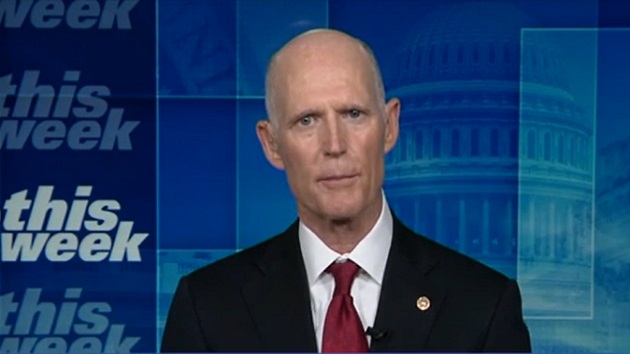
(WASHINGTON) — Sen. Rick Scott, R-Fla., the chair of the National Republican Senatorial Committee, condemned the assault on Speaker Nancy Pelosi’s, D-Calif., husband Paul Pelosi, calling it “despicable” and “unacceptable.”
In an interview on “This Week” Sunday, Scott told anchor Martha Raddatz that he had explored allowing campaign funds to be used for security and called for a more civilized public discourse.
“Well, we’ve got to figure out how to bring our country back together where we have a civil conversation and we have no violence. I mean, what happened to Paul Pelosi is despicable, it’s unacceptable,” he said.
“One thing I did when I got this job in January 2021, I went to the Federal Election Commission and said, ‘could our senators and House members, could they use their campaign dollars to pay for security for themselves and their family?'” Scott told Raddatz. “Unfortunately, it’s become a more dangerous place, and we’ve got to do everything we can to lower the rhetoric have a civil conversation, but also make sure people are safe.”
Scott’s remarks come after Paul Pelosi was attacked at his and the speaker’s home in San Francisco by a man who entered the house saying, “where’s Nancy” before striking Paul Pelosi with a hammer, police said. Paul Pelosi underwent successful surgery for a skull fracture and other injuries and is anticipated to make a full recovery.
Several Republicans condemned the assault — though former President Donald Trump has remained silent — and the attacker, identified as 42-year-old David Depape, has been charged with attempted murder, assault with a deadly weapon, burglary and elderly abuse.
Looking toward the midterms, Scott also boasted that the GOP could hold as many as 52 Senate seats in the next Congress, saying he was eyeing flips in Arizona, Georgia, Nevada and New Hampshire as well as possibly in Connecticut, Colorado and Washington. Scott also said Pennsylvania’s Senate race between Lt. Gov. John Fetterman, D, and GOP nominee Mehmet Oz is the “hardest” of the GOP seats to hold, but still expressed confidence.
“The Democrat agenda is very unpopular,” Scott said. “Turnout looks better for the Republicans than Democrats. So, I’m very optimistic that we’re going to win. We have great candidates.”
“I think the Democrats are going to get a rude awakening on November 8.”
When pressed by Raddatz on whether a Republican-controlled Congress would focus on investigating the Biden administration, Scott said a priority would be placed on economic issues as well as culture war battles like on immigration and support for law enforcement.
“What would you hope is that we figure out how to get inflation down. That means we have to live within our means. What you hope is that we get a secure border, we can get some immigration reform done, but you can’t do without a secure border. You hope that we start supporting law enforcement,” he said. “So, I’m hopeful that Republicans will pass good legislation and Joe Biden will sign it.”
Scott also advocated for some tighter voting laws to restore what he said was dropping public confidence in elections’ integrity despite no evidence of the widespread fraud alleged by some Republicans.
“I’ve tried make sure we make sure people feel comfortable that we have free and fair elections,” he said. “We’ve got to do that by passing ID laws, making sure we don’t have ballot harvesting, make sure we have monitored drop boxes.”
(WASHINGTON) — About half of Americans say either the economy or inflation is the most important issue in their vote for Congress, making pocketbook issues by far the most dominant in the run up to the midterm elections, according to a new ABC News/Ipsos poll.
Taken individually, 26% identify the economy as their single most important issue determining their vote while 23% cite inflation. Nearly three out of four Republicans point to the two economic concerns as a priority, compared to only 29% of Democrats per the ABC News/Ipsos poll conducted using Ipsos’ KnowledgePanel.
Democrats are much more likely than Republicans to say abortion, gun violence and climate change are the top reasons for their vote, according to the poll.
Importantly, independents closely mirror the national numbers, with 49% having the combination of inflation and the economy above all others.
The top two reasons for vote choice vary little by race and ethnicity. Regarding the economy and inflation, 45% of Black Americans and 47% of Hispanic Americans prioritize the pair of issues, essentially the same as the general public.
But there’s a meaningful difference by race and ethnicity on an issue that’s on the agenda for Democrats: gun violence. Although only 4% of white Americans name gun violence as the most important issue in their vote for Congress, 15% of Hispanic Americans and 17% of Black Americans list it as theirs.
This duo of issues – economy and inflation – are much more likely to drive voters toward Republicans, who have been hammering President Joe Biden and his administration for higher prices at the pump and the grocery store for months on end. But Democrats have also hoped that a recent decision by the Supreme Court that made access to abortion services more difficult – and in some cases nonexistent – will drive turnout in their favor.
Data from the new ABC News/Ipsos poll shows that about 6 in 10 Americans (61%) think abortion should be legal in all or most cases versus only 37 percent who think it should be illegal. The public has a clear preference in supporting candidates who align with that view with a large plurality saying they would be more likely to support a candidate who favors keeping abortion legal and available.
But access to abortion, while galvanizing for some, is less likely to be the primary motivation for one in five Americans who say the issue makes no difference at all in their voting decision, with that indifference being even higher among independents.
Indifference persists when Americans are asked about party control of Pennsylvania Avenue versus Capitol Hill. Half the country says it doesn’t matter if the same or opposite parties control Congress and the White House. Only 19% think it is better for the country to have a president from one political party and Congress controlled by the other.
Just under a third would prefer to have the same party control both branches of government, but that number is driven by 47% of Democrats who overwhelmingly want their party to control both. Even more independents, 55%, say it makes no difference.
This ABC News/Ipsos poll was conducted using Ipsos Public Affairs‘ KnowledgePanel® October 28-29, 2022, in English and Spanish, among a random national sample of 729 adults with oversamples of black and Hispanic respondents weighted to their correct proportions in the general population.. Results have a margin of sampling error of 3.9 points, including the design effect. Partisan divisions are 28-24-41 percent, Democrats-Republicans-independents. See the poll’s topline results and details on the methodology here.
ABC News’ Dan Merkle and Ken Goldstein contributed to this report.
(WASHINGTON) — The U.S. Supreme Court on Monday is hearing two major cases that could determine the future of race-based affirmative action in higher education across America.
While 40 years of legal precedent supports consideration of race in college admissions, a conservative advocacy group is asking the justices anew to reverse course and issue a blanket ban on the practice. How the court rules could have a dramatic impact, experts say.
What is affirmative action and why do schools use it?
Affirmative action in college admissions is a policy of taking an individual student’s race or ethnicity into account during the selection process.
Since the 1960s, seeking to overcome a legacy of segregation and inequality in higher education, many American colleges and universities began giving preference to applicants from underrepresented groups in order to proactively diversify their campuses.
In addition to redressing historic injustice, the schools say a diverse learning environment benefits all students and leads to a more informed society and workforce.
Where is affirmative action used in higher education?
Roughly 20% of four-year public universities still consider race during the admissions process, according to a report by Ballotpedia. Many of those institutions say they consistently evaluate race-neutral alternatives but that they are largely less effective in advancing campus diversity.
Since 1996, 10 states have banned the use of race in public university admissions, including California, Michigan and Florida, according to the American Educational Research Association.
Is there evidence that race-conscious policies are working?
Many schools, including Harvard and UNC, say consideration of race as one factor in a holistic assessment of applicants is an indispensable tool for building a diverse campus.
Since 1976, Black, Native American, Hispanic and Asian American student enrollment has surged, according to Department of Education data. Despite the gains, however, students of color remain underrepresented on campuses nationwide.
Didn’t the Supreme Court already uphold affirmative action?
The court has repeatedly said since 1978 that colleges and universities may consider the race of applicants — as one factor among many — in the interest of promoting compelling educational benefits that come from a diverse student body.
The court has prohibited the use of quota systems, but said in 2003 that narrowly-tailored use of race is permissible when making a holistic assessment for admission. It most recently affirmed this precedent in 2016.
Who is behind the latest challenge to affirmative action?
Students for Fair Admissions, a multiracial and multiethnic group of 22,000 students and parents led by longtime conservative activist Edward Blum, is opposed to race-conscious admissions policies.
The group believes affirmative action violates the Equal Protection clause of the 14th Amendment and Title VI of the Civil Rights Act of 1964, which prohibits racial discrimination any place that receives federal funding, like private universities.
In 2014, SFFA sued Harvard University, the nation’s oldest private college, and the University of North Carolina, the nation’s oldest public university, alleging illegal racial discrimination against Asian American applicants during the admissions process.
What do the schools have to say?
The schools say the nation’s history and tradition, including the 14th Amendment’s extension of citizenship rights to former enslaved people after the Civil War, make clear that explicit consideration of race is allowed to address inequality and promote societal benefits.
They say using race as one factor among many in a holistic review, consistent with the court’s precedents, is not exclusionary or harmful to other students.
How did lower courts rule in these cases?
After a fact-intensive trial examining Harvard’s admission policies in-depth, a federal district court rejected SFFA’s claims. An appeals court later affirmed that decision, finding the university’s practices consistent with Supreme Court precedent.
Separately, a federal district court rejected SFFA’s claims against UNC after trial. Before an appeal was heard, however, the Supreme Court agreed to take up the case in tandem with the Harvard case.
What is the Supreme Court being asked to do?
Opponents of affirmative action want the justices to overturn 40 years of precedent and categorically ban the use of race in higher education admissions policies nationwide.
The fact that the court agreed to take up SFFA’s appeals after definitive lower court judgments suggests the conservative majority is poised to significantly rollback precedent if not overturn it entirely.
How would ending affirmative action impact higher education?
Supporters of the policy say it would unequivocally mean fewer minority students on the campuses of the nation’s most selective colleges and universities. Without affirmative action, students of color would experience an estimated 23 percentage-point decline in likelihood of admission to highly selective public universities, according to one study from 2014.
Dozens of major American companies that employ tens of thousands of U.S. workers have told the Supreme Court that ending affirmative action would undermine recruitment of diverse, highly educated job candidates and, in turn, hurt profits.
Opponents of the policy, however, say the potential consequences are exaggerated, that alternative admissions strategies can advance racial diversity on campuses, and that race-blindness will restore equity for all Americans.
Where is public opinion on campus diversity and affirmative action?
Most Americans say they strongly support promotion of racial diversity on college and university campuses, according to recent polling. But strong majorities also oppose the use of race as a factor in admissions decisions.
A Pew Research Center study earlier this year found 68% of Hispanics, 63% of Asian Americans and 59% of African Americans oppose the use of race or ethnicity in college admissions.
(NEW YORK) — As Democrats seek to hold onto their slim majority in Congress, one traditionally blue haven for the party has turned more competitive than expected: New York.
Prominent figures on both sides are flocking to the state as several races, especially those for governor and Congress, have tightened in the final stretch.
President Joe Biden this week made a trip to Syracuse, and first lady Jill Biden will stump for Rep. Sean Patrick Maloney and other Democratic candidates on Sunday.
Florida Gov. Ron DeSantis was on Long Island Saturday to stump for Republican gubernatorial nominee Lee Zeldin as polls show a tightening in the contest between Zeldin and incumbent Gov. Kathy Hochul.
“It was always gonna be a tough cycle. Even in a blue state like New York, not every year is gonna be one where the Democrats run the table the way they did in the last midterms in 2018,” Evan Stavisky, a Democratic political consultant, told ABC News.
The governor’s race
New York has comfortably elected Democratic governors for years. A Republican hasn’t held the position since 2002, when former Gov. George Pataki won reelection.
Over the summer, Hochul at times held an 18-point lead over Zeldin, according to FiveThirtyEight’s polling average. Now, a little more than a week out from Election Day, Hochul’s lead is 6.9 points — still making her a frontrunner but close enough to cause some alarm among Democrats.
“When you consider that there’s a 2 million-plus Democratic registration edge, it shouldn’t be close at all,” Hank Sheinkopf, a longtime Democratic strategist based in New York, told ABC News.
Hochul’s spent a large part of her campaign casting Zeldin as an acolyte of former President Donald Trump and criticizing him for his stance on abortion. Zeldin praised the Supreme Court ruling overturning Roe v. Wade as a victory, and once voted in favor of a 20-week ban on abortion. Heading into the general election, he’s tried to shift to a more moderate stance, telling voters he wouldn’t change the state’s abortion laws.
Thomas Doherty, a political strategist and former aide to Pataki, said he thought Zeldin’s enthusiastic response to the Roe decision in a state as pro-choice as New York was “a bad mistake.”
But Doherty and other strategists said crime’s become the forefront issue in the state, as well as the economy. Those issues were front and center of the first and only debate between Zeldin and Hochul earlier this week.
“You’re poorer and less safe because of Kathy Hochul and extreme policies,” Zeldin said in his opening statement.
These past few weeks, Hochul’s been putting more emphasis on her efforts to take guns off the streets and recently announced actions to put more cops on New York City’s subways. In the debate, Hochul said she was “laser-focused” on fighting crime.
A Quinnipiac University poll found crime overshadowed other areas when likely voters were asked to choose the most urgent issue facing the state today. Twenty-eight percent of likely voters chose crime, 20% chose inflation and 6% said abortion was the most urgent issue.
New York’s congressional races
While Hochul has turned her attention toward New York City, where the turnout of reliably Democratic voters is essential to a statewide win, national Democrats have zeroed in on congressional races in suburban districts on Long Island and the Hudson Valley, often a bellwether for voters’ enthusiasm.
“A lot of this has to do with turnout. Where’s the energy? I think the energy is on the Republican side of things right now,” Doherty said. “You can sense that nationally as well and I think that’s carried over into New York.”
Republicans hope a tighter-than-expected campaign for governor will motivate GOP voters down the ballot.
Of the country’s 50 most competitive House races, according to FiveThirtyEight, seven are for New York seats. Five will be defended by Democratic incumbents, including Maloney’s 17th congressional district. Maloney, chairman of the Democrats’ congressional campaign arm, touted the president’s plan to invest in manufacturing jobs in the Hudson Valley and upstate New York on ABC News’ “This Week.”
Asked by ABC’s Chief Washington Correspondent Jonathan Karl if he’d support a Biden bid for reelection, Maloney did not commit. “Look, the president will make that decision,” he said.
Forecasters at the Cook Political Report recently changed the race between Maloney and Republican Mike Lawler from “leans Democrat” to “toss up.”
Jill Biden’s visit to the state will look to bolster Maloney and Robert Zimmerman, the Democratic nominee for New York’s 3rd congressional district, a swing Long Island seat vacated by Rep. Tom Suozzi, a Democrat.
The party is still favored to keep power there and in the neighboring 4th district, according to forecasters the Cook Political Report, where candidates are jousting for a long-held Democratic seat that shades moderate. Both Republican Anthony D’Esposito and Democrat Laura Gillen bucked their own party in a Newsday debate, D’Esposito insisting that “[abortion] is not on the ballot in New York” and Gillen taking aim at cashless bail, a policy advanced by Democrats in Albany.
Rep. Pat Ryan, who won a summer special election in the 19th district largely on the progressive momentum gained after the Dobbs case, will have to defend a Democratic seat in the 18th District on Election Day because of redistricting.
It will be a test of Democrats’ enthusiasm at the halfway point of Biden’s term in a state that sent him to the White House by 23 points.
(NEW YORK) — Congresswoman Val Demings, who spent 27 years working in law enforcement in Orlando, Florida, said her background has been crucial to her views as a politician. Now running to be a U.S. senator against incumbent Republican Sen. Marco Rubio, her principles will once again be put to the test.
“I’ve seen people at their worst and I’ve seen people at their best,” she told ABC News Correspondent Linsey Davis during an interview. “And I have a really clear understanding of how people find themselves in the circumstances they’re in in the first place.”
Demings, a former social worker, spent nearly three decades in law enforcement — beginning as an officer and working her way up to police chief.
Despite her tenure in law enforcement, several unions representing officers in the state, including her own former department, have endorsed Rubio, her opponent in the race.
“I think it’s politics again,” she told ABC News. “What I found is my opponent and too many other people try to use fear, [saying] ‘you know, she’s not with you because she’s a Democrat.’”
“I am the police chief who brought the community and the department together to reduce violent crime by over 40%,” she added.
It has been more than a decade since Florida has had a Democratic senator, and more than two decades since the state had a Democratic governor.
If she is elected, Demings would be the only Black woman actively serving in the U.S. Senate, and only the third in American history.
She told ABC News she believes the biggest issue for Floridians right now is the rising cost of living, a matter near and dear to her heart.
“I sit here as the daughter of a maid and a janitor,” she said. “I’ve struggled in my own life. I remember graduating from Florida State, saddled with college debt.”
“We have an affordable housing crisis in Florida,” she said. “People are worried about keeping a roof over their head, keeping the lights on.”
In a dependably red state, Demings is running against difficult odds. ABC News partner FiveThirtyEight’s figures show Rubio ahead by 7 percentage points.
Demings, who has served as a well-respected Congresswoman for the past five years, decided to run for the so-called upper chamber because she believes “our nation is in trouble.”
“I just want to create better opportunities for others,” she said. “It’s worth the run for me. It is worth the risk for me.”
Her campaign has raised more than $64 million, making her one of the top fundraisers among Senate hopefuls.
No stranger to adversity, she remembered being told that, “I was the wrong color, the wrong gender,” she said, and that “I probably wouldn’t amount to much.”
When asked what her greatest weakness is, she said her grandchildren. Demings is a mother of three and grandmother of five.
Her greatest strength? Her fearlessness, she said.
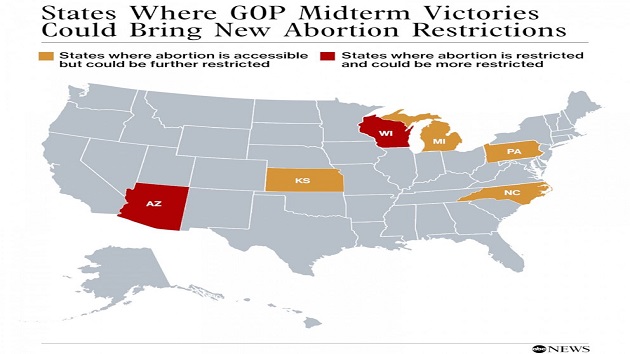
(NEW YORK) — GOP victories in the midterm elections could lead to more abortion restrictions in a handful of states.
The races range from gubernatorial seats to ballot measures, to eking out a veto-proof majority in the statehouse. In many states, it’s not just one race that will define the abortion rights outlook but a few different races coming together to form the new landscape for constituents.
Here’s are the six states where abortion laws could flip.
Pennsylvania
Pennsylvania might be the most straightforward example of how the gubernatorial race could flip a state’s abortion access on its head. If Democrat Josh Shapiro wins, abortion will stay accessible in Pennsylvania because he’s expected to veto any attempts at restrictions. If Republican Doug Mastriano wins, it would be a green light for the Republican-led state legislature to pass laws either severely restricting or outright banning abortion, with a nearly-guaranteed signoff from the governor’s office.
Kansas
Yes, Kansas passed a ballot initiative that made it clear the voters there support abortion rights in the state. But it didn’t enshrine protection for abortion — it only rejected the chance to chip away at it.
So all eyes are on the governor’s race, where a defeat of Democratic Gov. Laura Kelly would mean that the state legislature could pass restrictions and see them signed off by Republican challenger Derek Schmidt. But almost more importantly, a bunch of seats on the Kansas Supreme Court, which has been sympathetic to protecting abortion rights, are up for replacement. And new judges are chosen by the governor, which means Kansas could face a more conservative court that is far more open to allowing new abortion restrictions to stand.
Michigan
The governor’s race will actually have less influence over abortion rights in the state than a ballot measure that would enshrine abortion rights no matter who has political control.
If that ballot measure passes, it would keep abortion legal in the state and protect against future bans. But if the measure fails and Democratic Gov. Gretchen Whitmer is defeated by challenger Tudor Dixon, a Republican, the Republican-led statehouse could bring Dixon abortion restrictions or bans and see them quickly enacted. Two other races matter, though: the attorney general and the Michigan supreme court races, which Republicans would need to win to get rid of the Democrats currently protecting abortion rights from those perches.
North Carolina
It’s all about the statehouse in North Carolina. Republicans are very close to getting enough seats to override Democratic Gov. Roy Cooper’s veto power — and right now that’s all that’s standing in the way of state Republicans enacting a law that further restricts abortion in the state, where abortion is currently legal until 20 weeks. Republicans need to pick up two seats in the state Senate and three in the state House to have a veto-proof majority.
Arizona
Abortion is legal until 15 weeks of pregnancy in Arizona. If Republican Kari Lake wins the gubernatorial race, abortion could be restricted even further. If Democrat Katie Hobbs is elected, it will remain restricted at 15 weeks. (Hobbs wouldn’t have the votes in the statehouse to repeal that law, since it’s already in place). Of course, there’s still a near-total ban looming over the state in the form of a pre-Roe law that’s locked up in legal limbo.
Wisconsin
Even though Democrats control the governorship in Wisconsin, abortion is currently banned in the state by way of complete legal limbo that forced clinics to give up because of the confusion. But if incumbent Democrats Gov. Tony Evers and Attorney General Josh Kaul are defeated by Republicans in this election, abortion could be banned more concretely — regardless of the outcome of the current lawsuit — by the state legislature armed with a new Republican governor.
(NEW YORK) — Domestic violent extremists across the ideological spectrum pose a “heightened threat” to the 2022 midterms, according to a joint intelligence bulletin obtained by ABC News.
The Department of Homeland Security, the FBI, the National Counterterrorism Center and the U.S. Capitol Police also warn that following the midterms, “perceptions” of election fraud could cause violence.
“We assess that election-related perceptions of fraud and DVE reactions to divisive topics will likely drive sporadic DVE plotting of violence and broader efforts to justify violence in the lead up to and following the 2022 midterm election cycle,” the bulletin dated Friday said. “Following the 2022 midterm election, perceptions of election-related fraud and dissatisfaction with electoral outcomes likely will result in heightened threats of violence against a broad range of targets―such as ideological opponents and election workers.”
Domestic violent extremism activity leading up and during the midterms are likely to focus on “election-related infrastructure, personnel, and voters involved in the election process as attractive targets—including at publicly accessible locations like polling places, ballot drop-box locations, voter registration sites, campaign events, and political party offices.”
“Potential targets of DVE violence include candidates running for public office, elected officials, election workers, political rallies, political party representatives, racial and religious minorities, or perceived ideological opponents.”
The hope, the law enforcement agencies say, is possibly to sway voter habits, undermine perceptions of legitimate elections or prompt a particular government reaction.
“Enduring” ideological grievances and the “perceptions” of election fraud are “likely” driving the potential for DVE violence.
Certain factors that are likely to increase a DVE attack during the election cycle are people urging violent action, threats related to perceived illegitimate elections, perceptions of voter suppression and attacks on one group or party.
The federal government bulletin comes as the NYPD warned this week that poll workers could be targets and urged vigilance.
“However, hostile rhetoric and an abundance of generalized threats from likeminded [extremists] and malicious actors in chat groups, encrypted messaging channels, and other online forums may effectively create echo chambers that circulate and reinforce false narratives and establish a permissive environment for violent action against election-related infrastructure and personnel,” the NYPD bulletin dated on Wednesday and was first reported by ABC News states.
The number of domestic terrorism investigations nearly doubled from 2020 to 2021, largely due to the Jan. 6 riot at the U.S. Capitol, according to a report released Friday by the FBI and DHS.