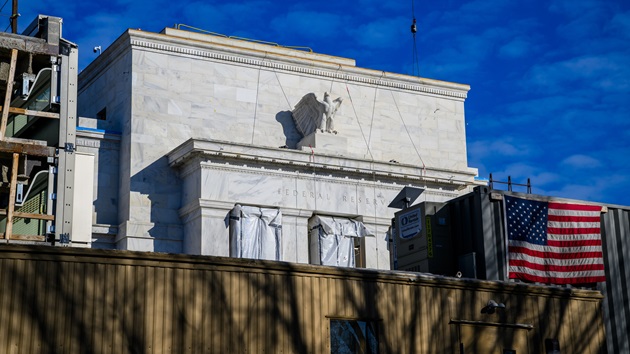
Construction on the Marriner S. Eccles Federal Reserve building in Washington, DC, US, on Monday, Jan. 12, 2026. (Pete Kiehart/Bloomberg via Getty Images)
(WASHINGTON) — Prosecutors from the U.S. attorneys office in Washington were turned away Tuesday after they made an unannounced visit to the Federal Reserve, where they allegedly requested a tour of renovations that have attracted scrutiny from the Trump administration, sources familiar with the matter confirmed to ABC News.
The unusual visit prompted immediate backlash from an attorney for Federal Reserve Chairman Jerome Powell, who wrote a letter to D.C. U.S. Attorney Jeanine Pirro’s office, citing the recent ruling from a federal judge that blocked subpoenas to the bank after determining DOJ’s criminal probe was driven by President Donald Trump’s political animus towards Powell.
Robert Hur, who formerly served as special counsel who investigated former President Joe Biden’s handling of classified documents and now represents Powell, warned DOJ in the letter reviewed by ABC News that future efforts to initiate contact with Fed representatives should be negotiated through legal counsel.
“As you know, Chief Judge [James] Boasberg has concluded that your interest in the Federal Reserve’s renovation project was pretextual. Should you wish to challenge that finding, the courts provide an avenue for you; it is not appropriate for you to try to circumvent it,” Hur said. “I ask that you commit not to seek to communicate with my client outside the presence of counsel.”
According to Hur’s letter, attorneys from Pirro’s office, Carlton Davis and Steven Vandervelden, and a case agent showed up at the Fed’s headquarters, stating they wished to “check on progress” and that they asked for a “tour.”
A source said they were then told they could not access the site without preauthorized clearance from Fed management and were given the contact information for the Fed’s legal counsel, after which the three left the area.
“Any construction project that has cost overruns of almost 80% over the original construction budget deserves some serious review,” Pirro said in a statement on X after the prosecutors were turned away. “And these people are in charge of monetary policy in the United States?”
Pirro publicly vented her frustrations about Boasberg’s ruling that effectively blocked her office from investigating Powell, which she has vowed to continue appealing despite threats from Republican Sen. Thom Tillis to block any confirmation of Powell’s replacement until the criminal probe is resolved.
The probe centered on Powell’s testimony to Congress last year about cost overruns in a multibillion-dollar office renovation project.
Trump on Wednesday again threatened to fire Powell if he does not step down when his term as chair ends May 15.
“I’ll have to fire him, OK, if he’s not leaving on time — I’ve held back firing him. I’ve wanted to fire him, but I hate to be controversial, you know, I want to be uncontroversial,” Trump said in an interview with Fox Business’ Maria Bartiromo.
Legal experts have questioned if Trump has the authority to fire Powell. His attempt to fire Fed Governor Lisa Cook last year is currently awaiting a decision at the Supreme Court.
The confrontational visit also comes as Pirro’s name has repeatedly been floated as a potential permanent replacement for Pam Bondi as the next attorney general.
Powell rebuked the investigation in a video message in January as a politically motivated effort to influence the Fed’s interest rate policy.
Pirro, at a press conference in March, denied that politics played any role in her probe of Powell and the focus was whether public money has been wasted as a result of the Fed’s renovations, and potential false statements to Congress by Powell about the operations.
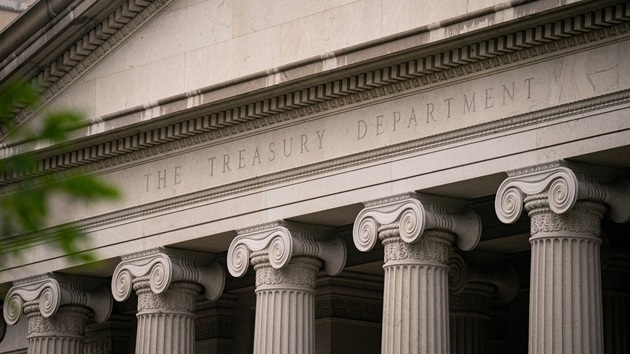
The US Treasury building in Washington, DC, US, on Tuesday, June 17, 2025. (Al Drago/Bloomberg via Getty Images)
(WASHINGTON) — Wednesday is Tax Day, the last day of this year’s tax season, and the average refund for filers is up 11% compared to last year’s filing season, according to new Treasury Department data.
The average refund this filing season is “over $3,400,” the Treasury Department data said.
The data, which is as of Tuesday, also showed that “over 53 million filers claimed at least one of President Trump’s signature new tax cuts,” which includes provisions from Trump’s sweeping legislation that was passed last year.
Treasury has also announced that more than 5 million filers have opened so-called Trump Accounts for children who were eligible under the law.
“Treasury and the IRS have worked tirelessly to ensure our tax system works for the people it is meant to serve,” Treasury Secretary Scott Bessent said in a press release on Wednesday. “From the shop floor to the kitchen table, taxpayers are feeling the difference of the largest tax cuts in our nation’s history, and millions of Americans are keeping more of what they earn and seeing their paychecks go further than ever before.”
Over 25 million filers have claimed No Tax on Overtime, with an average deduction of over $3,100, the department’s data noted, while more than 30 million seniors have claimed the Enhanced Deduction for Seniors, with an average deduction of over $7,500.
The data also showed that more than 105 million filers have claimed the permanently doubled standard deduction — the specific dollar amount that reduces the amount of income on which people are taxed.
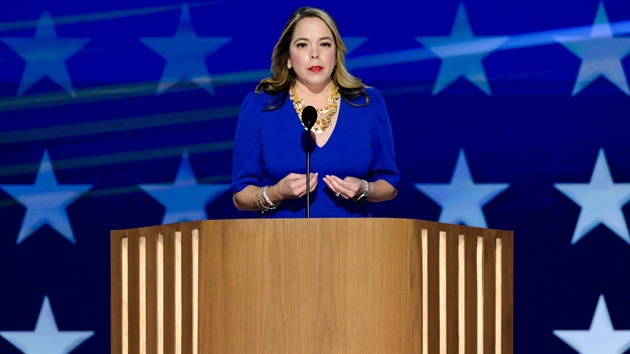
Olivia Troye, former national security official under the Trump administration, speaks during the Democratic National Convention (DNC) at the United Center in Chicago, Illinois, US, on Wednesday, Aug. 21, 2024. (David Paul Morris/Bloomberg via Getty Images)
(WASHINGTON) — Olivia Troye, a former aide to Vice President Mike Pence who was among the highest-profile Trump administration officials to become a vocal critic of the president during his first term, is launching a bid for Congress as a Democrat in Virginia.
Troye served as Pence’s homeland security adviser but spoke out against President Donald Trump over his handling of the coronavirus pandemic, and has since become a fierce critic of Trump. She also spoke at the 2024 Democratic National Convention as one of the Republicans supporting then-Vice President Kamala Harris’ presidential bid.
“They sent MAGA after me. Tried to bankrupt me. Threatened to kill me. They thought they could silence me. They obviously don’t know me very well,” Troye said in a video released by her campaign.
“In 2024, nothing could keep me from telling the truth on the stage of the Democratic National Convention. Because I believe in fighting for what’s right — for those who can’t fight for themselves. That’s why I’m a Democrat and that’s why I’m running for Congress.”
A press release from her campaign says that Troye is set to run in the “new proposed seventh district” in Virginia. That refers to the district lines in a new congressional map proposed by Democrats; voters are deciding in an April 21 statewide ballot measure vote in Virginia if the Democratic-controlled legislature should be allowed to implement it.
The current 7th district is represented by Democratic Rep. Eugene Vindman, although under the proposed map Vindman would be in the new 1st district. Troye’s campaign says she is working on helping the measure pass, but would not mount a primary challenge to Vindman if it does not.
Multiple other notable candidates such as former Virginia First Lady Dorothy McAuliffe, former federal prosecutor JP Cooney, and state Delegate Dan Helmer are also running for the proposed 7th district.
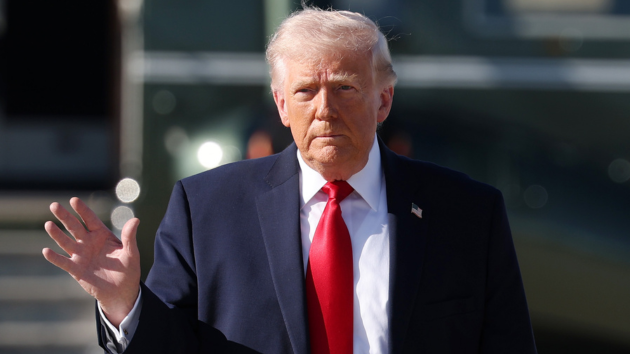
U.S. President Donald Trump walks to Air Force One on April 11, 2026, at Joint Base Andrews, Maryland. President Trump is traveling to Florida. (Photo by Tasos Katopodis/Getty Images)
(WASHINGTON) — President Donald Trump said Monday that a U.S. naval blockade in the Strait of Hormuz has begun, a new development in the now seven-week war after peace talks failed over the weekend.
Taking questions from reporters outside the Oval Office, Trump was asked what he hoped to achieve from the U.S. blockade of Iranian ports: Is it to force Iran back to the negotiating table or to reopen the critical waterway and bring down oil prices?
“Maybe everything,” Trump responded. “Both of those things, certainly, and more.”
“We can’t let a country blackmail or extort the world, because that’s what they’re doing,” he continued. “They’re really blackmailing the world. We’re not going to let that happen.”
Earlier Monday, Trump threatened any Iranian ships that come close to the new U.S. naval blockade of the Strait of Hormuz, writing they will be “ELIMINATED.”
Trump said while Iran’s navy has been “obliterated” by U.S. attacks, any smaller ships that near the U.S. barricade will be wiped out “using the same system of kill that we use against the drug dealers on boats at Sea.”
“It is quick and brutal,” Trump wrote in a post on his social media platform.
Iran has warned of consequences if the security of Iranian ports is threatened, with a spokesman for the country’s joint military command saying “no port in the Persian Gulf and the Sea of Oman will be safe.”
There are many outstanding questions about how the U.S. blockade will work and what impact it will have on the conflict.
Trump first said the U.S. would block “any and all Ships” trying to enter or leave the strait, through which roughly 20% of the world’s oil and gas supplies typically passes.
U.S. Central Command, however, said the blockade will be enforced against any ships entering Iranian ports or coastal areas but clarified its forces “will not impede freedom of navigation for vessels transiting the Strait of Hormuz to and from non-Iranian ports.”
Abroad, some U.S. allies have said they won’t back Trump’s Hormuz blockade.
“We’re not supporting the blockade,” British Prime Minister Keir Starmer told BBC radio in an interview Monday morning.
French President Emmanuel Macron said France and the U.K. will instead organize a “peaceful multinational mission” aimed at restoring freedom of navigation in the strait.
Trump on Monday was asked if he expected other countries to assist in the U.S. naval blockade.
“We don’t need other countries, frankly. But they’ve offered their services,” Trump said, though when asked Trump did not list any specific countries. “We’ll let it be known, probably tomorrow.”
At home, Trump faces potential political backlash over rising gas prices. Americans are now paying on average more than $4 for a gallon of gas, according to data from AAA.
Trump, in an interview with Fox News on Sunday, conceded that energy prices may not fall by the November midterm elections, and that they could even be “maybe a little bit higher.”
The U.S. naval blockade of the Strait of Hormuz comes after peace talks between the U.S. and Tehran in Islamabad on Saturday ended with no resolution. Vice President JD Vance, who led the U.S. delegation, said the U.S. needed a firm commitment from Iran that it would not seek a nuclear weapon.
Trump on Monday echoed that the sticking point was the enrichment question.
“Iran will not have a nuclear weapon,” Trump said. “And we agreed to a lot of things, but they didn’t agree to that. And I think they will agree to it. I’m almost sure of it. In fact, I am sure of it. If they don’t agree, there’s no deal. There’ll never be a deal. Iran will not have a nuclear weapon.”
Trump on Monday said the “right people” in Iran still want to reach an agreement.
“We’ve been called this morning by the right people, the appropriate people, and they want to work a deal,” Trump said.
ABC News’ Zoe Magee and Nicholas Kerr contributed to this report.
US President Donald Trump speaks to members of the media outside the Oval Office of the White House in Washington, DC, US, on Monday, April 13, 2026. (Salwan Georges/Bloomberg via Getty Images)
(WASHINGTON) — An AI-generated photo that President Donald Trump posted Monday on his social media platform that depicted him as a Jesus-like figure and drew criticism from some of the president’s religious backers was removed roughly 13 hours after it was posted.
At an unscheduled news conference at the White House Monday afternoon, Trump acknowledged he posted the image, but said he thought it was an image of him as a “doctor.”
“Well, it wasn’t a picture, it was me,” the president said. “I did post it, and I thought it was me as the doctor and it had to do with Red Cross as a Red Cross worker there, which we support.”
This is a developing story. Please check back for updates.
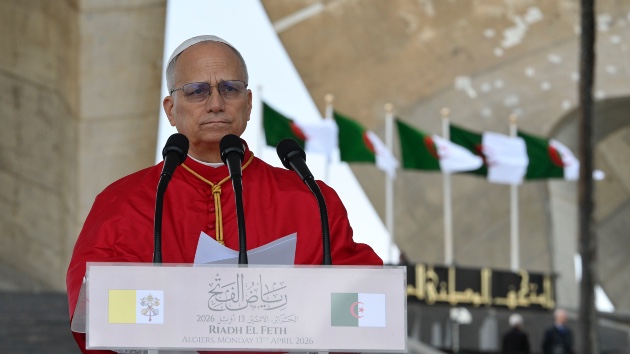
Pope Leo XIV holds his speech as he pays a visit to the Maqam Echahid Martyr’s Memorial on April 13, 2026 in Algiers, Algeria. (Photo by Simone Risoluti – Vatican Media via Vatican Pool/Getty Images)
(ALGIERS and LONDON) — Pope Leo XIV on Monday responded to criticism from President Donald Trump, telling reporters while traveling to Algeria that he has “no fear” of the White House.
“I have no fear of the Trump administration, nor speaking out loudly about the message of the Gospel,” the pontiff said on Monday, as he began a dayslong visit to four African nations. “That’s what I believe in. I am called to do what the church is called to do.”
The pope on Saturday called for an end to conflict, without explicitly mentioning the U.S.-Israeli war against Iran. “Enough of war,” Leo said during a peace vigil in St. Peter’s Basilica in Vatican City.
The pope also suggested “delusion of omnipotence” is fueling the U.S.-Israel war in Iran, imploring the country leaders to come to a peace agreement.
Trump on Sunday night posted on social media calling the pope “WEAK on Crime, and terrible for Foreign Policy.”
The pope, who was born in Chicago and is the first American to lead the Catholic Church, was elevated to his position in May 2025, a few months into Trump’s second term. The president at that time congratulated Leo, saying on social media that it was “such an honor” for an American to become pope.
The pontiff has voiced concern about several armed conflicts, repeatedly calling for peace, including mentioning the civil war raging in Sudan, the Russia-Ukraine war and the fighting between Israel and Hezbollah in Lebanon. He has called for peace in Iran and the broader Middle East since the beginning of the U.S.-Israeli strikes on Iran.
The pontiff has been a strong messenger for global peace since the start of his papacy last May.
He has repeatedly called for the parties involved to engage in negotiations, including saying on March 1 that he was making “a heartfelt appeal to all the parties involved to assume the moral responsibility of halting the spiral of violence before it becomes an unbridgeable chasm.” He has said that “God does not bless any conflict.”
Leo said on Monday that his comments “are certainly not meant as attacks on anyone and the message of the Gospel is very clear, ‘Blessed are the peacemakers.'”
“I will not shy away from pronouncing the message of the Gospel, of inviting all people to look for ways of building bridges for peace and reconciliation, of looking for ways to avoid war any time that’s possible,” Leo continued. “To put my message on the same plane as what the president has attempted to do here I think is not understanding what the message of the Gospel is and I’m sorry to hear that.”
Trump early on Monday had called for the pope to focus on “being a Great Pope, not a Politician.”
“It’s hurting him very badly and, more importantly, it’s hurting the Catholic Church!” Trump wrote on his social media network.
Responding to a question from reporters hours later, Leo said of the apparent tensions with Trump, “I do not look at my role as being political … I don’t want to get into a debate with him. I don’t think that the message of the Gospel is meant to be abused in the way that some people are doing.”
“I will continue to speak out loud against war, looking to promote peace, promoting dialogue, multilateral relationships among the states to look for just solutions to problems,” he said. “Too many people are suffering in the world today. Too many innocent people are being killed. And I think someone has to stand up and say, ‘There’s a better way to do this.'”
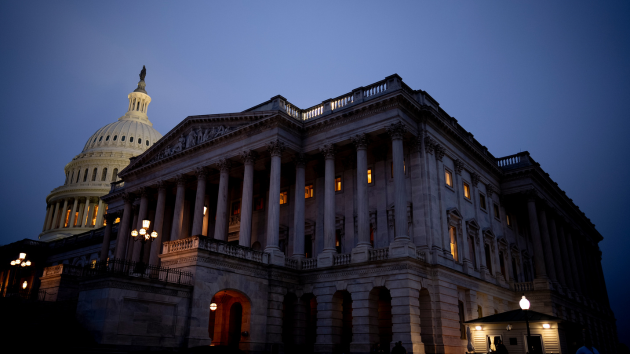
The Dome of the U.S. Capitol Building is visible in the early morning hours, April 2, 2026. (Photo by Andrew Harnik/Getty Images)
(WASHINGTON) — Congress returns from its two-week recess early this week — thrusting lawmakers back into the debate surrounding the Iran war as the President Donald Trump’s strategy faces continued scrutiny.
House and Senate Democrats plan to force separate votes in both chambers on Iran war powers resolutions this week. These resolutions would call on the president to terminate the use of U.S. armed forces in hostilities against Iran or any part of the Iranian government or military unless a declaration of war or authorization to use military force is enacted.
Previously these efforts have narrowly failed, but as the conflict drags on and lawmakers continue to face questions about the president’s actions, additional Republicans could decide to support the efforts.
Expulsion votes possible for four lawmakers The House could move as early as this week to expel several members of Congress.
Republican Rep. Anna Paulina Luna of Florida said she will force a vote to expel Rep. Eric Swalwell, D-Calif., next week amid allegations of sexual assault. Texas GOP Rep. Tony Gonzales could also face a similar vote after he admitted to having an affair with a former staffer. And Florida Democrat Rep. Sheila Cherfilus-McCormick is expected to face an expulsion vote, likely following a House Ethics Committee sanction hearing on April 21. The congresswoman was indicted on charges of stealing $5 million in Federal Emergency Management Agency funds, which she is accused of laundering to support her 2021 congressional campaign.
Expelling a member of Congress — which is a rare occurrence — requires a two-thirds majority vote, a higher threshold than the simple majority needed to pass most legislation. Only six lawmakers in U.S. history have been expelled, including George Santos in 2023.
As the expulsion resolutions stack up, Democrats are also clamoring for the expulsion of Florida Republican Rep. Cory Mills, who has faced his own allegations of misconduct.
Speaker Mike Johnson has previously been opposed to expulsion efforts and has argued that lawmakers deserve due process.
Awaiting Johnson’s next move on DHS funding Lawmakers return as the Department of Homeland Security’s partial shutdown drags on — hitting Day 66 on Monday when the Senate returns to session.
The partial shutdown is the longest in U.S. history.
Johnson has not yet acted on the Senate’s DHS funding bill, which stripped out funding for Immigration and Customs Enforcement and Customs and Border Protection.
It’s not clear what Johnson’s next move will be to attempt to reopen the agency, as he balances threats to the gavel against an arduous path to fully fund DHS’ breadth of agencies via reconciliation.
The Senate plans to move forward with a narrow budget reconciliation bill to fund ICE and CPB for the next three years with Senate Budget Committee Chairman Lindsey Graham leading the charge, Senate Majority Leader John Thune said.
Trump said on Friday that he met with senators Graham and John Barrasso to discuss the matter.
“Reconciliation is ON TRACK, and we are moving FAST and FOCUSED in keeping our Border SECURE, and getting funding to the Department of Homeland Security and the Justice Department to continue our incredible SUCCESS at MAKING AMERICA SAFE AGAIN!” Trump wrote on his social media platform on Friday.
While reconciliation is a lengthy process that sidesteps the filibuster, Trump has demanded that the bill land on his desk by June 1 — an enormous challenge for Republicans navigating small margins in both chambers.
As the next legislative blitz approaches, House Republicans get a smidgeon of relief with the arrival of Rep.-elect Clay Fuller, who won a special election in Georgia’s 14th Congressional District earlier this month to fill the seat once occupied by Marjorie Taylor Greene. Fuller is expected to take the oath of office during the House’s first vote series on Tuesday, April 14.
The addition means that Johnson can afford to lose two GOP votes with all members voting and present.
Cabinet members defend their budgets Trump’s FY2027 budget requests also take center stage as several Cabinet secretaries and administration officials are slated to testify before lawmakers including Health and Human Services Secretary Robert F. Kennedy Jr., Agriculture Secretary Brooke Rollins, Energy Secretary Chris Wright, Director of the United States Office of Management and Budge Russ Vought, United States Trade Representative Jamieson Greer, Secret Service Director Sean Curran and more.
Bipartisan backlash over Bondi While first lady Melania Trump brought the saga around convicted sex offender Jeffrey Epstein back into the headlines, the GOP-led House Oversight Committee is not slated to hold any depositions this week as part of their ongoing investigation into Epstein. The Department of Justice said former Attorney General Pam Bondi will not appear for a closed-door deposition with the committee on Tuesday, April 14 — which has prompted bipartisan backlash from lawmakers on the committee. The next scheduled deposition is expected April 30.
Conservatives present challenge for Johnson on FISA House Republican leadership are also aiming to put a clean extension of FISA Section 702, known as the Foreign Intelligence Surveillance Act, on the floor for a vote sometime this week. The federal law sets out rules and procedures for gathering foreign intelligence through electronic surveillance, physical searches, pen registers and more.
Johnson and Trump have publicly backed a clean extension through October 2027. However, several House conservatives do not support a clean extension — presenting Johnson a challenge to pass the bill relying on help from Democrats, who are mostly reluctant to help Republicans and Trump accomplish anything legislatively.
Once the House passes FISA legislation, the Senate will need to take up the measure by April 20 — when the law is set to expire.
Rep. Eric Swalwell, candidate for California governor, takes part in a forum at the Skirball Cultural Center on Thursday, February 26, 2026. (Photo by David Crane/MediaNews Group/Los Angeles Daily News via Getty Images)
(SAN FRANCISCO) — Democratic Rep. Eric Swalwell announced he is suspending his California governor’s race campaign after accusations made by a former staffer to the San Francisco Chronicle that he sexually assaulted her, which the congressman has denied.
It comes amid a growing push from his party to not only get out of the race, but to resign from Congress.
“I am suspending my campaign for Governor. To my family, staff, friends, and supporters, I am deeply sorry for mistakes in judgment I’ve made in my past,” Swalwell wrote in a post to X Sunday night.
“I will fight the serious, false allegations that have been made — but that’s my fight, not a campaign’s,” he wrote.
The San Francisco Chronicle published the account of a woman, who it did not identify, who says she was hired at the age of 21 to work as an intern in Swalwell’s district office.
She claims Swalwell began pursuing her and sent her a nude photo. In 2019, she went out for drinks with Swalwell and woke up naked the next morning in Swalwell’s hotel bed and “felt the effect of vaginal intercourse,” according to the article.
The woman alleges that five years later, at a gala in New York, when she was no longer working for him, Swalwell pursued her while she was inebriated and forced himself on her, according to the San Francisco Chronicle.
In the wake of the accusations, at least four other women have detailed allegations that range from sexual assault to inappropriate conduct by Swalwell. ABC News has not been able to corroborate all of the alleged accounts, including those reported by The San Francisco Chronicle and CNN.
ABC News spoke with Ally Sammarco, who accused the lawmaker of sending her inappropriate messages and an unsolicited nude picture of himself in 2021.
Sammarco, a social media content creator who said she was 24 at the time she met Swalwell, told ABC News that she was working on Terry McAuliffe’s race, as he was running to be governor of Virginia, and was looking for a job on Capitol Hill.
She says she sent the congressman a direct message on Twitter in August of 2021, asking about his upbringing growing up in a Republican family.
She says they spoke about the race in Virginia, and then Swalwell gave Sammarco his personal cell number, where she says he started to ask her “more personal questions.”
In September 2021, she says they began messaging on Snapchat, where she said he offered to help send her resume and find a job. He invited her to his office on Capitol Hill, according to text messages reviewed by ABC News.
She says he initially said she could meet his staff, but when she arrived, she said he escorted her in his office, and she “didn’t meet anybody but him.”
Sammarco told ABC News that sometime in October of 2021, Swalwell allegedly sent her an unsolicited picture of his penis.
She said the alleged photo made her feel “gross” and that he was “pushing a sexual agenda.”
In a video posted to social media late Friday evening, Swalwell called allegations made against him “flat false. They’re absolutely false.”
“They did not happen. They have never happened, and I will fight them with everything that I have,” he said.
Swalwell did not address the allegations in detail in the video statement.
Fellow Democratic Rep. Ro Khanna, also from California, called the allegations against Swalwell “sick and disgusting.”
Rep. Eugene Vindman, D-Va., told CNN’s “State of the Union,” “The accusations are absolutely heinous, and his admissions betraying his family are deplorable. So Eric Swalwell needs to resign. He needs to drop out of the race.”
Vindman emphasized the need to hold leaders accountable, regardless of party or stature.
“And we have grown far too accustomed to having our senior leaders, our elected officials, uh, fall far below what we expect their behavior to be morally, ethically … And Representative Swalwell needs to go,” Vindman said.
The top three House Democrats, including Leader Hakeem Jeffries, have called on Swalwell to end his bid for governor.
“Following the incredibly disturbing sexual assault accusations against Congressman Eric Swalwell, we call for a swift investigation into these incidents and for the Congressman to immediately end his campaign to be California’s next Governor,” Jeffries, Whip Katherine Clark and Caucus Chair Pete Aguilar said in a joint statement released Friday.
Pressed Sunday on whether Swalwell should resign, Jeffries told CNN’s Jeff Zeleny, “Our statement for the moment speaks for itself. We’ll reconvene in Washington early next week and we’ll have more to say.”
In his Friday video, Swalwell said the allegations “come on the eve of an election where I have been the frontrunner candidate” and cited his career as a public servant and prosecutor who went to court for sexual assault victims, he said.
“I do not suggest to you in any way that I am perfect or that I am a saint,” he said. “I have certainly made mistakes in judgment in my past. But those mistakes are between me and my wife and to her I apologize deeply for putting her in this position.”
Fellow Democrats started calling for Swalwell to drop his gubernatorial campaign shortly after news of the allegations broke.
In a statement, former Speaker Nancy Pelosi said: “This extremely sensitive matter must be appropriately investigated with full transparency and accountability. As I discussed with Congressman Swalwell, it is clear that is best done outside of a gubernatorial campaign.”
Rep. Jimmy Gomez, D-Calif., who chaired Swalwell’s campaign for governor, announced that he was stepping down from the campaign and referred to the accusations as “the ugliest and most serious accusations imaginable.”
“I cannot in good conscience remain in any role with this campaign, and I am stepping down from it effective immediately,” Gomez said. “The congressman should leave the race now so there can be full accountability without doubt, distraction, or delay.”
Democratic Sen. Ruben Gallego of Arizona, who had in recent days defended Swalwell from online rumors of misconduct, posted Friday that he was withdrawing his endorsement and said that he “regret[s] having come to his defense on social media.”
Sen. Adam Schiff, D-Calif., also said he is pulling his endorsement “immediately” and called on Swalwell to withdraw.
Republican Rep. Anna Paulina Luna of Florida said Saturday that she plans to force a vote next week to expel Swalwell if he does not resign.
“Eric has an option. I am going to bring this vote next week. If Democrats want to protect this type of garbage, I wouldn’t recommend it, but they are going to put on the board for that. I am tired of this,” Luna said on Fox News.
Swalwell added that he is willing to pursue legal action to combat the accusations.
“I will defend myself with the facts and where necessary bring legal action. My focus in the coming days is to be with my wife and children and defend our decades of service against these lies,” Swalwell said.
In the wake of the Chronicle’s reporting, several of Swalwell’s Democratic opponents in the governor’s race, including San Jose Mayor Matt Mahan, State Superintendent Tony Thurmond, and former State Controller Betty Yee have also called on Swalwell to drop out of the race.
The two frontrunners in the race, billionaire businessman Tom Steyer and former Congresswoman Katie Porter, expressed support for the alleged victim but stopped short of calling on Swalwell to drop out of the race.
Earlier this week, Swalwell’s campaign told ABC News that Swalwell has not received any complaints and has not asked anyone to sign non-disclosure agreements.
“This false, outrageous rumor is being spread 27 days before an election begins by flailing opponents who have sadly teamed up with MAGA conspiracy theorists because they know Eric Swalwell is the frontrunner in this race,” campaign spokesperson Micah Beasley said in a statement provided to ABC News on Tuesday.
“In 13 years, no one in Eric Swalwell’s Congressional office has ever been asked to sign an NDA. Ever,” Beasley said. “In 13 years, not a single ethics complaint by any staff in his office or any other office has ever been lodged. Ever.”
The Manhattan District Attorney’s Office is investigating allegations against Swalwell, a source familiar with the investigation said Saturday.
“We urge survivors and anyone with knowledge of these allegations to contact our Special Victims Division at 212-335-9373,” the Manhattan DA’s office said. “Our specially trained prosecutors, investigators, and counselors are well-equipped to help you in a trauma-informed, survivor-centered manner.”
Swalwell’s campaign has not responded to a request for comment. An attorney representing Swalwell said “no comment” on Saturday.
House ethics rules prohibit sexual relationships between members and interns or staffers but the House cannot investigate an incident occurring more than three terms of Congress ago.
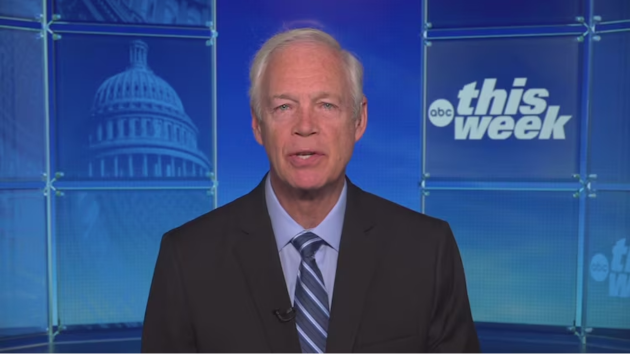
Sen. Ron Johnson, R-Wisc., appears on ABC News’ “This Week” on April 12, 2026. (ABC News)
(WASHINGTON) — Republican Sen. Ron Johnson said Sunday he was not surprised that peace talks between the U.S. and Iran stalled over the weekend, and that securing U.S. goals in Iran could be a “long-term project.”
“I’m not surprised at all,” Johnson told ABC News’ “This Week” co-anchor Martha Raddatz. “The ayatollahs, even though they have been so degraded in terms of their capabilities, nobody thought this would be easy. They’ve been preparing for this for 47 years.”
Peace talks between the U.S. and Iran in Islamabad ended over the weekend after Vice President JD Vance said Iran would not agree not to seek a nuclear weapon, a key sticking point for President Donald Trump and his administration.
But just before the peace efforts failed, Trump told reporters that he did not care if the U.S. made a deal with Iran, saying that the U.S. would win either way. But as the fate of the war remained uncertain Sunday, Johnson said that the job was not finished in Iran.
“We will not have won until we have completely defanged the Iranian regime,” Johnson said. “There’s multiple ways of potentially doing it. Short-term, long-term there are multiple avenues we can approach here. But we have not yet finished the job.”
Johnson later added that he did not think preventing Iran from having a nuclear weapon would require ground troops, but he also emphasized the need to remove Iran’s enriched uranium stockpile, which others have speculated would require ground troops.
Another sticking point for both countries was control over the Strait of Hormuz, critical to the world’s oil traffic. Iran’s blockade of the strait has sent global oil prices skyrocketing, leading to higher gas prices in the U.S.
Johnson raised the possibility Sunday that the U.S. could block oil coming from the strait from going to China or Russia, as reports have emerged saying the two countries may be helping Iran in the war.
On Sunday morning, Trump announced on his social media platform a blockade of all traffic in the Strait of Hormuz.
“Effective immediately, the United States Navy, the Finest in the World, will begin the process of BLOCKADING any and all Ships trying to enter, or leave, the Strait of Hormuz,” Trump wrote.
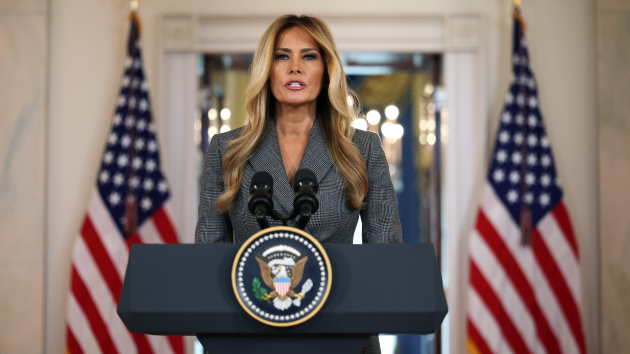
U.S. first lady Melania Trump delivers a statement at the Grand Foyer of the White House on April 9, 2026 in Washington, DC. (Alex Wong/Getty Images)
(WASHINGTON) — A senior adviser to first lady Melania Trump, Marc Beckman, said she wanted to “set the record straight” when she delivered her surprise statement at the White House denying any ties to late convicted sex offender Jeffrey Epstein.
Beckman elaborated on the first lady’s decision to publicly address the Epstein controversy during an appearance Friday morning on “Fox & Friends.”
“If she can’t stick up for herself, if she can’t defend herself and make sure that her reputation is impeccable, who will do it? Nobody’s done it to date,” Beckman said.
“She’s ready to fight,” he added.
The press was not given advance notice on the topic of the first lady’s Thursday remarks, in which she said she never had any knowledge of Epstein’s crimes and that she had no relationship with Epstein or Ghislaine Maxwell, his co-conspirator who was convicted of sex trafficking.
The first lady also called for public hearings into the Epstein controversy and to allow survivors to testify before Congress if they wish to do so.
“The lies linking me with the disgraceful Jeffrey Epstein need to end today,” Melania Trump said.
A spokesperson for the first lady’s office said the West Wing was aware she would make a statement.
But sources told ABC News that White House officials were caught off guard by the topic of her address, with some questioning why she was commenting on the subject now.
President Donald Trump said he did not know the first lady was going to make a statement today about Epstein, according to an MS Now reporter who said she had a brief phone interview with the president.
Asked by ABC News for clarification, a spokesperson for the first lady directed any questions about Trump’s knowledge about her statement to the West Wing. But the White House has said any questions related to the statement should come from her office.
President Trump has tried to shift focus away from the Epstein controversy, repeatedly calling it a “Democratic hoax.” Acting Attorney General Todd Blanche, in a recent interview, said the Epstein files matter “should not be a part of anything going forward” at the Department of Justice.
Beckman was asked on “Fox & Friends” why Melania Trump decided to come forward at this moment.
“First, enough is enough. This has been ongoing and it’s time for the public to refocus their attention on what achievements our first lady has done,” Beckman said, pointing to her foster care and education initiatives.
Beckman echoed the first lady’s comments that fake images and stories about her and Epstein have circulated for years, prompting her to come out and address them — despite headlines in recent weeks moving on from the Epstein files.
“The first lady accomplished three things yesterday as it relates to the disgraceful Epstein,” he said. “First, she cleared her record. She set the record straight. She debunked all of the lies surrounding her and Epstein. Second, she became a champion for these women, for the victims. Finally, third, she is a real leader in Washington, D.C. She is calling on Congress to act now.”
ABC News asked the White House if the president agrees with the first lady that Epstein’s victims should testify before Congress but has not gotten a response.
A group of 13 Epstein survivors and the brother and sister-in-law of another accused the first lady of “shifting the burden onto survivors,” rather than pushing for accountability.
“Survivors have done their part. Now it’s time for those in power to do theirs,” they said.
ABC News’ Rachel Scott and Isabella Murray contributed to this report.