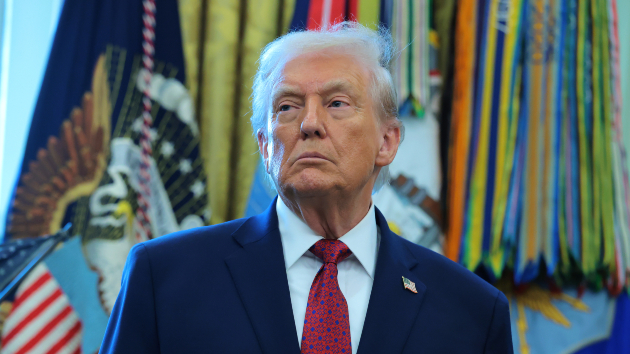
(WASHINGTON) — As the government teeters on the brink of a shutdown, President Donald Trump and Defense Secretary Pete Hegseth on Tuesday will address an auditorium packed with several hundred of the nation’s most seasoned military commanders summoned last-minute from around the world.
The event is slated to occur at a Marine Corps base in Quantico, Virginia, a secure site an hour south of the nation’s capital. Sources say Hegseth is expected to kick off the event at 8:15 a.m. ET with a 30-minute speech on the importance of the “warrior ethos,” a term used to describe the spirit that makes combat units effective.
Hegseth, who now goes by the title “secretary of war” as part of a broader rebranding ordered by Trump, is also expected to touch on the importance of enforcing combat standards that keep troops lethal, as well as reference new standards for grooming that include requirements for troops to remain clean-shaven.
Trump is expected to follow Hegseth with his own speech before releasing the military general and flag officers to return to their duty stations after the hourlong event.
Last week, general and flag officers at the one-star level and above were told to fly to Quantico from their duty stations with just several days’ notice and no hint as to what the meeting might be about. The Pentagon declined to comment on the meeting, and speculation quickly spread that the meeting might have to do with urgent cuts to the military force or the national defense strategy, which would set new priorities for the second Trump administration and could change how troops train and equip themselves.
In the end, though, sources said the meeting appeared — at least as of now — to be more of a “rally the troops” speech similar to what Hegseth frequently gives in public venues and in Fox News interviews. But his remarks, which will be livestreamed to the public, will also provide a prime photo opportunity with Hegseth addressing hundreds of top military generals as their boss.
On Sunday, the program was given an unexpected jolt when the White House announced Trump would join Hegseth at Quantico. The White House has not said when or how the president learned of Hegseth’s meeting or why he wanted to participate. Aides also haven’t said what Trump’s remarks will focus on.
The Defense Department, which now coined by Trump and Hegseth as the “Department of War,” has not said how much it will cost to fly in so many people last minute, although it is widely expected to cost several hundreds of thousands of dollars.
It’s also not clear exactly how many people were invited. Overall, there are 838 total general officers and admirals on active duty — 446 of them are from the higher two-star, three-star and four-star ranks — according to the Pentagon’s latest statistics from June.
The event comes as the government is careening toward a potential shutdown that could force some 2 million troops to work without pay if a spending bill doesn’t pass Congress by midnight Wednesday.
Most military personnel are on track to be paid Oct. 1, officials said Monday. But after that, troops would be at the mercy of negotiations on Capitol Hill, which remain at a stalemate.
According to a contingency plan posted by the Pentagon this weekend, all active-duty troops would be required to keep working. The plan says contracts can move forward, too, but under increased scrutiny with priority given to efforts to secure the U.S. southern border and build Trump’s U.S. missile shield known as “Golden Dome,” as well as operations in the Middle East and shipbuilding.
There had been speculation that the commanders traveling from around the world to hear Trump and Hegseth speak on Tuesday could get stuck away from their assigned work locations if the government shuts down that night. But according to government guidance, personnel must return home as soon as possible if a shutdown occurs while on work travel. Any travel costs incurred after the shutdown are reimbursable once spending resumes.
House Minority Leader Hakeem Jeffries speaks to reporters during a press conference at the U.S. Capitol Building, September 29, 2025 in Washington. Anna Moneymaker/Getty Images
(WASHINGTON) — Congressional leaders left a meeting with President Donald Trump at the White House Monday afternoon without a deal to avert a government shutdown that could go into effect in a little more than a day.
After the meeting, congressional leaders placed blame on the opposing party for a potential government shutdown, which would begin at 12:01 a.m. Wednesday, Oct. 1, if there is a lapse in federal government funding.
Senate Minority Leader Chuck Schumer told reporters that “large differences” remain — particularly on health care.
Vice President JD Vance joined Republicans after the meeting and said a shutdown could be ahead.
“I think we’re headed to into a shutdown because Democrats won’t do the right thing,” Vance said.
The high-stakes meeting with Trump was a last-ditch effort for both sides to come together to negotiate. Without a deal, there appears to be a greater likelihood of a government shutdown starting early Wednesday morning.
Hours before the meeting, White House press secretary Karoline Leavitt said that there’s “nothing to negotiate” with bipartisan congressional leadership Monday — as the administration continues to push lawmakers to pass a short-term funding bill known as a clean clean continuing resolution.
“Our message and what we want out of this is very simple: The president wants to keep the government open. He wants to keep the government funded. There is zero good reason for Democrats to vote against this clean continuing resolution,” Leavitt told reporters at the White House Monday morning. “The president is giving Democrats one last chance to be reasonable today.”
Lawmakers from both sides of the aisle are digging in ahead of the Tuesday night deadline – with Democrats maintaining their posture that they will not vote to keep the government open without lofty health care concessions. Those demands include restoring $1 trillion in Medicaid cuts passed into law this summer on top of a permanent extension of the Obamacare subsidies set to expire at the end of the year, saving health insurance for 3.8 million people at a cost of $350 billion over the next decade, according to the Congressional Budget Office.
“House Democrats, Senate Democrats are in lockstep,” House Minority Leader Hakeem Jeffries told reporters Monday morning at the Capitol, adding that he was heading to the meeting to have “a good faith negotiation about landing the plane in a way that avoids a government shutdown but does not continue the Republican assault on the health care of the American people.”
The meeting marked the first bicameral, bipartisan congressional leadership face-to-face meeting of Trump’s second term — and came after a previously scheduled meeting last week was nixed by the president after he said he reviewed the Democratic proposal and judged that a meeting would not be productive.
“Republicans control the House and the Senate, and as a Republican president, if the government shuts down, it’s because Republicans want to shut the government down,” Jeffries said.
A meeting was agreed to after Schumer implored Senate Majority Leader John Thune for help getting through to Trump, according to a Schumer aide — though Jeffries seems unmoved by the prospect of drawn-out negotiations.
Last week, the White House issued guidance to federal agencies that they should consider executing a reduction in force for federal employees whose jobs are not deemed essential to government operations — a move intended to increase pressure on Democrats who have a stated goal to protect a federal workforce that’s already been slashed by the Trump administration.
While House Republicans passed a stop-gap measure to keep the government open through Nov. 21, the measure has stalled in the Senate, where at least seven Democrats must vote for any measure that staves off a shutdown.
Republicans crafted a “clean” seven-week stop-gap bill in order to create more time for congressional appropriators to work through regular order: 12 separate full-year funding bills. Congress has not passed all 12 appropriations bills through regular order since 1997, and the task has only been completed four times since 1977 when current budget rules took effect.
Speaker Mike Johnson maintained over the weekend that passing the short-term continuing resolution is “buying a little time” for the regular appropriations process.
“The Obamacare subsidies is a policy debate that has to be determined by the end of the year, Dec. 31 — not right now, while we’re simply trying to keep the government open so we can have all these debates,” Johnson said on CNN on Sunday.
The federal government has shut down due to a lapse in appropriations 10 times since 1980, with the longest shutdown, 35 days, occurring during the first Trump administration.
President Donald Trump delivers remarks during a joint news conference with Israeli Prime Minister Benjamin Netanyahu in the State Dining Room at the White House, September 29, 2025 in Washington. Alex Wong/Getty Images
(WASHINGTON) — President Donald Trump on Monday fast-tracked his administration’s efforts to secure peace in Gaza, rolling out a detailed vision for a U.S.-backed ceasefire that the White House says will bring the war to an immediate end.
He said Israel has accepted the proposal but the success of the plan still hinges on the cooperation of Hamas.
Speaking alongside the president, Netanyahu appeared to sign off on the proposal.
“I believe that today we’re taking a critical step towards both ending the war in Gaza and setting the stage for dramatically advancing peace in the Middle East,” Netanyahu said.
Hamas did not immediately respond to comments from the president or the prime minister, but an official familiar with the negotiations said mediators had not yet fully briefed the group on the latest peace plan.
Shortly before Trump and Netanyahu addressed reporters, the White House released a 20-point plan, which calls for the release of all Israeli hostages held in Gaza within 72 hours of Israel accepting the agreement.
In exchange, more than 2,000 Palestinian prisoners would be released, all military operations will be suspended, and “battle lines will remain frozen until conditions are met for the complete staged withdrawal,” according to the plan.
The release from the White House also promises that, if the deal is enacted, members of Hamas “who commit to peaceful co-existence and to decommission their weapons will be given amnesty.”
“Members of Hamas who wish to leave Gaza will be provided safe passage to receiving countries,” the proposal reads.
But Trump made it clear that if Hamas doesn’t accept the terms, Israel would have his “full backing” to “finish the job of destroying the threat of Hamas.”
“Bibi, you’d have our full backing to do what you would have to do,” the president said, referring to the prime minister by his nickname.
Netanyahu also said Israel would not hesitate to restart its military campaign against Hamas if the militant group refused the deal or reneged on the terms of the agreement.
“This can be done the easy way, or the hard way,” Netanyahu said. “But it will be done.”
Although the White House called it a news conference, the two men left without taking questions from reporters.
“I think while we wait for these documents to be signed and get everybody in line, I think it maybe is not really appropriate to take questions,” Trump said.
After Trump asked the prime minister if he wanted to take a question or two from a “friendly Israeli reporter,” Netanyahu also declined, saying, “I would go by your instinct — we’ll have enough time for questions. Let’s settle the issue first.”
House Minority Leader Hakeem Jeffries speaks to reporters during a press conference at the U.S. Capitol Building, September 29, 2025 in Washington. Anna Moneymaker/Getty Images
(WASHINGTON) — Top congressional leaders are heading to the White House Monday afternoon to meet with President Donald Trump in a last-ditch effort to avert a government shutdown — but as a stalemate persists just one day from the deadline, a shutdown seems nearly inevitable barring an unexpected breakthrough.
Hours before the meeting, White House press secretary Karoline Leavitt said that there’s “nothing to negotiate” with bipartisan congressional leadership Monday — as the administration continues to push lawmakers to pass a short-term funding bill known as a clean clean continuing resolution.
“Our message and what we want out of this is very simple: The president wants to keep the government open. He wants to keep the government funded. There is zero good reason for Democrats to vote against this clean continuing resolution,” Leavitt told reporters at the White House Monday morning. “The president is giving Democrats one last chance to be reasonable today.”
Lawmakers from both sides of the aisle are digging in ahead of the Tuesday night deadline – with Democrats maintaining their posture that they will not vote to keep the government open without lofty health care concessions. Those demands include restoring $1 trillion in Medicaid cuts passed into law this summer on top of a permanent extension of the Obamacare subsidies set to expire at the end of the year, saving health insurance for 3.8 million people at a cost of $350 billion over the next decade, according to the Congressional Budget Office.
“House Democrats, Senate Democrats are in lockstep,” House Minority Leader Hakeem Jeffries told reporters Monday morning at the Capitol. “We’re headed into the meeting to have a good faith negotiation about landing the plane in a way that avoids a government shutdown but does not continue the Republican assault on the health care of the American people.”
On NBC’s “Meet the Press,” Senate Minority Leader Chuck Schumer said he hopes the meeting is focused on “serious negotiation.”
“We need a serious negotiation. Now, if the president at this meeting is going to rant, and just yell at Democrats, and talk about all his alleged grievances, and say this, that, and the other thing, we won’t get anything done. But my hope is it’ll be a serious negotiation,” Schumer said on Sunday.
The meeting marks the first bicameral, bipartisan congressional leadership face-to-face meeting of Trump’s second term — and comes after a previously-scheduled meeting last week was nixed by the president after he said he reviewed the Democratic proposal and judged that a meeting would not be productive.
“Republicans control the House and the Senate, and as a Republican president, if the government shuts down, it’s because Republicans want to shut the government down,” Jeffries said.
A meeting was agreed to after Schumer implored Senate Majority Leader John Thune for help getting through to Trump, according to a Schumer aide — though Jeffries seems unmoved by the prospect of drawn-out negotiations.
Last week, the White House issued guidance to federal agencies that they should consider executing a reduction in force for federal employees whose jobs are not deemed essential to government operations — a move intended to increase pressure on Democrats who have a stated goal to protect a federal workforce that’s already been slashed by the Trump administration.
While House Republicans passed a stop-gap measure to keep the government open through Nov. 21, the measure has stalled in the Senate, where at least seven Democrats must vote for any measure that staves off a shutdown.
Republicans crafted a “clean” seven-week stop-gap bill in order to create more time for congressional appropriators to work through regular order: 12 separate full-year funding bills. Congress has not passed all 12 appropriations bills through regular order since 1997, and the task has only been completed four times since 1977 when current budget rules took effect.
Speaker Mike Johnson maintained over the weekend that passing the short-term continuing resolution is “buying a little time” for the regular appropriations process.
“The Obamacare subsidies is a policy debate that has to be determined by the end of the year, Dec. 31 — not right now, while we’re simply trying to keep the government open so we can have all these debates,” Johnson said on CNN on Sunday.
The federal government has shut down due to a lapse in appropriations 10 times since 1980, with the longest shutdown, 35 days, occurring during the first Trump administration.
The United States Capitol building is seen in Washington D.C., United States, on September 24, 2025. Yasin Ozturk/Anadolu via Getty Images
(WASHINGTON) — Federal courts may be forced to quickly curtail operations — potentially delaying trials and other hearings — if congressional funding is not extended beyond Sept. 30, a spokesperson for the Administrative Office of U.S. Courts told ABC News.
While in previous government shutdowns the courts have found ways to use court fees and other financial tools to sustain full functionality and schedules — at least for several weeks — years of tighter budgets and rising costs have created a much more difficult situation in today’s landscape.
A government shutdown could begin at 12:01 a.m. Wednesday, Oct. 1, if there is a lapse is federal government funding.
“Judiciary operations would continue using court fees and other available balances through Friday, October 3,” the spokesperson, Jaculine Koszczuk, said in a statement.
After that, while the judiciary will not formally shut down, some operations may begin being put on hold.
“We will continue to assess available fees and balances after FY 2025 closes to determine if operations can be sustained beyond that date,” Koszczuk said. “Should fees and balances be exhausted before Congress enacts a continuing resolution or full-year funding, the Judiciary would then operate under the terms of the Anti-Deficiency Act. Federal courts would continue operating, but would be limited to activities needed to support the exercise of the Judiciary’s constitutional functions and to address emergency circumstances.”
Reuters was first to report that Judge Robert Conrad, director of the Administrative Office, issued a warning this week to judges and other court officials about the looming financial crisis — calling this year’s situation a “very sharp change” from the past.
The U.S. Supreme Court — which was established by the Constitution, not Congress — would be largely unaffected.
“In the event of a lapse of appropriations, the Court will continue to conduct its normal operations,” Supreme Court spokeswoman Patricia McCabe told ABC. “The Court will rely on permanent funds not subject to annual approval, as it has in the past, to maintain operations through the duration of short-term lapses of annual appropriations.”
Justices and federal judges would continue to be paid during a shutdown because federal law prohibits cuts to their pay once appointed for life. Many of the 33,000 other employees of the federal judiciary could face furloughs without pay.
The last time the judiciary experienced staff furloughs during a shutdown was 1995, when appropriations lapsed for three weeks until Congress reached a deal to end the standoff.
(WASHINGTON) — Secretary of State Marco Rubio announced in a statement Sunday the release of U.S. citizen Amir Amiry, who had been considered wrongfully detained in Afghanistan.
This is the fifth release of an American citizen from detention in Afghanistan this year. Amiry’s case was not previously known to the public.
In his statement, Rubio thanked and credited President Donald Trump for his leadership and commitment, and he also gave credit to Qatar for helping to secure Amiry’s release.
“Today, thanks to President Trump’s leadership and commitment to the American people, the United States welcomes home U.S. citizen Amir Amiry who was wrongfully detained in Afghanistan. We express our sincere gratitude to Qatar, whose strong partnership and tireless diplomatic efforts were vital to securing his release,” Rubio said in his statement.
Rubio said there are still other Americans “unjustly detained” in Afghanistan and Trump “won’t rest” until they are returned home.
Officials at the State Department have said they hope an executive order signed by Trump earlier this year will deter nations from wrongfully detaining American citizens and that it will help to secure the release of wrongfully detained Americans abroad. The EO enhances efforts to protect U.S. nationals from wrongful detention abroad by authorizing robust responses against foreign governments engaging in such practices.
Special envoy for hostage response Adam Boehler traveled to Kabul to personally oversee Amiry’s release and to make sure all went according to plan, according to an administration official.
The official notes that Amiry was an American citizen and had received a special immigrant visa (SIV), which is a U.S. immigration program for Iraqis and Afghans who worked for the U.S. government or military to become permanent residents. Examples of SIV holders include translators and interpreters. Details of Amiry’s employment were not provided.
The diplomatic talks and negotiations leading to Amiry’s release was a joint U.S.-Qatari effort. This was not a prisoner exchange and the U.S. did not give anything to the Taliban in exchange for Amiry’s safe return, a U.S. official said.
Amiry’s release and Boehler’s visit to the region comes one week after Trump urged the Taliban to give back control of Bagram Air Base to the United States, threatening “bad things” would happen to Afghanistan if it does not.
(WASHINGTON) — President Donald Trump praised the U.S. Supreme Court in June for a “monumental victory” when it rolled back nationwide injunctions against his executive order attempting to end birthright citizenship.
Three months later, after two federal courts universally blocked the order again on different grounds, Trump is asking the justices for a definitive judgment on his reinterpretation of more than a century of settled legal precedent.
In filings, reviewed by ABC News Sunday but not yet on the Supreme Court’s public docket, Solicitor General John Sauer urges the justices to give expedited consideration to Trump’s appeal and a decision by next summer.
“The government has a compelling interest in ensuring that American citizenship—the privilege that allows us to choose our political leaders—is granted only to those who are lawfully entitled to it,” Sauer wrote in a petition for writ of certiorari.
“The lower court’s decisions invalidated a policy of prime importance to the President and his Administration in a manner that undermines our border security,” he wrote. “Those decisions confer, without lawful justification, the privilege of American citizenship on hundreds of thousands of unqualified people.”
Courts and the government have long interpreted the 14th Amendment’s citizenship clause to apply to anyone born in the U.S., regardless of the immigration status of a child’s parents.
The Amendment, ratified after the Civil War, states that all “persons born or naturalized in the United States, and subject to the jurisdiction thereof, are citizens of the United States and of the state wherein they reside.”
On his first day in office, Trump signed an executive order unilaterally declaring that only newborns whose parents have permanent legal status are “subject to the jurisdiction” of the U.S. and therefore eligible to be citizens.
An estimated 255,000 children are born on U.S. soil each year to one or more parents without American citizenship or permanent legal status, according to the Penn State Social Science Research Institute.
The administration is not seeking to begin enforcing the executive order until the Supreme Court decides whether or not to take up the case and ultimately render judgment — a decision likely months away.
“This executive order is illegal, full stop, and no amount of maneuvering from the administration is going to change that,” said Cody Wofsy, deputy director of the ACLU’s Immigrants’ Rights Project, in a statement. “We will continue to ensure that no one baby’s citizenship is ever stripped away by this cruel and senseless order.”
A federal judge in New Hampshire in July ruled that Trump’s order plainly appears to violate the Constitution and blocked enforcement of it in a class-action suit that covers all children who would be affected.
A separate ruling by a federal appeals court, also in July, blocked enforcement of the order nationwide, saying that a group of state plaintiffs could only be protected from the citizenship restrictions if they were put universally on hold.
The administration told the Supreme Court it seeks to appeal both cases.
The plaintiffs in each case — the ACLU and Washington State attorney general — provided ABC News with copies of the government’s filings.
In 1898, the Supreme Court previously addressed the question of citizenship for children born to non-citizens on U.S. soil, ruling in the landmark case U.S. v Wong Kim Ark that they are Americans under the law.
“The [14th] Amendment, in clear words and in manifest intent, includes the children born, within the territory of the United States, of all other persons, of whatever race or color, domiciled within the United States,” wrote Justice Horace Gray for the 6-2 majority. “Every citizen or subject of another country, while domiciled here, is within the allegiance and the protection, and consequently subject to the jurisdiction, of the United States.”
The Trump administration is attempting to argue that there is wiggle room in that precedent to still exclude from citizenship children born to temporary visitors and illegal aliens.
“The reliance interest for all of the people who are already here in the United States to whom birthright citizenship is a cherished right, and for the nation prospectively – this would be an earthquake if the Supreme Court were to rule in Trump’s favor,” said Hofstra Law professor, constitutional scholar, and ABC News legal contributor James Sample.
“I don’t see that happening,” Sample said. “On a political level, however, Trump likely sees this as favorable ground in the sense that even if he loses on the law, even if he loses in the Supreme Court, many of his political allies would see this as the kind of red meat political fight that they relish, and he would love to run against a loss.”
(WASHINGTON) — At next week’s unusual gathering of several hundred senior U.S. generals and admirals, Defense Secretary Pete Hegseth will deliver his message of restoring the “warrior ethos” to the U.S. military and present new standards toward that goal, according to five U.S. officials.
Many of the senior military officers will come to the Marine base at Quantico, Virginia, from all over the United States and from around the world to hear Hegseth in an event that could last just 30 minutes, according to two officials.
ABC News has previously reported that only officers in command positions and not staff positions are being summoned to the gathering and that they will also be joined by the senior enlisted adviser in that unit.
Five U.S. officials told ABC News that the rare gathering will allow Hegseth to personally tell the officers about the warrior ethos he envisions for the U.S. military and the path forward.
That will also include a discussion of new standards associated with how to achieve that goal and how the U.S. military will conduct itself.
President Donald Trump plans to speak to the generals and admirals at the meeting, White House officials told ABC News on Sunday.
Pentagon Press Secretary Kingsley Wilson declined to comment to ABC News about what Hegseth planned to discuss at Tuesday’s meeting.
Restoring the warrior ethos to the U.S. military is a message that Hegseth delivers regularly during his speaking engagements in the U.S. and abroad.
While it is common for Hegseth and previous defense secretaries to meet with generals and admirals during their travels or at the Pentagon, it is unusually rare for so many high-ranking officers to be gathered at one location to hear from the defense secretary.
Overall, there are 838 total general officers and admirals on active duty — 446 of them are from the higher two-star, three-star and four-star ranks — according to the Pentagon’s latest statistics from June, though it is difficult to ascertain a breakdown of how many officers are in command positions versus staff positions.
Several questions have been raised about the increased security requirements that will be needed at the large Marine base located 35 miles south of Washington, D.C.
Questions have also been raised about the significant travel and lodging costs that would be associated with transporting so many senior military officers and their senior enlisted advisers to Quantico, said two U.S. officials.
Video of Tuesday’s meeting will be recorded by the Pentagon for future public distribution, according to officials.
The invitations that went out to officers in command positions earlier this week did not disclose a reason or topic as to why they were being summoned to the gathering in Quantico.
Because of that, speculation among military officials had been rampant about the topic for the meeting and whether it was related to his earlier announcement this year of a 20% reduction in the number of officers of four-star rank.
Concerns had also been raised about his previous removal of 15 senior military officers from their posts, including Gen. Charles “CQ” Brown, Jr. the then-chairman of the Joint Chiefs of Staff, and Adm. Lisa Franchetti, the Navy’s top admiral.
(NEW YORK) — House Minority Leader Hakeem Jeffries said Sunday he is “hopeful” a government shutdown can be avoided as Congress lurches toward its Tuesday deadline to reach a spending agreement.
Jeffries’ comments come after President Donald Trump canceled a meeting last week with Jeffries and Senate Democratic leader Chuck Schumer to hammer out a deal before saying Saturday he’d meet with the Democrats and Senate Majority Leader John Thune and House Speaker Mike Johnson on Monday.
“Our view going into the meeting is that we want to find bipartisan common ground, to find a spending agreement that avoids a government shutdown and actually meets the needs of the American people in terms of their health, their safety, and their economic well-being,” Jeffries told “This Week” co-anchor Martha Raddatz.
One of the main points of contention between Democrats and Republicans has been the impending expiration of the Affordable Care Act’s tax credits, which Democrats are fighting to extend.
“We know they don’t expire till the end of the year, so why not approve this and just get seven more weeks to negotiate?” Raddatz asked.
“Well, because notices are going to go out in a matter of days and it’s going to be a shock to the system of everyday Americans who are already struggling to get by,” Jeffries said.
Responding to Jeffries later on “This Week,” House Majority Leader Steve Scalise advocated for passing a short-term funding bill and continuing negotiations into the coming months.
“Let’s let those talks continue till November with this short-term government funding bill that’s in the Senate,” Scalise said. “But it’s the same levels of funding that the Senate voted for, Democrats included, back in March.”
Scalise noted that he, like Jeffries, is hopeful that a shutdown can be avoided.
“I’m not only hopeful, I, Speaker Johnson, all my Republican colleagues voted to prevent a government shutdown, and we passed that bill to the Senate,” Scalise said.
“There’s still time for an agreement to be reached. I’m glad that President Trump is showing leadership and meeting with all leaders, Republican and Democrat, Monday in the White House,” he added.
(NEW YORK) — President Donald Trump’s executive order strapping a six-figure fee to the H1-B visa has created confusion for tech firms and the tens of thousands of foreign employees that the companies have depended on for their growth, according to immigration and business experts.
Trump and his officials touted the recent order to add a $100,000 fee for every H1-B application as one that would help create more job opportunities for Americans. This visa program allows U.S. employers to hire foreign workers in specialty occupations.
However, the president’s move will make it difficult for tech firms to expand U.S. operations or incentivize highly talented foreign workers to choose America as the place they launch their next big idea, Stuart Anderson, the executive director of non-partisan think tank National Foundation for American Policy, told ABC News.
“More than half of the billion-dollar start-ups have at least one immigrant co-founder,” Anderson said. “And those firms lead to thousands of jobs for Americans.”
Anderson, who served as the executive associate commissioner at the U.S. Immigration and Naturalization Service under President George W. Bush, acknowledged that the H1-B program was in need of reform, particularly when it came to mega corporations dominating the visa’s lottery system. However, he said the current administration’s approach does more harm to the program than good.
He and other analysts noted that even if the $100,000 fee is reversed, some damage to the tech economy may have already been done as entrepreneurs and prospective employees rethink their options.
“If you cut off highly skilled people from coming into the country, you’re going to cut off chances of having a dominant economy,” Anderson said.
How H1-B works The H1-B visa program was created as part of the 1990 immigration bill and allowed foreign prospective employees with college and graduate degrees in select fields such as computer sciences, engineering and medical research to legally live and work in America.
The law allows for 65,000 H1-B visas a year, which lasts for three to six years, for applicants with bachelor’s degrees and an additional 20,000 a year for workers with higher-level degrees. Academic institutions are exempt from this cap.
Applicants can renew their visa when it expires with the approval of their employer.
A study released in March by Pew Research found that there were roughly 400,000 applications for the H1-B visa, the majority of which were for renewals.
In addition to paying for the visa’s fees, which are around $5,000 for filing costs, companies must follow strict rules in order for the visa to be approved, according to Greg Morrisett, the dean and vice provost of Cornell Tech.
“A company that files for an H1 has to provide an assertion that they hire for the same salaries as it does for an American citizen,” he said.
Morrisett said that many tech firms — such as Microsoft, Facebook and Google –have benefited from the program by hiring engineers and programmers from places like India, China and South Korea. He noted that these workers played essential roles in developing their products and successes.
Several major tech CEOs — including Microsoft’s Satya Nadella and Google’s Sundar Pichai — are foreign-born and were on H1-B visas after they finished their college and graduate studies in America.
“I think the U.S has led in technology and engineering because of the federal government’s investments and universities attracted the best minds and gave them the ability to thrive,” Morrisett said.
Despite its success, the program has come under criticism from conservative groups who argue that it takes jobs away from American-born workers.
Other critics argue that the visa lottery favors larger corporations, who have more money and resources to pay the filing fees and help process the applications, compared to smaller companies and startups.
Morrisett said the additional $100,000 fee will create a bigger push for the major corporations to get the H1-B talent.
“It’s devastating for the start-up world. The big tech companies can weather the storm but a lot of start-up companies simply don’t have the money,” he said.
The top companies with H1-B workers during the 2025 fiscal year were Amazon, with over 10,000 employees on the visa, followed by Tata Consulting Services, which has about 5,505, and Microsoft, Meta, Apple and Google, which each have around 5,100, according to U.S. Citizenship and Immigration Services.
Jeremy Robbins, the executive director of nonprofit advocacy group the American Immigration Council, told ABC News that smaller start-up firms are crucial for the tech industry’s growth. Every major tech company started off as a smaller mom and pop start-up that blossomed due to the right developer or engineer who cracked the code to bring an app or tech product across the finish line.
“Putting on a flat fee that privileges large companies over small ones, or incentivizes talent to go overseas or incentivizes companies to set up shop overseas, is not an answer,” he said.
Robbins acknowledged that some of the H1-B’s provisions needed tweaking. Some, such as the cap, are frozen in the economic landscape of the early ’90s, he noted. At the time, the country was in recession and falling behind in the tech boom.
“You want to think about how to do that and protect American workers. You would want to treat it differently from a boom time than during a recession,” he said.
Robbins said that Trump’s executive order on the H1-B “cut off the hand to treat a small pain in the finger.”
Trump’s EO creates confusion, fear On Sept. 19, Trump signed the order adding $100,000 to the fees associated with the H1-B visa. He and Commerce Secretary Howard Lutnick said the order was to promote American jobs.
“That’s the point of immigration: Hire Americans, and make sure the people coming in are the top, top people,” Lutnick told reporters at the time. “Stop the nonsense of letting people just come into this country.”
When asked if the executive order’s new fee covered first-time H1 applicants or all applicants once it kicked in on Sept. 21, Lutnick responded, “Renewals, first time.”
“The company needs to decide… is the person valuable enough to have a $100,000 a year payment to the government? Or they should head home and go hire an American,” he added.
The actual order, however, had different guidance and the discrepancy led to the frantic letters, according to the experts. The order said that the fee was a one-time charge that would only cover first-time applicants, which led to many companies sending frantic letters to their H1-B employees urging them not to leave the country, according to the American Immigration Council’s Robbins.
He told ABC News that his organization received reports of H1 visa holders who were overseas frantically booking flights to return to the U.S. during the weekend because they and their employers had no concrete information about their legal status.
“It’s thrown everyone into a disarray, and there are still questions as to how this will affect companies and their employees,” he said.
Representatives for Meta, Amazon, Apple and Google did not respond to ABC News’ requests for comment. Representatives from Microsoft declined to comment.
Robbins said that there will likely be legal challenges to the executive order. Federal law allows USCIS to collect fees only for the purpose of processing, since the agency is totally funded by fees, and the president’s power to change immigration law is murky, according to Robbins.
In 2018, the Supreme Court ruled that the president’s travel ban was constitutional since he based it off national security concerns. However, two years later, a California federal court blocked a Trump executive order that limited the approval of H1-B visas during the pandemic.
“Stay tuned,” Robbins said when asked about more details about legal challenges.
Ripple effects Whether or not Trump reverses his order either voluntarily or through the courts, the experts said that the American economy — especially the tech industry — will feel the effects of the move for years to come.
Morrisett said that he’s already heard concerns from Cornell Tech’s international students about their future job prospects in America in the wake of the order.
“When a student comes to study here, they get exposed to the tech ecosystem, they have a great idea, they want to create a company, and the start-ups have the tools to make that happen,” he said. “Now there are fewer incentives for them to stay in the country and foster that idea if they don’t have that visa.”
Morrisett added that the H1-B order, combined with the administration’s other actions to limit immigration such as Trump’s travel ban, increased deportation efforts and anti-immigration rhetoric, has tarnished America’s luster in the eyes of current and prospective foreign engineers.
“It is all compounding to the message, ‘We don’t want you in the United States,'” he said. “These are some of the smartest people in the world and they’re saying, ‘OK. We’ll go somewhere else.'”
Anderson said the talent won’t be the only group looking to more welcoming pastures. He noted that companies will be inclined to expand their presence internationally, countering Trump’s goal to strengthen America’s tech footprint.
“Even the smallest firms have international offices and if they want to get that skilled talent, they will go wherever they need to retain them,” Anderson said.
Robbins reiterated that there is definitely a need for reforms for the county’s immigration policies, including the H1-B program, but said leaders must recognize that the visa has been one of the most successful initiatives to expand the country’s tech industry and should not be hampered.
“Putting on a flat fee that privileges large companies over small ones, or incentivizes talent to go overseas or incentivizes companies to set up shop overseas, is not an answer,” he said.