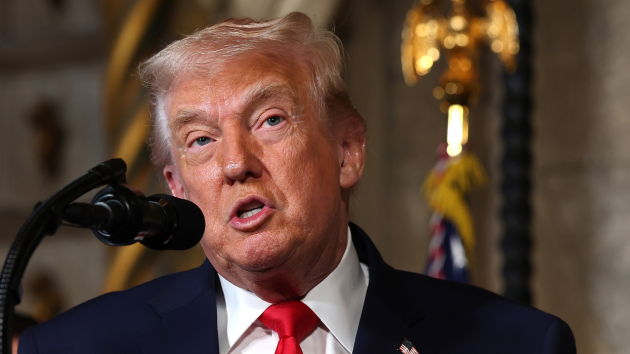
U.S. President Donald Trump announced the creation of the “Trump-class” battleship during a statement to the media at Trump’s Mar-a-Lago estate on December 22, 2025 in Palm Beach, Florida. Trump announced the new class of ship will become the centerpiece of his “Golden Fleet” program to rebuild and strengthen the U.S. shipbuilding industry. (Photo by Tasos Katopodis/Getty Images)
(FLORIDA) — President Donald Trump is continuing to ratchet up pressure on Venezuelan President Nicholas Maduro, saying it would be “smart” for him to step down and warning him not to play “tough.”
Trump, taking reporter questions at his Mar-a-Lago club in Florida on Monday evening, was directly asked if his administration’s ultimate goal in Venezuela is to force Maduro from power.
“Well, I think it probably would. I can’t tell him. That’s up to him what he wants to do. I think it would be smart for him to do that. But again, we’re going to find out,” Trump said.
At the same time, Trump issued a warning to Maduro.
“He can do whatever he wants, it’s alright, whatever he wants to do. If he wants to do something, if he plays tough, it’ll be the last time he’s ever able to play tough,” Trump said.
The president added, “We have a massive armada for him. The biggest we’ve ever had and by the far the biggest we’ve ever had in South America.”
The U.S. has built up its military presence in the region in recent weeks, with 15,000 U.S. troops and several warships standing ready in the Caribbean.
Trump last week also ordered what he called a “complete blockade” of all sanctioned oil tankers going into and out of Venezuela, targeting the government’s main source of revenue.
Maduro said Venezuela would continue to trade oil in the face of the “blockade,” and has said regime change “will just not happen, never, never, never.”
Separately, since September, the U.S. military has launched dozens of strikes on vessels in the Caribbean Sea and Pacific Ocean allegedly carrying drugs. These strikes have killed more than 100 people, according to numbers provided by the administration. The strikes have several raised legal questions from lawmakers of both parties and legal experts, though the administration’s justified the use of lethal force as part of what it calls its “war” on drug cartels.
“We’ll be starting the same program on land,” Trump said on Monday. “The land is much easier.”
While Trump continued to tease that land strikes on Venezuela, he also took it a step further and threatened land strikes on other countries.
“Anywhere drugs are pouring in. Anywhere, not just Venezuela,” Trump said when asked if he was only referring to Venezuela land strikes.
ABC News’ Alexandra Hutzler contributed to this report.
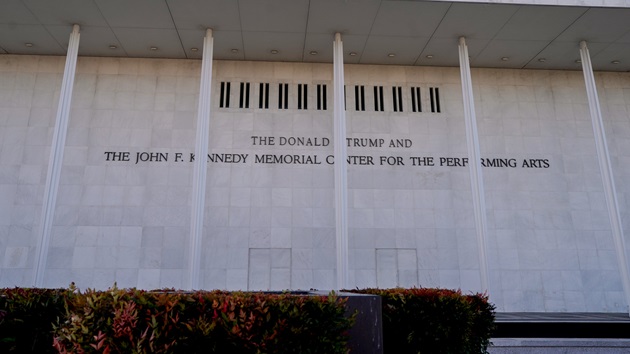
A new sign reads “The Donald Trump And The John F. Kennedy Center for the Performing Arts” at the Kennedy Center in Washington, DC, US, on Friday, Dec. 19, 2025. Al Drago/Bloomberg via Getty Images
(WASHINGTON) — House Democratic Rep. Joyce Beatty sued President Donald Trump on Monday — hoping to force the removal of his name from the John F. Kennedy Center for the Performing Arts.
The lawsuit from the congresswoman, who serves an ex-officio member of the board, argues that the board’s vote to rename the building was illegal because an act of Congress is required for such an action.
“This is a flagrant violation of the rule of law, and it flies in the face of our constitutional order. Congress intended the Center to be a living memorial to President Kennedy — and a crown jewel of the arts for all Americans, irrespective of party. Unless and until this Court intervenes, Defendants will continue to defy Congress and thwart the law for improper ends,” the lawsuit states.
ABC News has reached out to the White House for comment on the lawsuit.
The White House announced last week that the board at the Kennedy Center, which Trump now chairs and is filled with his appointees, voted “unanimously” to rename the building the “Trump-Kennedy Center” — with workers adding Trump’s name to the facade of the building the next day.
Beatty, however, said she was muted on the call during the vote and could not voice her opposition to the name change.
Beatty told reporters last week that she tried to speak up to oppose the name change.
“I said, ‘I have something to say,’ and I was muted, and as I continued to try to unmute, to ask questions and voice my opposition to this, I received a note saying that I would not be unmuted,” Beatty said to reporters. “I was not allowed to vote because I was muted. I would not have supported this.”
Beatty is represented by Norman Eisen, a White House ethics counsel in the Obama administration, and Nathaniel Zelinsky, co-counsel of the Washington Litigation Group.
“The President and his sycophants have no lawful authority to rename the Kennedy Center,” the two wrote in a statement.
Last week, Trump said his administration “saved” the historic arts and culture center.
“We’re saving the building. We saved the building. The building was in such bad shape — physically, financially, in every other way,” he said. “And now it’s very solid and very strong.”
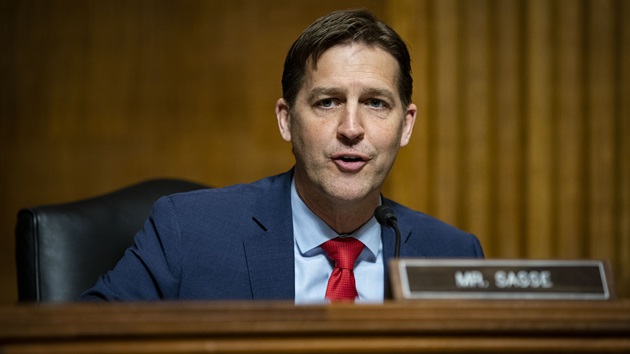
Former Senator Ben Sasse (R-NE) speaks during a Senate Judiciary Subcommittee on Privacy, Technology, and the Law hearing April 27, 2021 on Capitol Hill in Washington, D.C. Al Drago-Pool/Getty Images
(WASHINGTON) — Former Nebraska Sen. Ben Sasse shared on Tuesday that he has been diagnosed with advanced pancreatic cancer.
This is a developing story. Please check back for updates.
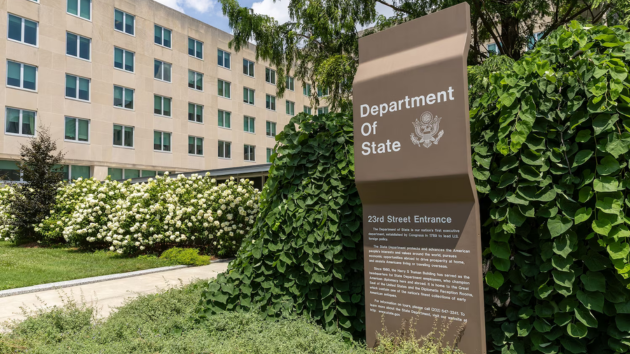
The Department of State building in Washington, July 11, 2025. Hu Yousong/Xinhua via Getty Images
(WASHINGTON) — The Trump administration is recalling dozens of career diplomats from overseas posts in the next month, according to a source familiar with the matter, the latest shakeup at the U.S. State Department.
More than two dozen senior diplomats have received notice that they must leave their roles in the next month, according to the source.
According to the American Foreign Service Association, the labor union that represents the U.S. foreign service and career diplomats, those affected by the recall report being notified by a phone call that they were being removed from their posts “abruptly,” with no explanation provided.
They were directed to vacate their posts by Jan. 15 or 16.
“This method is highly irregular,” a spokesperson for AFSA told ABC News.
“This is not normal practice. Career diplomats and ambassadors are not typically recalled in this manner. The lack of transparency and process breaks sharply with longstanding norms,” the spokesperson said.
Most of the impacted ambassadors are serving at U.S. diplomatic posts in Africa, but the removals also affect posts in Europe, Asia, the Middle East, and the Western Hemisphere.
A senior State Department official described the recall of the ambassadors as “a standard process in any administration.”
“An ambassador is a personal representative of the President, and it is the President’s right to ensure that he has individuals in these countries who advance the America First agenda,” they said.
The State Department declined to comment on specific numbers or ambassadors affected.
AFSA confirmed there is no official, verified list of recalled ambassadors.
There are various lists circulating that appear to be crowdsourced from people inside and outside the department, according AFSA.
POLITICO first reported on the removal of the diplomats.
The recall is the latest move by the Trump administration to reshape the State Department to align it more with its “America First” priorities. The recall comes after more than 1,300 officials and more than 240 foreign service officers were laid off earlier this year as part of what the administration said was a major reorganization aimed at increasing efficiency and reducing government size.
It is typically normal for new presidents to replace political appointments service in ambassador roles; however, career diplomats are typically allowed to continue serving in their roles.
The AFSA slammed the recall, saying it sends a “chilling signal” to career foreign service officers that their oaths to the Constitution take a backseat to political loyalty.
“Removing senior diplomats without cause undermines U.S. credibility abroad and sends a chilling signal to the professional Foreign Service: experience and an oath to the Constitution take a backseat to political loyalty. This is not how America leads,” the statement said.
AFSA says the recall represents “a steady erosion of norms, transparency, and professional independence in the Foreign Service.”
“Abrupt, unexplained recalls reflect the same pattern of institutional sabotage and politicization our survey data shows is already harming morale, effectiveness, and U.S. credibility abroad,” the spokesperson said.
AFSA is working with partners to confirm names one-by-one through direct contacts.
ABC News’ Luis Martinez and Josh Margolin contributed to this report.
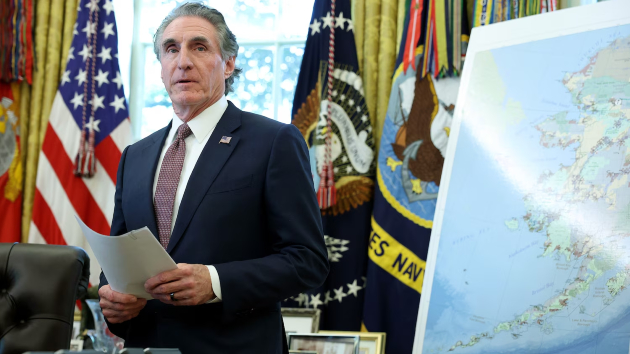
Interior Secretary Doug Burgum speaks during an event with President Donald Trump in the Oval Office at the White House on October 06, 2025 in Washington, DC. Anna Moneymaker/Getty Images
(WASHINGTON) — The Trump administration is pausing leases for five offshore wind projects due to “national security concerns” identified by the Department of Defense, Interior Secretary Doug Burgum announced on Monday.
“Today’s action addresses emerging national security risks, including the rapid evolution of the relevant adversary technologies, and the vulnerabilities created by large-scale offshore wind projects with proximity near our east coast population centers,” Burgum said in a press release about the move.
The administration did not disclose what national security risks the wind farms posed, saying that the Department of Defense found the threats in “completed classified reports.”
“As for the national security risks inherent to large-scale offshore wind projects, unclassified reports from the U.S. Government have long found that the movement of massive turbine blades and the highly reflective towers create radar interference called ‘clutter.’ The clutter caused by offshore wind projects obscures legitimate moving targets and generates false targets in the vicinity of the wind projects,” the Department of the Interior said in its press release.
The action affects projects off the coasts of Massachusetts, Rhode Island, Connecticut, Virginia and New York.
According to the Department of the Interior, that five leases that will be affected are: Vineyard Wind 1 (OCS-A 0501), Revolution Wind (OCS-A 0486), CVOW – Commercial (OCS-A 0483), Sunrise Wind (OCS-A 0487) and Empire Wind 1 (OCS-A 0512).
Connecticut Gov. Ned Lamont called the move “yet another erratic, anti-business move by the Trump administration that will drive up the price of electricity in Connecticut and throughout the region.”
“This project is nearing completion and providing good-paying clean energy jobs,” Lamont said in a statement.
Burgum wrote in an X post about the move that the projects were “expensive, unreliable, heavily subsidized offshore wind farms.”
Trump has made clear his distaste for windmills in many public events and on the campaign trail.
“Wind is the worst,” Trump said in a speech in Pennsylvania earlier this month. He added in his remarks, “We don’t want — we don’t approve windmills. We don’t approve it. I’m sorry.”
During an overseas trip to Scotland in July, Trump told Europe to “stop the windmills.”
“You’re ruining your countries. I really mean it. It’s so sad. You fly over and you see these windmills all over the place, ruining your beautiful fields and valleys and killing your birds. And if they’re stuck in the ocean, ruining your oceans. Stop the windmills,” Trump said.
Wind is the country’s largest source of renewable energy, accounting for about 10% of electricity generated in the United States, according to the Department of Energy. Proponents say renewable energy is instrumental in reducing the global reliance on fossil fuels, and the industry continues to grow worldwide despite political challenges.
The Sierra Club, an environmental organization, criticized the Trump administration’s action on Monday.
“The Trump administration’s vengeance towards renewable energy knows no end. Instead of progressing us forward as a nation, they are obsessed with attacking a growing industry that provides good clean energy jobs and affordable, clean electricity. Americans need cheaper and more reliable energy that does not come at the expense of our health and futures,” Melinda Pierce, the group’s legislative director, said in a statement.
This screen grab taken from a video posted on the X account of U.S. Secretary of Homeland Security Kristi Noem shows a U.S. Coast Guard aircraft flying over a crude oil tanker, last docked in Venezuela, before apprehending it on Dec. 20, 2025. Handout/US Secretary of Homeland Security via Getty Images
(WASHINGTON) — President Donald Trump last week announced a “complete blockade of all sanctioned oil tankers going into and out of Venezuela,” ratcheting up the pressure on Nicolás Maduro’s regime as 15,000 U.S. troops and 11 warships stand ready in nearby waters — and leaving questions over the scope of the apparent escalation.
A naval blockade is considered an act of war under international law. But Trump’s reference to “sanctioned” tankers indicated U.S. operations would continue as a law enforcement crackdown by the U.S. Coast Guard, which seized an oil tanker off the Venezuelan coast last week and another over the weekend.
A Coast Guard interdiction is not a military operation; it is a court-authorized enforcement of U.S. sanctions.
According to retired Marine Corps Col. Steve Ganyard, a former State Department official and an ABC News contributor, the president’s orders, announced on his social media platform, amount to a legal quarantine — and not a blockade — because the post references only legally sanctioned tankers.
But Trump also referred to the Venezuelan regime as a Foreign Terrorist Organization (FTO), which could implicate any oil tanker that enters Venezuelan waters.
It wasn’t clear how the administration could designate the government as terrorists — or whether Trump was making reference to Cartel de los Soles, which the administration designated as a terror organization and has said is headed by Maduro.
What impact could a quarantine or blockade have?
Trump’s post last week “leaves more questions than answers,” said Clayton Seigle, a senior fellow at the Center for Strategic and International Studies. “What exactly are we going to do? How are we going to do it?”
“None of that is really detailed,” he said.
Whether the escalated pressure will target sanctioned vessels — or all vessels — remains an open question, but both approaches would impact Maduro, Seigle said.
“If you cut off all oil exports, and the associated revenues — and that’s a big if –then I think in a matter of weeks, the regime in Caracas would face extreme pressure,” he said.
If the U.S. continues to target only sanctioned tankers, “then I think that it could be a more prolonged runway for the regime to try to work something out, find a compromise, or even plan a deliberate exit.”
The U.S. says it has killed more than 100 people in the 25 strikes it says it has carried out on alleged drug smuggling boats since September.
Experts have pointed to President John F. Kennedy’s quarantine of Cuba in 1962 as an analogue to Trump’s approach — with unknown possibilities inviting risk.
“What if a ship doesn’t stop? This was the debate in the Cuban Missile Crisis,” Seigle said. “It’s all fun and games if they pull over and let [themselves] get boarded.”
“What if they don’t? Are you opening fire? Are you sinking ships?”
The announced blockade, though, “looks like it’s a relatively low-risk military operation” designed “to prevent” such a “quagmire,” Seigle said.
“Because if it goes smoothly and they’re able to cut off a lot of Maduro’s oil revenue, then they have a reasonable chance of getting the political outcome that they want, which is Maduro fleeing.”
Yet Trump on Wednesday wouldn’t offer a comment when asked if he sought regime change in Venezuela. Instead, he repeated a claim he said was a premise for blocking tankers.
“You remember, they took all of our energy rights,” he said of Venezuela. “They took all of our oil from not that long ago, and we want it back. But they took it. They illegally took it.”
Trump did not specify which period of nationalizations undertaken by the Venezuelan governments aggrieved the U.S. in his view.
An international arbitration court in 2013 ordered Caracas to pay $8.7 billion to U.S. firm ConocoPhillips, penalizing Venezuela for expropriation of crude assets in 2007 which it found to be unlawful.
Operating in the shadows The U.S. has sanctioned hundreds of oil tankers around the world which it says are part of an illicit network often called the “shadow fleet.”
27 of those designated tankers are operating in Venezuelan waters, according to Seigle.
Venezuela, Russia, and Iran “share that sanctioned fleet,” he added, and Venezuela’s slice is the smallest of the three.
A full quarter of China’s oil imports are produced by those sanctioned countries, Seigle said, leaving the country with “an outsized concern.”
“This is going to raise eyebrows and maybe raise concerns in Beijing among strategic planners that are responsible for making sure that they have enough oil,” he said.
Sanctioned tankers represent less than a fifth of the oil exported from Venezuela, according to Seigle.
“But I think it can have outsized effects in a number of important areas, including whether and for how long Maduro can hold out in a leadership position in Caracas, and also with regard to Venezuela’s biggest oil customer, which is China.”
Why call Maduro’s regime terrorists?
|As a part of Trump’s lengthy post on social media, the president also said the “Venezuelan regime” was an FTO, which the State Department designated it as in November.
Trump and State officials, including Secretary of State Marco Rubio, have repeatedly said Maduro is a narco-terrorist and the head of a narco-terrorist organization, adding that Maduro is not the legitimate leader of Venezuela.
Trump is likely referring to the designation of the Cartel de los Soles when he points to the “Venezuelan Regime” in his post.
The State Department alleges in its designation that Maduro and other high-ranking officials head the Cartel de los Soles and have “corrupted Venezuela’s military, intelligence, legislature, and judiciary.”
Maduro’s government categorically denies the existence of the cartel.
Secretary of Defense Pete Hegseth said in November that the designation of Maduro as a terrorist gives the U.S. more military options in its anti-trafficking operation and public pressure campaign on the Venezuelan president.
The FTO designation “brings a whole bunch of new options to the United States,” Hegseth said. “It gives more tools to our department to give options to the president.”
Legal experts have told ABC that the designation does not in itself constitute an authorization of force. But administration officials have consistently pointed to these designations publicly when disclosing strikes on alleged drug traffickers.
Notably, while the Maduro regime has been targeted as a foreign terrorist organization, the country of Venezuela has not yet been placed on the official “State Sponsor of Terrorism” list.
Only Iran, North Korea, Syria and Cuba are currently listed as state sponsors of terrorism.
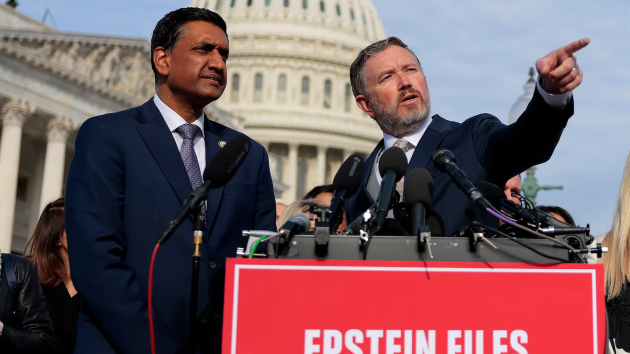
Rep. Thomas Massie speaks alongside Rep. Ro Khanna during a news conference on the Epstein Files Transparency Act outside the U.S. Capitol, November 18, 2025 in Washington. Heather Diehl/Getty Images
(WASHINGTON) — Minority Leader Chuck Schumer introduced legislation on Monday that would direct the Senate to initiate legal action to hold the Justice Department accountable for failing to release the complete files related to convicted sex offender Jeffrey Epstein by Friday’s deadline, which was mandated by the Epstein Files Transparency Act.
Schumer’s announcement came after Democratic Rep. Ro Khanna and Republican Rep. Thomas Massie announced on Sunday that they are pursuing “inherent contempt” charges against Attorney General Pam Bondi for not complying with the law to release the complete Epstein files.
If the effort passes, it could lead to Bondi’s arrest — though the pair is expected to introduce the resolution as “privileged” once the House returns in January, which would force a vote within two legislative days on the House floor, and it’s unclear if this effort would even be successful when it comes up for a vote.
“The law Congress passed is crystal clear: release the Epstein files in full so Americans can see the truth,” Schumer said in a statement. “Instead, the Trump Department of Justice dumped redactions and withheld the evidence — that breaks the law. Today, I am introducing a resolution to force the Senate to take legal action and compel this administration to comply.”
The DOJ faced a Friday deadline imposed by Congress and signed into law by the president to release a massive cache of records gathered during government investigations into the sex offender, who died in jail in 2019.
The Justice Department released thousands of files — ranging from investigative documents to grand jury testimony to snapshots taken by Epstein and his friends — but said it would fail to fully release all the files by the deadline. The law contains exceptions to protect victims and other circumstances, but critics say the DOJ is not following the letter and spirit of the law.
Schumer called the DOJ’s partial release on Friday a “blatant cover-up.”
“Pam Bondi and [Deputy Attorney General] Todd Blanche are shielding Donald Trump from accountability, and the Senate has a duty to act,” Schumer said.
Schumer is expected to force consideration of this bill on the Senate floor in January when the Senate returns from its holiday break. The bill would likely require unanimous consent to pass.
It is unclear if it would have that support, but the Senate unanimously passed the Epstein Transparency Act, which compelled the release of the Epstein documents.
On Sunday, Khanna and Massie, the co-authors of the Epstein Files Transparency Act, announced their intent to pursue inherent contempt proceedings.
The inherent contempt power permits Congress to rely on its own constitutional authority to detain and imprison a “contemnor” — someone held in contempt — until the individual complies with congressional demands like a subpoena or a monetary fine, according to the Congressional Research Service.
The power directs the Sergeant at Arms to arrest the individual who refuses to comply with a subpoena or fine, however, once the witness complies with the subpoena, they are released.
Notably, the resolution would not require passage in the Senate to be enforced.
“The quickest way, and I think most expeditious way, to get justice for these victims is to bring inherent contempt against Pam Bondi,” Massie said on “CBS News’ Face the Nation” on Sunday.
Khanna, who also appeared on the same program on Sunday, reiterated that inherent contempt is the right path at this point.
“We only need only need the House for inherent contempt, and we’re building a bipartisan coalition, and it would fine Pam Bondi for every day that she’s not releasing these documents. I’ll tell you why, I’ve talked to the survivors, why this is such a slap in the face,” Khanna said.
On NBC News’ “Meet the Press” on Sunday, Blanche said he wasn’t taking Massie and Khanna’s threats seriously because he said he believes they are in compliance with the law. Specifically regarding threats of legal action against the department, Blanche said, “Bring it on.”
A statement released Monday morning by attorneys representing a group of Epstein survivors said omissions in the files by either redactions or unreleased pages amounted to a failure.
“We are told that there are hundreds of thousands of pages of documents still unreleased,” the statement said.
A sign is displayed outside of the Internal Revenue Service (IRS) Building on June 7, 2025 in Washington, DC. (Photo by Kevin Carter/Getty Images)
(WASHINGTON) — Heading into the new year, Senate Democrats are raising concerns about the Internal Revenue Service’s ability to handle the upcoming tax filing season, amid changes in leadership and to the workforce in the first year of the Trump administration.
In a letter to Treasury Secretary and acting IRS Commissioner Scott Bessent obtained first by ABC News, the group of 17 senators, led by Elizabeth Warren of Massachusetts, and Angus King, a Maine independent who caucuses with Democrats, wrote that they have “serious concerns” the IRS is “not prepared” for the next tax season, and that taxpayers “may face delays and difficulties in filing returns and receiving refunds.”
The Trump administration has conducted large-scale layoffs and voluntary buyouts — some of which have been reversed — at the IRS, which is also responsible this year for implementing new changes to the tax code following the passage of Republicans’ major tax and domestic policy bill.
Bessent has served as acting IRS commissioner since August after President Donald Trump removed Billy Long, a former GOP congressman, from the role two months after he was confirmed by the Senate and nominated Long to become the U.S. ambassador to Iceland.
Bessent became the seventh official to lead the agency in 2025, following Long and a string of other senior officials.
The law made permanent the 2017 GOP tax cuts, while boosting funding for border security and the Defense Department, scaling back some social safety net programs, and limiting taxes on tips and overtime for some workers.
In a statement to ABC News, Warren accused the Trump administration of enacting changes that will benefit wealthy Americans and make it harder for other Americans seeking help from the agency.
“Donald Trump’s endless attacks on the IRS are good news for his billionaire buddies and giant tax prep companies, but bad news for Americans getting ready for filing season. Americans rely on the IRS to file their taxes and get their tax refunds quickly and easily, and I’m pressing for answers,” she wrote.
The Democrats also cited a September report from the Treasury Department Inspector General for Tax Administration on the previous filing season.
While the watchdog called the 2025 filing season “successful” and found that the agency processed more tax returns compared to the same time period in the previous year, it also found that the Trump administration’s workforce reductions “had no significant impact” on the 2025 filing season — but that they could “impact key processing programs and customer service going forward.”
According to the inspector general’s office, the staffing losses on customer service and anti-fraud teams could lead to the agency processing fewer returns, assisting fewer taxpayers, and failing to prevent $360 million in fraudulent refunds from being paid out.
The Treasury Department did not immediately respond to questions from ABC News about the inspector general’s report and the concerns raised by Democrats.
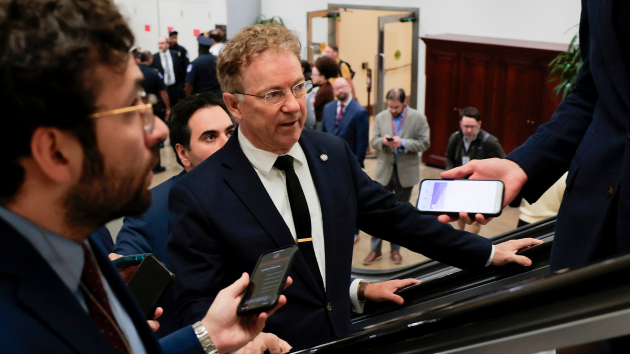
Senator Rand Paul (R-KY) walks through the Senate subway on December 09, 2025 in Washington, DC. (Heather Diehl/Getty Images)
(WASHINGTON) — Republican Sen. Rand Paul on Sunday criticized President Donald Trump’s military mission off Venezuela’s coast, calling the seizures of multiple oil tankers in the Caribbean Sea “a provocation and a prelude to war.”
“I’m not for confiscating these liners. I’m not for blowing up these boats of unarmed people that are suspected of being drug dealers. I’m not for any of this,” Paul told ABC News’ “This Week” co-anchor Jonathan Karl.
Paul also described the administration’s policy of handling suspected drug traffickers as “bizarre and contradictory.”
“And then why is the former president [Juan Orlando] Hernandez of Honduras, who was in jail for 45 years, why is he released?” Paul asked. “So, some narco-terrorists are really OK and other narco-terrorists we’re going to blow up. And then some of them, if they’re not designated as a terrorist, we might arrest them.”
Here are more highlights from Paul’s interview:
On Erika Kirk and Marco Rubio’s 2028 Vance endorsement Karl: Is JD Vance the heir apparent here?
Paul: I think there needs to be representatives in the Republican Party who still believe international trade is good, who still believe in free market capitalism, who still believe in low taxes. See, it used to separate conservatives and liberals that conservatives thought it was a spending problem. We didn’t want more revenue. We wanted less spending. But now all these pro terror protectionists, they love taxes, and so they tax, tax, tax, and then they brag about all the revenue coming in. That has never been a conservative position. So I’m going to continue to try to lead a conservative free market wing of the party, and we’ll see where things lead over time.
Karl: And that’s not JD Vance.
Paul: No.
On retaliatory strikes in Syria Paul: You know, it’s hard not to want to hit back when they kill some of our own. But I would like to go back, really, to the first Trump administration when he said he didn’t want the troops there. There’s like 900 troops, maybe a thousand, maybe 1,500. They’re not enough to fight a war. They’re not enough to be an effective strategic force. What they are is a target and a tripwire.
So we’ve done this retaliatory strike. Now, now, Donald Trump ought to do what Donald Trump proposed in the first administration, what Ronald Reagan did after the 1983 bomb. He left. There’s no reason for us to be in Syria. We need to leave Syria and not be a trip wire to getting back involved in another war.
On the potential for a one-year extension for ACA subsidies Paul: Look, we have health care in our country for poor people. It’s called Medicaid. All of the rest of this stuff has not worked. Obamacare has been a failure. President Obama said it would bring premiums down. Premiums gone through the roof. Every time we give more subsidies, the premiums go higher. I have a plan that says everybody in this marketplace, and it’s only about 4%, everybody in this marketplace should be able to go to Amazon or Costco or Sam’s Club and as a group, a large group — millions of people in the group — negotiate with Big Insurance to bring prices down. It’s the only proposal out there that — that has a chance of bringing prices down.
(NEW YORK) — The No. 2 official in the Justice Department told ABC News in an interview Friday that there has been “no effort” to redact President Donald Trump’s name from the release of files stemming from federal investigations into convicted sex trafficker Jeffrey Epstein.
Deputy Attorney General Todd Blanche was asked Friday in an interview by ABC News Chief Justice Correspondent Pierre Thomas whether every document that mentions Trump will be released as the government continues its rollout of hundreds of thousands of files in the coming weeks.
“Assuming it’s consistent with the law, yes,” Blanche said. “So there’s no effort to hold anything back because there’s the name Donald J. Trump or anybody else’s name, Bill Clinton’s name, Reid Hoffman’s name. There’s no effort to hold back or not hold back because of that and — and so — but again, we’re not, we’re not redacting the names of famous men and women that are associated with Epstein.”
When directly pressed over whether there’s been any order to DOJ personnel to redact materials involving Trump, Blanche rejected any such suggestion and accused Democratic lawmakers of using selective disclosures from Epstein’s estate to present Trump in a negative light.
“President Trump has certainly said from the beginning that he expects all files that can be released to be released and that’s exactly what we’re doing,” Blanche said.
Blanche sat for the interview just hours before the department released its first tranche of thousands of files, which contained little information related to Trump and instead included images of former President Bill Clinton without context, which were highlighted on social media by DOJ and White House officials.
A spokesperson for Clinton accused the department of selectively disclosing the pictures in a statement and denied that they showed any wrongdoing by the former president.
“The White House hasn’t been hiding these files for months only to dump them late on a Friday only to protect Bill Clinton,” Clinton’s spokesperson Angel Urena said Friday. “They can release as many grainy 20-plus-year-old photos as they want, but this isn’t about Bill Clinton.”
“Everyone, especially MAGA, expects answers, not scapegoats,” the spokesperson said.
In the ABC News interview, Blanche further sought to defend the department’s decision not to release the entirety of its files subject to disclosure under the bill signed into law by Trump, which gave the Justice Department a 30-day deadline to release the entirety of its Epstein investigative files.
“I did not say that all the files will not be released, I said all the files will not be released today,” Blanche said when asked about an interview he gave earlier Friday to Fox News. “And the law is very specific that the Department of Justice is required to make sure that we protect victims. And as recently as Wednesday, we learned of additional victim names, and so we’ve received over 1,200 names of victims and their family members since we started this process. And so there’s an established precedent that in a situation like this, where it’s in essence impossible for us to comply with the law today, that we comply with the law, consistent with the law.”
When asked whether the public should be confident that Blanche, who previously served as Trump’s personal defense attorney, would act in the public’s interest over Trump, Blanche said the American people should look at what the department ultimately releases.
“Your confidence should be in the fact that for decades, lots of people have been trying to go after President Trump falsely, and when it came to the Epstein saga, it’s exactly the same story.”
Blanche added that the process to make redactions to the documents, “was not Attorney General [Pam] Bondi, [FBI] Director Patel, Todd Blanche going through and coding millions of documents and saying, ‘yes, no, yes, no.’ You have multiple, dozens and dozens of the most highly trained lawyers in the Department of Justice working for the National Security Division. These are career lawyers engaged in this process.”
Blanche defends prison transfer of Epstein associate Ghislaine Maxwell
In the interview, Blanche also defended the department’s controversial move over the summer to transfer Epstein’s convicted associate Ghislaine Maxwell to a lower security prison facility just days after he sat for an interview with her over two days in Florida.
In an interview released by Vanity Fair earlier this week, White House chief of staff Susie Wiles denied that Trump was involved in the decision and said he disapproved of Maxwell’s transfer.
While Blanche said he was “not permitted” to talk about security for individual inmates, he said Maxwell was facing “multiple threats” that warranted her being moved to a separate low-security facility in Texas.
“At the time that she was moved, there were multiple threats against her life, and like happens all the time at the Bureau of Prisons when that happens, one of the things that one of the options available to the warden and the security system within the Bureau of Prisons is to move the inmate,” Blanche said. “She’s not released. She’s in federal prison.”
Blanche further denied Maxwell was receiving any preferential treatment in the new facility, despite recent whistleblower disclosures released by congressional Democrats.
Blanche says investigations into Comey, James will continue
ABC News separately asked Blanche whether the department plans to continue pursuing prosecutions against two of Trump’s top political targets, New York Attorney General Letitia James and former FBI Director James Comey after a federal judge tossed their indictments in November on the basis that a Trump-installed prosecutor was unlawfully appointed.
Two separate federal grand juries in the past two weeks have rejected the department’s efforts to re-indict James on mortgage fraud charges and a separate federal judge in Washington, D.C., has restricted prosecutors from accessing key evidence in their probe of Comey.
Blanche confirmed the department’s investigation into Comey “is continuing” and said it was “not a mystery” that DOJ plans to still seek charges against him and rejected any suggestion the prosecution was “vindictive.”
James and Comey have denied all wrongdoing.
When asked about the interview that Wiles, the White House chief of staff, gave to Vanity Fair in which she candidly appeared to concede the DOJ’s prosecution of James was “retribution,” Blanche again defended the department’s actions.
“Because we’re looking at the evidence, we’re investigating them, investigating the cases. We have law enforcement, career law enforcement, doing the investigations are being presented to a grand jury in the normal course,” Blanche said.
ABC News has previously reported that career prosecutors on both the James and Comey investigations recommended prosecutors not pursue either indictment based on what they considered the lack of sufficient evidence to secure a conviction.