(WASHINGTON) — A trade agreement between the U.S. and China on Monday slashed tit-for-tat tariffs between the world’s two largest economies and triggered a surge in the stock market.
The U.S. agreed to cut tariffs on Chinese goods from 145% to 30%, while China committed to reduce tariffs on U.S. products from 125% to 10%. The lowered tariffs will remain in place for 90 days while the two sides negotiate a wider trade deal.
Still, the agreement appeared to leave key sticking points unresolved as the two countries work through a newly established mechanism for further discussions.
In a joint statement, the U.S. and China touted the agreement as evidence that both sides recognize the “importance of a sustainable, long-term, and mutually beneficial economic and trade relationship.”
Here’s what to know about the new trade framework:
Lower tariffs The trade agreement temporarily reduces tariffs imposed by the U.S. and China in the aftermath of Trump’s “Liberation Day” announcement last month.
The previous set of sky-high tariffs had threatened a surge in prices and a possible U.S. recession, experts told ABC News.
Jonathan Pingle, chief U.S. economist at Swiss investment bank UBS, estimated the reduction in U.S. levies on China would bring average U.S. tariffs down from 24% to 14%.
In a statement to ABC News, Pingle described the agreement between the U.S. and China as a “cooling off.”
Sector-specific tariffs on autos, aluminum and steel remain in place for Chinese goods, Trump told reporters at the Oval Office on Monday. Trump also said China would be subject to tariffs the White House plans to impose on pharmaceuticals.
The agreement preserves a set of 20% tariffs targeting China over its role in fentanyl trade, as well as a 10% levy slapped on imports from nearly all countries.
A plan for further negotiations The framework established a mechanism for negotiations between the U.S. and China, setting up the countries for further discussions during the 90-day period of reduced tariffs.
Senior officials from both sides will take part in the talks, the statement added.
Treasury Secretary Scott Bessent and United States Trade Representative Jamieson Greer will represent the U.S., while China will be represented by Vice Premier of the State Council He Lifeng, a longtime associate of Chinese President Xi Jinping.
Shang-Jin Wei, a professor of finance and economics at Columbia University who studies the U.S.-China trade relationship, described the mechanism for negotiations as “meaningful.”
“It’s not an empty statement – there will be negotiations,” Wei said.
But, Wei added, the agreement struck on Monday amounts to a “temporary solution” as the two sides engage in a challenging set of discussions over the next few months.
“There’s a lot of uncertainty about what will happen in 90 days,” Wei said.
Sticking points remain unresolved Speaking at the White House on Monday, Trump acknowledged that verbal commitments made by both sides must be “papered,” meaning the broad accord has yet to be formalized through detailed agreements.
Trump has previously said he would like to narrow a $300 billion U.S. trade deficit with China, and roll back what he describes as non-tariff barriers to U.S. trade. The framework announced on Monday did not detail steps toward those efforts, Wei said.
The agreement also appeared to lack final resolution for a key sticking point centered on U.S. access to important materials largely controlled by China.
China imposed export restrictions on some rare earth elements and magnets that make up critical inputs in some U.S. auto, energy and defense products.
For now, Chinese companies can still export to U.S. customers, though the Chinese firms must receive approval from the Chinese government.
After the agreement, U.S. buyers are expected to have an easier path for such approval, but the restrictions are not expected to be fully removed, Reuters reported.
Rare earths are vital for a range of defense technologies, including F-35 fighter jets, Tomahawk missiles and radar systems, the Center for Strategic and International Studies, or CSIS, said last month.
The U.S. will likely also seek guarantees from China about the purchase of U.S. products, including agricultural goods, Wei said.
Meanwhile, Wei added, China will want to safeguard its access to U.S. markets, ensuring such exports continue to help drive the Chinese economy.
“China probably wants to adjust to reduce its dependence on U.S. markets,” Wei said. “But it wants to make sure those markets don’t go right away.”
(WASHINGTON) — President Donald Trump on Monday will embark on a four-day tour of the Middle East, stopping in Saudi Arabia, Qatar and the United Arab Emirates on a trip underscoring the deepening economic ties between the United States and the Gulf kingdoms.
Traveling to a region facing ongoing diplomatic, political and security challenges — including Iran’s nuclear program, the humanitarian crisis in Gaza and war between Israel and Hamas, and the fate of Syria following a brutal 14-year civil war — Trump is expected to focus on business development and trade agreements on his trip, following commitments from Saudi Arabia and the United Arab Emirates to invest hundreds of billions of dollars in the United States and on joint investments over the next several years.
On Friday, White House press secretary Karoline Leavitt said Trump’s trip will “focus on strengthening ties” between the U.S. and the Gulf nations.
“President Trump will return to reemphasize his continued vision for a proud, prosperous and successful Middle East where the United States and Middle Eastern nations are in cooperative relationship and where extremism is defeated in place of commerce and cultural exchanges,” she said.
Saudi Crown Prince Mohammed bin Salman pledged to invest $600 billion in the United States over four years after Trump’s November victory, and the United Arab Emirates have also committed to a $1.4 trillion U.S. investment package over the next decade. Business and technology leaders will be convening in Riyadh around Trump’s trip for a Saudi-U.S. investment forum.
ABC News has also reported that the Trump administration is preparing to accept a luxury Boeing jumbo jet from the Qatari royal family for use as a presidential aircraft before being transferred to the Trump presidential library foundation after his term ends.
White House press secretary Karoline Leavitt responded to ABC News’ reporting, saying in a statement that “any gift given by a foreign government is always accepted in full compliance with all applicable laws.”
The president’s family has also traveled to the region and has expanded its business interests in the Middle East: The Trump Organization has partnered with developers on new projects in Saudi Arabia, Doha and the United Arab Emirates, and is involved in a cryptocurrency venture connected to a fund with ties to the Emirati government.
Leavitt on Friday dismissed questions about the president’s family’s business dealings in the region ahead of his trip and said Trump “has actually lost money for being president of the United States.”
“The president acts with only the interests of the American public in mind, putting our country first and doing what’s best for our country — full stop,” she said.
“It’s frankly ridiculous that anyone in this room would even suggest that President Trump is doing anything for his own benefit. He left a life of luxury and a life of running a very successful real estate empire for public service,” she later added.
Trump also began his first term in office with a visit to Saudi Arabia, in a break with his predecessors who had visited traditional U.S. allies and major trade partners on their first official foreign trips.
That trip to Saudi Arabia — which also included stops in Israel and later in Europe — focused on encouraging local partners to redouble efforts to fight “extremism” and terrorist groups, and work to marginalize Iran.
Since then, Saudi Arabia and other Gulf states have improved relations with Iran, and are now supportive of the Trump administration’s diplomatic efforts to address Iran’s nuclear program.
“Both the Saudis and the Emiratis have decided that their priority is economic investment and getting away from energy, and that war with Iran is like a big danger to all of that. So they’ve completely shifted on Iran,” Ilan Goldenberg, a Middle East specialist who worked in the Obama and Biden administrations, told ABC News.
The ongoing war between Israel and Hamas and the humanitarian crisis in Gaza also looms over Trump’s trip, given Israel’s plans to expand military operations in Gaza.
In Riyadh, Trump is expected to join a Gulf Cooperation Council meeting before he travels to Qatar.
While the president has aimed to ink a regional diplomatic agreement expanding on the Abraham Accords of his first term, the war in Gaza has effectively frozen efforts to normalize diplomatic relations between Israel and Saudi Arabia and other Arab countries, experts told ABC News.
“From the Saudi perspective, it makes it harder” to improve diplomatic relations with Israel, Zineb Riboua, a fellow with Hudson Institute’s Center for Peace and Security in the Middle East. “Because of what has happened and what is currently happening [in Gaza], they are struggling.”
Trump could hear from Arab leaders about the humanitarian situation in Gaza, given the U.S.’s ongoing military support for Israel, and Israeli plans to expand its campaign in Gaza to root out Hamas.
In February, Trump proposed that the U.S. “take over” Gaza and help rebuild it, a plan that was rejected by Arab leaders, who put forward their own counterproposal that the U.S. and Israel have opposed.
There have also been disputes between the U.S., Israel and Arab nations over how to administer humanitarian aid blockaded by Israel to Palestinians in Gaza.
Though the trip is Trump’s first planned foreign trip, he traveled to Rome and the Vatican in April to attend the funeral of Pope Francis.
On the sidelines of that trip, Trump met with Ukrainian President Volodymyr Zelenskyy as the two countries worked to cement a minerals deal.
Saudi Arabia has hosted bilateral peace negotiations between Russia and Ukraine, underscoring the kingdom’s growing political influence, in addition to its economic and commercial importance in the region.
Trump “sees the Gulf as they see themselves, as a real fulcrum of global power,” Jon Alterman, the Middle East Program Chair at Center for Strategic and International Studies, told ABC News.
“A lot of people in the world think the Gulf is an outlier. A bunch of small, wealthy states that rely on the United States for security, protection. The Gulf sees itself differently, and the president is suggesting he sees the Gulf differently,” Alterman said.
Trump could receive a lavish welcome from the Gulf monarchs in the region, similar to the royal treatment he received when he visited Saudi Arabia in 2017.
The Saudis rolled out the red carpet for his arrival, greeting him at the airport with a military jet flyover and later awarding him a gold medal — the nation’s top civilian honor — and treating him to a traditional sword dance.
Trump’s trip also comes on the heels of Hamas announcing that they will be releasing Israeli soldier Edan Alexander, a dual US citizen, which will be part of steps taken to achieve a ceasefire. Hamas said that they have been in contact with American officials over the last few days over the efforts to try and achieve a ceasefire deal.
President Donald Trump posted on his social media platform, Truth Social, Sunday evening, confirming that Alexander will be released from Hamas. Trump did not specify when Alexander was expected to be released, but said, “This is the first of those final steps necessary to end this brutal conflict.
(WASHINGTON) — President Donald Trump on Monday embarked on a four-day tour of the Middle East, stopping in Saudi Arabia, Qatar and the United Arab Emirates on a trip underscoring the deepening economic ties between the United States and the Gulf kingdoms.
Traveling to a region facing ongoing diplomatic, political and security challenges — including Iran’s nuclear program, the humanitarian crisis in Gaza and war between Israel and Hamas, and the fate of Syria following a brutal 14-year civil war — Trump is expected to focus on business development and trade agreements on his trip, following commitments from Saudi Arabia and the United Arab Emirates to invest hundreds of billions of dollars in the United States and on joint investments over the next several years.
On Friday, White House press secretary Karoline Leavitt said Trump’s trip will “focus on strengthening ties” between the U.S. and the Gulf nations.
“President Trump will return to reemphasize his continued vision for a proud, prosperous and successful Middle East where the United States and Middle Eastern nations are in cooperative relationship and where extremism is defeated in place of commerce and cultural exchanges,” she said.
Saudi Crown Prince Mohammed bin Salman pledged to invest $600 billion in the United States over four years after Trump’s November victory, and the United Arab Emirates have also committed to a $1.4 trillion U.S. investment package over the next decade. Business and technology leaders will be convening in Riyadh around Trump’s trip for a Saudi-U.S. investment forum.
ABC News has also reported that the Trump administration is preparing to accept a luxury Boeing jumbo jet from the Qatari royal family for use as a presidential aircraft before being transferred to the Trump presidential library foundation after his term ends.
White House press secretary Karoline Leavitt responded to ABC News’ reporting, saying in a statement that “any gift given by a foreign government is always accepted in full compliance with all applicable laws.”
The president’s family has also traveled to the region and has expanded its business interests in the Middle East: The Trump Organization has partnered with developers on new projects in Saudi Arabia, Doha and the United Arab Emirates, and is involved in a cryptocurrency venture connected to a fund with ties to the Emirati government.
Leavitt on Friday dismissed questions about the president’s family’s business dealings in the region ahead of his trip and said Trump “has actually lost money for being president of the United States.”
“The president acts with only the interests of the American public in mind, putting our country first and doing what’s best for our country — full stop,” she said.
“It’s frankly ridiculous that anyone in this room would even suggest that President Trump is doing anything for his own benefit. He left a life of luxury and a life of running a very successful real estate empire for public service,” she later added.
Trump also began his first term in office with a visit to Saudi Arabia, in a break with his predecessors who had visited traditional U.S. allies and major trade partners on their first official foreign trips.
That trip to Saudi Arabia — which also included stops in Israel and later in Europe — focused on encouraging local partners to redouble efforts to fight “extremism” and terrorist groups, and work to marginalize Iran.
Since then, Saudi Arabia and other Gulf states have improved relations with Iran, and are now supportive of the Trump administration’s diplomatic efforts to address Iran’s nuclear program.
“Both the Saudis and the Emiratis have decided that their priority is economic investment and getting away from energy, and that war with Iran is like a big danger to all of that. So they’ve completely shifted on Iran,” Ilan Goldenberg, a Middle East specialist who worked in the Obama and Biden administrations, told ABC News.
The ongoing war between Israel and Hamas and the humanitarian crisis in Gaza also looms over Trump’s trip, given Israel’s plans to expand military operations in Gaza.
In Riyadh, Trump is expected to join a Gulf Cooperation Council meeting before he travels to Qatar.
While the president has aimed to ink a regional diplomatic agreement expanding on the Abraham Accords of his first term, the war in Gaza has effectively frozen efforts to normalize diplomatic relations between Israel and Saudi Arabia and other Arab countries, experts told ABC News.
“From the Saudi perspective, it makes it harder” to improve diplomatic relations with Israel, Zineb Riboua, a fellow with Hudson Institute’s Center for Peace and Security in the Middle East. “Because of what has happened and what is currently happening [in Gaza], they are struggling.”
Trump could hear from Arab leaders about the humanitarian situation in Gaza, given the U.S.’s ongoing military support for Israel, and Israeli plans to expand its campaign in Gaza to root out Hamas.
In February, Trump proposed that the U.S. “take over” Gaza and help rebuild it, a plan that was rejected by Arab leaders, who put forward their own counterproposal that the U.S. and Israel have opposed.
There have also been disputes between the U.S., Israel and Arab nations over how to administer humanitarian aid blockaded by Israel to Palestinians in Gaza.
Though the trip is Trump’s first planned foreign trip, he traveled to Rome and the Vatican in April to attend the funeral of Pope Francis.
On the sidelines of that trip, Trump met with Ukrainian President Volodymyr Zelenskyy as the two countries worked to cement a minerals deal.
Saudi Arabia has hosted bilateral peace negotiations between Russia and Ukraine, underscoring the kingdom’s growing political influence, in addition to its economic and commercial importance in the region.
Trump “sees the Gulf as they see themselves, as a real fulcrum of global power,” Jon Alterman, the Middle East Program Chair at Center for Strategic and International Studies, told ABC News.
“A lot of people in the world think the Gulf is an outlier. A bunch of small, wealthy states that rely on the United States for security, protection. The Gulf sees itself differently, and the president is suggesting he sees the Gulf differently,” Alterman said.
Trump could receive a lavish welcome from the Gulf monarchs in the region, similar to the royal treatment he received when he visited Saudi Arabia in 2017.
The Saudis rolled out the red carpet for his arrival, greeting him at the airport with a military jet flyover and later awarding him a gold medal — the nation’s top civilian honor — and treating him to a traditional sword dance.
Trump’s trip also comes on the heels of Hamas announcing that they will be releasing Israeli soldier Edan Alexander, a dual US citizen, which will be part of steps taken to achieve a ceasefire. Hamas said that they have been in contact with American officials over the last few days over the efforts to try and achieve a ceasefire deal.
President Donald Trump posted on his social media platform, Truth Social, Sunday evening, confirming that Alexander will be released from Hamas. Trump did not specify when Alexander was expected to be released, but said, “This is the first of those final steps necessary to end this brutal conflict.
When President Donald Trump arrives in the Persian Gulf Tuesday for his first overseas visit since regaining the White House, he’ll touch down in a region that’s rich in opportunity. On the diplomatic front, he’s expected to focus on trade agreements and economic ties.
But for Trump and his family, there are also opportunities in the form of business ventures and real estate deals.
Some ethics experts say the way his family business has approached these opportunities brings up familiar concerns of potential conflicts of interest as Trump meets with the region’s leaders, who could hold sway over the success of Trump’s ventures there.
During Trump’s first term, his family said they wouldn’t pursue any new overseas business ventures. But now, in Trump’s second term, the Trump Organization has several active projects in the Gulf region — including some that have launched in the months since Trump returned to office — suggesting that his self-imposed moratorium has dissipated.
Trump’s visit to the United Arab Emirates, for example, comes just over a week after the Trump Organization announced the development of an 80-floor residential building and club called the Trump International Hotel & Tower, Dubai.
At a launch party for the project last week, an executive of Dar Global, the development firm partnering with the Trump Organization, said in a highly produced social media clip that the project “is perfectly positioned to capture Dubai’s growth, offering investors the rare chance to be part of a global success — powered by the Trump name and Dar Global’s expertise.”
And last week, the Trump family’s cryptocurrency venture, World Liberty Financial, announced that an Abu Dhabi-based investment firm would be making a major $2 billion investment in the firm.
USD1, World Liberty Financial’s so-called “stablecoin” — a digital asset designed to maintain a stable value — is expected to be used to complete Emirati investment firm MGX’s $2 billion investment transaction in crypto exchange Binance, ABC News reported.
In Qatar, Trump will arrive just two weeks after his son Eric Trump inked a deal to develop a $5.5 billion golf club just north of Doha, called the Trump International Golf Club, Simaisima, which will include “an 18-hole golf course, exclusive clubhouse, and Trump-branded villas,” according to plans.
And in Saudi Arabia, three Trump Organization projects are currently underway, including two residential projects and a golf course. The development firm they’ve partnered with for many of these regional projects, Dar Global, reportedly has close ties to the Saudi government.
Trump also recently hosted a high-profile golf tournament for the Saudi-backed LIV Golf tour at his Trump National Doral resort near Miami.
Before Trump was sworn in for his second term, Eric Trump announced that the Trump Organization had hired an outside ethics adviser to help the firm enact a “series of comprehensive ethical measures” that would “proactively address potential conflicts.”
“Although neither federal law nor the United States Constitution prohibits Presidents from continuing to own, operate, and manage their businesses and investments while in office, The Trump Organization has taken these additional steps as part of its ongoing commitment to ensuring transparency, upholding the highest legal standards and avoiding even the appearance of ethical concerns,” said the announcement.
Many ethics experts have roundly criticized the arrangement as insufficient. Danielle Brian, executive director of the nonpartisan government watchdog Project on Government Oversight, told ABC News that the Trump Organization’s business endeavors, including those overseas, are entirely legal — but that Trump is “taking the weakness in our current ethics laws … to just a whole new level in this administration.”
“We’ve never seen the kind of money at stake and the kind of brazen leveraging of political power for a personal financial gain that we’ve seen in this administration,” Brian said.
Ahead of Trump’s visit to the Gulf, the ethics watchdog Citizens for Responsibility and Ethics in Washington wrote that “Trump knows that the decisions he makes as president could affect his bottom line, and foreign officials in those countries could provide special treatment for the president of the United States — or exact punishment for decisions they don’t like.”
Trump has yet to release his financial disclosures as president, so it’s unclear what arrangements he has made to ensure a firewall between his personal businesses and his presidency. But Trump and the White House have repeatedly and forcefully denied that his private business interests amount to a conflict of interest.
Asked Friday whether Trump would conduct any personal business meetings during his visit to the Middle East, White House Press Secretary Karoline Leavitt said it was “frankly ridiculous that anyone in this room would even suggest that President Trump is doing anything for his own benefit.”Ahead of Trump’s visit to the Gulf, the ethics watchdog Citizens for Responsibility and Ethics in Washington wrote that “Trump knows that the decisions he makes as president could affect his bottom line, and foreign officials in those countries could provide special treatment for the president of the United States — or exact punishment for decisions they don’t like.”When President Donald Trump arrives in the Persian Gulf Tuesday for his first overseas visit since regaining the White House, he’ll touch down in a region that’s rich in opportunity. On the diplomatic front, he’s expected to focus on trade agreements and economic ties.
But for Trump and his family, there are also opportunities in the form of business ventures and real estate deals.
Some ethics experts say the way his family business has approached these opportunities brings up familiar concerns of potential conflicts of interest as Trump meets with the region’s leaders, who could hold sway over the success of Trump’s ventures there.
During Trump’s first term, his family said they wouldn’t pursue any new overseas business ventures. But now, in Trump’s second term, the Trump Organization has several active projects in the Gulf region — including some that have launched in the months since Trump returned to office — suggesting that his self-imposed moratorium has dissipated.
Trump’s visit to the United Arab Emirates, for example, comes just over a week after the Trump Organization announced the development of an 80-floor residential building and club called the Trump International Hotel & Tower, Dubai.
At a launch party for the project last week, an executive of Dar Global, the development firm partnering with the Trump Organization, said in a highly produced social media clip that the project “is perfectly positioned to capture Dubai’s growth, offering investors the rare chance to be part of a global success — powered by the Trump name and Dar Global’s expertise.”
And last week, the Trump family’s cryptocurrency venture, World Liberty Financial, announced that an Abu Dhabi-based investment firm would be making a major $2 billion investment in the firm.
USD1, World Liberty Financial’s so-called “stablecoin” — a digital asset designed to maintain a stable value — is expected to be used to complete Emirati investment firm MGX’s $2 billion investment transaction in crypto exchange Binance, ABC News reported.
In Qatar, Trump will arrive just two weeks after his son Eric Trump inked a deal to develop a $5.5 billion golf club just north of Doha, called the Trump International Golf Club, Simaisima, which will include “an 18-hole golf course, exclusive clubhouse, and Trump-branded villas,” according to plans.
And in Saudi Arabia, three Trump Organization projects are currently underway, including two residential projects and a golf course. The development firm they’ve partnered with for many of these regional projects, Dar Global, reportedly has close ties to the Saudi government.
Trump also recently hosted a high-profile golf tournament for the Saudi-backed LIV Golf tour at his Trump National Doral resort near Miami.
Before Trump was sworn in for his second term, Eric Trump announced that the Trump Organization had hired an outside ethics adviser to help the firm enact a “series of comprehensive ethical measures” that would “proactively address potential conflicts.”
“Although neither federal law nor the United States Constitution prohibits Presidents from continuing to own, operate, and manage their businesses and investments while in office, The Trump Organization has taken these additional steps as part of its ongoing commitment to ensuring transparency, upholding the highest legal standards and avoiding even the appearance of ethical concerns,” said the announcement.
Many ethics experts have roundly criticized the arrangement as insufficient. Danielle Brian, executive director of the nonpartisan government watchdog Project on Government Oversight, told ABC News that the Trump Organization’s business endeavors, including those overseas, are entirely legal — but that Trump is “taking the weakness in our current ethics laws … to just a whole new level in this administration.”
“We’ve never seen the kind of money at stake and the kind of brazen leveraging of political power for a personal financial gain that we’ve seen in this administration,” Brian said.
Ahead of Trump’s visit to the Gulf, the ethics watchdog Citizens for Responsibility and Ethics in Washington wrote that “Trump knows that the decisions he makes as president could affect his bottom line, and foreign officials in those countries could provide special treatment for the president of the United States — or exact punishment for decisions they don’t like.”
Trump has yet to release his financial disclosures as president, so it’s unclear what arrangements he has made to ensure a firewall between his personal businesses and his presidency. But Trump and the White House have repeatedly and forcefully denied that his private business interests amount to a conflict of interest.
Asked Friday whether Trump would conduct any personal business meetings during his visit to the Middle East, White House Press Secretary Karoline Leavitt said it was “frankly ridiculous that anyone in this room would even suggest that President Trump is doing anything for his own benefit.”Ahead of Trump’s visit to the Gulf, the ethics watchdog Citizens for Responsibility and Ethics in Washington wrote that “Trump knows that the decisions he makes as president could affect his bottom line, and foreign officials in those countries could provide special treatment for the president of the United States — or exact punishment for decisions they don’t like.”
LONDON — American-Israeli hostage Edan Alexander — held captive by Hamas in the Gaza Strip since Oct. 7, 2023 — was set to be released Monday after successful negotiations between the U.S. and the Palestinian group.
Israeli security officials told ABC News there would be a temporary pause in combat, airstrikes and aerial reconnaissance in the area of Gaza where Alexander is to be released.
The pause will last until Alexander crosses into Israeli territory, officials said, which is expected to take less than 30 minutes.
This is a developing story. Please check back for updates.
The U.S. and China issued a joint statement on Monday announcing an agreement to cut reciprocal tariffs for 90 days, with both sides “recognizing the importance of a sustainable, long-term, and mutually beneficial economic and trade relationship.”
U.S. and Chinese representatives convened for talks in Geneva, Switzerland, this weekend in a bid to establish the basis for negotiations in a broader potential trade deal. President Donald Trump’s “Liberation Day” tariff measures announced in April touched off a spiralling trade war between the two economic giants, roiling markets and prompting fears of a recession in the U.S.
“We have reached an agreement on a 90-day pause and substantially move down the tariff levels,” Treasury Secretary Scott Bessent said at a Monday press conference in Geneva. “Both sides, on the reciprocal tariffs, will move their tariffs down 115%,” Bessent said.
U.S Trade Representative Jamieson Greer added that the U.S and China will maintain 10% reciprocal tariffs as part of the agreement.
“Today, with this agreement, we come to agreement that though that our reciprocal tariff rate will go down to 10% on the United States side,” Greer said. “The Chinese on their side also go down 115% to 10% and they remove the countermeasures that they have in place.”
Greer confirmed that during the pause, the effective tariff on Chinese goods entering the U.S. will be 30%. He also said that China’s effective tariffs will be at 10% for the duration of the pause. The changes will come into force by Wednesday, the joint U.S.-China statement said.
“What matters for the agreement today is that we each agreed to come down on the reciprocal tariff and related retaliation to 10%,” Greer said.
Monday’s announcement followed two days of talks that both sides described as successful.
In a media briefing on Sunday, Chinese Vice Premier He Lifeng said trade talks with the U.S. “achieved substantial progress and reached important consensus.”
Earlier Sunday, the White House said that it reached an agreement without providing any details.
While Greer called it a “deal,” Bessent said only that “substantial progress” had been made.
This is a developing story. Please check back for updates.
ABC News’ Lauren Minore, Hannah Demissie and Alex Ederson contributed to this report.
(WASHINGTON) — In what may be the most valuable gift ever extended to the United States from a foreign government, the Trump administration is preparing to accept a super luxury Boeing 747-8 jumbo jet from the royal family of Qatar — a gift that is to be available for use by President Donald Trump as the new Air Force One until shortly before he leaves office, at which time ownership of the plane will be transferred to the Trump presidential library foundation, sources familiar with the proposed arrangement told ABC News.
The gift is expected to be announced next week, when Trump visits Qatar on the first foreign trip of his second term, according to sources familiar with the plans.
Trump toured the plane, which is so opulently configured it is known as “a flying palace,” while it was parked at the West Palm Beach International Airport in February.
The highly unusual — unprecedented — arrangement is sure to raise questions about whether it is legal for the Trump administration, and ultimately, the Trump presidential library foundation, to accept such a valuable gift from a foreign power.
Anticipating those questions, sources told ABC News that lawyers for the White House counsel’s office and the Department of Justice drafted an analysis for Defense Secretary Pete Hegseth concluding that is legal for the Department of Defense to accept the aircraft as a gift and later turn it over to the Trump library, and that it does not violate laws against bribery or the Constitution’s prohibition (the emoluments clause) of any U.S. government official accepting gifts “from any King, Prince or foreign State.”
Sources told ABC News that Attorney General Pam Bondi and Trump’s top White House lawyer David Warrington concluded it would be “legally permissible” for the donation of the aircraft to be conditioned on transferring its ownership to Trump’s presidential library before the end of his term, according to sources familiar with their determination.
The sources said Bondi provided a legal memorandum addressed to the White House counsel’s office last week after Warrington asked her for advice on the legality of the Pentagon accepting such a donation.
The White House and DOJ didn’t immediately respond to request for comment. A spokesperson for the Qatari embassy did not respond to ABC’s inquiries.
The plane will initially be transferred to the United States Air Force, which will modify the 13-year-old aircraft to meet the U.S. military specifications required for any aircraft used to transport the president of the United States, multiple sources familiar with the proposed arrangement said.
The plane will then be transferred to the Trump Presidential Library Foundation no later than Jan. 1, 2029, and any costs relating to its transfer will be paid for by the U.S. Air Force, the sources told ABC News.
According to aviation industry experts, the estimated value of the aircraft Trump will inherit is about $400 million, and that’s without the additional communications security equipment the Air Force will need to add to properly secure and outfit the plane in order to safely transport the commander in chief.
As the Wall Street Journal first reported, the aviation company L3Harris has already been commissioned to overhaul the plane to meet the requirements of a presidential jet.
Both the White House and DOJ concluded that because the gift is not conditioned on any official act, it does not constitute bribery, the sources said. Bondi’s legal analysis also says it does not run afoul of the Constitution’s prohibition on foreign gifts because the plane is not being given to an individual, but rather to the United States Air Force and, eventually, to the presidential library foundation, the sources said.
The primary aircraft used in the current Air Force One fleet includes two aging Boeing 747-200 jumbo jets that have been operational since 1990. The Air Force contract with Boeing to replace those aircraft has been riddled with delays and cost overruns.
The original contract was signed in 2018, but as of last year, Boeing anticipated the aircraft would not be ready until 2029, after Trump leaves office.
The president has expressed deep frustration with the delays, tasking Elon Musk to work with Boeing and the Air Force to speed up the process. Those efforts have been modestly successful. Boeing’s most recent estimated delivery date is now 2027, but Trump has made it clear he wants a new plane this year.
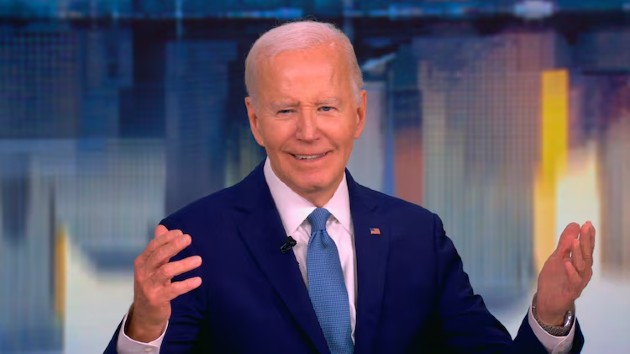
Former President Joe Biden appears on ABC News’ The View, May 8, 2025. Via ABC News.
(WASHINGTON) — Former President Joe Biden has reemerged into the public eye with two back-to-back sit-down interviews, sharing his diagnosis of the Democrats’ stinging election losses, defending his mental acuity, which was fiercely questioned at the end of his term, and all the while defining his version of his more than three-decades-long political legacy.
And while some Democrats say there is “a place for Joe Biden at the table,” others say it’s better for him to be out of the spotlight and that relitigating his campaign is stagnating the party.
Speaking to ABC’s “The View” on Thursday, Biden took responsibility for President Donald Trump’s historic return to the White House and pushed back on claims of cognitive decline in his final year in office. He also addressed his next steps, saying he was “getting squared away trying to figure out what the most significant and consequential role I can play, consistent with what I’ve done in the past.”
Part of that reflection will come in the form of a book that he said he is beginning to write now. But some Democrats are torn as to whether the book and a few media appearances are where they’d like his contributions to end.
Long-time allies of the former president told ABC News that they welcome Biden’s return and advocate for him to staunchly defend and define his reputation and accomplishments publicly.
“He has a responsibility and certainly the right to defend his record. Biden would be beyond crazy just to quietly let his record get misrepresented as it has been done all last week,” Democratic Rep. Jim Clyburn told ABC News. Clyburn said he was unable to watch Biden on “The View,” but was “glad” to see Biden out there.
Former Democratic National Committee Chair Jamie Harrison also said he was heartened by Biden’s recent appearances — another of which was with the BBC earlier this week.
“Seeing Joe Biden reminds me that our president can be a good, decent and honest leader. Reminds me that we have had presidents with slight majorities that have legislated to protect the environment, stabilized and grown the economy, created new jobs, reduced the cost of health care, invested in our infrastructure and respected our nation’s history. I will always be grateful to President Biden for his commitment to saving America in one of our darkest times,” said Harrison.
Veteran Democratic strategist Donna Brazile, former interim DNC chair, said she welcomed Biden back into the public square and pointed to Trump’s frequent invocation of the former president as a principal reason why Biden ought to respond.
Brazile, a current ABC News contributor, added that Biden stayed relatively quiet during Trump’s first 100 days in office this term, honoring an unwritten presidential tradition, and stressed that Biden deserves a platform.
“There’s a place for Joe Biden at the table, and we should acknowledge that,” Brazile said. “Just because you’re a former president doesn’t mean that you have to somehow or another disappear. Former presidents have every right to speak up.”
Brazile did have one concern: that the party would look to only one voice to take cues from in this period of rebuilding — a habit she said she finds unwise. Instead, Brazile said she hopes this becomes a time when a “new group of leaders” emerge.
Ken Martin, the current chair of the DNC, expressed gratitude for Biden in a statement to ABC: “No Democratic president has invested more in the Party’s infrastructure than Joe Biden, and I’m deeply grateful for the President’s service not only to our nation but his ongoing service to the Party.”
Jamie Selzler, a DNC member from North Dakota and former executive director of the state’s Democratic party, disagreed with some points Biden raised in his interview on “The View,” particularly that he could have prevailed over Trump.
Still Selzer along with other Democrats say that despite their breaks from Biden’s view of campaigns past, feel that he should be some part of the party’s future.
“We need more voices in this fight, not fewer, and President Biden’s voice is a welcome one,” Selzer said.
Other blocs of the party are far more critical, with some Democrats telling ABC News that they find the former president’s foray defensive and a misguided distraction.
One Democratic strategist said they believe Biden is mishandling his role and stagnating the party.
As long as the conversations revolve around Biden, the strategist, who has experience in Congress and presidential campaigns, said, “we cannot move forward as a country or a party.”
“He’s not really telling his own story. He’s just fighting with everyone else about their telling of his story,” the strategist said.
This strategist said they believe that Biden should follow in the less vocal post-White House footsteps of former presidents such as Barack Obama, George W. Bush and Bill Clinton. This person said Biden should focus his attention on his eventual presidential library and foundation.
“These first 100 days, these first six months, like this first calendar year, it’s all going to be political questions. You don’t have to answer those anymore. You actually shouldn’t be answering those anymore,” the strategist said of Biden. “Democrats talk a lot about how Donald Trump has ruined norms. Joe Biden is kind of ruining a lot of norms with how to be an ex-president right now.”
Senior Democratic strategist Sawyer Hackett told ABC News that while Biden is entitled to defend his legacy, relitigating campaign losses, or in his estimation, “rewriting political history,” is wholly unhelpful and stressed the party is in desperate need to move forward.
“The Democratic Party is working to claw itself out of the political wilderness we were left in under the stewardship of Joe Biden. It’s utterly delusional and extremely unhelpful for Biden to wax poetic about how he could have beaten Trump, given the dire straits he left our coalition in,” said Hackett.
To Hackett, Biden will best serve fellow Democrats from the wings.
“The most consequential role Biden can play is one off stage, far from the spotlight of domestic politics,” he said.
(WASHINGTON) — President Donald Trump offered some mixed messaging as Republicans put the final touches on their tax proposal, saying Friday that he would support raising taxes on the wealthiest Americans to help pay for his sweeping legislative agenda while adding in the same breath his belief that Republicans “should probably not do it.”
“The problem with even a ‘TINY’ tax increase for the RICH, which I and all others would graciously accept in order to help the lower and middle income workers, is that the Radical Left Democrat Lunatics would go around screaming, ‘Read my lips,’ the fabled Quote by George Bush the Elder that is said to have cost him the Election. NO, Ross Perot cost him the Election! In any event, Republicans should probably not do it, but I’m OK if they do!!!” Trump wrote in a post on his social media platform.
White House Press Secretary Karoline Leavitt called Trump’s position on raising taxes for the rich “very honorable” during Friday’s White House press briefing.
“The president himself has said he wouldn’t mind paying a little bit more to help the poor and the middle class and the working class in this country,” Leavitt said. “These negotiations are ongoing on Capitol Hill and the president will weigh in when he feels necessary.”
The ambiguous presidential declaration has thrown negotiators into a frantic scramble — with the House Ways and Means committee expected to mark up their legislation next week.
The inclusion of a tax hike in the “big, beautiful bill” would be a major reversal for House GOP leaders, who have argued that allowing the current tax rates to expire would amount to a tax increase.
“I’m not in favor of raising the tax rates because that’s — our party is the group that stands against that, traditionally,” Speaker Mike Johnson said in an interview on Fox News in late April.
During his acceptance speech at the Republican National Convention in 1992, incumbent President George H.W. Bush uttered the infamous line, “read my lips: no new taxes.” Voters ultimately rejected Bush at the ballot box after he broke his vow and signed legislation crafted by congressional Democrats that increased tax revenues to address the growing budget deficit.
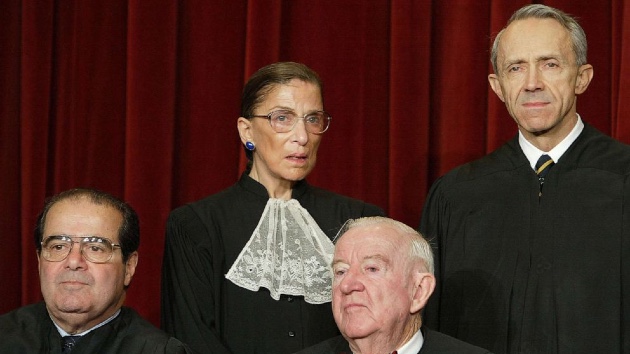
(L-R, Standing) Associate Justice Ruth Bader Ginsburg and Associate Justice David H. Souter, (L-R, Seated) Associate Justice Antonin Scalia and Associate Justice John Paul/ Mark Wilson/Getty Images
(WASHINGTON) — Former U.S. Supreme Court Justice David Souter, a lifelong public servant, judicial moderate and advocate for humanities and civics education, has died. He was 85 years old.
Chief Justice John G. Roberts Jr. said of Souter: “Justice David Souter served our Court with great distinction for nearly twenty years. He brought uncommon wisdom and kindness to a lifetime of public service. After retiring to his beloved New Hampshire in 2009, he continued to render significant service to our branch by sitting regularly on the Court of Appeals for the First Circuit for more than a decade. He will be greatly missed.”
Souter was nominated in 1990 by President George H.W. Bush, who praised him as “a remarkable judge of keen intellect and the highest ability.”
In more than 19 years on the bench, he authored notable opinions on abortion, religion and property rights.
His moderate positions surprised and disappointed many Republicans, who had hoped Souter would solidify as conservative the seat vacated by Justice William Brennan, a longtime leader of the court’s liberal wing.
Just five years after his appointment, the conservative Weekly Standard branded Souter a “stealth justice,” excoriating his position as “one of the staunchest liberals on the court.”
For many conservatives, Souter became a symbol of what future Republican presidents should avoid in a nominee.
His most controversial opinion came in 1992, jointly authored by Justices Sandra Day O’Connor and Anthony Kennedy, reaffirming the right to abortion under Roe v. Wade and creating an “undue burden” standard for judging state restrictions on the procedure.
“To overrule under fire, in the absence of the most compelling reason to re-examine a watershed decision, would subvert the Court’s legitimacy beyond any serious question,” the three justices wrote in Planned Parenthood v. Casey.
Souter’s defenders have long denied he was a secret liberal, emphasizing his respect for precedent and the philosophy of “originalism,” which emphasizes the historical meaning behind constitutional clauses and federal laws.
“The original meaning of conservatism was reluctance to embrace radical change,” Ernest Young, a former clerk of Souter’s and Duke law professor, told ABC News in 2009.
Souter, who was Episcopalian, was also known for advocating strict government neutrality in matters of religion and consistently opposing religious displays in public spaces.
During his confirmation hearing, he called it an “appalling fact” that Jewish children felt excluded when Christian prayers were recited in public schools.
In 2005, he authored a 5-4 decision blocking three Kentucky counties from displaying framed copies of the Ten Commandments in courthouses and public schools. He also voted against allowing organized prayers at high school graduation ceremonies and football games.
“He had no predisposed answer. He really relied on an analysis of [historical] materials to decide how he would come out in that case,” Stuart Benjamin, former clerk to Souter and Duke law professor, said in 2009.
Souter was one of four justices who strongly dissented from the 2000 decision in Bush v. Gore, which ended the contested Florida ballot recount and effectively handed the presidency to George W. Bush.
“To recount these manually would be a tall order, but before this Court stayed the effort to do that the courts of Florida were ready to do their best to get that job done,” Souter wrote. “There is no justification for denying the State the opportunity to try to count all disputed ballots now. I respectfully dissent.”
He was reportedly so distraught over the decision he contemplated resigning from the court, sources familiar with his thinking told Jeffrey Toobin, author of “The Nine, Inside the Secret World of the Supreme Court.” Some of the justice’s friends strongly rejected the notion.
In 2005, Souter joined the court’s more liberal members to expand the ability of local governments to seize private land for public use. His vote drew fierce protests and even prompted a ballot measure to seize his 200-year-old New Hampshire farmhouse as payback. It failed.
In testimony during his confirmation hearings, Souter also surprised conservatives with a robust defense of affirmative action. “There will be a need — and I am afraid for a longer time than we would like to say — a need for affirmative action which seeks out qualified people who have been discouraged by generations of societal discrimination from taking their place in the mainstream of America,” he said at the time.
Souter’s rejection of political ideology has been celebrated among his former clerks and friends.
“He was a classic frugal Yankee Republican,” former Souter clerk and Harvard law professor Rebecca Tushnet told ABC News in 2009.
“The Republican Party now has moved considerably to the right,” University of Pennsylvania law professor Kermit Roosevelt, who clerked for Souter in 1999 and 2000, told ABC News. “He doesn’t look like a modern Republican; he’s not a modern person in a lot of ways.”
Souter rarely spoke publicly about his jurisprudence, but when he did he pointedly rejected what he considered a simplistic approach to constitutional interpretation embraced by some of his Republican-appointed peers.
“Constitutional judging is not a mere combination of fair reading and simple facts,” Souter said in a 2010 commencement address at Harvard University.
“Judges have to choose between the good things that the Constitution approves, and when they do, they have to choose, not on the basis of measurement, but of meaning,” he added, rejecting the strict textualism endorsed by conservative icons Justice Clarence Thomas and the late Justice Antonin Scalia.
Retiring at just 69 years old, the never-married Souter quickly escaped Washington to return to his native New Hampshire and beloved two-centuries-old farmhouse.
To admirers, Souter brought a sense of compassion to the high court.
“He urged all judges to recognize the human aspect of their decisions, and to use all the power of their hearts and minds and beings to get their decisions right,” said Subra Suresh, former president of Carnegie Mellon University, where Souter spoke in October 2014.
Announcing Souter’s retirement in 2009, President Barack Obama hailed the justice as a “fair-minded and independent” judge who combined a “feverish work ethic” with a good sense of humor and integrity.
“He consistently defied labels and rejected absolutes, focusing instead on just one task — reaching a just result in the case that was before him,” said Obama, who later appointed Justice Sonia Sotomayor to fill his seat.
“He really was someone who saw himself as someone working in Washington but not being of Washington,” Meir Feder, one of Souter’s clerks from the 1990 term, told ABC News in 2009.
For years, he had shied from the Washington social scene when the court was not in session, retreating to the White Mountain woods where he loved to hike and read by the fire. Souter famously had no television or access to email.
“Far from being out of touch with the modern world, he has simply refused to surrender to it control over aspects of his own life that give him deep contentment,” said David McKean, former CEO of the John F. Kennedy Presidential Library Foundation, at a joint appearance with the retired justice in 2010.
Born in Massachusetts an only child, Souter spent most of his life in the rural town of Weare, New Hampshire. He enrolled in Harvard University as an undergraduate, studying philosophy, and later attended Oxford University as a Rhodes Scholar.
He returned to Boston to complete his law degree at Harvard, where he graduated in 1966. He quickly climbed the ranks of the legal world, rising to attorney general of New Hampshire and, later, associate judge in the state’s Supreme Court.
When Souter was plucked out of New Hampshire by President George H.W. Bush in 1990, he was little known outside of the state. The U.S. Senate confirmed Souter to the Supreme Court by a vote of 90-9.
“I loved my colleagues. I liked the work that I was doing. There were days when I wished things had turned out differently, but I still loved the court and just about everybody in that building,” Souter said in 2010, during a rare public appearance at the JFK Presidential Library. “But I feel liberated to do things that I couldn’t do on that court.”
For years after leaving the high court bench, Souter continued to be a judge, hearing more than 300 cases by designation for the 1st Circuit U.S. Court of Appeals in Boston and authoring dozens of opinions.
While he stayed largely out of the limelight, Souter spoke passionately about the need to bolster the humanities and civics education across America.
“I don’t believe there is any problem in American politics or American public life which is more significant today that the pervasive civic ignorance of the Constitution of the United States and the structure of government,” Souter said in a speech at the University of New Hampshire Law School in 2012.
“Some of the aspects of current American government that people on both sides find frustrating are in part a function of the inability of people to understand how government can and should function,” he said.
Asked in 2010 to name the most important part of the U.S. Constitution, Souter singled out the equal protection clause of the 14th Amendment.
“Ultimately, it is the golden rule,” he said. “Treat others the way you want to be treated with the corollary that if you don’t, you are not going to be treated that way either.”