

Johnson tries again to vote on Trump-backed budget blueprint after GOP hard-liners balked

Johnson tries again to vote on Trump-backed budget blueprint after GOP hard-liners balked
Andrew Harnik/Getty Images

(WASHINGTON) — House Speaker Mike Johnson on Thursday will try again to hold a vote on a budget blueprint to fund President Donald Trump’s agenda.

The House is expected to vote in the 10 a.m. hour on the measure, which was passed by the Senate last week.

“I’m happy to tell you that this morning, I believe we have the votes to finally adopt the budget resolution so we can move forward on President Trump’s very important agenda for the American people,” Johnson said at a news conference alongside Senate Majority Leader John Thune.

Johnson suffered a setback on Wednesday night when he was forced to scrap a planned vote due to opposition from a small group of Republican hardliners who are concerned the budget would add to the nation’s deficit.

Johnson said he had “very productive” deliberations with members on Wednesday night and on Thursday sought to highlight efforts to slash spending by more than a trillion dollars.

“We are committed to finding at least $1.5 trillion in savings for the American people while also preserving our essential programs,” Johnson said.

Thune seemed less enthusiastic about the target for deficit reduction but meekly endorsed the House’s lofty goal for budget savings — announcing the Senate’s ambition for fiscal sustainability is “aligned with the House.”

“We have got to do something to get the country on a more fiscally sustainable path and that entails us taking a hard scrub of our government, figuring out where we can find those savings,” Thune said. “The speaker has talked about $1.5 trillion. We have a lot of United States senators who believe that is a minimum and we’re going to do everything we can to be as aggressive as possible.”

President Donald Trump, who has been personally involved in trying to get the measure adopted, weighed in on Thursday morning that Republicans were “getting close.”

“‘The Big, Beautiful Bill’ is coming along really well. Republicans are working together nicely. Biggest Tax Cuts in USA History!!!,” Trump wrote in a post to his conservative social media platform

Johnson faces a short window to get the measure over the finish line before the House is slated to go on its two-week April recess.

The speaker can only afford to have only three defections from his caucus with all members voting and present.

House GOP leaders have scrambled for the past week to lock down the votes, after more than 20 Republicans expressed concern that the Senate’s resolution set a floor of just $4 billion in savings. Now, Johnson says he has the support needed.

“Our aim is to deliver on our promises,” Johnson said.

ABC News’ Alexandra Hutzler contributed to this report.

Copyright © 2025, ABC Audio. All rights reserved.
Democratic Party ‘doubling down’ on town hall meetings targeting Republican-held districts

Democratic Party ‘doubling down’ on town hall meetings targeting Republican-held districts
ABC News

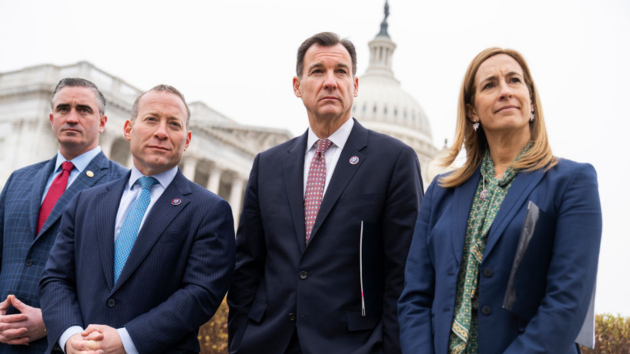
The Democratic National Committee — continuing its push to host town halls in Republican-held districts — is announcing a new set of town halls focused on the Republican-led budget bill and featuring high-profile officials such as Sen. Cory Booker, D-N.J., ABC News has learned exclusively.

These “People’s Town Halls,” which will be held during Congress’ two-week April recess that begins next week, comes as Democrats look to hammer Republicans and the White House and to reach out to voters over economic concerns and affordability.

The Democrats are focusing in large part on a budget blueprint that President Donald Trump has said will help his administration’s priorities, including tax cuts and border security investments.

But that bill has been criticized by Democrats as potentially leading to cuts to key programs Americans rely on, such as health care or food assistance, during a time of economic uncertainty.

“In both red and blue communities, people are sick and tired of Donald Trump and Elon Musk destroying the economy, threatening health care and Social Security, and making life worse for families,” DNC chair Ken Martin said in a statement.

“In April, we’re doubling down with leading Democratic voices joining even more town halls in key districts across the country. Republicans still want to pretend like their constituents don’t exist, but we believe Americans deserve to have their voices heard.”

Republicans have argued that the budget blueprint does not and will not threaten any benefits or entitlements, and Trump has said his administration will not cut or threaten Social Security benefits. Republicans have also pushed back against claims they are not hosting town halls, saying that they are continuing to host in-person events or are hearing from constituents by phone and virtually. Some members have faced fierce pushback from constituents at their events.

The Democratic Party town halls during the recess are set to feature high-profile congressional figures — including Booker, Connecticut Sen. Chris Murphy, Arizona Rep. Greg Stanton and Florida Rep. Maxwell Frost, according to the DNC.

Booker received heightened attention in early April after breaking a Congressional record, speaking for more than 24 hours in a marathon speech on the Senate floor protesting the national “crisis” he said President Donald Trump and key advisor Elon Musk had created.

“The Democratic Party is at its weakest when it’s concerned about the party. It’s at its strongest when it’s concerned about the people, when it’s bigger and broader than any narrow, political analysis,” Booker told ABC News’ “This Week” anchor George Stephanopoulos on Sunday.

The Democratic town halls will be held during the recess on April 13 in Arizona’s 6th District, on April 22 in Pennsylvania’s 8th District, on April 24 in Colorado’s 8th District and North Carolina’s 9th District, and on April 25 in Missouri’s 2nd District.

Two of those districts — Pennsylvania’s 8th, represented by Rep. Robert Bresnahan, and Colorado’s 8th, represented by Rep. Gabe Evans, were flipped by Republicans in the 2024 election.

North Carolina’s 9th District is represented by Rep. Richard Hudson, the chair of the National Republican Campaign Committee (NRCC). In March, Hudson encouraged House Republicans to do more virtual events instead of in-person town halls, although the NRCC said this was a suggestion to help members reach more constituents.

The Democrats’ new batch of town halls is also a joint effort between the DNC and two of its affiliates, the Democratic Congressional Campaign Committee (DCCC) and the Association of State Democratic Committees (ASDC).

“While vulnerable Republicans continue to run scared because they’re voting to raise costs, gut Medicaid, and threaten working families livelihoods, we’re going to make sure voters know they don’t have to wait until Election Day to hold them accountable,” DCCC chair Rep. Suzan DelBene, D-Wash., said in a statement.

According to the DNC, those three arms of the party have hosted 71 town halls in 35 states and territories in the past three weeks altogether, with tens of thousands of attendees overall.

ABC News’ Mariam Khan, Lauren Peller and Isabella Murray contributed to this report.

Copyright © 2025, ABC Audio. All rights reserved.

Ksenia Karelina, US ballet dancer, released from Russia in prisoner exchange

Ksenia Karelina, US ballet dancer, released from Russia in prisoner exchange
ABC News

LONDON — U.S.-Russian dual citizen Ksenia Karelina was released from Russian prison in an overnight prisoner exchange, Secretary of State Marco Rubio announced on Thursday.

The exchange took place overnight in Abu Dhabi in the United Arab Emirates. Karelina’s lawyer Mikhail Mushailov confirmed to ABC News that she had been released.

Secretary of State Marco Rubio confirmed the exchange in a tweet, writing, “American Ksenia Karelina is on a plane back home to the United States. She was wrongfully detained by Russia for over a year and President Trump secured her release.”

A U.S. official told ABC News that American and Russian intelligence agencies took the lead in negotiating the prisoner swap.

CIA Director John Ratcliffe said in a statement, “Today, President Trump brought home another wrongfully detained American from Russia. I’m proud of the CIA officers who worked tirelessly to support this effort and we appreciate the government of UAE for enabling the exchange.”

A CIA spokesperson told ABC News that “much of the swap was negotiated by the U.S. government, with CIA playing a key role engaging with Russian intelligence.”

“Through these engagements, CIA negotiated with Russia and worked closely with domestic and foreign partners, including the UAE, to carry out the exchange,” the spokesperson said. “We also collaborated closely with counterparts at agencies across the [U.S. government] to facilitate this exchange.”

Russia’s Federal Security Service also confirmed Karelina’s release, saying she had been pardoned via a decree from President Vladimir Putin. The FSB said the exchange was made at Abu Dhabi airport with the mediation of the UAE.

German-Russian citizen Artur Petrov — who was detained in Cyprus in 2023 at the request of the U.S. and later extradited — was exchanged for Karelina, the service said.

A Justice Department notice of his arrest said Petrov was accused of involvement in a scheme to procure U.S.-sourced microelectronics subject to export controls on behalf of a Russia-based supplier. The components were intended for manufacturers supplying weaponry and other equipment to the Russian military, the notice said.

A 2024 statement related to Petrov’s extradition to the U.S. said he was part of a network that secretly supplied Russia’s military industrial complex with “critical U.S. technology, including the same types of microelectronics recovered from Russian weapons on Ukrainian battlefields.”

Karelina — a ballet dancer — was serving a 12-year prison sentence in a penal colony, having been convicted of treason in August 2024. She was accused of organizing fundraisers for Ukraine’s military, attending pro-Ukraine rallies and posting social media messages against Russia’s war in Ukraine.

Her boyfriend, Chris Van Heerden, spoke to ABC News Live hours after her sentencing, saying she did nothing wrong. He said all she did was donate $50 to a Ukrainian charity.

This is a developing story. Please check back for updates.

ABC News’ Joe Simonetti, Cindy Smith, Tanya Stukalova and Shannon K. Kingston contributed to this report.

Copyright © 2025, ABC Audio. All rights reserved.
House GOP moves to prevent votes on rescinding Trump tariffs

House GOP moves to prevent votes on rescinding Trump tariffs
Andrew Harnik/Getty Images

(WASHINGTON) — House Republicans are exhausting all legislative tools to prevent future votes on repealing President Donald Trump’s tariffs — doubling down on their support for the administration’s policies.

GOP leaders on Wednesday inserted language into the “rule” for the budget blueprint that would prohibit the House, until at least September, from forcing a vote on legislation to rescind Trump’s national emergencies authority.

“The rule provides that each day during the period from April 9, 2025, through September 30, 2025, shall not constitute a calendar day for purposes of section 202 of the National Emergencies Act (50 U.S.C. 1622) with respect to a joint resolution terminating a national emergency declared by the President on April 2, 2025,” the rule states.

House Speaker Mike Johnson, R-La., defended the move, telling reporters, “I’ve made it very clear I think the president has executive authority. It’s an appropriate level of authority to deal with the unfair trade practices. That’s part of the role of the president is to negotiate with other countries.”

Johnson said Trump told him Tuesday night that “there are almost 70 countries that are [in] some stage in negotiation of more fair-trade agreement agreements with the United States. I think that is in the interest of the American people. I think that is an ‘America First’ policy that will be effective, and so we have to give them the space to do it.”

House Democrats, led by Rep. Gregory Meeks, D-N.Y., moved to force a vote on Tuesday on terminating the national emergency authority and blocking Trump’s sweeping tariffs. Now, that vote is unlikely to occur.

This is the second time Johnson has moved to stop the legislative calendar to prevent votes on Trump’s authority on tariffs. Under House rules, these votes would typically come up within 15 calendar days but now will not if the “rule” passes during the vote series Wednesday afternoon.

“I think you’ve got to give him the space,” Johnson argued on Trump’s tariffs. “It is having the desired effect right now. You see a number of nations going forward and proposing much more free trade agreements with the United States. The American people deserve that.”
 

Copyright © 2025, ABC Audio. All rights reserved.

DHS to screen social media of visa applicants for ‘antisemitic activity’

DHS to screen social media of visa applicants for ‘antisemitic activity’
Salwan Georges/The Washington Post via Getty Images

(WASHINGTON) — The Department of Homeland Security will begin screening visa applicants’ social media content for “antisemitic activity,” it announced on Wednesday.

“There is no room in the United States for the rest of the world’s terrorist sympathizers, and we are under no obligation to admit them or let them stay here,” Assistant Homeland Security Secretary for Public Affairs Tricia McLaughlin said. “Secretary [Kristi] Noem has made it clear that anyone who thinks they can come to America and hide behind the First Amendment to advocate for antisemitic violence and terrorism — think again. You are not welcome here.”

The directive from the department allows for U.S. Citizenship and Immigration Service to begin “considering” any antisemitic activity “immediately” when screening those applying for lawful permanent resident status, as well as foreign students and those affiliated with educational institutions linked to antisemitic activity.

USCIS will consider “social media content that indicates an alien endorsing, espousing, promoting, or supporting antisemitic terrorism, antisemitic terrorist organizations, or other antisemitic activity as a negative factor in any USCIS discretionary analysis when adjudicating immigration benefit requests,” according to a release from the agency.

Similar guidance was issued by the State Department in March.

A cable sent to consulates around the world called for a review of social media for foreign students and student exchange visitors and has directed visa denials if their applications for visas are inconsistent with their visa classifications.

“If the social media review uncovers potentially derogatory information indicating that the applicant may not be eligible for a visa, Fraud Prevention Units are required take screenshots of social media findings to the extent it is relevant to visa eligibility, to preserve the record against the applicants later alteration of the information,” per the cable, which was obtained by ABC News last month.

Secretary of State Marco Rubio said on March 28 that more than 300 visas had already been revoked under the criteria.

The cable also encouraged revocations based on perceived “hostile attitudes” toward U.S. culture or values and raised questions about whether this blurs the line between national security vetting and viewpoint discrimination.

Copyright © 2025, ABC Audio. All rights reserved.
DOJ, Coast Guard bust 45,000 pounds of cocaine tied to cartels

DOJ, Coast Guard bust 45,000 pounds of cocaine tied to cartels
ABC News

(WASHINGTON) — The Department of Justice and the U.S. Coast Guard busted 45,000 pounds of cocaine with a value of over $500 million, according to top DOJ officials on Wednesday.

Attorney General Pam Bondi and FBI Director Kash Patel were at Port Everglades in Florida on Wednesday and said the seizures of the drugs saved lives and protected the public.

“We have saved thousands and thousands of lives as a result of this incredible cooperation,” Bondi said. “We believe two cartels, CJNG and Sinaloa, were heavily tied to these shipments.”

She added that the Coast Guard used “drones, aircraft and ships to interdict the traffickers.”

Patel had a message for the cartels: There is new leadership throughout the DOJ.

“We are going to dismantle the ‘next-man-up’ theory that has been breeding in these Mexican cartels for generations,” Patel said of the Mexican drug cartels. “No more.”

The Coast Guard said the operation took 11 days for the crew of the Cutter James and that finding drug traffickers in their patrol area is like “finding a needle in a haystack.”

Bondi noted that 11 people were arrested in connection with the operation.

Patel said it was an interagency effort with Coast Guard, Department of Defense and DOJ assets at play.

U.S. Coast Guard Vice Adm. Nathan Moore told reporters that since February, the Coast Guard has seized over 59 metric tons of narcotics.

Copyright © 2025, ABC Audio. All rights reserved.

House Republicans tee up vote on Trump-backed budget blueprint despite hard-liner opposition

House Republicans tee up vote on Trump-backed budget blueprint despite hard-liner opposition
Tom Williams/CQ-Roll Call, Inc via Getty Images

(WASHINGTON) — House Republicans are plowing ahead with a vote on the Senate-approved GOP budget blueprint on Wednesday despite opposition from rank-and-file lawmakers.

Speaker Mike Johnson, R-La., with the help of President Donald Trump, will need to work to persuade nearly a dozen GOP holdouts to advance the legislation.

GOP leaders don’t have the votes right now. The speaker can only afford to lose three defections if all members are voting and present, and several GOP hard-liners from the House Freedom Caucus are likely to vote against the bill due to what they have said are concerns about how the plan would reduce the deficit.

If Johnson can pull off passing the legislation through the House in the face of likely drama on the House floor, he will deliver Trump a major win.

Trump posted Wednesday morning on his social media platform Truth Social that “it is more important now, than ever, that we pass THE ONE, BIG, BEAUTIFUL BILL. The USA will Soar like never before!!!”

The House will hold a vote at 3:30 p.m. on a “rule,” a procedure to advance legislation, which includes the budget blueprint. This will be a key test vote for Republicans.

If the rule vote passes, the House will vote on final passage of the budget blueprint at 5:30 p.m., requiring a simple majority.

Trump met with Johnson and several GOP hard-liners who have said they have concerns about the bill Tuesday afternoon in the Oval Office, though Reps. Ralph Norman, R-S.C., and Tim Burchett, R-Tenn., two likely no votes, said they were not invited.

Trump posted afterward that it was “a very good meeting.”

“I let them know that, I AM FOR MAJOR SPENDING CUTS! WE ARE GOING TO DO REDUCTIONS, hopefully in excess of $1 Trillion Dollars, all of which will go into ‘The One, Big, Beautiful Bill,'” he posted Tuesday night. “I, along with House Members and Senators, will be pushing very hard to get these large scale Spending Cuts done, but we must get the Bill approved NOW.”

Johnson, too, said he believed the meeting went well and that the president convinced the Republican holdouts to support the bill.

“A great meeting. The President was very helpful and engaged,” he said. “We have a lot of members’ whose questions were answered. We are making great progress right now.”

Reps. Chip Roy, R-Texas, Eli Crane, R-Ariz., Lloyd Smucker, R-Penn., Eric Burlison, R-Mo., Andy Biggs, R-Ariz., Keith Self, R-Texas, and Thomas Massie, R-Ky., were unlikely to support the bill, though it is unclear if they were convinced by the president to change their positions.

However, Roy said Tuesday that he still had concerns with the budget blueprint and will likely vote against the bill, telling reporters that the resolution has “enough” GOP objections to tank it.

“I’m not here for aspirations,” he posted on X. “The Senate’s bill does not add up – it’s all tax cuts with no spending cuts which = deficits.”

Trump made a final pitch to House Republicans while speaking at the National Republican Congressional Committee’s black-tie dinner Tuesday night.

“Just in case there are a couple of Republicans out there, you just got to get there,” Trump said. “Close your eyes and get there. It’s a phenomenal bill. Stop grandstanding. Just stop grandstanding.”

Copyright © 2025, ABC Audio. All rights reserved.
Acting IRS commissioner plans to resign after data-sharing deal with immigration authorities

Acting IRS commissioner plans to resign after data-sharing deal with immigration authorities
Kayla Bartkowski/Getty Images

(WASHIGTON) — The acting commissioner of the Internal Revenue Service is planning to resign following the agency’s data sharing agreement with the Department of Homeland Security to support the Trump administration’s efforts to deport undocumented immigrants, three sources familiar with her plans told ABC News.

Melanie Krause is the third leader of the agency to resign this year; Senate-confirmed Commissioner Danny Werfel resigned from his role on Inauguration Day, less than two years into his five-year term.

One month later, acting commissioner Doug O’Donnell, who spent nearly four decades at the IRS, retired amid concerns about the Trump administration’s management of the agency.

A Treasury Department spokesperson also confirmed Krause’s plans to leave the agency in a statement to ABC News.

“Melanie Krause has been leading the IRS through a time of extraordinary change. As we focus on IT modernization and re-organize the agency to better serve the taxpayer, we are also in the midst of breaking down data silos that for too long have stood in the way of identifying waste, fraud, and abuse and bringing criminals to justice. We believe these goals are critical to a more efficient government and safer country. We wish Melanie well on her next endeavor,” the spokesperson said.

Krause did not respond to a request to comment from ABC News.

Other senior agency officials are considering leaving the agency following the new data sharing agreement and are concerned about its legality.

Some found out about its finalization, after weeks of negotiations, only after it was reported by Fox News Tuesday morning, sources told ABC News.

“People at the IRS have a strong sense of pride in tax administration and protecting taxpayer rights, and everything happening isn’t aligned [with that],” one source told ABC News.

Treasury Secretary Scott Bessent signed the agreement with DHS on behalf of the IRS, according to the redacted copy of the deal included in a court filing.

Section 6103 of the federal tax code requires the IRS keep individual taxpayer information confidential with certain limited exceptions, including with law enforcement agencies “for investigation and prosecution of non-tax criminal laws” with approval from a court, according to the agency’s website.

Current and former agency officials also worry the new policy could impact tax collections and discourage undocumented immigrant workers who do pay taxes for a variety of reasons.

The agency has said it will continue to protect the privacy of taxpayer data under the new agreement.

Copyright © 2025, ABC Audio. All rights reserved.
State Department says talks with Iran are not a negotiation, will be direct

State Department says talks with Iran are not a negotiation, will be direct
Yasin Ozturk/Anadolu via Getty Images

(WASHINGTON) — Ahead of expected talks between the United States and Iran over the weekend, the State Department pushed back on the idea that the discussion would be a negotiation over Tehran’s nuclear program.

“This is a meeting that’s happening, right? On Saturday, there’s a meeting. There’s no negotiations,” State Department spokeswoman Tammy Bruce told reporters on Tuesday.

“This is a dynamic where the president has made very clear and certainly the secretary has made very clear that Iran will never have a nuclear weapon,” she said. “It’s touching base, yes. Again, it’s not a negotiation. It’s a meeting.”

However, Bruce and White House press secretary Karoline Leavitt both emphasized that President Donald Trump is seeking to cut a deal with Tehran.

“When it comes to Iran, the president has reimposed crippling sanctions on the Iranian regime, and he’s made it very clear to Iran they have a choice to make: You can strike a deal with the president, you can negotiate, or there will be hell to pay,” Leavitt said.

Bruce confirmed that Steve Witkoff, the special envoy to the Middle East, will represent the Trump administration during the session. But beyond that, both the White House and the State Department have been tight-lipped concerning details about the planned talks, which Trump announced during an Oval Office meeting with Israeli Prime Minister Benjamin Netanyahu on Monday.

Trump also asserted that the U.S. was already conducting direct diplomacy with Iran for the first time since 2018, when he exited an Obama-era nuclear deal with the country.

“We’re having direct talks with Iran, and they’ve started. It’ll go on Saturday. We have a very big meeting, and we’ll see what can happen,” Trump said.

Iranian Foreign Minister Abbas Araghchi later posted on X that the meeting Trump referenced would take place in Oman and that talks would be “indirect high-level talks.”

“It is as much an opportunity as it is a test,” Araghchi said.

On Tuesday, the White House and the State Department stood by the president’s initial description of the forthcoming conversations and rejected Iran’s characterization of the talks as indirect.

“That’s nice for the Iranians,” Bruce said of Araghchi’s comments. “I would refer back to the president of the United States, President Donald John Trump.”

Copyright © 2025, ABC Audio. All rights reserved.

Texas governor under fire after pushing special election to November

Texas governor under fire after pushing special election to November
Chip Somodevilla/Getty Images

(AUSTIN, TX) — Texas Gov. Greg Abbott announced in a proclamation Monday afternoon that the special election to fill the seat vacated following the death of Rep. Sylvester Turner, D-Texas, for the rest of his term will be held on Tuesday, Nov. 4, concurrent with Election Day.

But Democrats are arguing he is trying to keep the seat open as long as possible because of Republicans’ slim majority in the House.

Republicans have 220 seats to Democrats’ 213, and the special election would most likely install a new Democrat in the seat, given the district’s Democratic lean, cutting back on the GOP majority.

In a statement, Abbott blamed Harris County, where the district is located, for election administration issues, saying that is why he had to schedule the election for November.

“Forcing Harris County to rush this special election on weeks’ notice would harm the interests of voters. The appropriate time to hold this election is November, which will give Harris County sufficient time to prepare for such an important election,” Abbott wrote.

Abbott gave that reasoning in a recent local interview as well, telling local station KXAN on Thursday that the county will “need to have adequate time to operate a fair and accurate election, not a crazy election like what they conducted in the past.”

State audits found that Harris County had issues with administering elections in 2021 and 2022, according to Votebeat. Those issues included not properly training election workers and not issuing enough ballot paper at various places. But the county has also been a target for unfounded theories or allegations about elections.

However, Harris County Clerk Teneshia Hudspeth noted in a statement on Friday that the county has successfully run eight elections since election administration duties were given to the Harris County Clerk’s Office in September 2023 and said the county is prepared to run the special election.

House Minority Leader Hakeem Jeffries, D-N.Y., said on Monday afternoon that an announcement is “forthcoming” on litigation over filling the seat.

“The Republicans are on the run on the economy … and they’re on the run legislatively, which is why Gov. Abbott is conspiring with House Republicans to rig the system and not call a special election,” Jeffries said at a news conference in the U.S. Capitol.

In a later statement on Monday after Abbott announced the date, Jeffries said House Democrats are still considering legal action. The Texas Democratic Party has also threatened to file a lawsuit.

A spokesperson for Abbott’s office, when asked on Monday by ABC News about the governor’s response to Democratic allegations about margins in the House and the allegation that Abbott is following President Donald Trump’s or Republicans’ direction, pointed to Abbott’s comments from the local news interview, without elaborating.

The spokesperson did not address how Abbott might respond to any litigation.

Abbott’s announcement means the congressional seat will be vacant for about eight months since Turner’s passing in March, if the new date holds.

Sawyer Hackett, a Democratic strategist who works for various Texas Democratic clients, told ABC News on Monday that the seat vacancy comes “at a time when people absolutely need their congressional representation” as the Trump administration implements sweeping tariffs and cuts to the federal government.

From a legal standpoint, however, Texas state law appears to give the governor wide latitude to choose when to set special elections.

Joshua Blank, the research director of the Texas Politics Project at the University of Texas, Austin, told ABC News on Tuesday that the amount of time the seat will remain vacant in this case is much longer than previous occurrences in 2018 and 2021, when Abbott also called special elections to fill vacancies.

But Blank pointed out that Abbott, a former state attorney general and state Supreme Court justice, is likely sure he is on solid legal ground: “Gov. Abbott doesn’t seek out lawsuits against him. He was a sophisticated legal operator before he became a sophisticated politician and a sophisticated governor, and that really suffuses his politics and his approach.”

Chad Wilbanks, a Republican strategist and former Texas GOP executive director, told ABC News on Friday, “The governor is the sole authority of calling the special election for when he wants.”

“Democrats at the state and federal level support boys playing in girls sports, they support open borders and drags shows in public libraries,” he added, referring to LGBT and immigration issues. “There is no urgency because of their policies that Texans oppose.”

Copyright © 2025, ABC Audio. All rights reserved.