Sen. Darline Graham Nordone participates in a a ceremonial swearing-in at the U.S. Capitol, July 14, 2026, in Washington. (Finn Gomez/Getty Images)
(WASHINGTON) — Sen. Darline Graham, the sister of the late Republican Sen. Lindsey Graham, confirmed in an interview with Fox News that aired Monday she will run for the seat for a full term, in addition to serving out the rest of Lindsey Graham’s unfinished one.
“I’ve been praying a lot, talking to my family. But with the love of my family, with the support of his staff — I know I’m a hard worker. I learned that from Lindsey. He cared about the people of this state. I’ve worked for almost 30 years for the people of this state,” she said in the interview.
“I feel like I can do it,” she continued. “I feel an inner peace about it. Will it be difficult? Yes, absolutely.”
Asked by Fox News anchor Sean Hannity if she’s inclined to get into the race or if she’s made a final decision, Darline Graham said, “I’ve made a decision.”
“You’re in?” Hannity asked, to which she responded, “I’m in.”
Darline Graham was appointed by South Carolina Gov. Henry McMaster to finish the final few months of her brother’s current term, which expires in January. She was sworn in last week at the Capitol.
The late Sen. Lindsey Graham’s spot on the November general election ballot for a full six-year term is being filled by a special Republican primary election set for August 11. Filing for candidates for the primary opens on Tuesday and closes on July 28.
Republican Reps. Ralph Norman and Russell Fry of South Carolina have already launched campaigns, as has businessman Mark Lynch, who ran against Lindsey Graham in the state’s regular June primary.
But on Friday, President Donald Trump endorsed Darline Graham, encouraging her to run for the seat and writing, “There would be nobody better to honor the legacy of her beloved brother, Lindsey.”
Darline Graham served as a commissioner on the South Carolina Commission for the Blind and has worked in other state roles, including in roles where she worked with individuals with disabilities.
Darline Graham has spoken about how her brother took care of her after both of their parents passed away when they were young.
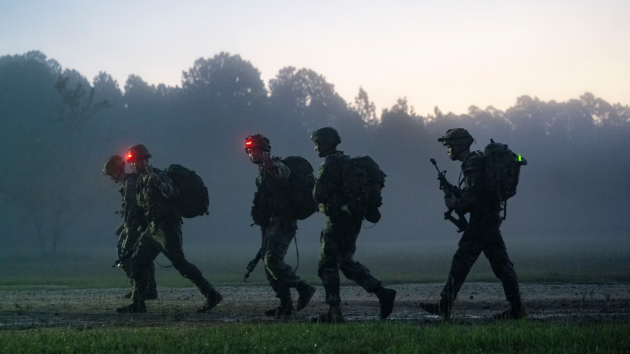
Paratroopers assigned to the 82nd Airborne Division, walk the final mile of the 12-mile ruck march during E3B on Fort Liberty, North Carolina, Sept. 21, 2024. (U.S. Army)
(WASHINGTON) — Senate Democrats are pressing Defense Secretary Pete Hegseth for answers about his directive requiring the military to measure troops’ testosterone levels, seeking details on how the policy will be carried out amid concerns over how it will apply to women and whether it could inadvertently encourage service members to self-medicate with potentially dangerous supplements.
In a letter to Hegseth, Sens. Richard Blumenthal of Connecticut, Mazie Hirono of Hawaii, Gary Peters of Michigan, Elizabeth Warren of Massachusetts and Ruben Gallego of Arizona said the Pentagon has provided little explanation for the new requirement, raising questions about its scientific basis, cost and potential consequences.
“The Department has provided no evidence that this sweeping new policy will improve force readiness or health, nor has it explained the scientific basis, costs, or risks associated with implementing it across the force,” the senators wrote.
Last week, Hegseth directed the military to begin screening testosterone levels for all service members, including women, age 30 and older as part of their annual physical health assessments, expanding routine exams that have traditionally focused on baseline health measures such as vision, hearing and other standard medical screenings. Troops under 30 may opt into testing voluntarily, and any recommendation for testosterone replacement therapy, or TRT, would also be voluntary for all ages.
The policy has yet to be formally implemented, thus the specifics have not yet been figured out and it remains unclear when service members will begin undergoing testosterone screenings as part of their annual health assessments, though Hegseth directed a plan be ironed out by Aug. 15.
The cost is also unknown and the Defense Department could require additional medical personnel to be hired for the screenings at routine annual exams.
The move comes as a broader focus on fitness has been core to Hegseth’s tenure — an unusual move for a role traditionally focused on large operations and the macro workings for the Pentagon — which includes regular videos from the Pentagon of Hegseth working out with troops.
Hegseth has directed the services to adjust their fitness tests and reassess body-fat standards, including new measurement methods introduced earlier this month. The Army has also begun integrating gender-neutral fitness requirements for soldiers serving in ground combat roles.
Among the unresolved questions are whether service members could face administrative consequences if their testosterone levels fall below a threshold the Pentagon has yet to define and how the policy will apply to women.
“Coupled with the Department’s recent repeated efforts to redefine military culture around an exaggerated conception of masculinity, this initiative risks undermining years of work to ensure that women service members are evaluated and valued based solely on their ability to perform the mission,” the senators wrote.
Some welcomed the expanded access to testosterone screening and treatment, arguing that obtaining testosterone replacement therapy through Tricare, the military’s health insurance program, can be cumbersome. But others warned the policy could create unintended incentives for troops to use unregulated supplements or anabolic steroids to avoid being flagged for potential health issues, while raising concerns about embarrassment for those found to have low testosterone.
“I think this is a great idea on paper, but we need to be careful about how it’s implemented,” said one official who works in fitness coaching and spoke on the condition of anonymity because they were not authorized to speak to the media.
Low testosterone has long been a concern in some parts of the military, particularly within the special operations community, where prolonged stress, intense physical demands and inadequate caloric intake are believed to contribute to lower hormone levels, though there’s little detailed research on the subject.
At the same time, testosterone replacement therapy, or TRT, has surged in popularity across podcasts, social media and the broader wellness industry, where it is often promoted as a way to boost energy, muscle mass and overall vitality. Medical experts caution, however, that clinically low testosterone is relatively uncommon.
Testosterone deficiency affects roughly 2% of men, according to the American Urological Association, and physicians have warned that the growing popularity of TRT has created the misleading impression that the condition is far more widespread than medical evidence suggests.
Moreover, factors such as insufficient sleep and poor nutrition can contribute to lower testosterone levels, studiesshow, two issues the military has long struggled to address.
Nutrition, in particular, has been a persistent challenge across the services, with troops often reporting inconsistent access to high-quality, protein-rich meals. Military dining facilities have faced criticism for menus heavy on fried foods and carbohydrates, sugar, limited portions and operating hours that do not always align with the schedules of service members working long or irregular shifts.
“It’s a readiness, retention, recruiting and long-term health issue,” Rob Evans, an Army veteran whose app Hots & Cots collects reviews from service members on housing and food on military bases, told ABC News about issues with nutrition on military facilities.
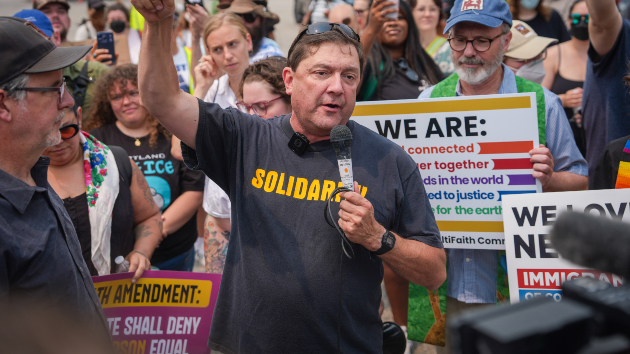
Troy Jackson, Democratic candidate for U.S. Senate, speaks during a demonstration outside of a federal immigration office after a man was fatally shot by U.S. Immigration and Customs Enforcement (ICE) agents, on July 14, 2026 in Scarborough, Maine. (Ryan Murphy/Getty Images)
(WASHINGTON) — Former Maine Senate President Troy Jackson appears all but certain to replace Graham Platner as the Democratic nominee for Senate in the party’s bid to unseat Republican incumbent Susan Collins this November.
Jackson’s campaign said Monday that “it is turning its full focus toward defeating Senator Susan Collins,” citing a “decisive advantage” during recent county-level caucuses.
Jackson, who comes from a logging family not far from the Quebec border, is a familiar face to Maine voters due to his history of activism and his lengthy background as a state lawmaker in Augusta.
His campaign’s statement also came after an eventful Sunday for Maine politics as four other Democrats dropped out of the running: Dan Kleban, Shenna Bellows and Nirav Shah and Jordan Wood.
“We are suspending our campaign tonight. This is the conclusion of the caucuses and letting this process play out,” Wood, the former chief of staff to Katie Porter when she served as a congresswoman representing California, said in a selfie-style video posted to social media on Sunday evening.
“I’m so proud to endorse my friend Troy Jackson. I didn’t know Troy until over a year ago when I decided to run for office for the first time, but he has become a friend, someone I trust, someone that I know represents and will serve all people in Maine,” Wood added.
Shah and Kleban, like Wood, also endorsed Jackson. Bellows did not mention Jackson when suspending her Senate campaign.
Maine Democrats held county-level nomination meetings over the weekend in order to select delegates ahead of their party’s Senate nominating convention set for this coming Saturday, July 25.
While the Maine Democratic Party’s website lists that eight candidates remain in the race to replace Platner, including former primary candidate David Costello and activist Ashley Webb, delegates who expressed support for Jackson received overwhelming support at the nomination meetings and the candidates who withdrew Sunday were previously viewed as Jackson’s main rivals.
Jackson’s campaign said that 481 of 500 county delegates support his candidacy. A total of 601 delegates will participate in the July 25 convention, with the additional 101 delegates being members of the Maine Democratic State Committee.
Just over six weeks ago, Jackson stood in front of a crowd in a Bar Harbor theater to ask Mainers to support his own bid for governor (a race he lost) and to vote for Platner in the Democratic Senate primary.
But after Platner was accused earlier this month of sexual assault by a former girlfriend, an allegation he’s denied, Jackson joined calls for him to exit the race. Platner formally withdrew his candidacy on July 10.
Now, in nearly a week, Maine voters should know for certain whether Jackson will officially be the Democrats’ pick to try to flip the high-profile Senate seat.
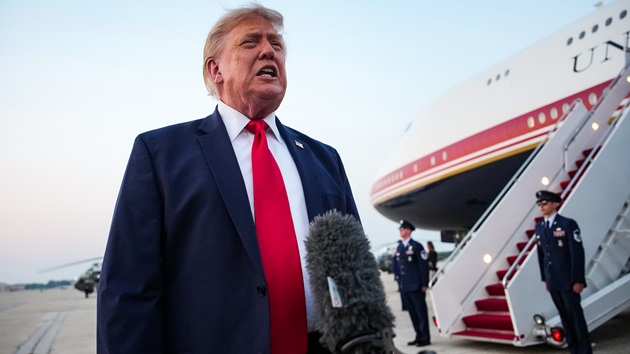
US President Donald Trump speaks to reporters after landing in Air Force One on July 19, 2026 in Joint Base Andrews, Maryland. (Andrew Harnik/Getty Images)
(WASHINGTON) — The new Air Force One will be “maxed out” with security features, undergoing an upgrade that’s expected to put the Qatari-gifted jet out of commission for about a month, President Donald Trump said on Sunday.
“Well, it has, it has a lot, and you know it has a lot of capability, but as I understand it, in about a month or so, they’re going to send it to have it be maxed out,” the president said of the newly retrofitted jet. “So they’re going to be sending it, and they’ll have it be maxed out.”
The jet had faced security concerns in the weeks since its first operational flight on July 1, when Trump flew on it to North Dakota. The plane, a Boeing 747-8 that was gifted from Qatar, later carried Trump to the NATO summit in Turkey this month.
As Trump prepared to depart the summit, the Secret Service urged the president to take the older Air Force One jet as a precaution, due in part for the differences in security capabilities, ABC News learned at the time.
The New York Times reported that the new jet did not have the same anti-missile capabilities as the previous model. Trump’s comment on Sunday followed a reporter’s question about those claims, which ABC News has not independently confirmed.
“Mr. President, this plane does not have antimissile defense systems on it,” the reporter asked. “Why are you flying on it?”
Trump in response said the plane would be “maxed out,” a process that he expected would “take about a month.” The president did not detail exactly when the upgrades were expected to begin.
The Qatari royal family’s donation of the luxury jet valued at approximately $400 million, an unprecedented foreign gift, raised questions from some lawmakers and ethics experts. Ahead of his first flight, Trump gave credit to the Qatari government.
“Frankly, we couldn’t build a plane like this because we wouldn’t be willing to spend the kind of money necessary,” he said on July 1. “They spent top dollar.”
“I said to Boeing, ‘What’s the best one?’ They said this is the best plane ever built, and you’re going to have the privilege of flying it, and I have a privilege also of flying it,” Trump said that day.
The U.S. Air Force said it had been modifying the jet Texas since September to meet the security, communications and other needs to transport the president.
The Air Force last year originally estimated it would cost less than $400 million to retrofit the gift, though it’s unclear how much exactly has been spent so far. Many of the details of the retrofitting on the new plane are considered classified.
The gifted plane is expected to be used as the new Air Force One until shortly before Trump leaves office, at which time ownership of the plane will be transferred to the Donald J. Trump Presidential Library Foundation, sources familiar with the proposed arrangement have told ABC News.
ABC News’ Emily Chang, Sarah Kolinovsky and Michelle Stoddart contributed to this report.
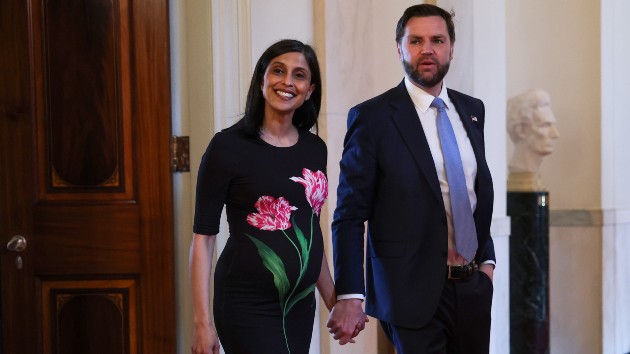
Second lady Usha Vance and U.S. Vice President JD Vance arrive for a military mothers celebration in the East Room of the White House on May 6, 2026 in Washington, DC. President Trump and the first lady honored America’s military mothers at the event ahead of Mother’s Day. (Photo by Anna Moneymaker/Getty Images)
(WASHINGTON) — Vice President JD Vance announced on Sunday that second lady Usha Vance gave birth to the couple’s fourth child, a son named Alec Neel Vance.
Vance said both Usha and the baby “are happy and healthy” and thanked the medical teams at Walter Reed National Military Medical Center and the White House Medical Unit.
“We are excited to announce that our baby boy, Alec Neel Vance, was born this morning. Usha and the baby are happy and healthy, and our kids are overjoyed to meet their little brother,” the vice president wrote on X.
JD and Usha Vance share three other young children: Ewan, Vivek and Mirabel.
The couple announced they were expecting their fourth child in January, writing on social media, “Our family is growing!” They met while studying at Yale Law School and got married in 2014.
The vice president often speaks about his family and marriage, and has been a leading voice in the Trump administration’s efforts to encourage the public to have more children.
“I want more babies in the United States of America. I want more happy children in our country, and I want — and I want beautiful young men and women who are eager to welcome them into the world and eager to raise them,” Vance said in one of the first speeches of his vice presidential term at the March for Life event in Washington last year.
“And it is the task of our government to make it easier for young moms and dads to afford to have kids, to bring them into the world and to welcome them as the blessings that we know they are here at the March for Life,” he added at the time.
In June, Usha Vance sat down with ABC News Live Prime anchor Linsey Davis for a wide-ranging interview. The second lady shared her thoughts about her husband’s political future and the biggest surprise she learned about President Donald Trump.
When asked whether she would like to see JD Vance as president one day, Usha Vance said, “I am not a particularly politically ambitious person; I would like to see him happy. I would like to see him making contributions that matter and whatever form that takes is a form that I’ll be supportive of,” she said.
The second lady said that the biggest surprise to her, as she’s gotten to know President Trump, has been his sense of humor and his gentleness toward children.
“He has a really good sense of humor and has a sort of gentleness towards his children, towards other people’s families and children,” she said. “It shows a lot of caring about what they’re going through and what is happening in their lives.”
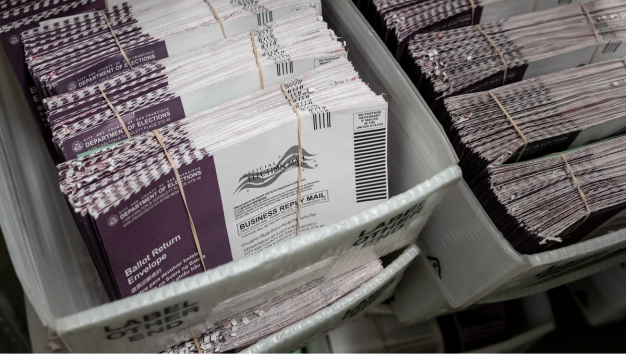
Mail-in ballots following a primary election at San Francisco County’s election operations facility at City Hall in San Francisco, California, US, on Tuesday, June 9, 2026. (David Paul Morris/Bloomberg via Getty Images)
(NEW YORK) — A federal appeals court in Washington, D.C., handed the Trump administration a temporary win on Friday in its attempt to increase federal oversight of elections.
In a unanimous ruling, a three-judge panel of the D.C. Circuit Court of Appeals put on hold a lower court ruling, which had blocked the U.S. Postal Service from attempting to restrict mail-in voting.
However, the Trump administration does not yet have a green light to move forward with the proposed rule. A separate judge in Massachusetts blocked the policy last month, and that injunction still stands.
The cases center on a proposed rule from the U.S. Postal Service that sought to compel states to create lists of approved voters, as well as impose stricter regulations on mail-in ballots.
Last month, Postmaster General David Steiner told the Senate Homeland Security and Governmental Affairs Committee that under the proposed rule, the Postal Service would refuse to deliver mail-in ballots in states that do not turn over their voter lists.
“Yes or no — if a state refuses to turn their absentee voter list over to the federal government, will the Postal Service still mail their ballots under this proposed rule?” asked Sen. Gary Peters, D-Mich.
“Under our proposed regulation, no. We would tell the state that we need the manifest,” Steiner said.
The NAACP, which brought the lawsuit, had previously sued the Postal Service in 2020, seeking to challenge delays in delivering mail-in ballots heading into that year’s presidential election. The two sides settled in 2021, with the Postal Service agreeing to “prioritiz[e] . . . the timely delivery of Election Mail” for every national election through 2028.
In Friday’s ruling, the appeals court said the Trump administration is likely to succeed because the lawsuit is premature — since the rule itself is not yet finalized — and not covered by a 2021 settlement between the NAACP and Postal Service.
The appeals court also said the Trump administration demonstrated they would be irreparably harmed if the Postal Service can’t finalize and implement the rule in time for the midterms.
“In this context, ‘there can be no do over’ once the election occurs,” the ruling said.
While the Trump administration cannot yet move forward with the new rule, the D.C. Circuit’s ruling signals that the Trump administration may be able convince other appeals courts to let them implement the policy while the lawsuits move through the courts — potentially past the November elections.
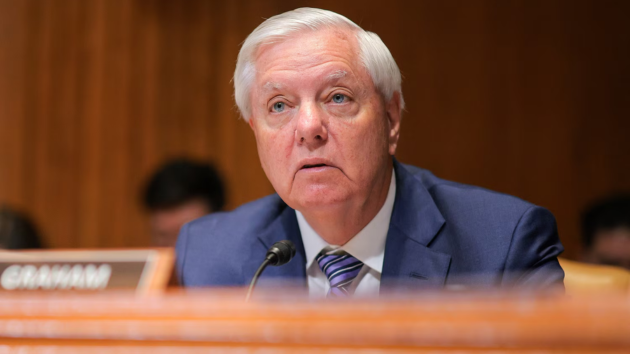
Sen. Lindsey Graham speaks during a Senate Appropriations Committee hearing on the FY2027 budget request on Capitol Hill on May 12, 2026, in Washington. Chip Somodevilla/Getty Images
(WASHINGTON) — The late Sen. Lindsey Graham will be honored later this month with separate services in Washington, D.C. and South Carolina, after the Republican died unexpectedly on July 11.
Graham’s office announced Friday that the senator’s life and legacy will be celebrated Tuesday, July 28 in Washington before separate services Wednesday, July 29 in South Carolina: Columbia, the state’s capital, and Pickens County, where Graham grew up and part of the district Graham represented.
While Graham’s office did not announce a location for the service in Washington, congressional sources told ABC News that the event is being held at the Washington National Cathedral. Graham’s office said that additional details regarding the services are forthcoming.
It’s not yet clear whether President Donald Trump will attend or have a role in the services.
Graham, a Trump ally who died serving in his fifth term in the Senate, was born in Central, South Carolina, in 1955. He graduated from Daniel High School in Central in 1973, according to his congressional biography.
Darline Graham, Lindsey Graham’s sister, was sworn in to the Senate on Tuesday after she was appointed by South Carolina Gov. Henry McMaster just days after her brother’s death. Trump supported her appointment, calling it a “fabulous tribute” to Lindsey Graham, who at a young age became Darline Graham’s legal guardian after the deaths of their parents.
On Friday, Trump called on Darline Graham to run in the upcoming special primary election for Senate in South Carolina, which would set her up to potentially fill the seat of her late brother in a more permanent way.
Darline Graham has not yet announced whether she intends to run for the seat for the full term. A source involved with South Carolina politics told ABC News on Friday that she has been having conversations about running in the special election.
ABC News has reached out to Darline Graham’s office, but did not immediately hear back.
Darline Graham, who lives in Lexington, South Carolina, has served since 2019 as commissioner of the South Carolina Commission for the Blind. She also serves on the South Carolina State Workforce Development Board and is president-elect of the National Council of State Agencies for the Blind.
She also previously held roles with Clemson University, the South Carolina Department of Employment and Workforce and the South Carolina Department of Vocational Rehabilitation, the governor’s office said.
A special-election primary is scheduled for Aug. 11 to determine a Republican candidate for the Nov. 3 general election ballot — though a runoff could occur two weeks later if no candidate secures an absolute majority of votes.
Democratic Senate candidate James Talarico speaks during a “Talarico for Texas: Frontera Tour” campaign rally at the La Posada facility, July 14, 2026, in Laredo, Texas. Brandon Bell/Getty Images
(WASHINGTON) — Democrats raised more money than their Republican opponents in key Senate races across the country in the second quarter, according to campaign finance filings made this week to the Federal Election Commission.
In Georgia, Democratic Sen. Jon Ossoff raised almost ten times what Republican Rep. Mike Collins did. In Ohio, Democrat Sherrod Brown outraised Republican Sen. Jon Husted by roughly $10 million. In Texas, Democrat James Talarico outraised Republican Ken Paxton by over $26 million.
Talarico’s haul marks a new record for second quarter fundraising, far surpassing other Democrats who previously pursued Senate seats in Texas.
At this point in Beto O’Rourke’s 2018 campaign, O’Rourke had raised a grand total of just under $24 million since the start of the election cycle. MJ Hegar had raised $6.6 million in 2020, and Colin Allred had raised over $38 million in 2024. All three of those Democratic candidates ultimately lost their general election fights.
Talarico has raised nearly $69 million this cycle, and the candidate still has over $21 million to spend. Lone Star Rising, a super PAC that supports Talarico, raised $12.7 million in the second quarter, most of it from LinkedIn co-founder Reid Hoffman.
Talarico’s opponent, Paxton, who is currently serving as the state’s attorney general, raised $2.2 million in the second quarter and has around $1.8 million in the bank, according to filings.
Lone Star Liberty, a super PAC that supports Paxton, raised about $4.3 million. They have about $35,000 cash on hand.
Republican PACs remain well-stocked, and Elon Musk contributions grow
Still, there are reasons for Republicans to be optimistic as the general election approaches.
In some cases, Republicans still have more money saved. Alaska Democrat Mary Peltola outraised her opponent, Republican Dan Sullivan, by nearly $5 million. But Sullivan spent little (under $1 million) in the second quarter, and still has more than $8 million on hand, according to FEC filings. That puts him $1 million ahead of Peltola.
Republican super PACs and party committees are also well-resourced. The Senate Leadership Fund, a flagship Republican super PAC affiliated with Senate Majority Leader John Thune, outraised its Democratic equivalent, the Senate Majority PAC, by nearly $20 million.
The National Republican Senatorial Committee (NRSC) reported having a cash on hand lead of over $10 million on the Democratic Senatorial Campaign Committee (DSCC) when those groups filed their most recent monthly reports. The Republican National Committee (RNC) has over $125 million in the bank, while the Democratic National Committee (DNC) is in debt.
MAGA Inc., a Donald Trump-affiliated super PAC, had over $382 million on hand when its most recent monthly report was filed.
Among MAGA Inc.’s donors is Elon Musk, who has emerged as one of the Republican party’s top supporters this midterm cycle despite past spats with Trump. He has invested at least $90 million dollars, including a recent $5 million donation, to Vivek Ramaswamy’s super PAC, V-PAC. Ramaswamy is running for Ohio governor against Amy Acton. Musk also endorsed Ramaswamy, which comes after notable tension between the two when co-leading the Department of Government Efficiency.
Musk’s own super PAC, America PAC, has kept a relatively low profile since last year, when Brad Schimel, Musk’s preferred candidate in a Wisconsin Supreme Court race, lost in a 10-point blowout. America PAC and other Musk-affiliated groups spent millions supporting Schimel.
Democrats face internal struggles in Michigan and Maine
Democrats also face challenges internally. In Michigan, two Democratic Senate candidates are still locked in a hard-fought primary, vying for the opportunity to challenge Republican Mike Rogers. Abdul El-Sayed, a progressive candidate endorsed by Sen. Bernie Sanders, raised $4.6 million, while Rogers raised under $3 million. Rep. Haley Stevens raised about $2.1 million, according to FEC filings. Rogers has more cash on hand, $5.7 million, than either of his potential Democratic opponents.
In Maine, Democrat Graham Platner’s campaign raised over $9 million, while Republican Sen. Susan Collins’ campaign raised around $5.7 million. Collins has far more cash on hand however, $11 million compared to the Platner campaign’s $1.8 million.
Given that Platner dropped out of the race earlier this month in the wake of a sexual assault allegation, which he’s denied, it is still unknown if and how Democrats will access the Platner campaign’s war chest to benefit whoever his replacement turns out to be. Candidate-to-candidate transfers are limited to $2,000.
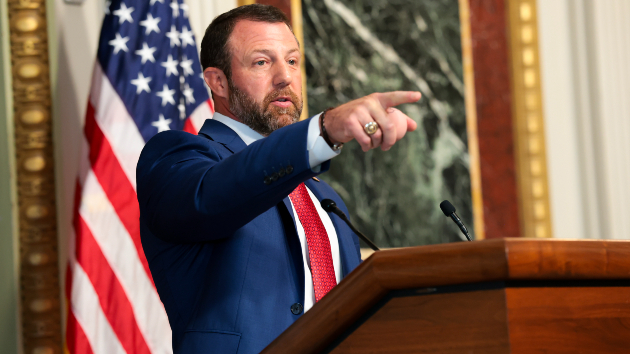
U.S. Secretary of Homeland Security Markwayne Mullin speaks during a news conference in the Eisenhower Executive Office Building on July 17, 2026 in Washington, DC. (Anna Moneymaker/Getty Images)
(WASHINGTON) — Department of Homeland Security Secretary Markwayne Mullin threatened on Friday to strip states of federal election-related aid, and to possibly seek criminal penalties against election officials, if they don’t comply with the administration’s voting roll probe ahead of the midterms.
Mullin told reporters that if states want to continue to receive federal reimbursement “to run federal elections,” they must now cooperate with DHS’s efforts to “scrub” their voter rolls and update the security of their election systems.
“We’re saying that the machines had to be secure, and that your voter registration list needs to be scrubbed,” Mullin said in a news conference.
It was not immediately clear what grants or funding could be in jeopardy for non-compliant states. DHS has previously threatened to withhold Federal Emergency Management Agency counterterrorism grants unless states complied with election security mandates.
“If states want the grant funding, to recap, they must secure the election,” Mullin said.
Mullin’s news conference came one day after President Donald Trump’s primetime speech on elections, in which he announced he was declassifying a slew of documents he claims reveal vulnerabilities in America’s elections systems and foreign interference, particularly by China.
Mullin, who was sworn in as DHS secretary on March 24, claimed America’s adversaries have the “key to the back” of American voting machines, alleging that bad actors could change the registration of voters — and even manipulate votes that have already been cast.
But Mullin offered no evidence that foreign vote manipulation has occurred, nor did he elaborate on how it is possible.
Mullin also argued, as Trump did on Thursday night, that America’s elections are also vulnerable because of noncitizen voters being on the voter rolls.
A DHS report released overnight alleged more than 250,000 noncitizens are on voter rolls in four states.
Mullin did not provide more information on how DHS arrived at the claim that 250,000 noncitizens are registered to vote in California, Pennsylvania, New Jersey, and Nevada, saying only it was pulled from public voter records.
The Department of Justice attempted to compel states to turn over their voter files, and sued more than two dozen that refused to do so. But courts have thrown out those lawsuits across the board, saying the DOJ lacks a compelling reason for the data.
Mullin said it would be a “little bit tougher” to obtain data from those states.
He said DHS will continue to comb through voter rolls in search of noncitizens and others ineligible to vote, and threatened them with jail time and or financial penalties.
“We will scrub all election records, looking for illegal aliens and those who are ineligible to vote, including those that somehow voted, yet they were deceased,” Mullin said.
“If you’re illegal and attempted to vote, or you tried to vote illegally for someone else, we will find you, and we will charge you,” Mullin continued. “Illegal voter restoration and illegal voting both carry penalties up to five years in prison and up to $250,000 in fines. We will pursue maximum pressure on this.”
The secretary said election officials would be held “accountable” if they don’t comply and that the penalties would be extended to them.
“If the election officials, once we gave them the information they need to secure their elections, and they chose not to, then those individuals can also be held accountable by fines, by penalties, and even depending on how far it goes, prison time,” he said.
Mullin said DHS will look into the integrity of both early voting and post-Election Day votes during this November’s midterm elections.
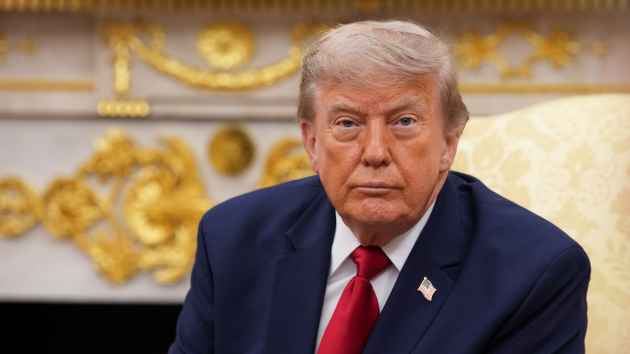
U.S. President Donald Trump looks on during a bilateral meeting with the Prime Minister of Iraq Ali al-Zaidi, in the Oval Office of the White House on July 14, 2026 in Washington, DC. (Photo by Andrew Harnik/Getty Images)
(WASHINGTON) — President Donald Trump, in a primetime address on Thursday, announced he has declassified a slew of documents he claims reveal vulnerabilities in America’s elections systems, election fraud and interference in elections by China, and ordered the Department of Justice to prosecute those believed to be involved.
“America is back and doing really well, but we still have a major challenge that must be urgently addressed because no country can be great without fair and honest elections, you have to trust your country,” Trump said. “Because if there can be no trust, there can be no greatness, and that’s very simple: no trust, no greatness.”
But throughout the more than 20-minute speech, the president did not provide specific evidence that the election outcome, or any votes, were altered in the 2020 election, despite his repeated claims that the election was “stolen” or “rigged.”
Trump has long pushed debunked conspiracy theories to claim that his 2020 election loss was fraudulent.
The president’s speech led to his main argument: he wants Congress to pass the SAVE America Act, his sweeping elections reform bill that Senate Majority Leader John Thune has repeatedly said does not have enough Republican votes to pass.
In his remarks, the president said that he would immediately declassify the release of “critical intelligence, revealing shocking vulnerabilities in our election infrastructure.”
According to the president, the documents focus on what he said were a number of areas of concern, including claims that China “compromised” election data during the 2020 election, and attempts to downplay the extent of China’s efforts.
Trump argued that the intelligence community suppressed information about China accessing 220 million voter files and trying to turn American opinion against him in the run-up to the 2020 election.
The president also accused the “deep-state” of keeping information about election meddling from him.
Trump claimed that U.S. intelligence agencies learned that tens of millions of voters’ data in 18 states had been “bought, stolen, or hacked” by China, and that the intelligence community deliberately kept this information from him while he was president.
Trump’s remarks asserting that the Chinese undertook a far more ambitious role in attempting to dictate the outcome of the 2020 election goes beyond what U.S. intelligence community has previously assessed.
In March 2021, two months into the Biden administration, a declassified “Intelligence Community Assessment” (ICA) that was produced at the end of Trump’s first term publicly acknowledged the belief among some intelligence officials that “China took at least some steps to undermine former President Trump’s reelection chances.” But the ICA said any such actions were “primarily through social media and official public statements and media,” not through interference with “election processes.”
Further, the ICA said that while China was “probably” trying “to gather information on U.S. voters and public opinion; political parties, candidates and their staffs; and senior government officials,” the more reliable intelligence indicated that such efforts were not actually intended to undermine Trump but instead to “predict electoral outcomes and to inform its efforts to influence US policy toward China under either election outcome.”
The heavily redacted documents released by the White House on Thursday do not appear to back up Trump’s assertions, instead containing scattershot intelligence that descries efforts to obtain — but not alter — voter records and to conduct social media activity to sow social discord.
One heavily-redacted document titled “200M Voter Records Compromised. repeatedly references personally identifiable information being compromised. This information includes names, phone numbers and addresses — which can also be found from many other sources.
In another series of near-completely redacted memos, words such as “state voter registration data” and “personal identifiable information” appear between large blocks of black redaction markings. It is impossible to surmise the meaning of these records without context, but they appear to point to some Chinese efforts to gather American voter data, much of which is publicly available.
Notably, these memos document Chinese activities ahead of both the 2020 and 2024 presidential elections.
Elsewhere in his remarks, Trump alleged that former Justice Department officials slow-walked an investigation in Michigan that involved the submission of voter registration applications that had forged signatures and other indications of fraudulent applications. Trump called on FBI Director Kash Patel to look into whether any charges can still be brought.
Local media at the time said that a state-level investigation was halted so the FBI could continue with a related investigation. It’s unclear why no federal charges were ever brought or if federal charges were warranted.
At the time, state officials said that the fact that the fraudulent applications were detected shows that the system worked.
The president also said the documents released Thursday include a Department of Homeland Security report he called “stunning,” alleging approximately 278,000 non-citizens were included on voter rolls.
In the documents released by the White House, the DHS report that alleged 250,000 noncitizen voters on the rolls came from a review of “public voter files” that appear to have come from four states: California, New Jersey, Pennsylvania and Nevada. DHS did not provide any methodology about how it reached that number, nor does it specify what “public voter files” it reviewed.
DHS acknowledged it did not have access to those states’ voter rolls, and alleges that in the 10 states that provided the federal government access to their rolls, the agency found 28,000 noncitizen voters.
Findings from the conservative-leaning Heritage Foundation have found only around 100 verified instances of non-citizen voting going back two decades.
-ABC News’ Lucien Bruggeman and Mike Levine contributed to this report.