(NEW YORK) — The U.S. seized the Russian-flagged Marinera oil tanker — formerly known as the Bella-1 — which has been linked to Venezuela and was transiting the North Atlantic, according to three sources familiar with the operation. And it also seized another tanker, according to Homeland Security Secretary Kristi Noem.
The operation for the Marinera was being carried out by the U.S. Coast Guard and other military assets, according to one source. Russian military vessels were in the area as the situation unfolded.
In a post on X, U.S. European Command confirmed the seizure of the tanker in the North Atlantic.
“In two predawn operations today, the Coast Guard conducted back-to-back meticulously coordinated boarding of two ‘ghost fleet’ tanker ships — one in the North Atlantic Sea and one in international waters near the Caribbean,” Noem said in a post on X. “Both vessels — the Motor Tanker Bella 1 and the Motor [Tanker] Sophia — were either last docked in Venezuela or en route to it.”
The U.S. Coast Guard has been tracking the Marinera tanker for the last two weeks after attempting to seize it on Dec. 20 when the empty ship was in the Caribbean and apparently headed to Venezuela.
On Dec. 31 the Russian Maritime Register of Shipping listed the ship — with the new name of Marinera — as a Russian vessel. The ship’s crew also painted a Russian flag on the ship’s side.
The Bella-1 previously flew a false Panamanian flag and is suspected to be part of Russia’s so-called “shadow fleet,” which Moscow is accused of using to evade international sanctions.
The ship recently activated its transponder allowing open source maritime tracking websites to locate the ship as being in the North Atlantic Ocean close to Iceland and the United Kingdom.
Russia’s Foreign Ministry on Tuesday said it was “monitoring with concern” the situation around the ship.
“At present, our vessel is sailing in the international waters of the North Atlantic under the state flag of the Russian Federation and in full compliance with the norms of international maritime law,” the ministry said.
“For reasons unclear to us, the Russian ship is being given increased and clearly disproportionate attention by the U.S. and NATO military, despite its peaceful status,” it said.
The vessel was put under U.S. sanctions in 2024 for carrying Hezbollah-owned cargo and for providing a form of support to the Iranian regime.
Nick Reiner attends AOL Build Speaker Series at AOL Studios In New York on May 4, 2016 in New York City. (Laura Cavanaugh/FilmMagic)
(LOS ANGELES) — Nick Reiner is expected to appear at an arraignment on Wednesday to enter a plea in the murders of his parents, renowned director Rob Reiner and his wife Michele Reiner.
The 32-year-old faces two counts of first-degree murder with the special circumstance of multiple murders.
Nick Reiner made a brief first court appearance on Dec. 17 and waived the right to a speedy arraignment.
Since his last appearance, sources told ABC News that law enforcement and defense attorneys have been working to piece together Nick Reiner’s psychiatric and substance abuse history. Legal experts say California law allows defense attorneys to signal as early as Wednesday’s hearing whether they will seek to use mental health in their defense.
Nick Reiner has a documented history of addiction and substance abuse treatment, and friends have told investigators that his mental health had been deteriorating prior to the murders.
He could enter a plea of not guilty by reason of insanity Wednesday, though that could also come later.
Under California law, a jury can find a defendant not guilty by reason of insanity, which would result in confinement to a state psychiatric hospital rather than prison. That process can begin at arraignment but is not required to.
To pursue this defense, attorneys must demonstrate that the accused suffered from a mental illness prior to developing an addiction. A mental illness caused solely by addiction does not meet the legal standard.
Nick Reiner’s defense attorney Alan Jackson issued a statement last month, reading: “We ask that during this process, you allow the system to move forward in the way that it was designed … not with jumping to conclusions, but with restraint and with dignity and with the respect that this system and this process deserves and that the family deserves.”
Rob Reiner and Michele Reiner were found stabbed to death in their Brentwood home on Dec. 14.
The night before the murders, Nick Reiner — who had been open about battling drug addiction since he was a teenager, and had been living on his parents’ property — got into an argument with Rob Reiner at a holiday party, and was seen acting strangely, sources told ABC News.
Nick Reiner was taken into custody in downtown Los Angeles hours after the bodies were discovered.
Rob and Michele Reiners’ other children, Jake and Romy Reiner, said in a statement last month, “Words cannot even begin to describe the unimaginable pain we are experiencing.”
“The horrific and devastating loss of our parents, Rob and Michele Reiner, is something that no one should ever experience. They weren’t just our parents; they were our best friends,” they said.
“We are grateful for the outpouring of condolences, kindness, and support we have received not only from family and friends but people from all walks of life,” Jake and Romy Reiner said. “We now ask for respect and privacy, for speculation to be tempered with compassion and humanity, and for our parents to be remembered for the incredible lives they lived and the love they gave.”
Volodymyr Zelensky President of Ukraine, Emmanuel Macron President of France and Keir Starmer Prime Minister of Great Britain sign a Declaration of Intent to deploy forces to Ukraine in event of a peace deal, during the ‘Coalition Of The Willing’ meeting at Elysee Palace on January 6, 2026 in Paris, France. (Tom Nicholson/Getty Images)
(LONDON) — U.S., European and Ukrainian representatives are gathering in Paris again on Wednesday for further talks regarding a potential peace deal to end Russia’s full-scale invasion of the country.
Participants were positive on the outcome of the first day of talks, with Jared Kushner — U.S. President Donald Trump’s son-in-law and a key member of the American delegation — describing Tuesday as a “real milestone,” though warning that a peace agreement is not imminent.
Notably, the U.K. and France signed a “Declaration of Intent” to send troops to Ukraine to safeguard any future deal, British Prime Minister Keir Starmer said on Tuesday.
The two nations said they would establish “military hubs” across Ukraine and protective facilities to be used by Ukraine’s armed forces to support the country’s defensive needs, Starmer said. The British leader, though, said that “the hardest yards are still ahead” in terms of reaching a deal.
German Chancellor Friedrich Merz, meanwhile, said at a joint press conference that Berlin is “not fundamentally ruling anything out” regarding its future involvement.
“Germany will continue to engage politically, financially, and also militarily,” Scholz said. “This could include, for example, deploying forces for Ukraine on neighboring NATO territory after a ceasefire.”
Kyiv has long said it cannot accept any peace deal with Russia without binding security guarantees from its Western partners to protect against future aggression from Moscow. The largely-European “Coalition of the Willing” group of nations has been pushing for such guarantees.
For its part, Russia has repeatedly said it will not accept the deployment of any troops from NATO nations to Ukraine as part of a peace deal.
The Coalition of the Willing said in a joint statement on Tuesday that its proposed guarantees will include a “U.S.-led ceasefire monitoring and verification mechanism” overseen by a “Special Commission” to address any “breaches, attribute responsibility and determine remedies.”
The Coalition also said it would continue “critical long-term military assistance and armament” to Ukraine alongside intelligence and military industrial cooperation and deploy a multinational force to “support the rebuilding of Ukraine’s armed forces and support deterrence.
The Coalition will offer “military capabilities, intelligence and logistical support, diplomatic initiatives, adoption of additional sanctions” in the event of any future Russian aggression, it said.
The extent of any U.S. involvement remains unclear, Trump having already ruled out deploying American forces to Ukraine.
Presidential envoy Steve Witkoff said in a post to X that Tuesday’s talks made “significant progress” on several critical issues related to the proposed 20-point peace plan, including on security guarantees.
“We agree with the Coalition that durable security guarantees and robust prosperity commitments are essential to a lasting peace in the Ukraine and we will continue to work together on this effort,” Witkoff said in a post on X.
Kushner, meanwhile, warned that there is still significant work to be done before any peace deal is finalized. “This does not mean we will make peace,” he said after Tuesday’s talks. “But peace would not be possible without the progress we made today.”
Ukrainian President Volodymyr Zelenskyy said in posts to social media that significant progress was made on the practicalities of future security guarantees.
“It’s determined which countries are ready to take leadership in elements of ensuring security on land, in the sky, at sea and in reconstruction. It’s determined what forces are needed. It’s determined how the forces will be managed and at what levels the command will be located,” he wrote.
“We had very substantive discussions with the American side on monitoring — to ensure there are no violations of peace. The United States is ready to work on this. One of the most critical elements is deterrence — the tools that will prevent any new Russian aggression,” he added.
“Thank you, America, for your willingness to provide backstop on all fronts: security guarantees, ceasefire monitoring and reconstruction,” Zelenskyy wrote.
(NEW YORK) — Earlier this week, the Centers for Disease Control and Prevention abruptly changed the childhood immunization schedule, reducing the number of recommended shots for all children from 18 down to only 11.
According to the new schedule, shots will now be categorized in three groups: those recommended for all children, those recommended for only certain high-risk children and others left up to shared clinical decision making, meaning only given if recommended by an individual’s doctor or based on parental preference.
Some pediatricians told ABC News that this decision will only cause more confusion and fuel a growing trend of vaccine skepticism and refusal amid a rise in some vaccine-preventable illnesses around the U.S.
Dr. Anita Henderson, a pediatrician at the Pediatric Clinic in Hattiesburg, Mississippi, told ABC News that removing seven shots from the schedule recommended for all kids is “reckless” and confusing.
This isn’t the first change to vaccine recommendations that has been made in the past year by the Department of Health and Human Services under Secretary Robert F. Kennedy Jr.
In 2025, guidance for vaccinating healthy children against COVID-19 was reversed and the universal birth dose of the hepatitis B vaccine was eliminated. Kennedy also fired all 17 members of the CDC’s vaccine advisory panel and handpicked their replacements, and has been criticized.
“Pediatricians are already facing families who are confused about vaccine recommendations. This confusion is intentional and meant to weaken vaccination rates in the US and sow seeds of doubt and division,” Henderson said.
Under the updated schedule, only seven vaccines are recommended based on shared clinical decision making between a doctor and parent and are no longer universally recommended for all children.
These include shots that protect against influenza, COVID-19, rotavirus and some types of bacterial meningitis and viral hepatitis. All of these vaccine-preventable illnesses can lead to severe infections or death and have limited to no treatment options.
“These latest changes will undoubtedly shake confidence in vaccines even further, to the detriment of the children we care for,” Dr. Molly O’Shea, a practicing pediatrician and spokesperson for the American Academy of Pediatrics, told ABC News.
O’Shea said that, in her practice, she’s had to navigate more vaccine skepticism and refusal over the past year, but wants parents to know that the science on effectiveness and safety hasn’t shifted “even though the recommended vaccine schedule has shifted.”
She continued, “The reason for that shift has nothing to do with whether or not vaccines are safe and effective and all children benefit from avoiding illness and being healthy, to attend school and be a part of the community.”
To address growing concerns about vaccines, O’Shea said the pediatric offices she works in have had to change their workflow to allow more time for discussions about vaccines and to address vaccine misinformation.
While happy to have these conversations with families, O’Shea said reserving time for these additional visits for vaccine counseling becomes more difficult during flu season, when more kids need to be seen due to illnesses.
She added that the offices have already had to scale back ordering some vaccines in bulk because uptake has decreased for some shots.
Henderson and O’Shea both reaffirmed that vaccines are safe — far safer than the dangerous illnesses they prevent.
“Over the last 30 years, I have hospitalized hundreds of children with complications from influenza, RSV, rotavirus and other vaccine-preventable diseases that have now been removed from the CDC schedule,” Henderson said. “I have never hospitalized a child from a vaccine reaction. Vaccines are safe and effective and protect our most vulnerable patients … our babies and children.”
“Vaccines are the safest way for a child’s immune system to become familiar with any of these illnesses, way safer than the disease itself,” O’Shea added.
Doctors are also concerned that the vaccination schedule updates may have secondary impacts, including how often children and families see their pediatrician.
Pediatric wellness checks include recommended vaccines, particularly in young childhood, but pediatricians say that there’s more to those visits than shots alone. Skipping visits could miss critical windows of a child’s growth, development, and recommended screenings.
“Absent vaccine, kids are really going to miss out on important other screening aspects of the wellness visits if their parents are opting out,” O’Shea said.
Pediatricians continue to urge parents to talk to their own child’s doctor and to trust their medical guidance.
“Your pediatrician really is your trusted source of information, and we have nothing to gain in the way things are going here,” O’Shea said.
“Vaccines are certainly not a way in which we make any money,” she went on. “But [a] pediatrician’s goal is to partner with parents to make the right decision for your child, and so, bringing your concerns and questions to your pediatrician is the best way to get quality information.”
Amid the shrinking childhood vaccine schedule, many vaccine-preventable illnesses remain common in the U.S. and other diseases, such as measles and whooping cough, are increasing.
Last year, the U.S. saw more measles cases than at any other time in the last 30 years and three people died from the disease. Two children died from whooping cough during an outbreak in Louisiana and more kids died from influenza than in any other year on record since it became a reportable illness in 2004.
(WASHINGTON) — The White House said Tuesday President Donald Trump and his advisers are discussing a range of options to acquire Greenland — adding “utilizing the U.S. military is always an option.”
“President Trump has made it well known that acquiring Greenland is a national security priority of the United States, and it’s vital to deter our adversaries in the Arctic region,” White House press secretary Karoline Leavitt said. “The President and his team are discussing a range of options to pursue this important foreign policy goal, and of course, utilizing the U.S. Military is always an option at the Commander in Chief’s disposal.”
This is a developing story. Please check back for updates.
(WASHINGTON) — The White House said Tuesday President Donald Trump and his advisers are discussing a range of options to acquire Greenland — adding “utilizing the U.S. military is always an option.”
“President Trump has made it well known that acquiring Greenland is a national security priority of the United States, and it’s vital to deter our adversaries in the Arctic region,” White House press secretary Karoline Leavitt said. “The President and his team are discussing a range of options to pursue this important foreign policy goal, and of course, utilizing the U.S. Military is always an option at the Commander in Chief’s disposal.”
This is a developing story. Please check back for updates.
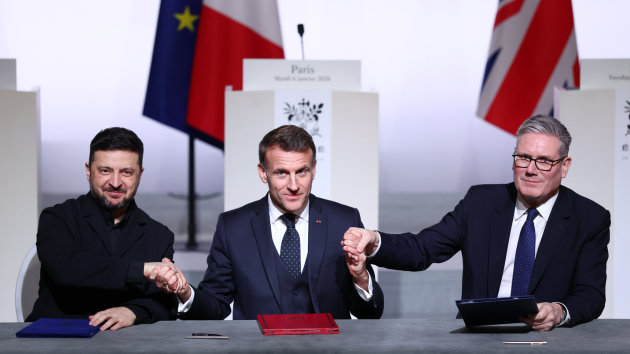
Volodymyr Zelensky President of Ukraine, Emmanuel Macron President of France and Keir Starmer Prime Minister of Great Britain sign a Declaration of Intent to deploy forces to Ukraine in event of a peace deal, during the ‘Coalition Of The Willing’ meeting at Elysee Palace on January 6, 2026 in Paris, France. (Photo b
(PARIS, France) — France, the U.K. and Ukraine signed a “Declaration of Intent” on Tuesday to send their forces to Ukraine in the event of a peace deal with Russia.
British, French and partner forces would be on the ground, establishing “military hubs” across Ukraine, U.K. Prime Minister Keir Starmer said, alongside French President Emmanuel Macron and Ukraine’s Volodymyr Zelenskyy.
Ukraine’s armed forces would use the protective facilities to retain Ukraine’s defensive needs, Starmer said.
Also present at the security summit on Tuesday in Paris were White House envoy Steve Witkoff, President Trump’s adviser and son-in-law, Jared Kushner and German Chancellor Friedrich Merz.
Merz said in a statement after the meeting that Germany could deploy forces for Ukraine on neighboring NATO territory after a ceasefire was established, but added, “I want to say for myself and also for the Federal Government that we are not fundamentally ruling anything out.”
During a press conference following the talks, Kushner said the agreement was a “real milestone,” but warned that peace is some way off.
“This does not mean we will make peace,” he said. “But peace would not be possible without the progress we made today.”
The outcome of the talks suggests the U.S. and Europe are more aligned on security guarantees and how a ceasefire should be policed after any deal. But Russia has given no indication it would be prepared to accept a deal that includes such guarantees.
The pledge by France and the U.K. to deploy troops into Ukraine could further complicate negotiations. The Kremlin has repeatedly ruled out any presence of NATO countries’ forces in Ukraine after any deal.
The Kremlin has repeatedly ruled out any presence of NATO countries’ forces in Ukraine after any deal.
During the press conference, Starmer also hailed the progress on security guarantees but noted that “the hardest yards are still ahead.”
This is all about building the practical foundations on which peace would rest,” he said.
“But we can only get to a peace deal if Putin is ready to make compromises. And so, we have to be frank. For all Russia’s words, Putin is not showing that he is ready for peace.”
Zelenskyy released a statement on the agreement, saying, “We understand which country is ready for what among all members of the Coalition of the Willing.”
“I would like to thank every leader and every state that truly wishes to be part of a peaceful solution,” he added.
A photo illustration of a physical gold Bitcoin collectible on December 3,2025, in London, England. (Photo by Peter Dazeley/Getty Images)
(MAINE) — One of the country’s top cryptocurrency kiosk vendors has agreed to pay the state of Maine nearly $2 million as part of a settlement to compensate victims of fraud, the state announced on Monday.
Bitcoin Depot, which operates more than 25,000 bitcoin ATMs across the country, will pay the state $1.9 million, which represents money “taken by third-party scammers who defrauded Maine consumers through their kiosks.”
Victims of fraud perpetrated using Bitcoin Depot kiosks may apply for compensation from the state. As part of the settlement, Bitcoin Depot admits to no wrongdoing or violation of state or federal laws.
Bitcoin ATMs, which allow users to insert cash and send it to a digital wallet anywhere in the world in only a few minutes, have emerged as scammers’ top go-to method for separating Americans from their cash, according to experts.
In a typical scam, fraudsters will convince their victims that they must make a payment or safeguard their cash by inserting it in a bitcoin ATM. Once the transaction is executed, experts say, the money can be nearly impossible to recover — making it an attractive method for prospective scammers.
In 2025, Americans lost more than $333 million to bitcoin ATM scams, the FBI recently told ABC News, representing a dramatic uptick from prior years.
Maine has taken some of the nation’s most aggressive steps in limiting the proliferation of scams using bitcoin ATMs, including establishing daily deposit limits and capping transaction fees.
A spokesperson for Bitcoin Depot, which currently faces a separate lawsuit in Iowa, did not immediately respond to a request for comment from ABC News.
(NEW YORK) — Flu activity could continue to increase in the U.S. over the next few weeks, according to a top flu epidemiologist at the Centers for Disease Control and Prevention.
“There’s a lot of influenza out there right now,” Dr. Carrie Reed, chief of the epidemiology and prevention branch of the CDC’s influenza division, told ABC News.
“We often see activity continue into the spring … I think the reality is that it’s going to continue to be elevated for a little bit longer,” she continued.
The CDC’s latest estimates indicate that there have been at least 11 million illnesses, 120,000 hospitalizations and 5,000 deaths from flu so far this season.
“That’s likely a low estimate based on the data that we’re seeing so far,” Reed said, adding that the federal health agency typically publishes the lower range of the estimates.
A new variant that first emerged in the summer, known as subclade K, has become the dominant strain, CDC data shows. Subclade K is a variant of the H3N2 virus, which is itself a subtype of influenza A.
Of the 994 flu samples tested since Sept. 30, nearly all were influenza A. Of those samples that underwent further testing roughly 90% were H3N2, CDC data shows.
“Subclade K has acquired some mutations in the virus that make it a little bit different than what’s in the vaccine and what was circulating over the last couple years,” Reed said.
Public health experts currently recommend that everyone ages 6 months and older, with rare exceptions, get an annual flu vaccine.
Although the current flu vaccine is not a perfect match to subclade K, it is still expected to offer some protection against the new variant and lower the risk of serious disease, hospitalization and death.
Reed added that the new variant does not appear to be driving more severe illness yet.
“There are still benefits to vaccine, even if the virus [has] somewhat drifted from what’s in the vaccine,” she said. “We haven’t seen increases in hospitalization and mortality yet in the ways that we have with [doctors’ visits], although that’s something that we continue to watch for as well.”
For those who have gotten sick, there are medicines available, known as antivirals, that may help reduce the severity and length of illness.
Reed said for those who contract the flu and have a higher risk of severe disease, they should seek care early and speak with their doctor about receiving a prescription for flu antivirals.
She explained that flu antivirals have been found to reduce the duration of illness as well as lower the risk for severe disease, hospitalization and death.
Health officials have stressed that it is not too late for people get a flu shot if they haven’t received one yet.
“There’s still time to get a flu vaccine,” Reed said. “It does take a couple weeks for your immune response to pick up after vaccination, but that does mean there’s many more weeks of flu activity to benefit from the protection of an influenza vaccine.”
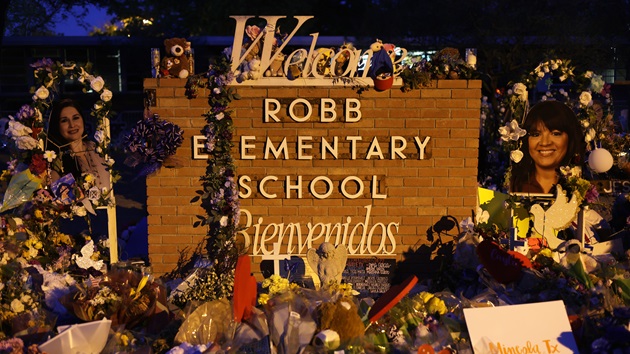
Flowers and photographs are seen at a memorial dedicated to the victims of the mass shooting at Robb Elementary School on June 3, 2022 in Uvalde, Texas. Alex Wong/Getty Images
(CORPUS CHRISTI, Texas) — Former Uvalde, Texas, school police officer Adrian Gonzales was alerted to gunman Salvador Ramos’ location before Ramos entered Robb Elementary School, but Gonzales failed to act, prosecutors argued in opening statements on Tuesday.
Gonzales — who is charged with 29 counts of child endangerment — is alleged to have neglected his duty and training during the chaotic response to the 2022 shooting, which left 19 children and two teachers dead.
This case marks the second time in U.S. history that prosecutors have sought to hold a member of law enforcement criminally accountable for their response to a mass shooting. Gonzales’ legal team maintains he’s being scapegoated.
Prosecutor Bill Turner spoke softly and on the verge of tears at the start of his opening argument. His statement marked the first time prosecutors have provided their rationale for charging Gonzales, disclosing that a teacher came face-to-face with Ramos before the shooter entered the school, and the teacher tried to warn Gonzales.
“She’s face-to-face with the gunman, and he fires on her, and she turns to run, and when she turns to run, she trips and she falls. And when she gets up, Adrian Gonzales, the police officer, is there,” Turner said. “She says, ‘He’s over there.’ She urges him to go get him.”
“He gets on the radio and says, ‘Shots are fired, he’s wearing black, he’s in the parking lot,'” Turner said. “He knows where he is, but Adrian Gonzales remains at the south side of the school.”
As Turner walked the jury through the tragic minutes that followed that encounter — describing the number of gunshots fired by Ramos as Gonzales allegedly waited outside — Turner hammered at the point that Gonzales allegedly stayed where he was, rather than try to stop the shooting.
Defense attorney Nico LaHood told the jury that “pure evil” visited Uvalde on May 24, 2022, but said convicting Gonzales will not deliver justice.
LaHood argued that Gonzales did everything he could in that moment — including gathering critical information, evacuating children and entering the school — and said Gonzales acted on the information he had.
LaHood and his partner Jason Goss delivered a lengthy opening argument that used a map and time codes to provide the jury with a minute-by-minute view of Gonzales’ actions.
“The government wants to make it seem like he just sat there, you know. He didn’t just sit there — he did what he could with what he knew at the time,” LaHood said.
LaHood also called out the prosecution for planning to show the jury autopsy photos. The judge has preliminarily allowed prosecutors to show the images, but reserves the right to hold photos from entering evidence.
“They’re going to really want you to focus on these photos, and I wish they wouldn’t — not because it hurts us — because .. it hurts those precious people over there,” LaHood said, pointing to some of the families and Uvalde community members in the gallery.
Despite nearly 400 officers responding to the shooting, law enforcement took 77 minutes to mount a counterassault to kill Ramos. Gonzales is one of only two officers charged in the case, along with former Uvalde schools Police Chief Pete Arredondo.
Judge Sid Harle seated a full jury after an emotionally fraught selection process on Monday. Dozens of potential jurors voiced frustration with the police response, and more than 100 excused themselves from the process, saying they did not believe they could be fair and impartial.
“They were only protecting themselves more than they were protecting the children,” one dismissed juror told the court, as others cheered and clapped in agreement. “I would have sacrificed myself to save them, but they didn’t. They just sat there.”
Gonzales has pleaded not guilty, and his lawyers argue he is being blamed for a broader law enforcement failure. During the jury selection process, some voiced frustration that more officers have not been charged in the years following the tragedy.
“Are you saying this man is the whole problem? You are sticking it on his shoulders alone?” one dismissed juror remarked. “How many of them were out there? They should all be sitting there with him.”
Gonzales was charged last year, along with Arredondo, the on-site commander on the day of the shooting. Arredondo’s trial has been indefinitely postponed due to a pending civil lawsuit after the members of an elite tactical unit with the U.S. Border Patrol refused to speak with prosecutors about their involvement that day.
Gonzales’ case is a rarity in U.S. law.
In 2023, a Florida jury acquitted Scot Peterson, a former Broward County sheriff’s deputy, who was charged with child neglect and culpable negligence for his alleged inaction during the 2018 shooting at Marjory Stoneman Douglas High School in Parkland, Florida. Peterson’s lawyers argued his role as an armed school resource officer did not amount to a caregiving post needed to prove child neglect in Florida, and that the response to the shooting was muddled by poor communication.
According to Bob Jarvis, a professor of law at Nova Southeastern University, prosecutors in the Gonzales case are likely to face the same legal hurdles that doomed the Peterson case.
“What you’re really trying to do,” he said, “is argue … that being a coward is a crime, and that is very, very difficult.”