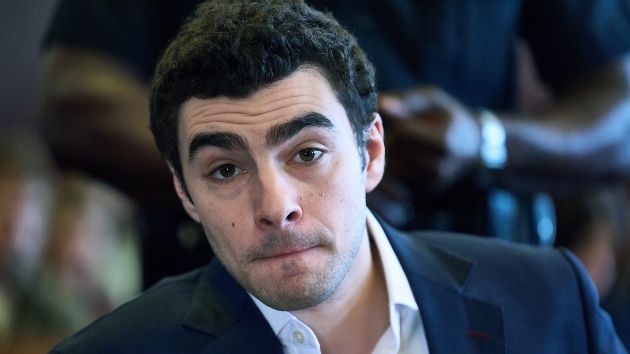
Luigi Mangione appears for a suppression of evidence hearing in the killing of UnitedHealthcare CEO Brian Thompson in Manhattan Criminal Court, December 18, 2025 in New York City. (Curtis Means-Pool/Getty Images)
(NEW YORK) — A federal judge on Monday changed her mind and decided there should be a hearing to determine whether Luigi Mangione’s backpack was lawfully seized and searched during his arrest in Altoona, Pennsylvania.
Judge Margaret Garnett said she considered “both the arguments made by counsel” during a hearing on Friday and “the seriousness of the charges the Defendant is facing” in deciding to hold the evidentiary hearing after previously saying a hearing was unnecessary.
The brief hearing should include testimony from an Altoona police officer about the department’s procedures for securing, safeguarding and inventorying the personal property of a person arrested in a public place, the judge said. She noted that the witness did not need to be one of the dozen officers involved in Mangione’s arrest.
Several Altoona officers testified during a three-week hearing in state court where Mangione is seeking to exclude evidence police seized from his backpack, including the alleged murder weapon, a notebook and writings.
Defense attorneys are also trying to eliminate those items from the federal case, which could result in a possible death sentence if Mangione is convicted. He has pleaded not guilty in both courts.
Mangione is accused of stalking and killing UnitedHealthcare chief executive Brian Thompson on a New York City sidewalk in 2024.
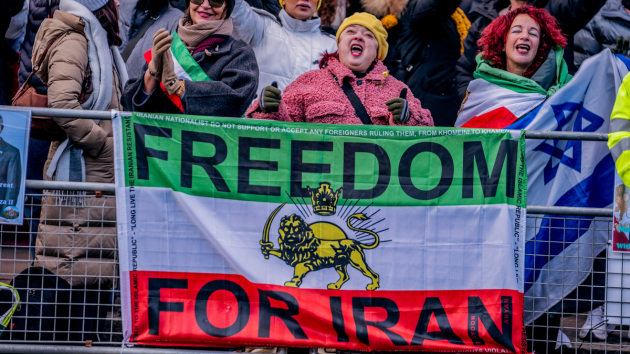
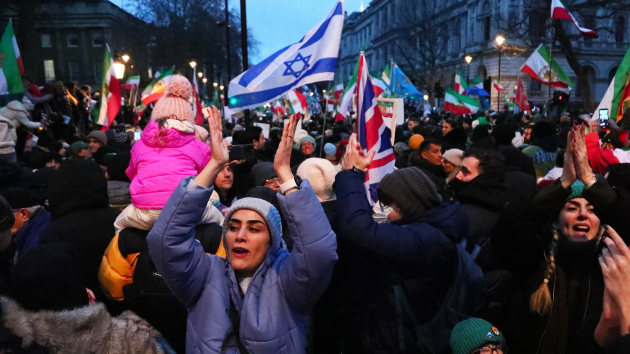
Hundreds joined a public rally in London in support of the protestors in Iran, calling for regime change from clerical rule and for Ayatollah Ali Khamenei to step down. (Lab Ky Mo/SOPA Images/LightRocket via Getty Images)
(LONDON) — Iranian Supreme Leader Ayatollah Ali Khamenei on Sunday hit back against U.S. President Donald Trump’s threats of military action in Iran in support of anti-government protests there, shortly before Trump told reporters that Tehran wants “to negotiate” with the U.S.
In a message on his official Farsi-language X account on Sunday, Khamenei posted an image of a crumbling statue with Trump’s likeness.
“That father figure who sits there with arrogance and pride, passing judgment on the entire world, he too should know that usually the tyrants and oppressors of the world, such as Pharaoh and Nimrod and Reza Khan and Mohammad Reza and the likes of them, when they were at the peak of their pride, were overthrown,” Khamenei wrote.
“This one too will be overthrown,” the ayatollah added.
Khamenei’s post came shortly before Trump spoke with reporters aboard Air Force One, first suggesting he may follow through on his threats of new strikes on Iran before revealing that fresh negotiations with Tehran may soon be underway.
Trump said it “looks like” Iran may have crossed the administration’s red line of killing protesters, adding that the U.S. military has “strong options” at its disposal. “We’ll make a determination,” he said.
Trump has repeatedly warned Tehran against the use of force to suppress the protests. On Saturday, Trump wrote on social media, “Iran is looking at FREEDOM, perhaps like never before. The USA stands ready to help!!!”
According to a U.S. official, the president will be briefed Tuesday to review possible U.S. responses to the situation in Iran.
Trump also said Sunday that Iranian leaders contacted him on Saturday and that a meeting is being set up between them. The president cautioned that the U.S. may take action before a meeting takes place.
“They do. They called,” Trump said when asked if he thinks Iran wants to engage diplomatically.
“Iran called to negotiate yesterday — the leaders of Iran called yesterday. They want to negotiate. I think they’re tired of being beat up by the United States,” he said.
“We may meet with them,” he added. “A meeting is being set up, but we may have to act — because of what’s happening — before the meeting, but a meeting is being set up,” Trump said.
Protests have been spreading across the country since late December. The first marches took place in downtown Tehran, with participants demonstrating against rising inflation and the falling value of the national currency, the rial. As the protests spread to cities across the nation, they took on a more explicitly anti-government tone.
The death toll from the protests had risen to 544 as of Sunday, according to data compiled by the U.S.-based Human Rights Activists News Agency (HRANA).
At least 10,681 people have been arrested, according to HRANA. Protests have taken place at 585 locations across the country, in 186 cities, spanning all 31 provinces, according to activists.
The HRANA data relies on the work of activists inside and outside the country. ABC News cannot independently verify the figures provided by the group.
The Iranian government has not provided any casualty figures for protesters related to the ongoing protests. State television has broadcast images of people attending morgues to identify bodies of friends and relatives.
The state-aligned Tasnim news agency reported on Sunday that 109 security personnel had been killed in the protests.
Widespread and sustained internet outages have been reported across the country amid the deepening protests and reported government crackdown. Online monitoring group NetBlocks said early on Monday that Iran’s “national internet blackout” had surpassed 84 hours.
Khamenei and top Iranian officials have said they are willing to engage with the economic grievances of protesters, though have also framed the unrest as driven by “rioters” and sponsored by foreign nations, prime among them the U.S. and Israel.
Iranian Foreign Minister Abbas Araghchi on Monday described the wave of protests as a “terrorist war” while speaking to foreign diplomats in Tehran.
Araghchi said that the situation is “under control” and that internet access would be restored.
The foreign minister also claimed that Tehran had gathered extensive evidence showing U.S. and Israeli involvement in the protests over recent days. “We believe what took place after 8th of January was infiltration,” he said, suggesting that “Mossad agents” are leading the demonstrations.
Araghchi also criticized Western nations for failing to condemn what he called “terrorists.”
On Monday, state television broadcast footage of pro-government rallies organized in Tehran and other major cities.
The footage showed crowds waving Iranian flags in the capital’s Revolution Square, shouting slogans including “death to America,” “death to Israel,” and “I’d sacrifice my life for the leader.”
State television described the Tehran demonstration as an “Iranian uprising against American-Zionist terrorism.”
Dissident voices abroad, meanwhile, have encouraged further demonstrations. On Sunday, Iran’s exiled Crown Prince Reza Pahlavi addressed protesters in a post to X, announcing what he said was “a new phase of the national uprising to overthrow the Islamic Republic and reclaim our beloved Iran.”
“In addition to taking and holding the central streets of our cities, all institutions and apparatuses responsible for the regime’s propaganda and for cutting communications are to be regarded as legitimate targets,” Pahlavi wrote.
“Employees of state institutions, as well as members of the armed and security forces, have a choice: stand with the people and become allies of the nation, or choose complicity with the murderers of the people — and bear the nation’s lasting shame and condemnation,” he added.
“We are not alone. International support will soon arrive,” Pahlavi wrote.
Becky Pepper Jackson competes in discus and shot put on the girls high school track and field team in her West Virginia hometown. (ABC News)
(WASHINGTON) — The Supreme Court on Tuesday will for the first time wade into the heated national debate over whether transgender girls should be allowed to participate in girls’ and women’s sports.
The justices will hear arguments in a pair of cases from Idaho and West Virginia, where federal courts have blocked state laws that would prohibit trans girls from participating on teams consistent with their gender identity.
The outcome of the cases will determine the fate of those laws and similar measures in 27 other states. There are an estimated 122,000 transgender American teens who participate in high school sports nationwide, according to the Williams Institute at UCLA Law School.
Lower courts have concluded separately that the bans discriminate “on the basis of sex” in violation of Title IX, the landmark civil rights law that has promoted equal opportunities for women and girls in athletics, and the Constitution’s Equal Protection Clause.
The states are asking the justices to overturn those decisions and reinstate their laws, arguing that sex and gender identity are not synonymous when it comes to women’s athletics and that allowing transgender girls to compete against cisgender girls is unfair and unsafe.
“It really comes down to one simple question,” said West Virginia Attorney General John McCuskey in an interview with ABC News. “Is it legal and constitutional for states to delineate their athletic playing fields based on the immutable physical characteristics that people have that are associated with their sex that’s assigned at birth?”
Becky Pepper Jackson, a high school sophomore from Bridgeport, West Virginia, who competes in discus and shot put on the track and field team, brought the legal challenge to her state’s law in 2021. She is the only known openly trans athlete in West Virginia in any sport.
“Someone has to do it. Someone has to do this for all of us,” Becky, 15, told ABC News in an exclusive interview. “Otherwise these laws and bills are just going to stand.”
Transgender athletes make up just over 1% of the more than 8 million teenage student athletes nationwide, according to the Williams Institute.
Idaho college student Lindsay Hecox, a former track and cross-country runner who was barred from trying out for her school teams, sued over her state’s ban in 2020. Last year, she asked the court to drop her case because she no longer wished to compete in sports and didn’t want to be in the spotlight. However, Idaho fought to keep the case alive.
“Everyone has had the experience of being told, look, you can’t play. You have to sit on the bench, or you can’t make the team. And everyone knows how that feels,” said Sasha Jean Buchert, an attorney with Lambda Legal, an LGBTQ advocacy group involved with the cases.
“That’s what’s happening to transgender kids right now,” Buchert said. “And the scope of [these bans] is absolutely absurd.”
Becky, who has openly identified as a girl since third grade, said she has never undergone male puberty, thanks to puberty-blocking medication, and has no physiological advantage over her peers.
“She has testosterone from her adrenal glands just like every female out there, but that’s the only testosterone she has,” said her mother, Heather Jackson. “She’s actually not the biggest person on her team. There’s people taller than her; there’s people shorter than her. She’s just an average female teenager.”
As a young cross-country runner, Becky was consistently at the back of the pack. More recently, she earned a spot in the state championship for discus and shot put, where she placed third and eighth, respectively.
“I put in time over the summer and after practices just trying to improve my technique and get better,” she said.
Her performance at an eighth grade track meet in 2024 drew protests from other athletes who claimed she made them uncomfortable in the locker room and on the field.
“I just didn’t think it was right,” said Sabrina Shriver, 16, a former discus thrower who refused to compete against Becky at the meet and later quit the sport because of her participation in the league. “It was just, I don’t know, we all just felt uncomfortable and we’re just, we didn’t want any part of it.”
The competitive advantage boys and men have physically over girls and women has been well established in physically demanding sports by medical research and serves as a primary basis for distinctions between the sexes in athletics.
Studies have shown testosterone produced during male puberty does lead to more muscle mass, larger hearts and lungs, greater body height and longer limbs on average for boys and men, according to the American College of Sports Medicine.
Before puberty, however, “sex differences in athletic performance are minimal,” the group says research shows.
A key issue in the West Virginia case is a dispute over whether Becky, 15, possesses an advantage at all, given she has not undergone male puberty, takes estrogen supplements and does not produce high levels of testosterone.
“If [sports leagues] look at the medical records of individuals like the Olympic committee does, testing people — they test for performance enhancing medications or drugs that their athletes take — so if we can look at those levels, let’s look at her levels,” Heather Jackson said.
McCuskey says a testing regimen is just not practicable and that Becky can still compete, but on a boys team. “We have to be able to draw a line here,” he said.
“Becky is bigger and stronger and faster than the females that she’s competing against,” said the attorney general.
He has urged the Supreme Court to stay out of the debate, arguing in a court brief that West Virginia’s law “implicates ‘fierce scientific and policy debates’ that elected legislators are best able to resolve.”
The U.S. Olympic Committee, the NCAA and 29 states ban transgender girls and women from competing on teams consistent with their gender identity. The other 21 states do not have bans, including California and New York, which have laws explicitly allowing trans athletes to compete.
Last year, the Supreme Court’s conservative majority upheld a Tennessee law banning some gender-affirming medical treatments for transgender minors, rejecting claims that the law discriminated “on the basis of sex” and saying that states should have leeway to regulate health care in an area of scientific uncertainty.
In 2020, however, the Court concluded in a landmark decision that a Michigan transgender woman fired by her employer for being transgender was discriminated against “on the basis of sex” under Title VII of the Civil Rights Act of 1964.
Justice Neil Gorsuch explained in his majority opinion that her termination was “for traits or actions it would not have questioned in members of a different sex.”
Becky, Lindsay, and their attorneys with the American Civil Liberties Union and Lambda Legal say the same reasoning should be applied to sports bans.
“There’s been a number of setbacks that we’ve experienced over the last few years in the courts, but I do have a sense of optimism with this case in light of the fact that the legal issues at play here are some of the same issues at play five years ago,” said Buchert, the Lambda Legal attorney.
Notwithstanding the legal arguments, 69% of Americans say transgender girls should only be allowed to play on boys teams, according to a June 2025 Gallup survey.
The Trump administration also supports the exclusion of transgender athletes from sports teams. An executive order signed in February 2025 says “it is the policy of the United States to rescind all funds from educational programs that deprive women and girls of fair athletic opportunities.”
Becky says, while she understands public opinion, she is unable to “go against who I am.”
“I’ve been a girl forever,” she said, “and playing on the guys’ team is going backwards.”
People take part in a rally in solidarity with protesters in Iran, on January 11, 2026 in London, England. (Alishia Abodunde/Getty Images)
(LONDON) — The death toll from mass protests in Iran has risen to 538, according to data compiled by the U.S.-based Human Rights Activists News Agency (HRANA) on Sunday.
The group says it has confirmed the deaths of 490 protesters and 48 members of security forces. 10,600 people also are recorded as having been arrested, according to HRANA.
The HRANA data relies on the work of activists inside and outside the country.
ABC News cannot independently verify these numbers. The Iranian government has not provided any death tolls during the ongoing protests.
Video footage shot by locals and posted to social media appeared to show thousands of people protesting in Tehran’s Punak Square on Saturday night despite reported efforts by government security forces to disperse crowds. Elsewhere, videos showed large crowds gathered in the northeastern city of Mashhad.
HRANA said in its Saturday update that it had recorded 574 protest locations across 185 cities and all 31 provinces of the country. Saturday marked the fourteenth day of protests, HRANA said.
The Iranian government has not released detailed statistics on casualties sustained among protesters. The state-aligned Tasnim news agency reported on Sunday that 109 security personnel had been killed in the protests.
HRANA and other human rights groups reported widespread and sustained internet outages across the country as the protests spread. Online monitoring group NetBlocks said early on Sunday that Iran’s “internet blackout” had surpassed 60 hours.
Protests have been spreading across the country since late December. The first marches took place in downtown Tehran, with participants demonstrating against rising inflation and the falling value of the national currency, the rial.
As the protests spread, some have taken on a more explicitly anti-government tone, with some protesters chanting slogans including “student, be the voice of your people,” and “death to Islamic Republic.”
The theocratic government in Tehran — headed by Supreme Leader Ayatollah Ali Khamenei — moved to tame the protests, with security forces reportedly using tear gas and live ammunition to disperse gatherings.
Khamenei and top Iranian officials have said they are willing to engage with the economic grievances of protesters, though have also framed the unrest as driven by “rioters” and sponsored by foreign nations, prime among them the U.S. and Israel.
In comments carried by Iranian state media, President Masoud Pezeshkian on Sunday blamed foreign “terrorists” for the protests but also addressed some of the issues that originally brought protesters out onto the streets.
“We are determined, and have decided, to resolve economic problems by any means possible,” Pezeshkian said.
Israeli Prime Minister Benjamin Netanyahu said at the start of his weekly cabinet meeting Sunday that “Israel is closely following what is happening in Iran” and the ongoing “demonstrations for freedom” there.
“Israel supports their struggle for freedom and strongly condemns the mass massacres of innocent civilians,” Netanyahu further said. “We all hope that the Persian nation will soon be freed from the yoke of tyranny, and when that day comes, Israel and Iran will once again be loyal partners in building a future of prosperity and peace for both peoples.”
Dissident figures abroad, meanwhile, have urged Iranians to take to the street and overthrow the government. On Sunday, Iran’s exiled Crown Prince Reza Pahlavi addressed protesters in a post to X, saying, “Do not abandon the streets. My heart is with you. I know that I will soon be by your side.”
U.S. President Donald Trump has repeatedly warned Tehran against the use of force to suppress the protests. On Saturday, Trump wrote on social media, “Iran is looking at FREEDOM, perhaps like never before. The USA stands ready to help!!!”
An Israeli official told ABC News on Sunday that Israeli Prime Minister Benjamin Netanyahu and Secretary of State Marco Rubio spoke on Saturday about events unfolding in Iran.
Tehran, meanwhile, has warned against outside intervention. On Sunday, Mohammad Bagher Qalibaf — the speaker of the Iranian parliament — said that the U.S. military and Israel will be “legitimate targets” in the event of American strikes on Iran.
Sen. Tina Smith, D-Minn., appears on ABC News’ “This Week” on Jan. 11, 2026. (ABC News)
(NEW YORK) — Minnesota Democratic Sen. Tina Smith said Sunday that the Trump administration was “attempting to cover up what happened” in the fatal shooting of Renee Good, a U.S. citizen and mother of three, by an Immigration and Customs Enforcement (ICE) agent in Minneapolis on Wednesday.
ABC News obtained cell phone video of the incident that was taken by the ICE agent who fired the shots.
“I think what we are seeing here is the federal government — [Department of Homeland Security Secretary] Kristi Noem, Vice President [JD] Vance, [President] Donald Trump — attempting to cover up what happened here in the Twin Cities, and I don’t think that people here and around the country are believing it,” Smith told ABC News’ “This Week” co-anchor Martha Raddatz.
Trump administration officials have asserted that Good was attempting to run over the ICE officer with her car, prompting the officer to shoot her in what they say was self-defense. Noem said Good’s actions were an act of “domestic terrorism.”
Local officials and many Democratic lawmakers have disputed DHS’s assessment of the incident.
“You are saying the administration is trying to cover up this shooting. That’s a pretty serious charge. What do you mean exactly,” Raddatz asked.
“What I mean by that is that you can see everything that they are doing is trying to shape the narrative, to say what happened, without any investigation,” Smith said.
Smith went on to criticize the administration for its response to the shooting.
“What I think is essential to keep in mind here is that if we’re going to trust the federal government, how can we trust the federal government to do an objective, unbiassed investigation, without prejudice, when at the beginning of that investigation they have already announced exactly what they saw — what they think happened.”
Smith said she has “seen nothing in any of the eyewitness videos, nor in any of the eyewitness reports from this tragic day, that would suggest that [Good] was in any way a threat to these officers.”
“Legally, do you think the ICE officer — certainly said he feared bodily harm. Is that possible in your eyes?” Raddatz pressed.
“It’s hard for me, looking at the evidence that I have seen, to imaging how he could feel bodily harm,” Smith said.
The FBI is investigating the shooting, but Minnesota officials said that the federal government has cut them out, blocking state agencies from accessing case material.
“And then they bar, from participating in the investigation, the unbiased state investigators who frequently collaborate with federal investigators on — when there are things that need to be looked into. So, I mean, I think they have just completely destroyed any credibility as they have so quickly rushed to judgement.”
The fatal shooting of Good sparked country-wide protests against ICE presence in American cities. In Minneapolis, local officials maintain that the protests have been mostly peaceful.
Here are more highlights from Smith’s interview:
On the actions of the ICE officer around the shooting, as captured by videos Smith: I understand how law enforcement, professional law enforcement, is trained. They are trained to deescalate situations, not make some worse, not make conflict worse. They are certainly trained to step out of the way of a moving vehicle, not place themselves in the middle of a moving vehicle. And no professional law enforcement would like, exchange words or banter with somebody who is engaged in their legal right to protest and then lose control, which is, you know, which looks to me like what happened here.
Message to people protesting shooting, ICE’s presence in communities Smith: Of course it is essential that we have peaceful protests. And what I have been saying to people, in all the opportunities I have when I talk to people on the street is that, that the Trump administration wants to foment chaos and division and fear and even violence. And it is essential that we do not fall into that trap, that our, our strength is in our unity, our strength is in our peaceful demonstrations. And, you know, we will not give in. We will not sort of cave in to the fear and the chaos that they are trying to create, they are creating, but we will meet that with unity and with peace.
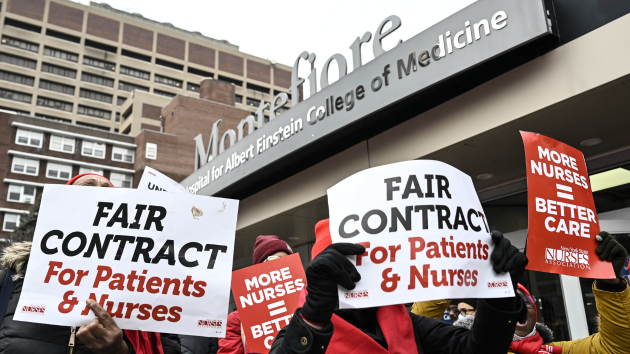
Nurses hold signs during a strike over contract negotiations on January 11, 2022. (Fatih Aktas/Anadolu Agency via Getty Images)
(NEW YORK) — The largest nurses’ strike in New York City history could begin on Monday morning if a tentative settlement isn’t reached between the nurses’ union and hospitals.
Nearly 16,000 nurses are threatening to walk off their jobs on Monday morning, according to the New York State Nursing Association (NYSNA), the union representing the nurses.
New York Gov. Kathy Hochul declared a state of emergency Friday in anticipation of a possible strike and appealed to the hospitals and nurses’ union to hammer out a last-minute deal, saying that a strike “could jeopardize the lives of thousands of New Yorkers and patients.”
“I’m strongly encouraging everyone to stay at the table, both sides, management and the nurses, until this is resolved,” Hochul said.
Five privately-run major hospitals in New York City would be affected by a strike. The hospitals, according to the union, are the wealthiest in the city and include Mount Sinai Hospital, Mount Sinai Morningside, Mount Sinai West, Montefiore Einstein, and New York-Presbyterian.
The hospitals are prepared to continue offering care despite any pending work interruptions, according to officials, who said patients should not avoid or delay seeking help for any medical emergencies.
The NYSNA said during an video conference update Sunday morning that there has been no movement in the labor talks with the five hospitals, affecting more than 15,000 nurses.
The NYSNA is calling for an agreement that includes pay hikes, safe staffing levels, full health care coverage and pensions, and workplace protections against violence.
A source familiar with the labor negotiations told ABC News that the nurses are expected walk off their jobs beginning at 6 a.m. Eastern time on Monday.
The nurses’ contract, reached in 2023 after a three-day strike, expired on Dec. 31.
“We continue to bargain in good faith in the hopes of reaching an agreement that is fair, reasonable, and responsible,” a spokesperson for the Mount Sinai Healthcare system said in a statement on Saturday. “While we know a strike can be disruptive, we are prepared for a strike that could last an indefinite amount of time and have taken every step to best support our patients and employees in the event NYSNA forces our nurses to walk away from the bedside for the second time in three years.”
The impasse between the NYSNA and management of the private New York City hospitals continued even as the union announced tentative settlements last week that diverted strikes at four so-called safety-net hospitals in the New York City area.
Nurses at three major Northwell Health hospitals on New York’s Long Island reached a tentative contract agreement on Thursday and called off a strike, according to the NYSNA. Nurses at Brooklyn Hospital Center and Wyckoff Heights Medical Center, and those who work for the BronxCare Health System, also rescinded strike notices when they reached a tentative contract, the NYSNA said.
“That leaves New York City’s wealthiest hospitals as the outliers who have refused to settle fair contracts that protect patients and nurses,” NYSNA President Nancy Hagans said in a video statement on Saturday.
Hagans added, “Instead of guaranteeing health care for nurses, these wealthy hospitals are pushing to cut health care benefits for nurses who put their own health on the line to care for New Yorkers during this historic flu surge, the COVID-19 pandemic and everyday injuries and hospital violence.”
Hagan pointed to a police-involved shooting last week at a Brooklyn hospital as the latest example of the violence hospital workers face.
On Thursday, a 62-year-old former NYPD officer, allegedly wielding a sharp object, was fatally shot by New York City police officers at New York-Presbyterian Brooklyn Methodist Hospital. The man, according to police, was shot after he allegedly barricaded himself in a room with an adult patient and a hospital security worker and threatened to hurt himself and others.
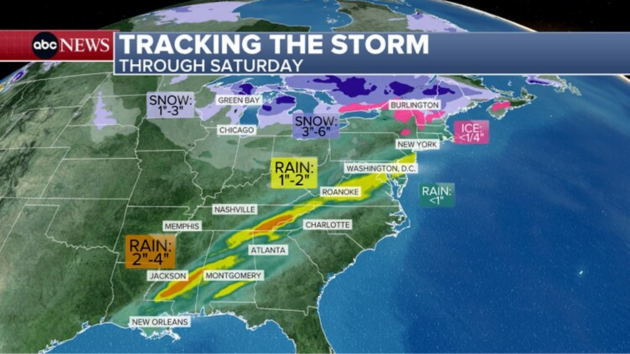
(NEW YORK) — A severe weather threat continues over the Deep South on Saturday with tornadoes and flash flooding possible. A Flash Flood Watch remains in effect for more than 8 million Americans in parts of Alabama and Georgia until Saturday evening.
Early Saturday morning, there were already active storms over parts of the South, primarily in Mississippi. The main threat will be in the morning into the afternoon hours where conditions will be more favorable for severe development.
These storms will continue into the afternoon from New Orleans to Clemson, South Carolina — including cities like Atlanta and Pensacola. Damaging wind, tornadoes, and some large hail are the primary threats Saturday morning and into the day.
The threat will die down later in the afternoon and into the early evening but rain continues to push east and northeast from the late evening into the overnight hours.
Another few rounds of heavy rain are likely and could inundate areas of the South again, leading to a widespread additional 1 to 3 inches, with some localized areas of Mississippi, Alabama and Tennessee getting up to 3 to 4 inches of additional rain.
Rain is expected to fall in Philadelphia starting at 11 a.m., New York City after 12 p.m. and Boston and further up the I-95 corridor later in the afternoon. Rain will continue through much of the day across most of the Northeast down to the Mid-Atlantic.
On the northern side of the storm, some light snow — quick dusting up to 3 inches — could fall in Chicago on Saturday morning, but will be clear before the NFL Wild Card Matchup this evening.
Parts of Wisconsin and especially Michigan could see 3 to 6 inches of fresh snow on Saturday, while northern New England could be cold enough to see a dusting to 3 inches of snow and up to a tenth of an inch of ice.
(LONDON)– It is one thing to make a New Year’s resolution. It is, however, a very different thing to be able to keep it.
Every year they are made with the best of intentions — with the hope and desire to become a better version of ourselves — so why is it that millions of people make New Year’s resolutions knowing the odds of them ever following through with them are minimal?
Jasper Rook Williams — fitness expert, online coach and owner of JRW Fitness — has made a successful career so far working with hundreds of clients around the world on improving their nutrition, training and lifestyle calibration. He has a good idea why.
“The goals, if sometimes a little ambitious, are rarely the problem and they are all set with best intentions,” Rook Williams tells ABC News. “The issue is there’s rarely enough thought put into the approach. People have high ambitions hinging on mostly unrealistic and unsustainable methods. Rather than just thinking ‘I’ll eat salads and join a gym’, people need to prioritize achievable routines, sustainability and lifestyle changes from a broader and more holistic perspective.”
According to research, Rook Williams isn’t wrong. The failure rate for New Year’s resolutions is said to be an estimated 80% with most people losing their resolve and motivation just weeks later in mid-February, according to U.S News and World Report.
“Changing your habits is very difficult, including finding the right moment to make a change,” Bas Verplanken, professor of social psychology at the University of Bath, said in a report released by the Society for Personality and Social Psychology in 2017. “Changing from December 31st to January 1st is not a dramatic discontinuity. Many resolutions are made on December 31st, and go down the drain on January 2nd.”
Psychologically speaking, the beginning of a new year is often viewed as a seminal moment — a time to reflect on the previous year and look ahead to the new one. But this doesn’t necessarily translate to immediate change and action just because of timing.
“Anything worthwhile is never without obstacle” Perhaps unsurprisingly, the top three New Year’s resolutions made each year are living healthier (23%), personal improvement or happiness (21%) and losing weight (20%), according to a report published by Statista in Nov. 2022.
“A great question to ask yourself when starting out is “does this feel sustainable?” Rook Williams explains to ABC News. “If you can’t keep up the routine then you definitely won’t keep the results.”
One of the things that Rook Williams has found leads to people maintaining their success is when people have — or are given — a sense of accountability.
“You have to bear in mind that creating new habits is hard and progress for anything worthwhile is never linear,” he said. “There will be times when either you want to stop or results seem to have stopped and that can be hard to deal with. That’s when having someone to guide you can keep you accountable can be invaluable in the process of change.”
Ultimately, to successfully make a change for the better, it comes down to striking the right balance, according to Rook Williams.
“In the case of fitness, it’s not just the food or training or wider lifestyle that will create the change but all three of these things working together,” he continued. “They’re not mutually exclusive. Lacking motivation is common and, in my experience, is something that comes when you don’t have a plan. Whether you hire a professional or not, just removing the guesswork and gaining a sense of direction always helps the individual on their path to success.”
“Motivation is temporary” One of the biggest obstacles to maintaining resolutions, particularly when it comes to fitness objectives, is to choose goals that are both achievable and sustainable.
An estimated 12% of all new gym memberships per year occur in January, according to a study done by IHRSA, the fitness industry’s only global trade association that represents health clubs worldwide. Another study indicates that four out of every five people who join the gym in January will actually quit within five months.
“Motivation is temporary for everyone,” says Rook Williams. “So the best thing you can do is use that time to create the habits and routines needed to see you through once it wanes. And it will wane. It always does. The classic thing new gym starters do in the new year is go from zero to 100 mph … They want to go from not working out at all and eating what they want to training five, six, seven days a week and eating like a rabbit. This just sets them up for failure because it’s just not realistic.”
One of the biggest reasons why Rook Williams’ clients often succeed when it comes to setting goals is the focus on maintaining a healthy outlook every day and “saying no to short-termism.”
“Being new at something and hoping to be perfect straight away is a sure fire way to give up on anything very quickly,” Rook Williams explains. “Be sure to cut yourself some slack. If you planned to train three days one week but only managed two, that doesn’t make you a failure. It’s still two more than you were doing before, so just wipe the slate clean and try it again without holding on to guilt or punishing yourself.”
“Everyone falls off the horse at some point, even the pros,” Rook Williams continued. “What’s important is how quickly you dust yourself off and get back to work. Those who make it do this right away. But those who let one mistake spill over into more mistakes are the ones who are most likely to give up and start again next year.”
“Never just one solution” No matter what resolution you may make in the New Year, for Rook Williams, success is all about perspective and making changes in incremental ways that suit your lifestyle rather than completely disrupting it.
“There is never just one solution to a problem, whatever that problem might be,” he continued. “Your goal might be set in stone, but how you achieve it shouldn’t be. Don’t get married to just one method. Finding sustainable success is all about finding the method that is easiest and most maintainable for you.”
Unrealistic expectations and the dangers of expecting to get it right the first time are one of the main things that Rook Williams warns his clients about.
“With so much conflicting information out there and each of us having our own unique goals, schedules and responsibilities, the chance of getting your nutritional approach spot on when going alone immediately is incredibly slim,” Rook Williams explains. “Even if it is working, it might not be sustainable so be prepared for a period involving a lot of trial and error.”
For Rook Williams this was a huge reason why he became a coach in the first place. “It took me ages to piece it all together and, once I had, I wanted to help others do the same and in far less time.”
Research actually backs this up. According to a 2012 study conducted by the University of Pennsylvania’s Weight and Eating Disorders Program, 65% of dieters return to their pre-diet weight within three years and only 5% of people who lose weight on a restrictive diet, such as a liquid or no-carb, manage to keep the weight off — just one out of every 20 dieters.
“Carbs are tasty, alcohol can be fun, food is for eating and going without all these things forever is, for most people, totally unrealistic. When you think about it logically like that, it’s no surprise the majority of people fail to keep off the weight they lose.”
Ultimately, making any major change in your life requires more than just the desire to do so. It requires a goal, determination and a willingness to learn all mixed with a heavy dose of reality and a well-constructed approach to change.
“If you have a day where you feel like you can’t be bothered with anything, remember you are running your own race,” Rook Williams explains. “Success isn’t made by being perfect everyday but by doing your best everyday, whatever that looks like to you. What I have learned myself — and what I have really seen leads people to success — is if you have good habits and routines in place that you have created over time, that’s what is going to get you to where you want to be.”
Said Rook Williams: “It’s not just the food or training or wider lifestyle that will create the change but all three of these things. They’re all connected.”
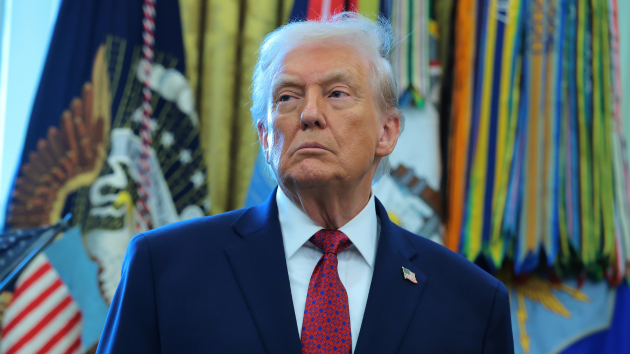
U.S. President Donald Trump listens during a ceremony for the presentation of the Mexican Border Defense Medal in the Oval Office of the White House on December 15, 2025, in Washington, DC. (Photo by Anna Moneymaker/Getty Images)
(WASHINGTON) — President Donald Trump this week issued an attention-grabbing proposal cracking down on Wall Street in an effort to lower home prices and ease affordability woes.
In a social media post, Trump said he would move to ban large institutional investors from “buying more single-family homes” and he urged Congress to codify the policy into law. Trump accused industry behemoths of buying up properties and shutting average Americans out of the housing market.
“People live in homes, not corporations,” Trump said in the post on Wednesday.
Several analysts who spoke to ABC News are skeptical that the proposal would meaningfully reduce home prices nationwide.
Institutional investors own a small fraction of single-family homes and many of those properties are occupied by renters, they said, meaning the ban would do little to address the supply shortage at the root of the affordability crisis.
“In the scheme of things, we’re talking about such a small number of homes,” Marc Norman, associate dean at the New York University School of Professional Studies and Schack Institute of Real Estate, told ABC News.
The median price of an existing home in November stood at $409,200, the National Association of Realtors, or NAR, said last month. Prices have surged 24% over the past five years, according to NAR data.
The average rate on a 30-year fixed mortgage is 6.16%, hovering near its lowest level in 15 months, Freddie Mac data showed. But mortgage rates remain well above sub-3% levels recorded as recently as 2021.
Trump aims to address sky-high prices by shutting institutional investors out of the market for single-family homes, which in theory could alleviate the supply-demand crunch and put downward pressure on prices.
“I am immediately taking steps to ban large institutional investors from buying more single-family homes, and I will be calling on Congress to codify it,” Trump said in a social media post.
Trump did not detail the steps he planned on taking to move forward with the ban. The White House did not immediately respond to ABC News’ request for comment.
On Wednesday, Sen. Bernie Moreno, R-Ohio, said in a post on X he would introduce legislation meant to codify the proposal.
Congress has previously put forward bills aimed at limiting the role of institutional investors in the market for single-family homes. In 2023, Democratic members of the House and Senate introduced a bill that would have imposed an excise tax on hedge funds that own a large number of single-family residences.
Shares of some major industry players fell in the immediate aftermath of Trump’s announcement. Blackstone, Invitation Homes and American Homes for Rent saw their stock prices fall between 4% and 6% on Wednesday.
The National Rental Home Council, or NRHC, a trade group working on behalf of the single-family rental home industry, issued a statement commending “the administration’s focus on ensuring Americans have access to a diverse mix of housing options.”
“We look forward to engaging with the White House and other policymakers in this important discussion,” the NRHC said.
The snag, these analysts said, is that institutional investors do not hold a big slice of the market.
Institutional investors own about 450,000 homes, which amounts to roughly 3% of the single-family market, the U.S. Government Accountability Office, or GAO, found in a study last year that analyzed data from 2022.
“The big question here is: Are large-scale institutional investors crowding out prospective homebuyers?” Jake Krimmel, senior economist at realtor.com, told ABC News Live. “The answer is ‘no.’”
Institutional ownership is concentrated in some regions, particularly in the Sun Belt, according to the GAO.
Institutions own 21% of homes in Jacksonville, Florida, and 18% of homes in Charlotte, North Carolina, the GAO found. In Atlanta, institutions own 1 out of 4 homes.
Analysts who spoke to ABC News disagreed about whether the ban on institutional ownership could lower prices in those highly concentrated markets.
Some said the elimination of a key source of demand could push down prices, while others cautioned the move would likely have little effect in those places, since an injection of new supply has already helped ease price pressures in many of those areas.
“In some select markets, this will have some bite,” Stijn Van Nieuwerburgh, a professor of real estate at Columbia University Business School, told ABC News. “Overall, it’s not such a big deal.”
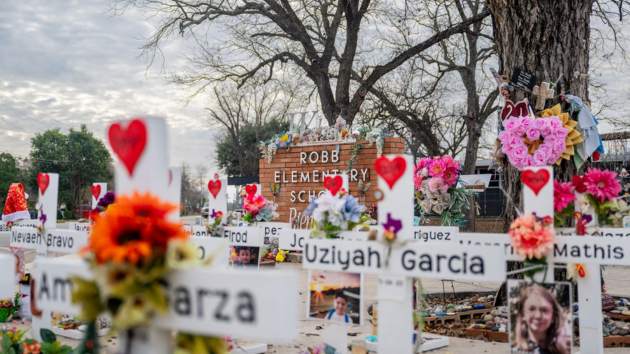
A memorial dedicated to the 19 children and two adults murdered on May 24, 2022 during a mass shooting at Robb Elementary School is seen on January 6, 2026, in Uvalde, Texas. Brandon Bell/Getty Images
(UVALDE, Texas) — Editor’s note: Some of the testimony described below is extremely graphic.
Gonzales — who was one of nearly 400 law enforcement officers to respond to Robb — is charged with child endangerment for allegedly ignoring his training during the botched police response. Nineteen students and two teachers were killed, and investigations have faulted the police response and suggested that a 77-minute delay in police mounting a counterassault could have contributed to the carnage.
Gonzales has pleaded not guilty and his legal team says he did all he could to help students.
Judge Sid Harle issued a warning to the gallery before the jury entered on Friday.
“I want to forewarn you, these photographs are going to be shocking and gruesome, and if anybody wants to step out, you are welcome to step out, but we cannot have any displays in front of the jury,” Harle said. “I’m forewarning you — these are not going to be pleasant to look at, and I’m sorry you’re going to have to look at them just like I had to.”
“There was a lot of shell casings,” said Torrez, who spent three days photographing the room. “There’s a lot of blood, a lot of blood swipes, and the weapon was in the closet.”
Using a pointer to highlight parts of the photos, Torrez testified about the location of the classroom, damage to the door and areas of the room where students didn’t attempt to hide. Defense lawyers had objected to showing the more graphic images, but Harle allowed the bulk of them into evidence due to their relevance to the prosecution’s case.
“Does the scene change?” prosector Bill Turner asked Torrez about some of the photos.
“As far as the presence of blood, it changes dramatically,” Torrez said. “A lot of bullet holes, a lot of shell casings covered in blood, a lot of bullet defects, perforations, penetrations, and just a lot of blood.”
Over the next hour, the courtroom fell almost entirely silent, other than the testimony and occasional ruffling of tissues and sniffling. Some of the jurors craned their necks to see the photos, while others covered their mouths or lifted tissues to wipe their eyes. The families of the victims sat quietly and no one left the courtroom during the testimony.
The photos did not show the bodies of students, which were removed prior to the photos being taken. But jurors did see photos showing large pools of blood and the drag marks made when the bodies were removed. Photos also showed dried bloodstains on desks, textbooks and office supplies.
Torrez testified that investigators placed rods in the cavities left by the bullets to demonstrate the direction of the gunshots. The pink and yellow rods showed that the shooter likely fired downward — through the desks — toward the sheltering students, Torrez said.
Torrez offered his testimony with little context other than his experience as a crime-scene photographer that day. Prosecutors did not explain how the images relate to Gonzales, other than suggesting that his alleged inaction contributed to the loss of life that day.
Defense attorneys say Gonzales is being scapegoated for a broader failure by law enforcement. In its opening statement this week, the defense alleged that prosecutors were playing on jurors’ emotions and that convicting Gonzales would be an injustice piled on top of one of the worst school shootings in U.S. history.
ABC News’ Juan Renteria contributed to this report.