(TRENTON, N.J.) — A New Jersey state senator is calling for a limited state of emergency over the mysterious drones that have been seen flying over New Jersey in recent weeks.
“The State of New Jersey should issue a limited state of emergency banning all drones until the public receives an explanation regarding these multiple sightings,” Republican state Sen. Jon Bramnick said in a statement Tuesday.
The call came amid numerous recent drone sightings reported across New Jersey in recent weeks. The drones are larger than the type typically used by hobbyists, officials and eyewitnesses have said.
The source and reason for the drones remains unknown as local, state and federal investigators look into the matter.
The Picatinny Arsenal in New Jersey — a military research and production facility in Morris County — has reported 11 confirmed sightings by a police officer or security guard in response to a report since Nov. 13.
“While the source and cause of these aircraft operating in our area remain unknown, we can confirm that they are not the result of any Picatinny Arsenal-related activities,” Picatinny Arsenal Garrison Commander. Lt. Col. Craig Bonham II said in a statement Tuesday.
An FBI spokesperson said the agency is “doing all we can figure out what’s going on.” “The public can continue to call our 800 line, or submit a tip online, we are acting on every substantive lead that we get,” the spokesperson said.
Law enforcement has limited authority to actually address such drone activity and the authority they do have is reactive rather than proactive, a senior U.S. official told ABC News.
The mayors of 21 towns in New Jersey penned a letter to Gov. Phil Murphy demanding action over the mysterious drones.
Michael Melham, the mayor of Belleville, New Jersey, posted Monday night on Facebook that there will be a briefing held exclusively for New Jersey mayors on Wednesday with the New Jersey State Police and the New Jersey Office of Homeland Security and Preparedness regarding the drones.
The drones have raised concerns due to their proximity to both a military installation and President-elect Donald Trump’s Bedminster golf course.
ABC News’ Alex Faul and Julia Reinstein contributed to this report.
(DENVER, Co.) — Law enforcement agencies in the Denver, Colorado, metropolitan area are investigating a rise in burglaries targeting Asian homes, businesses and places of worship across the community.
There have been around 100 reported burglaries of Asian homes across the state this year, according to Denver ABC affiliate KMGH-TV.
The sheriff’s office in Douglas County — which is south of Denver — told ABC News that there have been around 14 burglaries targeting homes of Asian business owners since the beginning of the year. Seven of these have happened since September, it noted.
In an interview that aired on Tuesday, Douglas County Sheriff Darren Weekly told ABC News Live’s Diane Macedo that there is a “multi-jurisdictional investigation” into a “sophisticated” operation, where the burglars are using “WiFi jammers to subvert alarm systems” and even conducting their own surveillance by setting up cameras near the homes of their victims to ensure that they are away when the burglars strike.
“Many times, these criminals will enter from the back, dressed as utility workers, are wearing vests,” Weekly said. “They’re very methodical. They plan these burglaries early, and they’ve made off with over $2.5 million that we’re aware of.”
The Douglas County Sheriff’s office first warned the community of these burglaries in an Oct. 31 statement and so far, no arrests have been made, a spokesperson confirmed to ABC News.
Asked why Asian business owners appear to be targeted, Weekly said that some are known to keep “large amounts” of cash in their homes, as opposed to depositing the money in a bank.
Lisa Nguyen, the owner of a plaza of Asian-owned businesses, told ABC News that one of the businesses in her plaza was burglarized.
“They are destroying small businesses,” Nguyen said in Tuesday’s interview. “The amount of money that they took is detrimental to, you know, them being able to operate.”
She’s also president-elect of the Denver Metro Association of Realtors, and said that the home of one of her real estate clients was burglarized twice since September.
According to Nguyen, who shared surveillance video of both burglaries with the ABC News, $17,000 worth of merchandise was stolen from a convenience store in her plaza.
She said a burglary of that scale puts families in a position where “multiple months of rent have been stolen” and “could cause businesses to completely shut down.”
Weekly urged the community to notify law enforcement if they see anything suspicious and advised residents to keep their homes locked, install lights on their property and to implement multiple security measures to safeguard their homes, as well as to communicate with their neighbors.
“It’s really critical if somebody sees something, call law enforcement so we can get out there,” Weekly said.
Weekly held a town hall on Monday night, along with Arapahoe County Sheriff Tyler Brown, the Organized Crime Unit and 18th Judicial District Attorney’s Office, to address the issue and share safety information with the community.
The Douglas County Sheriff’s office also partnered with the Colorado Asian Chamber of Commerce to distribute safety tips and urge anyone who has experienced a burglary or seen anything suspicious to come forward.
Nguyen said that she hopes an arrest will be made soon.
“I think my message is just that somebody literally has to know something out there,” she said. “And you know, that’s all it’s going to take is for somebody to come forward.”
(WASHINGTON) — A top government watchdog raised concerns Tuesday over the handling of leak investigations during the first Trump administration that targeted members of Congress and the media despite finding no evidence that the inquiries were politically motivated, according to a newly released report.
Justice Department Inspector General Michael Horowitz initiated the investigation after public reports that prosecutors, during President-elect Donald Trump’s first term, had obtained warrants to access communications records for members of Congress, congressional staffers and reporters at CNN, the New York Times and the Washington Post to identify sources of apparent leaks of classified information.
The investigations were not publicly disclosed until after Trump left office, in part because prosecutors had secured court orders that prevented lawmakers, their staff and media members from learning about the searches.
While Rep. Eric Swalwell and now-Sen. Adam Schiff, both California Democrats, previously revealed their records had been seized as part of the investigation, Horowitz’s report revealed prosecutors also searched the records of 43 others who were congressional staffers at the time the leaked information was published.
But Horowitz’s report noted that the partisan affiliation of the staffers was not imbalanced — 21 staffers whose records were searched were Democrats, 20 were Republicans, and two worked in nonpartisan positions. The inspector general investigation determined the basis for the staffers’ records being searched was entirely due to their known ability to access the materials that were found to be leaked to the press, while the investigations into Schiff, then a congressman, and Swalwell were initially bolstered by information given to the department by an unidentified committee staffer who suspected them of leaking — but provided no evidence to support the claims.
While his name is not mentioned directly in the report, Kash Patel, Trump’s pick for FBI director, was among the 43 people who were congressional staffers at the time of the Trump-era leak probe whose records were searched, a source familiar with the investigation confirmed.
Patel has also said publicly on multiple occasions that he was subject to investigation by Trump’s DOJ and was also informed by Google that the DOJ had sought information on his personal accounts.
Horowitz’s report expressed concerns regarding the congressional leak investigations largely related to a lack of existing policies at the DOJ to provide senior-level oversight over such investigations that implicate the separation of powers. Records reviewed by Horowitz said the inquiries into members of Congress were conducted by career prosecutors almost entirely without senior-level supervision or notification and that there was no evidence they were pressured to carry out the inquiries despite Trump and other Republicans repeatedly singling out Schiff and Swalwell as possible leakers.
According to Horowitz, that the department was able to carry out its sweeping investigation of the members of Congress and their staff solely on the basis of them having had access to the leaked information “risks chilling Congress’s ability to conduct oversight of the executive branch because it exposes congressional officials to having their records reviewed by the Department solely for conducting Congress’s constitutionally authorized oversight duties.”
As for the Trump-era leak investigations of reporters from CNN, the New York Times and the Washington Post, Horowitz found that officials in the department violated several policies that existed at the time then-Attorney General William Barr authorized the investigations. Prosecutors failed to convene a News Media Review Committee that would normally be consulted in the process of investigations of leaks to members of the media and, in one of the investigations, failed to obtain approval from the director of national intelligence, according to the report.
Upon disclosure of the news media leak investigations in 2021, Attorney General Merrick Garland convened several meetings with newsroom leaders across Washington, D.C., and ultimately implemented new DOJ policy that bars prosecutors from securing search warrants for reporters’ records to obtain information about their sources.
The future of that policy, however, remains very much in question — given public comments by Trump and his top allies suggesting they fully intend to use the powers of the DOJ and the FBI to target political enemies and even possibly members of the media during his second term. While Horowitz’s report offered up several recommendations for internal policy fixes to the issued identified in the report, all of which were accepted by the Biden DOJ, it will be up to leadership in the incoming Trump DOJ to determine whether those recommendations will be implemented.
Luigi Mangione is seen inside the police station in Altoona, Pennsylvania, Dec. 9, 2024/Obtained by ABC News
(NEW YORK) — Luigi Mangione, a 26-year-old accused of gunning down UnitedHealthcare CEO Brian Thompson outside a Midtown Manhattan hotel last week, considered the slaying to be a “symbolic takedown” of UnitedHealthcare over perceived corruption, according to a confidential assessment of the crime by the NYPD intelligence bureau described to ABC News.
Mangione “appeared to view the targeted killing … as a symbolic takedown and a direct challenge to its alleged corruption and ‘power games,'” the assessment said, according to a source. Mangione allegedly described himself as the “first to face” United Healthcare “with such brutal honesty.”
The assessment is based in part on the suspect’s writings.
When Mangione was arrested on Monday he had “written admissions about the crime” with him, according to the New York arrest warrant.
Mangione had several handwritten pages on him that expressed a “disdain for corporate America” and indicated “he’s frustrated with the health care system in the United States,” NYPD Chief of Detective Joe Kenny told ABC News’ “Good Morning America” on Tuesday.
“Specifically, he states how we are the No. 1 most expensive health care system in the world, yet the life expectancy of an American is ranked 42 in the world,” Kenny said.
Whether Mangione has a personal connection to UnitedHealthcare is unknown, NYPD Commissioner Jessica Tisch said, but the writings mention UnitedHealthcare by name, law enforcement sources told ABC News.
The sources described the handwriting as sloppy and included these quotes: “These parasites had it coming” and “I do apologize for any strife and trauma, but it had to be done.”
Mangione — who was arrested in Altoona, Pennsylvania, on Monday in connection with Thompson’s Dec. 4 slaying — is in custody in Pennsylvania and is set to appear at an extradition hearing at 1:30 p.m. Tuesday.
The NYPD was “thrilled” to get the call from Altoona police that they had a person of interest in custody, Tisch told “GMA.”
Kenny said “the key to this case” was releasing the photo of the suspect’s face to the media and the public.
“That picture reached Pennsylvania,” where Mangione was recognized at a McDonald’s on Monday morning, Kenny said.
“We are grateful as a city to that person,” Tisch said.
“We had collected early in the investigation some forensic evidence, some DNA evidence, some fingerprints, so we were very confident that we were ultimately going to get to the right person,” Tisch added.
“We do have a lot of evidence in this case,” Tisch told “GMA.”
Mangione was apprehended “in possession of the same New Jersey fake identification that was used” to check into a hostel on New York’s Upper West Side before Thompson was gunned down, she said.
The gun Mangione was allegedly found with on Monday “looks very similar” to the gun used in the murder, “with a similar suppressor,” Tisch said. “So there’s a lot of reasons that we feel very strongly that he is the person of interest.”
Officers allegedly found a 3D printed pistol and a 3D printed silencer, according to the criminal complaint filed in Pennsylvania.
“The pistol had one loaded Glock magazine with six nine-millimeter full metal jack rounds. There was also one loose nine-millimeter hollow point round,” the complaint said.
Kenny described the weapon as a “ghost gun,” meaning it had no serial number and was untraceable.
Mangione, a Maryland native and Ivy League graduate, has been charged in New York with second-degree murder, possession of a loaded firearm, possession of a forged instrument and criminal possession of a weapon.
He was charged with five crimes in Pennsylvania, including carrying a gun without a license, forgery, falsely identifying himself to authorities and possessing “instruments of crime,” according to the criminal complaint.
Mangione’s family said in a statement that they’re “shocked and devastated by Luigi’s arrest. We offer our prayers to the family of Brian Thompson and we ask people to pray for all involved.”
The Pennsylvania State Police is asking for the public’s help piecing together Mangione’s travel in Pennsylvania. Anyone with information is asked to call 1-800-4PA-TIPS.
Police are also looking at Mangione’s travel at various points across the United States and out of the county within the past year, sources said.
This is a developing story. Please check back for updates.
(NEW YORK) — The rates of late-stage breast cancer at diagnosis have risen among women in all racial and ethnic groups, but Black women have been hit the hardest, according to a new study published in the journal Radiology.
The study, which looked at data from 2004 to 2021, found that advanced breast cancer rates have risen among women of all ages, with the sharpest increases in young women aged 20 to 39, and women over 75.
Black women experience advanced diagnoses 55% more often than white women and are more likely to die from the disease, the study found.
While mammography does save lives by catching cancer earlier, fewer than 70% of eligible women are up to date on their screenings, the study found.
This trend is particularly alarming because early detection significantly improves survival. Five-year survival rates drop drastically from 99% for early-stage breast cancer to just 31% when the cancer is more advanced and has already spread to other parts of the body, the study found.
However, disparities persist despite Black women having similar self-reported mammography use rates as white women.
“Black women tend to have more aggressive breast cancers, including a higher rate of triple-negative breast cancers,” study co-author, Edward Hendrick, Ph.D., clinical professor of radiology at the University of Colorado told ABC News. “There may also be differences in how findings are acted upon, reflecting barriers to high-quality care.”
The COVID-19 pandemic made things worse as well, Hendrick noted, with many women skipping or delaying mammograms.
“Volumes at screening sites for the year 2020 were down as much as 90% from 2019 levels,” he said. “These missed screenings contributed to higher rates of advanced breast cancers in 2021 and likely subsequent years.”
The study also pointed to other possible reasons for the uptick in later-stage diagnoses.
“Obesity in post-menopausal women increases breast cancer risk, as does prolonged exposure to estrogen from early periods or late menopause,” explained study co-author, Debra L. Monticciolo, M.D., a professor of radiology at Texas A&M University.
She added that physicians could help by offering a breast cancer risk assessment to their patients starting at age 25. Identifying high-risk women early would help catch cancers sooner, she said.
Despite the concerning statistics, the study suggested that solutions are within reach. Increasing screening rates, expanding healthcare access, and ensuring follow-up care after abnormal mammograms could make a difference.
“Improving equity in care is critical to saving lives,” Monticciolo said. “By prioritizing access to care for all and emphasizing the importance of early detection, we believe this trend of rising late-stage diagnoses can be reversed.”
Late-stage breast cancer diagnoses are not just statistics — they reflect missed opportunities for prevention and early treatment, Hendrick added.
“We could benefit from greater public awareness of the importance of catching breast cancer at its earliest, most curable stages,” he said.
Breast cancer accounts for about one in three new cancer diagnoses in women every year, according to the latest American Cancer Society statistics. More than 40,000 American women die from the disease yearly.
Esther Zusstone, MD, is a radiology resident at NYU Langone, and a member of the ABC News Medical Unit.
Luigi Mangione is seen inside the police station in Altoona, Pennsylvania, Dec. 9, 2024/Obtained by ABC News
(NEW YORK) — Luigi Mangione is facing a second-degree murder charge in New York City in connection with the brazen shooting of UnitedHealthcare CEO Brian Thompson in Midtown Manhattan as new details emerge about the suspect and a potential motive, according to police.
When 26-year-old Mangione was arrested on Monday he had “written admissions about the crime” with him, according to the New York arrest warrant.
Mangione had several handwritten pages on him that expressed a “disdain for corporate America” and indicated “he’s frustrated with the health care system in the United States,” NYPD Chief of Detective Joe Kenny told ABC News’ “Good Morning America” on Tuesday.
“Specifically, he states how we are the No. 1 most expensive health care system in the world, yet the life expectancy of an American is ranked 42 in the world,” Kenny said.
Whether Mangione has a personal connection to UnitedHealthcare is unknown, NYPD Commissioner Jessica Tisch said, but the writings mention UnitedHealthcare by name, law enforcement sources told ABC News.
The sources described the handwriting as sloppy and included these quotes: “These parasites had it coming” and “I do apologize for any strife and trauma, but it had to be done.”
Mangione — who was arrested in Altoona, Pennsylvania, on Monday in connection with Thompson’s Dec. 4 slaying — remains in the custody of the Pennsylvania Department of Corrections pending his extradition to New York.
The NYPD was “thrilled” to get the call from Altoona police that they had a person of interest in custody, Tisch told “GMA.”
Kenny said “the key to this case” was releasing the photo of the suspect’s face to the media and the public.
“That picture reached Pennsylvania,” where Mangione was recognized at a McDonald’s on Monday morning, Kenny said.
“We are grateful as a city to that person,” Tisch said.
“We had collected early in the investigation some forensic evidence, some DNA evidence, some fingerprints, so we were very confident that we were ultimately going to get to the right person,” Tisch added.
“We do have a lot of evidence in this case,” Tisch told “GMA.”
Mangione was apprehended “in possession of the same New Jersey fake identification that was used” to check into a hostel on New York’s Upper West Side before Thompson was gunned down, she said.
The gun Mangione was allegedly found with on Monday “looks very similar” to the gun used in the murder, “with a similar suppressor,” Tisch said. “So there’s a lot of reasons that we feel very strongly that he is the person of interest.”
Officers allegedly found a 3D printed pistol and a 3D printed silencer, according to the criminal complaint filed in Pennsylvania.
“The pistol had one loaded Glock magazine with six nine-millimeter full metal jack rounds. There was also one loose nine-millimeter hollow point round,” the complaint said.
Kenny described the weapon as a “ghost gun,” meaning it had no serial number and was untraceable.
Mangione, a Maryland native and Ivy League graduate, has been charged in New York with second-degree murder, possession of a loaded firearm, possession of a forged instrument and criminal possession of a weapon.
He was charged with five crimes in Pennsylvania, including carrying a gun without a license, forgery, falsely identifying himself to authorities and possessing “instruments of crime,” according to the criminal complaint.
Mangione’s family said in a statement that they’re “shocked and devastated by Luigi’s arrest. We offer our prayers to the family of Brian Thompson and we ask people to pray for all involved.”
The Pennsylvania State Police is asking for the public’s help piecing together Mangione’s travel in Pennsylvania. Anyone with information is asked to call 1-800-4PA-TIPS.
Police are also looking at Mangione’s travel at various points across the United States and out of the county within the past year, sources said.
This is a developing story. Please check back for updates.
(NEW YORK) — Donald Trump’s impending inauguration as the next president does not impact his $454 million civil fraud judgment, a lawyer for New York Attorney General Letitia James said in a letter to the president-elect’s lawyer Tuesday.
Trump and his adult sons liable owe approximately $490 million including interest in their civil fraud case after a judge ruled last year that they repeatedly inflated Trump’s net worth to secure better loan terms over a decade of business dealings. Trump has appealed the ruling.
Because presidents do not have immunity from civil litigation, James plans to continue defending her judgment against Trump during his appeal of the case, the letter said.
“The ordinary burdens of civil litigation do not impede the President’s official duties in a way that violates the U.S. Constitution,” New York Deputy Solicitor General Judith Vale wrote in a letter to D. John Sauer, Trump’s appellate lawyer and nominee for solicitor general.
Last month, Sauer requested that James drop her civil case against Trump to “cure” partisan divides and improve “the health of our Republic.”
“In the aftermath of his historic election victory, President Trump has called for our Nation’s partisan strife to end, and for the contending factions to join forces for the greater good of the country. This call for unity extends to the legal onslaught against him and his family that permeated the most recent election cycle,” Sauer wrote, citing the recent dismissal of Trump federal election interference and classified documents cases.
Vale rejected the request, saying in her letter that there is “no merit to your claim that the pendency of defendants’ own appeal will impede Mr. Trump’s official duties as President.”
Because the New York attorney general’s case is civil, James faces no restriction in continuing to pursue her case as Trump returns to the White House.
“Accordingly, the various actions taken by the Special Counsel’s office or the District Attorney’s Office of New York County in the respective criminal cases brought by those offices against Mr. Trump are irrelevant here,” Vale’s letter said.
A ruling on Trump’s appeal of the judgment could come at any time.
(NEW YORK) — The climate crisis is not a distant threat; it’s happening right now and affecting what matters most to us. Hurricanes intensified by a warming planet and drought-fueled wildfires are destroying our communities. Rising seas and flooding are swallowing our homes. And record-breaking heat waves are reshaping our way of life.
The good news is we know how to turn the tide and avoid the worst possible outcomes. However, understanding what needs to be done can be confusing due to a constant stream of climate updates, scientific findings, and critical decisions that are shaping our future.
That’s why the ABC News Climate and Weather Unit is cutting through the noise by curating what you need to know to keep the people and places you care about safe. We are dedicated to providing clarity amid the chaos, giving you the facts and insights necessary to navigate the climate realities of today — and tomorrow.
The US just experienced its warmest autumn on record
Another season, another climate milestone. According to a new report from the National Oceanic and Atmospheric Administration (NOAA), persistent above-average to record-warm conditions across much of the United States made meteorological autumn, which lasts from September to November, the warmest ever recorded.
The record-warm fall season makes it more likely that 2024 will end up as one of the nation’s warmest, if not the warmest, years on record. As of November 2024, the contiguous U.S. year-to-date temperature was 3.3 degrees Fahrenheit above average.
Despite December’s chilly start for much of the country, with widespread below-average temperatures in many regions, NOAA’s Climate Prediction Center says that the cold will ease during the second half of the month with above-average temperatures favored from the West to the Northeast.
The stretch of abnormally warm temperatures was accompanied by extremely dry weather across much of the country, fueling dangerous wildfire conditions in regions like the Northeast. A very dry start to the season brought drought conditions to more than half of the lower 48 states by late October.
Fortunately, several significant rainfall events in November brought notable drought relief to large swaths of the country, reducing overall drought coverage by nearly 10.5% and suppressing the wildfire danger.
-ABC News meteorologist Dan Peck
Nearly one-third of the planet’s species risk extinction because of climate change
Nearly one-third of the world’s species could be at risk for extinction because of climate change if the world does nothing to reduce global warming, according to a new analysis from Science.
University of Connecticut researcher and biologist Mark Urban found that while some species are adapting to climate change, 160,000 species are already at risk. Many are now facing declining populations because of changes in our climate.
According to the study, with current global temperatures at 1.3 degrees Celsius above industrial levels, 1.6% of species are projected to become extinct. As the temperatures warm even more, Urban found the extinction rate would also increase, with the most severe scenario included (5.4 degrees Celsius of warming) putting the extinction risk at 29.7%.
“The increased certainty of predicted climate change extinctions compels action,” Urban wrote. “Extinction represents just the final endpoint of a species’ existence; even when extinction is avoided, declining abundances and shrinking ranges can strongly affect many other species, including humans.”
Urban defines the risk of extinction as the probability that any one species will go extinct without mitigation efforts. Urban found that extinction rates could increase dramatically if global temperatures rise over 1.5 degrees Celsius compared to industrial levels.
1.5 degrees Celsius is the warming limit set by the world’s nations under the Paris Agreement after the United Nations Intergovernmental Panel on Climate Change found that crossing that benchmark would lead to more severe climate change impacts.
Risks varied across geographic areas in the study, with Australia/New Zealand and South America facing the highest risks (15.7% and 12.8%, respectively) and Asia facing lower risks (5.5%).
-ABC News Climate Unit’s Kelly Livingston
Antarctic sea ice hits new low during Earth’s 2nd warmest November on record
Imagine you have a swimming pool with ice cubes filling it. Now, measure the total area of the pool that has ice on the surface, even if the ice cubes don’t cover it completely. Because ice often spreads out unevenly, leaving water between the chunks, scientists count areas where at least 15% of the surface is covered. So, because your pool is loaded with ice cubes, it would be considered ice covered. In the real world, scientists call it sea ice extent.
While you can add ice to your pool, you can’t to the ocean. And according to a new report by Copernicus, the European Union’s Climate Change Service, the sea ice extent in the Antarctic has dipped to its lowest value on record for the month of November. It is 10% below average. This occurred during a stretch of near-record global land and sea surface temperatures.
Last month ranked as the second warmest November on record globally, with an average temperature of 14.10 degrees Celsius, or 57.38 degrees Fahrenheit.
Copernicus noted the new data not only makes it virtually certain that 2024 will surpass 2023 as Earth’s warmest year on record, but it will likely be the first year to be 1.5 degrees Celsius warmer (2.7 degrees Fahrenheit) than the pre-industrial average of 1850-1900.
The Paris Agreement aims to limit global warming to 1.5 degrees Celsius to prevent the worst outcomes of climate change.
As of November 2024, the average global year-to-date temperature was 0.14 degrees Celsius (or 0.25 degrees Fahrenheit) higher than it was in 2023, which is the warmest year ever recorded.
Kelvin Roberts is wanted for murder and robbery in connection with a home invasion in Lower Merion Township, PA, on Dec. 8, the Montgomery County District Attorney’s Office said; Montgomery County District Attorney’s Office
(LOWER MERION TOWNSHIP, Pa.) — Police in Pennsylvania are searching for the gunman wanted for killing a young man and critically wounding his mother during a home invasion in an upscale Philadelphia suburb, officials said.
Bernadette Gaudio, 61, and her son, Andrew Gaudio, 25, were both shot multiple times at their home in Lower Merion Township around 2:20 a.m. Sunday, the Montgomery County District Attorney’s Office said.
Bernadette Gaudio managed to call 911 after she was shot, DA Kevin Steele said at a news conference.
It appears Andrew Gaudio “fought back and tried to help his mom,” Steele said.
He died from his wounds and Bernadette Gaudio was hospitalized in critical condition, officials said.
Police are searching for Kelvin Roberts, 42, of Philadelphia, who is wanted on charges including second-degree murder, robbery and burglary, the DA’s office said.
Police are also looking for a second unidentified person who was involved in the home invasion, Steele said.
“We’re dealing with dangerous people,” Steele said.
It’s not clear if the crime was targeted or random, Steele said, adding that the break-in appeared to be through the basement.
Police zeroed in on Roberts from dash-cam footage from a Lower Merion police car that showed “a white Hyundai Azera, driven by Roberts, leaving the scene of the homicide,” the DA’s office said.
Police matched the Hyundai Azera to an address on Sansom Street in Philadelphia, officials said. At that address, police showed a photo from the dash-cam footage to someone who identified the driver as Kelvin Roberts, the DA’s office said.
Bernadette Gaudio’s stolen jewelry box was found at the Sansom Street residence, Steele said.
As for Bernadette Gaudio’s condition, Steele said she “seems to be moving in the right direction, so we’re hopeful that she will survive.”
Bernadette Gaudio’s 2004 Green Jeep Cherokee, which was stolen during the home invasion, was recovered on Sunday in West Philadelphia, the district attorney’s office said.
A $5,000 reward is available for information leading to Roberts’ arrest, authorities said.
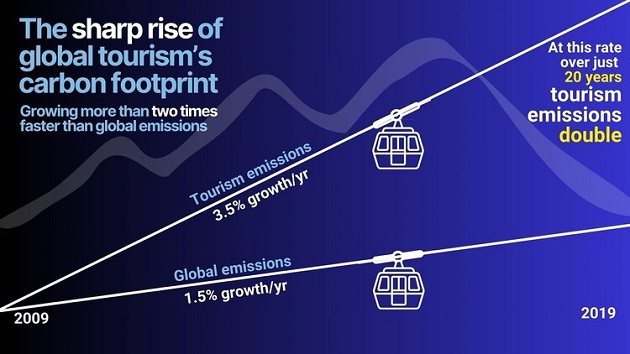
Tourism Emissions Project Team, University of Queensland
(NEW YORK) — The carbon footprint from the travel industry is growing at rates never seen before, according to new research.
An increasing demand for international travel over the past decade has led to higher rates of carbon dioxide emissions every year, according to a paper published in Nature Communications on Tuesday.
Greenhouse gas emissions from international tourism are growing at a rate of 3.5% every year — about twice as fast as the overall economy, Ya-Yen Sun, an associate professor at The University of Queensland in Australia and an author of the study, told ABC News.
In the top 20 countries associated with the highest tourism emissions, tourism may be growing “too fast” — up to 5% every year — which is causing those regions to expend more energy to provide services to more visitors, Sun said.
There are also disparities in per-capita tourism emissions, with the 20 highest-emitting countries — including the United States, China and India — contributing three-quarters of the total carbon footprint, the paper found.
Modes of transportation, including air and ground travel, are particular contributors to emissions given their carbon-intensive nature, according to the paper. Slow gains in the efficiency of technology have also contributed to the rise in emission rates from global tourism, the researchers said.
While travel halted in 2020 due to the COVID-19 pandemic, tourism came roaring back with a vengeance once the global health threat subsided, which has flooded the travel sector with even more rapid growth, Sun said.
Travel dropped by 60% during the pandemic, but tourism is expected to have fully recovered by the end of 2024, she added.
“We found this is something [that really needs] a lot of attention, because people just enjoy travel,” Sun said.
Carbon dioxide emissions from private planes have increased significantly in recent years, a separate paper published last month in the journal Communications Earth & Environment found.
Annual CO2 emissions from private aviation increased by 46% between 2019 and 2023, according to an analysis of flight tracker data from 18,655,789 private flights flown by 25,993 registered business jet-type private aircraft. Some individuals who regularly use private aviation may produce almost 500 times more CO2 in a year than the average individual, the paper found.
There were significant emissions peaks around certain international events, the study found. COP28 — the 2023 United Nations Climate Change Conference held in Dubai — was associated with 644 private flights, which produced 4,800 metric tons of carbon dioxide, and the 2022 FIFA World Cup, also hosted in the United Arab Emirates, was associated with 1,846 private flights, producing an estimated 14,700 metric tons of CO2, the study found.
However, private aviation only accounts for about 7.9% of total aviation emissions, the paper found.
A previous study that Sun conducted in 2018 found that tourism contributes to about 8% of global greenhouse gas emissions. That number is likely much higher today, Sun said.
“The sector has not made much progress in terms of decarbonizing itself,” she said.
Sun described the findings of the new paper out Tuesday as “quite problematic” because it showcases that emissions from tourism are growing every year,
The paper highlighted the urgent need for effective policy measures to align the tourism sector with global climate goals, the researchers said.
In order to do this, countries will need to begin to monitor tourism emissions at the national level, something that only New Zealand and Denmark are currently doing, Sun said.
It is especially important considering tourism is one of the biggest economic sectors in the world, as people require transportation, food, accommodation and shopping when they travel, Sun said. The global tourism industry was worth an estimated $10 trillion in 2023, according to the World Travel & Tourism Council.
“We found this is something really in need of a lot of attention, because people just enjoy travel,” Sun said.