(NEW YORK) — A bankruptcy judge rejected the sale of Infowars to The Onion, conspiracy theorist Alex Jones said during his podcast on Tuesday.
“We are deeply disappointed in today’s decision but The Onion will continue to seek a resolution that helps the Sandy Hook families receive a positive outcome for the horror they endured,” The Onion CEO Ben Collins said on social media.
“We will also continue to seek a path towards purchasing InfoWars in the coming weeks,” Collins’ statement continued.
Jones accused The Onion and Sandy Hook Elementary School families of “collusive bidding” and asked a bankruptcy court judge to halt the sale of his Infowars platform in November.
Jones, who defamed the Sandy Hook families by calling the 2012 massacre a hoax and the parents of the 20 first graders actors, called The Onion’s winning $1.75 million bid “sheer nonsense” because it’s half of what the losing bidder offered.
This is a developing story. Please check back for updates.
(SEOUL) — South Korean police raided South Korean President Yoon Suk Yeol’s office as a part of the ongoing investigation into the martial law declaration on Dec. 3, Yonhap, South Korean state media, reported Wednesday.
The South Korean National Police Agency’s National Investigation Headquarters Emergency Martial Special Consecution Team entered “the seizure and search,” of the President’s office Wednesday morning local time, Yonhap reported.
South Korean Police on Wednesday morning also arrested the South Korean National Police Commissioner Cho Ji Ho and the Seoul Police Chief Kim Bong Sik as a part of the ongoing investigation into the martial law declaration.
The police action followed more than a week of political turmoil in South Korea after Yoon’s brief failed imposition of a police state, a move that the president had at the time claimed necessary to protect the nation from enemies within. Yoon, a member of the conservative People Power Party, backtracked on his declaration within hours. Opposition parties then moved to impeach Yoon, but lawmakers in his party declined to join in the vote, leaving him in power.
Presidential Chief of Staff Jeong Jin Seok and several other staff members resigned soon after the martial law was lifted. Yoon soon after accepted the resignation of Defense Minister Kim Yong Hyun, who was described as the architect of Yoon’s plan.
The former defense minister, who took full responsibility for the martial law declaration in a statement from his attorney Tuesday, became the first government official to be formally arrested for the series of events late Tuesday evening local time. He was arrested for engaging in essential activities in insurrection and abusing his power during the six hours of martial law in action.
He had attempted suicide while he was in the bathroom before a warrant for his arrest was issued, Shin Yong Hae, the head of the South Korean Ministry of Justice’s correctional headquarters, said during a public judicial committee questioning Wednesday.
“Yesterday afternoon around 11:52 p.m., one of our personnel witnessed a suicide attempt… before a warrant was issued,” Shin said. “He gave up immediately as personnel opened the door. He is currently being held in shelter and is reported to be in good health.”
The two arrested Wednesday — the South Korean National Police Commissioner and the Seoul Police Chief — were arrested under insurrection charges, according to the South Korean Police’s special investigation team. They are suspected of instructing police officers to block lawmakers at the National Assembly who were there to reverse the martial law decree.
The arrests took place just one day since the two have been placed under a travel ban.
If you are struggling with thoughts of suicide or worried about a friend or loved one, call or text the Suicide & Crisis Lifeline at 988 for free, confidential emotional support 24 hours a day, seven days a week.
Fort Worth Star-Telegram/Tribune News Service via Getty Images
(LONDON) — The U.S. is communicating with rebel groups inside Syria amid the search for missing American journalist Austin Tice, State Department spokesperson Matthew Miller said Tuesday, as the prisons of former President Bashar Assad empty and more evidence of alleged atrocities emerges.
Miller told journalists at a Tuesday briefing, “We do continue to believe that he is alive and we continue to make clear in all of our conversations, either with entities on the ground in Syria or with entities that may be in communication with those on the ground in Syria, that we have no higher priority than the safe return of Austin Tice to his family.”
The U.S. has expressed its desire to find Tice to the lead Syrian rebel group now guiding the transition of power in Damascus, Hayat Tahrir al-Sham — led by Abu Mohammad al-Jolani, real name Ahmed Al-Sharaa — Miller said.
“It is a message that we have sent to HTS,” Miller told reporters. The group has its roots in Al-Qaeda and is a designated terrorist organization in the U.S. and the European Union. Jolani himself is still the subject of a $10 million U.S. bounty.
“We have sent very clearly the message that as they move through Syria liberating prisons, that our top priority is the return of Austin Tice,” Miller continued. “We want anyone who is operating on the ground in Syria to be on the lookout for him and if so — if they do find him, to help return him to us safely and as soon as possible.”
Tice went missing while reporting in Syria in 2012. The journalist is believed to have been kidnapped at a checkpoint in a contested area west of Damascus. His whereabouts and the identity of his abductors is unknown, though U.S. officials have previously said they believe Tice was being held by Syrian government forces.
The collapse of the Assad regime raised hopes that Tice would be found. “We believe he’s alive,” President Joe Biden said on Sunday. “We think we can get him back, but we have no direct evidence of that yet.”
On Monday, the State Department increased its reward for information on Tice to $10 million. The State Department also offered relocation for anyone that helps information that helps find and recover Tice.
Roger Carstens, the special presidential envoy for hostage affairs, also traveled to the Middle East to hold talks with regional officials to “get him home as soon as possible,” Miller said on Monday.
Debra and Marc Tice — Austin’s parents — released a statement urging “anyone who can do so to please assist Austin so he can safely return home to our family” following the collapse of the Assad government.
“We are watching the events unfold in Syria and seeing families reunited with their loved ones after years of separation,” said a statement released via the Press Freedom Center at the National Press Club.
“We know this is possible for our family, too,” they added. “Austin Tice is alive, in Syria, and it’s time for him to come home. We are eagerly anticipating seeing Austin walk free.”
Tice is one of the 157,000 people disappeared into the bowels of Assad’s totalitarian state between 2011 and 2024, per an estimate by the Syrian Network for Human Rights.
Rebel fighters surging south from Idlib and north from Daraa emptied government prisons as they advanced on Damascus at the close of an 11-day surprise offensive.
There, the infamous Saydnaya prison — once described as the “Human Slaughterhouse” by Amnesty International — became a rallying point for the hopeful family and friends of the missing.
Rebel fighters and Damascenes rushed through the facility, freeing groups of men, women and children from cells.
The Syrian Civil Defence, also known as the White Helmets, said that rumors of hidden underground cells proved unfounded. But rescuers said they found evidence of the regime’s vast torture apparatus as well as the bodies of those who did not live to see its fall.
Among them was famed anti-government activist Mazen Al-Hamada, who had been held in Saydnaya since February 2020.
ABC News’ Dee Carden and Camilla Alcini contributed to this report.
(WASHINGTON) — As Democratic governors prepare to navigate and resist parts of President-elect Donald Trump’s next administration, one told ABC News she is most alarmed by Trump’s tariff plan.
“Tariffs would be devastating to our economy, especially with the amount of trade we do with Canada,” Massachusetts Gov. Maura Healey told ABC News.
Trump has threatened to impose a 25% across the board tariff on Mexico and Canada, in addition to a 10% tariff on goods imported from China. These are the U.S.’s top three trading partners. Economists warn this would raise prices on everyday goods and wreak havoc on the economy.
“I’m a governor who’s come in, cut taxes, worked to lower housing costs, grow the economy. If he were to impose tariffs — it would first of all — I think it’s not smart to do — and it would be devastating to consumers,” Healey said, “Think about all the housing we’re trying to build here right now — what will that do to housing costs?”
In an interview with NBC News that aired on Sunday, Trump said he couldn’t guarantee that his tariff plan would not raise prices for American consumers.
Other Democratic governors, who gathered last weekend for the first time since the election for a winter meeting in Beverly Hills, California, said Trump’s tariff proposals were a chief concern among a number of others: threats to entitlements, his immigration proposals, and repeals of climate and reproductive protections. Several high-profile governors told ABC News they’re deep into preparations to use legislative, executive or legal actions to combat Trump’s moves.
At the Beverly Hilton over the weekend, the tight-knit group of Democratic talent — many of whom will be some of the strongest detractors of Trump’s policies and also some of the best-positioned to be at the top of the party’s presidential ticket in 2028 — gathered for private, closed-door meetings with one another, donors and other stakeholders. The group of about 18 governors and governors-elect, hosted by California Gov. Gavin Newsom, focused on how to navigate through Trump’s leadership, according to several who spoke with ABC News, rather than any significant post-election analysis following the Democrats’ losses last month.
The group of governors in Beverly Hills included many of the likely 2028 contenders, including blue state leaders like Newsom and Illinois Gov. JB Pritzker, who have been actively on offense against Republican leadership since Nov. 6, and red state ones like Democratic Governors Association Vice Chair and Chair-elect Kentucky Gov. Andy Beshear.
Healey, Michigan Gov. Gretchen Whitmer, North Carolina Gov. Roy Cooper, New York Gov. Kathy Hochul, and Minnesota Gov. Tim Walz were also on the guest list — many of whom have questions looming about their own political futures.
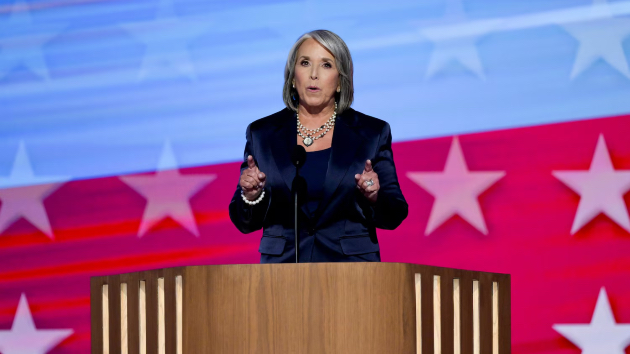
“I would expect that we’ll put up quite a fight to take the House back. And I think that we’ll have an incredible bench in the primary ’28,” New Mexico Gov. Michelle Lujan Grisham told ABC News about the plans of many of the governors.
Different tones in taking on Trump
The governors are striking different tones as they prepare for Trump’s presidency.
The strongest, most combative voices of course have been from leaders like Newsom, who initiated a recently convened a special legislative session in California to increase funding for its Department of Justice and other agencies so they’ll be able to quickly file litigation to challenge actions taken by a second Trump administration. Pritzker, too, has made not-so-veiled threats about how he’d approach the administration should it “come for” his people, and recently announced his position as co-chair, along with Jared Polis of Colorado, of a new nonpartisan coalition of governors committed to protecting the “state-level institutions of democracy” ahead of Trump’s presidency.
Other governors encouraged their peers to meet this moment offensively through their agendas.
“Democratic governors should approach this with strength and resolution and an activist agenda. Because this is the place where we can make progress too,” Washington Gov. Jay Inslee told ABC News.
“You can’t stop some 85% of the things I would like to do in that state, so I think the order of the day is defend where we can in fighting with an advance every day with our own ambitions and unaffected by him, so that shadow doesn’t fall in our state,” said Inslee, who is leaving his seat this winter to make way for incoming Gov. Bob Ferguson.
But a different group of governors are acting much more lukewarm in their approaches, emphasizing their desire to “work” with the Trump administration and some citing past collaborations with the president-elect’s team, like during the COVID-19 pandemic.
Beshear said last weekend that Democrats needed to lean into “reason” while Trump is in office and that he’s willing to work with the incoming administration.
“The middle ground, middle of the road, common ground, common sense, is open. It’s open,” Beshear told a group of reporters on Saturday.
Kansas Gov. Laura Kelly, the DGA’s chair, said this weekend that she wasn’t yet anticipating Trump or his agencies’ actions, but “We will always look for ways to work together” with the caveat that she’ll “draw the line” on things “that they push us to do that we think are wrong, illegal, anything like that.”
The varying approaches from governors to Trump’s agenda could be a coordinated strategy as the group wrestles with how best to support each other within a party attempting to rebuild — a complicated task as they also eye each other as potential presidential primary competition.
“We know how to create space to protect people and protect the priorities,” Lujan Grisham told ABC, noting that she and many other governors aren’t officially part of Pritzker and Polis’ new coalition, for example. “We did it on climate. We still do it on climate. We did it on reproductive premiums, we’re gonna have to still do it on reproductive premiums, and we’ll do some test cases in states that allow us to frame and direct these coalitions.”
“We want to be strategic about what it is that we are announcing. And here’s why: We’ve got a president-elect and a team that, before this and every day, said ‘We’re going to punish anyone in our way, and we’re going to particularly punish states,'” she went on. “And the difference in California versus New Mexico — California is definitely on the radar. I don’t minimize what the Trump administration can negatively do to my state, but we’re also very effective at watching and understanding what’s occurring, and then we can deploy our joint efforts pretty damn fast.”
Plans to fight Trump’s tariff, immigration proposals
While governors can mount legal fights against parts of Trump’s plan, the president can use executive power to impose sweeping tariffs.
But for immigration, on the other hand, governors can resist Trump’s proposals in clearer ways.
Border state Gov. Lujan Grisham told ABC News she’d block Trump’s ability to use detention centers, deploy the National Guard or even request data in her state if he attempted mass deportations.
“I take him at his word. He says he’s going to do, try to do mass deportations,” she said, adding that she wouldn’t be a partner in those moves: “There’s a lot that he can’t do by himself.” .”I mean, I’ve made it very clear over a number of years on this issue is that I will not use our National Guard to perform that kind of service,” Kelly told reporters.
“I will not send them to the border. We have had Guard members go to the border, but they have been federalized when they’ve been down there. I don’t see that as the role of the National Guard — they are there to serve Kansas, Kansas issues, so I don’t see that changing… The State Police are mine, and it’s not their job, either. So we will take the same approach as we have with the Guard,” Kelly added.
On immigration, most Democratic governors agree that violent criminals need to be deported, noting that it’s always been the case that local and state law enforcement work with federal authorities on investigating crimes. But where many governors draw the line is on deporting undocumented immigrants who have been living and working in America for a long time, arguing it’s inhumane and damages the economy.
“We don’t know what President Trump’s immigration plan is going to look like at the end of the day. He is a master of saying something, creating a great deal of noise, and then the reality may be different. So I’m going to wait to see exactly what it is he ultimately proposes,” incoming North Carolina Gov. Josh Stein told reporters about his plans to respond to Trump’s immigration moves.
“The people of North Carolina have every right to be safe in their communities, and anybody who commits a violent crime must be held accountable, fully, and that’s whether they’re in this country as American citizens or they’re here as undocumented people, and if they’re here undocumented, they should be deported,” Stein said.
They also question how Trump will execute his plan. Trump could direct the National Guard to help with transport and logistics, but one Democratic governor told ABC News these are precious resources, and they need their National Guard for emergencies like storms, fires and severe flooding.
Trump’s team has discussed in the past how to strip federal resources from Democratic-run cities if they refuse to work with the administration on deporting undocumented immigrants, according to sources familiar with the matter.
Blue state governors say they’re concerned about the Trump administration weaponizing federal funding and “picking winners and losers.” One governor told ABC News their state is focused on locking down every federal dollar the state is entitled to, and securing all of the funding made available through the Biden administration’s infrastructure law and CHIPS and Science Act.
In California, Newsom has also started to “Trump-proof” his budget, which is one of the aims of his move to convene the legislature last week.
(ALTOONA, Pa.) — The firearm found on the suspect in the murder of the UnitedHealthcare CEO is believed to have been an untraceable ghost gun, according to police.
Police have said they believe the gun was 3D printed, and that it had no serial number. The silencer may have been 3D printed as well, they said.
The ghost gun was discovered in suspect Luigi Mangione’s possession upon his arrest in Altoona, Pennsylvania, on Monday. Police have not yet confirmed if it’s the same weapon used in Brian Thompson’s killing, but NYPD Commissioner Jessica Tisch said it was “consistent with the weapon used in the murder.”
In a criminal complaint, Altoona Police Department officer said Mangione had “a black 3D-printed pistol and a black silencer,” which they described as having “a metal slide and a plastic handle with a metal threaded barrel.”
“The pistol had one loaded Glock magazine with six nine-millimeter full metal jacket rounds. There was also one loose nine-millimeter hollow point round,” the officers wrote. “The silencer was also 3D printed.”
Ghost guns, or privately made firearms without serial numbers, have surged in popularity in recent years. Due to the difficulty — or even impossibility — of tracing their origins, they can be an ideal weapon for those not legally permitted to own a gun, such as convicted felons or minors. Because of this, they are frequently the weapon of choice used in crimes.
Many ghost guns are homemade, typically 3D printed or assembled from kits that can be easily purchased online.
Due to their lack of serial numbers, it is impossible to know exactly how many exist, but thousands have been recovered from crime scenes in recent years.
About 45,240 suspected ghost guns were recovered from crime scenes between 2016 and 2021 — 692 of which were homicides or attempted homicides, according to the Bureau of Alcohol, Tobacco, Firearms and Explosives.
In 2022, the Department of Justice said it had “recovered 25,785 ghost guns in domestic seizures, as well as 2,453 through international operations.”
Though ghost guns are legal in the U.S., in recent years, lawmakers have begun pushing for stronger legislation to curb the proliferation of these firearms.
In 2022, President Joe Biden announced new measures that would require gun kits to include serial numbers — a move that has been swept up in litigation ever since as manufacturers fight regulation.
According to gun control advocacy group Everytown — which has called ghost guns the “fastest-growing gun safety problem facing our country” — there are 15 states that currently have laws governing the use of these firearms.
Many of these states require ghost guns to have serial numbers, and for their owners to go through background checks. Some require owners to disclose their ghost guns to officials.
Luigi Mangione is seen inside the police station in Altoona, Pennsylvania, Dec. 9, 2024/Obtained by ABC News
(NEW YORK) — Luigi Mangione, the man accused of gunning down UnitedHealthcare CEO Brian Thompson, yelled to the press about “an insult to the intelligence of the American people” as he was physically dragged into a Pennsylvania courthouse on Tuesday.
Mangione, who was shackled at the waist and ankles, was brought to court for an extradition hearing in connection with Thompson’s Dec. 4 slaying outside a Midtown Manhattan hotel.
Mangione, who was arrested in Pennsylvania on Monday and faces charges in New York including second-degree murder, is challenging his extradition. His defense was given 14 days to file a formal challenge.
At one point during Tuesday’s court appearance, Mangione tried to interject, while his attorney, Thomas Dickey, was attempting to convince the judge to release him on bail. He was discussing the $8,000 in U.S. currency and $2,000 in foreign currency Mangione was allegedly found with. Dickey instructed his client, “Don’t say a word.”
The judge ordered Mangione, 26, held without bail.
The Manhattan District Attorney’s Office said it will seek a governor’s warrant to try to force Mangione’s extradition. New York Gov. Kathy Hochul said in a statement that she’ll sign a request for the governor’s warrant “to ensure this individual is tried and held accountable.”
When Mangione was arrested on Monday, he had “written admissions about the crime” with him, according to the New York arrest warrant.
Mangione had several handwritten pages on him that expressed a “disdain for corporate America” and indicated “he’s frustrated with the health care system in the United States,” NYPD Chief of Detective Joe Kenny told ABC News’ “Good Morning America” on Tuesday.
Mangione’s writings, obtained by ABC News, addressed to the “Feds,” said, “I do apologize for any strife of traumas but it had to be done. Frankly, these parasites simply had it coming.”
He claimed that the U.S. has the most expensive health care system in the world, but ranks about No. 42 in life expectancy. He said UnitedHealthcare “has grown and grown, but as our life expectancy? No the reality is, these [indecipherable] have simply gotten too powerful, and they continue to abuse our country for immense profit.”
Mangione appears to have been inspired by the Unabomber, according to an NYPD intel analysis report obtained by ABC News.
The report warned that like Ted Kaczynski — whose 17-year bombing campaign killed three and injured 23 people — Mangione may become a “martyr” who inspires “a wide range of extremists” to act.
Mangione “appeared to view the targeted killing … as a symbolic takedown and a direct challenge to its alleged corruption and ‘power games,'” according to a confidential assessment of the crime by the NYPD intelligence bureau described to ABC News.
Whether Mangione has a personal connection to UnitedHealthcare is unknown, NYPD Commissioner Jessica Tisch said.
A UnitedHealth Group spokesperson said in a statement, “Our hope is that today’s apprehension brings some relief to Brian’s family, friends, colleagues and the many others affected by this unspeakable tragedy. We thank law enforcement and will continue to work with them on this investigation.”
Mangione was arrested in Altoona, Pennsylvania, on Monday in connection with Thompson’s Dec. 4 slaying.
The NYPD was “thrilled” to get the call from Altoona police that they had a person of interest in custody, Tisch told “GMA.”
Kenny said “the key to this case” was releasing photos of the suspect’s face to the media and the public.
“That picture reached Pennsylvania,” where Mangione was recognized at a McDonald’s on Monday morning, Kenny said.
“We are grateful as a city to that person,” Tisch said.
“We had collected early in the investigation some forensic evidence, some DNA evidence, some fingerprints, so we were very confident that we were ultimately going to get to the right person,” Tisch added.
“We do have a lot of evidence in this case,” Tisch told “GMA.”
Mangione was apprehended “in possession of the same New Jersey fake identification that was used” to check into a hostel on New York’s Upper West Side before Thompson was gunned down, she said.
The gun Mangione was allegedly found with on Monday “looks very similar” to the gun used in the murder, “with a similar suppressor,” Tisch said. “So there’s a lot of reasons that we feel very strongly that he is the person of interest.”
Officers allegedly found a 3D printed pistol and a 3D printed silencer, according to the criminal complaint filed in Pennsylvania.
“The pistol had one loaded Glock magazine with six nine-millimeter full metal jack rounds. There was also one loose nine-millimeter hollow point round,” the complaint said.
Kenny described the weapon as a “ghost gun,” meaning it had no serial number and was untraceable.
Mangione, a Maryland native and Ivy League graduate, has been charged in New York with second-degree murder, possession of a loaded firearm, possession of a forged instrument and criminal possession of a weapon.
He was charged with five crimes in Pennsylvania, including carrying a gun without a license, forgery, falsely identifying himself to authorities and possessing “instruments of crime,” according to the criminal complaint.
Mangione’s family said in a statement that they’re “shocked and devastated by Luigi’s arrest. We offer our prayers to the family of Brian Thompson and we ask people to pray for all involved.”
The Pennsylvania State Police is asking for the public’s help piecing together Mangione’s travel in Pennsylvania. Anyone with information is asked to call 1-800-4PA-TIPS.
ABC News’ Peter Charalambous and Josh Margolin contributed to this report.
(HOUSTON, Tex.) — A restaurant owned by NBA player James Harden in Houston, Texas, has been named in a wrongful death lawsuit filed this week.
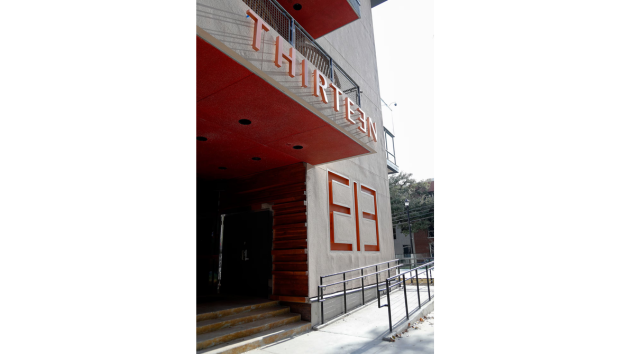
The lawsuit, filed in Harris County District Court on Monday, alleges that the restaurant, Thirteen by James Harden, caused Christian Daniel Herrera’s intoxication and provided him with alcohol in excess that led to a fatal car accident.
Cassaundra Jackson, the mother of Taylar Jackson, one of the seven victims in the fatal accident in November 2023, filed the lawsuit alleging that the restaurant “had a statutory duty to refrain from providing alcohol to an obnoxiously intoxicated person,” according to court documents. She is seeking more than $1 million in damages, court documents show.
The restaurant allegedly served Herrera alcohol to the point where he became “obnoxiously intoxicated,” and became a danger to himself and others, the lawsuit claims.
According to the lawsuit, Herrera allegedly left the restaurant driving his vehicle, disregarded a red light and T-boned a vehicle, ultimately killing Taylar Jackson, 30, and six other victims, including 25-year-old Herrera.
The victims also include Izuchu Oragwu, 31; Frank Johnson, 31; Zachary McMillian, 32; NFL cornerback Derek Hayden, 33, and Lauren Robinson, 32, according to the Houston Police Department.
ABC News has reached out to lawyers for Cassaundra Jackson and Harden.
In a statement to Houston ABC station KTRK, the restaurant said: “We cannot imagine what the family of Taylar Jackson has gone through this past year and offer our deepest sympathies to them and everyone whose lives were deeply impacted by that tragic accident. We were just made aware of the filing of this lawsuit. We ask for your patience as we gather more information on this filing and will make a more formal statement as soon as possible.”
(WASHINGTON) — Senate Republican Leader Mitch McConnell fell during the Senate Republican lunch on Tuesday.
It was initially unclear if McConnell, 82, was injured or what the severity of the fall was. Two medical responders were seen briefly entering his office and then departed.
Shortly afterward, McConnell’s office put out a statement that he had sustained a “minor cut” to the face and a “sprained wrist” from the incident.
“Leader McConnell tripped following lunch. He sustained a minor cut to the face and sprained his wrist. He has been cleared to resume his schedule,” his spokesperson said.
Newly-elected Senate Republican Leader John Thune, who will take the mantle from McConnell in January, was asked about McConnell’s fall during the Republican press conference after the lunch.
“He’s fine, he’s in his office,” Thune said, deferring further questions to McConnell’s staff.
McConnell, who has walked with a limp after overcoming polio at a young age, has taken previous falls.
One fall in March 2023 at a hotel in Washington resulted in a prolonged absence from the Senate. McConnell suffered a concussion and fractured rib from the incident, requiring hospitalization and outpatient rehabilitation that forced him to miss six weeks on Capitol Hill.
McConnell also sparked concern after two episodes last year during which he appeared to freeze in front of television cameras, though he was later cleared to work by the Capitol physician.
The longtime Kentucky senator announced in February he was stepping down from the leadership role he’s held for two decades.
McConnell later Tuesday afternoon exited his office to cast a vote on the Senate floor.
McConnell wore a brace on his left hand and had a visible bandage under his left eye.
He said “good” when asked by ABC News how he was feeling.
WASHINGTON) — Robert F. Kennedy Jr., President-elect Donald Trump’s pick to lead the Department of Health and Human Services, is set to head to Capitol Hill next week for meetings with multiple senators, Kennedy’s spokesperson says.
Kennedy transition spokesperson Katie Miller told ABC News that Kennedy will be on the Hill for four consecutive days for marathon meetings as Kennedy works to shore up support ahead of Senate confirmation hearings.
The meetings, which are typical before confirmation hearings, are planned for Dec. 16, 17, 18, and 19.
That includes a meeting on Dec. 19 with Republican staff of the Senate Health, Education, Labor, and Pensions (HELP) Committee, according to a separate person familiar with the plans.
Kennedy, a longtime environmental lawyer and vaccine skeptic, founded and has drawn a salary from the Children’s Health Defense, a prominent anti-vaccine nonprofit that has campaigned against immunizations and other public health measures like water fluoridation. Some medical experts have expressed concerns about Kennedy contributing to a rise in medical misinformation.
HHS oversees major federal health agencies including the Centers for Disease Control and Prevention, the Food and Drug Administration and the Centers for Medicare & Medicaid Services, among others.
(PHILADELPHIA) — Family and friends reacted with shock and disbelief after Luigi Mangione, a 26-year-old Ivy League graduate, was identified as the suspect in the murder of UnitedHealthcare CEO Brian Thompson.
Mangione was taken into custody at a McDonald’s in Pennsylvania on Monday following a dayslong manhunt after an individual at the establishment thought he bore a resemblance to the suspect being sought in the fatal shooting of Thompson last week outside a hotel in Midtown Manhattan. He has since been charged in New York with second-degree murder in what police have said is a targeted, premeditated attack.
“Our family is shocked and devastated by Luigi’s arrest,” Mangione’s family said in a statement. “We offer our prayers to the family of Brian Thompson and we ask people to pray for all involved.”
“We are devastated by this news,” the statement added.
The Gilman School, a private school in Baltimore from which Mangione graduated as valedictorian in 2016, said his “suspected involvement in this case is deeply distressing news on top of an already awful situation.”
“Our hearts go out to everyone affected. Here on campus, our focus will remain on caring for and educating our students,” the statement continued.
A classmate who graduated from Gilman with Mangione told ABC News that Mangione “is the last person I expected to be involved in something like this.”
“He always came off as a really good kid, very nice, very humble, open to talk to anyone,” the classmate said. “Really not a problematic kid in high school. He never really got in trouble, wasn’t attention-seeking or anything like that. Just a bright kid with a bright future, is kind of what I thought.”
Mangione went on to study computer science at the University of Pennsylvania and graduated with bachelor’s and master’s degrees in engineering. It was “expected that he would go down like a typical path,” the classmate said.
“So when we heard about all of this, it came as a huge shock to us, and honestly, like our whole community,” the classmate said.
About six months ago, the classmate said he heard from other classmates that Mangione’s family was “inquiring about his whereabouts.”
“I heard that he got back surgery so we were all a little worried and many people reached out to him. No response,” the classmate said. “I didn’t hear anything about him until today when all the news dropped.”
“Huge shock, definitely,” they added.
Mangione’s last known address was in Honolulu, police said. R.J. Martin, the founder of a co-living space for remote workers in Honolulu who said he was Mangione’s roommate there, said he was “beyond shocked” by the news.
“It’s unimaginable,” Martin told Honolulu ABC affiliate KITV.
“Never once talked about guns, never once talked about violence,” Martin told the station. “He was absolutely a not violent person, as far as I could tell.”
Martin also recalled that Mangione had a back injury after a surf lesson and needed surgery.
He said they would talk about issues like health care, housing and food systems but “it wasn’t anything specific.”
“It wasn’t like he had an ax to grind,” he said.
When Mangione was arrested on Monday he had “written admissions about the crime” with him, according to the New York arrest warrant.
The suspect had several handwritten pages on him that appeared to express a “disdain for corporate America” and to indicate “he’s frustrated with the health care system in the United States,” NYPD Chief of Detective Joe Kenny told ABC News’ “Good Morning America” on Tuesday.
Mangione considered the killing of Thompson to be a “symbolic takedown” of UnitedHealthcare over perceived corruption, according to a confidential assessment of the crime by the NYPD intelligence bureau described to ABC News. The assessment is based in part on the suspect’s writings.
It is unknown if Mangione has a personal connection to UnitedHealthcare, NYPD Commissioner Jessica Tisch said.
In addition to murder, Mangione was charged in New York with possession of a loaded firearm, possession of a forged instrument and criminal possession of a weapon.
He was also charged with carrying a gun without a license, forgery, falsely identifying himself to authorities and possessing “instruments of crime” in Pennsylvania, where he remains in custody.
There is no information on counsel of record for him, a Pennsylvania court spokesperson said.
ABC News’ Aaron Katersky, Peter Charalambous and Sabina Ghebremedhin contributed to this report.