A worker stacks groceries at a store in Brooklyn on May 12, 2026, in New York City. The rise in fuel, food, and other essentials for millions of Americans comes as the war with Iran continues to be a drag on both the domestic and international economy. (Photo by Spencer Platt/Getty Images)
(WASHINGTON) — Inflation jumped for a second consecutive month in April as the Iran war drove up gasoline prices and strained household budgets, government data on Thursday showed.
Prices rose 3.8% in April compared to a year earlier, according to the Personal Consumption Expenditures (PCE) Index, an inflation gauge preferred by the Federal Reserve. The PCE stood at 2.8% as recently as February.
Inflation now stands at its highest level since May 2023, the Commerce Department report showed.
The savings rate, meanwhile, fell to 2.6%, its lowest level since 2022, suggesting some strapped consumers are struggling to stash away extra funds.
A persistent increase in consumer prices may put pressure on the Fed to raise interest rates as a means of dialing back inflation. The latest reading comes days after Fed Chair Kevin Warsh began a four-year term atop the central bank.
For now, futures markets overwhelmingly expect the Fed to hold interest rates steady when policy makers meet next month, according to the CME FedWatch Tool, a measure of investor sentiment.
However, markets peg the chances of a quarter-point rate increase by the end of the year at more than one in three, well above where odds of a rate hike stood prior to the war, the tool shows.
The benchmark interest rate stands at a level between 3.5% and 3.75%. That figure marks a significant drop from a recent peak attained in 2023, but borrowing costs remain well above a 0% rate established at the outset of the COVID-19 pandemic.
The Middle East conflict prompted the Iranian closure of the Strait of Hormuz, a maritime trading route that facilitates the transport of about one-fifth of global oil supply. The standoff triggered one of the largest oil shocks ever recorded.
As a result, gasoline prices surged. The price of an average gallon of gas stood at $4.42 as of Thursday, AAA data showed – an increase of $1.44 per gallon since the war began on Feb. 28. That amounts to a 48% price jump in about three months.
(MINNEAPOLIS) — A suspect has been apprehended after a 26-year-old man was fatally shot while attending a prayer service in Minnesota, authorities said.
Khalid Ibrahim Abdi was shot multiple times just before 10 a.m. Wednesday at the Canterbury Park Expo Center in Shakopee, about 25 miles outside of Minneapolis, the Shakopee Police Department said.
He was taken to the Hennepin County Medical Center and later died from his injuries, police said.
A suspect was taken into custody Thursday morning and is being held pending charges, police said. The suspect’s name has not been publicly released.
Abdi was a member and field representative of the AFSCME Council 5 labor union, according to AFSCME Council 5 executive director Bart Andersen.
“It is with unimaginable sadness and heartbreak to share that we lost our union brother and AFSCME Council 5 Field Representative Khalid Abdi today, who was shot and killed while attending an Eid prayer gathering,” Anderson said in a statement.
“Khalid will be forever remembered for his tenacious organizing spirit, his warm and inviting presence, and his unyielding passion and drive to fight for the working-class and all historically marginalized communities,” Anderson said.
“Please keep Khalid’s family, friends, neighbors, and all of us coworkers in your thoughts,” he continued. “Khalid’s tenacity, heart, and joy lives in all of us forever.”
U.S. President Donald Trump speaks during a Cabinet meeting in the Cabinet Room of the White House on May 27, 2026 in Washington, DC. (Win McNamee/Getty Images)
(NEW YORK) — A court filing shows how businesses are getting money back from the U.S. government after the Supreme Court ruled many of President Donald Trump’s tariffs were illegal.
The Trump administration has sent out $20.6 billion in tariff refunds so far, according to a new court filing.
The filing sheds light on how tens of thousands of American businesses are starting to get money back from the federal government after the Supreme Court ruled many of President Donald Trump’s tariffs were illegal in February.
Walmart suggested last week it will cut prices for shoppers using the estimated $2.4 billion in refunds it’s owed.
“On tariffs, we are availing ourselves of the process to get refunds. We would definitely bias and try to prioritize price investment for that … we think the single best return that we can have on a $1 of capital right now is to invest in the customer and invest in price,” Walmart CFO John David Rainey said on the company’s earnings call.
Major companies like Walmart, Costco, Apple, Home Depot and General Motors have all confirmed in recent weeks they’re applying for refunds.
It’s unlikely that most companies will give money directly back to shoppers who already bought products with higher prices because of tariffs. The nonpartisan Tax Foundation estimates the tariffs that were ruled illegal cost the typical American household $700 last year.
UPS, FedEx and DHL said they will directly refund customers. UPS recently updated its website with details on how importers can claim to get money back.
In total, U.S. Customs and Border Protection has said it could owe up to $166 billion to more than 330,000 importers. The new filing notes $85 billion in refunds have been accepted so far, and the $20.6 billion represents money that has successfully gone back to importers who filed for refunds on the government’s online portal.
A U.S. trade official previously overstated the amount of money that had gone out to companies by $10 billion, the filing noted.
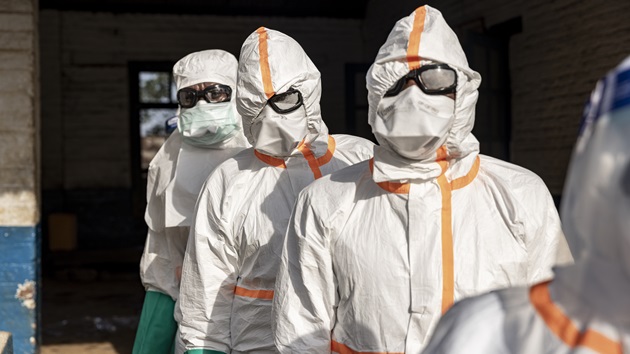
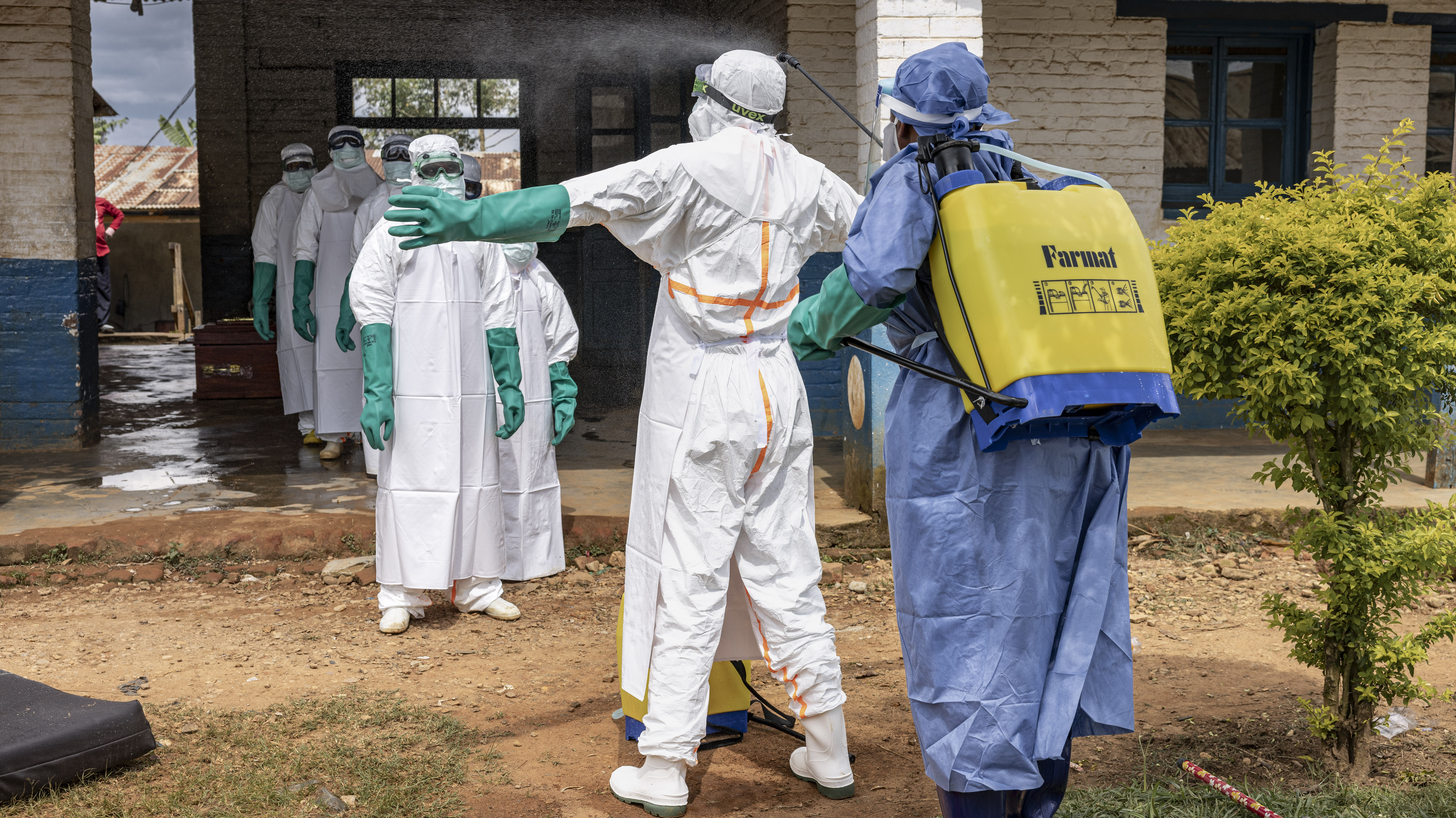
Workers line up to disinfect their protective equipment at General Referral Hospital of Mongbwalu during the Ebola outbreak response in Mongbwalu, Ituri province, eastern Democratic Republic of Congo, on May 20, 2026. (Michel Lunanga/Getty Images)
(LONDON) — Doctors and public health workers at the epicenter of the Ebola outbreak in eastern Democratic Republic of Congo (DRC) told ABC News that the deadly virus is still spreading at an alarming rate.
“The outbreak is completely out of control,” said Dr. Richard Kojan in an interview from the city of Bunia in Ituri province, which is the hardest hit.
Kojan, who has been involved in fighting previous Ebola outbreaks in central and western Africa and is president of the Alliance for International Medical Action, said deep mistrust within some local communities is hampering efforts to contain the virus.
Another clinician, Dr. Richard Lokudi, who is the director of the main hospital in Mongbwalu, the hardest hit area, told ABC News that the disease was spreading “at an exponential speed.”
Dr. Lokudi said seven symptomatic patients suspected of having Ebola had recently “escaped” from Mongbwalu Hospital.
This was creating “chains and chains of contamination,” Dr. Lokudi said, adding that this was making the virus “difficult to fight.”
According to the World Health Organization, more than 1,000 suspected cases of a rare strain of Ebola, known as Bundibugyo, have been identified in the eastern DRC and more than 230 suspected deaths from the virus have been recorded.
There is currently no vaccine for the Bundibugyo strain. Seven confirmed cases have also been identified in neighboring Uganda, the WHO said.
Last week, the World Health Organization declared the outbreak a public health emergency of international concern.
Jeremy Konyndyk, who worked as a senior official at USAID under Presidents Barack Obama and Joe Biden and is now president of Refugees International, said that the outbreak had already reached an “explosive” level of transmission.
Konyndyk, who is based in Maryland, described the situation in central Africa as“about as urgent as any Ebola response has ever been” and said the 1,000 suspected cases were “almost certainly the tip of the iceberg” and “perhaps even an undercount by a factor of two or three.”
Health officials believe the Bundibugyo strain of Ebola had been circulating, undetected, in the Ituri province for up to three months before it was officially identified. The unusual strain was harder to identify via testing.
However, levels of mistrust within local communities toward measures to contain the virus, as well as skepticism that the virus even exists, are now hampering efforts to stem the outbreak, health officials say.
Kojan said there is currently a lack of laboratory testing capacity in the region, which is needed for accurate diagnosis and effective contact tracing.
The lack of lab capacity means symptomatic patients suspected of having the virus can wait for days for test results, increasing the risk of them leaving isolation prematurely, Kojan said.
“People don’t trust that, you know, Ebola is a reality,” he said.
The Congolese clinician said he was on “the front line” without access to a laboratory, meaning he was struggling to build trust with patients.
New cases every day
Both Both Dr. Lokudi and Dr. Kojan said their healthcare facilities were receiving new suspected cases of Ebola every day.
Amidst the high levels of mistrust, there has also been growing anger towards strict healthcare procedures, which are necessary to safely bury the dead and stop the virus from spreading.
The two Congolese doctors confirmed reports that on two occasions, isolation tents and healthcare facilities had been set on fire by angry crowds in recent days.
In an exchange of messages with ABC News on Tuesday, Lokudi said the police and military were now protecting his hospital, but he said angry groups of youths had still been gathering nearby.
He said that in some cases, amid “resistance” from local populations, officials were unable to safely access remote areas of Ituri province to investigate suspected deaths from the virus.
Lokudi described the situation as “really concerning,” saying that if teams do not go to such areas, then family members face a high risk of catching the virus if they themselves bury their loved ones.
Ebola is transmitted via bodily fluids, so treating sick patients and handling the deceased should only be done by healthcare teams in protective suits. Ideally, a victim’s home should also be sprayed down with disinfectant.
In the remote rural communities affected, these vital protective measures can run contrary to local burial practices and reports suggest this, mixed with a level of misunderstanding, has been the source of many people’s anger.
Kojan described a lack of masks and protective clothing as another “really big problem,” and both doctors said more adequately trained healthcare professionals were needed on the ground to raise awareness and implement barriers to stop the spread of the virus.
Cuts to U.S. programs created difficulties
Konyndyk said significant cuts to U.S, humanitarian aid in the DRC had made things harder.
“We’re kind of fighting this one with several hands tied behind our back,” Konyndyk told ABC News.
“When we have fought Ebola in the past on this scale, it has been a combination of the Ministry of Health, WHO, USAID, CDC,” he said.
“USAID is fully gone, CDC is badly weakened. WHO has been badly weakened, the U.S., of course, withdrew from WHO and cut off all funding,” Konyndyk added.
The former USAID official said in an interview that they were “almost certain” that if USAID were still in place, this outbreak would have been caught earlier.
Konyndyk said he believed earlier reports of “an unknown viral hemorrhagic fever outbreak” in the region “would have been brought to the attention of the U.S. mission” in the DRC.
“I’ve talked with some of the members who worked on that team, who were forced out of the government, who would say things like, look, I would be on the phone every week with health leaders in this part of the country,” Konyndyk told ABC News.
“I think the U.S. visibility on that diminished badly and that contributed certainly to the US being slow to wake up to this, but also to the world being slow to wake up to it,” the humanitarian leader said.
A White House official in response said the claim that cuts to U.S. aid have affected the response to the Ebola outbreak in the DRC was “ridiculous.”
“You could just as easily say people died because England didn’t give enough money or Canada didn’t give more or China didn’t. Why not blame the other countries who don’t do any foreign aid?” the official added.
The Trump administration has argued that its “America First Foreign Assistance programs” are intertwined with broader foreign policy goals and the national interest.
“The United States has saved more lives, and continues to save more lives, than any other country in the world, and we’re going to continue to do it,” the White House official said in a statement. “We’re not going to continue to pour billions of dollars out the door of American taxpayer funds for programs that don’t work and in some cases were flat-out corrupt.”
Back in the affected area of the DRC, both doctors interviewed by ABC said they had messages for the US and the world.
International support is needed urgently “on all levels,” according to Lokudi.
Kojan said he is appealing to the world to realize that this is about people’s “humanity.”
“People are really scared. It’s our humanity … so my message is, you know, we need attention.”
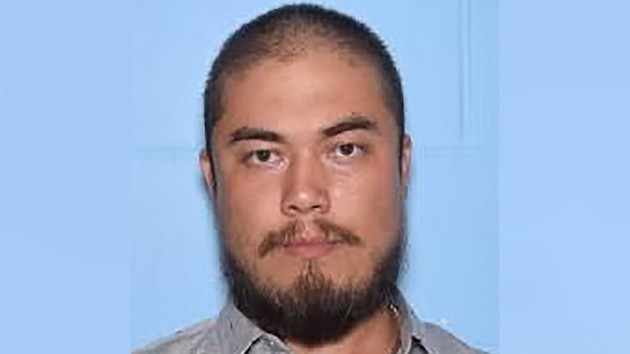
Hawaiʻi Island police released this undated photo of Jacob Daniel Baker, 36. (Hawaiʻi Island Police)
(HAWAII) — Police in Hawaii said they’re searching for a 36-year-old man wanted in connection with three homicides within days.
“Over the past 48 hours, our island has experienced three separate homicides in the Puna district, all of which we believe are connected and involve a single suspect,” Hawai’i Island Police Chief Reed Mahuna said at a news conference. Hawai’i Island is also known as the Big Island.
“We have mobilized significant resources and personnel to address this situation swiftly and thoroughly,” the chief said. “Bringing this suspect into custody without anyone further being harmed is the No. 1 priority.”
The suspect is identified as Jacob “Jake” Daniel Baker, of Pāhoa, Hawaii, police said. A gun wasn’t used in any of the homicides, but Baker “should be considered armed and extremely dangerous,” Mahuna said.
The first death was discovered Monday evening, when an officer responded to a home and found a 69-year-old man partially submerged inside a cement pond, police said.
On Tuesday afternoon, officers responded to a home just 400 to 500 feet away from the first victim and found a 79-year-old man dead from apparent blunt force trauma, police said.
On Tuesday night, the third victim — a 69-year-old man — was found dead about 19 miles away from the first two locations, police said.
No motive is known, police said. There’s no known connection between the victims besides the first two living near each other, police added.
“These are a tragic series of events and our thoughts are with those who are grieving,” the chief said.
Police urge anyone who sees Baker to not approach him and to immediately call 911.
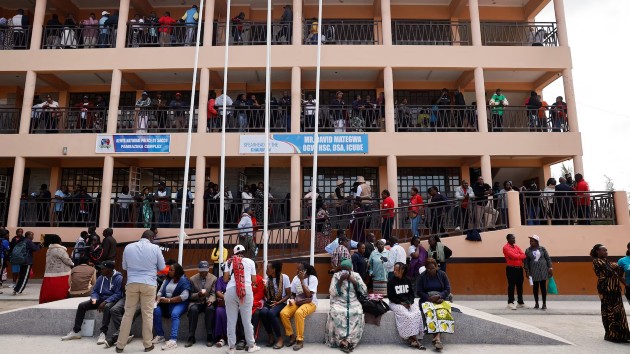
Parents and guardians stand at Utumishi Girls Academy following the deadly fire in Nakuru, north of the Kenyan capital Nairobi on May 28, 2026. (Simon Maina/AFP via Getty Images)
(LONDON) — At least 16 students died in an overnight fire at a boarding school for girls in central Kenya, a government minister said Thursday.
Education Minister Julius Ogamba said in a statement posted to X that a “regrettable fire tragedy befell Utumishi Girls Academy in Nakuru County. Most unfortunately, 16 learners lost their lives while several others suffered injuries in the incident.”
The Kenya Police Service said in a statement posted to Facebook that “several other students were injured and are receiving treatment.”
The blaze broke out in a dormitory at the Utumishi Girls Senior School in the town of Gilgil in Kenya’s Nakuru County, police said, around 74 miles from the capital Nairobi.
Search and rescue operations are ongoing, police said. “We are working to account for all students and support affected families during this difficult time,” the service said in its statement.
The fire was reported early Thursday at around 3:30 a.m. local time, according to the Kenya Red Cross, which said its team were supporting the ongoing multi-agency response. “Several students have been evacuated and are receiving treatment in various hospitals,” Kenya Red Cross said.
Ogamba expressed “our heartfelt condolences to the families, friends and relatives of the learners who lost their lives in this sorrowful incident. We wish a quick recovery to those who were injured. We pray that God grants everyone strength and fortitude during this difficult and painful period.”
“Investigations into the cause of the fire are ongoing and updates will be provided in due course,” the minister added.
ABC News’ Charlotte Gardiner contributed to this report.
Texas State Rep. James Talarico, who won the Democratic nomination for the U.S. Senate in the Texas primary election, speaks to ABC News. (ABC News)
(WASHINGTON, D.C.) — Texas state Rep. James Talarico, the Democratic nominee in the pivotal U.S. Senate race in Texas, appeared on Wednesday to walk back some of his past comments on religion that have become a major line of attack in the race against Republican state Attorney General Ken Paxton.
When asked about his comments in 2021 during floor debate in the legislature that “God is non-binary” in an interview on ABC News Live, Talarico replied that “Ken Paxton is clipping my past cringey comments to distract from his career of corruption,” as part of a “playbook” of “distraction and division.”
When pressed on his comments, Talarico replied that they were “meant to be deliberately provocative” and that he believes “you can’t use human categories to define God.” He said that Republicans are seizing on the comments “to try and distract from the corrupt system that Ken Paxton embodies.”
ABC News reached out to Paxton’s campaign for response to Talarico’s comments.
Talarico’s comments along with other statements on transgender rights and immigration were highlighted in Paxton’s first general election ad, which ends with the tagline “Radical Talarico: too low-T for Texas.” “Low-T” is a reference to levels of testosterone that is used to insult men for a lack of masculinity.
Republicans have used transgender rights as a major line of attack, including in the 2024 presidential race. The DNC’s after-action report on the election identified the Trump campaign’s attack ads labeling his opponent, then-Vice President Kamala Harris, as “for they/them” as one of the most effective ads of the cycle.
Democrats think Talarico’s potential to reach beyond the Democratic base and appeal to independents and Republicans disaffected by Paxton’s candidacy could be enough to win the seat and possibly control of the Senate next year.
Paxton faced ethical and personal questions during the primary. He was acquitted in an Republican-driven impeachment trial in 2023. Paxton’s wife filed for divorce last year, citing “biblical grounds.”
Republican leadership, which had encouraged President Donald Trump to back Paxton’s opponent in the primary, Sen. John Cornyn, as more electable in the general election, have begun to coalesce around Paxton as the Republican nominee.
Senate Majority Leader John Thune said in a radio appearance Wednesday that Republicans were going “all-in” on Paxton and attacked Talarico as a “far left liberal.”
The Senate Majority PAC, which backed Cornyn in his primary race, has taken down past press releases and ads attacking Paxton and has issued a statement opposing Talarico without mentioning Paxton by name.
Talarico has made explicit overtures to Trump voters and Cornyn voters, who are necessary to win any statewide election in Texas, saying, “There is a lot of disillusionment among the president’s supporters here in Texas, and I’m extending an open hand to those Trump voters. So that they know they have a place in our campaign.”
While Cornyn has not explicitly endorsed Paxton in the election, he has said that he will “support the Republican ticket.”
U.S. President Donald Trump gestures after delivering remarks during a campaign and economic policy event in the Eugene Levy Fieldhouse at SUNY Rockland Community College on May 22, 2026, in Suffern, New York. (Photo by Roberto Schmidt/Getty Images)
(WASHINGTON) — President Donald Trump said during a Cabinet meeting on Wednesday that he isn’t concerned about making a deal soon with Iran, adding that he doesn’t “care about the midterms” in what he said he thinks is the regime’s calculation that he has to negotiate a deal before what are expected to be highly-competitive elections in November.
“They thought they were going to out-wait me, you know. ‘We’ll out-wait him. He’s got the midterms.’ I don’t care about the midterms. Look what happened last night, that was a prelude to the midterms. People understand it,” Trump said, likely referencing his endorsed candidate, Ken Paxton, winning the Senate Republican runoff in Texas.
With tensions escalating with Iran and gas prices still up across the country, Trump said he feels no urgency to end the war.
“Mr. President, you’ve said that you’re in no rush to make a deal, but with gas prices that are still high across the country, people are paying more for travel. Does that give you more urgency to make a deal? Why doesn’t it?” ABC News Senior Political Correspondent Rachel Scott asked Trump during the Cabinet meeting.
“Well, I’ll tell you, the primary urgency, I’ve said this, it wasn’t covered properly, but the primary urgency is that we can’t let Iran have a nuclear weapon,” Trump responded.
The president also appeared to issue a new threat against Oman, a key American ally in the Middle East.
Trump said he would not accept a short-term deal that allows Iran and Oman to control the Strait of Hormuz — as reported in Iranian state media, and that the critical shipping lane will be “open to everybody.”
“Oman will behave just like everybody else or we’ll have to blow them up. They understand that,” Trump said.
Trump on Wednesday was asked whether he would consider easing any sanctions on Iran. He said no.
“No, we’re not talking about any easing of sanctions or giving money. No sanctions, no money, no nothing,” Trump said. “We have control of money that they claim is theirs. We’ll keep control of that money. And when they behave properly and when they do what’s right, we’ll let them have their money. But right now, we’re not doing that … One thing is not contingent on the other.”
The comments come after a senior administration official told reporters over the weekend that Iran could be rewarded with a lifting of sanctions and unfreezing of assets in exchange for a deal on its nuclear program.
On the status of negotiations, Trump said on Wednesday he’s “not satisfied” and that Iran is “negotiating on fumes.”
“We’re not satisfied with it, but we will be. We will be. Either that or we’ll have to just finish the job,” Trump said.
(MINNEAPOLIS) — A 26-year-old man was shot multiple times while attending a prayer service in Minnesota, and the suspects are at large, authorities said.
The shooting unfolded just before 10 a.m. Wednesday at the Canterbury Park Expo Center in Shakopee, about 25 miles outside of Minneapolis, the Shakopee Police Department said.
The victim was taken to the Hennepin County Medical Center in unknown condition.
“We are actively working to identify the involved individuals,” police said in a statement. “Anyone with information should contact Shakopee Police Department at 952-445-1411.”
This is a developing story. Please check back for updates.
Health workers wearing protective equipment are disinfected after leaving the isolation area at the General Referral Hospital during the Ebola outbreak response on May 21, 2026, in Mongbwalu, Democratic Republic of Congo. The World Health Organization has declared the Ebola outbreak in the Democratic Republic of Congo and Uganda a “public health emergency of international concern,” as the death toll and number of confirmed cases continue to rise. (Photo by Michel Lunanga/Getty Images)
(WASHINGTON) — The White House confirmed Wednesday that the U.S. is setting up a health facility in Kenya to receive Americans who are exposed to the Ebola virus while in regions affected by the ongoing outbreak.
According to an administration official, the U.S. will establish what they called a “state-of-the-art facility” in Kenya “through a coordinated effort with the Departments of State, Health and Human Services, and War.”
The news was first reported by The New York Times.
The official said that the purpose and design of the facility would be to “provide access to high-quality care for Americans who would need to quickly get out” of the Democratic Republic of Congo (DRC) to quarantine, and argued that it would cut down on the “risks of a lengthy transport back to the U.S.”
“Time is of the essence for Ebola patients, and this facility will enable Americans in the region who contract Ebola to receive lifesaving care as quickly as possible without 12-plus hours of medevac flight time,” the official said.
The official added that the treatment capabilities at the Kenya facility are “expected to be able to care for the full-spectrum of Ebola Virus Disease, including critical care needs,” but added that patients would be evaluated on a case-by-case basis for possible “forward transport” for more advanced care as needed.
The White House did not immediately respond to an ABC News request for additional specifics regarding patients who would be quarantined and treated at the facility.
The president previously invoked his authority under Title 42, barring travel to the U.S. for non-citizens, with specific exceptions, who have visited the DRC, Uganda, or South Sudan within the last 21 days. The order was expanded last week to include U.S. green card holders.
American citizens who have visited those countries are being directed to specific U.S. airports for additional health screening, including Dulles International Airport, John F. Kennedy International Airport in New York, Hartsfield-Jackson Atlanta International Airport, and George Bush Intercontinental Airport in Houston.
The news comes as New York-based International Rescue Committee (IRC) aid organization warned on Tuesday that the ongoing Ebola outbreak in the DRC and neighboring Uganda is now spreading faster than responders can contain it and risks becoming “the deadliest on record” without urgent international action.
“The outbreak is spreading faster than the response, with over 900 suspected cases and at least 223 deaths already reported across DRC and Uganda, including in major transport hubs like Goma and Kampala,” the IRC wrote.