Russian Police officers walk next to the entrance of a residential building on Volokolamsk Highway, where an assassination attempt on General Lieutenant Alexeyev (Alekseev) was made earlier in the morning, on February 6, 2026, in Moscow, . (Photo by Contributor/Getty Images)
(LONDON) — Lt. Gen. Vladimir Alexeyev, a high-ranking Defense Ministry official, was shot and injured in an ambush-style attack on Friday in a residential area of Moscow, according to the Investigative Committee of Russia and state-affiliated media.
“According to investigators, on Feb. 6, 2026, in a residential building located on Volokolamskoye Highway in Moscow, an as-yet-unidentified individual fired several shots at a man and fled the scene,” Svetlana Petrenko, the committee’s spokesperson, said in Russian on the Telegram messaging app.
The victim was transported to a local hospital, Petrenko said. She did not immediately describe the extent of his injuries.
State-affiliated news outlet TASS identified the victim as Alexeyev, adding that a criminal investigation had been launched.
“Special services are currently doing their job,” Kremlin spokesperson Dmitry Peskov said. “Of course, this has been reported to the head of state. We wish the general a speedy recovery.”
Sergey Lavrov, Russia’s foreign minister, claimed without evidence that Ukraine and its president, Volodymyr Zelenskyy, may be responsible for the shooting. He suggested that it may be an attempt by Ukraine to disrupt negotiations between Washington, Kyiv and Moscow.
“The regime is ready to do anything to convince its Western sponsors not to lag behind the United States in their desire to derail the process of achieving a just settlement,” Lavrov told reporters at a briefing on Friday.
ABC News’ Joe Simonetti, Dragana Jovanovic and Anna Sergeeva contributed to this report.
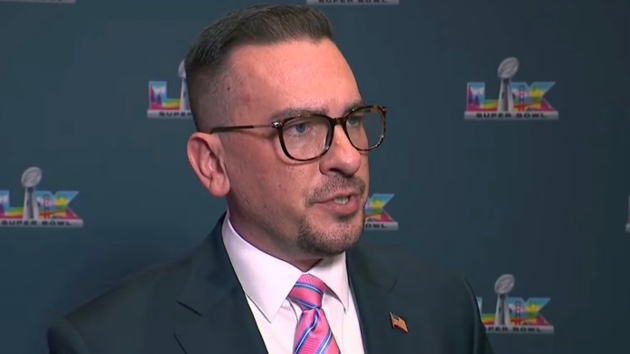
DHS Federal Coordinator Jeff Brannigan speaks with ABC News at the Moscone Center in San Francisco. (ABC News)
(SANTA CLARA, Calif.) — There will be a “substantial law enforcement presence” in the Bay Area for the week leading up to Super Bowl Sunday, the man who is leading it all told ABC News.
“We have multiple command centers that we are operating as the federal government in concert with our local partners,” Jeff Brannigan, the Department of Homeland Security federal coordinator, told ABC News in an interview. “It’s a broad footprint with a lot of personnel. Some are uniformed and, very clearly, government officials of some way.”
Others are working behind the scenes, he said.
The Super Bowl is a SEAR 1 event, meaning there is extensive federal security coordination.
“The federal government has brought resources to bear to augment the security planning of the cities of Santa Clara, San Francisco and San Jose, and we have brought resources that those cities don’t necessarily have, and that really is a full-domain security posture to include air support, maritime support and support on the ground,” he said.
The federal government will have support from the FBI; the Bureau of Alcohol, Tobacco, Firearms and Explosives; the U.S Coast Guard; aerial assets from Customs and Border Protection; the Cybersecurity and Infrastructure Security Agency (CISA); and even a helicopter that scans for nuclear technology.
Brannigan said he couldn’t get into specifics, but that there are “hundreds of federal special agents from across the government,” working with local police departments to provide security for the event.
Brian Clark, the associate chief of operations for the Drug Enforcement Administration’s Pacific and Southwest region, said his agency is also providing support to state and local law enforcement in the area.
“For Super Bowl events, you have a lot of human trafficking that comes in,” he said. “You’ll also see a lot of drug trafficking that comes in the area for parties and things … So we would like to say for people to be aware, to have that conversation. Take this time, when you’re gathering with your friends and family, have that conversation about the dangers of fentanyl, because one pill, one time can kill.”
There are also law enforcement from outside the immediate area that are being brought in for “mutual aid,” Brannigan said.
Some of the concerns are lone wolf attackers, threats from drones and cyberattacks, he said.
“Oftentimes, people you know will see something and they want to dismiss it as that’s, ‘That’s my imagination,’ or ‘That’s not an issue,'” he said. “It is always better for members of the public to call the police and tell them about something they find suspicious, let the police investigate it, determine it isn’t an issue. But if you see something, say something.”
In this handout photo released by the Omani Ministry of Foreign Affairs on Feb. 6, 2026, Omani Foreign Minister Sayyid Badr Hamad Al Busaidi, US President Donald Trump’s Special Representative for the Middle East, Steve Witkoff and U.S. negotiator Jared Kushner meet ahead of the US-Iran talks, in Muscat, the capital of Oman. (Photo by Oman Foreign Ministry/Anadolu via Getty Images)
(LONDON) — Negotiating teams from the United States and Iran are expected to meet on Friday in Oman, marking a reopening of nuclear talks following weeks of tensions and threats, as leaders in Tehran oversaw a deadly crackdown on widespread protests.
The U.S. side will be led by President Donald Trump’s Middle East envoy, Steve Witkoff, and Trump’s son-in-law Jared Kushner, according to the White House.
“The President has obviously been quite clear in his demands of the Iranian regime,” Karoline Leavitt said on Thursday during a press briefing. “Zero nuclear capability is something he’s been very explicit about.”
Iranian state-run media published photos and videos early on Friday of Foreign Minister Abbas Araghchi in the Omani capital, where he met with his local counterpart.
“Iran enters diplomacy with open eyes and a steady memory of the past year. We engage in good faith and stand firm on our rights,” Araghchi said on social media on Friday.
The talks, which were expected to begin at 10 a.m. local time, followed weeks of escalating tension between the U.S. and Iran, fueled in part by massive protests that have roiled Iran.
Those protests began in Tehran in late December in response to the collapse of the Iranian currency and the worsening of economic conditions, and then quickly took on a political character — with crowds on the streets openly calling for regime change.
Iranian authorities responded by launching a brutal crackdown on protests, according to observers. At least 6,495 protesters, along with hundreds of members of the state’s security forces, have been killed, according to the U.S.-based Human Rights Activist News Agency, an activist group. The group said it was reviewing thousands of other cases of possible deaths. ABC News cannot independently verify those figures.
As those protests escalated in January, Trump voiced concern for the protesters, saying, “I have cancelled all meetings with Iranian Officials until the senseless killing of protesters STOPS. HELP IS ON ITS WAY.”
Trump later in January said a “massive Armada” was heading toward the region. He warned Tehran to make a nuclear deal, saying another U.S. attack would be “far worse” than the U.S. strike on nuclear sites within Iran in June of last year.
The Iranian foreign minister responded by saying the country’s military had “their fingers on the trigger.”
Those tensions had to some extent begun to thaw by last week, when Iran’s president, Masoud Pezeshkian, said he had instructed Araghchi to pursue “fair and equitable” talks with Washington. The White House had sought help from regional allies, who assisted in bringing Iran back to the negotiating table, according to both countries.
Araghchi said on Friday that any commitments made between the two countries “need to be honored,” adding, “Equal standing, mutual respect and mutual interest are not rhetoric — they are a must and the pillars of a durable agreement.”
Members of the Trump administration last held a series of nuclear talks with Iran in April and May 2025 in Oman. A round of those talks planned for June was scuttled after Israel launched aerial strikes on Iran, an attack that the U.S. later joined.
Senior U.S. officials have continued publicly voicing concerns about the Iranian leadership in the days since the latest round of talks were announced.
“The Iranian regime does not reflect the people of Iran, nor their culture rooted within a deep history,” Secretary of State Marco Rubio said on Thursday. “I know of no other country where there’s a bigger difference between the people who lead the country and the people who live there.”
The virtual U.S. Embassy in Iran posted on Thursday a security alert again calling for all U.S. citizens to depart Iran, provided it’s safe for them to do so.
“If you cannot leave, find a secure location within your residence or another safe building,” the alert said.
Leavitt on Thursday said Trump was seeking a deal with Iran, but, she added, “I would remind the Iranian regime that the President has many options at his disposal, aside from diplomacy, as the commander in chief of the most powerful military in the history of the world.”
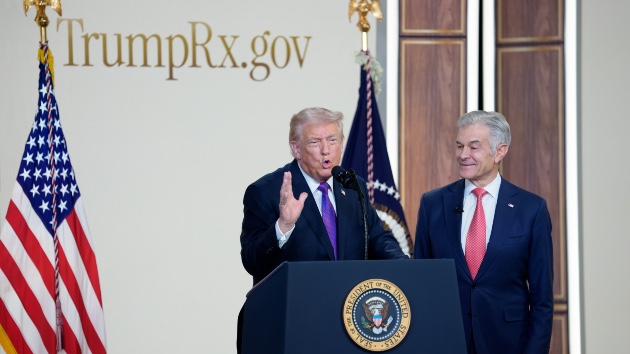
US President Donald Trump, left, and Mehmet Oz, administrator of the Centers for Medicare & Medicaid Services, during an announcement in the South Court Auditorium of the Eisenhower Executive Office Building at the White House in Washington, DC, US, on Thursday, Feb. 5, 2026. Trump launched a new website to help Americans directly buy select medicines at a discount, . (Photographer: Aaron Schwartz/CNP/Bloomberg via Getty Images)
(WASHINGTON) — President Donald Trump on Thursday unveiled his TrumpRx website in an event at the White House, listing 40 drugs at lower cost than previous list prices to patients paying out of pocket and calling the launch part of the “most transformative health care initiatives.”
Trump made the announcement alongside Centers for Medicare and Medicaid Services Administrator Dr. Mehmet Oz and National Design Studio Director Joe Gebbia.
“Starting tonight, dozens of the most commonly used prescription drugs will be available at dramatic discounts for all consumers throughout a new website is called TrumpRx.gov,” Trump said at the White House event.
Some of the reduced cash prices were announced last year by the administration and some of the new prices had already gone into effect.
The president touted the use of his Most Favored Nation (MFN) policies — making sure the U.S. isn’t paying more than other countries — for making the lower prices possible.
“For years, politicians from both parties have promised to bring down prescription drug prices and make health care more affordable, but they all failed,” Trump said.
According to the TrumpRx website, these drugs can be obtained at participating pharmacies using coupon card codes displayed on the website or directly through manufacturers’ websites.
The website also notes that “TrumpRx discounted pricing is only available for cash-paying patients,” in a FAQ section. The discounts are not available for patients trying to pay through insurance and do not go toward insurance deductibles.
Only a few dozen drugs are offered on the website, though the website says that “many more drugs are coming soon,” in a FAQ section.
What some experts are saying
“It’s nice that they are aggregating coupons in one place,” Benjamin Jolley, PharmD, a senior fellow for health care at the American Economic Liberties Project told ABC News. “But it’s a convenience to check the website to see the coupons all in one place for the first time.
Dr. Christina Madison, the founder of The Public Health Pharmacist told ABC News: “There are a lot of patient assistance programs out there and this appears similar to programs like GoodRX but the difference here is that you would not have to go through the manufacturer’s website to get them.”
In a statement, Good RX tells ABC News they are a key integration partner for pharma companies that is offering discounted cash prices on TrumpRX, “The self-pay price is hosted on the GoodRx platform and GoodRx then integrates the price into TrumpRx.”
GoodRX-provided codes can currently be used at over 70,000 retail an home delivery pharmacies.
How much will consumers save?
Trump said the discount offers “tremendous” savings.
But experts say the overall savings are not clear and may only benefit a certain group of people.
“TrumpRx’s offerings are very limited, fewer than 50 drugs listed,” Rena Conti, an associate professor at the Boston University Questrom School of Business, told ABC News.
“This suggests it pays for consumers to check their insurance coverage and ask their regular doctor or pharmacist before they use this service,” Conti added.
The website boasted savings on GLP-1s, showing that the Wegovy pill’s lowest TrumpRx price was $149 a month, slashed from what the website says is an original price of $1,349. And while the full cash price of Ozempic and Wegovy (FDA approved for weight loss) did start at over $1,000 a month, those prices have been slowly going down in price. It was reduced voluntarily first to $499 in March 2025 and then to $199 in November after negotiations with the federal government.
Some drugs remain very expensive, including Xeljaz, which is marked at a starting price of $1,518, despite a 50% savings.
Fertility drugs
One of the big categories of drugs included in TrumpRx are fertility drugs.
According to the website, Gonal-F is available for an 83% discount, down from $966 to just $168 for the pen. Another IVF drug, Cetrotide, is offered at a 93% discount. And Ovidrel is offered for a 67% discount.
“One in three families is having trouble having a baby. We’re gonna have a lot of Trump babies with these costs, folks cannot afford these medications. It’s gonna change their lives,” Oz said during the White House event.
“The fertility drug discount is legitimately a big deal for people trying to get IVF,” Jolley said. “These medicines are quite expensive and this seems like a big discount. In general IVF is not covered by insurance and so people prior to this who needed certain drugs would be paying the full $1400 price.”
Jolley noted for example, that the price slash on certain fertility drugs could lower the cost of an IVF cycle by about 20% overall.
Trump first revealed his administration’s goal of launching the website back in September when he announced that Pfizer had agreed to lower its prices for prescription drugs offered through Medicaid. Pfizer so far is the largest participant in Trump RX with over 30 medications listed.
Trump last month released his “Great Healthcare Plan,” in which he called on Congress to codify the “most favored nation” initiative.
The plan also proposed sending money directly to Americans to buy health insurance and included calls to increase price transparency and hold insurance companies accountable — though it largely lacked specifics.
Polls show most Americans are concerned about health care costs.
A survey last month from KFF, a nonprofit health policy research organization, found two-thirds of U.S. adults worried about being able to afford health care for them and their family — outranking other expenses like gas and groceries. A majority of Americans, 56%, said they expect health care to become less affordable in the coming year.
The poll also found that two-thirds of Americans said Congress “did the wrong thing” by allowing enhanced Affordable Care Act tax credits to expire. Millions of Americans were expected to face increased premium costs as a result of the lapse.
ABC News’ Eric Strauss, Michelle Stoddart, Emily Chang and Isabella Murray contributed to this report.
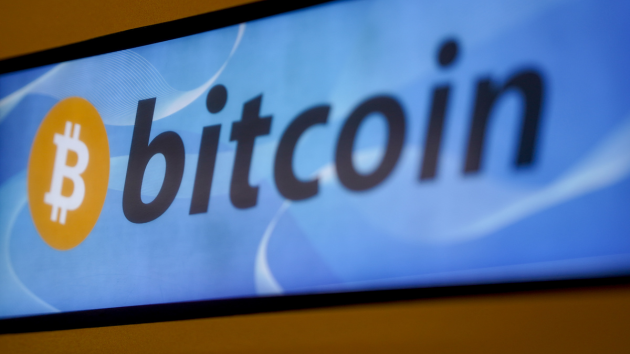
Bitcoin signage on the exhibition floor during the Plan B Forum Bitcoin conference in San Salvador, El Salvador, on Friday, Jan. 30, 2026. The conference brings together world leaders, technologists, and entrepreneurs to discuss nation-state Bitcoin adoption, economics, financial freedom, and freedom of speech. (Photographer: Camilo Freedman/Bloomberg via Getty Images)
(NEW YORK) — The price of bitcoin plunged more than 10% on Thursday, sinking the world’s largest cryptocurrency to its lowest level since October 2024 and erasing sizable gains made since then.
That was weeks before the election of President Donald Trump, a crypto supporter whose return to the nation’s highest office helped propel bitcoin to record highs.
Bitcoin clocked in at a price of about $66,100 on Thursday afternoon, leaving it 48% below an all-time high of about $126,210 attained just four months earlier, in October 2025.
The decline of bitcoin deepened a days-long stretch of sharp losses stretching back to last week.
Ethereum, the second-largest cryptocurrency, also extended recent losses, shedding about 10% of its value on Thursday. Solana, another popular crypto coin, saw its price dip 11%.
Experts who previously spoke to ABC News attributed the recent decline in crypto prices to looming geopolitical and economic uncertainty, which has prompted a momentum-driven selloff as crypto holders raced to the exits. The initial drop likely forced some leveraged buyers to sell off their positions, intensifying the downward pressure, they added.
The labor market has slowed in recent months, while inflation has hovered above the Federal Reserve’s target rate of 2%.
Meanwhile, geopolitical conflict looms amid negotiations over Greenland, U.S.-backed leadership in Venezuela, the ongoing war between Russia and Ukraine, as well as escalating U.S. threats against Iran over the past few weeks.
In recent weeks, Trump has threatened tariffs against Canada, South Korea and eight European countries, invoking the tool as means of exerting pressure over a range of foreign-policy issues.
The current market for crypto is a far cry from the boom enjoyed by the sector in the aftermath of the 2024 presidential election.
Bitcoin climbed more than 40% over the weeks after Election Day, when voters opted for Trump, who had previously vowed to make the U.S. the “crypto capital of the world.”
On the campaign trail, Trump also vowed to bolster the cryptocurrency sector and ease regulations enforced by the Biden administration. Trump also promised to establish the federal government’s first National Strategic Bitcoin Reserve.
Bitcoin has proven highly volatile since its launch about 15 years ago
As recently as 2022, bitcoin suffered a downturn that cut its value by more than 60%. A similar drop happened in each of the prior two years, when the pandemic helped trigger waves of buying and selling.
Despite its ups and downs, bitcoin has sustained an upward long-term trajectory. Over the past five years, the price has climbed 63%. Over that period, the S&P 500 has increased 75%.
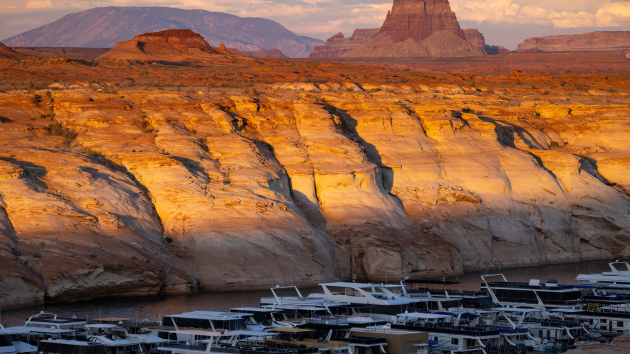
Boats descend lower into a desert canyon at Antelope Point Marina, requiring construction of alternative boat ramps, as Lake Powell continues to shrink on September 3, 2022, near Page, Arizona. (Photo by David McNew/Getty Images)
(NEW YORK) — It has been a tale of two winters on the opposing U.S. coasts this season.
While the East has been slammed with frigid temperatures and punishing winter storms, the West is experiencing a snow drought amid warmer-than-normal temperatures.
Prolonged drought across much of the West has been worsened this winter by below‑average snowfall and persistent warmth, fueling a widespread and intensifying snow drought. With sharply reduced mountain snowpack, the region’s water supplies and winter tourism are facing mounting challenges, experts told ABC News.
“This winter, we’ve just had an extreme lack of storm activity, and the storms that we have had have either brought very small amounts of snowfall or have brought rain,” Jon Meyer, assistant Utah state climatologist, told ABC News.
Warm temperatures have prevented snow from accumulating
Much of the western United States entered winter already grappling with a lack of rain. Widespread moderate to severe drought conditions stretched from New Mexico to Washington, including much of the Colorado River Basin, leaving soil moisture low and reservoir levels depleted heading into the season.
More than one-third of the West is currently facing some form of drought condition, with much of Utah, Colorado and New Mexico experiencing a moderate drought or worse, according to the U.S. Drought Mitigation Center’s U.S. Drought Monitor.
Utah is facing the worst drought conditions among western states, with more than 94% of the state experiencing what the USDM categorizes as a Moderate Drought and more than 40% of the state experiencing Severe Drought.
Salt Lake City has only received a tenth of an inch of snow so far this season – the lowest to date since records began in 1874, according to the National Weather Service. Their lowest seasonal snowfall was 14.3 inches during the winter of 1933-34. By comparison, parts of the Southeast, which typically don’t see much snowfall, have seen more snow than Salt Lake City this season.
“Just totally uncharted territory for the amount of low-elevation and mid-elevation snowfall Utah has seen, and that’s a pattern that’s played out across much of the Western U.S.,” Meyer said.
While many western states received average or above-average precipitation in the fall and early winter, warmer temperatures caused much of it to fall as rain rather than snow, leading to unusually low snowpack and a rapidly developing snow drought.
“If you look at most of the West, it’s at or above average, with regards to precipitation to date,” Eric Sproles, an associate professor of earth sciences at Montana State University, told ABC News. “But if you look at the the amount of water that’s stored in the snow pack is, it’s pretty bleak.”
Meteorological winter, which begins in the U.S. on December 1, kicked off with record warmth across much of the West. December 2025 was the warmest December on record for cities including Phoenix and Tucson, Arizona; Las Vegas, Nevada; Salt Lake City, Utah; Albuquerque, New Mexico; Portland, Oregon and Boise, Idaho, according to the National Oceanic and Atmospheric Administration (NOAA).
Nine western states – Arizona, California, Colorado, Nevada, New Mexico, Oregon, Utah, Washington and Wyoming – recorded their warmest December on record. For the winter season to date, Colorado is currently experiencing its warmest winter since 1934, while Utah is experiencing its warmest winter on record, according to NOAA.
The snow drought is threatening water supplies
Drought on its own already stresses water supplies, agriculture and ecosystems. But when winter fails to deliver significant mountain snow, the resulting snow drought – a period of abnormally little snowpack for the time of year – can intensify those impacts, according to NOAA.
The snowpack typically acts as a natural water reservoir. However, without an adequate snowpack to slowly release water through the spring and summer snow melt, rivers run lower, soils dry out earlier, and drought conditions can deepen and linger.
Melting snow provides a slow release of the water into reservoirs and dams but also recharges ground water as well, Sproles said: “That slow, steady release is important. The snowpack is kind of like a savings account.”
In Utah, the snow water equivalent – meaning how much water is in the snowpack – is currently at only 55% of its median, which is the lowest snow water equivalent to date. Moreover, only a quarter of the state has seen a ground snow cover depth of at least 1 inch.
Colorado and Oregon are also reporting their lowest snow water equivalents to date, with Montana approaching its lowest snow water equivalent to date.
In much of the West, snowmelt provides a large percentage of the water used by communities, agriculture, and ecosystems; in some states, up to about 75 percent of the water supply can come from melting snow, according to the U.S. Geological Survey. As such, the snow water equivalent is a vital measure of the region’s water resources.
According to NOAA, a persistent snow drought can trigger a cascade of hydrologic changes. Low snowpack and early snowmelt can affect vegetation, reduce surface and subsurface water storage and alter streamflow, all of which directly impact water management and planning across the West.
While soil moisture in not currently a concern, it could dry out over the next couple of months, according to Meyer.
“We’ve become critically reliant on soil moisture observations for drought monitoring and predictions,” Meyer said.
The reservoirs along the Colorado River are especially threatened, the experts said. Major reservoirs in the Colorado River Basin remain well below average, according to latest figures from the U.S. Bureau of Reclamation (USBR). As of early February, Lake Powell, in southern Utah and northern Arizona, was about 26 % full, while Lake Mead – the nation’s largest reservoir by volume, located in Arizona and Nevada – was about 34% full.
Total storage in the Colorado River system, which provides water for more than 40 million people and fuels hydropower resources in seven western states, was roughly 37% of capacity, down from about 42% at the same time last year, according to the USBR, which has flagged 13 reservoirs, the majority located in the West, for having the lowest observed water storage levels for the current time period.
The Colorado River system also serves as a vital resource for 30 tribal nations, sustaining 5.5 million acres of farmland and agricultural communities throughout the West, while also supporting critical ecosystems and protecting endangered species, the USBR said.
Winter sports have been impacted by lack of snow
The snow drought is also impacting local economies that rely on winter sports, an industry that contributes $20 billion annually to the U.S. economy, according to The Climate Reality Project.
“The resort winter tourism is a huge economic backbone for many of these mountain resort communities,” Marcene Mitchell, senior vice president for climate change for the World Wildlife Fund, told ABC News. “And so as they lose their snowfall, they also lose these revenue.”
Vail Resorts, a Colorado-based company that owns and operates some of the largest ski resorts in North America, reported in January that skier visits to its North American resorts were down about 20% through Jan. 4, compared to the same period last year. The company issued the update as a mid-season report on skier visits and revenue, citing a lack of early-season snowfall as a major factor in the decline.
Season-to-date total lift revenue, including an allocated portion of season pass revenue, was down 1.8% from the same period last year, said the tourism company, which operates dozens of resorts across North America, including Vail Mountain and Breckenridge in Colorado and Park City Mountain in Utah.
“We experienced one of the worst early season snowfalls in the western U.S. in over 30 years, which limited our ability to open terrain and negatively impacted visitation and ancillary spending for both local and destination guests during the period,” Chief Executive Officer Rob Katz said in a statement.
Vail’s Tahoe-area resorts in California also had a slow start through mid-December, but holiday-period snowstorms allowed the company to open more terrain, Katz said.
February and March typically can bring significant amounts of snow to the region, and odds favor above-average precipitation for much of the region over the next few weeks, according to NOAA’s Climate Prediction Center, with persistent unusually warm conditions less likely. However, NOAA notes, snowfall in the coming months may not be able to make up for existing deficits.
Forecasters further caution that this pattern may not last for the rest of the month, with overall warmer and drier-than-average conditions still favored for the month as a whole.
A Nike logo is seen at the Nike flagship store, Dec. 20, 2019, in New York. (Stephanie Keith/Getty Images)
(WASHINGTON) — The federal agency that investigates workplace discrimination is seeking court enforcement of a subpoena it has issued to Nike as it pursues allegations that the athletic apparel maker has been discriminating against its white employees in its corporate diversity policies.
The Equal Employment Opportunity Commission (EEOC) filed its motion this week in U.S. District Court for the Eastern District of Missouri, where Nike has a factory that produces its famous AIR footwear technology.
The agency’s charges against Nike date to 2024, when commission member, and current Trump-appointed chair, Andrea Lucas alleged that Nike had been engaging in a pattern of discriminatory practices, including “race-based workforce representation quotas,” and hiring, promotion, demotion and firing decisions that were a function of “disparate treatment against White employees, applicants, and training program participants.”
In its filing, the EEOC says the charges were not triggered by internal complaints from workers, but were “based on publicly available information regarding Nike,” including the company’s public pledges to have “30% representation of racial and ethnic minorities at Director level and above in the U.S.,” and 35% representation across its entire U.S. corporate workforce.
The EEOC said in the filing that it has gone to court because the company provided some, but not all, of the data the agency requested on the racial and ethnic makeup of its workforce following the issuance of a subpoena last September.
“Respondent NIKE’s failure to comply with the subpoena has delayed and hampered the EEOC’s investigation of alleged unlawful employment practices under Title VII” of the Civil Rights Act of 1964, the motion states.
In a statement to ABC News, a Nike spokesperson said that the EEOC’s move to seek court enforcement of the subpoena “feels like a surprising and unusual escalation.”
“We have had extensive, good-faith participation in an EEOC inquiry into our personnel practices, programs, and decisions and have had ongoing efforts to provide information and engage constructively with the agency,” the Nike statement said. “We have shared thousands of pages of information and detailed written responses to the EEOC’s inquiry and are in the process of providing additional information.”
Nike’s statement further said it is “committed to fair and lawful employment practices and follow[s] all applicable laws, including those that prohibit discrimination,” adding, “we believe our programs and practices are consistent with those obligations and take these matters seriously. We will continue our attempt to cooperate with the EEOC and will respond to the petition.”
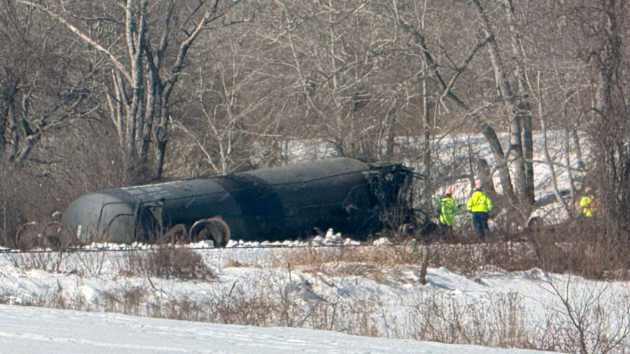
In this photo released by the Norwich Fire Department, a train derailment is shown in Mansfield, Conn., on Feb. 5, 2026. (Norwich Fire Department)
(MANSFIELD, Calif.) — A freight train carrying flammable liquids derailed in Connecticut on Thursday, prompting a shelter-in-place advisory, officials said.
Approximately 14 railcars of a New England Central Railroad (NECR) train went off the tracks shortly after 9 a.m. in Mansfield near a body of water, fire officials said.
Six railcars carrying liquid propane went fully off the track, with four ending up in water, officials said.
Other derailed cars were carrying liquified natural gas and cooking grease, according to Mansfield Fire Chief John Roache.
The derailment occurred along the Willimantic River, near Eagleville Lake, according to NECR.
Air monitoring has not detected any flammable leaks from any of the train cars, Roache said during a press briefing Thursday. An NECR spokesperson also said there is no indication of any leaks.
Richard Scalora, a supervising emergency response coordinator with the state’s Department of Energy and Environmental Protection, said his staff is working on several of the railcars to “assure that we don’t have any releases.”
“We’re going to continue in this position until all the rail cars are back on their wheels and safely removed from the area,” he said during the press briefing.
All residents within a half-mile of the area have been advised to shelter in place out of an abundance of caution, due to concerns over a potential natural gas leak, officials said.
No injuries have been reported, according to an NECR spokesperson.
“First responders are on scene with NECR managers to assess the situation,” the spokesperson said in a statement. “Emergency response contractors are also en route to assist with an expeditious cleanup.”
The cleanup is anticipated to take several days due to the hard-to-reach location, with crews working to gain access to the site and bring in cranes, according to Roache.
“It’s not going to be a today operation,” he said. “We’re definitely taking it slow and methodical.”
Mansfield Town Manager Ryan Aylesworth said he will be issuing an emergency declaration later Thursday, calling it a “very serious event.”
“We are blessed with natural resources in this community that we want to safeguard, and certainly potential hazardous waste spill is a serious concern,” he said during the briefing. “Fortunately, right now, it appears that the situation is under control and the public health and safety is being maintained.”
Connecticut Gov. Ned Lamont said he is in touch with “our state emergency management and environment teams to assess any impacts regarding the train derailment involving hazardous materials in Mansfield.”
In this screen grab from a video, first responders are shown at the scene after a car crashed into a market in Los Angeles, on Feb. 5, 2026. (KABC)
(LOS ANGELES) — At least three people were killed and six others were hurt when a car crashed into a grocery store in the Westwood area of Los Angeles, according to Los Angeles Fire Department officials.
It appears the driver — a woman who’s about 70 years old — lost control of her car, hitting a bicyclist and then crashing into the market, LA fire officials said.
The crash is being investigated as accidental, not intentional, officials said.
It appears some victims were trapped under the car, officials said.
Six people were injured: two suffered serious or critical injuries; two had minor or moderate injuries; and two declined to be taken to a hospital, officials said.
The driver is being evaluated and is speaking with officers, officials said.
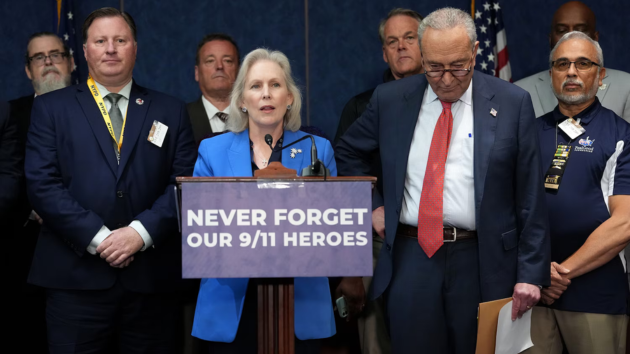
In this May 13, 2025, file photo, Sen. Kirsten Gillibrand speaks at a press conference on the World Trade Center Health Program at the U.S. Capitol in Washington, D.C. (Kevin Dietsch/Getty Images)
(WASHINGTON) — Congress has approved legislation for a funding fix that fully supports the World Trade Center Health Program and prevents a projected multibillion-dollar shortfall that threatened the program’s future.
At a press conference Thursday morning, Sen. Kirsten Gillibrand, D-N.Y., highlighted the action as a critical step toward protecting long-term care for those sickened by toxic exposure after the Sept. 11 attacks.
“Fully funding the World Trade Center Health Program honors our promise to never forget 9/11 survivors and the brave first responders who put their lives on the line for our country,” Gillibrand said.
Since its creation in 2011 through an act of Congress, the program reports it has helped over 150,000 individuals get care and medical monitoring. Gillibrand said the package will fully fund the program through 2040.
The new measure updates how the program is financed, allowing it to meet rising medical costs and growing enrollment without the risk of sudden funding gaps.
Supporters say the change provides long-term stability for the thousands of people whose health was harmed by exposure to toxic chemicals after the Sept. 11 terror attacks in New York, Pennsylvania, and Washington, D.C.
“Making sure our 9/11 first responders and survivors have the resources they need to cope with the long-term health effects from toxic exposure has been one of my top priorities for my entire service in Congress,” Gillibrand said. “I am relieved that, after years of fighting tirelessly for its passage, this funding has been signed into law.”
The World Trade Center Health Program provides medical monitoring and treatment for first responders, cleanup workers, and community members affected by 9/11-related exposure. Advocates stressed that stable funding is critical not only for current patients but also for people who may develop related illnesses years or decades later.
Doctors, responders, advocates, and survivors have long warned that the program faced a looming financial crisis.
Enrollment has continued to grow as more people develop cancers and chronic conditions linked to toxic dust and debris, while aging patients require more complex care, Benjamin Chevat, executive director for nonprofit Citizens for the Extension of the James Zadroga Act, told ABC News.
An outdated funding formula failed to reflect those realities, raising concerns that treatment could be delayed or limited, advocates cautioned.
Still, supporters say funding alone does not resolve all of the program’s challenges.
“Finally, fully funding the World Trade Center Health Program after so many years is a real accomplishment, for the 9/11 responders and survivors who walked the halls of Congress and called their representatives, and for Rep. Andrew Garbarino and Sen. Gillibrand among others who worked to get it done,” Chevat said.
The James Zadroga 9/11 Health and Compensation Act is named after a New York City Police Department officer whose 2006 death was linked to exposures from the World Trade Center disaster.
Chevat said that some challenges remain for the program.
Certification of new conditions has slowed, staffing shortages persist at some clinical sites, and administrative backlogs have delayed care for certain patients, Chevat said. Addressing these issues will ensure the program can fully deliver on its mission, he added.
Dr. Joseph Wendt, a member of the ABC News Medical Unit, contributed to this report.