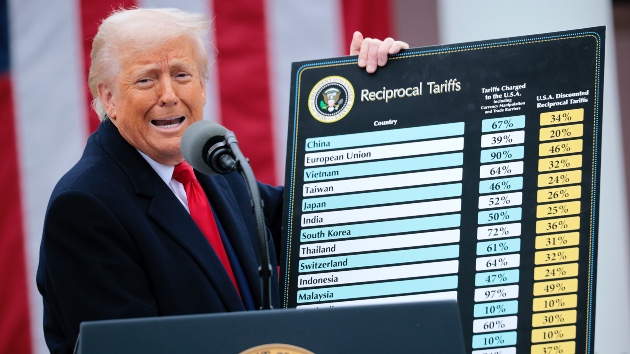
(NEW YORK) — President Donald Trump’s sweeping tariffs are an “unprecedented and unlawful expansion” of executive power, a lawyer for a group of small businesses told a federal court Tuesday morning.
The hearing at the Court of International Trade in Manhattan marks the first time a federal court has taken up the question of whether Trump’s “Liberation Day” tariffs are legal.
According to Jeffrey Schwab – a lawyer from the conservative Liberty Justice Center representing the plaintiffs – the question isn’t even close. Schwab argued that the International Emergency Economic Powers Act – a 1977 law that gives the president the right to regulate commerce during national emergencies – does not give Trump the right to unilaterally to impose tariffs.
He added that Trump’s purported emergency of trade deficits has been a problem for years and fail to meet the legal standard for an emergency of being brief, rare and not ongoing.
“This case is so far outside of what an emergency is and what an unusual and extraordinary threat is that this Court could easily say that it is not an emergency,” Schwab argued.
When the three judge panel hearing the case – including judges appointed by Presidents Obama, Trump and Reagan – pushed for a legal standard on which to issue their future ruling, Schwab said the unlawfulness of the tariffs is so obvious that the judges shouldn’t overthink it.
“I’m asking this court to be an umpire and call a strike, you’re asking me, well, where’s the strike zone? Is it at the knees or slightly below the knees?” Schwab said. “I’m saying it’s a wild pitch and it’s on the other side of the batter and hit the backstop, so we don’t need to debate that.”
The lawsuit was filed last month by a group of small businesses, including a New York liquor distributor, Utah pipe company, Virginia electronics store, Pennsylvania-based tackle shop, and Vermont cycling company. Each company argued they rely on imports from countries like China and Mexico and would be irreparably harmed by what they called Trump’s “unprecedented power grab illegal.”
The small business argue that the International Emergency Economic Powers Act does not give the president the power to unilaterally impose tariffs like Trump did last month with a blanket tariff rate and higher rates for certain countries.
They described the national emergency Trump used to justify the tariffs as a “figment of his own imagination” because the United States has operated with massive trade deficits for years without causing economic harm.
“If actually granted by statute, this power would be an unlawful delegation of legislative power to the executive without any intelligible principle to limit his discretion,” they argued.
Lawyers with the Department of Justice have pushed back on the lawsuit, saying that Congress permits the president to impose some tariffs, and Trump’s invoking of a national emergency makes his power “broader,” justifying the sweeping tariffs. They have also argued that a court order blocking the tariffs would unlawfully encroach on the president’s authority.
“Plaintiffs’ proposed injunction would be an enormous intrusion on the President’s conduct of foreign affairs and efforts to protect national security under IEEPA and the Constitution,” they argued.
At least six separate lawsuits have targeted Trump’s use of tariffs, including a case filed by the state of California and a coalition of twelve state attorneys general. While some of the cases were filed in district courts, the cases have gradually been transferred to the Court of International Trade, making Tuesday’s argument the first time a panel of judges hears a challenge to Trump’s tariffs.
Last month, the court rejected an emergency request for a temporary order to block the tariffs, finding that the businesses failed to prove that an “immediate and irreparable harm” would stem from the tariffs.
Tuesday’s argument will be heard by a panel of three judges – Gary S. Katzmann, Timothy M. Reif, and Jane A. Restani – who were appointed by Presidents Obama, Trump and Reagan respectively.
Tucked away in a corner of New York’s Foley Square, the Court of International Trade has nationwide jurisdiction on trade disputes and has recently focused its energy on more niche issues, like honey customs disputes and mattress imports. Tuesday’s oral argument is set to provide the most high-profile hearing for the court in recent memory.
(NEW YORK) — A federal judge on Tuesday seized control of New York City’s notorious jail complex on Rikers Island, which will now be run by an official who reports directly to the court.
In a 77-page ruling, Judge Laura Taylor Swain wrote that she found the conduct of city over the last nine years “leaves no doubt that continued insistence on compliance with the court’s orders by persons answerable principally to political authorities would lead only to confrontation and delay.”
She also wrote “that the current management structure and staffing are insufficient to turn the tide within a reasonable period; that defendants have consistently fallen short of the requisite compliance with court orders for years, at times under circumstances that suggest bad faith; and that enormous resources — that the city devotes to a system that is at the same time overstaffed and underserved — are not being deployed effectively.”
The manager, who will report to the judge, will work with the city’s jails commissioner and will be “empowered to take all actions necessary” to fix the complex.
“While the necessary changes will take some time, the court expects to see continual progress toward these goals,” the judge wrote.
New York Mayor Eric Adams addressed the ruling during a news conference at city hall on Tuesday, saying that Rikers’ problems were “decades in the making.” He claimed that the legal requirement that the jail close in 2027 limited his administration’s ability to address them.
“It stated you can’t make any capital improvements on Rikers Island,” Adams said. “We can’t spend money on Rikers Island to improve the conditions.”
Mayoral candidate Scott Stringer, who previously served as the city’s comptroller, praised the judge’s ruling as “long-overdue but necessary” in a statement released on Tuesday.
“For decades, Rikers has represented a systemic failure of multiple mayoral administrations — plagued by violence, neglect, and dangerous and inhumane conditions,” he said. “While I applaud this decision, I do not view it as a victory; instead, it is a scathing indictment of our city’s failed leadership.”
(WASHINGTON) — House Republicans are plowing ahead Tuesday to advance key components of their bill to fund President Donald Trump’s agenda — including taxes and Medicaid cuts — even as they remain at odds over several critical issues.
Sources tell ABC News that dueling, dramatic hearings are expected to drag deep into the night and into Wednesday as Democrats try to challenge Republicans’ efforts to write those sections of Trump’s “big, beautiful bill.”
Democratic members of the House Energy and Commerce Committee, which has jurisdiction over energy and health care programs, plan to offer several doomed amendments and might try an unusual move of calling impromptu witnesses to testify about how Medicaid impacts their life. Republicans are likely to block both efforts.
Dozens of people in wheelchairs chanting “No cuts to Medicaid!” tried to block the doors of the Energy and Commerce markup before it began and were blocked by Capitol Police. Several were arrested.
The markup in the House Ways and Means Committee, which has jurisdiction over taxes, is also expected to slide into the night amid an internal GOP battle over caps to the State and Local Tax deduction. Democrats are expected to trash the bill as a massive break for the wealthiest taxpayers.
While the GOP plan proposes massive cuts to Medicaid, it does not include some of the most drastic cuts that Republican hardliners were pushing for, putting its passage in flux amid a conservative revolt.
Texas Republican Rep. Chip Roy said Monday he’s opposed to the proposals and needs “significant” changes to support the final package.
“I remain open-minded because progress has been made based on our forceful efforts to force change. But we cannot continue down the path we’ve been going down – and we will need SIGNIFICANT additional changes to garner my support,” he said in a post on X.
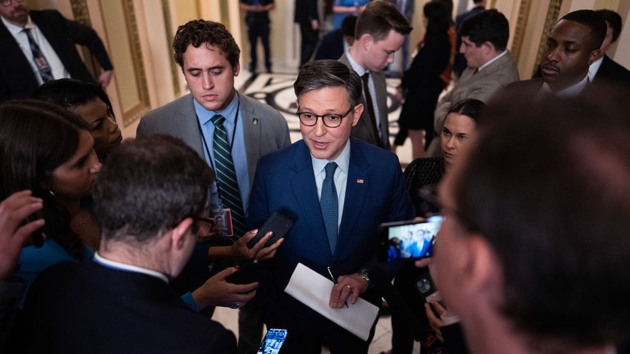
Asked on Tuesday if he was worried about members like Roy getting behind the bill,” House Speaker Mike Johnson responded, “No one is going to get 100 percent of what we want. Chip is one of my best friends. We communicated within the last hour, and we’ll talk again today. I think we get everybody to yes.”
Trump has repeatedly promised to not cut Medicaid and he and Republicans said they’ll come up with savings by cutting waste and fraud in the program.
Before heading off on a four-day trip to the Middle East on Monday, he urged Republicans to “UNIFY” around the bill and said the executive order he signed Monday that would “slash the cost of prescription drugs” and the “hundreds of billions of tariff money coming in” should be factored into the bill’s scoring.
With Republicans in control of both chambers of Congress, they are using a process called reconciliation that only requires a simple majority for passage to fast-track their legislation.
Republicans unveiled legislative text over the weekend that outlined their plans to slash Medicaid spending by imposing work requirements for recipients, make more frequent eligibility checks, and penalize states like New York and California that offer Medicaid to illegal immigrants.
The Congressional Budget Office wrote in a letter to Energy and Commerce Chairman Brett Guthrie that the proposal met its lofty target for $880 billion of savings over the next decade.
The Energy and Commerce committee resisted pressure from hardliners like Roy who demanded GOP leaders propose lowering the percentage the federal government pays to states’ Medicaid programs or include per-capita caps on federal Medicaid payments to states.
The health portions would save about $715 billion, according to CBO. However, at least 8.6 million more Americans will go uninsured.
Some culture war issues were addressed in the bill, including a provision to strip Medicaid funding from organizations that offer abortion services such as Planned Parenthood.
The legislation has already received pushback from Republicans in the Senate who will have to go along with it, including Missouri Sen. Josh Hawley, who wrote an opinion piece in the New York Times Monday warning against moves to cut Medicaid.
“This wing of the party wants Republicans to build our big, beautiful bill around slashing health insurance for the working poor. But that argument is both morally wrong and politically suicidal,” Sen. Hawley wrote.
Meanwhile, the Ways and Means Committee, which is marking up the tax portion of the bill, outlined a permanent extension of Trump’s 2017 Tax Cuts and Job Act, as well as making good on his campaign promises like no tax on tips and no tax on overtime.
The plan would temporarily increase the child tax credit, create a MAGA savings account for children and temporarily increase the standard tax deduction. It also calls for a $4 trillion increase to the debt ceiling, which Congress must address by mid-July to avoid default.
Some moderate Republicans have been adamant about not cutting into Medicaid, a benefit many of their constituents rely on.
The legislation also includes one of the most controversial components — a tax proposal that would hike the cap on state and local tax deductions (SALT) from $10,000 to $30,000 for those earning less than $400,000, which some moderate Republicans from states with higher taxes say is not enough.
New York Rep. Nick LaLota said he is “still a hell no” in a post on X.
Rep. Mike Lawler of New York told Bloomberg TV the proposal was “woefully inadequate,” adding that he will vote against the bill if it comes to the floor.
“We will continue to work in good faith with leadership, with the administration to get this done, but we need to have an honest and serious discussion about the issue,” he added.
Here’s what’s in the bill:
Medicaid cuts
Medicaid work requirements: The bill would impose work requirements on able-bodied Medicaid recipients — at least 80 hours per month — or require enrolling in an educational program for at least 80 hours or some combination per month.
More frequent eligibility checks: The legislation would require states to conduct more frequent eligibility determinations — from every 12 months to every six months.
Prohibits Medicaid funds for gender transition for minors: The measure would ban federal Medicaid funds from going to gender-affirming care for transgender minors.
Blocks Medicaid funding for non-citizens: Federal funding would be blocked from going to states that provide health care coverage under Medicare for migrants in the country without authorization.
Targets Medicaid funding for organizations that provide abortions: The measure includes language that would essentially prohibit health care providers who offer abortion services from receiving Medicaid funds.
Drug pricing: The bill makes a change to the Inflation Reduction Act and allows drugs to be exempt from Medicare’s drug price negotiation if they are approved to treat multiple diseases.
Cuts energy programs in Inflation Reduction Act: The proposal would cut Inflation Reduction Act programs like spending on electric vehicles, claw back climate-related federal funding and phase out clean energy credits.
Tax provisions
No tax on tips: A huge tax break for the service industry and a provision that was also trumpeted by Kamala Harris as the Democratic nominee for president, though she tied the tax break to an increase for the federal minimum wage. This is temporary and would expire at the end of 2028.
No tax on overtime: Would relieve millions of Americans who work overtime. This is temporary and would also expire at the end of 2028.
Extension of 2017 Tax Cuts and Job Act: Makes tax from the 2017 Tax Cuts and Jobs Act permanent; does not include a tax increase on the wealthiest earners. Trump posted last week that the proposal shouldn’t raise taxes on high-earners, “but I’m OK if they do!!!”
Creation of MAGA savings account for children: The contribution limit for any taxable year is $5,000. It includes a pilot program to start the accounts with $1,000.
SALT: Lifts state and local tax deduction cap to $30,000 with an income phase-down above $400,000. Married couples filing taxes separately are subject to a $15,000 cap and phase-down above $200,000 income.
Debt limit increase: The measure calls for increasing the debt limit by $4 trillion. Treasury Secretary Scott Bessent said last week lawmakers must address the debt limit by mid-July to avoid a default.
Enhanced tax deduction for seniors: Seniors would get a $4,000 higher standard tax deduction subject to income limits. This is temporary and would also expire at the end of 2028.
Hikes excise tax on colleges: Those with endowments over $2 million per student would increase from 1.4% to 21%, targeting Ivy League schools. Religious schools would be exempt.
Child tax credit: A temporary increase from $1,000 to $2,500 through 2028 and to $2,000 after that. Recipients will be required to have a Social Security number.
Deduction for qualified business: The bill would increase the deduction for qualified business income from 20% to 22%.
Extends increased estate and gift tax exemption: Would increase the estate and gift tax exemption to $15 million.
Elevates standard tax deduction: The measure includes some new tax cuts like temporarily elevating the standard deduction by $2,000 to $32,000 for 2025 for joint filers and by $1,000 to $16,000 through 2028.
(LOS ANGELES) — Erik and Lyle Menendez’s much-anticipated resentencing hearing is underway, with lawyers set to battle over whether the brothers should get a lesser sentence, clearing the way for a potential release from prison.
Defense attorney Mark Geragos, who is pushing for their release, said he plans to call seven witnesses during the Tuesday and Wednesday proceedings, while the prosecution said it will call no witnesses.
Menendez cousin Anamaria Baralt was the first on the stand as Erik and Lyle Menendez watched via video from prison.
Through tears, Baralt pleaded with the judge to release her cousins, noting time is running out for them to be reunited with aging family members.
“They are very different men” than when they committed the murders, Baralt said, adding that “their transformation is remarkable.”
During cross-examination, Baralt told prosecutors that the brothers have taken full responsibility for the crimes and Lyle Menendez has admitted to asking a witness to lie at trial. But Baralt conceded they haven’t acknowledged some aspects of the case to her, as prosecutors argue the brothers haven’t admitted to the full extent of their crimes and cover-ups.
Erik and Lyle Menendez are serving life without the possibility of parole for the 1989 murders of their parents, Jose and Kitty Menendez. They have the support of over 20 family members in their efforts to be freed after 35 years behind bars.
Their resentencing case gained momentum in October when then-Los Angeles County District Attorney George Gascón announced he supported a reduced sentence.
Gascón recommended the brothers’ sentences of life without parole be removed, and said they should instead be sentenced for murder, which would be a sentence of 50 years to life. Because both brothers were under 26 at the time of the crimes, they’d be eligible for parole immediately under California law.
Gascón’s office said its resentencing recommendations take into account many factors, including rehabilitation in prison and abuse or trauma that contributed to the crime. Gascón praised the brothers’ conduct in prison, saying they rehabilitated themselves and started programs to help other inmates.
In November, Gascón lost his reelection bid to Nathan Hochman, who in March filed a motion to withdraw the resentencing petition, calling the brothers’ claims of self-defense part of a litany of “lies.” The judge denied Hochman’s request.
This resentencing hearing will be a face-off between Geragos and Hochman, who is trying to keep the brothers behind bars.
“The issue is not never for the resentencing,” Hochman told ABC News in an exclusive interview Monday night. “It’s not yet.”
“The Menendez brothers have failed to come clean with the full extent of their criminal conduct, their cover-up, their lies and their deceit,” Hochman said outside court Tuesday morning.
“When and if they do, and they do it sincerely,” Hochman said, they would be “ready for resentencing.”
Hochman continues to refuse to say whether he believes the brothers were sexually abused.
A hearing was held Friday to determine whether the resentencing case should include information from the California Board of Parole’s newly completed risk assessment, which was conducted as a part of a separate clemency path. The risk assessment came at the request of Gov. Gavin Newsom as a part of the brothers’ clemency bid; the brothers are pursuing multiple avenues to freedom, and the clemency path is separate from the resentencing path.
The risk assessment said Erik and Lyle Menendez pose a moderate risk to the community if they’re released.
The assessment revealed the brothers possessed illegal cellphones in prison, among numerous other violations, though many are not recent. However, Erik Menendez had a phone as recently as January of this year, which Hochman stressed was during the resentencing effort when he should have been on his best behavior.
The defense noted Erik Menendez had one write-up for violence 25 years ago and Lyle Menendez has had none.
Judge Michael Jesic indicated he will take some of the risk assessment into account for the resentencing case, but he added that the information in the assessment is preliminary and attorneys can’t question the psychologists who performed the examinations.
(TALLAHASSEE, Fla.) — The 20-year-old who allegedly killed two and wounded several others in a mass shooting on the Florida State University campus last month made his first appearance in court on Tuesday after spending weeks in the hospital.
The suspect, FSU student Phoenix Ikner, was shot and wounded by officers minutes after he allegedly opened fire on the Tallahassee campus on April 17, officials said.
Ikner was released from the hospital on Monday and taken to a detention facility on two counts of first-degree murder and seven counts of attempted murder, Tallahassee police said.
He made his first court appearance remotely on Tuesday as victims watched the proceedings in person and on Zoom.
Ikner was held on no bond and is prohibited from contacting any victims, their families or potential witnesses.
Cellphone video from the day of the shooting showed 23-year-old graduate student Madison Askins lying on the ground while Ikner stood “with his feet shoulder width apart and his arms outstretched in front of him,” according to the probable cause affidavit released Tuesday.
“After Ikner takes this stance, three gunshots can be heard in succession” and then Ikner fled, the document said.
Askins was shot and survived.
Video also showed Ikner allegedly chasing and shooting 45-year-old Tiru Chabba, according to the probable cause affidavit. Ikner then allegedly returned to Chabba and shot him again as he laid on the ground, the document said.
Chabba, an employee of campus vendor Aramark Collegiate Hospitality, died from his injuries.
A camera also showed Ikner allegedly running up behind Robert Morales and fatally shooting him in the back, the probable cause affidavit said.
(NEW YORK) — In an obscure courthouse in downtown Manhattan on Tuesday, a group of small businesses will take on one of President Donald Trump’s boldest uses of executive authority.
A panel of judges on the Court of International Trade will hear arguments in a lawsuit challenging Trump’s sweeping tariffs, as the president’s trade war continues to disrupt the international economy and raise the specter of a recession.
The lawsuit was filed last month by a group of small businesses, including a New York liquor distributor, Utah pipe company, Virginia electronics store, Pennsylvania-based tackle shop, and Vermont cycling company. Each company argued they rely on imports from countries like China and Mexico and would be irreparably harmed by what they called Trump’s “unprecedented power grab illegal.”
The small business argue that the International Emergency Economic Powers Act does not give the president the power to unilaterally impose tariffs like Trump did last month with a blanket tariff rate and higher rates for certain countries. They described the national emergency Trump used to justify the tariffs as a “figment of his own imagination” because the United States has operated with massive trade deficits for years without causing economic harm.
“If actually granted by statute, this power would be an unlawful delegation of legislative power to the executive without any intelligible principle to limit his discretion,” they argued.
Lawyers with the Department of Justice have pushed back on the lawsuit, saying that Congress permits the president to impose some tariffs, and Trump’s invoking of a national emergency makes his power “broader,” justifying the sweeping tariffs. They have also argued that a court order blocking the tariffs would unlawfully encroach on the president’s authority.
“Plaintiffs’ proposed injunction would be an enormous intrusion on the President’s conduct of foreign affairs and efforts to protect national security under IEEPA and the Constitution,” they argued.
At least six separate lawsuits have targeted Trump’s use of tariffs, including a case filed by the state of California and a coalition of twelve state attorneys general. While some of the cases were filed in district courts, the cases have gradually been transferred to the Court of International Trade, making Tuesday’s argument the first time a panel of judges hears a challenge to Trump’s tariffs.
Last month, the court rejected an emergency request for a temporary order to block the tariffs, finding that the businesses failed to prove that an “immediate and irreparable harm” would stem from the tariffs.
Tuesday’s argument will be heard by a panel of three judges – Gary S. Katzmann, Timothy M. Reif, and Jane A. Restani – who were appointed by Presidents Obama, Trump and Reagan respectively.
Tucked away in a corner of New York’s Foley Square, the Court of International Trade has nationwide jurisdiction on trade disputes and has recently focused its energy on more niche issues, like honey customs disputes and mattress imports. Tuesday’s oral argument is set to provide the most high-profile hearing for the court in recent memory.
(NEW YORK) — Attorneys for wrongly deported Kilmar Abrego Garcia pushed back on the Trump administration’s invocation of the state secrets privilege in a court filing Monday, saying that the government has produced no evidence “showing that it has made the slightest effort to facilitate” Abrego Garcia’s release from detention in El Salvador.
“There is little reason to believe that compliance with a court order to facilitate the release and return of a single mistakenly removed individual so that he can get his day in court implicates state secrets at all,” the attorneys argued.
“No military or intelligence operations are involved, and it defies reason to imagine that the United States’ relationship with El Salvador would be endangered by any effort to seek the return of a wrongfully deported person who the Government admits never should have been removed to El Salvador in the first place,” they said.
The filing came a week after the judge overseeing the case, U.S. District Judge Paula Xinis, said in a court order that the Trump administration had invoked the rarely used state secrets privilege to shield information about the case.
Judge Xinis has scheduled a May 16 hearing on the matter.
Abrego Garcia, a Salvadoran native who had been living with his wife and children in Maryland, was deported in March to El Salvador’s CECOT mega-prison — despite a 2019 court order barring his deportation to that country due to fear of persecution — after the Trump administration claimed he was a member of the criminal gang MS-13. His wife and attorneys deny that he is an MS-13 member.
The Trump administration, while acknowledging that Abrego Garcia was deported to El Salvador in error, has said that his alleged MS-13 affiliation makes him ineligible to return to the United States.
Judge Xinis ruled last month that the Trump administration must “facilitate” Abrego Garcia’s return to the United States, and the U.S. Supreme Court unanimously affirmed that ruling, “with due regard for the deference owed to the Executive Branch in the conduct of foreign affairs.”
Following the government’s inaction, Judge Xinis ordered several government officials to testify under oath through expedited discovery in order to resolve the matter, which prompted the administration to invoke the state secrets privilege.
In their filing Monday, Abrego Garcia’s argued that the Trump administration “does not come close to making a showing that would disturb the common sense conclusion that there are no genuine state secrets at play here,” saying the administration’s public statements — including in congressional testimony, public interviews and social media posts — demonstrate that “answering the requested discovery would not imperil national security.”
Attorneys for the Department of Justice argued in their own brief Monday that the discovery requests by Abrego Garcia’s attorneys “would damage United States’ foreign relations.”
Secretary of State Marco Rubio, in a sealed declaration submitted to the court, affirmed “after actual personal consideration” that “disclosure of such materials reasonably could be expected to cause significant harm to the foreign relation[s] and national security interests of the United States,” DOJ attorneys said.
“Specifically, Secretary Rubio feared that if this information were disclosed, foreign governments would be less likely to work cooperatively with the United States in the future because the disclosure would be viewed as a breach of trust,” said the DOJ attorneys.
Attorneys for Abrego Garcia responded that because Rubio is not the head of either the Justice Department or the Department of Homeland Security, “he did not and could not claim” state secrets privilege for those departments.
“Simply saying ‘military secret,’ ‘national security’ or ‘terrorist threat’ or invoking an ethereal fear that disclosure will threaten our nation is insufficient to support the privilege,” they argued.
(GAZA) — Gaza’s entire population is experiencing critical levels of hunger amid the ongoing Israel-Hamas war and the third month of Israel cutting off aid to the strip, according to a report published Monday.
Gaza’s 2.1 million residents will face a “crisis” level of food insecurity — or worse — from now through the end of September, according to a new report from the Integrated Food Security Phase Classification partnership, whose members include the World Health Organization.
“Crisis” is the third-highest level of food insecurity, out of five, according to the IPC classification system. This is when households are either struggling to access food and are seeing cases of malnutrition or “are marginally able to meet minimum food needs but only by depleting essential livelihood assets,” according to the IPC.
Of the entire population, three-quarters of Gaza’s population are already classified at the “emergency” or “catastrophe” levels, which are the two worst stages of food insecurity, per the IPC.
The report projected that by the end of September, about 470,000 people Gaza, equivalent to about 22% of the population, will be classified as living under “catastrophe,” which is equivalent to famine levels of starvation.
In the previous IPC report, released in October 2024, 12% of the population was projected to be under classified as living under “catastrophe.”
The IPC said famine is classified when an area has 20% of households facing an extreme lack of food, 30% of children suffering from acute malnutrition, and two of every 10,000 people dying each day due to starvation or a combination of malnutrition and disease.
In a press release, the WHO said the situation in Gaza is “one of the world’s worst hunger crises, unfolding in real time.”
“We do not need to wait for a declaration of famine in Gaza to know that people are already starving, sick and dying, while food and medicines are minutes away across the border,” WHO Director-General Dr. Tedros Adhanom Ghebreyesus said in a statement on Monday. “Today’s report shows that without immediate access to food and essential supplies, the situation will continue to deteriorate, causing more deaths and descent into famine.”
Ingredients have started running out in Gaza, and some food relief organizations have already closed.
In late April, the United Nations’ World Food Programme said it had delivered its last remaining food stocks to hot meal kitchens in Gaza, and it expected to fully run out of food in the coming days.
Additionally, the nonprofit group World Central Kitchen announced on Wednesday that it had run out of supplies and ingredients needed to cook meals or bake bread in Gaza.
“Families in Gaza are starving while the food they need is sitting at the border. We can’t get it to them because of the renewed conflict and the total ban on humanitarian aid imposed in early March,” Cindy McCain, executive director of the United Nations World Food Programme, said in a statement. “It’s imperative that the international community acts urgently to get aid flowing into Gaza again. If we wait until after a famine is confirmed, it will already be too late for many people.”
The Israeli government said the blockade is meant to pressure Hamas to release its hostages, as well as the remains of those who have died, and to accept a new proposal to extend phase one of the ceasefire deal, which ended March 18.
The WHO said that since the blockade began, 57 children have died from malnutrition, citing figures from the Hamas-run Gaza Ministry of Health. If the current situation persists, an estimated 70,500 children between ages 6 months and just under 5 years old will experiencing acute malnutrition by March 2026, according to the IPC report.
Pregnant and breastfeeding women are also at risk with nearly 17,000 expected to need treatment for acute malnutrition by March 2026.
Aid workers told ABC News that malnutrition makes it harder for Gazans to heal from injuries suffered during the war, and they can also be at risk of infections or skin graft failure.
An official from President Donald Trump’s administration told ABC News there is a not-yet-finalized plan to administer the delivery of humanitarian aid in Gaza, starting with fewer than half a dozen distribution sites set up throughout the enclave.
“Our team members inside Gaza are surviving on the cheapest staples they can find — lentils, fava beans, dry chickpeas — if anything is available at all,” Kate Phillips-Barrasso, vice president of global policy and advocacy for the humanitarian organization Mercy Corps, said in a statement. “The people of Gaza are enduring one of the most harrowing humanitarian crises in recent history.”
“All barriers to food, water, and aid must be lifted now,” she said, “before even more lives are lost.”
Aristide Economopoulos For The Washington Post via Getty Images
(NEW YORK) — As testimony begins in Sean “Diddy” Combs’ criminal trial, his fate is in the hands of a jury that represents the city that allowed Combs to rise from working-class roots to the pinnacle of global cultural fame.
Twelve New Yorkers were sworn in as jurors, along with six alternates — who do not yet know of their alternate status — on Monday.
The jurors range in age from 30 to 74, with an average age of 52, and come from across the Southern District of New York, including five jurors from Manhattan, three from the Bronx and four from Westchester. Eight of the jurors are men, and four are women.
Each juror has some kind of college degree – including two master’s degrees and one PhD. The jurors work in a diverse array of fields, with an architect and scientist sitting alongside a deli clerk and massage therapist.
With allegations about Combs well publicized in the past year, at least seven of the jurors said they heard about the case before they arrived for jury selection last week, though they each vowed to remain unbiased and to rely only on the evidence presented at trial.
Here’s what we know about the New Yorkers who will decide Combs’ racketeering and sex trafficking case:
The 12 jurors
Male, 69, massage therapist: He works as a massage therapist, has a BFA in Acting and lives alone in Manhattan. He told the judge overseeing the case that an immediate family member was a victim of domestic violence, but that experience would not bias him as a juror.
Male, 31, investment analyst: He works as an investment analyst, lives in Manhattan and is an active member of his church. While he vowed to be a fair juror, he flagged that he has a moral objection to capital punishment. He said he saw the video of Combs assaulting his former girlfriend, Cassie Ventura, and is aware of the allegations against Combs.
Male, 51, scientist: He has a PhD in Molecular Biology and works as a scientist. He told the judge overseeing the case that he is vaguely aware of the allegations against Combs based on news reports.
Female, 30, deli clerk: She works as a deli clerk, generally doesn’t watch the news and lives with her family in the Bronx. She said she enjoys listening to hip-hop music and reggae.
Female, 42, nursing home aide: She works in a nursing home, lives in Manhattan, has two children and prefers getting her news by “word of mouth.” She said she got a ticket 15 years ago for carrying an open container of alcohol and said she is generally familiar with the allegations against Combs.
Male, 41, clerk at correctional facility: He works as a clerk in a correctional facility, said he enjoys listening to ’90s hip-hop and lives in the Bronx. He said he was familiar with the basic allegations of the case but his preexisting knowledge would not prevent him from being a fair juror. He said he pleaded guilty to misdemeanor fraud after the medical practitioner he used after a car accident was accused of insurance fraud. He got a one-year conditional discharge.
Male, 68, retired: He is retired but used to work for a bank, lives in Westchester and has adult children. He said he enjoys listening to Indian music and playing cricket and volleyball.
Male, 68, retired: He is a retired lineman for a telephone company who enjoys listening to classic rock. He lives with his family in Westchester. He said he was familiar with some of the names associated with the case because he watched Combs’ reality television series, “Making the Band,” when it originally aired in the early aughts. Despite having a distaste for “looking at violence on video,” he said he watched the Ventura assault video.
“I seen a video of Mr. Combs and it seems like this person was in this video and harm was being done to her in the video on TV,” he said. “I didn’t exactly know the reason why he was doing that. But I don’t think that would impede me from making a decision as far as if he went any further with it or what. I didn’t see too much of it.”
Female, 43, physician’s assistant: She works as a physician’s assistant, lives in Westchester with her family and listens to R&B and hip-hop. She is part of both a community-based organization for women in Harlem and a social-justice public theater.
Male, 39, social worker: He works as a preventative social worker for a child care organization, frequently handling domestic violence cases. He is also a licensed security guard. He lives with his family in the Bronx, likes listening to R&B and Afrobeats, gets his news from YouTube, and likes watching sports.
Male, 67, bank analyst: He works as an analyst for a bank, lives in Westchester and has three adult children, including one who works as a security guard. He said he once served on a jury for a criminal case in the Bronx, but the jury did not reach a verdict.
Female, 74, treatment coordinator: She works as a treatment coordinator for an organization dedicated to serving the disabled, lives alone in Manhattan and enjoys classical music. She has a bachelor’s degree in sociology.
6 alternate jurors
Male, 57, architect: He works as an architect, lives in Westchester and is active in the Boy Scouts. He said he is familiar with the allegations against Combs based on media reports but generally does not pay attention to “celebrity media.”
“I’m old enough to have heard a lot of stories before trial and then when the evidence is actually presented, things are, you know — the truth comes out,” he said.
Male, 35, unemployed: He is unemployed but used to work as a window cleaner, enjoys watching crime shows and listens to metal and R&B music. He said he was familiar with the basic allegations against Combs despite not watching the news.
“He was accused of like the sex trafficking, but that was about it,” he said.
Male, 40, physician: He is a physician who lives in Manhattan with his wife. He said he previously read an article written by someone who said Combs threatened her but does not think that information is relevant to the trial.
Female, 71, nonprofit employee: She works for a dance nonprofit, lives with her spouse in Manhattan and enjoys classical music.
Female, 24, site operator: She works as a site operator for a coffee service company, lives in the Bronx and is married, though her spouse lives in West Africa. She listens to hip-hop, rap, soul and West African music. She said she is aware of the Ventura video but said he could still be a fair juror.
“There are both sides to every story. I don’t know the full story, so I can’t be completely one-sided,” she said.
Male, 37, officer at international organization: He works as an administrative officer with an international government organization and has a master’s degree in international relations. He enjoys rock, pop and classical music. He said he was familiar with the allegations in the case despite not liking “celebrity kinds of cases.”
“No one likes hearing about prostitution and things like that. I mean, no one is not like pro-prostitution, and things like that, or other drug charges, and things like that. You know, they’re not good allegations. But I could still be objective and fair,” he said.
(WASHINGTON) — Republicans were on Capitol Hill Monday night as they dodged or laughed off ABC News’ exclusive reporting that President Donald Trump was considering accepting a luxury jet as a gift from the Qatari government to potentially use as Air Force One.
While several senators avoided questions or made jokes, few were willing to give a full-throated defense of the proposed gift.
Like most Republicans, Sen. Cynthia Lummis, R-Wyo., initially said she didn’t know enough about the story to comment but called it “an interesting one.”
When ABC News told her that Trump intended to use the gifted plane as Air Force One, she broke into laughter. “It might make me consider the appropriateness of that? Yes,” she said.
Asked if she had security concerns about its use as Air Force One, she broke out laughing and said, “Well, they better sweep that plane from front to back.”
Sen. Josh Hawley, R-Mo., made a tongue-in-cheek comment of his own when asked about security concerns.
“Well, I think it’d be better if it were a big, beautiful jet made in the United States of America,” he said.
Majority Leader John Thune said he needed more information on the reports before he could make an appropriate assessment. “I don’t know enough about it yet and I don’t know that it’s — I don’t know if there’s — any offer. I’m sure if and when we have more information, we’ll sort it out,” Thune said.
House Speaker Mike Johnson refused to comment, saying he didn’t have enough information. “I’m not going to comment on it,” Johnson said, adding, “I haven’t seen all the details about it.”
When asked about the price tag of the potential gift — an estimated $400 million – Sen. John Kennedy, R-La., sidestepped the issue.
“I think we ought to follow the law, whatever that is,” he said. “Well, France gave us the Statue of Liberty,” Kennedy told reporters.