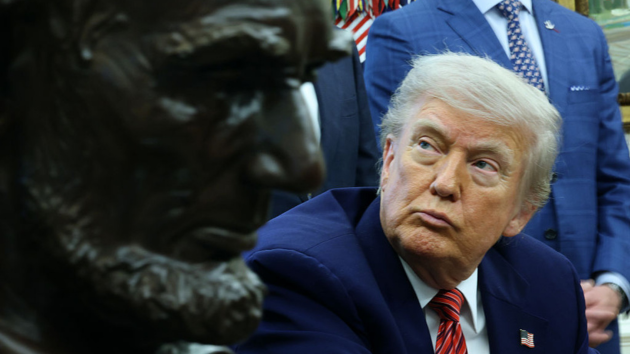
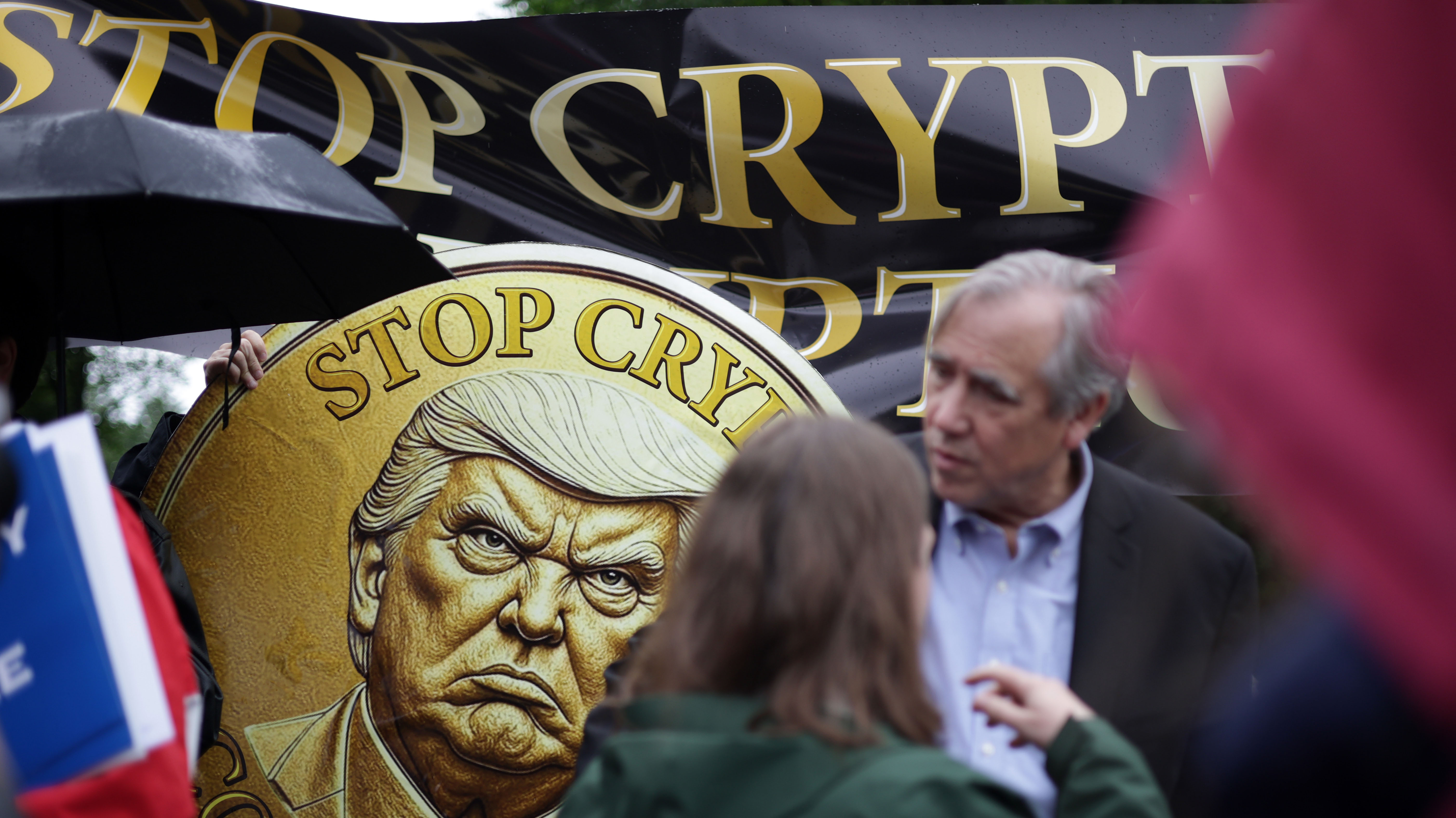
(WASHINGTON) — Despite repeated claims from the White House that President Donald Trump’s Thursday night gala for the top holders of his cryptocurrency meme coin had nothing to do with his official duties, several of those investors visited the White House Friday afternoon for what they described as a special VIP event, the attendees told ABC News.
Sangrok Oh, a Korean crypto investor and entrepreneur, told ABC News on Friday that he and other top investors had been invited to tour the White House Friday afternoon, though it was not clear to him whether Trump himself would meet them.
“So, we’re going to visit and tour the White House [and] at the same time talk about crypto industries and the future of crypto,” Oh said.
Thursday night’s black tie event, held at Trump’s Washington-area golf club, was attended by around 200 cryptocurrency traders, including many from overseas, who gained admission through a contest that awarded invitations to the top investors in Trump’s meme coin — with at least some of the funds flowing directly into the Trump family’s coffers.
Critics have blasted the gala as a “pay for play” event in which investors who poured millions into Trump’s crypto coin got special access to the president.
News that top $TRUMP coin investors visited the White House appeared to contradict White House Press Secretary Karoline Leavitt’s assertion Thursday that the president was attending the crypto gala in a personal capacity, and that since the dinner did not take place at the White House, it was separate from his official duties.
“The president is attending [the dinner] in his personal time,” Leavitt said Thursday. “It is not a White House dinner. It’s not taking place here at the White House.”
The White House did not immediately respond on Friday to a request for comment from ABC News.
Cherry Hsu, an executive at MemeCore, a Singapore-based blockchain startup, said the firm’s founder, known publicly as “Ice,” had also been invited to the White House on Friday afternoon. MemeCore, according to the contest leaderboard, finished second in the competition with $TRUMP coin holdings in excess of $1 million.
And late Friday, Justin Sun, a Chinese crupto mogul and the top investor in Trump’s meme coin, posted a highly produced video of his White House tour, writing on X, “Was an honor to be invited to tour the @WhiteHouse. Such a privilege to see it in person.”
In addition to his multimillion-dollar investment in the $TRUMP coin, Sun has also invested $75 million in World Liberty Financial, another Trump-backed crypto venture. One month after that investment, SEC lawyers under the Trump administration moved to halt an alleged fraud case against Sun.
The Trump meme coin’s website at one point earlier this month advertised a “Special VIP White House tour” for the top 25 meme coin holders as part of the contest — but as of last week, the site said only that a “Special VIP tour” would be arranged, without mentioning the White House.
The site also included a disclaimer saying the tour was being arranged by the Fight Fight Fight LLC, and that the president himself would be appearing as a “guest.”
Photo by Georg Wendt/picture alliance via Getty Images
(HAMBURG, GERMANY) — At least 12 people were injured, including three critically, in a stabbing attack at a train station in Germany on Friday, authorities said.
The suspect in the stabbing — a 39-year-old woman — has been arrested, police said.
The incident occurred at a train station in Hamburg. A knife was used in the attack, police said.
Police have not publicly identified the suspect. She is believed to have acted alone, according to Hamburg police, who said they are investigating her background. Police believe she may have been in “mental distress.”
“So far, we have no evidence that the woman could have acted with political motivation,” Hamburg police spokesperson Florian Abbenseth told reporters. “Rather, we have findings on the basis of which we are now investigating in particular whether she may have been in a state of mental distress.”
This is a developing story. Please check back for updates.
Photo by Horacio Villalobos#Corbis/Corbis via Getty Images
(SOUTH PACIFIC) — A Carnival Cruise Line ship rescued four people and three dogs from a disabled catamaran caught in treacherous conditions in the South Pacific on Thursday morning, marking the second rescue operation by the cruise line in a week, according to a press release from Carnival Cruise Line.
“We were stuck in an interesting position,” one of the rescued passengers said in video obtained by ABC News. “We got demasted, lost our engines, and after we got demasted, it was stuck under the boat, and it was hitting it on every big wave.”
The Carnival Splendor diverted its course after receiving an alert from the Maritime Rescue Coordination Centre in Nouméa about a distress call. The ship reached the stranded vessel after a five-hour journey south of New Caledonia.
The situation had become increasingly dangerous for the stranded sailors.
“It was like four to five meters swell, 30 to 40 knot winds, and we’re in this massive lightning storm, and the swell was coming over the boat,” the rescued passenger said. “Yeah, we were dead in the water, 170 nautical miles off of New Caledonia with the three puppies.”
The rescued passengers—two couples and their three dogs—are now receiving food, water, and medical assistance aboard the Carnival Splendor.
“Luckily, Carnival, the captain here was an absolute legend came and he saved the day, and now the doggies get their first cruise,” the rescued passenger added.
The rescue operation won’t impact the cruise schedule, with the ship’s 3,300 passengers still set to visit Mystery Island and Noumea as planned before returning to Sydney on Tuesday. The Splendor departed Sydney on Monday for an eight-day round trip cruise to Vanuatu and New Caledonia, Carnival Cruise stated.
This rescue follows another recent Carnival Cruise Line operation in which the Carnival Paradise rescued five men from a makeshift raft south of Cuba last week, according to video obtained by FOX35.
Photo by Andrew Lichtenstein/Corbis via Getty Images
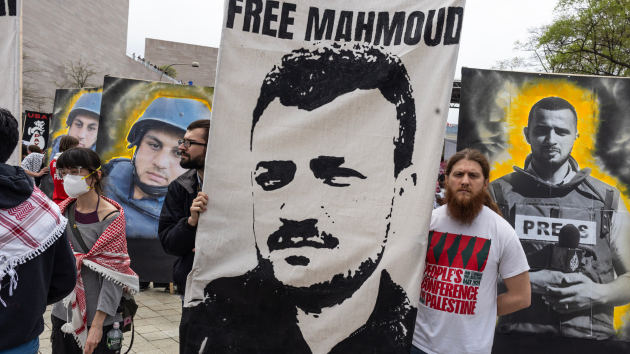
(NEW YORK) — Following a nearly 10-hour court hearing Thursday, an immigration judge will not immediately decide if Palestinian activist Mahmoud Khalil, who the Trump administration has targeted for deportation after he helped organize pro-Palestinian protests as a student at Columbia University, is eligible for asylum.
Instead Judge Jamee Comans is giving attorneys for Khalil, who took the stand Thursday, as well as attorneys for the Trump administration until June 2 to file written closing statements on the matter before she makes her decision.
Khalil, a green card holder who is married to an American citizen, has been held in a Louisiana detention facility since ICE agents arrested him in the lobby of his apartment building in New York City in March.
When he took the stand Thursday, Khalil testified in support of his case for asylum and for withholding of removal to either Algeria or Syria.
He spoke at length about growing up in a Palestinian refugee camp in Syria where he said his friends and family faced torture, kidnappings and, in some cases, death. He repeatedly stated that the Trump administration’s accusations that he’s a Hamas supporter makes him a target for Israel in any country he could be deported to. In Syria, he also said remnants of the Assad regime as well as military factions within the country could target him as well or that he could be used as a “bargaining chip” in negotiations between the new Syrian government and other nations including the U.S.
Prior to the hearing, Khalil met his infant son for the first time. The proceedings were attended by Khalil’s wife, Dr. Noor Abdalla, who gave birth to the couple’s son on April 21 during Khalil’s ongoing detention in Louisiana.
Throughout the hearing Khalil would often look back toward his baby when the newborn cooed.
Khalil also testified about his role negotiating between different protest groups at Columbia.
“The liberation of Jewish people and Palestinian people are intertwined,” he said.
In one of his final remarks on the stand, Khalil said he would continue to protest against the war in Gaza.
“I spent a good time of my life fleeing from harm, advocating for the marginalized to have rights. That’s what put me in danger. Israel is committing genocide. America is funding that genocide. Columbia is investing in it. That is what I was protesting. This is what I will continue to protest. This is what everyone should protest. This is where our efforts should go,” he said.
Earlier in the hearing, several expert witnesses were called by Khalil’s legal team, including U.C. Davis historian Muriam Davis, an expert on the Middle East and North Africa, who testified to the dangers Khalil might face if deported to Algeria or Syria, due to the notoriety of the case.
“In general, his case has achieved an international prominence that would make him a target,” Davis testified.
During a cross-examination Thursday, DHS Deputy Chief Counsel Numa Metoyer pressed Khalil about whether he was ever personally harmed when he lived in Syria, or the few times he’s visited Algeria.
Khalil recalled that the Assad regime would often kidnap and torture people involved in humanitarian efforts, like he was. When two of his friends were “disappeared” he said he made the decision to flee to Lebanon. He also repeated that he had friends and family members who were either killed by the regime or kidnapped and tortured.
“What physical persecution did you face before you left,” Metoyer asked, attempting to make the point that Khalil himself had not been harmed.
“In December 2012, the regime attacked my camp. We were under bombardment by the regime,” Khalil said.
When pressed if he had been harmed, Khalil said no, but that his neighbors had been.
Last month, Comans ruled that Khalil is deportable based on Secretary of State Marco Rubio’s assertion that his continued presence and actions in the country poses “adverse foreign policy consequence.” She did not ask to review any evidence backing those claims.
Officials from President Donald Trump’s administration have said Khalil was detained for his purported support of Hamas — a claim his legal team has rejected.
In a memo filed in the case, Rubio wrote that Khalil should be deported because of his alleged role in “antisemitic protests and disruptive activities, which fosters a hostile environment for Jewish students in the United States.”
Earlier in Thursday’s proceedings, Comans denied Khalil’s motion to terminate the case based on his allegation that his arrest and detention is illegal because he was arrested without a warrant.
The judge also declined to hear argument from Khalil’s team pertaining to the government’s allegations that Khalil lied on his application for a green card, saying the issue was “irrelevant” because she had already determined that Khalil was removable.
There were several heated exchanges between Khalil’s counsel, Marc Van Der Hout, and Judge Comans, who at one point cautioned Van Der Hout “not to argue with her.”
Van Der Hout, his voice rising, replied, “Well, I am going to argue with you.”
“And you’re going to lose,” Comans responded.
Ahead of the hearing, Khalil’s attorney submitted over 600 pages of documents, declarations and expert analyses supporting their claim that he is not antisemitic and that he could face torture and death if he were to be deported.
(WASHINGTON) — Boeing has reached an agreement in principle with the Department of Justice to avoid prosecution in the case over two deadly 737 Max crashes, also allowing Boeing to avoid going to trial next month, according to a new court filing.
The agreement still has to go through the judge in the Northern District of Texas, who rejected a previous version of the deal due to a diversity, equity and inclusion provision.
The terms of the agreement include that Boeing “will admit to conspiracy to obstruct and impede the lawful operation of the Federal Aviation Administration Aircraft Evaluation Group,” according to a DOJ status report filed on Friday.
They also include that Boeing pay and invest over $1.1 billion — including $444.5 million to crash victims’ families, $455 million to strengthen Boeing’s compliance, safety and quality programs, and an additional $243.6 million fine, according to the filing.
The DOJ said it will file the motion to dismiss and the written agreement by the end of next week.
“It is the Government’s judgment that the Agreement is a fair and just resolution that serves the public interest,” the DOJ said in the filing. “The Agreement guarantees further accountability and substantial benefits from Boeing immediately, while avoiding the uncertainty and litigation risk presented by proceeding to trial.”
Lawyers representing the families of the crash victims said they hope to convince the judge to reject the agreement.
“This kind of non-prosecution deal is unprecedented and obviously wrong for the deadliest corporate crime in U.S. history,” Paul Cassell, a lawyer representing some of the families, said in a statement. “My families will object and hope to convince the court to reject it.”
The two 737 Max crashes killed 346 people in total.
The first crash, on Oct. 29, 2018, in Jakarta, Indonesia, killed all 189 passengers and crew. Black box data from the Lion Air jet revealed the pilots struggled to fight the plane’s malfunctioning safety system from takeoff to the moment it nose-dived into the water.
The second crash, on March 10, 2019, happened in Addis Ababa, Ethiopia, when a Boeing aircraft crashed minutes after takeoff and killed 157 people onboard.
The initial plea agreement over the crashes was rejected by U.S. District Judge Reed O’Connor in December 2024, who cited the government’s DEI policies as a factor in the selection of an independent compliance monitor for Boeing. Under that deal, the aircraft manufacturing giant had agreed to plead guilty to conspiracy to defraud the United States and pay a fine of at least $243 million.
(NEW JERSEY) — New Jersey is set to hold its gubernatorial elections this year, with hotly contested primaries set for next month — and many experts are saying the high-stakes race could be a harbinger for the mood of the country ahead of 2026’s critical midterm elections.
“This is going to be the first real test for the potential Democratic backlash against the Trump administration. We’ve seen a little bit from special elections that Democratic voters are motivated to turn out. Does that continue going forward in the fall in New Jersey?” Daniel Bowen, a political science professor at The College of New Jersey, told ABC News.
Brigid Callahan Harrison, the chair of the Political Science and Law Department at Montclair State University, told ABC News that the race might not only be a “bellwether” for how voters feel about President Donald Trump and the upcoming midterms, but that it could indicate both how partisan allegiances are shifting in New Jersey and the strength of Trump’s endorsement of Republican candidate Jack Ciattarelli.
Harrison points to Kamala Harris’ small margin of victory in New Jersey, too. Harris won New Jersey by around 6 percentage points in 2024; then-Vice President Joe Biden won the state by about 16 percentage points in 2020.
At stake in the race are also issues in New Jersey such as immigration enforcement and sanctuary cities, and the cost of housing and general affordability — issues that have divided and animated Americans around the country and that are set to take center stage in the midterms as well.
Democrats contend with a crowded field
The Democratic primary features six figures hoping to succeed incumbent and term-limited Democratic Gov. Phil Murphy and to keep the governorship blue.
Polling shows that U.S. Rep. Mikie Sherrill, who represents the state’s 11th Congressional District, is leading the pack. Sherrill’s experience as a former U.S. Navy helicopter pilot and network of political supporters from a previous run for Congress work in her favor, Harrison said.
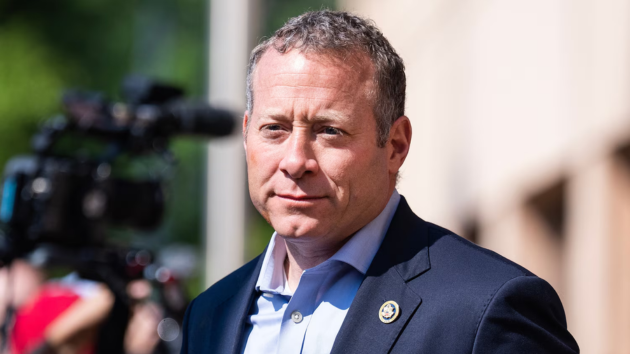
Another Democratic candidate, Josh Gottheimer, has represented New Jersey’s 5th Congressional District since 2017. The former political operative is widely seen as a moderate. Similar to other candidates, Gottheimer is positioning himself as ready to take on Trump. He has also framed himself as being the best one to tackle affordability in the state.
Newark Mayor Ras Baraka was an educator in Newark Public Schools and a member of the city council before being elected mayor for the first time in 2014. He was arrested earlier this month while joining members of Congress at an Immigration and Customs Enforcement detention center in Newark. Trespassing charges against Baraka have since been dismissed.
Steven Fulop was first elected mayor of Jersey City in 2013. The ex-Goldman Sachs investment banker and former Marine has overseen population growth, increased development and municipal reforms.
Steve Sweeney, a former ironworker who served as New Jersey’s state Senate president for more than a decade, spent two decades as a lawmaker in that chamber before losing to a Republican in 2021. He has touted his strong support from unions and experience as a legislator.
Sean Spiller, the president of the New Jersey Education Association — the state’s largest teacher’s union — has pointed to his experience as the former mayor of the city of Montclair as evidence that he is able to take on issues such as affordable housing and investing in childcare.
As the June 10 primary gets closer, experts say they’re all facing some of the same headwinds. After New Jersey eliminated its old primary ballot design, which used to allow most county parties to give preferential placement to their endorsed candidates, candidates now must focus more on their own get-out-the-vote operations, Harrison said.
“Nobody’s run in a race like this,” she said.
Republicans play the Trump card — as he endorses a returning challenger
Republicans are hoping to flip New Jersey’s governorship red — and point to the closer-than-expected margin between Trump and Harris in 2024 as evidence that it’s in reach.
A recent New Jersey Republican Party fundraising email encouraged voters to “finish the job” and “flip New Jersey red, for good.”
Experts said the presidential results might not necessarily indicate how competitive the gubernatorial race will be. Bowen said that New Jersey’s off-cycle gubernatorial elections often show voters largely voting against the incumbent party in power in the White House, although he added that Republicans also see the race as intertwined with Democratic incumbent Murphy finishing up his time in office.
Still, most of the Republican candidates have been eager to align themselves with Trump.
Trump has endorsed the Republican front-runner Ciattarelli in the race that the president wrote is being “closely watched by the entire World.”
Ciattarelli has been involved in local politics for decades, serving various roles including councilman and state assemblyman. He has had his sights on governor since 2017, where he ran for the first time but lost the primary. Ciattarelli succeeded in clinching the Republican nomination in 2021, but ultimately lost to Murphy.
Ciattarelli, who says his top priority is making the state more affordable, has shifted his stance on Trump over the years. In 2015, he issued a statement calling Trump “out of step with American values” and “not fit” to be president. But he now supports the president, and endorsed Trump in the 2024 election.
Trump, recently wrote on his social media platform that Ciattarelli, “after getting to know and understand MAGA, has gone ALL IN, and is now 100% (PLUS!)”
After the endorsement, Ciattarelli told Fox News that he will support the president’s agenda. He has acknowledged his previous comments about Trump, too, but compared himself to Vice President JD Vance — who at one point also did not support the president but is now vice president under Trump.
Ashley Koning, the director of the Eagleton Center for Public Interest Polling at Rutgers University, told ABC News that Trump’s endorsement could help encourage undecided Republican voters to favor Ciattarelli. She said the center’s polling showed that with Republican voters who were split, about half said an endorsement from Trump would make them more likely to vote for that candidate.
Conservative talk show host Bill Spadea previously ran unsuccessful campaigns for the U.S. House and the state assembly, and has said he isn’t afraid to call out both parties. He has expressed a desire to end taxpayer subsidies for Planned Parenthood and replicate the Department of Government Efficiency in New Jersey, in addition to promising to combat illegal immigration and increase affordability. Still, he said he has disagreed with Trump on “multiple occasions.”
Jon Bramnick, a former state senator, appears to be less supportive of Trump. Last April, he made it clear that he would not vote for Trump in the 2024 presidential race, though he also said he probably wouldn’t vote for the Democratic candidate either.
Still, some of Bramnick’s positions reflect stances similar to Trump’s. In addition to branding himself as the “toughest candidate on immigration,” Bramnick also seeks to end sanctuary state policies in New Jersey, and introduced the “New Jersey Laken Riley Act,” which intends to align the state’s law with Trump’s legislation.
Mario Kranjac, the former mayor of the town of Englewood Cliffs, is running a pro-Trump campaign, branding himself as a “political outsider.” Justin Barbera, a contractor, is also running a pro-Trump campaign, telling the New Jersey Monitor he is guided by his military and Christian background.
Even with Ciatterelli standing out as the front-runner, Bowen said that nothing is certain until the primary wraps.
“It certainly looks like the race is Ciatterelli’s to lose at this point — although, of course, in a primary, anything can happen,” Bowen said.
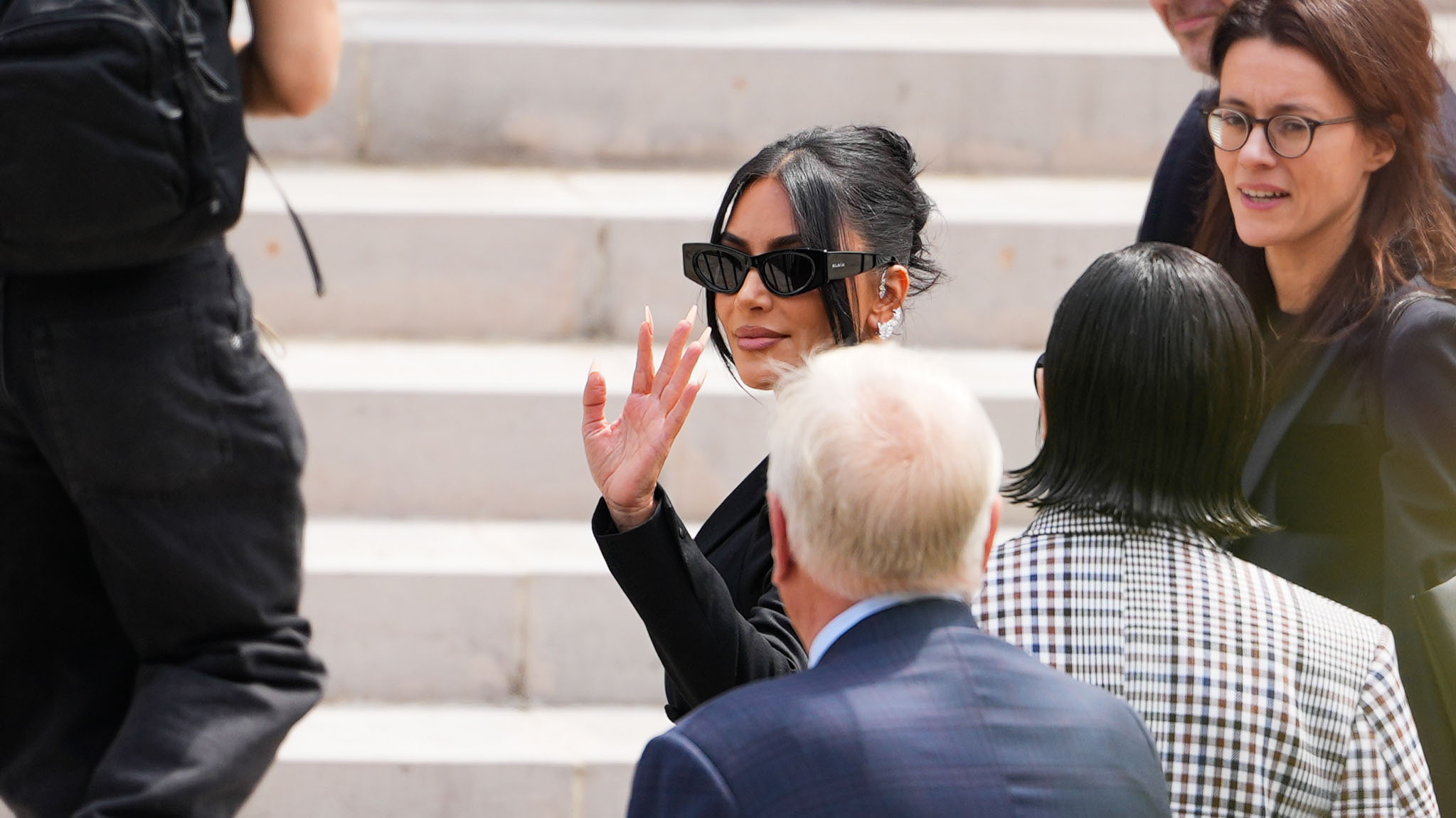
(PARIS) — A verdict was reached Friday in the 2016 jewelry heist of Kim Kardashian in Paris.
Nine men and one woman were accused in connection with the robbery, during which five masked men posing as police officers allegedly stormed into Kardashian’s hotel suite.
The suspects allegedly made off with valuables worth at least $6 million, including a diamond engagement ring given to Kardashian by her then-husband Kanye West. That ring alone was said to be worth about $4 million.
This is a developing story. Please check back for updates.
(CORVALLIS, Ore.) — Two women have been arrested in connection with a dating app scheme that led to the shooting of a man in Corvallis, Oregon, authorities said.
Julia Dell Yepez, 20, and Alexa Montano Corral, 20, were taken into custody following an investigation into the May 17 shooting of a man they allegedly met through the Chispa dating app, according to the Benton County Sheriff’s Office.
Investigators believe the women used the app to lure the victim with the intention of robbery. The victim, who has not been identified, remains hospitalized with non-life-threatening injuries.
Chispa is a dating app where Latino and Latina singles can connect with others in their area. The company did not immediately respond to ABC News’ request for comment.
According to investigators, Yepez and Corral are also suspects in similar criminal activity in a nearby county.
The incident unfolded around 5:30 a.m. local time on May 17 when emergency dispatchers received a 911 call reporting a shooting near Highway 99W and Lakeside Drive in Corvallis. Witnesses described seeing two Hispanic women, one wearing a long-sleeve black shirt, fleeing the scene on foot.
Yepez was arrested Tuesday and faces multiple charges, including attempted murder, first-degree assault and kidnapping. She is being held at the Benton County Jail on $300,000 bail, court records show.
Corral, who was arrested Thursday, faces multiple conspiracy charges. Her bail was set at $250,000, according to court records.
The case has prompted authorities to issue renewed warnings about dating app safety.
“Always meet in public and never isolate yourself until you are certain of the other person’s intentions,” the sheriff’s office advised in a statement.
Anyone who may have had contact with either suspect through dating apps is urged to contact the Benton County Sheriff’s Office or submit anonymous tips at 541-573-8477.
The investigation remains ongoing with assistance from multiple law enforcement agencies, including the U.S. Marshals Service.
(WASHINGTON) — More than a dozen World Food Programme trucks were looted in southern Gaza late Thursday as 2 million people in the Strip face “extreme hunger and famine without immediate action,” the aid group said.
The organization said 15 trucks were looted “while en route to WFP-supported bakeries.” The WFP, which is part of the United Nations, did not say who looted the trucks.
“These trucks were transporting critical food supplies for hungry populations waiting anxiously for assistance. Hunger, desperation, and anxiety over whether more food aid is coming, is contributing to rising insecurity,” the WFP said in a statement.
“Hunger, desperation, and anxiety over whether more food aid is coming, is contributing to rising insecurity,” the WFP continued. “We need support from the Israeli authorities to get far greater volumes of food assistance into Gaza faster, more consistently, and transported along safer routes, as was done during the ceasefire.”
The looting came just days after the Israeli government ended the blockade as a part of a three-phase plan to start getting more aid into Gaza. Aid trucks started slowly re-entering Gaza in the past two days, according to the U.N. and the Gaza Government Media Office.
An Israeli blockade on food and aid entering Gaza has been in place since March 2.
“WFP cannot safely operate under a distribution system that limits the number of bakeries and sites where Gaza’s population can access food. WFP and its partners must also be allowed to distribute food parcels directly to families — the most effective way to prevent widespread starvation,” the WFP said.
The Israeli blockage on humanitarian aid entering the Gaza Strip has caused widespread malnutrition and conditions likely to lead to famine, according to the U.N. and other international aid organizations.
One in five people in Gaza, about 500,000 people, faces starvation, the Integrated Food Security Phase Classification platform said on May 12, according to the U.N.
The Israeli government is working with the U.S. to set up aid distribution points in southern and central Gaza, Israeli Prime Minister Benjamin Netanyahu said Wednesday. But the plan faces criticism from established aid organizations that have been operating inside of Gaza for the past 19 months.
“We will not take part in any scheme that fails to respect international law and the humanitarian principles of humanity, impartiality, independence and neutrality,” U.N. Secretary-General Antonio Guterres said in a statement about the U.S.-Israeli deal.
The Israeli-American system for distributing aid in Gaza is set to begin on Monday, according to two sources familiar with the matter.
(STERLING, VA.) — Calling them “pioneers,” President Donald Trump praised the top investors in his cryptocurrency meme coin at an exclusive black-tie dinner Thursday as protesters outside the event chanted and displayed signs blasting the gala as a pay-for-play event.
Two hundred and twenty cryptocurrency traders, including many from overseas, pumped tens of millions of dollars into Trump’s meme coin to gain admission to the gala through a contest that awarded invitations to the top investors — with at least some of the funds flowing directly into the Trump family’s coffers.
Among those spotted arriving for the event at Trump’s private golf club outside Washington were Lamar Odom of the NBA and “Keeping Up With the Kardashians” fame, controversial cryptocurrency mogul Justin Sun, and Kendall Davis, an Austin-based cryptocurrency investor, who told ABC News that he “came here to advocate for things to be done right in the crypto space.”
The top 220 holders of Trump’s meme coin — a type of digital currency that’s often based on an internet meme — collectively spent upwards of $140 million for a seat at the table on Thursday, according to an analysis by the data analytics firm Nansen. According to CNBC’s reporting of blockchain analytics firm Chainalysis’ data, 58 crypto wallets had made millions from their Trump coin investments as of May 6 — while roughly 764,000 crypto wallets had lost money.
White House Press Secretary Karoline Leavitt said the gala was not a White House event and that the president was attending in a personal capacity. The White House did not release a list of the event’s attendees.
Protesters outside the event — which included Sen. Jeff Merkley, D-Ore. — chanted slogans and displayed signs reading “Stop Trump’s Crypto Corruption” and “America is not for sale” as attendees made their way into the venue.
Trump, addressing attendees at the dinner, said that he always puts the country “way ahead of the business” and added, “You can’t say that about Hunter Biden and Joe Biden,” according to social media posts.
On the topic of cryptocurrency, Trump attacked the previous administration and touted his own administration’s support of crypto.
“The Biden administration persecuted crypto innovators, and we’re bringing them back into the USA where they belong. They were fleeing. They were leaving our country,” Trump was seen saying in a social media video posted by an attendee.
Many of the dinner guests were overseas investors, and several of them told ABC News they had flown into the country just for a chance to see the president of the United States.
One attendee, who asked that he not be identified, told ABC News he flew in from Taiwan for the dinner.
“The second day Trump made the announcement about the dinner, I bought a bunch of tokens,” he said. The attendee said he didn’t have anything specific he wanted to hear from Trump, but that he wanted to attend the dinner because “I just think to have opportunity to come to an event like this is very rare.”
Another attendee, who asked to be identified only by his first name, Alex, told ABC News he is an investment banker from Moscow, Russia, who currently resides in Cancun.
He said he didn’t understand much of what Trump spoke about at the dinner because of the language barrier, but that he’s a supporter of Trump and that he was happy to see him.
Attendee Bryce Paul, in a video he posted to social media, likened Trump’s meme coin gala to crypto’s “Iwo Jima” moment — where attendees would be “raising the flags, behind the enemy lines, right here in the swamp of D.C.”
“I’m just one of 220 people that are invited,” Paul said. “There’s no media, there’s no recording, there are no plus-ones. It’s just truly some of the most influential figures in crypto, in policy, and of course, the man himself.”