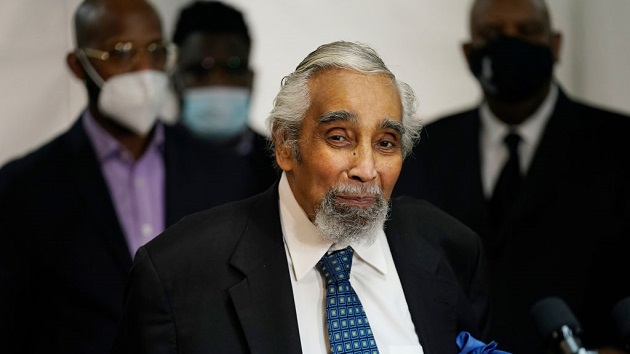
(WASHINGTON) — Former New York Rep. Charles Rangel, a founding member of the Congressional Black Caucus who spent more than four decades in the House, died on Monday, according to his family. He was 94 years old.
Rangel, a Democrat, served in the House from 1971 until 2017, spending part of his tenure as the chairman of the House Ways and Means Committee.
“A towering figure in American politics and a champion for justice, equity, and opportunity, Congressman Rangel dedicated over four decades of his life to public service,” his family said in a statement about his death.
While in Congress, Rangel — often referred to as the “Lion of Lenox Avenue” by his Harlem district — achieved many notable firsts during his 46 years in Congress: he was a founding member of the Congressional Black Caucus in 1971 and became the first Black chair of the Ways and Means Committee in 2007.
He stepped down from leading the Ways and Means Committee amid an ethics scandal for violating House rules. Rangel was accused of 13 counts of violating those rules, but emphatically denied any wrongdoing. Ultimately, Rangel was found to have violated 11 separate rules of the House and was censured — a public shaming in the well of the chamber. That vote made him the 23rd member of the House to be censured — and the first in nearly 30 years.
Still, after he being embroiled in the scandal, Rangel was reelected and went on to serve two more terms in Congress — and was still widely respected. As he was censured, he talked about being wounded in the Korean War — for which he received a Purple Heart and Bronze Star with Valor — and not having another bad day since.
After leaving Congress, Rangel served as statesman-in-residence at The City College of New York, its website said.
“Rangel was a war hero, history-making congressman, and master lawmaker,” the college wrote in an obit for Rangel, later adding that he was “recognized as one of the hardest working legislators in Congress.”
His family added that his legacy lives on through the school’s Charles B. Rangel Center for Public Service, “which continues to inspire and train new generations of public servants.”
‘Transformational force of nature’
After news of his death, tributes came in from those who worked with the former congressman.
The Congressional Black Caucus mourned the passing of one of its “trailblazing” founders, calling him “the very definition of a life devoted to public service.”
“His legacy is one of tireless advocacy, historic firsts, and unwavering dedication to justice and equality. May he rest in power and everlasting peace,” Congressional Black Caucus Chair Yvette Clarke said in a statement.
House Minority Leader and fellow New Yorker Hakeem Jeffries honored Rangel Monday morning, acknowledging his service in the military and Congress in a post on X.
“Rep. Charlie Rangel was a phenomenal patriot, hero, statesman, leader, trailblazer, change agent & champion for justice. The Lion of Lenox Ave was a transformational force of nature. Harlem, NYC & America are better today because of his service. May he forever rest in power,” Jeffries posted on X.
Senate Minority Leader Chuck Schumer posted to X on Monday that Rangel “was a great man, a great friend, and someone who never stopped fighting for his constituents and the best of America.”
“The list of his accomplishments could take pages, but he leaves the world a much better place than he found it,” Schumer said.
Rep. Nancy Pelosi, the former speaker of the House, called Rangel “an impactful legislator and a lifelong voice for the voiceless and champion of the oppressed.”
“Throughout his decades of public service, Chairman Rangel was a skilled, relentless advocate for justice, for equality and for the people of Harlem,” Pelosi said in a statement. “May it be a comfort to his loving wife Alma, their beloved children Steven and Alicia and the entire Rangel family that so many mourn their loss and are praying for them at this sad time.”
LONDON — Russia and Ukraine continued long-range cross-border drone attacks on Sunday night into Monday morning, despite President Donald Trump’s criticism of presidents Vladimir Putin and Volodymyr Zelenskyy — the latest signal of Trump’s frustration at his inability to bring Moscow’s 3-year-old invasion of its neighbor to a close.
Ukrainian officials said air defenses engaged targets across the country, including in the capital Kyiv where damage was reported to buildings.
Ukraine’s air force said Russia launched a total of 364 “air attack vehicles” — nine cruise missiles and 355 attack drones — in the latest bombardment. All missiles and 288 drones were shot down or neutralized in flight, the air force said. Impacts were reported in five regions and falling debris in 10 regions, the air force said.
Ukrainian President Volodymyr Zelenskyy said in a post to Telegram that Russian forces “used the largest number of drones against our cities and communities since the beginning of the full-scale war.”
“Only a sense of complete impunity can allow Russia to carry out such strikes and constantly increase their scale,” Zelenskyy said. “Like any criminal, Russia can only be brought to justice by force. Only through force — the force of the United States, the force of Europe, the force of all nations that respect life — can we achieve a complete cessation of these attacks and real peace.”
Russia’s Defense Ministry, meanwhile, said its forces downed 128 Ukrainian drones over 12 regions overnight and into Monday morning.
Andriy Kovalenko, the head of the Counter-Disinformation Center operating as part of Ukraine’s National Security and Defense Council, said “unknown drones” attacked the city of Yelabuga in Russia’s Tatarstan Republic — more than 500 miles east of Moscow and some 740 miles from the closest Ukrainian-controlled territory.
The target was a facility producing Russia’s Iranian-designed Shahed strike drones, Kovalenko said.
Other drones attacked “a chemical enterprise” in the Ivanovo region, around 150 miles northeast of Moscow, he added. The facility “creates components for Russian equipment and weapons, including missiles,” Kovalenko said.
Near-nightly cross-border strikes have become a prominent feature of Russia’s war on Ukraine, now more than three years old with little sign of an imminent ceasefire or peace deal. Recent months have seen the bombardments grow in size.
On Saturday night into Sunday, for example, Russia launched what Ukrainian officials described as its largest aerial attack of the war. The assault included 367 drones and missiles and killed at least 18 people, officials said.
The attack prompted Trump to rebuke Putin while speaking with reporters and later on social media.
“I’m not happy with what Putin is doing,” the president said. “He’s killing a lot of people, and I don’t know what the hell happened to Putin. I’ve known him a long time. Always gotten along with him, but he’s sending rockets into cities and killing people, and I don’t like it at all.”
Trump reiterated his close relationship with Putin but suggested that “something has happened” which has made him “crazy.”
“I’ve always said that he wants ALL of Ukraine, not just a piece of it, and maybe that’s proving to be right, but if he does, it will lead to the downfall of Russia!” Trump wrote on Truth Social.
Trump also attacked Zelenskyy, who he has repeatedly framed as an impediment to a U.S.-brokered peace deal. “Likewise, President Zelenskyy is doing his Country no favors by talking the way he does,” Trump wrote.
“Everything out of his mouth causes problems, I don’t like it, and it better stop,” Trump continued.
On Monday, Kremlin spokesperson Dmitry Peskov said Russia is “really grateful to the Americans and personally to President Trump for his assistance in organizing and launching this negotiation process. This is a very important achievement.”
“President Putin makes the decisions that are necessary to ensure the security of our country,” Peskov said, adding that the Kremlin is “closely monitoring” any “emotional overload” and “emotional reactions” connected to the peace process.
Zelenskyy and his officials have cited Russia’s continued massed strikes as evidence that Moscow is not genuine in its public appeals for peace.
Ukrainian leaders have repeatedly appealed to Trump to impose new, tougher sanctions on Moscow to push the Kremlin to downgrade its maximalist war goals. Those include the annexation of swaths of Ukrainian territory, Ukrainian demilitarization and a permanent block on the country’s accession to NATO.
Ukrainian requests have so far gone unanswered, despite Trump’s threats to introduce new measures to press Putin into negotiations. Kyiv is pushing for a 30-day ceasefire during which time peace talks can take place. Russia has so far refused the proposal.
Following the latest round of Russian strikes, Andriy Yermak — the head of Zelenskyy’s presidential office — wrote on Telegram on Monday morning, “Russia should speed up the ceasefire, now Moscow is slowing down even with the discussion of proposals, no specifics, only delaying time.”
Zelenskyy again urged sanctions. “The increase in Russian attacks should be met with increased sanctions,” he wrote on Telegram on Monday. “Russia’s disregard for diplomacy and refusal to even accept a ceasefire should be met with a blockade of Russian finances and trade in Russian oil.”
“Thank you to everyone in the world who is pushing this very strong agenda,” the president added. “Russia must end this war of its own. And for that to happen, we must deprive their will to fight of resources.”
After more than two months without aid entering Gaza, raising the risk of famine for millions of people, some aid trucks have begun entering the territory in the past few days.
Israeli Prime Minister Benjamin Netanyahu announced some aid would resume entering the Gaza Strip Sunday, May 18. The Israeli government is working with the U.S. to set up aid distribution points. However, the plan faces criticism from established aid organizations. The Israeli-American system for distributing aid in Gaza is set to begin on Monday, according to two sources familiar with the matter.
Some local content creators in Gaza, who gained a following with their food and recipe videos, continued posting from food kitchens amid the shortage of aid — a way to keep hope alive and find joy as war rages on, they say.
“For me, this is passion, to cook delicious things in these difficult times, and I really started feeling like a useful person in this crisis and war,” Hamada Sho told ABC News. Sho is a popular content creator on social media who makes videos from Gaza, cooking and serving food to his community in Khan Yunis.
He began working with social media before the war, previously working in marketing and development with restaurants in Gaza. After deciding to help people during the ongoing war by cooking, he started to post videos showing his cooking process in March 2024, sharing them on social media for people beyond Gaza to see what life there is like.
One of the videos before the blockade, posted online in February, shows Sho making a dessert with fresh fruit and cream over a base of Twinkies and then delivering the treats to children gathered on the beach as he is greeted with loud cheers.
After Israel implemented a total aid blockade on Gaza on March 2, ingredients entering Gaza also halted. Because of the lack of supplies entering the Strip, the supplies that are inside have skyrocketed in price.
“Now I can’t cook larger quantities. I can barely purchase some from the market with these unbelievable prices.” Sho said. “Whether it was rice, beans or anything, the most important thing is that people have at least one meal a day.”
The Israeli government has said the aid blockade was meant to put pressure on Hamas to release the remaining Israeli hostages still being held in Gaza since the Oct. 7, 2023, Hamas-led attack on Israel, in which Hamas fighters killed 1,200 people and kidnapped 251 hostages. There are still 58 hostages held captive by Hamas, 20 of whom are presumed to be alive. The war has taken a large toll on Palestinians, with over 53,000 killed in Gaza since the conflict began, according to the Hamas-run Gaza Health Ministry.
The blockade, which began on March 2, started a day after a temporary six-week ceasefire between Hamas and Israel ended on March 1. Israeli forces resumed military operations in Gaza on March 18.
Sho works with local organizations, like Watermelon Relief, a grass-roots initiative in Gaza providing aid to displaced families, to get raw materials, which he uses to cook and provide food to refugee camps and communities in need of food, generally cooking from community kitchens.
Ahmed El-Madhoun, a coordinator for Watermelon Relief, explained that the raw food used in many of the videos posted by Sho was sourced from humanitarian aid entering the strip and traders located in Gaza.
“After Ramadan, things got worse. The border closed tighter, and food became harder and harder to find. Basic things like flour, cooking oil and even clean water,” El-Madhoun said.
Watermelon Relief had to close its kitchen due to the lack of cooking material, he added.
“No vegetables, no meat, nothing in the market. And if it’s available, it’s very expensive,” El-Madhoun told ABC News.
The Integrated Food Security Phase Classification (IPC), a system used around the world to track food insecurity and malnutrition, released an updated report on May 12, classifying the entire Gaza Strip as Phase 4, indicating that “the entire population is expected to face crisis or worse acute food insecurity.”
Twenty-two percent of Gaza will likely experience a food “catastrophe” according to the Integrated Food Security Phase Classification (IPC) report.
“Our team members inside Gaza are surviving on the cheapest staples they can find—lentils, fava beans, dry chickpeas—if anything is available at all. A single sack of flour, once a basic item, now sells for up to 1,700 shekels, or nearly $480. These last supplies will not last much longer,” Mercy Corps, a humanitarian aid organization, wrote in a statement regarding the IPC report. “The people of Gaza are enduring one of the most harrowing humanitarian crises in recent history.”
As food continues to be hard to access for many in Gaza, people have begun to rely on kitchens started by organizations that can make large quantities of food and serve it to the community.
“Everyone relies on community kitchens for their food now,” said Mohammed Abu Rijela, another content creator posting videos of cooking food in Gaza.
He was a content creator before the war. After being displaced at the beginning of the war, he decided to help his community by starting community kitchens in Gaza, producing over 10,000 meals a day.
Since the blockade, the number of meals Abu Rijela was able to produce has decreased significantly.
“Instead of making 10,000 meals a day, now I make 3,000. At the same time, people’s demand increased greatly in the kitchen,” he added.
Sho’s and Abu Rijela’s viral food videos were met with backlash on social media, with commenters denying the reality of the food crisis, citing the large amounts of food in the videos as evidence of the contrary. A post Sho made in March 2025, showing him cooking a chicken shawarma, became a focus of the online backlash.
El-Madhoun, with Watermelon Relief, told ABC News that most of the videos featuring meat were likely filmed months ago.
“We have not been able to find any meat for two months,” El-Madhoun said. Some traders were able to keep some meat in their warehouses, but due to the lack of electricity, storing the meat was not possible, he added.
Sho said many of the kitchens have shut down due to the lack of food, adding he has been cooking mostly legumes, peas, beans and rice during this time of low availability. Even these ingredients are sometimes unavailable, he said.
“The prices of very basic goods are skyrocketing. And the children, 1.1 million children, are suffering from that. They don’t have enough food,” a UNICEF spokesperson in Gaza told ABC News.
A UNRWA senior communications officer and spokesperson, speaking in Geneva on May 20, described the slow arrival of aid as: “Not enough. Five trucks, nowhere near. Not enough.” The comment came as humanitarian agencies have received permission from Israel for “around 100” more aid trucks to enter the Strip, five of which were let in on Monday.
In a press release on May 12, the World Health Organization (WHO) called the situation in Gaza “one of the world’s worst hunger crises, unfolding in real time.”
“We do not need to wait for a declaration of famine in Gaza to know that people are already starving, sick, and dying, while food and medicines are minutes away across the border,” said WHO Director-General Dr. Tedros Adhanom Ghebreyesus.
(JACKSON, Tenn.) — Gunfire erupted in a Jackson, Tennessee, park Saturday night leaving seven people, including juveniles, injured and police seeking the perpetrators of the shooting, authorities said.
The shooting occurred at the Kate Campbell Park northeast of downtown Jackson, according to the Jackson Police Department.
One of the gunshot victim was hospitalized in critical condition, two were in stable condition and four others were treated and released, police said in an updated statement Sunday morning.
No arrests have been announced.
Police officers responded to the park after receiving reports at around 8:41 p.m. of a shooting incident involving juveniles, authorities said in an earlier statement.
The circumstances surrounding the shooting and a motive for it remain under investigation, police said. Investigators were continuing to collect evidence at the crime scene Sunday morning and were interviewing witnesses.
The Jackson Police Department urged anyone with information about the shooting or who may have video footage of the incident to contact investigators immediately.
This is a developing story. Please check back for updates.
LONDON — Russian drones and missiles again bombarded cities across Ukraine on Saturday night into Sunday morning despite the completion of the largest prisoner exchange of the 3-year-old war.
The Armed Forces Operational Command in Poland — a NATO nation that borders Ukraine to the west — said in a Sunday morning post to X that its fighter jets were scrambled during the Russian attack. “Intensive activity of long-range aviation of the Russian Federation has been observed, associated with strikes carried out on objects located, among others, in the western territory of Ukraine,” the statement said.
Ukraine’s air force said in a post to Telegram that Russia launched a total of 367 “air attack vehicles” — among them nine Iskander ballistic missiles, 56 cruise missiles, four guided air missiles and 298 attack drones — at targets across the country.
The air force said 45 cruise missiles and 266 drones were shot down or otherwise neutralized during the attack.
“Most regions of Ukraine were affected by the enemy attack,” the air force wrote, with strikes reported in 22 locations and downed cruise missiles or strike drones reported in 15 locations.
Ukraine’s Interior Ministry said in a statement that at least 18 people were killed — among them three children from the same family — and 85 people injured. More than 80 residential buildings were damaged and 27 fires recorded, it added.
President Volodymyr Zelenskyy wrote on social media early Sunday, “Today, rescuers have been working in more than 30 Ukrainian cities and villages following Russia’s massive strike.”
“These were deliberate strikes on ordinary cities,” Zelenskyy continued. “Ordinary residential buildings were destroyed and damaged. In Kyiv, dormitories of the university’s history department were hit. There were also strikes on enterprises. Tragically, people were killed, including children.”
Russia’s Defense Ministry claimed the attacks constituted “a massive strike by sea, air, land-based precision weapons and unmanned aerial vehicles against enterprises of Ukraine’s military-industrial complex that produce missile weapon components, radio electronics, explosives, rocket fuel and strike drones for the Armed Forces of Ukraine, as well as radio-technical reconnaissance and satellite communications centers.”
“The targets of the strike have been achieved,” the ministry said in a post to Telegram. “All designated targets have been hit.”
The latest attack marks the fourth consecutive night during which Russia launched more than 100 missiles and drones into Ukraine, per Ukrainian air force figures. Though long-range attacks have occurred almost nightly in recent months, Russia’s recent bombardments have been notable for their scale.
Ukraine is also continuing its own drone strikes into Russia, with the Defense Ministry in Moscow reporting the downing of 110 Ukrainian drones overnight into Sunday.
The barrages came despite the beginning of a multi-day prisoner exchange process on Friday. Some 1,000 troops from both sides were expected to be swapped, with the process complete as of Sunday morning, according to Zelenskyy.
The prisoner exchange was the largest since Moscow’s invasion began in February 2022. Russia and Ukraine have swapped prisoners of war throughout the conflict, despite their failure to agree a lasting ceasefire.
U.S.-brokered peace talks since President Donald Trump’s return to office in January have likewise failed to reach an accord, with both Kyiv and Moscow accusing each other of undermining negotiations.
Ukraine is demanding a full 30-day ceasefire, during which time peace talks can take place. Zelenskyy has repeatedly ruled out ceding territory to Moscow in any peace deal.
Trump’s threats of new sanctions on Russia — as yet unrealized despite Ukrainian and European appeals for more American pressure on President Vladimir Putin — do not appear to have pushed the Kremlin away from its maximalist war goals, which essentially equate to Ukrainian capitulation.
Those demands include the annexation of four partially-occupied Ukrainian regions — plus the retention of Crimea, which Russia seized in 2014 — Kyiv’s demilitarization, a permanent block on Ukrainian accession to NATO and the “denazification” of the country — a nebulous demand based on Russia’s false representation of the Ukrainian government as a far-right dictatorship.
Ukrainian leaders have cited Russia’s continued massed strikes as evidence that Moscow is not genuine in its appeals for peace.
“Each such terrorist Russian strike is a sufficient reason for new sanctions against Russia,” Zelenskyy said on Sunday. “Russia is dragging out this war and continues to kill every day. The world may go on a weekend break, but the war continues, regardless of weekends and weekdays. This cannot be ignored. Silence of America, silence of others around the world only encourage Putin.”
“Without truly strong pressure on the Russian leadership, this brutality cannot be stopped,” he added. “Sanctions will certainly help. Determination matters now — the determination of the United States, of European countries, and of all those around the world who seek peace. The world knows all the weaknesses of the Russian economy.”
“The war can be stopped, but only through the necessary force of pressure on Russia,” Zelenskyy said. “Putin must be forced to think not about launching missiles, but about ending the war.”
Andriy Yermak — the head of Zelenskyy’s office — wrote on Telegram early Sunday, “Instead of a ceasefire, there are murders.”
“Without pressure, nothing will change and Russia and its allies will only build up forces for such murders in Western countries,” Yermak continued. “Moscow will fight as long as it has the ability to produce weapons.”
Buying a Tesla has become a bit more complicated in the past year.
The company’s Model Y and Model 3 continue to be the best-selling electric vehicles in the U.S., accounting for more than 40% of all EVs sold last year, according to Cox Automotive data. But Tesla’s stronghold on the EV market is slipping.
The U.S. electric automaker has seen its popularity dip in recent months, with insiders attributing the decline to more competition and Elon Musk’s political views.
Reports of Tesla owners selling their vehicles, violent demonstrations at Tesla showrooms and anti-Musk rallies across the globe have convinced some consumers to search for an alternative. The good news is that legacy automakers and electric startups are quickly answering that demand, unveiling new models that offer performance, styling and impressive range.
If you’re searching for an EV, here are some suggestions that could meet your driving needs.
Model 3
Jason Cammisa, host of Hagerty’s “ICON” series, said motorists have “legitimate” concerns about Tesla: “Buying one is making a political statement,” he told ABC News. But the Model 3 is also “the best consumer product in the world,” he argued.
“It’s the best car in the world, period, full stop, not up for discussion,” he said. “You won’t find a better car on planet earth, not at that price and combination of attributes.”
He added, “The thing about Tesla is that is spans so many different price points and socioeconomic situations … you have value shoppers looking at Model 3s as well as billionaires.”
Cammisa, however, has plenty of praise for several Model 3 competitors, including the Hyundai Ioniq 5 ($42,400), the Kia EV6 ($42,900) and Genesis GV60 ($52,350).
“The Hyundai products tend to hit all the marks well — the packaging is good and the UX (user experience) works well enough,” he noted. “The Ioniq 5 N is the enthusiast choice — it has drift modes and you get Lamborghini levels of performance in that car.”
Cammisa said he reviews and ranks EVs on factors that may not have been top priorities for motorists in the past.
“The biggest differentiators in the market now are not things like powertrains and suspension tuning. The consumer experience is the real differentiator now,” he said.
Patrick George, editor-in-chief of InsideEVs, said he’s heard from many Tesla owners who are ready “to move on” from their cars.
“They’re done with Tesla because of Elon,” he told ABC News. “Getting rid of Teslas are a real thing.”
He and his staff have compiled a list of non-Teslas to chose from, which includes the EV6 and Ford Mustang Mach-E.
George noted that the BMW i4 and i5 were superb replacements: “I was massively impressed with how those drive,” he said.
Model Y
Jared Rosenholtz, editor at large for CarBuzz, has two favorite Model Y replacements: the Chevy Equinox ($33,600) and Porsche Macan Electric ($77,295).
“The Equinox EV is a fantastic little vehicle with a nice interior and more than 300 miles of range,” he told ABC News. “With incentives, the price will come in under $30,000.”
The pricier Macan EV “drives just as well as the gas version,” according to Rosenholtz, who is also a fan of the Audi Q6 e-tron ($63,800), which is similar in size and power.
Camissa, too, was impressed with the Macan, saying it had “the best stereo I ever heard in a car.”
“The Macan EV is the total package,” he said.
Rosenholtz also recommended the new Volvo EX30 ($46,195), a smallish yet mighty crossover that packs 422 hp and sprints from 0-60 mph in 3.4 seconds.
“The EX30 is super adorable and the quickest Volvo ever made,” he said.
Model S
Cammisa, Rosenholtz and George all agreed that the Lucid Air, a handsome electric sedan that can travel at least 420 miles on a single charge, was without question a top competitor to the S, or any sedan on the market.
“It has unbelievably fast charging and drives amazing,” said Rosenholtz. “And you can get a Lucid for $10,000 less than the cheapest Model S.”
The Air, which is available in four trims, has a starting price of $69,900. Owners can “fill up” their Air with 200 miles of charge in about 12 minutes if they opt for the Wunderbox battery charger, according to the company.
Cammisa raved about the Air Sapphire ($250,000), which is priced like a Bentley and performs like a supercar: 0-60 mph in 1.89 seconds.
“It’s the best-handling sedan ever made in the history of the world,” he said. “The Lucid Gravity is even better — if you want a minivan looking SUV. Dynamically that thing is unbelievable and the packaging is unbelievable. I send people to Lucids all the time.”
In addition to the Lucid Air, George listed the Porsche Taycan ($100,300) and Hyundai Ioniq 6 ($37,850) as two great options, depending on one’s budget.
“The Ioniq 6 is outstanding on range,” he pointed out. “The Taycan is the OG Model S competitor — it’s more like a sports car with really fast charging.”
Model X
Americans love their big, three-row SUVs and plenty of Model X challengers have hit the market in recent months. George said Tesla owners are increasingly turning to startup Rivian, which makes the fashionable R1S ute ($75,900).
“We’ve seen a lot of Model X owners move to Rivian. It’s the closest to Tesla in so many areas — software updates, range and performance,” George said. “Everyone who has gotten a Rivian has so far adored it. It’s one of my favorite trucks.”
Added Cammisa: “The R1S is the EV that Range Rover owners want.”
Cammisa still prefers the Lucid Gravity ($79,900), which is available to order now on the Lucid site.
“It does have the proportions of a minivan but the engineers have crafted the perfect commuter vehicle,” he said. “This thing has everything you need but the question will be: is this what people want?”
George also pointed to the Polestar 3 ($67,500), a sleek and haute SUV that can be configured in all-wheel drive or rear-wheel drive. The 3’s long range dual motor model makes 489 horsepower and 620 lb.-ft. of torque and its dual chamber active air suspension improves the handling and ride quality by adapting to sensor input 500 times a second.
“The Polestar 3 is very Tesla-esque,” said George. “It’s got great tech, outstanding performance and great styling.”
Honda’s Prologue ($47,400), the company’s first electric SUV, has already been a hit with consumers since it launched last year. The interior is spacious, the optional panoramic roof adds brightness to the cabin and designers included high-quality materials and large buttons and knobs. Honda has partnered with General Motors on battery development and technology, so there are many similarities with the Chevy Blazer EV.
“The Prologue is a great gateway to EVs,” said George, who noted how “normal” the Prologue drove compared to more aggressive regenerative braking systems. Plus, “it has buttons if you don’t want a car that’s all screens and minimalist.”
Gunfire erupted in a Jackson, Tennessee, park Saturday night leaving seven people, including juveniles, injured and police seeking the perpetrators of the shooting, authorities said.
The shooting occurred at the Kate Campbell Park northeast of downtown Jackson, according to the Jackson Police Department.
One of the gunshot victim was hospitalized in critical condition, two were in stable condition and four others were treated and released, police said in an updated statement Sunday morning.
No arrests have been announced.
Police officers responded to the park after receiving reports at around 8:41 p.m. of a shooting incident involving juveniles, authorities said in an earlier statement.
The circumstances surrounding the shooting and a motive for it remain under investigation, police said. Investigators were continuing to collect evidence at the crime scene Sunday morning and were interviewing witnesses.
The Jackson Police Department urged anyone with information about the shooting or who may have video footage of the incident to contact investigators immediately.
This is a developing story. Please check back for updates.
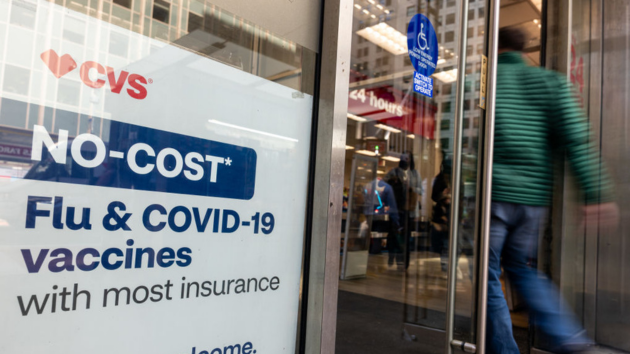
(NEW YORK) — More than five years after the first cases of COVID-19 were detected in the United States, hundreds of people are still dying every week.
Last month, an average of about 350 people died each week from COVID, according to data from the Centers for Disease Control and Prevention (CDC).
While high, the number of deaths is decreasing and is lower than the peak of 25,974 deaths recorded the week ending Jan. 9, 2021, as well as weekly deaths seen in previous spring months, CDC data shows.
Public health experts told ABC News that although the U.S. is in a much better place than it was a few years ago, COVID is still a threat to high-risk groups.
“The fact that we’re still seeing deaths just means it’s still circulating, and people are still catching it,” Dr. Tony Moody, a professor in the department of pediatrics in the division of infectious diseases at Duke University Medical Center, told ABC News.
The experts said there are a few reasons why people might still be dying from the virus, including low vaccination uptake, waning immunity and not enough people accessing treatments.
Low vaccine uptake, waning immunity
During the 2024-25 season, only 23% of adults aged 18 and older received the updated COVID-19 vaccine as of the week ending April 26, according to CDC data.
Among children, just 13% of them received the updated COVID vaccine over the same period, the data shows.
Dr. Gregory Poland, a vaccinologist and president and co-director of the Atria Research Institute — which focuses on disease prevention — said there are likely not enough people receiving the vaccine, which is contributing to the number of weekly COVID deaths.
However, for those who have received the vaccine, some may not be developing a proper immune response.
“There are some people who may be genetically inclined to not respond well to the vaccine. That’s the topic I have studied with other viral vaccines,” Poland told ABC News. “The more common issue is that people are immunocompromised and can’t respond well.”
Additionally, Poland said that immunity from COVID-19 vaccines wanes over time, increasing the likelihood of being infected.
This is why the current recommendation for those aged 65 and older is to receive two doses of the updated COVID vaccine six months apart.
“Another reason for death due to COVID is being elderly, being what we call immunosenescent, where you do not have the immunologic ability to respond the same way you did in your 30s and 40s,” Poland said. “On top of it, if you do get infected by the time you’re in your 70s, 80s, there is some … accumulating co-morbidity.”
CDC data shows that those aged 75 and older currently have the highest rate of COVID-19 deaths at 4.66 per 100,000.
Not accessing COVID treatments
Currently, there are treatments for COVID-19 patients in the form of antiviral pills, including molnupiravir from Merck and Ridgeback Biotherapeutics and Paxlovid from Pfizer.
Both treatments must be started within five days of COVID symptoms appearing and are given twice daily for five days, with Merck’s being four pills each time and Pfizer’s being three pills each.
There is also remdesivir, an intravenous medication that must be started within seven days of COVID symptoms appearing.
“I do think that we don’t necessarily make use of the tools that we have on hand in the best way possible,” Moody said. “I’ve certainly talked to people who have gotten medications when they got COVID and they made a huge difference. … The trials’ data would definitely suggest that the drugs are effective.”
“I do think that we may not be using the drugs as effectively, or in as many people as it might help,” he continued.
Moody said it’s possible some COVID patients are coming down with symptoms but are not going to the doctor until their symptoms become severe. Alternatively, some people are not undergoing COVID testing when they have symptoms and, therefore, are missing COVID diagnoses.
“I’m sure that there are people who are infected who are not being detected [and not being] treated,” Moody said, but he added that not everyone needs to be tested regularly and that just high-risk people should test more frequently.
(NEW ORLEANS) — During the ongoing massive manhunt for 10 inmates who escaped from a New Orleans jail last week, authorities say the use of facial recognition cameras run by a private organization helped lead to the recapture of one of the fugitives — even as the police department has come under scrutiny by critics from civil rights organizations to conservative politicians over its use of the technology.
Earlier this week, New Orleans Police Department Superintendent Anne Kirkpatrick told ABC News that facial recognition cameras maintained by Project N.O.L.A. had been used in the New Orleans manhunt despite the fact that she recently ordered a pause in the automated alerts her officers had been receiving from the group, which operates independently of the police department.
Kirkpatrick recently told The Washington Post she ordered the alerts to officers turned off until she is “sure that the use of the app meets all the requirements of the law and policies.”
Citing the New Orleans Police Department’s partnership with Project N.O.L.A., the American Civil Liberties Union said in a statement it is believed to be the first known widespread effort by a major American law enforcement agency to use artificial intelligence technology to identify suspects in an assortment of crimes across the city.
In a statement, the ACLU said the use of live facial recognition raises constitutional and privacy issues and “is a radical and dangerous escalation of the power to surveil people as we go about our daily lives.”
Critics of the New Orleans Police Department’s use of facial recognition cameras said that the average citizen should understand that they are not opting in or are being made aware that they are being scanned by the cameras.
“Facial recognition technology poses a direct threat to the fundamental rights of every individual and has no place in our cities,” Alanah Odoms, executive director of the ACLU of Louisiana, said in a statement about the city’s partnership with Project N.O.L.A. “We call on the New Orleans Police Department and the City of New Orleans to halt this program indefinitely and terminate all use of live-feed facial recognition technology.”
Some Republicans in Congress also opposed the unchecked use of the technology, most notably Reps. Jim Jordan of Ohio, Andy Biggs of Arizona, Warren Davidson of Ohio, Thomas Massie of Kentucky and Sens. Mike Lee of Utah and Steve Daines of Montana.
In a March 27, 2025 letter to Kash Patel, who was then acting director of the federal Bureau Alcohol, Tobacco, Firearms Explosives, Biggs, the chairman of the House Subcommittee on Crime and Federal Government Surveillance, and Davidson raised concerns over news reports indicating the ATF utilized facial recognition technology to identify gun owners. “The Subcommittee has concerns about ATF’s use of facial recognition and Al programs and the effects that its use has upon American citizens’ Second Amendment rights and rights to privacy,” the lawmakers wrote in their letter, requesting documents on policies and training in the use of facial recognition technology.
Democrats, including Rep. Zoe Lofgren of California and Sen. Ron Wyden of Oregon have also joined bipartisan efforts to curtail the use of such surveillance.
How authorities are using live facial recognition
The 10 inmates escaped from the Orleans Justice Center in New Orleans on May 16, officials said. Five of the fugitives have since been recaptured, leaving five others, including three charged with murder, still on the run as of Thursday afternoon.
Kirkpatrick told ABC News this week that one of the fugitives was caught and another narrowly got away after live facial recognition cameras operated by Project N.O.L.A. located them while scanning crowds in the French Quarter.
Bryan Lagarde, executive director of Project N.O.L.A., told ABC News that after being notified of the jailbreak on Friday, state police gave his group a list of the escapees.
“We put that into our facial recognition. It took approximately four minutes to do that and within, literally, less than a minute later we started tracking two of the escapees,” Lagarde said.
He said the information about fugitive Kendall Myles and another escaped inmate, who he said is facing attempted second-degree murder charges, was sent to state police investigators who confirmed the two men were part of the jailbreak.
“Then they immediately went out to the French Quarter, which is where we were tracking them walking down Bourbon Street,” Lagarde said.
Myles was arrested after police found him hiding under a car. The second escapee, however, managed to get away.
“I’m sure they knew there were cameras because they were walking around with their faces held down and things like that. All it takes is just a second for them to look up and then there’s facial recognition,” Lagarde said.
Citing the ongoing investigation, Lagarde declined to say if his cameras have located any of the other escapees.
Group operates 200 facial recognition cameras in New Orleans Largarde said that his organization has been using live facial recognition cameras in New Orleans for the past two years.
In response to potential privacy concerns, Lagarde said, “As far as the facial recognition is concerned, it’s scanning your face, my face, everyone’s faces. If you’re wanted and we know that you’re wanted, you’re going to be in trouble. If you are not wanted, its going to instantly disregard your face and just move on to the next person.”
He said his group maintains about 5,000 cameras in New Orleans, including 200 that have facial recognition capabilities. He said the facial recognition cameras not only scan faces, but also clothing, vehicle and license plates.
“We work a very large number of the major crimes here in New Orleans: Homicides, shootings, stabbings, home invasions, rapes, robberies all the way down to the thefts and the burglaries,” Lagarde said.
Project N.O.L.A. works with the New Orleans Police Department and the Louisiana State Police but does not have an official contract with either agency, officials said.
Before the manhunt, the New Orleans police had appeared to distance themselves from Project N.O.L.A..
The police department “does not own, rely on, manage, or condone the use by members of the department of any artificial intelligence systems associated with the vast network” of Project N.O.L.A.’s cameras, a spokesman for the police department agency said in a statement to The Washington Post.
Kirkpatrick, the New Orleans police superintendent, said her agency has operated surveillance cameras across the city, many in the entertainment districts, but none of them have facial recognition capabilities. According to the New Orleans Police & Justice Foundation, the city has about 3,600 police operated cameras across the city.
What local laws say
While the city has an ordinance on the use of facial recognition technology, Kirkpatrick said there are exceptions to the rules.
“Sometimes, people think that we have a total ban on the use of facial recognition and that is not quite accurate,” Kirkpatrick said. “There are exceptions, and I think that this one would meet the exception of those ordinances.”
According to the city ordinance, “Evidence obtained from facial recognition alone shall not be sufficient to establish probable cause for the purpose of effectuating an arrest by the NOPD or another law enforcement agency. The source of the image and the underlying reasons for the requested use of facial recognition systems as an investigative lead shall be documented in a police report.”
The ordinance says “facial-recognition technology, shall not be used as a surveillance tool.” But the ordinance also states that “nothing in this section shall prohibit NOPD from requesting the use of facial recognition technology in the investigation of the prior occurrence of the following significant crimes as defined in Louisiana Revised Statute,” including murder, manslaughter, solicitation of murder, first-degree robbery, drive-by shootings and carjackings.
“They had my permission, that’s for sure,” Kirkpatrick said of the use of facial recognition technology in the manhunt.
Three of the five escaped inmates still being sought on Friday have been have been charged with murder or attempted murder, including one who was convicted in a double homicide, authorities.
A ‘dragnet system?’
The Washington Post investigation published this week reported that New Orleans police were using Project N.O.L.A.’s network of facial recognition cameras to monitor the streets for wanted suspects over the past two years in ways that appeared “out of step” with the local ordinance.
In the interview with ABC about the manhunt, Kirkpatrick said that Project N.O.L.A. is a “useful partner” but stressed that it is not law enforcement and is not bound by the local ordinance, raising issues of accountability about Project N.O.L.A. and the data it collects on ordinary citizens who are being surveilled in this untargeted manner.
“I’m very supportive of any technology that we can use to bring violent people back in, and then we can deal with the issues later, but we actually operate within the boundaries of the law,” she said. “As long as it’s constitutional, ethical, we’re going to stay within the boundaries. But this is a bigger topic and discussion, mainly for our politicians to decide what kind of laws they want.”
Other police departments across the country have faced questions over their use of the technology.
The use of facial recognition software by U.S. businesses has also grown sharply in recent years, analysts and privacy advocates told ABC News.
The uses range from tech companies securing personal devices and retailers scanning for potential shoplifters to e-commerce giants tracking delivery drivers. Retailers are also using facial recognition scanning on shoppers to adjust pricing in stores.
Companies contend that the technology helps them achieve a safe and efficient operation, benefiting consumers and employees alike. Critics say the powerful tool encroaches on the privacy of everyday people, risking undue punishment or discrimination, the experts said.
Jake Laperruque, deputy director of the Center for Democracy & Technology’s Security and Surveillance Project, said facial recognition cameras are an “unproven, error-prone tool.”
“This is the first documented case in the U.S. of police using untargeted facial recognition, which countries like China employ to track people across cities and surveil their Uyghur citizens,” Laperruque said in a statement to ABC News regarding New Orleans’ police use of the technology. “This kind of dragnet system belongs in a dystopian sci-fi movie, not in American cities. Average pedestrians shouldn’t have to worry that untested AI technology will set off alarm bells and send police after them.”
One of the key issues of facial recognition and AI is that studies have shown that it can be racially biased and is particularly error prone with people of color, older people and women.
“There’s been error rates between 80 and 90%. That means nine out of every ten times that the system says, ‘Hey, here’s someone from our watch list,’ it’s actually a false alarm,” Laperruque said of the use of these cameras as untargeted or real-time surveillance tools based on pilot programs run in the United Kingdom.
“Facial recognition could be used to catalog attendees at a protest or political rallies of any affiliation, individuals going to a church, people visiting a medical clinic, or an array of other sensitive activities,” Laperruque told ABCNews.
He added, “Given these risks it’s no surprise that surveillance reform in general — and placing guardrails on facial recognition in particular — has support from across the political spectrum, including some of the most progressive and conservative members of Congress — just last month at a Congressional hearing conservative members of Congress highlighted the dangers of facial recognition and other unchecked forms of surveillance.”
(WASHINGTON) — President Donald Trump has disrupted global trade and roiled markets in an effort to bring manufacturing jobs back to the U.S. Some of his top tech allies, however, have backed ventures that replace human workers with robots.
Elon Musk, a top donor and adviser to Trump, has touted humanoid robots as a future growth area for electric-carmaker Tesla. “You can produce any product,” Musk said of the robots’ potential capacity during a February interview with Dubai’s World Governments Summit.
Amazon founder Jeff Bezos, who Trump last month called “terrific,” has invested in several advanced robotics firms.
Bezos last year poured funds into Figure, a humanoid robot company that says its initial rollout will focus on manufacturers and warehouses, among other business applications. “We believe humanoids will revolutionize a variety of industries,” the company says on its website.
Nvidia CEO Jensen Huang and OpenAI CEO Sam Altman – both of whom joined Trump on his recent trip to the Middle East – helmed their respective companies as each invested in Figure. OpenAI ended its partnership with Figure last year.
“Trump is talking about bringing back the jobs, and he’s not understanding the tension between that goal and automation, which the tech bros have enthusiasm for,” Harry Holzer, a professor of public policy at Georgetown University and a former chief economist at the U.S. Department of Labor, told ABC News. “There’s a fundamental conflict between those goals.”
Musk did not immediately respond to ABC News’ request for comment made through Musk-owned firm SpaceX. Neither Bezos, Huang nor Altman responded to ABC News’ request.
Speaking at a conference in April, Huang said the onset of artificial intelligence would fuel “new types of factories,” which in turn would create jobs in construction and steelmaking, as well as in trades such as plumbing and electricity.
Even more, Huang said, AI is set to trigger a surge in productivity at companies that adopt the new technology, allowing them to add employees as the firms increase output and revenue.
“New jobs will be created, some jobs will be lost, every job will be changed,” Huang said. “Remember, it’s not AI that’s going to take your job. It’s not AI that’s going to destroy your company. It’s the company and the person who uses AI that’s going to take your job. And so that’s something to internalize.”
Even after a rollback of some levies, consumers face the highest overall average effective tariff rate since 1934, the Yale Budget Lab found earlier this month.
A key reason for the tariffs, White House officials say: Reshoring factories and rejuvenating employment in the manufacturing industry.
Commerce Secretary Howard Lutnick said this month in an interview with Fox News that Trump’s vision for ushering in a “golden age” for America involved enticing manufacturers to open factories and build in the United States.
“We’re going to have huge jobs in manufacturing. You’ve heard the president talk about trillions and trillions of factories being built in America,” he said in the interview on May 11.
In response to ABC News’ request for comment, White House Spokesperson Kush Desai said “the importance of President Trump’s push to reinvigorate American industry goes beyond creating good-paying jobs for everyday Americans.”
“Supply chain shocks of critical pharmaceuticals, medical equipment, and semiconductors during the COVID era prove that America cannot rely on foreign imports. The Trump administration remains committed to reshoring manufacturing that’s critical to our national and economic security with a multifaceted approach of tariffs, tax cuts, rapid deregulation, and domestic energy production,” Desai added.
The share of U.S. workers in manufacturing has plummeted for decades. Roughly 8% of U.S. workers currently hold positions in manufacturing, which marks a steep decline from about a quarter of all employees as recently as 1970.
Researchers attribute such decline to overlapping trends, including the offshoring of manufacturing to low-wage markets overseas and the adoption of labor-saving technology throughout the sector.
Long before current advances, automation significantly increased productivity in U.S. factories, meaning the same number of workers could produce many more goods, researchers at Ball State University found in 2015. As a result, they said, manufacturing employment stagnated for decades even as output climbed.
“Automation is something we’ve seen for a long time,” Philipp Kircher, a professor of industrial and labor relations at Cornell University, told ABC News.
Some of Trump’s tech allies have backed firms that seek to further automate manufacturing, touting a new wave of artificial-intelligence equipped robots as a replacement for some workers and salve for labor shortages.
Robotics outfit Vicarious boasts $250 million in investments from a set of backers that includes Bezos, Musk and Meta CEO Mark Zuckerberg – all of whom flanked Trump during his inauguration.
On a webpage displaying photos of robots for use in warehouse settings, Vicarious tells potential clients that the products can “reduce both your costs and person-hour needs.”
In 2022, Vicarious was acquired by Alphabet-backed robotics software firm Intrinsic. Alphabet CEO Sundar Pichai also sat alongside tech leaders at Trump’s inauguration.
Alphabet did not respond to ABC News’ request for comment. Meta declined to comment.
Yong Suk Lee, a professor of economics and technology at the University of Notre Dame, described the views on automation among Trump’s tech allies and some of his trade advisers as “opposed.”
The tech position, Lee said, would likely win out, even if some firms do open plants in the U.S.
“If you want to reshore, are you going to pay the same wages as Vietnam? Probably not,” Lee said. “Companies are faced with higher labor costs. In that case, they’ll probably automate.”
Discordant views among some tech leaders and White House officials surfaced in April, when Musk sharply criticized tariff-advocate Peter Navarro, Trump’s senior counselor for trade and manufacturing. Navarro, Musk said, is “truly a moron.”
In an interview with CNBC, Navarro responded, saying Musk “isn’t a car manufacturer — he’s a car assembler.”
To be sure, analysts said, automation in manufacturing would likely continue regardless of support from Trump’s tech allies, since producers are locked in a competition to lower costs and increase output. The precise outlook for manufacturing employment is unclear, they added, since additional technology may add jobs for those maintaining and optimizing the machinery.
“Whether it’s the companies that currently support the U.S. president or not, somebody would be doing this innovation, maybe slightly slower,” Kircher said.
Even at current employment levels, a labor shortage bedevils U.S. manufacturers. Roughly one of every five U.S. factories that failed to produce at full capacity cited a shortage of workers, Jason Miller, a professor of supply chain management at Michigan State University, found in a January study analyzing government data.
Agility Robots, an Amazon-backed firm building humanoid robots, identifies the current push for rejuvenated U.S. manufacturing as an opportunity for greater adoption of technology.
“Manufacturing companies are seeing a massive reshoring movement spanning various industries,” Agility Robots says on its website. “Adding a humanoid robot to your manufacturing facility is a great way to stay on the leading edge of automation.”
In response to ABC News’ request for comment, an Amazon spokesperson pointed to previous remarks about robotics made by a company executive.
“Our goal is to ensure these systems improve safety and productivity. Technology should be used to help us retain and grow our talent through skill development and reimagining how we make our workplace better, both in productivity and safety. If we do this well, we’re certain to always innovate for our customers,” Tye Brady, chief technologist at Amazon Robotics, said in a September blog post.
Amazon has “created more U.S. jobs in the last decade than any other company,” Amazon said this month.