(WALKER, Iowa) — More than 40 years after a 24-year-old man was killed in rural Iowa, a suspect has now been arrested in connection to his murder through DNA research, according to the Linn County Sheriff’s Department.
Michael Schappert, 64, was arrested on Wednesday for the 1983 murder of Ronald Lee Novak, who was brutally killed on Dec. 23, 1983, in rural Walker, Iowa, officials announced on Wednesday.
At the time of the incident, a friend of Novak found him “deceased in an unheated room in his home” after “what appeared to be an apparent robbery and/or burglary,” officials said in a press release.
Novak had been beaten, shot in the chest and was found with his hands bound behind his back, officials said. At the time, the medical examiner ruled that Novak “died from a combination of those injuries, shock and hypothermia,” officials said.
Over the course of the last 10 to 12 years, investigators have tested DNA on Novak’s clothing and a hammer believed to have been used in the attack. The testing eventually led to the identification of Schappert as the suspect, Linn County Attorney Nick Maybanks said during a press conference on Wednesday.
Officials said genetic genealogy — the process of taking unknown DNA and identifying it by comparing it to family members who voluntarily submitted their DNA samples to a database — “assisted in Schappert’s identification.” Through testing, investigators were able to narrow the DNA down to three brothers, and did further testing to allow them to determine it was Schappert.
The investigation revealed that Schappert, who now lives in Fairview, Oregon, and others “likely went to Novak’s home with the intent to rob him of money and marijuana,” officials said. The investigation still remains open as officials said they believe at least one more suspect was involved in Novak’s murder.
“By naming a suspect, it may cause other people to now come forward that maybe weren’t willing to do so previously, or maybe this has jogged their memory some 41 years later,” Linn County Sheriff Brian Gardner said during the press conference.
Patti Wilson, Novak’s sister, told reporters on Wednesday that the investigation has been “a long ride” for the family and she “didn’t know if I would ever see this day come.”
“You start to give up hope that there will be an answer. I wanted it so bad. We look forward to the trial,” Wilson said.
Wilson said her brother was “a little elusive” and they are not sure who he was spending time with when he died, but she said the family did not recognize Schappert.
“We recognize the pain and trauma that Mr. Novak’s loved ones have endured for more than 40 years while his murder went unsolved. It takes strength to endure such hardship and to remain hopeful that someday the person or persons responsible would be caught and brought to justice,” Gardner said in a statement.
Schappert has been charged with first-degree murder and is currently being held in the Multnomah County Detention Center in Portland, Oregon, “pending an extradition hearing to be returned to Linn County, Iowa,” officials said.
It was not immediately clear whether Schappert has retained an attorney to speak on his behalf.
Officials said anyone with more information related to the investigation or additional potential suspects related to this case should contact the Linn County Sheriff’s Office.
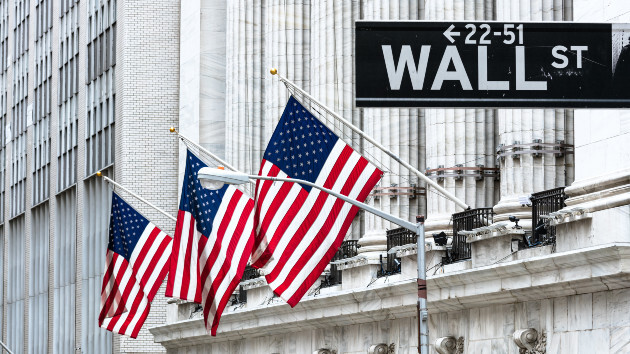
(NEW YORK) — Stocks were mixed on Thursday after a panel of federal judges blocked President Donald Trump from slapping some of his far-reaching tariffs on China and other major U.S. trading partners.
The Dow Jones Industrial Average fell 25 points, or 0.06%, while the S&P 500 increased 0.3%. The tech-heavy Nasdaq climbed 0.6%
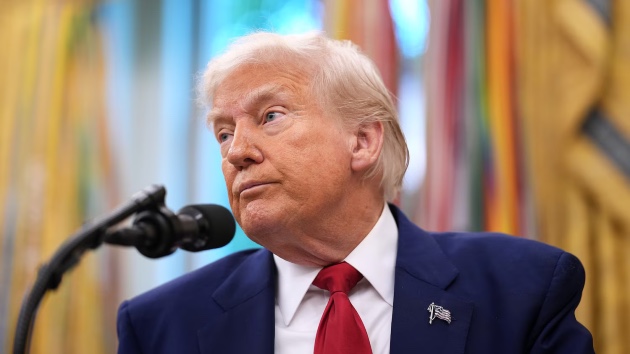
The ruling from the U.S. Court of International Trade late Wednesday marked a major blow for Trump’s tariff policy, invalidating levies on dozens of countries unveiled in a Rose Garden ceremony that Trump had dubbed “Liberation Day.”
Trump later paused those so-called “reciprocal tariffs” for 90 days, embarking on trade negotiations with the target nations that remain ongoing.
A separate set of tariffs focused on Mexico and Canada over their alleged role in the fentanyl trade fell victim to the court’s decision. The ruling also invalidated a 10% tariff imposed on goods from nearly all countries.
The Trump administration appealed the ruling within minutes, leaving the ultimate fate of the tariffs unclear.
The ruling centered on Trump’s unprecedented invocation of the International Economic Emergency Powers Act as a legal justification for tariffs.
The 1977 law allows the president to stop all transactions with a foreign adversary that poses a threat, including the use of tools like sanctions and trade embargoes. But the measure does not explicitly permit tariffs, putting Trump in untested legal territory.
The ruling afforded the Trump administration as many as 10 days to halt the tariffs.
Even before the court’s decision, Trump had rolled back some of the levies at issue.
A trade agreement between the U.S. and China earlier this month slashed tit-for-tat tariffs between the world’s two largest economies and triggered a surge in the stock market. Within days, Wall Street firms softened their forecasts of a recession.
The U.S.-China accord came weeks after the White House paused the reciprocal tariffs. Trump eased duties on some goods from Mexico and Canada.
The ruling did not impact sector-specific tariffs used under separate legal statutes, including levies targeting autos, steel and aluminum.
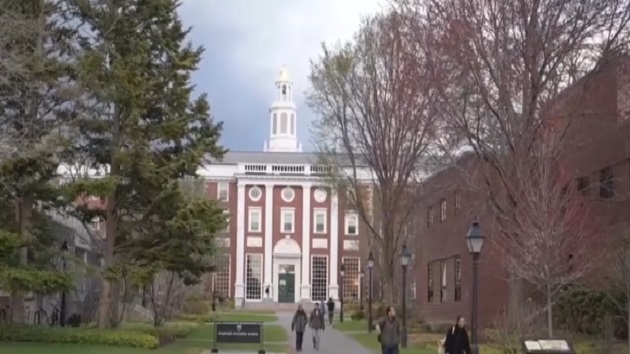
(CAMBRIDGE, Mass.) — Ahead of a federal hearing over Harvard University’s ability to enroll international students, the acting director of the U.S. Immigration and Customs Enforcement issued a letter Thursday giving the school 30 days to challenge the administration’s revocation of that certification.
The letter formally notifies the school that its Student and Exchange Visitor Program certification would be withdrawn — but backtracks from the administration’s earlier stance by giving Harvard 30 days to achieve compliance.
“Your school has 30 calendar days from the date of service of this Notice to submit written representations under oath and supported by documentary evidence, setting forth the reasons why SEVP should not withdraw your school’s certification,” the notice said. “If SEVP certification is withdrawn, your school will then no longer be approved to enroll or continue to educate nonimmigrant students.”
The notice comes one week after Secretary of Homeland Security Kristi Noem announced she had ordered the termination of the school’s SEVP certification.
“As a result of your refusal to comply with multiple requests to provide the Department of Homeland Security pertinent information while perpetuating an unsafe campus environment that is hostile to Jewish students, promotes pro-Hamas sympathies, and employs racist ‘diversity, equity, and inclusion’ policies, you have lost this privilege,” Noem wrote last week in a letter to the university.
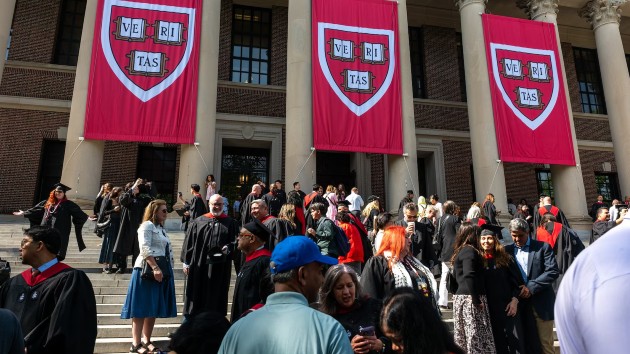
As thousands of Harvard University students and their families gather this morning for commencement, a federal judge is set to hear arguments over whether to extend an order blocking the Trump administration from stripping Harvard of its SEVP certification.
In an escalation of Trump’s recent attacks on Harvard, the Department of Homeland Security last week revoked the school’s Student and Exchange Visitor Program certification, throwing the status of the school’s nearly 7,000 international students into immediate uncertainty.
Harvard quickly sued to block the policy, arguing the students have become “pawns in the government’s escalating campaign of retaliation” — and a federal judge on Friday granted a temporary order that barred the Trump administration from revoking the school’s SEVP certification.
U.S. District Allison Burroughs, an Obama appointee, granted the temporary order within hours of Harvard filing its lawsuit, writing that the school was likely to suffer “immediate and irreparable injury” if the policy was enacted. Harvard’s lawyers have argued that nearly every one of its international students would have to transfer or drop out if the Trump administration carries out the revocation.
“With the stroke of a pen, the government has sought to erase a quarter of Harvard’s student body, international students who contribute significantly to the University and its mission,” their lawsuit said.
Arguing that the Trump administration actions are part of a “campaign to coerce Harvard into surrendering its First Amendment rights,” Harvard has alleged that the SEVP revocation is unlawful because it violates the school’s free speech rights; that the policy is arbitrary and therefore violates the Administrative Procedure Act; and that the policy runs roughshod over the school’s due process protections because it was not given the opportunity to respond to the revocation.
“The surrounding events, and Defendants’ express statements, make clear that the Department of Homeland Security took these actions not for any valid reason, but purely as punishment for Harvard’s speech, its perceived viewpoint, and its refusal to surrender its academic independence or relinquish its constitutional rights,” the lawsuit argued.
“It is the latest act by the government in clear retaliation for Harvard exercising its First Amendment rights to reject the government’s demands to control Harvard’s governance, curriculum, and the ‘ideology’ of its faculty and students,” said the suit.
DHS officials have said that the revocation was necessary because Harvard failed to turn over information about international students — including disciplinary records — as requested by the Trump administration.
“It is a privilege, not a right, for universities to enroll foreign students and benefit from their higher tuition payments to help pad their multibillion-dollar endowments. Harvard had plenty of opportunity to do the right thing. It refused.’ DHS Secretary Kristi Noem said in a statement last week.
Harvard is also fighting the Trump administration’s attempt to freeze more $2.2 billion in grants and $60 million in contracts to the school. Harvard filed a separate lawsuit to challenge the funding freeze in April, and the next hearing in that case is set for July.
Trump has continued to ratchet up the pressure on the school over the last two months, threatening to revoke the school’s tax-exempt status, directing his administration to cancel contracts with the school, and continuing to demand information on international students. Speaking to reporters on Wednesday, Trump suggested that Harvard should cap the number of international students to 15% of the school’s total student body.
“We have people who want to go to Harvard and other schools, they can’t get in because we have foreign students there. But I want to make sure that the foreign students are people that can love our country,” Trump said.
(NEW YORK) — Stocks surged at the open of trading on Thursday after a panel of federal judges blocked President Donald Trump from slapping some of his far-reaching tariffs on China and other major U.S. trading partners.
The Dow Jones Industrial Average jumped 55 points, or 0.1%, while the S&P 500 increased 0.8%. The tech-heavy Nasdaq climbed 1.4%
The ruling from the U.S. Court of International Trade late Wednesday marked a major blow for Trump’s tariff policy, invalidating levies on dozens of countries unveiled in a Rose Garden ceremony that Trump had dubbed “Liberation Day.”
Trump later paused those so-called “reciprocal tariffs” for 90 days, embarking on trade negotiations with the target nations that remain ongoing.
A separate set of tariffs focused on Mexico and Canada over their alleged role in the fentanyl trade also fell victim to the court’s ruling.
The Trump administration appealed the ruling within minutes, leaving the ultimate fate of the tariffs unclear.
The ruling centered on Trump’s unprecedented invocation of the International Economic Emergency Powers Act as a legal justification for tariffs.
The 1977 law allows the president to stop all transactions with a foreign adversary that poses a threat, including the use of tools like sanctions and trade embargoes. But the measure does not explicitly permit tariffs, putting Trump in untested legal territory.
The ruling afforded the Trump administration as many as 10 days to halt the tariffs.
Even before the court’s decision, Trump had rolled back some of the levies at issue.
A trade agreement between the U.S. and China earlier this month slashed tit-for-tat tariffs between the world’s two largest economies and triggered a surge in the stock market. Within days, Wall Street firms softened their forecasts of a recession.
The U.S.-China accord came weeks after the White House paused the reciprocal tariffs. Trump eased duties on some goods from Mexico and Canada.
The ruling did not impact sector-specific tariffs used under separate legal statutes, including levies targeting autos, steel and aluminum.
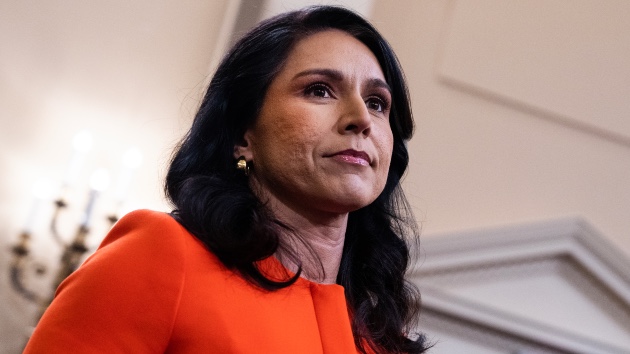
(NEW YORK) — Director of National Intelligence Tulsi Gabbard is leading a U.S. delegation to Singapore this week to attend the Shangri-La Dialogue, Asia’s premier security summit, another signal of the Trump administration’s intensified focus on the Indo-Pacific region.
The summit will convene more than 550 delegates from 40 nations, including military, intelligence, business and security leaders, from across the Asia-Pacific, Europe and North America, a source familiar with plans told ABC News.
Gabbard will be joined by Defense Secretary Pete Hegseth at the 22nd annual summit, hosted by the International Institute for Strategic Studies, which runs from May 30 to June 2 in Singapore.
Gabbard is expected to “discuss major security challenges” with leaders, a source familiar with Gabbard’s plans told ABC News. This year’s U.S. delegation includes higher-level representation than in previous years, the source added.
The Shangri-La Dialogue is considered Asia’s top defense summit, comparable to the Raisina Dialogue and the Munich Security Conference, both of which Gabbard attended earlier this year.
This trip marks Gabbard’s second trip to Asia in recent weeks, seemingly reinforcing the Trump administration’s renewed focus on the region.
Shortly after her confirmation, Gabbard traveled to India and met with Indian Prime Minister Narendra Modi ahead of President Donald Trump’s bilateral meeting with Modi in February.
Her relationship with Modi spans more than a decade, dating back to 2013 when she became the first Hindu member of Congress. They met again during her 2014 visit to India at Modi’s invitation.
Earlier this year, Gabbard accepted an invitation from Modi to speak at the Raisina Dialogue in New Delhi, a multilateral conference on geopolitics and geoeconomics, but, before returning to Washington, D.C., Gabbard made stops in Japan, Thailand and France. Her diplomatic tour began in Honolulu, Hawaii — her hometown — where she represented the state in Congress for eight years.
While in Hawaii, Gabbard met with intelligence community partners and visited United States Indo-Pacific Command (INDOPACOM) headquarters in Honolulu.
In Singapore this week, she will hold bilateral meetings with regional leaders to “explore opportunities to chart a path that advances mutual interests of security, peace, and prosperity in the region,” according to a source familiar with the agenda.
Long before taking the helm of the intelligence community, Gabbard was already on the ground in Southeast Asia and, in 2019 while she was running for president, she paused her campaign for two weeks to serve on active duty with the U.S. Army National Guard in Jakarta, Indonesia, becoming the first candidate in modern history to do so.
Now, as director of national intelligence, her return to the region marks a shift from military service to high-stakes diplomacy, an evolution that underscores not only her long-standing personal and strategic ties to the Indo-Pacific, but also hints the administration’s broader efforts to elevate U.S. engagement in the region.
(WASHINGTON) — The Trump administration is urging the New York-based Court of International Trade to delay its order blocking President Donald Trump’s sweeping tariffs, warning that enforcement of the ruling will cause a “foreign policy disaster scenario.”
In an opinion on Wednesday, the three-judge panel struck down Trump’s global tariffs as “contrary to law.”
The judges found that the International Emergency Economic Powers Act — which Trump used to enact his tariffs — does not give him the “unlimited” power to levy tariffs like the president has in recent months.
“The President’s assertion of tariff-making authority in the instant case, unbounded as it is by any limitation in duration or scope, exceeds any tariff authority delegated to the President under IEEPA. The Worldwide and Retaliatory tariffs are thus ultra vires and contrary to law,” the judges wrote.
According to the judges, Congress, not the president, has the authority to impose tariffs under most circumstances, and Trump’s tariffs do not meet the limited condition of an “unusual and extraordinary threat” that would allow him to act alone.
The Department of Justice on Thursday requested a stay, saying it’s needed “to avoid immediate irreparable harm to United States foreign policy and national security.”
“It is critical, for the country’s national security and the President’s conduct of ongoing, delicate diplomatic efforts, that the Court stay its judgment. The harm to the conduct of foreign affairs from the relief ordered by the Court could not be greater,” lawyers with the Department of Justice argued.
According to the administration, the court order would strip the president of leverage in trade negotiations, imperil the trade deals already reached, and make the country vulnerable to countries that “feel a renewed boldness to take advantage of” the current situation.
Responding to the ruling, White House spokesman Kush Desai evoked the trade deficit and said, “It is not for unelected judges to decide how to properly address a national emergency,” adding that that the administration is committed to using “every lever of executive power to address this crisis.”
The Trump administration had quickly filed a notice of appeal to challenge Wednesday’s decision.
The case now heads to the United States Court of Appeals for the Federal Circuit where they could ask for a stay of the order.
The Court of International Trade issued the decision across two cases — one filed by a group of small businesses and another filed by 12 Democratic attorneys general.
Nevada Attorney General Aaron Ford called the ruling “a win for the rule of law and for Nevadans’ pocketbooks.”
“I am extremely pleased with the court’s decision to strike down these tariffs; they were both unlawful and economically destructive,” he said. “The president had no legal authority to impose these tariffs, and his unlawful actions would have caused billions of dollars of damage to the American economy.”
Since Trump announced sweeping tariffs on more than 50 countries in April, his administration has faced half a dozen lawsuits challenging the president’s ability to impose tariffs without the approval of Congress.
New York Attorney General Letitia James called the decision a “major victory for our efforts to uphold the law and protect New Yorkers from illegal policies that threaten American jobs and economy.”
“The law is clear: no president has the power to single-handedly raise taxes whenever they like. These tariffs are a massive tax hike on working families and American businesses that would have led to more inflation, economic damage to businesses of all sizes, and job losses across the country if allowed to continue,” James’ statement continued.
Lawyers for the small businesses alleged that the International Emergency Economic Powers Act — which Trump invoked to impose the tariffs — does not give the president the right to issue “across-the-board worldwide tariffs,” and that Trump’s justification for the tariffs was invalid.
“His claimed emergency is a figment of his own imagination,” the lawsuit said. “Trade deficits, which have persisted for decades without causing economic harm, are not an emergency.”
During a hearing earlier this month, a group of three judges — who were appointed by presidents Obama, Trump and Reagan — pushed a lawyer for the small businesses to provide a legal basis to override the tariffs. While a different court in the 1970s determined that the Trading with the Enemy Act of 1917 — the law that preceded the International Emergency Economic Powers Act — gave the president the right to impose tariffs, no court has weighed whether the president can impose tariffs unilaterally under the IEEPA.
During a May 13 hearing, Jeffrey Schwab, a lawyer from the conservative Liberty Justice Center representing the plaintiffs, argued that Trump’s purported emergency to justify the tariffs is far short of what is required under the law.
“I’m asking this court to be an umpire and call a strike; you’re asking me, well, where’s the strike zone? Is it at the knees or slightly below the knees?” Schwab argued. “I’m saying it’s a wild pitch and it’s on the other side of the batter and hits the backstop, so we don’t need to debate that.”
The ruling marks the first time a federal court has issued a ruling on the legality of Trump’s tariffs. In May, a federal judge in Florida nominated by Trump suggested the president has the authority to unilaterally impose tariffs, but opted to transfer the case to the Court of International Trade.
-ABC News’ Hannah Demissie contributed to this report.
Tourists at a beach property in South Carolina who initially thought they found fossils have accidentally discovered they found human remains at a forgotten burial site dating back 200 years, authorities said.
The incident occurred last Friday when the Colleton County Sheriff’s Office in South Carolina received a call regarding human remains being discovered on Edisto Island, according to a statement from Colleton County Sheriff’s Office.
“Deputies were dispatched to the Jeremy Cay community near Legare Road, a beachfront property, after tourists exploring the area uncovered what they initially believed to be fossils,” police said. “Upon closer examination, they realized the remains appeared to be human and promptly contacted the Colleton County Sheriff’s Office and the Edisto Beach Police Department.”
Police responded to the call and secured the scene before conducting an initial investigation.
“The location of the discovery is historically significant, once home to the 19th-century settlement known as Edingsville Beach,” authorities confirmed. “Early indications suggest the remains may originate from a long forgotten burial site.”
The Colleton County Coroner’s Office responded to assist in the recovery of the human remains, which have since been taken to the Medical University of South Carolina for forensic analysis and identification.
The identity of the individual and circumstances surrounding their death remain unknown, police said.
The investigation is currently active, and Colleton County authorities are working with the coroner’s office and other partner agencies to determine more about the remains and their origins.
Further updates will be provided as more information becomes available, police said.
Amid the Trump administration’s battle with Harvard University, hundreds of grants worth millions of dollars for medical research have been canceled.
The White House has accused Harvard of allowing antisemitism to go unchecked on campus and of not ending diversity, equity and inclusion practices.
In a letter on April 11, the Trump administration argued Harvard “failed to live up to both the intellectual and civil rights conditions that justify federal investment” and proposed terms including changing the school’s governance, adopting merit-based hiring, shuttering any DEI programs and allowing “audits” to ensure “viewpoint diversity.” The administration then said it was withholding $2.2 billion in multi-year grants and $60 million in multi-year contract value to the institution.
Harvard has taken steps such as renaming the Office for Equity, Diversity, Inclusion and Belonging to the Office of Community and Campus Life. Additionally, Harvard’s president said the school is committed to making changes to create a “welcoming and supportive learning environment” but argued the Trump administration’s requests go too far.
At least 350 grants from the National Institutes of Health (NIH), National Science Foundation (NSF) and elsewhere been canceled at Harvard Medical School, excluding the School of Public Health and the School of Engineering, a Harvard University faculty source told ABC News.
Harvard has said the loss of research funding interrupts work on topics including tuberculosis, chemotherapy, pandemic preparedness, Parkinson’s disease and Alzheimer’s disease. The school has also said the Trump administration’s threats have endangered its educational mission.
The Trump administration did not immediately reply to ABC News’ request for comment.
This includes research for studying biotic resistance, identifying the earliest precursors of breast cancer, breaking barriers to deliver effective drugs for Alzheimer’s disease, studying microbial evolution and researching cures for ALS.
Scientists at Harvard say the cancellations of their research grants are collateral damage in the battle with the Trump administration and worry some scientific breakthroughs will never be discovered.
“I will say that receiving a grant from the NIH is very challenging,” David Sinclair, a professor in the department of genetics at Harvard Medical School, told ABC News. “It takes years of work and a lot of effort. You have to go through peer review, and it can take years to get this money, and when you get it — I’ve literally dropped to my knees with gratitude of receiving one of these grants. These are a big deal, and they literally are our lifeblood, and to just have that terminated is devastating.”
‘What do I say to her’?
Sinclair was inspired to find a cure for ALS (amyotrophic lateral sclerosis), a debilitating neurological disorder, after his partner’s mother was diagnosed with it.
“We’ve watched her descend from an active, healthy lady in her 70s to now, where she’s on a breathing machine and being saved by a tube,” he said. “And our house is an ICU unit with nurses 24/7 and for us, it’s a race against time.”
Sinclair said within the last month, his lab had a breakthrough using artificial intelligence to find both synthetic and naturally occurring molecules that may reverse the aging process and treat ALS.
Sinclair received word on May 15 that two grants of his were being terminated. One was an NIH grant awarded to Sinclair’s lab on a project to reverse the aging process and the second was a career award given to a postdoctoral researcher in his lab on the ALS project.
The career award grant was paying for the salaries of the researcher and two people working under her. Now all three are effectively without salaries unless another form of funding can be found.
Sinclair said in the interview that he had not told his partner’s mother that the ALS grant has been canceled.
“I just feel so concerned for the patients who, like my partner’s mother, are counting on us scientists to find treatments and cures for what ails them,” he said. “And what do I say to Serena’s mom? I haven’t talked to her yet. What do I say? That the research that looked so promising is now terminated? That her life is counting on us, and she’s just one of millions of people in this country who are counting on the research at Harvard Medical School to make the breakthroughs that will literally save their lives.”
Similarly, on a search for stopping debilitating diseases, Joan Brugge, director of the Ludwig Center at Harvard Medical School, was studying how to identify the earliest precursors of breast cancer with a goal of designing treatments to prevent them from becoming cancerous.
The work was supported by an approximately seven-year grant from the NIH’s National Cancer Institute totaling at about $600,000. The grant was in its sixth year with 1.5 more years left.
Another canceled grant was a fellowship for a postdoctoral researcher in Brugge’s lab. These grants support costs such as training, tuition and fees and child care, according to the NIH.
“These kinds of things are going to affect our ability to make progress in the way we want,” Brugge told ABC News. “This is not right. Why should Americans be deprived of potential benefits from this research?”
Claims of antisemitism
Steven Shuken, a postdoctoral researcher at the Gygi Labs at Harvard Medical School, was studying what the barriers are in developing treatments for Alzheimer’s disease.
He said drugs don’t penetrate the blood-brain barrier very well, resulting in failures to receive FDA approval to treat Alzheimer’s disease.
“They seem to have some effectiveness at some dose, but once you get up to the high dose that you need to see the effect, there are these terrible side effects that come up,” he told ABC News.
In order to improve future drugs’ efficacy and reduce side effects enough to make them safe and effective for Alzheimer’s patients, Shuken teamed up with Boston Children’s Hospital to see if they could leverage the chorid plexis, a section of the blood-cerebral spinal fluid barrier as a pathway without side effects.
Shuken had been awarded a K99/R00 grant, which is for postdoctoral scientists completing research that will eventually lead to a tenure-track or equivalent faculty position.
The K99 portion supports one to two years of postdoctoral research training and the R00 portion supports up to three years “contingent on the scientist securing an independent, tenure track faculty position,” according to the NIH.
Two weeks ago, he received news that the K99 grant – which was awarded last year for two years – was terminated and there is no policy that supports activating an R00 on a K99 that’s been terminated, effectively terminating the R00 as well.
Shuken said no reason was given for the grant terminations, but he said he did see the letter sent to Harvard from the NIH citing semitism.
Trump and other members of his administration have accused the university of fostering antisemitism on its campus, specifically related to pro-Palestinian demonstrations amid the Israel-Hamas war.
“Harvard’s failure to protect students on campus from anti-Semitic discrimination — all while promoting divisive ideologies over free inquiry — has put its reputation in serious jeopardy,” Secretary of Education Linda McMahon said in a letter in March.
The administration’s joint task force, made up of the Department of Education, Department of Health and Human Services and the General Services Administration, is conducting a review of Harvard, saying it is part of an effort to remove alleged antisemitic conduct and harassment.
Last year, a federal judge in Boston ruled that Harvard “failed its Jewish students” and must face a lawsuit over antisemitism on campus. Some Jewish students had claimed Harvard had been indifferent to their fears of walking through the campus and facing alleged harassment from pro-Palestinian protesters.
However, some Jewish students and faculty members, such as Shuken, said he has not experienced antisemitism during his time at Harvard. He said if there is antisemitism occurring on the main campus, he’s not sure why retaliatory grant cuts are affecting the university’s medical school.
“I will note that I work at the Harvard Medical School quad, which is a half-hour shuttle ride away from the main campus,” he said. “So even if there is antisemitism on the main campus, which — as far as I can tell — is dramatically exaggerated in certain news outlets, if it’s happening over there, it’s not happening where I work.”
Michael Baym was also affected by the grant terminations at Harvard. He said there is a disconnect between the political battle raging between the Trump administration and Harvard and the grants awarded to the medical school that were cut as a result.
“Our lab studies bacteria. None of the content of this research is related to a contemporary political or is part of a contemporary political battle,” he told ABC News. “There’s no sense in it. It’s bacteria; how can bacteria be antisemitic?”
Harvard has said it is resolved in its commitment to combatting antisemitism and anti-Israeli bias.
Grants are not gifts to Harvard
Baym’s laboratory at Harvard Medical School studies the biology of how bacteria become resistant to biotics and what things keep them from gaining resistance. The World Health Organization has called microbial resistance one of the world’s top public health and development threats.
Earlier this month, Baym learned that five grants to his laboratory and researchers in his lab were being terminated. This included an NIH five-year flexible award to support all basic research in the lab and two NSF grants, one to help study bacteriophages that kill biotic-resistant bacteria, and the other to help study the basic biology of the vectors of biotic resistance.
Additionally, an NIH graduate student grant for a project looking for new bacteriophages was terminated as well as two NIH postdoctoral fellowships that were on the same grant. The total cost of the grants canceled was $4.35 million.
Baym said what he thinks many people don’t understand is that the grants are not monetary gifts from the government to a rich, private university. They are contracts awarded by panel of impartial experts directly to researchers and to projects. In this case, the researchers happen to conduct their work at Harvard.
“That’s what’s being cut,” he said “These grants, this is not a gift to build a dorm. This is a research contract that’s being terminated, right.”
Michael Desai, a professor of organismic and evolutionary biology at Harvard, who was also subject to grant terminations, agreed, saying the grants don’t support operations of the university and Harvard’s endowment, valued at $53.2 billion, cannot cover all the costs of grants that were terminated.
“There’s all kinds of specific purposes that donors have designated for their money to be spent on,” he told ABC News. “The other thing is that Harvard already spends roughly 5% of the endowment every year. The way to think about it is a retirement account … and it’s supposed to last for hundreds of years, rather than dozens.”
“If they spend more than they already are, then it will, over the course of 10 to 20 years, just be gone, and the university would have to shut down,” Desai added.
Fear of losing scientists to other countries
At the time of the terminations, Desai’s work was focused on microbial evolution and population genetics, which looks at how microbial populations — microorganisms — adapt to new conditions.
Desai had three grants terminated on May 15, two from the NIH and one from the NSF.
The NIH grants totaled about $300,000 to $350,000 per year in direct costs plus a little under $200,000 per year in indirect costs, and the NSF grant was about $100,000 per year in direct costs and another $69,000 in indirect costs, Desai said.
Desai said he wasn’t surprised the grants were terminated due to news that the Trump administration was planning on freezing grant money, but he expressed concern for the younger scientists whose research and salaries were being supported on these grants.
“There’s a battle, as we all know, between Harvard and the Trump administration,” he said. “It centers around things that have absolutely nothing to do with science. There’s broad support for the kind of science we and many other people at Harvard are doing. I don’t think it’s an intended target, but it’s certainly getting caught up in the battle.”
Desai emphasized the broader impact grant freezing could on have U.S. scientific dominance, highlighting the potential for young American scientists to go aboard or international scientists to not come to the U.S.
“Over the past 15 years that I’ve been at Harvard, I can’t think about how many hundreds of emails I’ve gotten from the smartest people in China and India and Europe and all over the world asking if they could come work with me or my colleagues across the country and basically bring all of their talents to essentially work for us, to work for trying to increase the United States’ technological dominance in the world,” he said.
Desai went on, “I kind of worry that 10 years from now, our smartest students are going to be writing professors in research institutes in China hoping that they can go do science to make China stronger. The bottom line is if we don’t invest in this stuff, other people certainly will.”
LONDON — The “Make America Great Again” roadshow arrived in Europe this week with events in two nations where American conservatives see prime opportunities for a new transatlantic political culture — one molded by President Donald Trump’s right-wing populism and imbued with grand “clash of civilizations” rhetoric.
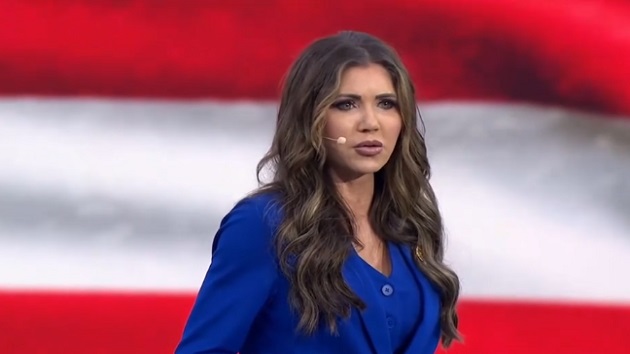
The Conservative Political Action Conference — CPAC — opened its week of European events on Tuesday in Jasionka, Poland, where Department of Homeland Security Secretary Kristi Noem was among the speakers, urging Poles to vote for right-wing presidential candidate Karol Nawrocki in this weekend’s runoff election.
Noem eschewed the diplomatic norm of non-alignment in elections in allied nations, as have other administration officials including Vice President JD Vance. “You will be the leaders that will turn Europe back to conservative values,” she told attendees in Jasionka.
“We need you to elect the right leader,” Noem said, dismissing Nawrocki’s rival — liberal Warsaw Mayor Rafal Trzaskowski — as “an absolute train wreck of a leader.”
“Donald Trump is a strong leader for us, but you have an opportunity that you have just as strong of a leader in Karol if you make him the leader of this country,” Noem said.
CPAC’s next stop will be in Budapest, Hungary, on Thursday, hosted by populist Prime Minister Viktor Orban — a totem of the European anti-establishment right wing who has long enjoyed cozy relations with Trump.
Peter Kreko, the director of the Political Capital Institute in Budapest, said Orban is positioning himself as “another recipient of the MAGA soft power export.”
“Orban is still positioning himself as someone who is exporting his campaign tactics, who can help others in terms of campaign consultancy and provide help from the United States,” Kreko said. “He’s trading off of his good partnership with Donald Trump.”
On the web page promoting CPAC’s Hungary event, the organization hit out at “corrupt elites” who it said “betray all that once made us great: patriotic virtue has been replaced by internationalism, common sense by bureaucracy and tradition by woke madness.”
“People on both sides of the Atlantic have risen up against this repackaged version of socialism, but success can only be complete when the tides of change converge and the age of patriotism begins at both poles of the West,” CPAC wrote.
Internationalism is front and center in the CPAC event agendas. Among the speakers in Budapest will be American conservative commentator Ben Shapiro, Yair Netanyahu — the son of Israeli Prime Minister Benjamin Netanyahu and Santiago Abascal, the leader of Spain’s far-right Vox party.
Also attending will be a host of other European conservative politicians from Poland, Austria, the Czech Republic, Croatia, Denmark, France, Estonia and Greece — among others.
“With the triumph of Donald Trump and the rise of the European Right, the Age of the Patriots of Western Civilization has begun — CPAC Hungary 2025 will be the hub of this movement,” the organizing website said.
But the CPAC events come at a moment of peril for transatlantic relations. Trump’s “Liberation Day” tariffs threaten to touch off a costly trade war with the European Union.
Trump has made no secret of his disdain for the bloc. “Now we’re going to charge the European Union,” Trump said when unveiling his tariff plans in April. “They’re very tough. Very, very tough traders. You know, you think of the European Union, very friendly. They rip us off. It’s so sad to see. It’s so pathetic.”
Trump announced last weekend that his planned 50% tariffs on EU goods would be delayed into July. But the bloc remains on a collision course with the Trump administration.
The economic and political aspirations of all EU leaders rely heavily on the bloc’s own fortunes, even for those populist leaders like Orban who so often define themselves in opposition to the grand European project.
The president’s European offensive could yet sour budding ties between the MAGA movement and its foreign allies, if the latter’s “core interests appear directly threatened by Trumpism,” Celia Belin, a senior policy fellow at the European Council on Foreign Relations and head of its Paris office, told ABC News.
Kati Piri, Hungarian-born member of the Dutch parliament and the Labour Party’s spokesperson for foreign affairs, migration and asylum, told ABC News in a statement that “Trump’s unilateralist policies are designed to hurt all Europeans, and that so-called allies will not be spared.”
“Trump’s continued threats of tariffs on EU products and global trade wars are making him an unpopular friend to have — and this is fragmenting the unity of the global right,” Piri suggested.
The glitz and glamour of CPAC’s Budapest event will be welcome for Orban, Kreko said, as the prime minister grapples with his own domestic challenges — not least the meteoric rise of liberal opposition leader Peter Magyar.
Around 10,000 people rallied in Budapest earlier this month to protest government plans to restrict the rights of independent media organizations — the latest in a wave of large protests against Orban and his Fidesz party government.
Kreko said Orban’s popularity is flagging after 15 years of uninterrupted power, even as he positions himself at the forefront of the nascent right-wing “illiberal international.”
“Orban is nowhere as popular as he was, let’s say in 2022, when he won the last elections,” Kreko said. “His popularity is waning, he is having a hard time getting it back and he also uses increasingly authoritarian tools to be able to keep power.”
“He has a hard time at home persuading his own constituency that the regime he is promoting all over the world is as powerful, as beautiful, as successful as it is seen by the MAGA camp in the United States,” Kreko added.
Trump’s America has become the center of gravity of the global right-wing movement — with the weight of the federal government and the broader national conservative movement behind it.
This week Samuel Samson — a senior advisor for the State Department’s Bureau for Democracy, Human Rights, and Labor — gave an indication of the prevailing winds in American transatlantic policy, publishing an article setting out “the need for civilizational allies in Europe.”
Claiming the existence of “an aggressive campaign against Western civilization itself,” Samson accused European governments of having “devolved into a hotbed of digital censorship, mass migration, restrictions on religious freedom and numerous other assaults on democratic self-governance.”
Opening the CPAC event in Poland on Tuesday, chairman Matt Schlapp told attendees, “The globalists intend to take each one of us out one by one — to shame us, to silence us, to bankrupt us, to ruin us, to make our kids turn against us.”
That is why, he said, it was important to “win all these elections, including in Poland, that are so important to the freedom of people everywhere.”
For now, Kreko suggested the transatlantic MAGA project is incomplete, as did recent election results in Romania, Portugal and the first round of Poland’s presidential vote in which conservative and far-right candidates did not win power.
“What is common between Trump, Orban and many others in central and eastern Europe is that they really want to build this illiberal international,” Kreko said.
“But at the same time, we also have to be careful about overestimating its impact,” he said.
(WASHINGTON) — President Donald Trump officially pardoned reality TV stars Todd and Julie Chrisley on Wednesday.
The official word came a day after his communications adviser announced the president would pardon the pair, who are serving time for tax evasion and bank fraud.
Their daughter, Savannah Chrisley, posted an image on Instagram Wednesday afternoon appearing to show Trump signing and posing with the pardon. A White House official confirmed the pardon.
Savannah Chrisley had appealed to the Trump administration for pardons for her parents and spoke at the 2024 Republican National Convention. She said on Tuesday that Trump had called her to notify her that “he was signing paper pardon paperwork for both of my parents.”
“I will forever be grateful for President Trump, his administration and everyone along the way, all of my lawyers, the people who put in countless hours and effort and love for my family to make sure that my parents got home,” the 27-year-old said in a video on Instagram on Tuesday.
The couple, who became famous for their show “Chrisley Knows Best,” were sentenced in November 2022 to a combined 19 years in prison on charges including fraud and tax evasion. Todd Chrisley was sentenced to 12 years in prison and 16 months of probation while Julie Chrisley was ordered to serve seven years in prison and 16 months of probation.
The couple was also ordered to pay $17.8 million in restitution.
The charges against the Chrisleys stem from activity that occurred at least as early as 2007, when the couple allegedly provided false information to banks and fabricated bank statements when applying for and receiving million of dollars in loans, according to the U.S. Attorney’s Office. In 2014, two years after the alleged bank fraud scheme ended, the couple is accused of fabricating bank statements and a credit report that had “been physically cut and taped or glued together when applying for and obtaining a lease for a home in California.”
In their sentencing memo, prosecutors said the Chrisleys had engaged in a “fifteen-year fraud spree.”
“Chrisley Knows Best” premiered in 2014 and followed the lavish lifestyle of wealthy real estate developer Todd Chrisley and his family.
This is a developing story. Please check back for updates.