

Gazans rush for humanitarian aid as Israeli strikes continue

Gazans rush for humanitarian aid as Israeli strikes continue
/AFP via Getty Images

(LONDON) — Gazans camped out close to a humanitarian aid distribution site near the city of Rafah on Wednesday night, as a controversial U.S.- and Israel-backed project to distribute food in the devastated Palestinian territory expanded.

Local journalists told ABC News that thousands of people gathered at the site northeast of Rafah in the hope of receiving food aid, but there was not enough to satisfy demand when distribution began on Thursday.

The site is located close to the Morag corridor — a strip of land controlled by the Israel Defense Forces separating the Gazan cities of Rafah and Khan Younis.

Videos from the site showed large crowds of Gazans rushing to collect aid, carrying boxes stamped with the mark of the Gaza Humanitarian Foundation, or GHF — which is directing the aid distribution in collaboration with the American and Israeli governments.

“It is very difficult, we want to eat, we want to live — what should we do?” one man said when speaking with Reuters.

Another man left the site empty-handed, telling Reuters, “Every time I go, I hold a box, a hundred people crowd over me, 300. I could not take anything.”

Meanwhile, Israeli strikes continued across the strip. The Hamas-run Gaza Health Ministry said Thursday that 67 people were killed and 184 people injured by Israeli action over the previous 24 hours.

The latest casualties bring the total toll in Gaza since Oct. 7, 2023, to 54,249 people killed and 123,492 injured, the ministry said.

The Israeli government had been implementing a blockade on all humanitarian aid being sent into Gaza since March 2. The blockade was instituted to pressure Hamas to release the remaining hostages, Israel said. Hamas still holds 58 hostages, with about one-third of them believed to be alive, according to The Associated Press.

The blockade has caused widespread malnutrition and conditions likely to lead to famine, according to the U.N. and other international aid organizations. Two million people in the Gaza Strip face “extreme hunger and famine without immediate action,” the U.N.’s World Food Programme, or WFP, said last week.

Last week, Israel began allowing small amounts of humanitarian aid to enter Gaza, approving GHF’s responsibility for distribution. Israel had demanded a new aid distribution system, having accused Hamas of previously siphoning off aid.

GHF — launched earlier this year and run by U.S. security contractors, former military officers and humanitarian workers — has set up a handful of hubs protected by armed contractors close to IDF positions. Gazans have been told to travel to the hubs to collect aid.

The United Nations and other humanitarian aid groups have refused to take part in the new effort, citing concerns that it will allow Israel to control — and weaponize — aid supply.

WFP, for example, said it “cannot safely operate under a distribution system that limits the number of bakeries and sites where Gaza’s population can access food. WFP and its partners must also be allowed to distribute food parcels directly to families — the most effective way to prevent widespread starvation.”

GHF Executive Director Jake Wood resigned earlier this week, saying in a statement it had become “clear that it is not possible to implement this plan while also strictly adhering to the humanitarian principles of humanity, neutrality, impartiality, and independence, which I will not abandon.”

GHF on Wednesday denied reports that it was forced to pause operations after thousands of Palestinians overran one of its aid distribution sites in Gaza on Tuesday.

The group said its “operations will continue to scale up” on Thursday, having distributed a total of eight trucks worth of aid — enough for 378,262 meals — on Wednesday.

GHF later said that three of its sites were operational on Thursday, distributing around 997,920 meals. That brought the total number of meals distributed to approximately 1,838,182, GHF’s statement said.

However, multiple aid organizations and nongovernmental organizations have said the aid distributed so far is just a drop in the bucket compared to what is needed.

ABC News’ Helena Skinner, Diaa Ostaz, Joe Simonetti, Nadine El-Bawab, Camilla Alcini and Will Gretsky contributed to this report.

Copyright © 2025, ABC Audio. All rights reserved.
White House slams judges who ruled against Trump on tariffs

White House slams judges who ruled against Trump on tariffs
Jim Watson/AFP via Getty Images

(WASHINGTON) — The White House on Thursday lashed out at federal judges who have blocked President Donald Trump from being able to impose global tariffs — a key part of his second-term agenda.

Trump, who has a long history of going after judges whose rulings he disagrees with, as of Thursday afternoon had yet to weigh in on two courts deeming some of his tariffs as “unlawful.”

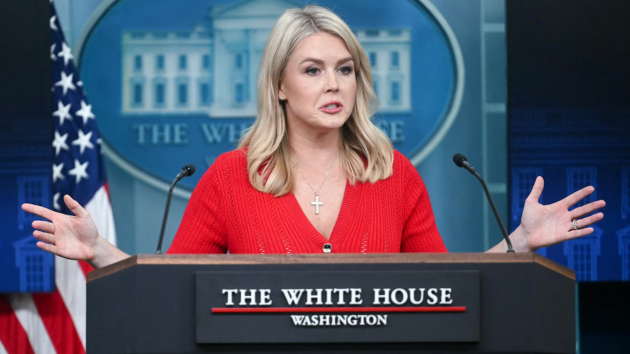
White House press secretary Karoline Leavitt, though, opened her briefing with a lengthy attack on the legal setbacks. She called it “judicial overreach” and called on the nation’s highest court to step in.

“These judges are threatening to undermine the credibility of the United States on the world stage,” Leavitt said. “The administration has already filed an emergency motion for a stay pending appeal and an immediate administrative stay to strike down this egregious decision. But ultimately, the Supreme Court must put an end to this for the sake of our Constitution and our country.”

The Court of International Trade on Wednesday struck down Trump’s global tariffs as “contrary to law.” A federal appeals court is temporarily delaying the ruling while the administration challenges the ruling, reinstating the policy for now.

The three-judge panel had found the International Emergency Economic Powers Act, which Trump leaned on to enact his tariffs, does not give him the “unlimited” power to impose the levies he has in recent months. They said it the authority for most tariffs rests with Congress, and Trump’s tariffs don’t constitute “unusual and extraordinary threat” that would allow him to act unilaterally.

Leavitt criticized the panel as “activist judges” despite its three members being appointed to the bench by three different presidents: Trump, Barack Obama and Ronald Reagan.

“The president’s rationale for imposing these powerful tariffs was legally sound and grounded in common sense,” she said. “President Trump correctly believes that America cannot function safely longterm if we are unable to scale advanced domestic manufacturing capacity, have our own secure, critical supply chains, and our defense industrial base is dependent on foreign adversaries.”

“Three judges of the U.S. Court of International Trade disagreed and brazenly abused their judicial power to usurp the authority of President Trump, to stop him from carrying out the mandate that the American people gave him,” she added.

Leavitt also touted the Republican-controlled Senate declining a bipartisan measure put forward to block Trump’s tariffs. That measure failed by the slimmest of margins in a 49-49 vote.

“Following Liberation Day, Congress firmly rejected an effort led by Senator Rand Paul and Democrats to terminate the president’s reciprocal tariffs. The courts should have no role here,” she argued.

When Trump announced his long-anticipated “Liberation Day” tariffs against nearly all U.S. trading partners in early April, he deemed chronic trade deficits a national emergency that “threatens our security and our very way of life.”

Since then, he’s often changed or delayed the tariff rates originally set out, often resulting in market turmoil. A 90-day pause on the higher, so-called “reciprocal” levies instituted so Trump could work on trade deals is set to expire in early July.

ABC News Senior Political Correspondent Rachel Scott asked the White House if its actively reviewing other methods to implement Trump’s tariff agenda in light of the court orders.

“The president’s trade policy will continue. We will comply with the court orders. But yes, the president has other legal authorities where he can implement tariffs,” Leavitt said.

“We can walk and chew gum at the same time,” Leavitt said.

ABC News’ Kelsey Walsh and Peter Charalambous contributed to this report.

Copyright © 2025, ABC Audio. All rights reserved.
Appeals court reinstates Trump’s tariffs for now after ruling blocking them

Appeals court reinstates Trump’s tariffs for now after ruling blocking them
Andrew Harnik/Getty Images

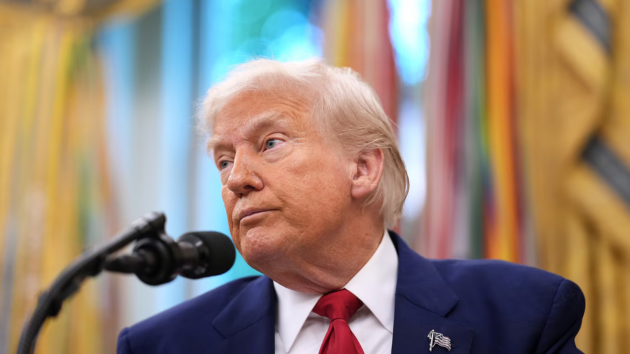
(WASHINGTON) — A federal appeals court is temporarily delaying Wednesday’s court order blocking President Donald Trump’s tariffs, reinstating them at least for the time being.

The United States Court of Appeals for the Federal Circuit issued an administrative stay of the decision while it considers Trump’s appeal.

The administration earlier Thursday urged the New York-based Court of International Trade to delay its order, warning that enforcement of the ruling will cause a “foreign policy disaster scenario.”

In an opinion on Wednesday, the three-judge panel struck down Trump’s global tariffs as “contrary to law.”

The judges found that the International Emergency Economic Powers Act — which Trump used to enact his tariffs — does not give him the “unlimited” power to levy tariffs like the president has in recent months.

“The President’s assertion of tariff-making authority in the instant case, unbounded as it is by any limitation in duration or scope, exceeds any tariff authority delegated to the President under IEEPA. The Worldwide and Retaliatory tariffs are thus ultra vires and contrary to law,” the judges wrote.

According to the judges, Congress, not the president, has the authority to impose tariffs under most circumstances, and Trump’s tariffs do not meet the limited condition of an “unusual and extraordinary threat” that would allow him to act alone.

On Thursday, a second federal court determined that Trump’s global were “unlawful.”

U.S. District Judge Rudolph Contreras said in an order the International Economic Emergency Economic Powers Act does not give the president the power to impose most of his recent tariffs.

Notably, the decision from Contreras – an Obama appointee – only restricts the Trump administration’s ability to collect tariffs from the two companies that filed the lawsuit, Learning Resources, Inc., and hand2mind, Inc.

The Department of Justice on Thursday requested a stay to Wednesday’s ruling, saying it’s needed “to avoid immediate irreparable harm to United States foreign policy and national security.”

“It is critical, for the country’s national security and the President’s conduct of ongoing, delicate diplomatic efforts, that the Court stay its judgment. The harm to the conduct of foreign affairs from the relief ordered by the Court could not be greater,” lawyers with the Department of Justice argued.

According to the administration, the court order would strip the president of leverage in trade negotiations, imperil the trade deals already reached, and make the country vulnerable to countries that “feel a renewed boldness to take advantage of” the current situation.

Responding to the ruling, White House spokesman Kush Desai evoked the trade deficit and said, “It is not for unelected judges to decide how to properly address a national emergency,” adding that that the administration is committed to using “every lever of executive power to address this crisis.”

The Trump administration had quickly filed a notice of appeal to challenge Wednesday’s decision.

The case now heads to the United States Court of Appeals for the Federal Circuit where they could ask for a stay of the order.

The Court of International Trade issued the decision across two cases — one filed by a group of small businesses and another filed by 12 Democratic attorneys general.

Nevada Attorney General Aaron Ford called the ruling “a win for the rule of law and for Nevadans’ pocketbooks.”

“I am extremely pleased with the court’s decision to strike down these tariffs; they were both unlawful and economically destructive,” he said. “The president had no legal authority to impose these tariffs, and his unlawful actions would have caused billions of dollars of damage to the American economy.”

Since Trump announced sweeping tariffs on more than 50 countries in April, his administration has faced half a dozen lawsuits challenging the president’s ability to impose tariffs without the approval of Congress.

New York Attorney General Letitia James called the decision a “major victory for our efforts to uphold the law and protect New Yorkers from illegal policies that threaten American jobs and economy.”

“The law is clear: no president has the power to single-handedly raise taxes whenever they like. These tariffs are a massive tax hike on working families and American businesses that would have led to more inflation, economic damage to businesses of all sizes, and job losses across the country if allowed to continue,” James’ statement continued.

Lawyers for the small businesses alleged that the International Emergency Economic Powers Act — which Trump invoked to impose the tariffs — does not give the president the right to issue “across-the-board worldwide tariffs,” and that Trump’s justification for the tariffs was invalid.

“His claimed emergency is a figment of his own imagination,” the lawsuit said. “Trade deficits, which have persisted for decades without causing economic harm, are not an emergency.”

During a hearing earlier this month, a group of three judges — who were appointed by presidents Obama, Trump and Reagan — pushed a lawyer for the small businesses to provide a legal basis to override the tariffs. While a different court in the 1970s determined that the Trading with the Enemy Act of 1917 — the law that preceded the International Emergency Economic Powers Act — gave the president the right to impose tariffs, no court has weighed whether the president can impose tariffs unilaterally under the IEEPA.

During a May 13 hearing, Jeffrey Schwab, a lawyer from the conservative Liberty Justice Center representing the plaintiffs, argued that Trump’s purported emergency to justify the tariffs is far short of what is required under the law.

“I’m asking this court to be an umpire and call a strike; you’re asking me, well, where’s the strike zone? Is it at the knees or slightly below the knees?” Schwab argued. “I’m saying it’s a wild pitch and it’s on the other side of the batter and hits the backstop, so we don’t need to debate that.”

The ruling marks the first time a federal court has issued a ruling on the legality of Trump’s tariffs. In May, a federal judge in Florida nominated by Trump suggested the president has the authority to unilaterally impose tariffs, but opted to transfer the case to the Court of International Trade.

-ABC News’ Hannah Demissie contributed to this report.

Copyright © 2025, ABC Audio. All rights reserved.
Stocks close higher after mixed rulings on Trump’s tariffs

Stocks close higher after mixed rulings on Trump’s tariffs
Matteo Colombo/Getty Images

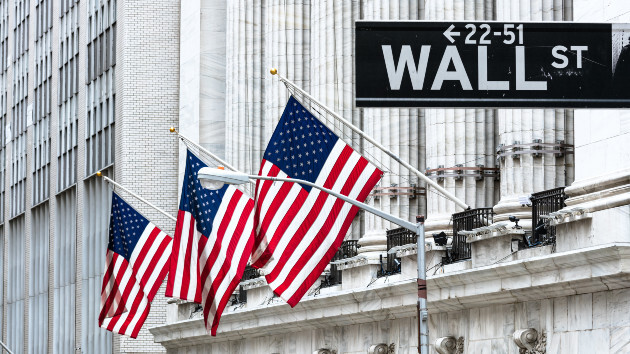
(NEW YORK) — Stocks closed higher on Thursday after a panel of federal judges blocked President Donald Trump from slapping some of his far-reaching tariffs on China and other major U.S. trading partners.

A federal appeals court moved to temporarily reinstate the tariffs on Thursday afternoon, however, leaving the ultimate fate of the policy uncertain.

The Dow Jones Industrial Average closed up 117 points, or 0.2%, while the S&P 500 increased 0.4%. The tech-heavy Nasdaq climbed 0.3%

The ruling from the U.S. Court of International Trade late Wednesday marked a major blow for Trump’s tariff policy, invalidating levies on dozens of countries unveiled in a Rose Garden ceremony that Trump had dubbed “Liberation Day.”

Less than a day later, an appeals court opted to revive the policy on administrative grounds, affording the judges additional time to weigh the case.

A set of tariffs focused on Mexico and Canada over their alleged role in the fentanyl trade would also fall victim to the U.S. Court of International Trade’s ruling, if it ends up being upheld. The decision would also invalidate a 10% tariff imposed on goods from nearly all countries.

The Trump administration appealed the ruling within minutes on Wednesday night.

The ruling centered on Trump’s unprecedented invocation of the International Economic Emergency Powers Act as a legal justification for tariffs.

The 1977 law allows the president to stop all transactions with a foreign adversary that poses a threat, including the use of tools like sanctions and trade embargoes. But the measure does not explicitly permit tariffs, putting Trump in untested legal territory.

The ruling Wednesday afforded the Trump administration as many as 10 days to halt the tariffs.

Even before the court’s decision, Trump had rolled back some of the levies at issue.

A trade agreement between the U.S. and China earlier this month slashed tit-for-tat tariffs between the world’s two largest economies and triggered a surge in the stock market. Within days, Wall Street firms softened their forecasts of a recession.

The U.S.-China accord came weeks after the White House paused the reciprocal tariffs. Trump eased duties on some goods from Mexico and Canada.

The ruling did not impact sector-specific tariffs used under separate legal statutes, including levies targeting autos, steel and aluminum.

Copyright © 2025, ABC Audio. All rights reserved.

Car launches into Missouri veterans hall roof for 2nd time in 3 months

Car launches into Missouri veterans hall roof for 2nd time in 3 months
Excelsior Springs Police

(EXCELSIOR SPRINGS, Mo.) — In a stunning repeat of a February incident, a vehicle crashed into the Clay-Ray Veterans Memorial Hall in Excelsior Springs, Missouri, on Wednesday morning, damaging the same section of roof that had only recently been repaired.

The organization expressed its disbelief on Facebook, posting “Here we go AGAIN!!Round #2” shortly after the incident.

Emergency crews responded to 208 Veterans Memorial Drive just before 7:30 a.m., where they found a vehicle that had driven off Sycamore Street and crashed into the building’s roof.

“Though it might seem like a recurring issue, these are very unique situations,” said Lt. Ryan Dowdy of the Excelsior Springs Police Department, who has served on the force for 13 years. “One was during a police chase from a driver trying to evade capture; the other was possibly due to a medical condition.”

Unlike the previous incident, the vehicle didn’t completely penetrate the roof, but the crash’s impact was severe enough that the car’s engine was ejected, landing near the building’s flagpole.

According to Dowdy, while the incident is dramatic, it is being investigated as a traffic crash.

“If during that investigation we determine that a crime has occurred and believe there is probable cause to support charging an individual, we will not hesitate to file those charges if applicable,” he said.

The February crash resulted in arrests and charges after a 22-year-old man crashed while fleeing police during a traffic stop. That incident left two teenage passengers with serious injuries, while the driver sustained non-life-threatening injuries.

“The representative of the VFW stated that they have had that property for over 80 years, and this is only the second time this has happened,” Lt. Dowdy noted, addressing concerns about the location’s safety.

The Clay-Ray Vets Club, which manages the building, had been in the process of rebuilding and restoration following the February incident, according to their Facebook post.

Authorities have not yet released the identity of the driver or additional details about the most recent crash. The investigation is ongoing.

Copyright © 2025, ABC Audio. All rights reserved.

New Orleans jail escape: Reward for tips leading to arrest of 2 remaining fugitives increases to $50,000

New Orleans jail escape: Reward for tips leading to arrest of 2 remaining fugitives increases to ,000
New Orleans jail escape: Reward for tips leading to arrest of 2 remaining fugitives increases to $50,000
Louisiana State Police

(NEW ORLEANS, La) — The reward for the arrest of the two remaining inmates who broke out of a New Orleans jail this month has more than doubled to $50,000, authorities announced on Thursday, as police said they believe they are closing in on the “dangerous” fugitives.

Antoine Massey and Derrick Groves are among 10 inmates who escaped from the Orleans Justice Center on May 16, according to Louisiana State Police.

In the nearly two weeks since, eight of the inmates have been captured, but Massey and Groves remain on the run, police said.

There are now rewards totalling $50,000 per inmate for tips leading to their arrest, according to Louisiana State Police Superintendent Col Robert Hodges. That includes rewards being offered from the Crimestoppers of Greater New Orleans, the FBI and the Bureau of Alcohol, Tobacco, Firearms and Explosives, he said.

Hodges said police have “some strong leads” about where the remaining two fugitives are, though they still need tips because of the men’s movement.

“We’re confident that we are closing in on the remaining two escapees, and that we should have them in custody soon,” he said during a press briefing on Thursday. “We’re resilient, and although they’re going to get tired and frustrated as they try to move around Louisiana or move around the metropolitan area, they know the walls are closing in.”

Authorities urged anyone with information on the whereabouts of the two fugitives to reach out while acknowledging that may be difficult.

“We understand, along with our law enforcement partners, that some of you might be reporting a friend, a loved one, a relative, and albeit not easy, it is critical to your safety and the safety of the public that you report that,” Walter Martin, chief deputy U.S. marshal for the Eastern District of Louisiana, said during the briefing.

Martin vowed to recapture the “dangerous inmates.” One of them, Groves, was recently convicted of two counts of second-degree murder in a 2018 Mardi Gras Day shooting and faces a sentence of life in prison without the possibility of parole, prosecutors said. Unrelated to that case, he also subsequently pleaded guilty to two counts of manslaughter, online court records show.

Hodges warned that anyone who helps the remaining fugitives will be arrested and prosecuted.

“Now is the time to make the right choice,” he said.

Crimestoppers of Greater New Orleans President and CEO Darlene Cusanza said Thursday the organization has received nearly 700 tips related to the inmates’ escape, resulting in the arrest of three of them. One inmate was arrested within 30 minutes of receiving the tip, she said. Three tipsters will be paid $10,000, she said.

The 10 inmates escaped from the Orleans Justice Center in the early morning hours of May 16 after climbing through a hole behind a toilet. Their disappearance was not noticed for several hours and touched off a massive manhunt.

Over a dozen people have been arrested on suspicion of helping the escapees, including another inmate in the jail and a jail maintenance worker who is accused of shutting off water to the toilet allowing escapees to remove it.

Three of the 10 inmates who escaped were apprehended in New Orleans within the first 24 hours of the jailbreak. The others were captured in the following days, including in Baton Rouge and two in Texas.

The eight captured inmates have been transported to a secure state facility in Louisiana, Hodges said.

Copyright © 2025, ABC Audio. All rights reserved.
Second court blocks Trump tariffs as ‘unlawful’

Second court blocks Trump tariffs as ‘unlawful’
Andrew Harnik/Getty Images

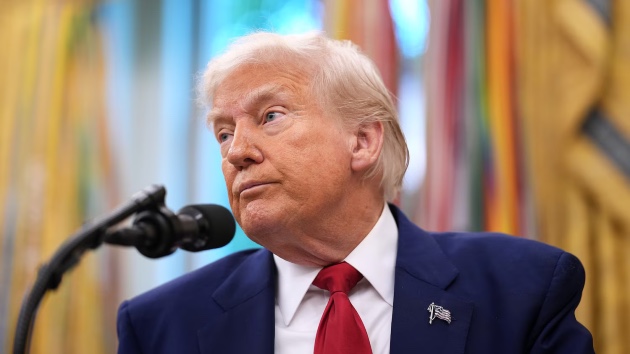
(WASHINGTON) — The Trump administration is urging the New York-based Court of International Trade to delay its order blocking President Donald Trump’s sweeping tariffs, warning that enforcement of the ruling will cause a “foreign policy disaster scenario.”

In an opinion on Wednesday, the three-judge panel struck down Trump’s global tariffs as “contrary to law.”

The judges found that the International Emergency Economic Powers Act — which Trump used to enact his tariffs — does not give him the “unlimited” power to levy tariffs like the president has in recent months.

“The President’s assertion of tariff-making authority in the instant case, unbounded as it is by any limitation in duration or scope, exceeds any tariff authority delegated to the President under IEEPA. The Worldwide and Retaliatory tariffs are thus ultra vires and contrary to law,” the judges wrote.

According to the judges, Congress, not the president, has the authority to impose tariffs under most circumstances, and Trump’s tariffs do not meet the limited condition of an “unusual and extraordinary threat” that would allow him to act alone.

On Thursday, a second federal court determined that Trump’s global were “unlawful.”

U.S. District Judge Rudolph Contreras said in an order the International Economic Emergency Economic Powers Act does not give the president the power to impose most of his recent tariffs.

Notably, the decision from Contreras – an Obama appointee – only restricts the Trump administration’s ability to collect tariffs from the two companies that filed the lawsuit, Learning Resources, Inc., and hand2mind, Inc.

The Department of Justice on Thursday requested a stay to Wednesday’s ruling, saying it’s needed “to avoid immediate irreparable harm to United States foreign policy and national security.”

“It is critical, for the country’s national security and the President’s conduct of ongoing, delicate diplomatic efforts, that the Court stay its judgment. The harm to the conduct of foreign affairs from the relief ordered by the Court could not be greater,” lawyers with the Department of Justice argued.

According to the administration, the court order would strip the president of leverage in trade negotiations, imperil the trade deals already reached, and make the country vulnerable to countries that “feel a renewed boldness to take advantage of” the current situation.

Responding to the ruling, White House spokesman Kush Desai evoked the trade deficit and said, “It is not for unelected judges to decide how to properly address a national emergency,” adding that that the administration is committed to using “every lever of executive power to address this crisis.”

The Trump administration had quickly filed a notice of appeal to challenge Wednesday’s decision.

The case now heads to the United States Court of Appeals for the Federal Circuit where they could ask for a stay of the order.

The Court of International Trade issued the decision across two cases — one filed by a group of small businesses and another filed by 12 Democratic attorneys general.

Nevada Attorney General Aaron Ford called the ruling “a win for the rule of law and for Nevadans’ pocketbooks.”

“I am extremely pleased with the court’s decision to strike down these tariffs; they were both unlawful and economically destructive,” he said. “The president had no legal authority to impose these tariffs, and his unlawful actions would have caused billions of dollars of damage to the American economy.”

Since Trump announced sweeping tariffs on more than 50 countries in April, his administration has faced half a dozen lawsuits challenging the president’s ability to impose tariffs without the approval of Congress.

New York Attorney General Letitia James called the decision a “major victory for our efforts to uphold the law and protect New Yorkers from illegal policies that threaten American jobs and economy.”

“The law is clear: no president has the power to single-handedly raise taxes whenever they like. These tariffs are a massive tax hike on working families and American businesses that would have led to more inflation, economic damage to businesses of all sizes, and job losses across the country if allowed to continue,” James’ statement continued.

Lawyers for the small businesses alleged that the International Emergency Economic Powers Act — which Trump invoked to impose the tariffs — does not give the president the right to issue “across-the-board worldwide tariffs,” and that Trump’s justification for the tariffs was invalid.

“His claimed emergency is a figment of his own imagination,” the lawsuit said. “Trade deficits, which have persisted for decades without causing economic harm, are not an emergency.”

During a hearing earlier this month, a group of three judges — who were appointed by presidents Obama, Trump and Reagan — pushed a lawyer for the small businesses to provide a legal basis to override the tariffs. While a different court in the 1970s determined that the Trading with the Enemy Act of 1917 — the law that preceded the International Emergency Economic Powers Act — gave the president the right to impose tariffs, no court has weighed whether the president can impose tariffs unilaterally under the IEEPA.

During a May 13 hearing, Jeffrey Schwab, a lawyer from the conservative Liberty Justice Center representing the plaintiffs, argued that Trump’s purported emergency to justify the tariffs is far short of what is required under the law.

“I’m asking this court to be an umpire and call a strike; you’re asking me, well, where’s the strike zone? Is it at the knees or slightly below the knees?” Schwab argued. “I’m saying it’s a wild pitch and it’s on the other side of the batter and hits the backstop, so we don’t need to debate that.”

The ruling marks the first time a federal court has issued a ruling on the legality of Trump’s tariffs. In May, a federal judge in Florida nominated by Trump suggested the president has the authority to unilaterally impose tariffs, but opted to transfer the case to the Court of International Trade.

-ABC News’ Hannah Demissie contributed to this report.

Copyright © 2025, ABC Audio. All rights reserved.
Supreme Court limits environmental impact studies, expediting infrastructure projects

Supreme Court limits environmental impact studies, expediting infrastructure projects
Alex Wong/Getty Images, FILE

(WASHINGTON) — The Supreme Court on Thursday put new limits on the scope of federally mandated environmental impact statements for major transportation and energy projects, clearing the way for a proposed rail line linking Utah and Colorado and for more expeditious approvals of similar construction programs nationwide.

The decision in Seven County Infrastructure Coalition v. Eagle County was 8-0. (Justice Neil Gorsuch recused from the case but did not explain his decision.)

The dispute, the first of its kind in 20 years to reach the court, focused on the purpose of the National Environmental Policy Act of 1969, which requires federal agencies to study the significant environmental effects of a project and identify alternatives to mitigate any harms.

The law, known as NEPA, has been the basis of major litigation by groups opposed to particular projects, which frequently sue to block construction by alleging that the impact study was incomplete or inaccurate.

Industry groups have long complained about years, even decades, of costly delays to get projects completed.

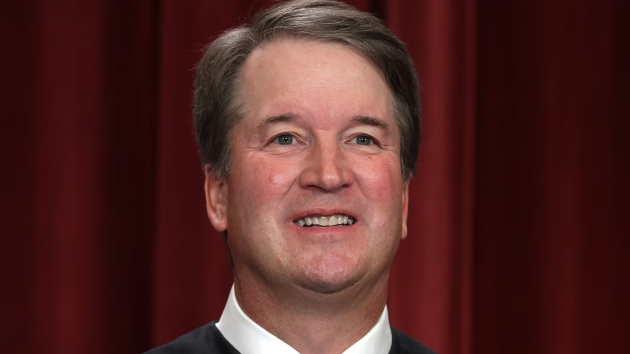
Acknowledging those concerns, Justice Brett Kavanaugh writing for the majority said use of NEPA to stymie energy and infrastructure programs has gotten out of hand and needs to be curtailed.

“A 1970 legislative acorn has grown over the years into a judicial oak that has hindered infrastructure development under the guise of just a little more process,” Kavanaugh wrote. “A course correction of sorts is appropriate to bring judicial review under NEPA back in line with the statutory text and common sense. “

Kavanaugh said the law imposed merely a “modest procedural requirement,” related only to the project at hand, not a mandatory study of possible upstream or downstream impacts far afield from actual construction.

The proposed 88-mile railway at the heart of the case, linking the oil-rich Uinta Basin of Utah with the national rail network in Colorado, has undergone years of environmental study. Its impact statement exceeds 3,600 pages of analysis.

Environmental groups challenged the study, however, saying it failed to consider secondary impacts of exporting millions of gallons of oil to refineries along the Gulf, such as the risk of oil spills in the Colorado River, pollution in the Gulf and greenhouse gas contributions to climate change. The U.S. Court of Appeals for the District of Columbia Circuit agreed.

The groups told the Supreme Court that approving the railway could also mean heightened risk of oil spills, train spark-induced wildfires and enhanced greenhouse gas emissions nationwide.

Colorado Attorney General Phil Weiser, who opposes the railway project, lamented the high court decision in a statement, saying the court had approved a “risky scheme to transport waxy crude oil along the Colorado River, right alongside our most critical water resource and posing major risks to Colorado’s Western Slope communities.”

The Seven County Infrastructure Coalition, which supports the railway, said those downstream risks are too far afield and beyond the scope of the law and that the project has fallen victim of bureaucratic red tape.

“The effects from a separate project may be factually foreseeable, but that does not mean that those effects are relevant to the agency’s decision making process or that it is reasonable to hold the agency responsible for those effects,” Kavanaugh wrote. “In those circumstances, the causal chain is too attenuated.”

The opinion said judges should show “deference” to the agency officials preparing the environmental impact statement.

Justices Sonia Sotomayor, Elena Kagan and Ketanji Brown Jackson concurred with the judgment but wrote separately to explain their reasoning.

Proponents of the rail line, who have pitched it as an economic boon for the country, say it will help extract hundreds of thousands of gallons of waxy crude oil and drive down energy prices for consumers.

“The Supreme Court has issued an important corrective to the current judicial approach to the National Environmental Policy Act,” said University of Minnesota Law School professor James Coleman, who specializes in energy and transportation law, “demanding more deference from courts for the agencies performing judicial review and explaining why it is inappropriate to demand agencies to consider the upstream and downstream effects of energy transport projects.”

Copyright © 2025, ABC Audio. All rights reserved.

Harvard student fears visa loss as Trump administration targets international enrollment

Harvard student fears visa loss as Trump administration targets international enrollment
ABC News

(BOSTON) — A Harvard graduate student has described a “devastating” atmosphere of uncertainty on campus as the Trump administration appears to intensify its efforts to restrict international students at the prestigious university.

“It’s definitely been a roller-coaster ride,” said Fangzhou Jiang, who has one semester remaining in his master’s program at Harvard’s Kennedy School of Government. “Over the last week, everybody was really panicking about whether they should stay in the United States or depart immediately.”

A federal judge in Boston announced Thursday she would issue a preliminary injunction blocking the Trump administration’s attempts to prevent Harvard from enrolling international students.

The ruling marks a temporary victory for the university in its ongoing confrontation with the White House, which has launched multiple actions against the institution.

The acting director of U.S. Immigration and Customs Enforcement issued a letter Thursday giving the school 30 days to challenge the administration’s revocation of the certification to enroll international students.

The Trump administration has already frozen more than $3 billion in federal funding to Harvard and plans to cancel remaining federal contracts worth an estimated $100 million. President Donald Trump has also expressed interest in revoking the university’s tax-exempt status.

Tensions escalated further Wednesday when Secretary of State Marco Rubio announced officials would begin to “aggressively revoke” the visas of some Chinese students, sparking fresh concerns among the international student community.

“Everybody is wondering about the plan for next year—whether we should take a leave of absence, whether we should go back home and finish our semester online, or wait for more guidance,” Jiang said, who serves as vice president of student government on family affairs.

For Harvard, where international students comprise more than a quarter of the student body, according to the university, the impact could be significant. Jiang emphasized that international students play crucial roles on campus, from conducting academic research to facilitating cultural exchanges.

“Removing international students from Harvard will really not make Harvard the Harvard it has been for the last 400 years,” Jiang said. “It’s going to impact the amount of perspectives Harvard has. It will definitely weaken Harvard’s international influence and reputation. It is definitely not in the best interest of American higher education or the United States as a nation.”

Jiang said that while the university has committed to protecting international students through legal actions and other means, specific guidance for the upcoming academic year is unclear. Based on experiences during the COVID-19 pandemic, Jiang remains optimistic that online learning options could provide a solution if necessary.

“The school has committed to protecting international students in whatever capacity,” Jiang said. “I remain confident that the university will be able to provide measures to help us finish our education at Harvard.”

Harvard University did not immediately respond to ABC News’ request for comment.

Copyright © 2025, ABC Audio. All rights reserved.
Trump’s Air Force One deal with Qatar not finalized, being reviewed by prospective legal teams: Sources

Trump’s Air Force One deal with Qatar not finalized, being reviewed by prospective legal teams: Sources
Marco Mantovani/Getty Images

(WASHINGTON) — Despite previous claims from the Department of Defense that the United States has officially accepted the luxury Boeing 747-8 jumbo jet from Qatar, the United States and Qatar have not yet finalized the details of the agreement, which are still being reviewed by the prospective legal teams, according to a White House official and sources familiar with the discussions.

A White House official stated that the White House’s legal team is currently finalizing the details of the gift, working on a memorandum of understanding — or MOU — between the United States and Qatar. The Washington Post first reported the news.

The plane from Qatar is currently in the United States, according to sources familiar with the matter as well as President Donald Trump, who confirmed the plane was here. However, Qatar wants to clarify the details surrounding the transfer, specifically emphasizing that the Trump administration was responsible for initiating the discussions about the donation of the luxury jet to the U.S. government, sources familiar with the negotiations said.

“As the President has said, this will be a sovereign-to-sovereign gift to the US Air Force,” White House spokesperson Anna Kelly said in a statement.

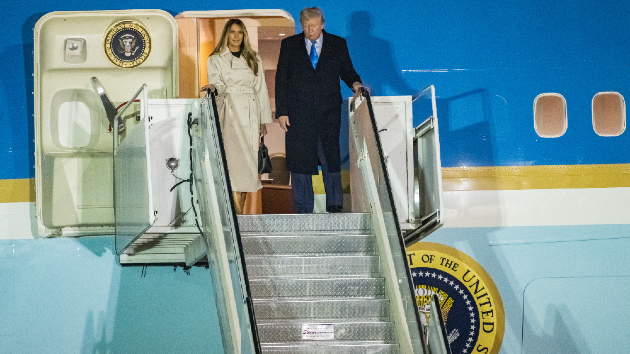
As ABC News first reported earlier this month, the aircraft is expected to be available for use by Trump as the new Air Force One until shortly before he leaves office, at which time the ownership of the plane is expected to be transferred to the Trump presidential library foundation, sources familiar with the matter told ABC News.

Last week, chief Pentagon spokesperson Sean Parnell said that the Pentagon had officially accepted the luxury jet from Qatar.

“The secretary of defense has accepted a Boeing 747 from Qatar in accordance with all federal rules and regulations,” said Parnell, adding that the Department of Defense would “work to ensure proper security measures and functional-mission requirements are considered for an aircraft used to transport the president of the United States.”

The Trump administration’s plan to accept the luxury jet donated by the Qatari government to use as Air Force One has raised significant security concerns, according to intelligence experts and government officials.

Democratic lawmakers have expressed concerns that the plane could pose significant security risks and potentially grant a foreign nation access to sensitive systems and communications, raising counterintelligence issues. Conversely, Republican lawmakers have questioned the president’s decision to accept a gift from a foreign nation, also raising intelligence concerns.

“Any building or vehicle or airplane that the president is located is a high-value target for foreign intelligence services who want to gather as much information about the president,” said John Cohen, an ABC News contributor and former acting Homeland Security official.

For his part, Trump said “it would be stupid” not to accept the free plane and has called the gift from Qatar a “very nice gesture.”

“I would never be one to turn down that kind of an offer,” Trump said earlier this month. “I mean, I could be a stupid person and say, ‘No, we don’t want a free, very expensive airplane.’ But it was, I thought it was a great gesture.”

Copyright © 2025, ABC Audio. All rights reserved.