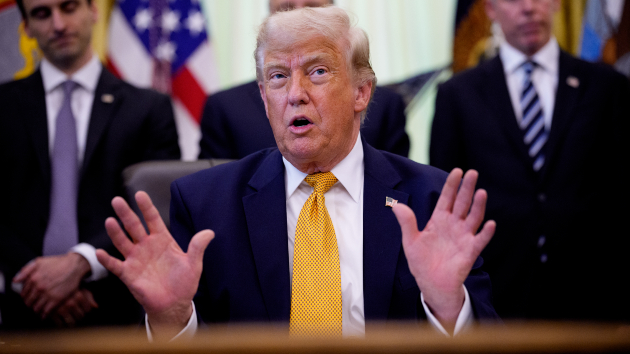
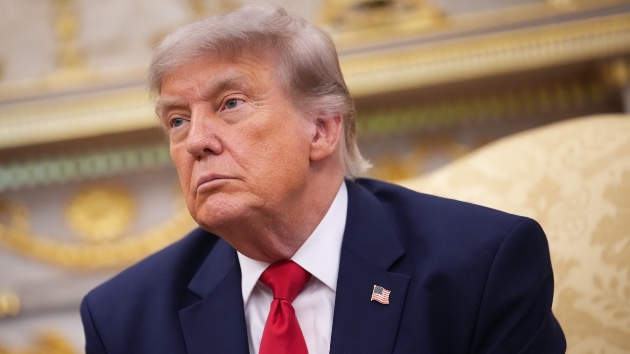
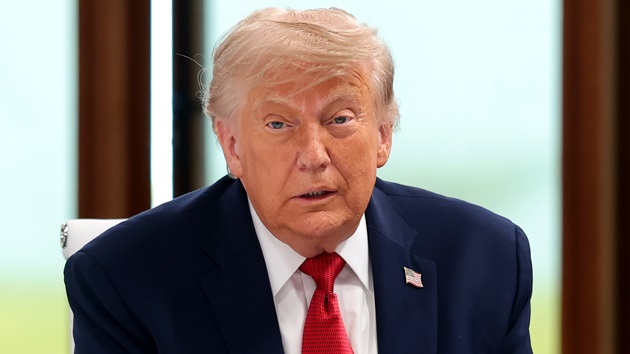
U.S. President Donald Trump speaks during an event in the Oval Office of the White House on June 22, 2026 in Washington, DC. (Andrew Harnik/Getty Images)
(WASHINGTON) — A federal judge Thursday morning blocked part of President Donald Trump’s executive order on mail-in voting, marking the third time in less than a week that a federal judge has stymied the Trump administration’s attempt to increase federal oversight of elections.
Judge Indira Talwani of the U.S. District Court for the District of Massachusetts issued an injunction barring the Trump administration from creating a national list of approved voters eligible to receive mail-in ballots from the Postal Service, as well as new regulations intended to increase the Postal Service’s oversight of mail-in voting.
“[T]he Constitution reserves the power to determine voter eligibility to the States alone. … Neither the Executive Branch nor Congress may interfere with this power,” Talwani wrote, in part.
Talwani said that the efforts included in Trump’s March 2025 executive order exceeded his authority as president and encroached on the right of states to oversee elections.
“The Constitution does not grant the President any specific powers over elections,” Talwani further wrote. “The President ‘plays no direct role in the process’ of appointing electors, ‘nor does he have authority to control the state officials who do.’”
Neither the White House nor the postmaster general have yet commented publicly on the ruling.
A federal judge on Wednesday permanently blocked an executive order provision that required proof of citizenship to register to vote and demanded mail-in ballots be received by Election Day. On Monday, another federal judge blocked a Trump administration voter-screening database, ruling that the government’s “haphazard” system unlawfully consolidated “the private information of millions of Americans” in an effort to purge non-citizens from voter rolls.
Prior to Thursday’s ruling, a different judge declined to issue an order blocking the mail-in voting policy because it had not yet been implemented. However, earlier this month, the Postal Service posted a proposed rule to enact part of the executive order, while Postmaster General David Steiner on Wednesday said that his agency would refuse to deliver ballots unless states turn over lists of voters.
Thursday’s ruling effectively stops that policy in its tracks, though the Trump administration is expected to appeal.
“[N]o law enacted by Congress delegates authority to control mail-in voting to USPS. The voting-related guidance currently issued by USPS is not binding on the States, merely recommended,” Talwani’s ruling Thursday said.
S. President Donald Trump attends a meeting with NATO Secretary-General Mark Rutte in the Oval Office of the White House on June 24, 2026 in Washington, DC. (Photo by Andrew Harnik/Getty Images)
(WASHINGTON) — The Supreme Court ruled Thursday that the Trump administration can cancel the temporary protected status (TPS) for thousands of Haitians and Syrians, concluding that the Department of Homeland Security has broad discretion with little-to-no judicial oversight to decide when they must return home.
The ruling is likely to have a sweeping impact on the approximately 1.3 million people who rely on TPS to live and work in the United States legally, and advocates said they fear it will have devastating and possibly deadly long term costs for those refugees.
Writing for the 6-3 majority, Justice Samuel Alito said that courts cannot override the federal government’s determination about TPS status in most cases.
TPS status, established by the Immigration and Nationality Act, provides work authorization and protection from deportation — as long as the Homeland Security Secretary certifies that a foreign country is unsafe because of armed conflict, natural disaster, or “extraordinary and temporary conditions.”
Alito concluded that the law establishing the TPS program did not give courts the authority to second guess the DHS’s determinations about which countries merit the protected status, which was created to shield immigrants from countries ravaged by war or national disasters.
“The TPS statute plainly bars consideration of respondents’ non-constitutional claims. It allows ‘no judicial review of any determination … with respect to the … termination of a TPS designation,” Alito wrote.
Though the ruling centered on the TPS of Haitians and Syrians, the ruling effectively gives the Trump administration the green light to carry out similar terminations, which they have already done for 13 countries.
James Percival, the Department of Homeland Security’s General Counsel, praised Thursday’s ruling.
“The T in TPS stands for TEMPORARY, yet many of these designations became de facto amnesty. This is a win for the rule of law and common sense,” he said in a statement.
Attorneys for the Haitian plaintiffs said in a statement Thursday that the ruling “will directly result in thousands of innocent people dying violent, needless deaths.”
“This decision will endanger Haitian TPS holders who fled their homeland in pursuit of what generations of immigrants yearned for when they made the painful decision to leave all they have known. to live in safety,” Geoffrey Pipoly and Andrew Tauber told ABC News in a statement.
“It’s a very sad day, not only for Haitian TPS holders but for anyone who believes, as we do, that immigrants are one of America’s greatest strengths,” they added. “The responsibility to save these lives is now with Congress–and we urge the Senate to pass the extension of TPS now pending in that chamber. “
It is unclear if Congress will vote on an extension, however, Trump has repeatedly called for the end of TPS protections and would not likely sign off.
The court’s liberals also lambasted the decision, arguing that the statements made by President Donald Trump about some of the countries whose status was cancelled — including making baseless claims that Haitians eat dogs and cats during the 2024 presidential race — demonstrate that race played a role in the decisions.
“The evidence they have offered includes statements by the President so repellent and racially inflected that the majority declines to put them in print,” wrote Justice Kagan. “The references–of filth, disease, and primitiveness–are shot through with racial stereotypes and tropes.”
The court’s liberals also argued that the statute creating TPS does allow courts to review if DHS carried out legally-required procedures to cancel the status — something the plaintiffs allege did not happen.
“It does nothing to stop courts from reviewing things other than the Secretary’s ‘determination[s]’ concerning TPS designations,” Kagan wrote.
Immigrant advocacy groups have warned about the possible sweeping consequences of this ruling, saying it will open the door for an “astonishing human tragedy.”
Haiti experienced a devastating earthquake in 2010 and has since been hit by subsequent natural disasters, political unrest following a presidential assassination, and waves of rampant gang violence.
More than 113,000 Haitian TPS holders work in Florida alone, which is home to a high proportion of America’s seniors, according to the Florida Immigrant Coalition.
Syria devolved into civil war around 2011 and has been considered by the U.S. government a hotbed of terrorism and extremism for nearly two decades. A major earthquake in 2023 plunged the country into a deeper economic and humanitarian crisis.
“This is an awful harbinger for what we expect this administration to try to do for other TPS designations. Hundreds of thousands of people who have lived here for decades now see heartbreaking chaos ahead,” FWD.us President Todd Schulte said in a statement Thursday.
Then-DHS Secretary Kristi Noem, in separate acts last year, moved to terminate TPS status for Haiti and Syria by certifying that, in her estimation, conditions on the ground in those countries were sufficiently safe for immigrants to return.
Those decisions were blocked by lower courts, which concluded that Noem did not follow proper procedures for cancelling TPS and may have also unlawfully discriminated against the immigrants on the basis of race.
Pastor Carl Ruby, a prominent community leader in Springfield, Ohio, who has sought to stand up for Haitians there after Trump’s false comments about them eating pets rattled the community and preceded numerous bomb threats.
“This is the worst possible outcome,” Ruby told ABC News through tears. “I had always held out hope that we would get a good decision and can’t believe that we’re here now.”
Ruby contended that there was racial motivation behind the administration’s actions.
“If you look at the history of the president’s comments about Haiti and Haitians, it’s clear that this wouldn’t be happening if these were refugees from Norway. I just feel like we have failed as a country and I don’t think I’ve ever been as disappointed in our country as I am right now,” he said.
Ohio Gov. Mike DeWine, a Republican who has defended the Springfield community, said deporting Haitians “is a mistake.”
“As a result of today’s ruling, the over 10,000 Haitians who have been living in Ohio (mostly in the Springfield area) legally through TPS will now be here illegally and will be subject to immediate deportation,” the governor said in a statement.
“This also means that while these Haitians were working and contributing to our community and economy yesterday, today it is now illegal to employ them,” he added.
“The situation in Haiti could hardly be much worse. The violent gangs run most of the country. The government barely functions. And, the economy is in shambles,” DeWine said.
-ABC News’ Laura Romero, Armando Garcia and Ivan Pereira contributed to this report.
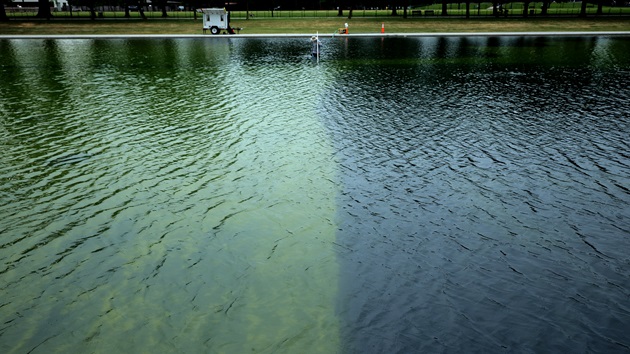
National Park Service employees and contractors use vacuums to remove green algae from the bottom of the Lincoln Memorial Reflecting Pool on June 18, 2026 in Washington, DC. (Chip Somodevilla/Getty Images)
(WASHINGTON) — U.S. Park Police are seeking assistance in identifying a person wanted in connection to a “destruction of government property” investigation related to the Lincoln Memorial Reflecting Pool.
Park Police posted on social media Wednesday a video of the alleged incident that shows a person reaching into the Reflecting Pool and appearing to pull something from the water. The video is somewhat blurry and shot from a distance. ABC News has reached out to National Park Service and Park Police about the source of the video.
The incident allegedly occurred at 3:36 p.m. ET on Friday, June 19. Park Police said anyone with information on the identity of the individual should contact their tip line.
The bulletin comes as President Donald Trump continues to blame vandals for alleged damage at the Reflecting Pool after his administration’s $16 million renovation.
The White House has yet to provide evidence that shows the alleged vandalism to the site.
“The Reflecting Pool that you’ve heard so much about, which is so incredible, it’s been gruesomely vandalized by thugs, bad people, but soon will be looking as beautiful as it looked just two weeks ago,” Trump said on Wednesday night as he kicked off Freedom 250’s Great American State Fair with remarks on the National Mall.
“In fact, I looked at it just a little while ago, it looks perfect already,” the president continued. “But we’re fixing it. The vandals got to it, they’ve largely been caught and are being prosecuted. We can’t let that happen to our country.”
The Interior Department and the U.S. Park Police, though a spokesperson earlier this week, confirmed there had been several arrests and federal citations for alleged vandalism. Trump said on Tuesday that six people had been arrested.
Trump also said earlier this week that the Reflecting Pool will be drained again for “permanent repair” around the Fourth of July.
A drone is seen carrying a payload as photographed by the Georgia Department of Corrections. (Georgia Department of Corrections)
(NEW YORK) — Twelve individuals have been charged in what the Justice Department is calling a vast conspiracy to smuggle contraband into 10 federal prisons across the country through a coordinated drone operation.
The 17-count indictment, unsealed Wednesday, alleges that starting in September 2023, those charged allegedly used six drones to drop contraband at least 38 times into 10 federal prisons from Atlanta to Mississippi.
The Bureau of Prisons has a drone alert system that notifies prison staff when a drone is nearby, according to court documents.
Some of the individuals charged in the indictment unsealed Wednesday were inmates at prisons around the country and used cellphones to schedule drops at various prisons.
The contraband was allegedly stored at what is referred to in court records as “The Lab.”
U.S. President Donald Trump during the G7 Summit on June 17, 2026 in Evian-les-Bains, France. (Anna Moneymaker/Getty Images)
(WASHINGTON) — A federal judge is again directing the Justice Department to formally address whether the Trump administration’s “Anti-Weaponization Fund” is dead, as the agency has claimed.
The order, filed Wednesday by District Judge Leonie Brinkema, comes after the Justice Department refused to issue a signed declaration verifying the $1.8 billion fund was not moving forward.
In her order, Brinkema said she is not satisfied with the DOJ’s contention that Acting Attorney General Todd Blanche’s recent testimony before Congress is proof enough that the fund is dead.
“That the defendants have refused to accord a genuine degree of trustworthiness to their representations about the Fund not going forward is particularly concerning because of the President’s consistent support for the Fund and Acting Attorney General Blanche’s acknowledgement that the Fund remains ‘important,'” Brinkema wrote.
She is demanding that the DOJ file papers issuing another response in the coming weeks and hinted in her order that Blanche may have to answer questions about his plans for the fund in a deposition.
The $1.776 billion fund was announced in May by the Justice Department to compensate those who allege they were wrongly targeted under the Biden administration.
It was proposed in exchange for President Donald Trump agreeing to drop his $10 billion lawsuit against the IRS as well as two civil claims for $230 million related to the Russia collusion investigation he faced during his first term in office and the 2022 search of his Mar-a-Lago estate — sparking accusations of self-dealing and a bipartisan uproar over the possible use of taxpayer money to pay rioters who attacked the U.S. Capitol on Jan. 6, 2021.
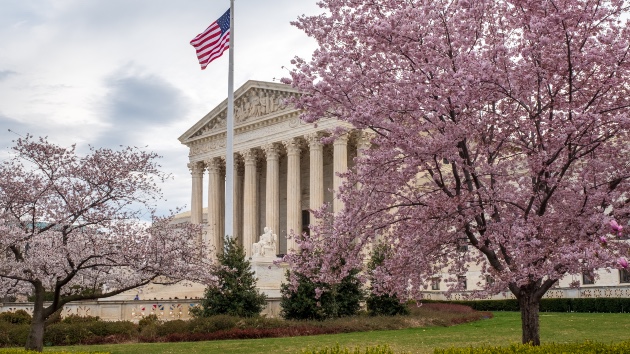
Cherry blossoms at the Supreme Court on a windy morning in Washington, D.C. (John Baggaley/Getty Images)
(WASHINGTON) — The Supreme Court on Thursday struck down a Hawaii law that prohibits the carry of a firearm onto private property that is open to the public unless the property owner gives express consent.
In a 6-3 decision by Justice Samuel Alito, the court’s conservative majority said the law imposed “severe restrictions on the daily activities” of lawful gun owners in violation of the Second Amendment.
“Rather than allowing all to enter private property open to the public unless specifically prohibited, these new laws provided that no one carrying a firearm may enter without express authorization,” Alito wrote.
“The Hawaii law at issue here violates the constitutional right to keep and bear arms,” the opinion said.
The ruling, which likely also invalidates similar laws in California, Maryland, New York and New Jersey, is a setback for gun control advocates that had argued the measures were necessary for public safety in places like shopping malls, bars, restaurants, theaters, farms, arenas and private beaches.
Hawaii had argued that there is no such thing as a right to armed entry onto private property without consent, pointing to a handful of historical examples of similar laws since America’s founding.
But the court’s conservatives concluded that those analogues were “outlier legal rules adopted in a few locales.”
“Overwhelming evidence shows an enduring American tradition permitting public carry,” Alito wrote.
While private property owners may still prohibit firearms on their premises, the onus now falls entirely on those owners to post signage banning guns. The default rule, in essence, is that lawful gun owners may carry their weapons unless told otherwise, according to the decision.
Forty-five states presume that it is okay to carry guns on private property open to the public unless property owners make their contrary wishes clear.
In dissent, Justice Ketanji Brown Jackson, joined by Justice Sonia Sotomayor, said the ruling “only further binds the hands of modern legislatures attempting to balance and protect their residents’ interests.”
“Today’s decision makes one thing clear: The Court’s objective is protecting guns, not consistently preserving any principle of law,” Jackson wrote.
The National Rifle Association, which backed the challenge to the Hawaii law, praised the majority decision in a statement on X.
“Law-abiding gun owners will no longer be forced to beg for special permission simply to exercise their constitutional right to bear arms in public places,” wrote NRA-ILA Executive Director John Commerford.
Brady, a gun safety group, slammed the court’s decision as “deeply dangerous” and one that “privileges guns over everything and all people in society.”
“This common-sense law is what the people of Hawaii wanted, but the court has complete disregard for that community will. Ultimately, the court makes it clear that it cares little about the threat of gun violence posed to the American people,” said Kris Brown, the group’s president.
S. President Donald Trump attends a meeting with NATO Secretary-General Mark Rutte in the Oval Office of the White House on June 24, 2026 in Washington, DC. (Photo by Andrew Harnik/Getty Images)
(WASHINGTON) — The Supreme Court ruled Thursday that the Trump administration can cancel the temporary protected status (TPS) for thousands of Haitians and Syrians.
Writing for the 6-3 majority, Justice Samuel Alito said that courts cannot override the federal government’s determination about TPS status.
This is a developing story. Please check back for updates.
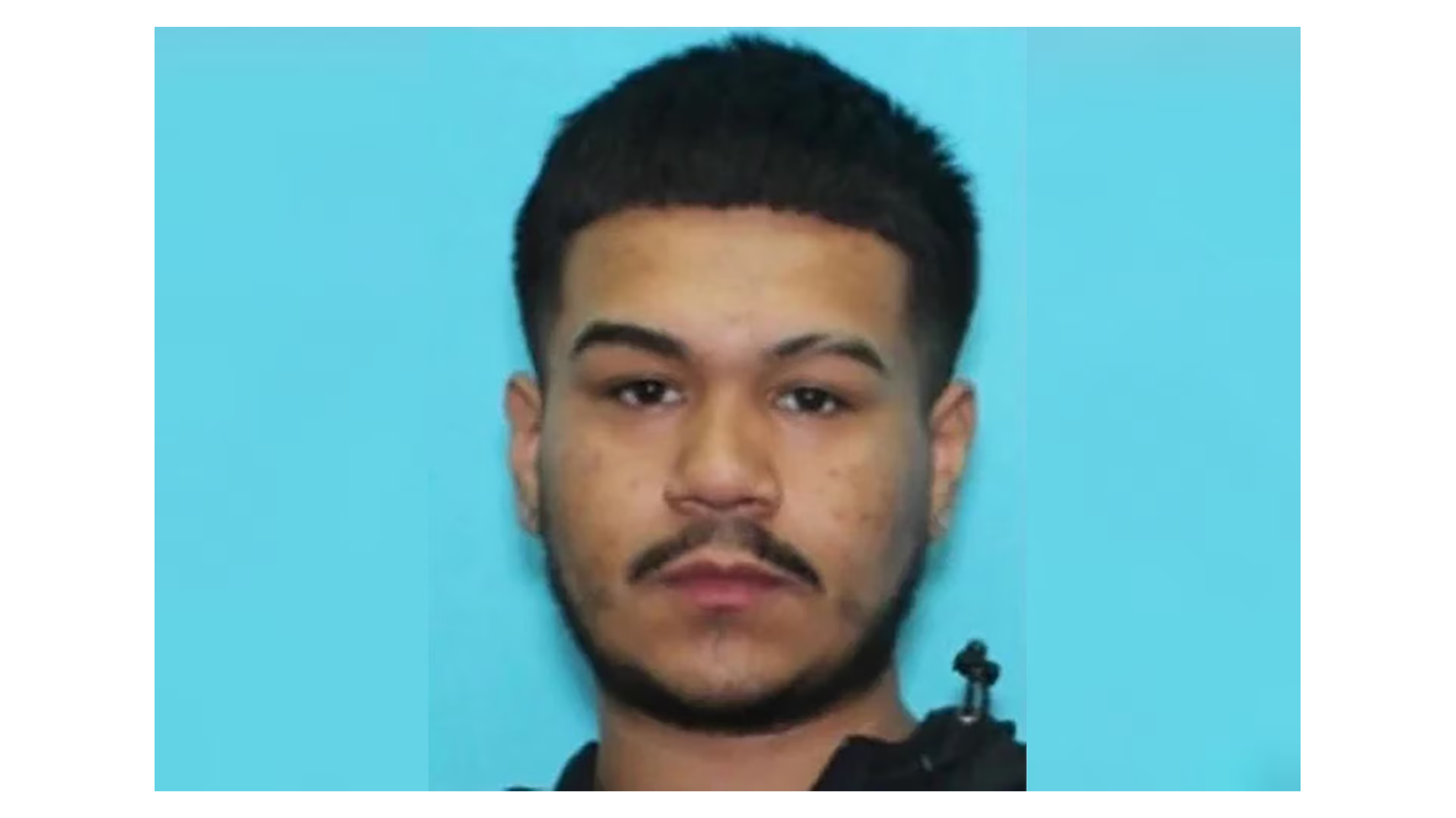
The FBI said it is offering a reward of up to $25,000 for information leading to the arrest of Oscar Sanchez-Munoz. (FBI)
The man wanted by the FBI in a string of shootings in the Kansas City, Missouri, area is believed to have been found dead, according to police.
Oscar Sanchez-Munoz, 22, allegedly shot at a car in Wyandotte County, Kansas, on June 11, authorities said, and then on June 16, he allegedly shot at five cars along Interstate 70 in Kansas City, Missouri. The June 16 shootings killed one person and wounded four, police said.
On the night of June 16, Sanchez-Munoz barricaded himself inside a house in Independence, Missouri, east of Kansas City, and engaged in a standoff with police, authorities said. In the middle of the night, the house went up in flames, and once firefighters put out the blaze and police entered the house, Sanchez-Munoz was not there, authorities said.
The manhunt for Sanchez-Munoz had been underway ever since, with the FBI offering a $25,000 reward.
On Wednesday afternoon, Sanchez-Munoz’s relatives, who were going through the damage at the house in Independence, called detectives to say they noticed the smell of decomposition in the basement, and when they moved some items aside, they saw what they thought was a body, police said.
Responding officers found a body in clothes consistent with what Sanchez-Munoz was wearing the night of the shootings, police said.
“Based on clothing description, and last known location, detectives preliminarily believe this deceased person in the residence is Sanchez-Munoz,” police said in a statement.
The medical examiner will confirm the identity and determine the cause and manner of death, police said.
Cherry blossoms at the Supreme Court on a windy morning in Washington, D.C. (John Baggaley/Getty Images)
(WASHINGTON) — The Supreme Court on Thursday struck down a Hawaii law that prohibited the carry of handguns by permit holders on private property open to the public unless the property owner gives express permission.
The 6-3 decision was handed down by Justice Samuel Alito.
This is a story in development. Please check back for updates.
(WASHINGTON) — Hours after President Donald Trump blasted Sen. Bill Cassidy for supporting a war powers resolution that narrowly passed the Senate on Tuesday, Cassidy helped to deliver Trump a victory by voting with the majority of Republicans late Wednesday to block a separate resolution aimed at reining in the president’s war powers in Iran from advancing.
The Senate voted 47-50-1 late Wednesday to block a war powers resolution led by Democratic Sen. Tim Kaine from moving forward. The resolution, which aims to limit Trump’s ability to wage war in Iran but does not have the force of law, had narrowly advanced in a previous procedural vote.
It was a remarkable departure for Louisiana Republican senator who, just hours previously, was in a shouting match with the president during a lunch between Trump and the GOP conference.
Cassidy said he later received a briefing from Vice President JD Vance and Special Envoy Steve Witkoff on Iran.
“I want to thank Vice President Vance and Special Envoy Witkoff for the thorough briefing this afternoon on Iran. I appreciate the quick invitation to the White House to address many of my concerns,” Cassidy posted.
Cassidy wasn’t the only Republican who changed his vote on the latest war powers vote.
Sen. Rand Paul voted ‘present’ instead of voting to support the resolution as he had previously been doing.
“Tonight I will vote present on the War Powers resolution. My opinion on the debate over war and executive power has not changed and I have voted that way several times,” Paul posted on X ahead of the vote. “But since hostilities seem to be over and the President asked me to give consideration to his negotiating position, I will do so. My vote of present is a way to give the President more space and leverage to negotiate a lasting peace.”
Republican Sens. Susan Collins and Lisa Murkowski voted in favor of the resolution, as they have in the past. All other Republicans voted against it.
Sen. John Fetterman was the only Democrat to vote against the resolution. All other Democrats voted for it. Sens. Mitch McConnell and Michael Bennet were absent during Wednesday night’s vote.
Trump celebrated Wednesday’s vote in a post on his social media platform.
“Wow! The Senate just changed its vote on Iran from 50-48 against, to 50-47 for,” Trump said in the post. “Rand Paul and Bill Cassidy changed. Thank you to Leader John Thune, Lindsey Graham, Bernie Moreno, and all. This vote puts Iran on notice!
The earlier clash between Trump and Cassidy came as the president met with Republican senators on Capitol Hill.
At one point, Trump called Cassidy a “lunatic,” according to multiple sources. Cassidy did not dispute that when asked by ABC News.
After the meeting, Cassidy acknowledged that he lost his temper with Trump.
“He asked why would anybody vote for the War Powers Act? As he continued, I said, ‘is that a rhetorical question, or would you like to really know?’ He said, ‘I’d like to know.’ I stood and said, ‘You have not told the American people what’s going on. It was supposed to last four weeks. It’s lasted four months. Our original objectives have not been achieved, and I want to know what’s going on,'” Cassidy said.
The White House had dismissed the earlier Senate vote on the resolution, saying it was of “no significance.”