

Kilmar Abrego Garcia set to appear in court in Tennessee after judge orders his release

Kilmar Abrego Garcia set to appear in court in Tennessee after judge orders his release
A protester holds a photo of Kilmar Abrego Garcia/Michael M. Santiago/Getty Images

(NEW YORK) — Kilmar Abrego Garcia, who is back in the U.S. after being mistakenly deported to his native El Salvador, is set to appear in court in Tennessee on Wednesday for a hearing to address the conditions of his release after a magistrate judge ordered that he should not be detained while he awaits a federal trial on human smuggling charges.

However, he is not expected to go free because U.S. Immigration and Customs Enforcement will likely take him into custody.

On Sunday, U.S. Magistrate Judge Barbara Holmes acknowledged that determining whether Abrego Garcia should be released is “little more than an academic exercise” because ICE will likely detain him due to an immigration detainer the government has on him.

Yet the judge said the government failed to prove there is a “serious risk” that Abrego Garcia will flee or that he will obstruct justice in his criminal case.

Abrego Garcia has been the subject of a prolonged legal battle since he was deported in March to El Salvador’s CECOT mega-prison — despite a 2019 court order barring his deportation to that country due to fear of persecution — after the Trump administration claimed the undocumented immigrant was a member of the criminal gang MS-13, which his family and attorneys deny.

The Trump administration, after arguing for nearly two months that it was unable to bring him back, returned him to the U.S. earlier this month to face charges of allegedly transporting undocumented migrants within the U.S. while he was living in Maryland. He has pleaded not guilty to the charges.

In her 51-page ruling, Judge Holmes raised questions about some of the evidence the government presented during a June 13 hearing — much of which she said consisted of “general statements, all double hearsay from two cooperating witnesses.”

Statements from the two witnesses about Abrego Garcia’s alleged MS-13 membership contradicted each other, Holmes said. One cooperating witness, according to the special agent who testified during the hearing, said that the Salvadoran “may belong to MS-13.” But a second witness, according to the special agent, said that in ten years of acquaintance with Abrego Garcia, there were no signs or markings, including tattoos, indicating that he is a member of MS-13.

“Even without discounting the weight of the testimony of the first and second male cooperators for the multiple layers of hearsay, their testimony and statements defy common sense,” Holmes said.

“The government alleges that Abrego is a longtime, well-known member of MS-13, which the Court would expect to be reflected in a criminal history, perhaps even of the kind of violent crimes and other criminal activity the government describes as typically associated with MS-13 gang membership,” Holmes said. “But Abrego has no reported criminal history of any kind.”

Statements from the cooperating witnesses introduced during the June 13 hearing accused Abrego Garcia of trafficking drugs and firearms and of abusing women and minors that he allegedly transported.

Copyright © 2025, ABC Audio. All rights reserved.

Axiom Space launches 4 private astronauts to ISS, moves forward space station plans

Axiom Space launches 4 private astronauts to ISS, moves forward space station plans
Joe Raedle/Getty Images

(Merritt Island, Fla.) — After several postponed launches, Axiom Space’s four private astronauts are finally on their way to the International Space Station (ISS).

The multinational crew lifted off successfully aboard a SpaceX Dragon launched by a Falcon 9 rocket from NASA’s Kennedy Space Center’s Launch Complex 39A in Florida early Wednesday at 2:31 a.m. EDT. The Dragon will dock with the ISS at approximately 7 a.m. EDT on Thursday.

In the final minutes before lift-off, SpaceX mission control wished the crew well, telling them to “Enjoy the ride and science the heck out of all your experiments.”

After the launch, it took about nine minutes for the spacecraft to reach orbit and begin its more than 28-hour journey to the ISS. SpaceX successfully returned the first-stage booster to Earth a little over seven minutes into the mission, with it landing nine miles from the launch site. The company plans to reuse the booster on a future mission.

For a time, the launch was in danger of being scrubbed when mission control had an issue with uploading wind conditions to the Dragon’s launch escape system. The data is crucial, as it enables the computer to accurately target an offshore splashdown location if the capsule needs to unexpectedly separate from the rocket in the event of an emergency.

The mission was delayed several times due to mechanical issues with the Falcon 9 booster and the ISS itself. NASA postponed the launch temporarily so it could evaluate repair work made to the Russian-built and maintained Zvezda Service Module.

For years, Roscosmos, the Russian space agency, has been attempting to seal air leaks in the module. In the days leading up to the Axiom launch, a “new pressure signature” was detected in an area with a long-standing leak. NASA said that the agency and Roscosmos have agreed on a technical solution to make the Axiom mission possible.

“NASA and Roscosmos have a long history of cooperation and collaboration on the International Space Station. This professional working relationship has allowed the agencies to arrive at a shared technical approach and now Axiom Mission 4 launch and docking will proceed,” said acting NASA Administrator Janet Petro in a statement.

The AX-4 mission marks another milestone for Axiom as it advances plans to build the world’s first commercial space station, Axiom Station, before NASA retires the ISS in 2030. Wednesday’s mission is the fourth team to visit the ISS since Axiom began partnering with NASA in 2022. The astronauts use their time aboard the station to conduct research, undergo training and participate in various scientific activities.

“The AX-4 crew represents the very best of international collaboration, dedication, and human potential. Over the past 10 months, these astronauts have trained with focus and determination, each of them exceeding the required thresholds to ensure mission safety, scientific rigor and operational excellence,” said Allen Flynt, Axiom Space’s chief of mission services, during a pre-launch press conference.

The four-person crew is traveling to the ISS aboard a newly built SpaceX Dragon spacecraft. SpaceX says this is the second time the Falcon 9 booster has been used and the maiden flight of a new Dragon capsule—named Grace—that includes multiple design upgrades.

“This is the first flight for this Dragon capsule, and it’s carrying an international crew—a perfect debut. We’ve upgraded storage, propulsion components and the seat lash design for improved reliability and reuse,” said William Gerstenmaier, SpaceX’s vice president of build and flight reliability.

Peggy Whitson, a former NASA astronaut and now director of human spaceflight at Axiom, is commanding the mission. Whitson, who has already spent 665 days in space across three long-duration NASA missions, also commanded Axiom’s AX-2 mission in 2023, adding another 10 days in orbit. She now holds the record for the most cumulative time spent in space by a woman.

“We’re thrilled to welcome Peggy Whitson back. This will be her fifth trip to space—three with NASA and now two with Axiom,” Dana Weigel, NASA’s manager of the International Space Station Program, said. “She’s made substantial contributions to ISS and now helps lay the foundation for future commercial missions.”

Joining Whitson on the AX-4 mission are astronauts from India, Poland and Hungary. This will be the first time that nationally-sponsored astronauts from those countries have visited the ISS. It has also been more than 40 years since those three countries sent someone into space.

Indian Air Force pilot and astronaut Shubhanshu Shukla, the mission’s pilot, will be the second person from India to go to space and the first since 1984. Polish engineer Sławosz Uznański-Wiśniewsk, a mission specialist and a European Space Agency project astronaut, will be the second person from his country to head to space and the first since 1978. And Tibor Kapu, a mechanical engineer and mission specialist, will be the second Hungarian astronaut to rocket into space. That country’s last space mission was 45 years ago.

“For India, Poland, and Hungary, this mission marks a return to human spaceflight after more than 40 years, and their first missions to the ISS. It’s a powerful reminder of what we can achieve when we work together across borders, disciplines, and cultures,” Flynt said.

The AX-4 mission will last up to 14 days, during which the crew will conduct about 60 scientific studies and experiments. The company said 31 countries have contributed to the research plan, and the projects will focus on biological, life and material sciences, as well as Earth observation. Axiom said that the work done at the station will help the company advance its goal of building Axiom Station, which would be the world’s first commercial space station.

To lay the foundation for its space station, Axiom plans to attach several of its commercial modules to the ISS while it’s still operational. When the ISS is decommissioned, those modules will detach from the station and become part of the privately run Axiom Station.

Unlike space tourism, which is operated independently of NASA and government support, the Axiom mission is part of NASA’s private astronaut mission program. This private-public partnership provides selected commercial space companies with access to the ISS and technical and logistical support from NASA.

“NASA’s framework for private astronaut missions gives industry responsibility for launch, free flight, and landing,” Weigel said.

“It’s an incredible time for spaceflight. These missions help train teams, build partnerships and shape the future of low Earth orbit,” she added.

SpaceX’s Dragon program has completed 52 launches and 17 human spaceflight missions while safely transporting 66 crew members from 17 countries. It has facilitated over 1,000 research experiments in microgravity and delivered 300,000 pounds of cargo to the ISS.

Copyright © 2025, ABC Audio. All rights reserved.

New York City Democratic mayoral primary: Mamdani declares victory, Cuomo concedes before ranked choice votes are counted

New York City Democratic mayoral primary: Mamdani declares victory, Cuomo concedes before ranked choice votes are counted
Michael M. Santiago/Getty Images

(NEW YORK) — In the closely watched New York City Democratic mayoral primary, no candidate reached the 50% threshold needed to be declared the winner outright. But after a strong showing in the first round, state Assemblyman Zohran Mamdani declared victory over former Gov. Andrew Cuomo, who conceded earlier, in what was shaping up to be a remarkable upset.

The New York City Board of Elections reported as of 10:30 p.m. Tuesday that Mamdani was leading among the candidates voters ranked first on their ballot, with 44% of the vote. Cuomo was second with about 36%. City comptroller Brad Lander followed with about 11%.

The early results amounted to a strong showing for Mamdani, a member of the Democratic Socialists of America, who had gained momentum in polling and fundraising in the closing weeks of the campaign and capitalized on social media virality and enthusiasm among younger voters.

In an impassioned speech to supporters shortly after midnight, Mamdani declared, “Tonight, we made history,” adding, “I will be your Democratic nominee for the mayor of New York City.”

To his cheering supporters, Mamdani said, “We have won because New Yorkers have stood up for a city they can afford, a city where they can do more than just struggle, one where those who toil in the night can enjoy the fruits of their labor in the day.”
Cuomo addressed his supporters earlier Tuesday.

“Tonight was not our night; tonight was Assemblyman Mamdani’s night, and he put together a great campaign and he touched young people and inspired them and moved them and got them to come out and vote,” Cuomo said at an event Tuesday night. He added, “Tonight is his night. He deserved it. He won. We’re going to take a look and make some decisions.”

Shortly after his remarks, in a surprise announcement, Cuomo’s campaign said he was conceding the primary and “looking toward November,” indicating he was not ruling out an independent run.

Earlier this spring, Cuomo’s campaign said he would consider running on a “Fight and Deliver” ballot line in the general election that he says is meant for voters disillusioned with the Democratic Party.

Cuomo’s run for mayor was to mark his political comeback nearly four years after he resigned the governorship after several women accused him of sexual harassment and inappropriate conduct. Cuomo has consistently denied the allegations.

In the mayoral race, Cuomo has campaigned on a message of being the most experienced in the race and being the candidate who has already taken on President Donald Trump during his time as governor. Mamdani has focused on a progressive, economy-focused platform that included a rent freeze for rent-stabilized apartments and eliminating fares for New York City buses.

Mamdani, who would be the city’s first Muslim mayor and its youngest mayor in a century if elected, faced skepticism over the feasibility of some of his proposals and backlash over some of his comments on Israel.

Even with Cuomo’s announcement, the race is set to proceed to a ranked-choice count since no candidate of the 11 on the ballot got more than 50%.

Tuesday’s results do not yet reflect any ranked-choice tabulation. More comprehensive results won’t be reported until July 1, when the board of elections plans to run the ranked-choice tabulations. Under the city’s ranked choice voting system, if no candidate breaks 50%, the candidate with the least amount of votes is eliminated, and the vote tabulation continues in rounds. In the second round, voters whose first-choice candidate got eliminated get their second-choice vote counted. That keeps going until only two candidates remain, and the candidate in the lead at that point wins the primary.

A spokesperson for the city’s board of elections, Vincent Ignizio, told ABC News that the week-long wait for comprehensive results is due, in part, to the time it takes to retrieve voting machine data.

The Board of Elections plans to finish counting votes over the next few weeks and will certify the results on July 15.

Nearly 1 million New Yorkers voted early or on the day of the primary, per the Board.

During the 2021 Democratic mayoral primary, which was the first time New York City used ranked-choice voting, a total of 942,031 votes were cast in the mayoral race, according to data from the New York City Board of Elections.

In heavily Democratic New York, it’s likely the Democratic primary winner in the mayoral race has the advantage in the general election in November.

Potentially complicating matters however, is the fact that incumbent Democratic Mayor Eric Adams is running as an independent in the fall.

ABC News’ Jack Moore contributed to this report.

Copyright © 2025, ABC Audio. All rights reserved.

Alleged accomplice in California fertility clinic bombing dies in federal custody

Alleged accomplice in California fertility clinic bombing dies in federal custody
David McNew/Getty Images

(PALM SPRINGS, Calif.) — The man charged earlier this month with conspiring to assist the suspected California fertility clinic bomber has died in federal custody, according to a statement from the Bureau of Prisons.

Daniel Park was found unresponsive on Tuesday at the Metropolitan Detention Center in Los Angeles, the federal law enforcement agency said.

“Responding employees initiated life-saving measures. Emergency medical services (EMS) were requested while life-saving efforts continued,” the statement said. “Mr. Park was transported by EMS to a local hospital and subsequently pronounced deceased by hospital personnel.”

The Federal Bureau of Investigation and the United States Marshals Service were notified, the Bureau of Prisons said.

Park, a 32-year-old Washington state native, was charged with conspiracy to manufacture an unregistered device and terrorism in the car bombing at a fertility clinic in Palm Springs, according to the U.S. Attorney for the Central District of California.
The explosion occurred on May 17 at about 11 a.m. local time, rocking nearby buildings and leading to a fire and the collapse of a building, according to authorities. The debris field covered over 250 yards.

Four people were transported to the hospital for injuries sustained in the blast but were released the following day, officials said at the time.

The clinic, the American Reproductive Center of Palm Springs, said no members of its staff were harmed, and its lab — including all eggs, embryos and reproductive materials — were undamaged in the attack.

The primary suspect in the case, 25-year-old Guy Edward Bartkus, was found dead next to the detonated vehicle, the assistant director in charge of the FBI’s LA field office said last month.

Park was arrested at John F. Kennedy Airport in New York earlier this month after being detained in Poland on May 30, officials said at the time. Park allegedly fled to Europe four days after the bombing, officials said.

Park allegedly shipped approximately 180 pounds of ammonium nitrate, an explosive precursor commonly used to construct homemade bombs, from Seattle to Bartkus in California as part of a plot related to the pair’s nihilist beliefs, according to officials. Park also allegedly paid for an additional 90 pounds of the substance in the days leading up to the Palm Springs attack, officials said.

Federal investigators allege the materials were used in the car bombing. Park also allegedly spent two weeks visiting the main suspect’s home in late January and early February of this year, the officials said. The two are believed to have been conducting experiments together in the main suspect’s garage.

Park and Bartkus followed a “pro-mortalism, anti-natalism, and anti-pro-life ideology,” officials said in a press conference after his arrest, adding the pair believed people should not be born without their consent and “nonexistence is best.”

Park and Bartkus appeared to have found each other in chat forums online as like-minded individuals, according to officials.

Copyright © 2025, ABC Audio. All rights reserved.
Schumer angered over postponement of Senate’s Iran-Israel conflict briefing

Schumer angered over postponement of Senate’s Iran-Israel conflict briefing
Joe Raedle/Getty Images

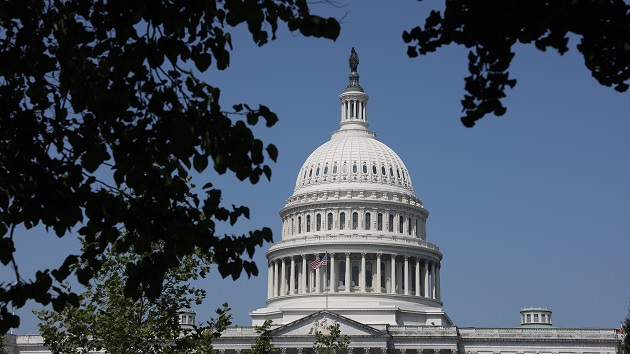
(WASHINGTON) — A frustrated Minority Leader Chuck Schumer called the Trump administration’s postponement of Tuesday’s scheduled classified briefing on the Iran-Israel conflict “outrageous,” “evasive” and “derelict” — and former House Speaker Nancy Pelosi called the postponement of the House’s briefing “a slap in the face to the Congress of the United States.”

“There is a legal obligation for the administration to inform Congress of what is happening. What are they afraid of? Why won’t they engage Congress in the critical details, the result of the recent strike, the scope and trajectory of the conflict, the administration’s long-term strategy to prevent Iran from obtaining nuclear weapons, the potential risks facing American citizens and our service members who we all have an obligation to protect?” Schumer said while addressing reporters Tuesday afternoon.

Schumer said senators deserve transparency.

“This last-minute postponement of our briefing is outrageous, it’s evasive, it’s derelict. They are bobbing and weaving and ducking. Senators deserve full transparency,” he said.

The Senate’s classified briefing, which was set to include briefers from the Department of State as well as Chairman of the Joint Chiefs Dan Caine, CIA Director John Ratcliffe and DNI Tulsi Gabbard, had been postponed to later in the week to allow for other briefers to join.

Schumer suggested, and a GOP leadership aide confirmed, that those other briefers who are expected to join the rescheduled meeting on Thursday are Secretary of State Marco Rubio and Secretary of Defense Pete Hegseth, who are currently at the NATO conference. It’s unclear whether the original slate of briefers will still attend Thursday’s briefing.

“I was given no explanation for this delay,” Schumer told reporters. “They said ‘well Hegseth and Rubio will be here Thursday.’ We are happy to hear them on Thursday in addition to this briefing, which we think will be far more valuable than hearing from Hegseth and Rubio, who are secretaries and top people and are very good at political talking points. We need facts; we need real information.”

Schumer said if Rubio and Hegseth wish to address members he’s happy to hear from them. But he also wants to hear from the original slate of briefers.

“If they want to come up on Thursday in addition — not in replacement of this hearing — that is OK,” Schumer said. “But the obstruction of this administration on a crucial issue like this where American lives and particularly the lives of American service members are at stake, is their obligation and it undermines the very principles of accountability and oversight that safeguard our democracy.”

Schumer said he has still not received a more formal briefing from the administration since he received a brief call informing him of Saturday night’s strike just before it occurred. That call, he said, lacked any specific details.

‘Slap in the face’

The House’s classified briefing set for Tuesday afternoon was postponed as well, which prompted a legislative tantrum on the floor Tuesday afternoon, with lawmakers demanding an explanation.

Democratic Rep. Yvette Clarke, the chair of the Congressional Black Caucus, attempted four times to seek an explanation from the chair as part of a “parliamentary inquiry.”

Clarke’s inquisition was dismissed repeatedly by the presiding chair, Republican Rep. Scott DesJarlais, who informed Clarke that she had not properly stated a parliamentary inquiry.

After some back and forth, Clarke then informed DesJarlais that without an explanation for the postponed briefing, she’d offer a motion to adjourn. That forced the lawmakers to return to the chamber for an unexpected vote to defeat the Democratic motion.

Pelosi criticized the postponement of the briefing.

“We must all exercise our best judgement in how we prevent Iran from having a nuclear weapon and honor our relationship with Israel in the interest of our national security. But the unjustified cancellation of this briefing by the Trump administration is an intolerable insult to their co-equal branch of government and the constitutional requirement that the president comes to Congress before going to war,” the California Democrat said. “The president owes the American people an explanation on why his administration is keeping them and their representatives in the dark.”

It’s not yet clear when the House’s briefing will be rescheduled.

Massie considers pulling War Powers Resolution

When the meetings occur, it’s expected that lawmakers, especially Democrats, will be looking for answers and evidence at the briefings from the administration — specifically why Trump said there was an imminent threat and carried out U.S. strikes on Iran’s nuclear sites over the weekend.

Their meetings come after several lawmakers on Capitol Hill argued the military action was unconstitutional. There are several bipartisan resolutions that could receive a vote in coming days that may put some lawmakers in uncomfortable positions as they consider whether Trump ignored the role of Congress in striking Tehran.

Republican Rep. Thomas Massie and Democratic Rep. Ro Khanna introduced a War Powers Resolution last week to rebuke the president’s decision to launch strikes. As Massie continued to rail against Trump and his role in the conflict, the president lashed out at the Kentucky Republican, saying he was “not MAGA” and threatened to campaign for Massie’s Republican primary opponent in the next election.

Massie has now softened his approach, telling reporters at the Capitol on Monday that he’s now considering pulling the bipartisan War Powers Resolution.

“If the ceasefire holds, and we’re not engaged in hostilities, then it’s a moot point. I wouldn’t need to bring it to the floor,” Massie said.

Massie also added that he is open to patching things up with the president: “I’d like a ceasefire between me and President Trump. If I can get the same deal, after his bunker busters he dropped on me.”

Trump on Monday announced that Israel and Iran had agreed to a ceasefire, after more than a week of fighting following Israel’s strikes — and subsequent U.S. attacks — on Iran’s nuclear program. Hours after the ceasefire took effect, Israel said Iran violated it — which Iran denies.

Trump expressed anger at both Israel and Iran, accusing both of violating the ceasefire agreement shortly after it began.

“I’m not happy with Israel. OK, when I say now you have 12 hours, you don’t go out in the first hour and just drop everything you have on them. So I’m not happy with them. I’m not happy with Iran either,” Trump said to reporters Tuesday morning.

Speaker Mike Johnson said late Monday that he expects the House briefing to have a different “tone” in the light of the ceasefire.

ABC News’ Rachel Scott contributed to this report.

Copyright © 2025, ABC Audio. All rights reserved.

Trump says no vacations until Congress passes his megabill

Trump says no vacations until Congress passes his megabill
Tasos Katopodis/Getty Images

(WASHINGTON) — President Donald Trump on Tuesday told Senate Republicans to lock themselves in a room if necessary to work out their differences and pass the megabill that will fund his second-term agenda.

“To my friends in the Senate, lock yourself in a room if you must, don’t go home, and GET THE DEAL DONE THIS WEEK,” Trump posted on his social media platform while on his way to the NATO summit in the Netherlands. “Work with the House so they can pick it up, and pass it, IMMEDIATELY. NO ONE GOES ON VACATION UNTIL IT’S DONE.”

Both the Senate and House are under pressure to reconcile differences between the House and Senate versions of the bill and get it to Trump’s desk by July 4.

Speaker Mike Johnson warned House Republicans Tuesday that their Independence Day celebrations may be in jeopardy as the House waits for the Senate to complete its changes to the One, Big, Beautiful Bill Act and the speaker sticks to the Fourth of July deadline.

While the House is scheduled to leave town Friday for a week back in their districts, the speaker set off his own fireworks — telling his conference that members will not be dismissed for recess until the House approves the Senate’s changes.

“I said to keep your schedules flexible. July 4 is always a district work period. This is tradition, so everybody can go home and celebrate the Fourth of July with their constituents and their families,” Johnson said. “But this — there’s nothing more important that we should be involved in, or can be involved in than getting one big, beautiful bill to the president’s desk. So if the Senate does its work on the timeline that we expect, we will do our work as well. And I think everybody’s ready for that.”

The bill would make the Trump 2017 tax cuts permanent, allocate additional funding for border security and the Department of Defense, scale back Medicaid and SNAP benefits, limit taxes on tips and overtime, change state and local tax caps, and do far more.

Republicans are attempting to pass the bill using budget reconciliation, a procedure that allows them to sidestep Senate rules that normally require 60 votes to pass legislation and to instead pass the bill with a simple majority.

A KFF poll released Tuesday suggests nearly two-thirds of the public views the One Big Beautiful Bill Act unfavorably, by nearly twice as much who view it favorably, 35% to 64% of those polled.

When those polled learned the impact the bill would have on health care — for example, increasing the number of people without insurance and decreasing funding to hospitals — support fell, even among MAGA supporters.

The poll found 83% of the public, including 74% of Republicans, have a favorable view of Medicaid, and 66% have a favorable view of the Affordable Care Act.

Senate Republicans met behind closed doors Monday night to go over the latest contours of their version of the bill as Senate Parliamentarian Elizabeth MacDonough continued to go through the bill to ensure provisions are within the scope of using reconciliation.

Her rulings have already rankled some Republican plans, and Monday’s meeting appeared to have focused largely on how they intend to retool their provisions for compliance.

A lot remains outstanding, but there’s general optimism in the conference that a floor vote this week is still possible.

The meeting also took into account “considerations as to what the president wants,” according to Sen. Shelley Moore Capito, R-W.Va., who said she still expects the bill to make it to the floor later this week.

Johnson said Tuesday he expects the Senate to vote on Friday or Saturday — after the lower chamber had been expected to conclude its legislative work period — potentially pushing the House’s consideration of the Senate’s changes into next week.

There remains a number of challenges that Republicans must address between now and then. Here’s where things stand on some of the key provisions:

State and local taxes

The House and Senate have been divided on this issue as Senate Republicans have made clear they want to modify language in the House bill that some House moderates could balk at.

Sen. Markwayne Mullin, R-Okla., who has been leading negotiations over SALT said Monday that the Senate has more or less reached a place of “acceptance” on SALT. The proposal, he said, won’t touch the $40,000 cap negotiated in the House, but it will alter the income threshold.

“It’s not going to lose any votes,” Mullin said, speaking for his conference. “But, as I said, it’s not a joyful spot for any of us to be in. I’ll be happy when this is done, and then we can move on.”

But Rep. Nick LaLota, R-N.Y., told reporters Tuesday that the SALT caucus of five House Republicans has banded together to create a bloc that could defeat a vote given Johnson’s slim three-vote majority.

“I hope they recognize the reality that five very salty House Republicans will vote no if they break apart on that deal,” LaLota said.

Supplemental Nutrition Assistance Program

Capito said that provisions on SNAP were the most “upended” by the parliamentarian. Her ruling threatens to lessen the savings to the federal government that Republicans are hoping the bill will achieve.

Some of Monday’s meeting focused on the parliamentarian’s ruling that a provision that would require states to share the cost of the SNAP was out of order.

Sen. John Boozman, R-Ark., chairman of the Senate Agriculture Committee that has jurisdiction over SNAP, said that Republicans are aiming to retool the SNAP provision to make it compliant with Senate rules.

“What we’re trying to do is give the states more time to understand what they’re dealing with so they can respond,” Boozman said.

Rural hospitals

Perhaps the biggest thorn in the Senate’s side right now is an ongoing debate about Medicaid cuts — specifically how alterations of the provider tax rate could hamstring rural hospitals in some states.

Sen. Josh Hawley, R-Mo., said Tuesday that moving the Senate’s version of the bill on provider tax rates back to the House’s framework would “absolutely” solve issues on the provision.

“What needs to happen now is that the leader needs to get with the rural hospitals, and he needs to satisfy their concerns and make sure that they can stay open. I mean, that will solve the problem of the House, too. You got the House out there now saying they can’t pass the Senate version of this bill,” Hawley said.

“This is not a game of chicken. This is real now, it’s like, this is — this is not like some Model UN or student government. Like, this is a real deal. So they need to get with the House. They need to get with the speaker. Make sure that they can pass this bill,” Hawley added.

ABC News’ Lauren Peller contributed to this report.

Copyright © 2025, ABC Audio. All rights reserved.

Trump narrates dizzying 24 hours from Iranian retaliation to fragile ceasefire: Timeline

Trump narrates dizzying 24 hours from Iranian retaliation to fragile ceasefire: Timeline
Erik Marmor/Getty Images

(WASHINGTON) — The past 24 hours in the Israel-Iran war have been been highlighted by President Donald Trump’s whirlwind diplomatic efforts, aimed at being seen as a peacemaker amid the conflict.

The world seesawed between fears of escalation as Iran retaliated against the United States to Trump’s surprise ceasefire announcement to his angry comments about early violations from both countries.

Notably, the president narrated the fast-changing developments in real time on his conservative social media site, showing, in often personal terms, his style of dealmaking diplomacy — and his mounting frustration with both sides.

Here’s how the sometimes dizzying sequence of events unfolded.

Monday afternoon: Iran fires missiles at US military base in Qatar

Alarms were raised when when Tehran, in response to the U.S. strikes against Iran’s nuclear facilities over the weekend, retaliated on Monday by firing missiles at Al Udeid Air Base, the largest U.S. military base in the region.

Reports of the attack came in around 1 p.m. ET on Monday. The U.S. shot down the missiles with assistance from Qatar. No injuries or extensive damage were reported.

Although Trump had threatened a massive response if Iran retaliated, raising fears of escalation, he issued a statement on his social media account about 4 p.m. ET calling the attack “very weak” and said it was “very effectively countered,” not mentioning any military action.

“I am pleased to report that NO Americans were harmed, and hardly any damage was done. Most importantly, they’ve gotten it all out of their ‘system,’ and there will, hopefully, be no further HATE,” the president wrote. “I want to thank Iran for giving us early notice, which made it possible for no lives to be lost, and nobody to be injured.”

“Perhaps Iran can now proceed to Peace and Harmony in the Region, and I will enthusiastically encourage Israel to do the same. Thank you for your attention to this matter!” he wrote.

Monday evening: Trump announces ceasefire

The, at 6:08 p.m. ET, Trump, in a bombshell post, announced a ceasefire agreement he said would end the war within 24 hours.

The agreement described by Trump involved two 12-hour ceasefire periods that would come “when Israel and Iran have wound down and completed their in progress, final missions,” Trump wrote.

Iran would start the ceasefire for the first 12 hours, Trump said, and Israel would then follow with a second 12-hour ceasefire. When that period was over, Trump said, “an Official END to THE 12 DAY WAR will be saluted by the World.”

“It’s a great day for America. It’s a great day for the Middle East. I’m very happy to have been able to get the job done,” Trump told NBC News, taking credit. “I think the ceasefire is unlimited. It’s going to go forever.”

In the immediate aftermath of Trump’s announcement, however, neither Israeli nor Iranian officials publicly commented on the proposal.

At 1:08 a.m. ET, Trump posted: “THE CEASEFIRE IS NOW IN EFFECT. PLEASE DO NOT VIOLATE IT!”

Overnight: Reports Israel and Iran continue to exchange fire

In the final hours before the ceasefire was set to go into effect, Israel and Iran launched a barrage of missiles. Israel said four people were killed and 20 injured as Iranian missiles hit Beersheba. Iran said at least 15 people were killed in strikes around the country.

Then, came reports of exchanged fire in the opening hours of the ceasefire.

Israel said Iran violated the ceasefire agreement by launching missiles between midnight and 3:30 a.m. ET, which Israel said were intercepted or fell in open areas. Iran denied firing the missiles.

Israel then acknowledged its Air Force “destroyed a radar installation near Tehran” in response to the alleged violations.

Tuesday morning: Trump lashes out at Israel and Iran

In some startlingly blunt comments, Trump showed his frustration with both Iran and Israel as he departed the White House around 6:30 a.m. ET to attend a NATO summit in the Netherlands.

“Israel as soon as we made the deal, they came out and dropped a boatload of bombs the likes of which I’ve never seen before,” Trump said. “The biggest load that we’ve seen, I’m not happy with Israel. Ok, when I say now you have 12 hours, you don’t go out in the first hour and just drop everything you have on them. So, I’m not happy with him. I’m not happy with Iran either.”

While he accused both nations of violating the ceasefire, much of his ire was aimed toward Israel, in language rarely heard from a president in public.

“We basically have two countries that have been fighting so long and so hard, that they don’t know what the f— they’re doing. Do you understand that?” a visibly angry Trump told ABC News Senior Political Correspondent Rachel Scott when asked if both nations were committed to peace, before turning away to board his Marine One helicopter.

Soon after, he fired off a warning to Israel on social media — in all capital letters — to stop attacking Iran.

During the morning, Trump spoke with Israeli Prime Minister Benjamin Netanyahu, sources familiar with the call told ABC News. A White House source, in a readout of the call, said Trump was firm and direct with Netanyahu about what was necessary to sustain the ceasefire.

“ISRAEL is not going to attack Iran. All planes will turn around and head home, while doing a friendly ‘Plane Wave’ to Iran. Nobody will be hurt, the Ceasefire is in effect!” Trump wrote.

Once aboard Air Force One, on his way to the Netherlands, he told reporters he wasn’t thinking about consequences for Israel when he warned against retaliation, claiming “they didn’t do anything” because of his post on social media.

The Israeli prime minister’s office said in a statement that Israel has “refrained from additional attacks” on Iran following the conversation between Trump and Netanyahu.

Iran said it won’t violate the ceasefire unless Israel does, according to Iran’s state-run media.

As of Tuesday afternoon, the fragile ceasefire appeared to be holding, 24 hours after Iran retaliated against the U.S.

Copyright © 2025, ABC Audio. All rights reserved.
Dangerous heat wave invades East Coast: Latest forecast

Dangerous heat wave invades East Coast: Latest forecast
ABC News

(NEW YORK) — A life-threatening heat wave has enveloped the East Coast, hitting cities with the worst of the high temperatures on Tuesday before relief moves in later in the week.

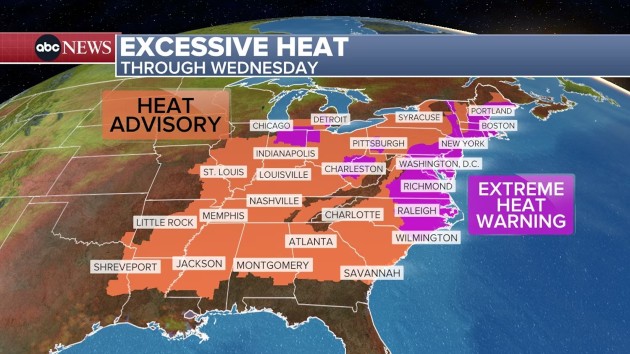
This is the first major heat wave of the season, with extreme heat warnings and heat advisories in effect for over 150 million Americans from Texas to Maine, including the entire Interstate 95 corridor.

Extreme heat warnings are in effect across the Northeast, including Boston, New York City, Philadelphia, Baltimore and Washington, D.C. Actual temperatures are approaching 100 degrees, while the heat index — what the temperature feels like with humidity — is soaring above 100 degrees.

Philadelphia, Baltimore and Raleigh, North Carolina, all broke daily heat records on Monday with temperatures of 99 degrees, 104 degrees and 100 degrees, respectively. In New York City, the heat index on Monday reached 106 degrees — the highest in the area in four years.

Tuesday is the hottest day of the heat wave for the Northeast. Boston, New York City, Philadelphia and D.C. could break daily record highs.

Amtrak said some trains in the Northeast may be delayed due to heat-related speed restrictions. Amtrak issues these restrictions when temperatures are higher than 95 degrees and the tracks reach 128 degrees.

On Tuesday, it’ll feel like 106 degrees in Boston and Philadelphia; 102 degrees in New York City; 109 in D.C.; 107 in Charlotte, North Carolina; and 105 in Charleston, South Carolina.

The extreme heat will even reach upstate New York and New England, where the heat index is forecast to hit 102 degrees.

This kind of rare, long-duration heat with little overnight recovery can be life-threatening, especially for people without adequate cooling or hydration available.

Con Edison is urging everyone in New York City to conserve energy.

“Customers’ need to run their air conditioners to stay comfortable place stress on electric delivery equipment,” Con Edison explained. “The company asks customers to refrain from using intensive appliances such as washers, dryers, and microwaves during peak hours.”

Relief from the oppressive heat will arrive on Thursday. Temperatures will drop to 69 degrees in Boston, 78 in New York City, 91 in Philadelphia and 93 in D.C.

Click here for what you need to know to stay safe in the heat.

Copyright © 2025, ABC Audio. All rights reserved.

2 million student loan borrowers at risk of garnished wages in July

2 million student loan borrowers at risk of garnished wages in July
Celal Gunes/Anadolu Agency via Getty Images

(NEW YORK) — Nearly two million student loan borrowers are at risk of having their wages garnished next month, credit-reporting agency TransUnion said on Tuesday.

Fresh data shows a sharp increase in the number of delinquent student loan borrowers in recent months, following the end of a pandemic-era pause on student debt payments.

Student loan borrowers are considered delinquent if they fail to make a loan payment for 90 days. When late payment stretches on for a total of 270 days, then the borrower falls into default.

Roughly 6 million student loan borrowers entered delinquency between February and April, TransUnion said, estimating that about one-third of those borrowers could enter default in July.

When a federal student loan enters default, the government can send it for collections, garnishing wages or even taking money from Social Security payments or tax refunds.

The Trump administration started collecting defaulted student loan payments in May, lifting a pause initiated in 2020 at the onset of the COVID-19 pandemic.

“We continue to see more and more federal student loan borrowers being reported as the 90+ days delinquent, making a larger number of consumers vulnerable to entering default and the start of collections activities,” Michele Raneri, vice president and head of U.S. research and consulting at TransUnion, said in a statement.

Some borrowers’ credit scores have also suffered. Student loan holders who have entered delinquency in recent months have suffered an average credit-score reduction of 60 points, TransUnion data showed.

Roughly one in five of the newly delinquent borrowers held relatively strong credit ratings of prime or above.

“This underscores the fact that student loan borrowers of any credit risk tier can find themselves falling behind in their payments and at risk for default, even during a time in which we’ve seen most consumers are managing their debt relatively well,” Joshua Turnbull, senior vice president and head of consumer lending at TransUnion, said in a statement.

The risk to borrowers’ credit scores dates back to policy decisions made when former President Joe Biden’s administration resumed federal student loan payments after a period of relief that had been enacted during the COVID-19 pandemic.

When the Biden administration lifted the pause in the fall of 2023, the White House set in motion a 12-month moratorium. The administration did not count late payments toward delinquency. That moratorium ended in October, meaning borrowers could be considered delinquent if they didn’t make payments for more than 90 days, returning to the way the process worked pre-pandemic.

In all, some 42 million borrowers owe more than $1.6 trillion in student debt, the Department of Education said in April.

Despite the surge in newly delinquent borrowers, many of the loan holders still have time to avert garnished wages. Just 0.3% of the newly delinquent borrowers have already entered default, TransUnion said.

Copyright © 2025, ABC Audio. All rights reserved.
Disgraced former Rep. Anthony Weiner among scandal-ridden New York City candidates

Disgraced former Rep. Anthony Weiner among scandal-ridden New York City candidates
Spencer Platt/Getty Images

(NEW YORK) — New York City’s municipal races are bringing disgraced politicians back into the limelight, with multiple candidates seeking a political comeback and raising the question of whether voters will give them a second — or third — chance.

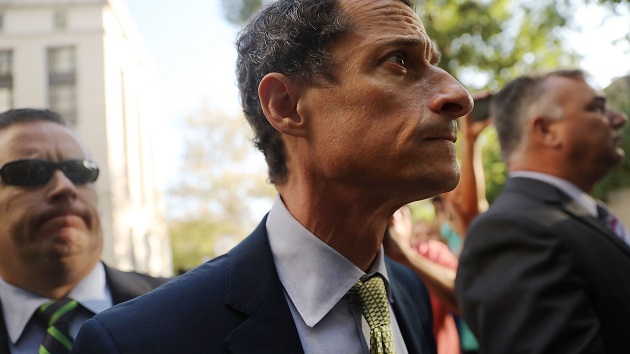
Among the slate is Anthony Weiner, the disgraced former congressman whose downfall came after a slew of sexting scandals that culminated in a 21-month federal prison sentence, who is vying for Manhattan’s City Council seat.

This comes as New York City’s mayoral race faces its share of controversy as well, with former New York Gov. Andrew Cuomo continuing to deny the sexual harassment allegations that led to his resignation nearly four years ago.

And though the federal investigation into incumbent Mayor Eric Adams over fraud and bribery was dismissed earlier this year, he continues to take heat as the first sitting mayor to be indicted as he attempts to court voters running as an independent.

Yet Weiner, 60, is attempting to differentiate himself from the other candidates with checkered pasts by emphasizing accountability for his wrongdoings.

“All of that happened, and I accept responsibility for it,” he told ABC’s “The View” in May. “You won’t hear me do what some other people in public life have done — Donald Trump or Andrew Cuomo or Eric Adams: ‘I’m a victim, they persecuted me for no reason.’ I was dealing with very serious problems. I was dealing with what I now understand to be addiction.”

“I am saying ‘Yes, I did these things. I got into recovery. I tried to make my life better,'” he said. “And now I can be of service. And I’m a damn good politician.”

In 2011, Weiner resigned from his congressional seat after a sexually explicit photo was posted on his social media page — which he initially said was a hack, but later admitted was his own doing — in addition to revelations of more sexting content with various women online.

He attempted a comeback two years later in an unsuccessful New York City mayoral run. Despite his initial lead, his campaign was plagued by controversy as more sexually explicit messages and images became public, with Weiner operating under the alias “Carlos Danger.”

In 2016, new sexting allegations came to light which prompted his wife Huma Abedin to announce the couple’s split.

In 2017, Weiner was sentenced to 21 months in federal prison after one of his sexting scandals was found to involve a 15-year-old girl. Following his release, he was also designated a Level 1 registered sexual offender, classified as a low-risk to reoffend.

During his appearance on “The View,” Weiner emphasized that he was still in recovery for sex addiction.

He also recognized that he would receive blowback during his campaign, but he did not think his past should hold him back. He cited a need for change among Democratic candidates as his reason for getting back into politics.

“When I woke up in November of ’24 and saw the election results — but more than who won, I looked around New York City and saw how many fewer Democrats even turned out to vote. And I started to say to myself ‘something is seriously wrong here,'” he said. “We’re hardcore anti-Trump territory and Trump did better.”

Weiner presents a more moderate platform than some of his Democratic counterparts. According to his campaign website, some of his goals include increasing police presence, protecting undocumented immigrants but deporting violent criminals, taxing the rich, and eliminating waste.

In Tuesday’s Democratic primary, Weiner faces Assembly Member Harvey Epstein, Manhattan Community Board Chair Andrea Gordillo, nonprofit leader Sarah Batchu, and community advocate Allie Ryan. 

Copyright © 2025, ABC Audio. All rights reserved.