(NEW YORK) — Days after attacking a megabill that advances President Donald Trump’s agenda, Elon Musk slammed it again on Tuesday calling it a “disgusting abomination” in a post on X.
“I’m sorry, but I just can’t stand it anymore. This massive, outrageous, pork-filled Congressional spending bill is a disgusting abomination,” Musk wrote. “Shame on those who voted for it: you know you did wrong. You know it.”
This is a developing story. Please check back for updates.
(WENATCHEE, Wash.) — Three young sisters in Washington who had not been seen since they left home for a scheduled visitation with their father have been found dead, according to the Wenatchee Police Department.
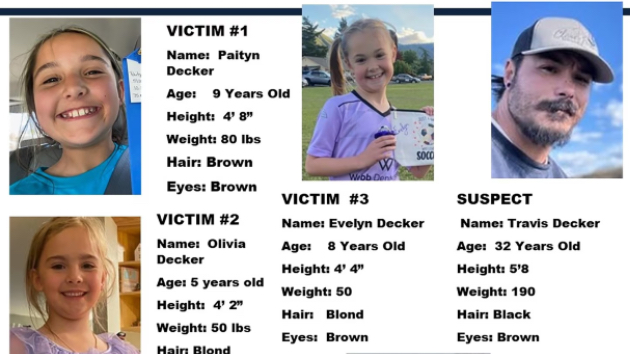
Paityn Decker, 9; Evelyn Decker, 8; and Olivia Decker, 5, were last seen at approximately 5 p.m. on Friday when they left to be with their father, Travis Decker, on a “planned visitation,” police said.
At approximately 3 p.m. on Monday, officials located Decker’s vehicle unoccupied near the Rock Island Campground in Chelan County, Washington, police said in a press release on Tuesday. Additional law enforcement officers responded to the scene and found the bodies of the three girls, but “Decker was not located,” police said.
“We want to express our sincere and deep heartfelt condolences to the family at this time,” police said.
Officials continue to search for Decker, 32, who is homeless and has been living in his vehicle or at various motels or campgrounds in the area, officials said. He is currently wanted for three counts of first-degree murder and one count of first-degree kidnapping. Police said Decker is a former member of the military with “extensive training,” but it is unknown whether he is currently armed.
Police said Decker may pose a “significant risk” and should not be approached due to safety concerns.
The Endangered Missing Persons Alert for the three girls was canceled late Monday, according to the Washington State Patrol.
Prior to discovering the girls’ bodies, police said visitation had been a part of the family’s parenting plan, but Decker went “outside the parameters of it which is not normal and cause for the alarm.”
Prior to the news of the sisters’ death, their mother, Whitney Decker, said in a statement that she “just wants the girls back home safe and sound” and that she was “concerned” about the safety of her children.
“This is an unimaginable situation. I am pleading for everyone to look out for them,” Whitney Decker said in a statement provided to ABC News.
Travis Decker, who is described as 5 feet, 8 inches tall with black hair and brown eyes, was last seen wearing a light shirt and dark shorts, according to police.
Officials said anyone who has any information on Decker or knows of his whereabouts should call 911 immediately.
(OCALA, Fla.) — A city in Florida began the formal process of removing fluoride from its water supply on Tuesday to be in compliance with a new state law.
Ocala — 75 miles northwest of Orlando — currently has a city ordinance requiring fluoride to be added to the water supply. Last month, Gov. Ron DeSantis signed a bill banning local governments from adding fluoride to public water systems.
Gregory Davis, public information officer for the city of Ocala, told ABC News the city’s council will be voting on Tuesday to amend the ordinance.
Ocala had been adding fluoride to the water supply since 1961 and had spent about $50,000 a year doing so, according to Davis.
Davis said it’s unclear how long it will take Ocala to remove fluoride from its water supply but added that the city’s water resource team said it will be in compliance by July 1, which is when the state law goes into effect.
Local communities in Florida had moved to stop adding fluoride to the public water supply prior to the statewide bill, with Miami-Dade County commissioners voting in favor 8-2 last month to ban fluoride.
Additionally, the city of Stuart — about 80 miles north of Fort Lauderdale — removed fluoride from its water supply in November 2024 after state surgeon general Dr. Joseph Ladapo announced guidancerecommending against water fluoridation.
Fluoride is a mineral that naturally occurs in water sources such as lakes and rivers and is even naturally present in some foods and beverages, according to the American Dental Association.
It is added to some dental products, such as toothpaste, to help prevent cavities.
High-quality studies show fluoride prevents cavities and repairs damage to teeth caused by bacteria in the mouth. Fluoride makes tooth enamel stronger and rebuilds weakened tooth enamel, the ADA says.
Fluoride also replaces minerals lost from teeth due to acid breakdown, according to the Centers for Disease Control and Prevention.
Influential skeptics such as Ladapo and Health and Human Services Secretary Robert F. Kennedy Jr., however, have long raised doubts about the benefits of fluoride.
In an interview with NPR in November 2024, Kennedy doubled down on his promise of persuading local governments to remove fluoride from their water supplies.
Earlier this year, Kennedy said he planned to assemble a task force and ultimately change the CDC’s guidance to stop recommending fluoride. The comments came during a press conference in Utah after the state became the first in the nation to ban fluoride from water drinking systems.
A large review paperpublished in January 2025 suggested a link between fluoride and lower IQ in children, but the study only pointed to a possible link — not proven cause and effect. Meanwhile, much of the underlying data was pulled from other countries, where fluoride exposure is far higher than levels used in drinking water in the U.S.
Some health professionals have also expressed concerns about excessive fluoride intake and potential toxicity.
Many doctors and dental associations, however, argue that fluoride in water is still a crucial, low-risk/high-reward public health tool, especially for disadvantaged children and adults who may not be able to practice regular dental hygiene.
ABC News’ Sony Salzman contributed to this report.
(NEW YORK) — Smoke from raging wildfires in Canada continues to bring dangerous air quality conditions to parts of the northern United States, with hazy and smoky skies also possible for the East and South.
As of Tuesday, there are 208 active wildfires burning in Canada, with 107 of these considered to be “out of control,” meaning fires that are being observed and assessed, but not immediately suppressed, according to the Canadian Interagency Forest Fire Centre.
The haze from the wildfires — which was seen all the way to the Gulf Coast on Monday — will continue to travel into the East and the South on Tuesday, bringing a lightly tinted sunset in the Northeast.
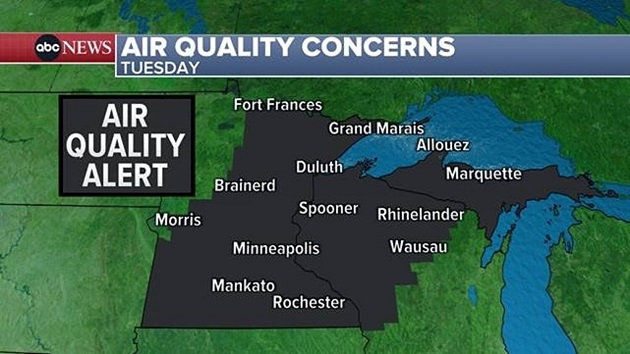
There are not currently any air quality alerts for the East or South since the smoke is expected to stay below the surface, but potentially dangerous conditions are expected in Minnesota, Wisconsin and the Upper Peninsula of Michigan.
On Tuesday morning, Minneapolis was among the top 10 worst air quality conditions in the world. While the entire state of Minnesota is under an air quality alert until Wednesday afternoon, eastern Minnesota is expected to reach an “unhealthy” air quality index, or level four of six on the AQI Index.
In these conditions, most people could experience irritated eyes, nose and throat, coughing, chest tightness or shortness of breath, the pollution control agency said.
Rain on Tuesday should alleviate the poor air quality briefly, but there is a chance for additional heavy smoke later Tuesday afternoon, especially from Duluth to Minneapolis.
Air quality conditions should improve on Wednesday across Minnesota as the smoke continues to move east.
As of Tuesday, the areas of Canada with the most fires include British Columbia with 74 and Alberta with 16, according to the CIFFC.
Last week, the provinces of Saskatchewan and Manitoba declared state of emergencies due to the fires, with around 17,000 residents already evacuated, according to The Associated Press.
The combination of dry conditions and “little-to-no precipitation” will continue to feed the flames and make it difficult for officials to manage the fires, Saskatchewan Public Safety said on Sunday.
During a press conference on Monday, Saskatchewan Public Safety discouraged any nonessential travel due to the significant fire activity.
Aircraft and dozens of personnel from other Canadian provinces and the United States — including Arizona, Oregon and Alaska — are being sent to help fight the wildfires, according to the Saskatchewan Premier Scott Moe.
Moe said last week there has been a “significant lack of moisture” in the northern parts of the province, causing “over 200 wildfires” in Saskatchewan this spring.
(WASHINGTON) — Two Chinese nationals have been charged with allegedly smuggling into the U.S. a fungus called “Fusarium graminearum, which scientific literature classifies as a potential agroterrorism weapon,” the Justice Department said Tuesday.
Yunqing Jian, 33, and Zunyong Liu, 34, citizens of the People’s Republic of China, were allegedly receiving Chinese government funding for their research, some of which at the University of Michigan, the Justice Department said.
This is a developing story. Please check back for updates.
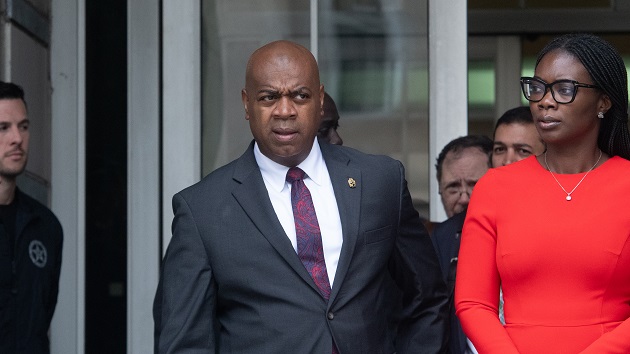
(NEWARK, N.J.) — Newark Mayor Ras Baraka filed a lawsuit against interim U.S. Attorney for the District of New Jersey Alina Habba on Tuesday, accusing her of malicious prosecution over his arrest outside a U.S. Immigration and Customs Enforcement detention facility last month.
The suit seeks compensatory and punitive damages and is against Habba and the Department of Homeland Security special agent who Baraka claims unlawfully took him into custody on May 9 at Delaney Hall, where he was joined by three members of Congress for what they said they intended to be an inspection of conditions at the detention facility.
Baraka accuses Habba and Assistant Homeland Security Secretary for Public Affairs Tricia McLaughlin of seeking to politicize his arrest by promoting a “false and defamatory narrative” about the events that led to him being taken into custody.
While Habba and McLaughlin accused Baraka of attempting to “storm” the facility, his lawsuit noted he was actually invited onto the property by an agent of the GEO Group, a private prison operator that runs Delaney Hall, and was only placed under arrest after he had exited the gates when instructed.
“The false Affidavit was made with malice, particularly seeking to assure that the evening news included videos of the Black Mayor of Newark, New Jersey being led away in handcuffs by federal officials,” the lawsuit said.
The lawsuit also takes issue with what it describes as the unusual treatment of Baraka following his arrest. It said he was kept in custody for over five hours before making a first appearance before a judge, whereas typically people are given a summons after being charged with the petty offense of trespassing.
Habba’s office moved to dismiss its case against Baraka, though prosecutors in a May 21 hearing were admonished by the federal judge assigned to Baraka’s case who said the charges against him appeared to be rushed and based on politics.
“The hasty arrest of Newark Mayor Ras Baraka, followed swiftly by the dismissal of these trespassing charges a mere 13 days later, suggests a worrisome misstep by your office,” Magistrate Judge Andre Espinosa said. “The apparent rush in this case, culminating today in the embarrassing retraction of charges, suggests a failure to adequately investigate, to carefully gather facts and to thoughtfully consider the implications of your actions before wielding your immense power.”
Habba posted on X Monday night in response to a report on Baraka’s planned lawsuit, writing, “My advice to the mayor – feel free to join me in prioritizing violent crime and public safety. Far better use of time for the great citizens of New Jersey.”
Federal prosecutors have separately charged Rep. LaMonica McIver, D-N.J., for allegedly assaulting agents outside the Delaney Hall facility. McIver has said she plans to plead not guilty and vigorously disputes the charges.
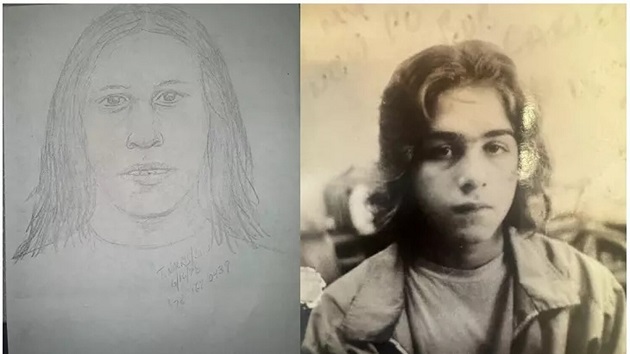
A June 1978 sketch of the suspect accused of killing San Jose schoolteacher Diane Peterson, left, compared to then-student Harry Nickerson, now identified as her killer, in an undated photo, right. Santa Clara County District Attorney’s Office
(SAN JOSE, Calif.) — The brutal murder of a school teacher, stabbed in the chest at a California high school in 1978, has finally been solved, according to authorities, with the district attorney’s office now revealing the then-16-year-old killer confessed to a family member minutes after the murder.
Diane Peterson was found stabbed at Branham High School in San Jose one day after school ended for the summer. And though they had suspects over the years, her murder had never been solved.
One of those suspects, Harry “Nicky” Nickerson, has now been confirmed as the killer, the Santa Clara County District Attorney’s Office announced Monday.
Earlier this year, investigators learned Nickerson had confessed to a family member he committed the murder. Investigators met with the family member, who admitted to police that Nickerson came to their home minutes after the murder and confessed to stabbing Peterson, solving the decades-old murder, according to the district attorney’s office.
The district attorney’s office will not be filing charges against the family member who revealed Nickerson admitted to the murder, the DA’s office told ABC News.
“The relative did not participate in the killing and did not provide protection or assistance. Just a witness. The relative was emotional and appeared relieved after having kept a secret for almost 50 years,” the office said in a statement to ABC News.
“The relative did not expressly say why they did not come forward,” the office said, saying it is “reasonable to surmise it was out of fear of retaliation.”
In the years after the murder, Nickerson was arrested and convicted of armed robbery, assault with a deadly weapon and kidnapping, according to the DA’s office. He was shot and critically injured in 1984 while attempting a drug robbery, but no charges were filed against him “given the circumstances,” the district attorney’s office said.
Nickerson died by suicide in 1993, according to the district attorney’s office.
“This marks the end of a terrible and tragic mystery. Ms. Peterson would have been a senior citizen today if she had not crossed paths with this violent teenager. I wish she was. I am pleased that we have solved this case, even though the murderer is not alive to face justice. I wish he was,” Santa Clara County District Attorney Jeff Rosen said in a statement.
“Let this serve as a solemn reminder: no matter how much time passes, we will continue to seek the truth — because every victim matters, and every life deserves justice,” San Jose Police Chief Paul Joseph said in a statement.
A student found Peterson stabbed to death in the high school hallway in 1978, the district attorney’s office said. Peterson suffered a single stab wound to her chest, according to the district attorney’s office.
The murder occurred one day after school ended for the summer, while teachers were cleaning their classrooms, according to the district attorney’s office.
A witness had previously told police that Nickerson confessed to the crime and that he had seen Nickerson “carrying a knife that had written on it: ‘Teacher Dear,'” according to the district attorney’s office. Police were not able to corroborate that claim, according to the district attorney’s office.
Nickerson had long been a suspect in the killing, according to the district attorney’s office. Nickerson allegedly had a “strong similarity to a composite sketch based on eyewitness accounts of the attack,” according to the DA’s office.
The family of a student told police in 1983 that their son had claimed to have seen the killing and that he identified Nickerson as the killer. The student later denied this, according to the district attorney’s office.
In 1984, a witness told police that Nickerson implicated himself in the murder, claiming he killed Peterson after he was discovered making a drug deal, according to the district attorney’s office.
Extensive DNA work on the case in 2023 and 2024 was unable to identify the killer, according to the district attorney’s office.
A family member of the victim, who asked to not be identified by police, thanked investigators for “not giving up for 47 years.”
“Diane was a beautiful and wonderful person who is missed dearly,” the relative said in a statement.
(NEWARK, N.J.) — Newark Mayor Ras Baraka filed a lawsuit against interim U.S. Attorney for the District of New Jersey Alina Habba on Tuesday, accusing her of malicious prosecution over his arrest outside a U.S. Immigration and Customs Enforcement detention facility last month.
This is a developing story. Please check back for updates.
(WASHINGTON) — Ramon Morales-Reyes, the man Department of Homeland Security Secretary Kristi Noem publicly accused of writing letters threatening President Donald Trump, was framed by another inmate who wanted Morales-Reyes to be deported so he would no longer be able to testify against him in an upcoming trial, according to a court filing in Wisconsin yesterday.
“The investigation into the threat is ongoing,” the DHS said in a statement. “Over the course of the investigation, this individual was determined to be in the country illegally and that he had a criminal record. He will remain in custody.”
Last week, the DHS said Morales-Reyes, who is allegedly in the United States without legal status, threatened to shoot and kill Trump and posted what appeared to be a threatening letter sent from him to a U.S. Immigration and Customs Enforcement agent.
The letter claimed he was going to shoot and kill Trump at one of his rallies, and Morales-Reyes was arrested by ICE agents, the DHS said.
Reyes was involved in a dispute with another man who is currently in jail for allegedly physically assaulting him, and wanted to get Reyes deported to avoid testifying against him, multiple sources told ABC News.
During an interview with officials, Morales-Reyes said the “only person who would want to get him in trouble, was the person who had robbed him and who law enforcement knows to be the defendant, Demetric D. Scott.”
Demetric Deshawn Scott, 52, was charged Monday with identity theft, felony intimidation of a witness and two counts of bail jumping.
Morales-Reyes, 54, submitted to a handwriting test that did not match the handwriting in the letter, officials said.
Milwaukee police interviewed Scott last week. “During this interview, the defendant admitted that he wrote everything on the letters and envelopes himself. He stated that the letters were made without the assistance of anyone. When asked what was going through his head at the time of writing the letters, the defendant stated ‘Freedom,'” the court filing said.
Scott, according to the court records, can be heard allegedly concocting the plan to have Morales-Reyes arrested, thinking it would lead to the dismissal of his robbery case, of which he is currently waiting for trial.
Scott told the person on the other line he had a “hell of a plan.”
Scott allegedly told investigators he knew that by including Trump in the threat, Secret Service would have to get involved.
Police also searched his jail cell and found the blue pen with which he had written the letters.
(NEW YORK) — The United States’ economic growth forecast was cut sharply on Tuesday by the Organization for Economic Co-operation and Development, or OECD, which attributed the gloomy outlook in part to tariffs issued by President Donald Trump.
The OECD expects the U.S. economy to grow 1.6% in 2025, marking a substantial reduction from a 2.2% expansion forecast in March.
The nation’s economic growth will slow further in 2026, the OECD said, cutting its forecast for that year to 1.5%.
The dampened outlook for the U.S. mirrors a slowdown expected for the global economy, the OECD said, predicting global economic growth to fall from 3.4% in 2024 to 2.9% in 2025.
“Global economic prospects are weakening,” the OECD said in a statement, pointing to an array of factors that includes “substantial barriers to trade” and “heightened policy uncertainty.”
The OECD also warned of a potential upsurge in U.S. consumer prices, saying inflation could approach 4% by the end of 2025. The inflation rate currently stands at 2.3%.
“Higher trade costs, especially in countries raising tariffs, will also push up inflation,” the OECD said.
The OECD forecast echoes concerns raised by Wall Street analysts and Federal Chair Jerome Powell about the possibility that President Donald Trump’s tariffs may cause what economists call “stagflation,” which is when inflation rises and the economy slows.
A growing set of major retailers have warned of possible tariff-driven price hikes, including Nike, Target, Walmart and Best Buy.
Consumer attitudes have soured for four consecutive months as tariffs have taken hold, according to a survey conducted by the University of Michigan.
Consumer spending, which accounts for about two-thirds of U.S. economic activity, could weaken if shopper appetites diminish. In theory, a slowdown of spending could hammer some businesses, prompting layoffs that in turn further shrink consumer activity.
“Global trade tensions are hitting sentiment,” the OECD said.
U.S. tariffs remain above where they stood before Trump’s second term began, but a number of levies have rolled back in recent weeks.
A trade agreement between the U.S. and China last month slashed tit-for-tat tariffs between the world’s two largest economies and triggered a surge in the stock market. Within days, Wall Street firms softened their forecasts of a recession.
The U.S.-China accord came weeks after the White House paused far-reaching “reciprocal tariffs” on dozens of countries. Trump also eased sector-specific tariffs targeting autos, and rolled back duties on some goods from Mexico and Canada.
Trump’s steepest tariffs fell into legal limbo last week, casting uncertainty over a major swath of the president’s signature economic policy.
For now, key measures of the economy remain fairly strong.
The unemployment rate stands at a historically low level and job growth remains robust, though it has slowed from previous highs. In recent months, inflation has cooled, reaching its lowest level since 2021.