Savannah Guthrie and mother Nancy Guthrie on Thursday, June 15, 2023. (Nathan Congleton/NBC via Getty Images)
(TUCSON, Ariz.) — ABC News has confirmed that law enforcement will imminently release an image of a potential suspect in the disappearance of Nancy Guthrie, the 84-year-old mother of “Today” show host Savannah Guthrie.
Guthrie was taken from her home in Tucson, Arizona, on Sunday, Feb. 1, according to authorities. A Monday ransom deadline by persons claiming to be Guthrie’s abductors passed as the search for her continues.
This is a developing story. Check back for updates.
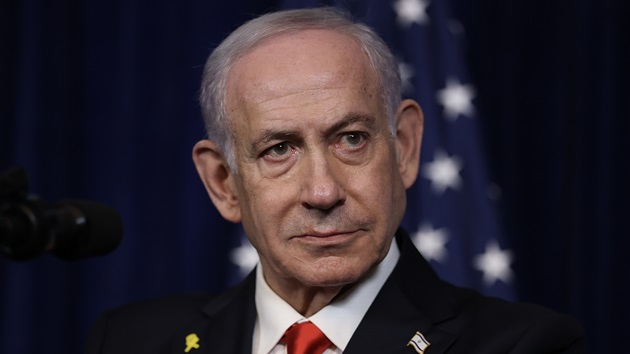
Israeli Prime Minister Benjamin Netanyahu holds a press conference with U.S. President Donald Trump at Mar-a-Lago on December 29, 2025 in Palm Beach, Florida. Joe Raedle/Getty Images
(LONDON and TEL AVIV) — The Israeli government adopted a series of significant, bureaucratically complex measures that would allow Israelis and Jews abroad to more easily purchase and build on contested land in the West Bank, consolidating Israeli control in the area that would potentially serve as the heartland for a future Palestinian state.
The measures, which were approved over the weekend, are likely to be challenged in the Israeli Supreme Court. But they represent the most far-reaching attempts by Prime Minister Benjamin Netanyahu’s right-wing government to advance a de-facto annexation of the West Bank.
The Palestinian Authority, the governing body for Palestinians that already has only limited powers in the West Bank, described the moves as an “unprecedented escalation” and “illegal,” views echoed by regional Arab states.
U.S. President Donald Trump has previously said the U.S. opposes attempts by Israel to annex the West Bank, a long-held dream of some settler groups and far-right ministers who now hold powerful positions in Netanyahu’s government.
The newly adopted measures are expected to deepen Israeli civil — as opposed to military — control of new areas within the West Bank, including key religious sites in Hebron, and are designed to make it easier for Israelis to buy land in the territory.
Israel’s Security Cabinet, headed by Netanyahu, approved on Sunday a series of new measures that would lift a ban on the sale of land to private Israeli Jews, transfer construction authority at religious and sensitive sites in the city of Hebron to the Israeli government, and declassify land registry records.
The United Nations condemned the measures, with a spokesperson for the secretary-general saying in a statement that “all Israeli settlements in the occupied West Bank, including East Jerusalem, and their associated regime and infrastructure, have no legal validity and are in flagrant violation of international law, including relevant United Nations resolutions.”
The measures would allow the Israeli government to operate under the guise of civilian issues in Palestinian areas A and B for the first time, which contravenes the Oslo Accords. Under the Oslo Accords, the Palestinian Authority is the sole authority responsible for civilian matters in Area A and B. Israel, in contrast, has full Israeli civil and security control over Area C, which represents about 60% of the West Bank.
Bezalel Smotrich, Israel’s far-right, pro-settlement finance minister, hailed the move as an “historic day for settlement for Judea and Samaria,” as parts of the West Bank are known in Hebrew.
He said the changes would “fundamentally change the legal and civil reality.” He boasted that it would end the prospects for a potential Palestinian State.
Netanyahu has vowed that a Palestinian state “will not be established,” even as Western countries, including France, Canada and the United Kingdom, have moved to recognize a Palestinian state.
The office of the Mahmoud Abbas, the president of the Palestinian Authority, issued a statement condemning the measures as “dangerous decisions” designed to “deepen attempts to annex the occupied West Bank.”
The president’s office said the move was a “blatant violation” of the Oslo Accords, which divided the West Bank into Areas A, B and C, adding that the move represents an “unprecedented escalation targeting the Palestinian presence and its national and historical rights throughout the Palestinian territory.”
Abbas’ office described the move as illegal and called for the U.S. and the European Union to intervene.
A joint statement by the foreign ministers of eight Muslim countries condemned the new measures.
The foreign ministers of Saudi Arabia, Jordan, Qatar, Indonesia, Egypt, Turkey, Pakistan and the United Arab Emirates said in a statement posted on social media that they collectively “condemned in the strongest terms the illegal Israeli decisions and measures aimed at imposing unlawful Israeli sovereignty, entrenching settlement activity, and enforcing a new legal and administrative reality in the occupied West Bank, thereby accelerating attempts at its illegal annexation and the displacement of the Palestinian people.”
“They reaffirmed that Israel has no sovereignty over the occupied Palestinian territories,” the statement added.
According to Peace Now, an Israeli settlement watchdog and activist nongovernmental organization, the measures adopted over the weekend would effectively mean that Israeli authorities can now carry out legal demolitions of Palestinian property in Areas A and B, which comprise around 40% of the West Bank and which under the Oslo accords have been governed by the Palestinian Authority.
While the Israeli military could operate in those areas as the occupying power, the “government is now seeking to ignore its international commitments and begin administrative operations inside areas of the Palestinian Authority. Under the Oslo Accords, Israel has operated militarily in PA areas since the early 2000s,” the watchdog said.
Israeli Prime Minister Benjamin Netanyahu holds a press conference with U.S. President Donald Trump at Mar-a-Lago on December 29, 2025 in Palm Beach, Florida. Joe Raedle/Getty Images
(LONDON and TEL AVIV) — The Israeli government adopted a series of significant, bureaucratically complex measures that would allow Israelis and Jews abroad to more easily purchase and build on contested land in the West Bank, consolidating Israeli control in the area that would potentially serve as the heartland for a future Palestinian state.
The measures, which were approved over the weekend, are likely to be challenged in the Israeli Supreme Court. But they represent the most far-reaching attempts by Prime Minister Benjamin Netanyahu’s right-wing government to advance a de-facto annexation of the West Bank.
The Palestinian Authority, the governing body for Palestinians that already has only limited powers in the West Bank, described the moves as an “unprecedented escalation” and “illegal,” views echoed by regional Arab states.
U.S. President Donald Trump has previously said the U.S. opposes attempts by Israel to annex the West Bank, a long-held dream of some settler groups and far-right ministers who now hold powerful positions in Netanyahu’s government.
The newly adopted measures are expected to deepen Israeli civil — as opposed to military — control of new areas within the West Bank, including key religious sites in Hebron, and are designed to make it easier for Israelis to buy land in the territory.
Israel’s Security Cabinet, headed by Netanyahu, approved on Sunday a series of new measures that would lift a ban on the sale of land to private Israeli Jews, transfer construction authority at religious and sensitive sites in the city of Hebron to the Israeli government, and declassify land registry records.
The United Nations condemned the measures, with a spokesperson for the secretary-general saying in a statement that “all Israeli settlements in the occupied West Bank, including East Jerusalem, and their associated regime and infrastructure, have no legal validity and are in flagrant violation of international law, including relevant United Nations resolutions.”
The measures would allow the Israeli government to operate under the guise of civilian issues in Palestinian areas A and B for the first time, which contravenes the Oslo Accords. Under the Oslo Accords, the Palestinian Authority is the sole authority responsible for civilian matters in Area A and B. Israel, in contrast, has full Israeli civil and security control over Area C, which represents about 60% of the West Bank.
Bezalel Smotrich, Israel’s far-right, pro-settlement finance minister, hailed the move as an “historic day for settlement for Judea and Samaria,” as parts of the West Bank are known in Hebrew.
He said the changes would “fundamentally change the legal and civil reality.” He boasted that it would end the prospects for a potential Palestinian State.
Netanyahu has vowed that a Palestinian state “will not be established,” even as Western countries, including France, Canada and the United Kingdom, have moved to recognize a Palestinian state.
The office of the Mahmoud Abbas, the president of the Palestinian Authority, issued a statement condemning the measures as “dangerous decisions” designed to “deepen attempts to annex the occupied West Bank.”
The president’s office said the move was a “blatant violation” of the Oslo Accords, which divided the West Bank into Areas A, B and C, adding that the move represents an “unprecedented escalation targeting the Palestinian presence and its national and historical rights throughout the Palestinian territory.”
Abbas’ office described the move as illegal and called for the U.S. and the European Union to intervene.
A joint statement by the foreign ministers of eight Muslim countries condemned the new measures.
The foreign ministers of Saudi Arabia, Jordan, Qatar, Indonesia, Egypt, Turkey, Pakistan and the United Arab Emirates said in a statement posted on social media that they collectively “condemned in the strongest terms the illegal Israeli decisions and measures aimed at imposing unlawful Israeli sovereignty, entrenching settlement activity, and enforcing a new legal and administrative reality in the occupied West Bank, thereby accelerating attempts at its illegal annexation and the displacement of the Palestinian people.”
“They reaffirmed that Israel has no sovereignty over the occupied Palestinian territories,” the statement added.
According to Peace Now, an Israeli settlement watchdog and activist nongovernmental organization, the measures adopted over the weekend would effectively mean that Israeli authorities can now carry out legal demolitions of Palestinian property in Areas A and B, which comprise around 40% of the West Bank and which under the Oslo accords have been governed by the Palestinian Authority.
While the Israeli military could operate in those areas as the occupying power, the “government is now seeking to ignore its international commitments and begin administrative operations inside areas of the Palestinian Authority. Under the Oslo Accords, Israel has operated militarily in PA areas since the early 2000s,” the watchdog said.
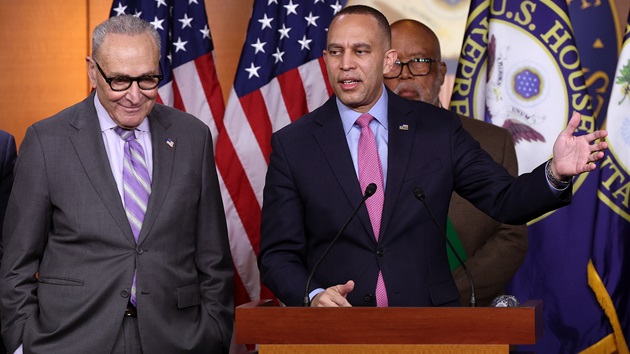
U.S. House Minority Leader Hakeem Jeffries (D-NY) (R) and Senate Minority Leader Chuck Schumer (D-NY) hold a press conference on Department of Homeland Security (DHS) funding at the U.S. Capitol on February 04, 2026 in Washington, DC. Kevin Dietsch/Getty Images
(WASHINGTON) — With just a few days until a Friday deadline to fund the Department of Homeland Security, Republican and Democratic lawmakers still appear to be at an impasse on how to move forward with Democrats’ demands for new restrictions on President Donald Trump’s immigration crackdown.
Senate Minority Leader Chuck Schumer said Democrats delivered proposed legislative text that reflects their 10-item list of demands to Republican leadership over the weekend. The GOP presented a counterproposal, which Schumer and House Minority Leader Hakeem Jeffries said they rejected Monday night.
Details of the GOP counteroffer have not been made public, but according to Democrats, it didn’t include “details” or “legislative text.”
“The initial GOP response is both incomplete and insufficient in terms of addressing the concerns Americans have about ICE’s lawless conduct. Democrats await additional detail and text,” Schumer and Jeffries said in the statement.
Senate Majority Leader John Thune would not provide details on the GOP offer when asked by reporters on Tuesday.
“I think both sides are right now trying — other than it sounds like the Democrats up here are talking about it — are trying to keep the conversations moving forward and not litigating that in public,” Thune said.
The negotiations are coming as another partial government shutdown looms. If a DHS funding solution is not reached and passed in both chambers by the end of the day Friday, DHS would then shut down.
The TSA, Coast Guard, Customs and Border Protection, U.S. Secret Service, CISA and FEMA would be impacted even though lawmakers’ focus is on Immigration and Customs Enforcement reform. ICE operations would not be impacted after it received $75 billion in separate funding from the already-passed “Big Beautiful Bill.”
In a letter last week to Republican leaders, Jeffries and Schumer laid out 10 key demands from Democrats on DHS funding, including calling for judicial warrants before agents can enter private property, a ban on ICE agents wearing face masks, requiring the use of body cameras and new laws for use-of-force standards.
Schumer has called Democrats’ demands “exceedingly reasonable.”
“We are asking ICE to do nothing more than follow the standards that the vast majority of law enforcement agencies already follow. Why should ICE be different, especially when they have such a record of brutality?” Schumer said.
The funding fight over DHS erupted in the aftermath of the death of Alex Pretti, an ICU nurse, who was killed in a shooting involving federal law enforcement in Minneapolis on Jan. 24. Renee Good, a mother of three, was fatally shot by ICE agents in Minneapolis on Jan. 7.
Earlier Monday, Thune said on the Senate floor that Democrats engaged in “meaningful talks” with the White House on a path forward for funding DHS over the weekend.
“Democrats have made their demands known in detail. Some of them are positive starting points for further discussions; others are non-staters and unnecessarily tie the hands of law enforcement,” Thune said on the Senate floor.
But Thune said Republicans, in conjunction with the White House, will seek demands of their own.
“I expect that the Trump administration, with the full backing of congressional Republicans, will continue to resist any effort to make it harder for law enforcement to detain and deport dangerous illegal aliens, which is what many of the Democrats demands would do, and I expect that the administration — again with the backing of Republicans here in Congress — will insist on reforms of its own,” Thune said.
As negotiations continue behind the scenes, Thune said on Monday that lawmakers will likely need more time to complete their work. He urged Democrats to support a stopgap funding proposal to keep the lights on at DHS while they continue discussions on ICE reform.
“We are just a few days away from the deadline that Democrats chose,” Thune said. “And it’s very possible we won’t have our work finished by then. If Democrats are serious about finding a solution there, they may need to find more time to bring these efforts to a productive conclusion.”
In these images released by the Sumter County Sheriff’s Office, Kentravious Holmes, 21, and Rickey Martin, 20, are shown. The two inmates escaped custody from the Sumter County Jail. Sumter County Sheriff’s Office
(SUMTER COUNTY, Ga.) — Authorities are continuing the search for two murder suspects who escaped from a Georgia jail on Sunday.
Rickey Martin, 20, and Kentravious Holmes, 21, escaped Sumter County Jail at around 9:30 p.m. on Sunday, according to the sheriff’s office.
The two inmates were also in custody on charges including aggravated assault and aggravated battery, according to the Sumter County Sheriff’s Office.
Martin is 5 foot 4 inches and weighs 120 pounds. He is a Black male with un-twisted dreads, according to the sheriff’s office.
Holmes is 5 foot 8 inches in height and weighs 155 pounds. Holmes is a Black male with un-twisted dreads and multiple tattoos on his face and neck, including a “$” sign, a broken heart and “Baby Kay” over his right eye, according to the sheriff’s office.
Anyone who sees either individual or has any information on their whereabouts, is asked to call 911 or the Sheriff’s Office directly at 229-924-4094.
(NEW YORK) — U.S. Southern Command announced on Monday that its forces conducted a new airstrike against an alleged drug smuggling boat in the Eastern Pacific, killing two people aboard and leaving one survivor.
SOUTHCOM said in a statement posted to X that it “immediately notified U.S. Coast Guard to activate the Search and Rescue system for the survivor.”
The statement was accompanied by video of the strike.
“Intelligence confirmed the vessel was transiting along known narco-trafficking routes in the Eastern Pacific and was engaged in narco-trafficking operations,” SOUTHCOM said, noting that the strike was launched at the direction of commander Gen. Francis L. Donovan.
Monday’s operation is the 38th airstrike conducted by U.S. forces since Sept. 2. The killings bring to 130 the number of people killed in these strikes.
(NEW YORK) — U.S. Southern Command announced on Monday that its forces conducted a new airstrike against an alleged drug smuggling boat in the Eastern Pacific, killing two people aboard and leaving one survivor.
SOUTHCOM said in a statement posted to X that it “immediately notified U.S. Coast Guard to activate the Search and Rescue system for the survivor.”
The statement was accompanied by video of the strike.
“Intelligence confirmed the vessel was transiting along known narco-trafficking routes in the Eastern Pacific and was engaged in narco-trafficking operations,” SOUTHCOM said, noting that the strike was launched at the direction of commander Gen. Francis L. Donovan.
Monday’s operation is the 38th airstrike conducted by U.S. forces since Sept. 2. The killings bring to 130 the number of people killed in these strikes.
Large areas of Lviv are facing emergency blackouts following targeted Russian attacks on Ukraine’s energy infrastructure. (Mykola Tys/Global Images Ukraine via Getty Images)
(LONDON) — Governors of two Russian regions bordering Ukraine said Tuesday that residents are facing sustained power outages as a result of Ukrainian attacks on energy infrastructure, as both sides continue long-range strikes in the run-up to the fourth anniversary of Moscow’s full-scale invasion of its neighbor.
Vyacheslav Gladkov, the governor of Russia’s western Belgorod region said in posts to Telegram that power and heating outages had forced hundreds of people to rely on “heating points.”
“Unfortunately, rolling blackouts are inevitable,” Gladkov said, noting that Belgorod city will be among the areas subject to unpredictable outages.
Gov. Alexander Khinshtein of the neighboring Kursk region said that 28,000 customers were without power as a result of “another series of cowardly attacks on our territory.”
Both regions have been subject to regular Ukrainian drone, missile and artillery attacks. Both have also seen Ukrainian ground incursions during the nearly 4-year-old war.
Recent months have seen both Russia and Ukraine focus attacks on energy infrastructure targets. In Ukraine, millions have faced rolling outages as a result of months of Russian missile and drone strikes on energy targets all across the country. Moscow, Kyiv has said, is trying to freeze Ukrainians into submission.
The Kremlin, meanwhile, has framed long-range Ukrainian strikes as “terrorist attacks.”
Zelenskyy on Sunday defended Ukraine’s retaliatory attacks inside Russia, describing the Russian energy sector as “a legitimate target.”
“We do not have to choose whether we strike a military target or energy,” Zelenskyy said while addressing students at the National Aviation University in Kyiv. “He sells this energy. He sells oil. So is it energy, or is it a military target? Honestly, it’s the same thing. He sells oil, takes the money, invests it in weapons. And with those weapons, he kills Ukrainians.”
Zelenskyy said that left Ukraine with two options: “We either build weapons and strike their weapons. Or we strike the source where their money is generated and multiplied. And that source is their energy sector. That is what is happening. All of this is a legitimate target for us.”
The nightly exchange of drones continued on Monday night.
Ukraine’s air force said Russia launched 125 drones into the country overnight, of which 110 were shot down or suppressed. Thirteen drones impacted across six locations, the air force said in a post to Telegram.
Vadym Filashkin, the governor of Ukraine’s eastern Donetsk region, said in a post to social media that two people were killed and seven people injured by a Russian strike in the city of Slovyansk, close to the front line.
At least four people were injured by a drone strike on a house in the southern city of Zaporizhzhia, Ukraine’s Interior Ministry said. Among the injured was a 1-year-old child, the ministry said.
Oleh Kiper, the governor of the southern Odesa region, said in a post to Telegram that Russian drones attacked energy infrastructure overnight, leaving at least three communities partially without power.
The Russian Defense Ministry, meanwhile, said its forces shot down at least six Ukrainian drones overnight into Tuesday morning.
Russia’s federal air transport agency, Rosaviatsiya, said that temporary flight restrictions were introduced at airports in the Black Sea city of Gelendzhik and in the western city of Kaluga.
Peace maneuvers are ongoing against the backdrop of long-range strikes and Russia’s attritional offensive operations in eastern Ukraine.
Zelenskyy said in a post to social media on Monday night that proposed post-war Western security guarantees intended to protect Ukraine from repeated Russian aggression are “ready.”
“There is no alternative to security. There is no alternative to peace. There is no alternative to rebuilding our country,” Zelenskyy said.
The Ukrainian president also said there will be “significant international events this week — on defense and security.”
“Our negotiating team is working every single day on the documents and proposals that could deliver results at the upcoming meetings,” Zelenskyy said.
“Most importantly, our partners must be aligned the same way we are in Ukraine: peace is needed, and reliable security guarantees are the only real foundation for peace and for preventing the Russians from breaking agreements through strikes or hybrid operation of some kind,” he added.
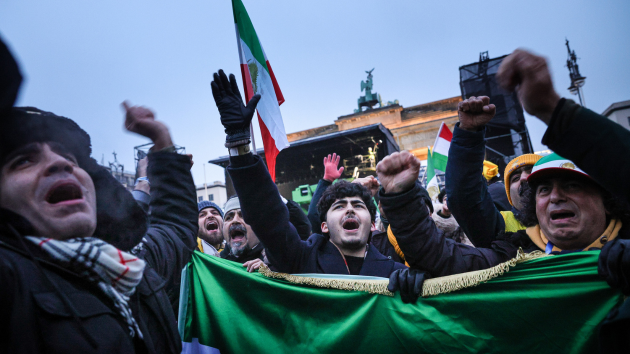
Thousands of people protest in Berlin, Germany for the overthrow of the current Iranian regime and the creation of a democratic government in Iran on February 7, 2026. (Omer Messinger/Getty Images)
(LONDON) — One month after Iran was rocked by the beginning of the deadliest crackdown in its modern history, the full toll of the regime’s response to nationwide protests is still coming into focus.
On Jan. 8 and 9, Iranian security forces launched what activists describe as the most brutal assault yet on citizens who had poured into streets across the country, chanting for regime change.
While international media coverage has gradually shifted toward renewed negotiations between the United States and the Islamic Republic over Tehran’s nuclear program, human rights groups and Iranians inside and outside the country warn that repression on the ground has intensified. They describe an atmosphere of fear, torture, and systemic violence ruling the country.
As of Monday, more than 6,400 protesters have been killed and over 51,500 arrested on charges linked to the demonstrations, according to the U.S.-based Human Rights Activists News Agency (HRANA). Over 11,000 more related deaths remain under review. ABC News cannot independently verify these numbers.
Farsi-language social media remains flooded with images of the dead, missing and detained. Videos show families grieving loved ones killed in the streets, while others are pleas from relatives searching for missing family members in morgues and prisons, or seeking legal support for those behind bars.
Many wounded protesters still seek medical advice from doctors on social media on how to treat their injuries at home, because they fear getting arrested in hospitals by regime forces, who closely monitor hospitals in order to track wounded protesters. An Iranian lawyer told ABC News last week that several of doctors who provided home treatment to wounded protesters have been arrested.
The volume of such social media posts has shown no sign of slowing.
200 students were killed The Coordinating Council of Iranian Teachers’ Trade Associations (CCITTA) published the names on Sunday of 200 students they said are confirmed killed during the protests.
“Each name carries a wish with it: I wish he were alive; I wish his school was still waiting for him,” CCITTA said in a statement on X, adding that “the empty benches are not just a sign of absence; they are a reminder of a crime that has reached the classroom.”
Mounting concerns over detainees Over the weekend, in a post on X, the Hengaw human rights organization warned of widespread sexual violence during this wave of arrests, citing interviews with former detainees. Hengaw described the mental condition of those still in custody as “dire,” because of the torture during detention.
Among those arrested is Iranian journalist and activist Vida Rabbani, who was detained after signing a joint statement declaring the downfall of the Islamic Republic “inevitable.” Her husband says she has been tortured after her arrest.
“There were many obvious bruises on Vida’s body. She had been severely beaten,” Hamidreza Amiri wrote on Instagram this weekend after visiting her in prison.
He said that when Rabbani refused to wear the compulsory hijab in prison, guards pulled out her hair.
“The artist girl had made a bracelet from a handful of her own hair,” he wrote. “The bracelet, next to the bruises on her hand, created a strange and deeply moving scene.”
Activists warn that if such abuse is inflicted on high-profile figures with media visibility, the treatment of ordinary protesters whose cases often go unreported may be far worse.
Waves of forced confessions According to HRANA, at least 331 forced confessions related to the protests have been broadcast so far.
One recent case involves Mohammad Ali Saedinia, a prominent business owner who had supported the protests by closing all branches of his well-known confectionery chain nationwide and joining strike actions.
On Monday, state-affiliated Fars News published a scanned letter allegedly signed by Saedinia, calling his decision to shut down his stores in January a “mistake,” condemning Israel and the U.S., and apologizing to the Iranian people. Earlier this month, the judiciary’s spokesperson confirmed Saedinia’s arrest, and that his properties were ordered seized by the Iranian regime.
Arrests of reformist figures The Iranian regime also arrested several prominent reformist figures on Monday, according to Fars News, after they allegedly criticized the authorities’ handling of the protests. They face charges including “attacking national unity” and “coordinating with enemy propaganda,” according to Fars News.
Speaking anonymously for security reasons, an Iranian analyst told ABC News on Monday that the arrests are “significant,” since the Trump administration might be weighing the possibility of engaging with some insiders of the Iranian government if the regime collapses.
The analyst added that the move could be hardliners aligned with Iranian Supreme Leader Ayatollah Ali Khamenei tightening their grip on power, given the uncertainty of the future of the ongoing negotiations with the U.S.
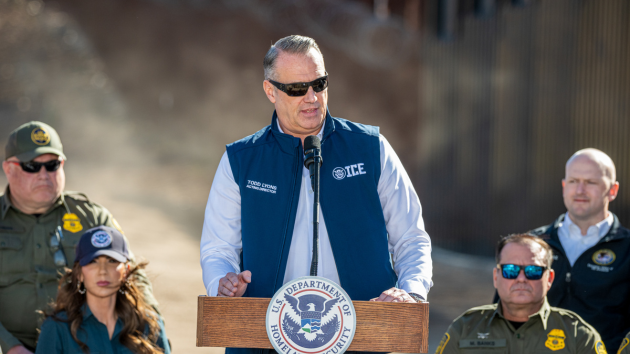
Todd Lyons, acting director of US Immigration and Customs Enforcement (ICE), speaks during a news conference in Nogales, Arizona, US, on Wednesday, Feb. 4, 2026. (Ash Ponders/Bloomberg via Getty Images)
(WASHINGTON) — Amid a funding fight on Capitol Hill and polls showing more than 60% of Americans disapproving of how U.S. Immigration and Customs Enforcement (ICE) is enforcing immigration laws, senior immigration officials will testify Tuesday before the House Department of Homeland Security Committee.
Acting ICE Director Todd Lyons, Customs and Border Protection (CPB) Commissioner Rodney Scott are to appear in the first of two hearings on oversight of the two agencies. Joseph Edlow, director of U.S. Citizenship and Immigration Services (USCIS) is also expected to appear.
The three are scheduled to testify before the Senate Homeland Security and Governmental Affairs Committee on Thursday.
Tuesday’s testimony will be their first since two fatal shootings of U.S. citizens by federal law enforcement officers in Minneapolis and since the partial drawdown of federal officers from Minnesota.
“In order to get [Department of Homeland Security funding] done, I think we need to get some questions asked and make everybody feel comfortable about what ICE, USCIS, and CBP are doing, what their goals are, and what they’re trying to accomplish,” House Homeland Security Chairman Andrew Garbarino, R-N.Y. said on the “Julie Mason Show” over the weekend. “I think having these directors there will give them the opportunity to talk about the training that their officers receive. There was a huge investment to hire more ICE and CBP officers that came through the One Big Beautiful Bill. It’s going to be good to have these directors giving answers and setting the record straight.”
Democrats have been calling for more accountability for ICE and CBP. They have also called on Department of Homeland Secretary Kristi Noem, who oversees the immigration agencies, to resign, which she has said she will not.
In a statement released Monday, Rep. Bennie Thompson, the ranking Democrat on the committee, said the hearing “is going to be just the start of a reckoning for the Trump administration and its weaponization of government against our country.”
“Donald Trump and Kristi Noem must be held accountable for the immigration operations creating chaos in our communities, terrorizing people, and hurting U.S. citizens and immigrants alike,” he continued. “I hope my Republican colleagues will remember that our job is to conduct oversight, not cover for Donald Trump and his out-of-control administration, which is running roughshod over Americans’ rights, killing U.S. citizens, and threatening our very democracy.”
Polls show Americans disapprove of how the agencies are conducting President Donald Trump’s immigration enforcement operation.
A Quinnipiac poll released earlier this month found that 63% of voters disapprove of the way ICE is enforcing immigration laws and 34% approve — a lower rating than the agency received in a January Quinnipiac poll, when 57% disapproved and 40% approved.
And an Ipsos poll from early February found that 62% of Americans said efforts by ICE officers to deal with unauthorized immigration goes “too far.” That is up slightly from 58% who said the same in a Reuters/Ipsos poll conducted the week before. The share of Republicans saying ICE efforts go too far was up 10 points, from 20% to 30%.
Funding for DHS is set to expire on Friday if there is no deal on DHS reforms Democrats want passed for CBP and ICE.
In a letter last week to Republican leaders, House Minority Leader Hakeem Jeffries and Senate Minority Leader Chuck Schumer laid out 10 key demands from Democrats on DHS funding, including calling for judicial warrants before agents can enter private property, a ban on ICE agents wearing face masks, requiring the use of body cameras and new laws for use-of-force standards.
Republican Sen. Katie Britt, who has been deputized by leadership to lead talks on behalf of Senate Republicans, ripped into the Democrats’ proposal in a post on X last week.
“Democrats’ newest proposal is a ridiculous Christmas list of demands for the press,” Britt said. “This is NOT negotiating in good faith, and it’s NOT what the American people want. They continue to play politics to their radical base at the expense of the safety of Americans.”
Senate Majority Leader John Thune told reporters Monday evening that Republicans are preparing a counteroffer to Democrats’ proposal that could be made available soon.