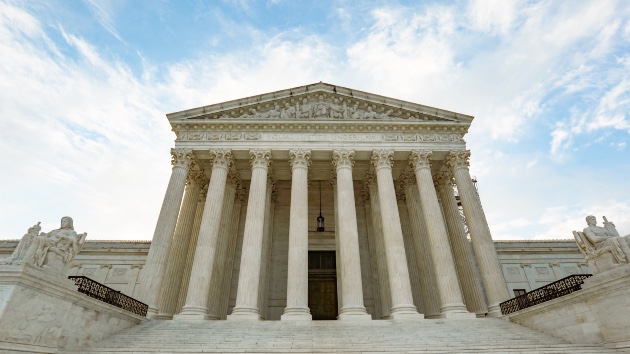
(WASHINGTON) — The Supreme Court on Tuesday rejected President Donald Trump’s attempt to end birthright citizenship in the U.S. by executive order, reaffirming in a 6-3 ruling more than a century of legal precedent and national tradition that babies born on American soil are automatically American citizens.
The decision is a blow to Trump, who had lobbied the court to uphold his Day 1 order and attended oral arguments in the case, becoming the first sitting president to do so.
Trump had argued that children born to unlawful immigrants and temporary visitors, like tourists and foreign students, do not qualify for citizenship under terms of the 14th Amendment, which was enacted after the Civil War to address the status of former slaves and their descendants.
Immigrant advocates and civil liberties groups opposing the policy change warned that it would harm hundreds of thousands of children born every year to non-citizen parents and create a bureaucratic nightmare for older Americans, who would no longer be able to prove citizenship simply with a birth certificate.
An estimated 255,000 children born every year to non-citizen parents would have lost legal status under the order, according to the Migration Policy Institute. Some may have faced difficulty establishing citizenship in any country, effectively being born as “stateless.”
Every lower court to have considered Trump’s unprecedented order deemed it unlawful, issuing injunctions to put it on hold. The high court’s decision preserves the status quo.
The 14th Amendment, which was ratified in 1868, says all “persons born or naturalized in the U.S. and subject to the jurisdiction thereof” are citizens. Congress later codified the same language in federal citizenship law in 1940.
The administration insisted children born to parents who are not American citizens or legal permanent residents are not “subject to the jurisdiction” of the U.S. because they still owe political “allegiance” to a foreign nation.
The Supreme Court previously rejected that argument in 1898.
“The [14th] Amendment, in clear words and in manifest intent, includes the children born, within the territory of the United States, of all other persons, of whatever race or color, domiciled within the United States,” wrote Justice Horace Gray in the landmark Wong Kim Ark v. U.S. decision, addressing the status of children born to noncitizens.
This is a developing story. Please check back for updates.
The U.S Supreme Court is seen on June 25, 2026 in Washington, DC. . (Photo by Kevin Dietsch/Getty Images)
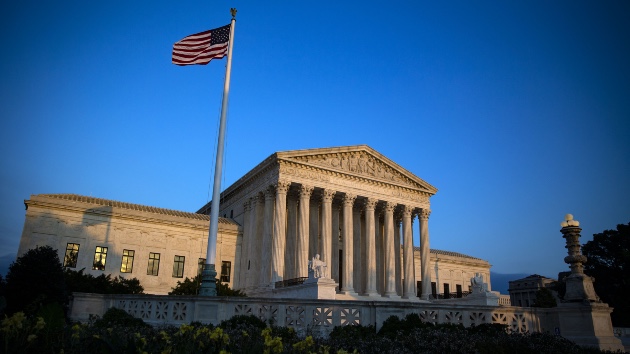
(WASHINGTON) — The Supreme Court on Tuesday rolled back longstanding limits on the amount of money political parties can spend in coordination with individual candidates for federal office — a ruling that could unleash a wave of new spending before the midterms. The Supreme Court said the spending limits violate the First Amendment.
This is a developing story. Please check back for updates.
The U.S. Supreme Court building stands in Washington, D.C., U.S. Photographer: Al Drago/Bloomberg
(WASHINGTON) — The Supreme Court on Tuesday upheld state bans on transgender girls from participating in girls’ and women’s competitive sports, reversing a pair of lower court decisions that had blocked the bans as violations of Title IX and the 14th Amendment.
The 6-3 decision came from Justice Brett Kavanaugh.
The ruling in a pair of cases from West Virginia and Idaho effectively upholds laws in those two states, plus 27 others that block trans girls from teams consistent with their gender identity.
The decision marks the first time the high court has weighed in on the heated national debate over transgender athletes.
The court’s ruling is a major setback for the estimated 122,000 transgender American teenagers who participate in high school sports, according to the Williams Institute at UCLA.
For trans teens and their families, the dispute has involved a matter of immutable identity and equal opportunity.
For many states and top U.S. athletic organizations, including the U.S. Olympic Committee and NCAA, the inclusion of trans athletes has been seen as creating an unfair and unsafe playing field.
The competitive advantage boys and men have physically over girls and women has been well established in physically demanding sports by medical research and serves as a primary basis for distinctions between the sexes in athletics.
Studies have shown testosterone produced during male puberty does lead to more muscle mass, larger hearts and lungs, greater body height and longer limbs on average for boys and men, according to the American College of Sports Medicine.
Many transgender teens who have received gender-affirming medical treatment from a young age argue that they lack any physiological advantage because they have not undergone male puberty.
Twenty-one states allow transgender girls to compete on girls’ sports teams, including California and New York, which have laws explicitly protecting the right of trans girls to play.
Becky Pepper Jackson, the only known openly transgender athlete in West Virginia in any sport, sued her state in a bid to continue competing on her high school track team where she throws discus and shot put. Jackson recently won the state championship in girls shot put.
“I’ve been a girl forever, and playing on the guys’ team is going backwards,” she told ABC News in an interview last year.
When West Virginia’s law takes effect, she will no longer be allowed to participate in girls competitive sports leagues. Competing with boys, she said, would “go against who I am.”
Becky, who has openly identified as a girl since third grade, said she has never undergone male puberty, thanks to puberty-blocking medication.
Idaho college student Lindsay Hecox, a former track and cross-country runner who was barred from trying out for her school teams, sued over her state’s ban in 2020. Last year, she asked the Supreme Court to drop her case because she no longer wished to compete in sports and didn’t want to be in the spotlight. However, Idaho fought to keep the case alive.
Lower courts concluded separately that the state bans discriminate “on the basis of sex” in violation of Title IX, the landmark civil rights law that has promoted equal opportunities for women and girls in athletics, and the Constitution’s Equal Protection Clause.
The Supreme Court’s conservative majority reversed those decisions and reinstated the laws.
Last year, the same majority upheld a Tennessee law banning some gender-affirming medical treatments for transgender minors, rejecting claims that the law discriminated “on the basis of sex” and saying that states should have leeway to regulate health care in an area of scientific uncertainty.
In 2020, however, the high court concluded in a landmark decision that a Michigan transgender woman fired by her employer for being transgender was discriminated against “on the basis of sex” under Title VII of the Civil Rights Act of 1964.
Justice Neil Gorsuch explained in his majority opinion at the time that her termination was “for traits or actions it would not have questioned in members of a different sex.”
Sixty-nine percent of Americans believe transgender girls should only be allowed to play on boys’ teams, consistent with their gender assigned at birth, according to a June 2025 Gallup survey.
This is a developing story. Please check back for updates.
Ukrainian President Volodymyr Zelensky during a meeting with British Prime Minister Keir Starmer on the sidelines of the G7 summit on June 16, 2026 in Evian-les-Bains, France. (Photo by Isabel Infantes – Pool/Getty Images)
(LONDON) — Ukraine struck a satellite communications center in the Moscow region in an aerial attack on Tuesday, Kyiv said, as Moscow claimed to have shot down hundreds of drones launched into its territory overnight.
Ukrainian President Volodymry Zelenskyy said Ukraine struck the site, the “Dubna” space communications center, for the second time.
“This is a specialized satellite communications facility used, among other things, for intelligence gathering and coordinating the activities of Russia’s occupying forces in Ukraine,” Zelenskyy said on social media on Tuesday.
Russia’s Ministry of Defense said in a morning update on its official Russian-language Telegram channel that air defense systems had intercepted and destroyed at least 419 Ukrainian drones since late Monday evening.
Those drones were shot down in at least 16 regions, including Moscow, along with Russian-occupied areas in Crimea, the ministry said.
Sergey Sobyanin, the mayor of Moscow, said early on Tuesday that at least 61 Ukrainian drones had been shot down in the capital region overnight.
Zelenskyy in announcing the Ukrainian strike on the satellite communications center noted that the facility was more than 500 km, or about 310 miles, from the Ukrainian-Russian boarder.
“Recently, our Defense Forces of Ukraine already reached four such Russian centers, not only in the Moscow region but also in the Vladimir region,” he said on social media.
He added, “Step by step, we are implementing our plan of long-range sanctions and making it as difficult as possible for the aggressor state to carry out its invasion operations against Ukraine and the occupation of our territories.”
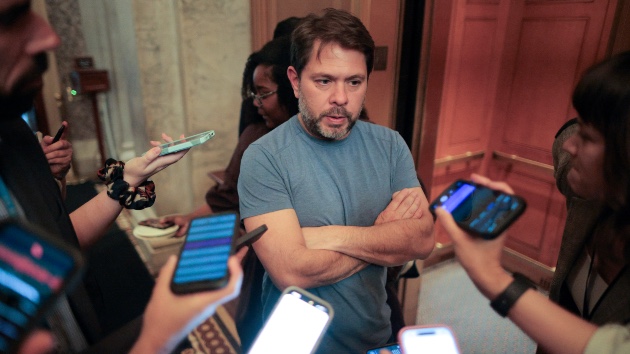
Sen. Ruben Gallego (D-AZ) talks to reporters as he heads for a vote at the U.S. Capitol on June 01, 2026 in Washington, DC. (Photo by Chip Somodevilla/Getty Images)
(WASHINGTON) — Arizona Sen. Ruben Gallego is under federal investigation for suspected campaign finance violations, a person familiar with the matter confirmed to ABC News.
According to multiple reports, Gallego, a Democrat, used campaign funds to fly his family to the Caribbean, Miami, Nantucket and Puerto Rico. He also allegedly used funds to pay for childcare.
Campaign funds may be used to pay for a candidate’s childcare expenses that are incurred as a direct result of campaign activities, according to the Federal Election Commission.
On Monday, the Senate Ethics Committee closed its inquiry into allegations of sexual misconduct and campaign finance violations after finding no evidence that Gallego violated Senate rules or applicable law, according to a letter released by his office.
In regards to the federal investigation, a Gallego spokesperson told Axios that “it’s the least surprising news of the week that this comes immediately after the Senate Ethics Committee cleared Senator Gallego of right-wing smears pushed by the administration.”
ABC News has reached out to Gallego’s office for comment on the investigation. The Department of Justice has not yet commented on the probe.
Doug Band, a former adviser to Bill Clinton, is seen with Ghislaine Maxwell in this undated photo. (U.S. Justice Department)
(WASHINGTON) — Doug Band, a former close adviser to President Bill Clinton, is due on Capitol Hill Tuesday morning for a closed-door interview with the congressional committee probing the government’s investigation of convicted sex offender Jeffrey Epstein.
Band, who began his tenure with Clinton as an intern in the mid-1990s, is expected to be questioned by the House Oversight Committee about the former president’s interactions and travels with Epstein in the years after Clinton left the Oval Office in 2001.
Often described as one of the architects of Clinton’s post-presidential endeavors, including the Clinton Foundation and the Clinton Global Initiative, Band can also expect to be pressed about his own communications with Epstein’s convicted co-conspirator, Ghislaine Maxwell, which were made public earlier this year by the Justice Department as part of the release of files mandated by the Epstein Files Transparency Act.
Emails between Band and Maxwell included talk of meetings with Epstein and numerous exchanges containing suggestive innuendo and cheeky nicknames for each other like “babycakes” and “booboo,” according to the DOJ records.
The bulk of the messages were exchanged between 2001-2004, before Epstein first faced criminal charges in Florida in 2006.
Band, 54, has not been accused of any wrongdoing. An attorney expected to accompany Band to the interview did not reply to a message seeking comment in advance of Band’s appearance in Washington, D.C.
Earlier this year, Band told The New York Times that his messages with Maxwell occurred when he was in his 20s and unmarried — and he denied any romantic involvement with Maxwell, who is currently serving a 20-year sentence for sex-trafficking and other offenses.
“There was absolutely no physical relationship that occurred between us. Ever,” Band said in a statement to the Times, in which he referred to Maxwell as “a monster.”
The committee is also expected to query Band about his explosive claim — reported by Vanity Fair in 2020 — that the former president had visited Epstein’s private estate in the U.S. Virgin Islands in early 2003. The article, which centered on Band’s contentious split with the Clintons, did not detail how Band knew about the purported island trip or if he had any evidence to bolster his claim.
Records created by Epstein’s pilots made public through civil litigation show Clinton — and an entourage that typically included Band — aboard Epstein’s plane on more than two dozen flight legs in 2002-03, but none of those flights went to the island, according to the pilot’s logs. Clinton, Epstein and Maxwell have all denied that the former president had ever been to Little St. James, as Epstein’s island was known.
“He never, absolutely never went. And I can be sure of that because there’s no way he would have gone,” Maxwell told then then-Deputy Attorney General Todd Blanche in a recorded interview last summer.
“I’ve never been to that island,” Clinton said in his own interview with the Oversight Committee in February.
The former president has not been accused of any wrongdoing in connection to his association with Epstein. He has said he stopped interacting with Epstein before any criminal allegations surfaced and has denied knowledge of any of Epstein’s crimes.
Clinton told the committee that he and Band were once “close,” and that Band had been one of the people he tasked to “operationalize” plans to develop the Clinton Global Initiative in his early post-presidency years.
“He worked for me for years,” Clinton said. “[H]e arranged airplane flights and things like that and was doing work on the first Clinton Global Initiative in 2005. And I know that he knew both Epstein and Maxwell. I do not know to what extent he was in contact with them.”
In her interview with Blanche, Maxwell said she began spending time with Clinton after he left the White House in 2001, as he was forging his post-presidential path through the establishment of the Clinton Foundation and, later, the Clinton Global Initiative.
“I was part of the beginning process of the Clinton Global Initiative. And that was something that I helped with and that was me, and Epstein may have helped me help them,” she said, according to a transcript of the July 2025 interview.
“I started spending time with the former president and with Doug and his team,” Maxwell said. “I had no purpose, really, other than I had — obviously offered something. I don’t know, ideas.”
Band’s appearance before the Oversight Committee is voluntary and will not be recorded. The committee has typically released transcripts of interviews after they are reviewed for accuracy and redacted to remove any potential references to alleged victims.
In recent weeks the committee has heard from Microsoft co-founder Bill Gates and two of Epstein’s former assistants, Sarah Kellen and Lesley Groff.
Later this summer, interviews are scheduled with former Obama White House counsel Kathryn Ruemmler, former Epstein attorney Alan Dershowitz, and Epstein’s former private banker at JPMorgan Chase, Jes Staley.
The committee’s chairman, Rep. James Comer, R-Ky., has indicated that a report on the investigation’s findings will be issued by the end of the year.
U.S. President Donald Trump talks to reporters in the Oval Office at the White House on June 29, 2026 in Washington, DC. (Photo by Alex Wong/Getty Images)
(WASHINGTON) — The United States and Iran are sharing conflicting messages about the prospects of a meeting between key negotiators in Qatar this week, injecting even more uncertainty into a peace process that is supposed to be focused on addressing Iran’s nuclear program but has so far been dominated by the Strait of Hormuz.
Talks between the countries were originally scheduled to take place in Switzerland this week and center on nuclear issues, but the venue and agenda for the planned high-level and technical meetings changed following a fresh round of tit-for-tat strikes between the U.S. and Iran over the strategic waterway, a U.S. official and another source said.
While the Trump administration is pushing for direct talks, it is still unclear whether Iranian and American officials will meet face-to-face or communicate solely through Qatari mediators, they added.
President Trump announced on Monday that a meeting would take place in Qatar’s capital on Tuesday at Tehran’s request.
“IRAN HAS REQUESTED A MEETING. IT WILL TAKE PLACE TOMORROW IN DOHA!” Trump said in a social media post on Monday morning.
White House Press Secretary Karoline Leavitt later said the U.S. would be represented by Special Envoy Steve Witkoff and the president’s son-in-law, Jared Kushner, adding that both high-level and technical talks with Iran were expected to take place.
Esmail Baghaei, a spokesman for Iran’s foreign ministry, painted a different picture of the upcoming meetings. He said that while an Iranian delegation would travel to Doha to discuss the implementation of the interim deal between the U.S. and Iran, their trip bore no connection to Kushner and Witkoff’s visit.
“There are no negotiation meetings with the U.S. side at any level scheduled in the coming days,” Baghaei asserted.
The Iranian regime’s apparent hesitancy to resume in-person talks is a significant step back from the high-level talks that took place in Switzerland earlier this month following the signing of a memorandum of understanding between the countries. After that meeting, Vice President JD Vance reported that lengthy conversations with senior Iranian officials had resulted in a “good foundation for a successful final deal,” and said they made progress towards the creation of a “mechanism” to ensure the Strait of Hormuz would remain open.
The interim deal stipulates that Iran should “make arrangements using its best efforts for the safe passage of commercial vessels with no charge for 60 days only from the Persian Gulf to the Sea of Oman and vice versa.”
But Iran has repeatedly threatened to close the strait, and on Thursday, it attacked a container ship transiting the waterway–setting off a four-day exchange of strikes with the U.S. that stymied ship traffic.
Trump administration officials are eager to restore conditions in the Strait of Hormuz to their pre-war norm, but sources told ABC News that recent intelligence reports predict Tehran will continue threatening to resume its chokehold on the waterway — a reality that gives Iran significant leverage over the global economy.
The memorandum of understanding also calls for Iran and the U.S. to hammer out a sweeping agreement within 60 days. Almost a quarter of that time has now expired.
While the interim deal says that period can be extended by mutual agreement, Trump has repeatedly declared he wouldn’t let Iran draw out the negotiations.
“We’re negotiating from a position of pure strength, pure strength. They know that,” Trump said on Thursday.
Melat Kiros participated in a League of Women Voters Congressional District 1 candidate forum at Montview Presbyterian Church on May 28, 2026, in Denver, Colorado. (Photo by RJ Sangosti/MediaNews Group/The Denver Post via Getty Images)
(NEW YORK) — After victories in New York City, democratic socialists are taking their fight against the Democratic establishment to Colorado.
On Tuesday, Rep. Diana DeGette will face her toughest reelection fight yet, against 29-year-old attorney and democratic socialist Melat Kiros, who was born months after she won her seat in Congress, 30 years ago.
Kiros, who was fired from her law firm in 2023 after writing an open letter criticizing her employers’ response to pro-Palestinian protests, told ABC News she hopes to build on the movement’s momentum from last Tuesday in New York and channel voters’ anger with the political system.
“Ultimately, folks are really tired of the party failing to meaningfully represent the values and policies that are extremely popular with our base,” she said. “And we’re looking for leaders that are unbought and unafraid to stand up to a lot of these corporations and special interests that have gotten us into this mess in the first place.”
While Kiros has netted the endorsement of progressive stalwart Sen. Bernie Sanders (I-Vermont) and some left-leaning groups, the race does not break down evenly along ideological fault lines. DeGette is a leading member of the Congressional Progressive Caucus who has led Democratic messaging on abortion rights and served as a House impeachment manager during President Trump’s second impeachment trial.
Unlike some incumbent Democrats facing primaries, she has criticized Israel’s handling of the war in Gaza and voted against additional U.S. military aid to Israel.
“Denver knows I don’t back down. That’s why I’m taking on Donald Trump to protect our reproductive freedom, abolish ICE, and pass Medicare for All. Together we’ll win and deliver on our progressive values,” DeGette said in a statement to ABC News.
In a recent interview with ABC affiliate KMGH-TV, DeGette argued that her time in Congress is an asset to her constituents.
But that long record has also made her a target for frustrated progressives, who sense momentum after democratic socialists Darializa Avila Chevalier and Claire Valdez defeated establishment-backed Democrats in two New York City primaries – including the chairman of the Congressional Hispanic Caucus – last week, with the help of democratic socialist Mayor Zohran Mamdani.
“They see Melat as someone who has put up a fight – not just against Republican fascism, but also against the Democratic establishment that has failed voters,” Usamah Andrabi, communications director for Justice Democrats, told ABC News.
The group has helped Kiros and her allies knock on tens of thousands of doors and make more than 200,000 calls to potential voters since last week.
DeGette’s record “is very progressive, and she’s not a moderate,” Doug Friednash, an attorney who was chief of staff to former Gov. John Hickenlooper, told ABC News. “A lot of young voters are demanding change … they look at rising health care costs, gas prices, and there’s a view that the establishment hasn’t done enough.”
Outside of Denver, the Democratic establishment faces tests in primaries for governor and Senate.
Hickenlooper, now serving as Colorado’s junior senator, faces progressive state senator Julie Gonzales in the primary.
And Sen. Michael Bennet is locked in a competitive race against Attorney General Phil Weiser to replace outgoing Democratic Gov. Jared Polis.
Weiser, who served in the Obama administration and as Colorado’s attorney general since 2019, has positioned himself as the insurgent in the race against Bennet, linking the longtime senator to Washington.
And in Colorado’s 8th district, a battleground seat currently held by a Republican, Democrat Manny Rutinel, a 31-year-old state representative, is vying for the Democratic nomination against former state lawmaker Shannon Bird.
New York City Mayor Zohran Mamdani and NYC Congressional candidate Claire Valdez embrace during a primary-night watch party, June 23, 2026, in Brooklyn. (Michael M. Santiago/Getty Images)
(NEW YORK) — A trio of progressive Democrats sharply criticized billionaires on their way to victory in House primaries in New York City.
The clean sweep for candidates endorsed by far-left New York City Mayor Zohran Mamdani on Tuesday drew attention to economic populism as affordability remains a top issue for voters ahead of the midterm elections.
In Manhattan and Brooklyn’s 10th District, incumbent Rep. Dan Goldman lost in a landslide to former comptroller Brad Lander, who vowed to “put working people first – not billionaires.”
Darializa Avila Chevalier, a community organizer, defeated incumbent Rep. Adriano Espaillat in New York’s 13th District, which covers upper Manhattan and the Bronx. Claire Valdez, a one-term state assemblymember, beat Brooklyn Borough President Antonio Reynoso in the primary race for New York’s 7th District.
Valdez and Chevalier, both of whom are democratic socialists, called for a four-day work week and a pause in the construction of AI data centers, among other measures.
To be sure, center-leaning candidates won Democratic primaries on Tuesday in upstate New York and Utah. New Jersey Gov. Mikie Sherrill and Virginia Gov. Abigail Spanberger, who are both Democrats, won general elections last year with moderate campaigns touting their own plans to ease price woes.
Here’s what to know about economic proposals put forward by Lander, Chevalier and Valdez:
Tax on billionaires
All three of the victorious progressive House candidates support a tax on wealthy individuals.
Lander “strongly supports” the Ultra-Millionaire Tax Act, a bill proposed by Democratic Sen. Elizabeth Warren that would tax the net wealth of households with over $50 million, according to Lander’s website.
Lander also backs an ultra-wealth tax on individuals worth over $1 billion, as well as the Equal Tax Act, which matches tax rates for capital gains and ordinary income over $1 million.
Chevalier supports the Ultra-Millionaire Tax Act and the Equal Tax Act. Similarly, Valdez has voiced support for taxing billionaires as means of funding social programs.
The top opponents in each of the three primary races held similar positions. Both Espaillat and Goldman had signed on to the Ultra-Millionaire Tax Act and the Equal Tax Act. Reynoso said he would “fight to tax the rich – a lot.”
Proponents say wealth taxes could raise tax revenue from affluent Americans in a position to spare funds. Critics, on the other hand, warn wealthy individuals may move assets abroad or prove less likely to start businesses or other ventures.
For his part, Mamdani sought a two-percentage-point tax increase for residents making more than $1 million, which would have raised the tax rate for high earners in New York City from roughly 3.9% to 5.9%.
Instead, New York enacted a tax on second homes in New York City valued at $1 million or more.
Pause on construction of AI data centers
All three progressive House candidates back a moratorium on the construction of AI data centers.
Many of the nation’s largest companies have poured funds into the chips and data centers necessary to operate AI.
The data center projects have drawn ire from critics who say they drive up residential water and electricity bills in some areas, while offering limited job gains. Proponents of the sector point to its role in fueling economic growth and ensuring the competitiveness of U.S. tech firms.
Sen. Bernie Sanders, I-Vt., and Rep. Alexandria Ocasio-Cortez, D-N.Y, have proposed the AI Data Center Moratorium Act, which would pause the development of data centers until the federal government imposes industry regulations.
Goldman, Lander’s opponent, signed onto the AI Data Center Moratorium Act. By contrast, Espaillat – Chevalier’s opponent – has not supported the bill. Reynoso’s position on a data center moratorium could not be immediately found.
On her campaign website, Valdez said she would “fight to hold major technology corporations accountable, protect our workforce from the harms of AI, and ensure that new technologies benefit communities, not just corporate executives.”
Four-day work week
Chevalier and Valdez support shifting from a standard workweek of 40 hours spread across five days to one lasting 32 hours across four days.
Such an approach, Valdez says, would reclaim the “economic gains of automation for workers.”
Spain, Iceland and South Africa are among the nations that have implemented a trial of the four-day workweek for select companies and workers.
In California and the U.S. House, lawmakers have introduced bills that would set the standard workweek at 32 hours.
The Thirty-Two Hour Workweek Act, introduced in the U.S. House in March 2023, garnered support from eight members. Neither Goldman nor Espaillat was among the backers.
Reynoso’s position on a four-day workweek could not be immediately found, though last month he spoke in support of unionized Kickstart employees seeking a four-day workweek as part of their labor contract.
Some experts previously told ABC News that a combination of escalating market pressure and legislative activity could ultimately bring a nationwide four-day workweek standard; others said such an outcome would prove nearly impossible, at least anytime soon.
Labor law reform
The share of unionized workers has fallen nationwide in recent decades. All three of the New York City progressives say they want to reverse that.
Lander, Valdez and Chevalier each support the PRO Act, a labor law reform measure with strong backing among U.S. labor unions.
The legislation would ease the path toward forming unions and winning labor contracts. The latest version of the bill, known as the Richard L. Trumka Protecting the Right to Organize Act, boasts the support of 215 House members, including at least one Republican.
Both Goldman and Espaillat signed onto the PRO Act. Reynoso, meanwhile, vowed to “champion the PRO Act.”
On her campaign website, Chevalier calls for passage of the PRO Act, so that “everyone who wants a union can form one.”
The healthcare.gov website on a laptop arranged in Norfolk, Virginia, Nov. 1, 2025. (Stefani Reynolds/Bloomberg via Getty Images)
(WASHINGTON) — Millions of Americans have dropped health insurance coverage under the Affordable Care Act (ACA), according to new data from the Department of Health and Human Services (HHS).
The report, which was published on Friday, showed that about 19.2 million people were enrolled under the ACA in the first two months of 2026, down by about 3 million people compared to the same time last year.
HHS attributed the lower number of enrollees to its efforts to crack down on fraud.
The report claimed the administration stopped “1.5 million enrollees from receiving subsidies they did not qualify for and ended or blocked another 1.4 million through February 2026, for a total of 2.9 million people who had previously been improperly receiving subsidies they did not qualify for.”
However, the decrease in enrollees comes amid rising costs and a pause of the enhanced premium tax credits.
The enhanced premium tax credits, also known as ACA subsidies, help lower or eliminate the out-of-pocket cost of monthly premiums for those who purchase insurance through the health insurance marketplace.
The subsidies were part of the original ACA passed during the Obama administration. The amount of financial assistance was increased along with eligibility during the COVID-19 pandemic. The subsidies expired at the end of 2025.
Republicans said the expansions from the pandemic era went too far and tried to persuade Democrats to fund a temporary spending bill that didn’t address the expiring ACA subsidies, with promises of discussing ways to continue the subsidies later.
Meanwhile, Democrats insisted on extending the premium tax credits as part of a bill to end the shutdown, warning that their expiration could be detrimental for millions of American families.
In January, the House passed a three-year extension of the enhanced premium tax credits, but the measure is now stalled in the Senate.
Estimates from the Congressional Budget Office have suggested that gross benchmark premiums — the price of a standard plan before government subsidies are applied — could increase by 4.3% in 2026 and by 7.7% in 2027 without an extension.
An April report from the actuarial firm Wakely Consulting Group found more than one in 10 ACA enrollees did not pay their health insurance premiums at the beginning of the year. Data also showed “extensive buy downs,” with enrollees moving to lower-tier or cheaper plans.
The nonprofit KFF found that premium payments from enrollees increased by an average of 58% from $113 to $178 per month, including among those who did not receive the enhanced premium tax credits.
Emma Wager, senior policy analyst for the program on the ACA at KFF, said there is fraud in the ACA marketplace, but the scale described by the federal government may be exaggerated.
“I think when you look at what the federal government has said about this drop, they refer to it as being the result of a crackdown on fraud and fraudulent enrollment,” Wager told ABC News. “Given the data that we have, it’s really not possible to determine how much of the drop in enrollment is related to fraud versus people voluntarily dropping coverage.”
She noted that we know premiums rose “significantly” from last year to this one.
“So many people really couldn’t find coverage that was affordable for their families and they were faced with that difficult choice,” she continued. “People faced double-digit, triple-digit increases in their premiums between 2025 and 2026.”
Insurance companies previously told ABC News that plan rates are rising, even without the tax credits, due to “higher utilization and more complex care among ACA members — particularly in emergency room visits, behavioral health and specialty pharmacy. For instance, ACA members use the ER at nearly twice the rate of those with employer-sponsored coverage.”
Wager said those who choose to drop coverage, or those who are uninsured, are at risk of massive financial problems if they become sick, injured or need health care.
“That’s obviously something none of us can control,” she said. “So if you suddenly have a hospitalization or an illness that costs you thousands and thousands of dollars and you don’t have any form of coverage whatsoever, you can face bankruptcy, you can face the loss of your savings. It’s a very large financial risk.“