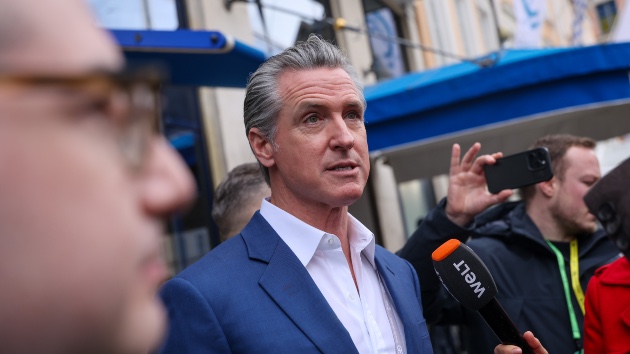
Gavin Newsom, governor of California, at the Munich Security Conference in Munich, Germany, on Friday, Feb. 13, 2026. Nuclear deterrence is set to be a hot topic at the conference. (Photographer: Alex Kraus/Bloomberg via Getty Images)
(WASHINGTON) — While it’s not Des Moines or Manchester, Munich may be on some Democrats’ path to a White House run or higher office.
Several Democrats thought to be considering 2028 presidential runs are attending the Munich Security Conference in Germany this weekend to boost their profiles and strengthen bonds with European allies strained in the first year of President Donald Trump’s second term.
From Gov. Gavin Newsom of California to Sen. Ruben Gallego, D-Ariz., and Rep. Alexandria Ocasio-Cortez, D-N.Y., the Democrats plan to push an alternative to Trump’s aggressive and transactional foreign policy agenda, lawmakers, aides and analysts told ABC News.
Newsom is expected to address the conference, meet with German Chancellor Friedrich Merz and formalize a new partnership between California and Ukraine.
In a post on X, Gallego previewed his visit, writing: “I’m headed to the Munich Security Conference this weekend to talk about rebuilding alliances and restoring steady American leadership. To meet the threat of China, the world needs a partner it can count on again, not chaos.”
At last year’s gathering, Vice President JD Vance criticized European allies, accusing them of censoring right-wing political parties and not doing more to stop illegal migration.
Since then, Trump’s on-again, off-again tariffs, repeated threats to seize Greenland and calls for NATO allies to spend more on security have forced longtime U.S. allies to question American commitments.
“We know the old order is not coming back. We shouldn’t mourn it,” Canadian Prime Minister Mark Carney said in a speech in Davos, Switzerland, last month. “Middle powers must act together because if we’re not at the table, we’re on the menu.”
Democrats will have to reaffirm their support for strong transatlantic ties while navigating European skepticism after Trump’s 2024 victory, Damian Murphy, a former Democratic foreign policy staffer and senior vice president of National Security at the Center for American Progress, told ABC News.
“They have to be careful not to overpromise and send too much of a message of reassurance, because at the end of the day, Trump is still in the White House and still directs foreign policy,” he said. “But it’s important for a European audience to understand that that’s not a monolithic view.”
The conference is also an opportunity for Democrats to bring new perspectives to the world stage and give them an opportunity to “establish relationships” with world leaders, Murphy added.
Ocasio-Cortez, who is one of the most prominent progressive voices in the party, is running for reelection in 2026 and has not said whether she plans to run for Senate or the White House in 2028, though supporters have encouraged her to do so.
The New York Democrat, who does not serve on any national security committees in Congress like most lawmakers traveling to Munich, will participate in two panels on Friday, as she takes a bigger step onto the foreign policy stage.
Matt Duss, a former adviser to Sen. Bernie Sanders, I-Vt., who has advised Ocasio-Cortez on foreign policy, told ABC News he expects her to share a progressive perspective on foreign policy, one intertwined with her domestic politics aimed at combating economic inequality and improving the conditions for working people.
“I think it’s safe to say that the American electorate has some very serious questions and different ideas about how the U.S. should act in the world than it has previously,” Duss told ABC News.
Ocasio-Cortez has also been a critic of Israel’s war in Gaza against Hamas and accused Israel of genocide against the Palestinian people. She also voted against an amendment that would have stripped U.S. funding for Israel’s missile defense systems, but has pushed back against U.S. offensive military aid to Israel.
Secretary of State Marco Rubio, who is leading the Trump administration’s delegation to Munich, called the summit “an important conference” and that other delegations “want honesty” and “want to know where we’re going, where we’d like to go with them.”
“We live in a new era in geopolitics, and it’s going to require all of us to sort of reexamine what that looks like and what our role is going to be,” he said.
ABC News’ Isabella Murray contributed to this report
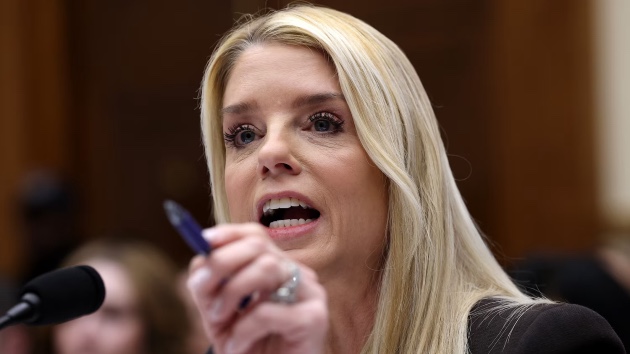
Attorney General Pam Bondi testifies before the House Judiciary Committee, February 11, 2026 in Washington. (Win McNamee/Getty Images)
(WASHINGTON) — The Justice Department’s failure this week to convince a grand jury to hand up an indictment against six members of Congress is the latest stumbling block faced by prosecutors as they seek to rebuke the administration’s perceived political opponents.
The U.S. attorney’s office in Washington, D.C., was unable to secure an indictment against six congressmembers after President Donald Trump called for them to be arrested and tried for posting a video on social media telling military service members that they could refuse illegal orders, sources said Tuesday.
Following a classified briefing on the deadly strikes on alleged drug boats in Latin America, Sen. Mark Kelly, Sen. Elissa Slotkin, Rep. Maggie Goodlander, Rep. Jason Crow, Rep. Chrissy Houlahan, and Rep. Chris DeLuzio, all former members of the military and intelligence community, posted a video in November telling current members that — per the Uniform Code of Military Justice — they should refuse to carry out unlawful orders.
“Each one of these traitors to our Country should be ARRESTED AND PUT ON TRIAL,” Trump posted to social media in response to the video on Nov. 20.
Prosecutors under U.S. Attorney Jeanine Pirro sought to convince a grand jury to indict the six lawmakers, but the panel did not comply.
It is exceedingly rare for a grand jury to not indict after prosecutors have made their presentation. In fiscal year 2016, the most recent year for which figures are available from the DOJ’s Bureau of Justice Statistics, the DOJ sought federal charges against 69,451 felony defendants — and in only six cases did a grand jury return a vote of no bill, indicating a refusal to indict.
Yet the current Justice Department has faced this outcome several times in recent months while attempting to prosecute perceived foes of the president’s agenda.
“This is pretty rare for a prosecutor to want an indictment and not get one,” University of Illinois Professor Andrew Leipold, an expert on the federal judiciary system, told ABC News. “The most obvious answer is that the government is being aggressive in prosecuting federal crimes, and grand juries are simply not in agreement.”
Vice President JD Vance has said that any such actions are “driven by law and not by politics.”
After a federal judge in November dismissed the cases the Justice Department had brought against former FBI Director James Comey and New York Attorney General Letitia James, the DOJ again sought an indictment of the New York AG.
The move came after U.S. District Judge Cameron McGowan Currie ruled that that the appointment of Trump’s handpicked interim U.S. attorney, Lindsey Halligan, was unconstitutional and that Halligan acted in an “unlawful” and “ineffective” manner when she brought charges of making false statements against Comey and mortgage fraud charges against James.
Ten days after Judge Cameron’s ruling, a federal grand jury in Norfolk, Virginia, refused to indict James on the same charges when the Justice Department attempted to refile the case, according to sources.
A second grand jury in the Eastern District of Virginia’s Alexandria branch then rejected the charges when the DOJ attempted to file the case for a third time.
“This unprecedented rejection makes even clearer that this case should never have seen the light of day,” James’ attorney, Abbe Lowell, said in a statement.
Last August, D.C. prosecutors failed to secure an indictment against a man accused of throwing a sandwich at a Customs and Border Protection agent after video of the confrontation went viral and provoked an all-out public relations blitz from the White House and Justice Department touting his arrest and the federal assault charge against him.
Sean Charles Dunn was arrested on charges of allegedly throwing a Subway sandwich at a CBP agent who was patrolling with Metro Transit Police in northwest Washington on the night of Aug. 9, amid the Trump administration’s deployment of National Guard troops in the capital.
“You f—— fascists! Why are you here? I don’t want you in my city!” Dunn is alleged to have shouted at the CBP officer before allegedly throwing the sandwich, which struck the officer in the chest.
Prosecutors similarly failed to convince a federal grand jury in D.C. to indict a woman who was accused by the government of assaulting an FBI agent during an inmate swap with U.S. Immigration and Customs Enforcement.
The U.S. attorney’s office was unable to secure an indictment against Sidney Reid despite making three separate attempts, according to court records.
ABC News’ Alexander Mallin and Katherine Faulders contributed to this report.
(ORANGEBURG, S.C.) — Two people were killed and one person was wounded after a shooting Thursday night on the campus of South Carolina State University, the school said.
The shooting, which was reported in an apartment at the Hugine Suites student residential complex on the Orangeburg campus, prompted a campus lockdown that remained in place hours after the shooting, according to a news release from the university.
Officials have not released any details about a suspect.
The South Carolina Law Enforcement Division (SLED) is investigating the shooting, the university said.
The university said school officials have not confirmed the victims’ identities or the condition of the wounded person.
Classes are canceled Friday, the university said.
Two shootings on the campus in October, including one at the same student housing complex, left one person dead and another wounded.
The university has a student population of about 2,800 students.
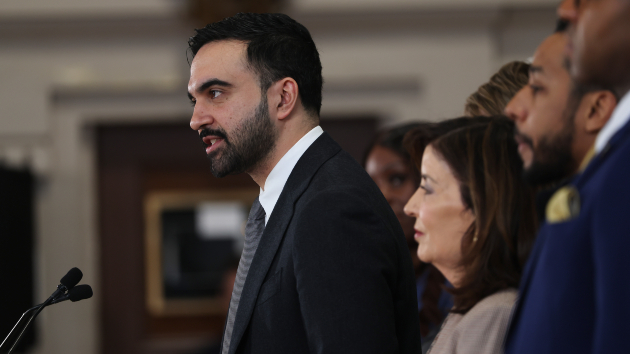
New York City Mayor Zohran Mamdani is joined by New York Governor Kathy Hochul at an event in Brooklyn to support more housing construction in New York City on February 10, 2026 in New York City. (Spencer Platt/Getty Images)
(GARDEN CITY, N.Y.) — Just over three months after he won New York City’s mayoral election, Zohran Mamdani is already at the center of another election — even though he’s not on the ballot.
With the New York governor’s race on the horizon, some voters and Republican officials who attended New York State’s Republican convention on Long Island on Monday mentioned Mamdani’s name immediately as they spoke about Gov. Kathy Hochul.
“Kathy Hochul is scrounging for votes and she latched onto Mamdani,” convention attendee Phil Orenstein, from Queens Village, told ABC News. “She endorsed him. He endorsed her in the governor’s race and you can see where that’s going. It’s going so far off the cliff.”
The most prominent Republican New York native, President Donald Trump, criticized Mamdani heavily prior to last November’s election.
Yet after the democratic socialist and former state assemblyman defeated former New York Gov. Andrew Cuomo and Republican Curtis Sliwa in November, Trump appeared to change his perspective on Mamdani.
When Mamdani visited the White House after his victory, President Donald Trump congratulated the then-mayor-elect and said that he thought Mamdani “could do some things that are going to be really great.”
Trump’s praise of Mamdani has raised questions over how Republicans seeking to defeat Hochul this November will incorporate the new mayor into their messaging.
Nassau County Executive Bruce Blakeman, who became the likely Republican gubernatorial nominee after Rep. Elise Stefanik dropped out of the race in December, did not mention Mamdani by name in his opening remarks at the Republican convention in suburban Garden City on Monday.
However, Blakeman’s campaign previously issued a statement criticizing the “Hochul-Mamdani agenda” and posted on social media shortly before the convention began that “Zohran Mamdani and Kathy Hochul are pushing New York in the wrong direction.”
Hochul, who had been facing a primary challenge from Lieutenant Gov. Antonio Delgado until Delgado suspended his campaign on Tuesday, touted Mamdani’s endorsement last week.
“Mayor Mamdani understands that we need to build a New York that everyone can afford — I’m grateful for his partnership in finally bringing universal child care to New York, and I know that he’ll stand strong alongside me as we fight against Donald Trump’s attacks on this state,” the governor said in a statement.
Mamdani’s proposals have ranged from free fares on the country’s largest bus system to free child care for 2-year-olds in the city.
“His policies are completely backwards and we are not a socialist country. We are not a socialist state,” Broome County Republican Committee Chair Benji Federman told ABC News at the convention on Monday. “The vast majority of voters disagree with the policies that he has put forward across New York.”
Just under 45% of New York State’s population lives in New York City.
“You have so many people who are in the Senate and the Assembly from New York City [that] if something happens locally down here, they’re going to try to bring it statewide,” Mike Sigler, an upstate Republican county legislator who lives outside Ithaca, told ABC News.
Mamdani and Hochul have each expressed disagreements with each other on a number of issues, particularly regarding taxes.
“Those of us entrusted with the sacred oath of service must heed that call and work together to honor it. That requires not the absence of disagreement but the presence of trust,” Mamdani wrote in his endorsement of Hochul that was published by The Nation. “We must be able to disagree honestly while still delivering for the people we serve.”
On Tuesday, New York leaders gathered for a press conference in the city about housing and infrastructure. Hochul and Mamdani were standing side by side at the podium.
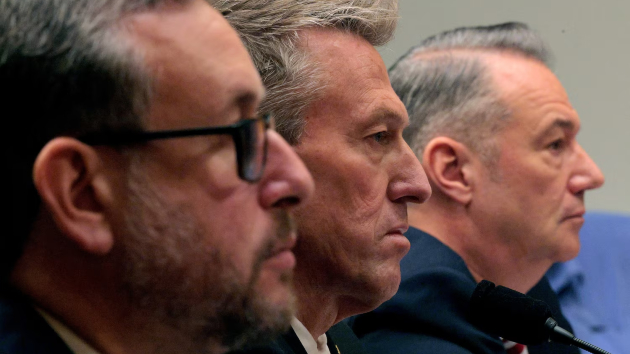
Director of US Citizenship and Immigration Services, Joseph Edlow, US Customs and Border Protection, Commissioner Rodney Scott, and Acting Director of US Immigration and Customs Enforcement, Todd Lyons testify before a Senate Homeland Security and Governmental Affairs Committee hearing, February 12, 2026 in Washington. (Chip Somodevilla/Getty Images)
(WASHINGTON) — Sen. Rand Paul had strong words on Thursday for the heads of the federal agencies spearheading the Trump administration’s immigration enforcement in Minneapolis and across the U.S.
Immigration and Customs Enforcement acting director Todd Lyons, Customs and Border Protection commissioner Rodney Scott, and Citizenship and Immigration Services director Joseph Edlow were testifying in front of the Senate Homeland Security Committee.
“Witness the thousands of people in the streets in Minneapolis and in Minnesota, and the millions of viewers who witnessed the recent deaths,” Paul, the committee’s chairman, said. “It’s clearly evident that the public trust has been lost. To restore trust in ICE and Border Patrol, they must admit their mistakes, be honest and forthright with their rules of engagement, and pledge to reform. I hope the leadership of ICE and Border Patrol here today will participate in a meaningful way.”
Paul and ranking member Sen. Gary Peters went frame by frame on videos of the shooting of Alex Pretti, the 37-year-old Minneapolis nurse killed in an encounter with federal agents last month. Federal officials initially said that Pretti “approached U.S. Border Patrol officers with a 9mm semi-automatic handgun” and “attacked” officers carrying out immigration duties.
State and local officials said Pretti was lawfully carrying a gun, with a concealed carry permit, and video reviewed and verified by ABC News does not appear to show that Pretti drew his gun on the agents and instead was holding up a cell phone, not a gun, to record agents during the incident.
Another Minneapolis resident – Renee Good — was also shot and killed by federal agents in early January. Federal officials say that the agents acted in self defense after Good allegedly tried to ram them with her car, which local city officials and her family have disputed.
Paul said that it isn’t so much about the specifics of the investigation, but rather the training that CBP and ICE agents receive.
“No one in America believes shoving that woman’s head and face in the snow was de-escalation,” Paul said of video showing agents scuffling with Pretti and a woman moments before the shooting. “But your officer, you need to know they…had a verbal encounter with them. She did not place her hands on the officers. She wasn’t trying to get their weapon. It’s not great. I mean … I don’t like to see these encounters either, but is it appropriate for the officers to respond to a verbal, barrage of words or whatever? Is it proper, to physically throw a woman down or throw anyone down if the only action is verbal?”
Both Scott and Lyons agreed that it wasn’t de-escalation if the only action against the agents had been verbal.
“I understand you not wanting to make conclusions yet, but nobody believes you’re gonna because you made conclusions immediately,” Paul told the law enforcement leaders. “Not you. But people within the government made conclusions immediately that [Pretti] was a terrorist and an assassin … people aren’t believing there’s going to be an honest investigation.”
In the hours after the shooting, Homeland Security Secretary Kristi Noem said Pretti committed an “act of domestic terrorism” and White House Deputy Chief of Staff Stephen Miller called him a “would-be assassin” and a “terrorist.”
Paul added at the hearing, “I think it’s terrible police work, but there has to ultimately be repercussions.”
Scott said that he would not jump to conclusions and asked the nation to do the same. He said he was committed to releasing the officers’ body-worn-cameras once the investigation is complete.
“There’s body-cam video, that’s all being looked at,” Scott said. “And until all that evidence is evaluated, I can’t jump to a conclusion on either direction. I would ask America to do the same thing, but I am committed to transparency, to making sure all the information we have is made public when it’s appropriate.”
Paul said that he saw “nothing, not even a hint of something that was aggressive on [Pretti’s] part.”
“I don’t think this should take months and months and years and years. There needs to be a conclusion,” Paul said. “We need to have answers here and there needs to be an announcement. These are the new policies. This is how we’re going to interact with the public, because the public needs to know to, you know, if I go to a protest and I shout something at people, could I be killed?”
Scott also did not say whether the gun was accidentally discharged by officers in the Pretti case, citing an ongoing investigation.
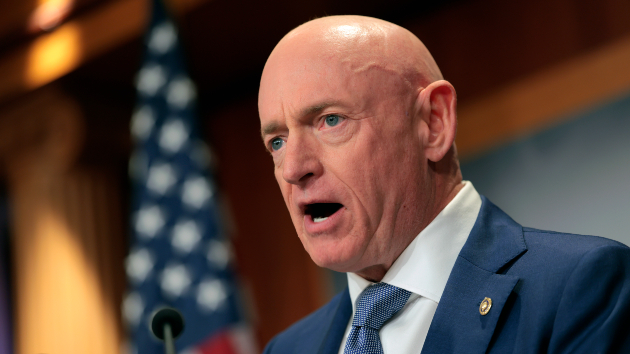
U.S. Sen. Mark Kelly speaks on the failed grand jury indictment against him during a news conference at the U.S. Capitol on February 11, 2026 in Washington, DC. (Heather Diehl/Getty Images)
(WASHINGTON) — In a biting opinion that chastised Defense Secretary Pete Hegseth, a Republican-appointed judge on Thursday blocked the Defense Department from trying to punish Sen. Mark Kelly over a video he and other Democrats made urging service members not to follow illegal orders, accusing Hegseth of “trampling” on the Arizona senator’s First Amendment rights and suggesting Hegseth should be more “grateful” for the wisdom of retired service members.
“This Court has all it needs to conclude that Defendants have trampled on Senator Kelly’s First Amendment freedoms and threatened the constitutional liberties of millions of military retirees,” Washington D.C. District Court Judge Richard J. Leon wrote in his opinion.
Leon sharply questioned Trump administration lawyers on whether there was legal precedent for the Defense Department’s attempt to demote and reduce retirement benefits for Kelly, who has been sharply critical of the White House.
“Rather than trying to shrink the First Amendment liberties of retired servicemembers, Secretary Hegseth and his fellow Defendants might reflect and be grateful for the wisdom and expertise that retired servicemembers have brought to public discussions and debate on military matters in our Nation over the past 250 years,” Leon wrote. “If so, they will more fully appreciate why the Founding Fathers made free speech the first Amendment in the Bill of Rights! Hopefully this injunction will in some small way help bring about a course correction in the Defense Department’s approach to these issues.”
The Justice Department could appeal the decision, although it’s not clear if it would. The Pentagon and Hegseth on Thursday did not immediately respond to requests for comment.
The case has drawn considerable attention as a major test of the First Amendment rights of military veterans and the government’s separation of powers. Kelly was suing the Pentagon for threatening to demote him in rank and reduce his military retirement benefits because of a video he made with other Democrats that urged troops not to comply with illegal orders, which they did not specify.
Hegseth accused Kelly of violating a federal law that prohibits undermining good order and discipline within the military and accused him of hiding behind his position as a U.S. senator to do so.
In a video posted online to social media on Thursday, Kelly said he is grateful for the judge’s opinion.
“I appreciate the judge’s careful consideration of this case and the clarity of his ruling, but I also know that this might not be over yet, because this president and this administration do not know how to admit when they’re wrong,” he said.
This is a developing story. Please check back for updates.
Signage at the Environmental Protection Agency (EPA) headquarters in Washington, DC, US, on Tuesday, Feb. 10, 2026. Stefani Reynolds/Bloomberg via Getty Images
(WASHINGTON) — The Environmental Protection Agency has walked back a landmark environmental decision to regulate greenhouse gas emissions and fight climate change.
Calling it “the single largest deregulatory action in U.S. history,” the EPA announced Thursday that it was “eliminating both the Obama-era 2009 Greenhouse Gas (GHG) Endangerment Finding and all subsequent federal GHG emission standards for all vehicles and engines of model years 2012 to 2027 and beyond.”
For more than 16 years, the EPA’s endangerment finding served as the scientific and legal foundation for federal regulations on carbon dioxide and five other heat-trapping greenhouse gases. The 2009 decision found that certain greenhouse gases endanger public health and welfare. The regulations that resulted cover everything from vehicle tailpipe emissions to the release of greenhouse gases from power plants and other significant emission sources.
EPA Administrator Lee Zeldin made the announcement in the White House, alongside President Donald Trump.
“The Endangerment Finding has been the source of 16 years of consumer choice restrictions and trillions of dollars in hidden costs for Americans,” Zeldin said in a statement after the announcement. “The Trump EPA is strictly following the letter of the law, returning commonsense to policy, delivering consumer choice to Americans and advancing the American Dream.”
The EPA said the decision would “[save] American taxpayers over $1.3 trillion,” and “restores consumer choice, makes more affordable vehicles available for American families, and decreases the cost of living on all products by lowering the cost of trucks.”
In a statement to ABC News prior to Thursday’s announcement, the EPA called the endangerment finding “one of the most damaging decisions in modern history,” adding, “in the intervening years, hardworking families and small businesses have paid the price as a result.”
Some climate scientists and policy experts say the agency’s decision to repeal the finding, even just for cars and trucks, could significantly affect U.S. efforts to address human-amplified climate change. The EPA calculates that the transportation sector is the largest contributor of direct greenhouse gas emissions in the country, with cars and trucks accounting for more 75% of those emissions.
“This is taking away the principal federal authority to regulate greenhouse gases. All of the federal regulations under the Clean Air Act to regulate greenhouse gases depend on the endangerment finding. If it’s wiped out, none of those regulations exist,” said Michael Gerrard, a professor at Columbia Law School and the faculty director of the Sabin Center for Climate Change Law.
Gerrard said the immediate impact of the EPA’s decision will be somewhat muted by the fact that the Trump administration has already revoked most regulations on greenhouse gas emissions. These include greenhouse gas emission limits on passenger vehicles, emission controls on fossil fuel-powered power plants, and controls on methane leakage from oil and gas wells.
“But this action attempts to be the nail in the coffin of all those regulations, at least for the balance of the Trump administration,” Gerrard added.
Saying the decision “amounts to the largest act of deregulation in the history of the United States,” the Trump administration estimates the move will save Americans $1.3 trillion, primarily by reducing the cost of cars and trucks. The EPA said consumers will save more than $2,400 on the purchase of a new vehicle.
But Lou Leonard, dean of Clark University’s School of Climate, Environment, and Society, says the repeal could also result in companies facing more financial and legal challenges.
“It’s going to expose, particularly businesses that are very fossil fuel intensive, to legal claims that they might not have otherwise been exposed to,” said Leonard.
“When the EPA vacates the space legally and says we’re not going to regulate, we’re out of this game, then that not only creates room for other state and local governments to do their regulation, but it also creates room for legal claims against companies for not acting on climate, because they can’t say, well, we’re just following the regulations that the federal government has created,” he added.
“The EPA’s 2009 endangerment finding triggered a trillion-dollar regulatory cascade that Congress never authorized,” the conservative nonprofit Pacific Legal Foundation said in a statement to ABC News. “What began as authority to address regional smog and acid rain has been stretched to vehicle emissions, power plants, oil and gas operations, and federal lands – reshaping America’s entire energy economy and ability to harness natural resources through administrative fiat.”
The EPA’s expected repeal of the 2009 finding “restores the principle that decisions of this magnitude require clear congressional authorization, not bureaucratic improvisation,” the statement continued.
A widely anticipated decision
The announcement from the administration was widely anticipated; the Trump administration has made the endangerment finding’s review a priority since the first day of Trump’s second term.
On Jan. 20, 2025, Trump signed an executive order titled “Unleashing American Energy” that required the head of the EPA to work with other agencies to “submit joint recommendations to the Director of OMB on the legality and continuing applicability of the Administrator’s findings” regarding the endangerment finding. The order gave them 30 days to respond.
Then, in March, the EPA announced more than two dozen policy recommendations aimed at rolling back environmental protections and eliminating a series of climate change regulations, including plans to “formally reconsider the endangerment finding.”
In a statement at the time, EPA Administrator Lee Zeldin wrote, “The Trump Administration will not sacrifice national prosperity, energy security, and the freedom of our people for an agenda that throttles our industries, our mobility, and our consumer choice while benefiting adversaries overseas. We will follow the science, the law, and common sense wherever it leads, and we will do so while advancing our commitment towards helping to deliver cleaner, healthier, and safer air, land, and water.”
As part of the March announcement, the agency released a fact sheet about the endangerment finding, describing it as “the first step in the Obama-Biden Administration’s (and later the Biden-Harris Administration’s) overreaching climate agenda” and stating that it has cost the country trillions of dollars.
The EPA announced its proposal to rescind the endangerment finding in late July 2025, citing recent Supreme Court decisions that limited the regulatory power of executive agencies and arguing that the Obama administration misinterpreted Congress’s intent when it passed the Clean Air Act.
The Supreme Court case that led to the endangerment finding
The endangerment finding stems from the 2007 Supreme Court decision Massachusetts v. EPA, which held that the EPA could regulate greenhouse gases from motor vehicles under the 1970 Clean Air Act because those gases are air pollutants.
That ruling became the legal foundation for many of the federal government’s greenhouse gas emissions regulations for vehicles, fossil-fuel power plants, and other sources of pollution responsible for climate change.
Writing for the court at the time, Justice John Paul Stevens said, “If EPA makes a finding of endangerment, the Clean Air Act requires the agency to regulate emissions of the deleterious pollutant from new motor vehicles.”
“Under the clear terms of the Clean Air Act, EPA can avoid taking further action only if it determines that greenhouse gases do not contribute to climate change or if it provides some reasonable explanation as to why it cannot or will not exercise its discretion to determine whether they do,” Stevens added.
In 2009, the head of the EPA made a landmark environmental decision. Lisa P. Jackson, appointed by President Barack Obama to lead the agency, determined that the current and projected concentrations of six greenhouse gases, including carbon dioxide, “endanger both the public health and the public welfare of current and future generations.” Her decision, based on a nearly 200-page EPA analysis of the science, more than 380,000 public comments and two public hearings, became what is now known as the “endangerment finding.”
Critics of decision say the underlying science is even stronger today
Critics of the administration’s plan to rescind the finding argue that the science linking greenhouse gas emissions to climate change is even stronger today than when the endangerment finding was established in 2009. They argue that the repeal lacks both a scientific basis and a legal foundation and will exacerbate the harmful impacts of climate change. Some are already promising to fight the decision in court.
“The Trump administration justifies this assault on science and our health by falsely claiming that U.S. climate-heating pollution doesn’t matter and that it lacks the authority to cut it. That’s a lie, and any 6-year-old knows it’s wrong to lie,” said Dan Becker, director of the Center for Biological Diversity’s Safe Climate Transport Campaign, in a statement to ABC News.
“The United States is the second-largest carbon polluter in the world after China, and the largest historical emitter of greenhouse gases. The U.S. emitted 11% of the world’s greenhouse gases in 2021, and during Trump’s first term his administration admitted that emissions in excess of 3% were ‘significant,’” he added.
“EPA’s own settled science shows that managing greenhouse gases is fundamental to protecting Americans. Rolling back these safeguards is a dangerous breach of responsibility to protect people, the environment, and our economy, benefitting polluters at the expense of all people,” said World Resources Institute (WRI) U.S. Director David Widawsky in a statement.
Overwhelming scientific evidence
In the more than 16 years since the EPA issued its 2009 endangerment finding, the science on how greenhouse gases impact human health has become more robust.
In response to the EPA’s request for public input, the National Academies of Sciences, Engineering, and Medicine conducted a comprehensive independent assessment of the science behind the endangerment finding to help inform the agency’s final decision. They released their report in September, concluding the EPA’s 2009 determination was accurate and is now supported by stronger scientific evidence, with many uncertainties that existed at the time now resolved.
“[T]he evidence for current and future harm to human health and welfare created by human-caused greenhouse gases is beyond scientific dispute,” the report stated.
The National Academies of Sciences, Engineering, and Medicine are private, nonprofit institutions that provide independent, objective analysis and advice to the nation on such issues. They operate under an 1863 congressional charter to the National Academy of Sciences, signed by President Abraham Lincoln.
Similarly, the United Nations concluded that “health and the climate are inextricably linked, and today the health of billions is endangered by the climate crisis.” The U.N. cited severe weather events, toxic air pollution, an increased risk of infectious disease outbreaks, and extreme heat as evidence that human-amplified climate change poses a significant danger to people.
In 2021, 200 leading medical journals issued a joint editorial stating that “the science is unequivocal: a global increase of 1.5° C above the pre-industrial average and the continued loss of biodiversity risk catastrophic harm to health that will be impossible to reverse.”
And in 2023, the Fifth National Climate Assessment, a report that the federal government describes as providing “authoritative scientific information about climate change risks, impacts, and responses in the U.S.,” found that “climate changes are making it harder to maintain safe homes and healthy families; reliable public services; a sustainable economy; thriving ecosystems, cultures, and traditions; and strong communities.”
“This is another setback in the fight against climate change. We’re already seeing climate change having very negative impacts. It worsens flooding, heat waves, wildfires and other impacts. We’ve seen catastrophes already in the United States for all of these. We will see more,” Gerrard said.
What happens next?
A coalition of state attorneys general, including those from California, New York, Connecticut, and Massachusetts, along with environmental groups such as the Natural Resources Defense Council, has indicated they will challenge the EPA’s decision. They argue the action is unlawful because it ignores the agency’s obligations under the Clean Air Act to regulate pollutants that endanger public health and welfare.
“This action is unlawful, ignores basic science, and denies reality. We know greenhouse gases cause climate change and endanger our communities and our health – and we will not stop fighting to protect the American people from pollution,” said California Governor Gavin Newsom and Wisconsin Governor Tony Evers, who are also the co-chairs of the U.S. Climate Alliance.
While the courts could overturn the repeal, Gerrard said they could also rule that the EPA needs congressional authorization for significant regulatory actions.
“If the Supreme Court says that, that would tie the hands of another president in reinstating the endangerment finding and in using the Clean Air Act to regulate greenhouse gases. It would not block another president from rejoining the Paris Agreement or doing lots of other things to fight climate change, but it would greatly hurt their ability to use the Clean Air Act,” said Gerrard.
Previous lawsuits challenged the endangerment finding itself, but the courts have consistently rejected those efforts. In 2012, the D.C. Circuit Court of Appeals upheld the endangerment finding after fossil fuel industry groups challenged the EPA’s use of scientific assessments. The court ruled that the EPA’s findings were supported by substantial evidence and that the agency had considered the scientific evidence in “a rational manner.” The following year, the Supreme Court declined to hear petitions specifically contesting the finding.
Leonard warns that it will be a “long road” to learn out how the decision plays out.
“There’s a lot of uncertainty, and we’re gonna have even more starting tomorrow or the next day, and that’s not good. It’s not good for the public health of Americans, it’s not good for the welfare of our communities, and it’s not good for the business climate and the economy in America,” said Leonard.
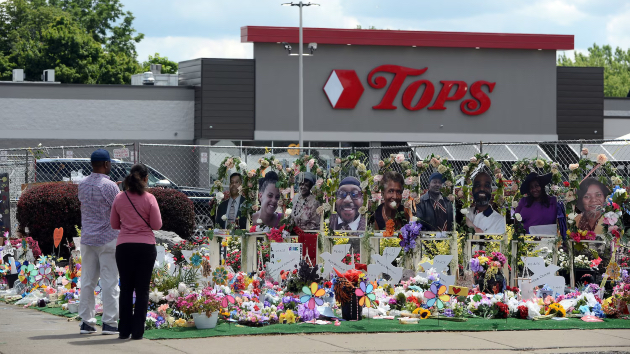
Community members pay respects at a “Memorial Garden” filled with flowers, photos and mementos outside the Tops Friendly Market on Jefferson Avenue on July 14, 2022 in Buffalo, New York. (John Normile/Getty Images)
(BUFFALO, N.Y.) — Nearly four years after 10 Black people were gunned down in a racially motivated mass shooting at a Buffalo, New York, supermarket, the victims’ families have reached a settlement with the firearms accessory company listed as a defendant in the case.
The Georgia-based manufacturer Mean Arms has agreed to pay $1.75 to settle a lawsuit filed in 2023, accusing the company of providing online instructions on how to remove a locking device it manufactured for AR-15-style rifles to turn the guns into assault weapons, New York Attorney General Letitia James announced.
“Today, justice looks like accountability, and we have ensured that this device will never be sold in our state again,” James, who filed the lawsuit along with the group Everytown for Gun Safety and the Giffords Law Center, said in a statement on Wednesday.
Mean Arms did not immediately respond to a request from ABC News for comment on the settlement. The company agreed to the settlement “without admitting or denying any allegations, claims, or assertions in the complaints filed in this action,” according to court papers filed in New York Supreme Court in Buffalo.
On May 14, 2022, the gunman, Payton Gendron, a self-professed white supremacist, opened fire with a Bushmaster XM-15 rifle in a Tops supermarket on Buffalo’s East Side neighborhood, killing 10 Black shoppers and injuring three other people.
According to the lawsuit, Gendron followed step-by-step instructions provided by Mean Arms to remove a device sold attached to the weapon called an MA Lock, which prevented the rifle from accepting magazines with more than 10 rounds. New York law bans the possession of assault weapons with high-capacity magazines that hold more than 10 rounds.
The removal of the lock allowed Gendron, who was 18 at the time of the shooting, to attach a 30-round magazine and convert the gun into an illegal assault weapon that he used in the attack, according to the lawsuit.
“With a pistol grip and the high-capacity magazines, he did not have to stop to reload his weapon, and when he did reload, he could do so quickly. As a result, he was able to kill 10 people and injure three others,” according to James’ statement.
As part of the settlement, Mean Arms agreed to permanently stop selling the MA Lock in New York and, according to James, remove any statements that claim the MA Lock is legal in New York and state on all packaging that the device cannot be sold or resold in New York.
“This has not been an easy fight and no amount of money will ever make up for the loss of our loved ones, but through this courageous action and in this instance, justice has prevailed and this settlement will provide additional fuel for the fight ahead,” said Garnell Whitfield, the former Buffalo fire chief whose 86-year-old mother, Ruth Whitfield, was killed in the massacre.
Gendron pleaded guilty in November 2022 to 15 state charges, including domestic terrorism motivated by hate, murder and attempted murder. He was sentenced to life in prison without the possibility of parole.
Gendron is scheduled to face a federal trial this coming summer, in which he could get the death penalty if convicted.
“We will never forget and stop fighting for our 10 neighbors who were senselessly taken away from us in a tragic, racist act of terror,” New York Gov. Kathy Hochul said in a statement. “As we continue to help the families and community heal, I’m grateful to the Attorney General for her partnership in seeking justice for those impacted and working to keep New Yorkers safe by ensuring our nation-leading gun laws are being followed.”
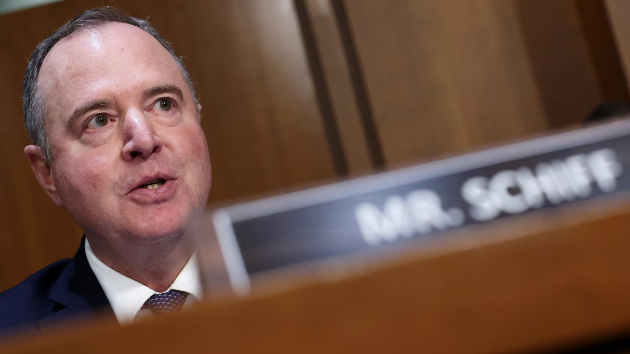
U.S. Sen. Adam Schiff questions U.S. Attorney General Pam Bondi as she testifies before the Senate Judiciary Committee on October 7, 2025 in Washington, DC. (Win Mcnamee/Getty Images)
(WASHINGTON) — Sen. Adam Schiff of California and a group of fellow Democrats are launching a probe into Freedom 250, a new non-profit group closely aligned with President Donald Trump that is raising private funding for high-profile events surrounding America’s 250th birthday this summer.
Freedom 250 — a nonprofit subsidiary of the National Park Foundation, the congressionally chartered fundraising arm of the National Park Service — was announced by the White House X account in December 2025, as an alternative for the congressionally chartered “America250” commission that is planned to celebrate the nation’s birthday this year.
The New York Times is reporting on allegations that the Freedom250 group is exchanging access to Trump for donations, and concerns have been raised in Congress about the arrangement between the group’s donations and their political fundraising.
Schiff’s inquiry, first shared with ABC News, raises concerns about the large sums of private donations and alleged “pay-to-play” access implications involved in the Freedom 250 effort.
When asked to respond to Schiff’s inquiry, White House spokesperson Davis Ingle said, “President Trump is ensuring that America gets the spectacular birthday it deserves. The celebration of America’s 250th anniversary is going to display great patriotism in our Nation’s Capital and throughout the country.”
Democratic Sens. Chris Van Hollen, Cory Booker, Richard Blumenthal, Elizabeth Warren, Dick Durbin and Gary Peters joined Schiff in sending a letter on Wednesday to White House Chief of Staff Susie Wiles, demanding the White House produce a list of Freedom 250 donors and describing any benefits, access, recognition or other consideration donors have received or been promised related to their contributions.
The senators raised concern that the potential coordination between the Trump administration and Freedom 250 could violate federal bribery, conflict of interest and ethics statutes. Schiff’s inquiry is also asking for an explanation on the ethical guidance the group received from the Office of Government Ethics or White House ethics officials.
“It is imperative that Congress and the public understand how decisions are made, who exercises control, and what guardrails exist to prevent inappropriate donor influence. Absent clear rules, this structure risks blurring the line between legitimate civic fundraising and pay‑for‑play access tied to official government functions, an all too familiar feature of the current Administration,” the senators wrote.
Trump — who repeatedly promised on the campaign trail a grand celebration for America’s 250th birthday that would be comparable to past world’s fairs — announced Freedom250 in December as a public-private partnership to spearhead the festivities.
On Tuesday, congressional Democrats accused the Trump administration of trying to alter plans to celebrate the nation’s 250th birthday and using the National Park Foundation to solicit money from private donors.
Democratic Rep. Jared Huffman claimed “Trump and his Freedom 250 party planners are working to obscure reality with a fake narrative.”
“America250 could have been an honest celebration. Trump didn’t have control over the congressionally charted nonpartisan organization leading the celebration,” Huffman said, adding that Trump is working to “monetize it.”
During a hearing in the House Natural Resources Oversight and Investigations Subcommittee, Jeff Reinbold, the foundation’s president and CEO, promised anonymity to donors who requested it. Reinbold also said he would not provide Congress with any contracts signed by Freedom 250 donors.
Democratic Rep. Maxine Dexter claims Freedom 250 is using public money meant to go to America250, which was created in 2016. Dexter asserted that Freedom 250 is co-mingling fundraising for Trump with private donations for the nation’s birthday celebrations.
“This leaves us all guessing which one of Donald Trump’s billionaire buddies and which foreign interests are buying access,” Dexter said.