Map of search and rescue patterns. Courtesy of U.S. Coast Guard
(PORTLAND, Ore.) — The United States Coast Guard suspended the search for a missing fisherman after a vessel with four people on it capsized in 7-foot swells and heavy winds off the coast of Oregon, officials said.
Authorities at Coast Guard Sector Columbia River received a report at about 4 p.m. on Sunday that a 40-foot fishing vessel named Das Bug had taken on water while transiting through the Yaquina Bay Jetty and capsized with all four crew members ending up in the water, according to a statement from the Coast Guard on Monday.
“Three individuals were rescued from the water by a 47-foot Motor Lifeboat crew from Coast Guard Station Yaquina Bay and transferred to emergency medical services,” the Coast Guard said. “The individuals were taken to Samaritan Pacific Communities Hospital and treated for hypothermia.”
Crews from Coast Guard Station Yaquina Bay and an MH-65 Dolphin crew from Coast Guard Air Station North Bend conducted evening searches for the missing individual but could not locate the missing fisherman.
A first light search was also conducted on Monday by an MH-65 Dolphin crew from Coast Guard Air Station North Bend but the decision was made to suspend the search for the missing man shortly after when crews were unable to find him.
In total rescue crews searched for eight hours, covering a total of 54 square miles and searched in inclement weather, including 7-foot swells and 13 knot winds.
“Suspending a search without finding the person you have been looking for is always one of the most difficult decisions we have to make,” said Lt. Cdr. Jacqueline Hunnicutt, search and rescue mission coordinator for Coast Guard Sector Columbia River. “Our thoughts are with the family and loved ones during this incredibly difficult time.”
(LONDON) — Ukrainian President Volodymyr Zelenskyy claimed on Tuesday that Russian President Vladimir Putin is preparing for “new offensive operations” despite Friday’s looming peace summit in Alaska.
Fierce frontline combat and long-range drone and missile strikes are ongoing as the U.S. and Russia prepare for Friday’s meeting. Ukrainian representatives are not expected to attend, though a source in Zelenskyy’s office told ABC News on Monday that “everything is very fluid.”
Zelenskyy and his officials have gone on a diplomatic offensive ahead of the meeting, seeking to shore up foreign support behind Ukraine’s key demands in any peace deal.
On Monday, Zelenskyy suggested that Putin is not ready to end the fighting, despite Friday’s meeting in Alaska.
Citing a report from his intelligence and military commands, Zelenskyy said in a statement that Putin “is definitely not preparing for a ceasefire or an end to the war. Putin is determined only to present a meeting with America as his personal victory and then continue acting exactly as before, applying the same pressure on Ukraine as before.”
“So far, there is no indication whatsoever that the Russians have received signals to prepare for a post-war situation,” he added. “On the contrary, they are redeploying their troops and forces in ways that suggest preparations for new offensive operations.”
“If someone is preparing for peace, this is not what he does,” Zelenskyy said.
Zelenskyy has said Kyiv will not cede any territory to Russia, will not abandon its NATO ambitions and will not allow any limitations on its armed forces.
Among Moscow’s demands are that Ukraine cede several regions — not all of which are controlled by Russian troops — in the south and east of the country, accept curbs on the size and sophistication of its military and be permanently excluded from NATO. Putin also wants all international sanctions on Russia to be lifted in the event of a peace deal.
Russia’s demands, Zelenskyy has said, constitute an attempt to “partition Ukraine.”
President Donald Trump on Monday described the coming summit as a “feel out meeting,” telling reporters, “I’m going in to speak to Vladimir, and I’m going to be telling him, ‘You got to end this war. You got to end it’.”
“And at the end of that meeting, probably in the first two minutes, I’ll know exactly whether or not a deal can be made,” Trump said.
When asked how he would know if a deal is possible, the president replied, “Because that’s what I do. I make deals.”
(WASHINGTON) — Policymakers and business leaders will closely watch the release of inflation data on Tuesday, marking the latest look at price increases as the economy risks a tariff-induced rise of inflation.
The inflation report is the first major data release from the U.S. Bureau of Labor Statistics (BLS) since Trump fired the agency’s commissioner earlier this month, just hours after the release of a weak jobs report.
Price increases have sped up over the past two months, including a jump in the cost of commonly imported products like clothes, furniture and toys. Tariffs modestly contributed to the uptick in overall inflation, analysts previously told ABC News.
Economists expect prices to have risen 2.8% in July compared to a year earlier, which would amount to a slight uptick from 2.7% year-over-year growth in the previous month.
Still, the anticipated inflation rate would clock in below 3% recorded in January, the month Trump took office.
On Aug. 1, Trump fired BLS Commissioner Erika McEntarfer, an appointee of former President Joe Biden who was confirmed by a bipartisan vote in the Senate in 2024.
In a social media post, Trump leveled sharp criticism and baseless accusations at McEntarfer, claiming without evidence that the data had been “manipulated.” The jobs report featured revisions of previous months’ data, which is a routine practice.
The president touted his economic performance in a social media post: “The Economy is BOOMING under ‘TRUMP’ despite a Fed that also plays games, this time with Interest Rates.”
BLS Deputy Commissioner William Wiatrowski is serving as acting commissioner while the Trump administration selects a replacement.
The fresh inflation data is set to arrive at a wobbly moment for the U.S. economy. The weak Aug. 1 jobs report raised alarm among some analysts that the U.S. may be slipping toward a recession. Employers are hiring at their slowest pace since 2020, the jobs data showed.
That came two days after GDP data indicated average annualized growth of 1.2% over the first half of 2025, well below the 2.8% growth in the same period last year.
The combination of elevated prices and sluggish hiring could hurtle the U.S. toward an economic double-whammy known as “stagflation,” in which the economy slows while prices rise.
Potential stagflation poses difficulty for the Federal Reserve. If the Fed raises interest rates as a means of protecting against tariff-induced inflation under such a scenario, it risks stifling borrowing and slowing the economy further. On the other hand, if the Fed lowers rates to stimulate the economy in the face of a potential slowdown, it threatens to boost spending and worsen inflation.
The Fed will hold its next rate-setting meeting in September. Investors peg the chances of an interest rate cut at 86%, according to the CME FedWatch Tool, a measure of market sentiment.
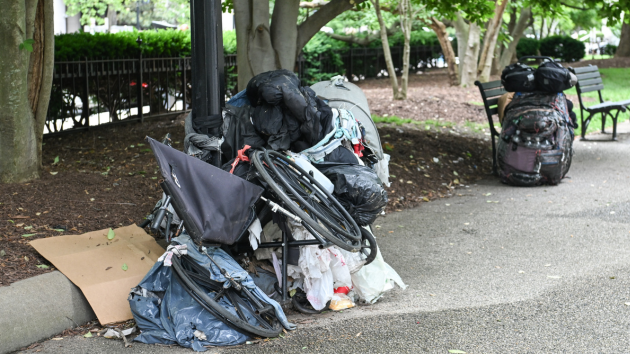
(WASHINGTON) — President Donald Trump vowed this week to rid Washington, D.C., of homeless encampments, issuing a warning that the “homeless have to move out, IMMEDIATELY.” Though what those plans will look like, including where people will go, is unclear, sparking concerns among advocacy groups.
While previewing an announcement regarding D.C., Trump told those experiencing homelessness in a social media post on Sunday, “We will give you places to stay, but FAR from the Capital.”
In his remarks the following day, Trump said that the federal government will be “removing homeless encampments from all over our parks” in D.C. as part of an effort to “rescue our nation’s capital from crime, bloodshed, bedlam and squalor and worse.”
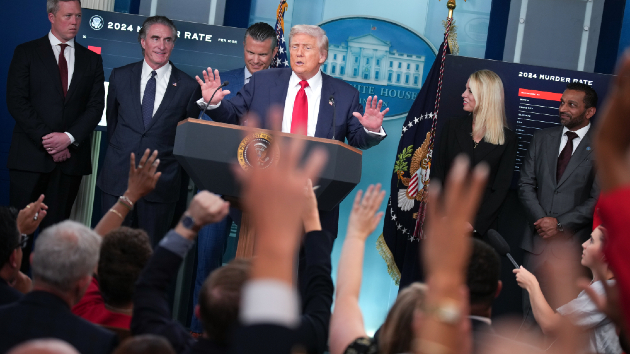
“There are many places that they can go, and we’re going to help them as much as you can help. But they’ll not be allowed to turn our capital into a wasteland for the world to see,” Trump said during a press briefing on Monday while announcing plans for the federal government to take over the D.C. police department and deploy National Guard troops in D.C.
Dismantling homeless encampments is not a new practice in D.C. for either the Trump administration or local government, Dana White, the advocacy director for Miriam’s Kitchen, a nonprofit focused on ending chronic homelessness in D.C., told ABC News.
“What is particularly startling is the vague language about removing them from the district altogether, without any details about where they would go, who would transport them, how that’s funded, what that means for their human and civil rights,” White said of Trump’s recent remarks.
Donald Whitehead Jr., executive director of the D.C.-based National Coalition for the Homeless, said that though Trump mentioned homelessness during Monday’s press conference several times, there was “no concrete information about how to address the issue,” such as resources that would be developed to address the issue in a non-punitive matter, or where people will be moved.
“Our question is, is this the same solution that we’ve seen with the immigration population? Are people just going to be moved to remote destinations?” he said.
“Really, for a homeless advocate, it was really an information-less press conference,” Whitehead said. “It points to it being more of a stunt than an actual conference about solutions to homelessness.”
The two executive orders issued Monday, which were the focus of Trump’s press briefing, did not specifically mention homelessness.
D.C. Mayor Muriel Bowser told reporters Monday that her office has not gotten any more details from the White House but will be following up with Attorney General Pam Bondi.
“We really haven’t gotten any more detail about the plan, about the words that he said,” she said during a press briefing Monday afternoon when asked about Trump’s remarks on homelessness. “It wasn’t referenced in the executive order that came down.”
“I believe he had a previous executive order that also identified Attorney General Bondi as a point of contact as it relates to homelessness and such, so we’ll follow up with her,” Bowser continued.
On any given night in D.C., there are 798 unhoused people on the street, according to the Community Partnership, a nonprofit working to prevent homelessness in D.C.
In March, Trump issued an executive order for the removal of homeless encampments on federal land within D.C. Since then, the U.S. Park Police have removed over 70 homeless camps, Interior Secretary Doug Burgum said Monday.
Last month, Trump also signed an executive order seeking to make it easier for cities and states to remove homeless people from the streets and into treatment centers by reversing judicial precedents and ending consent decrees. It also looks to redirect federal funds toward programs that tackle substance abuse and targets “housing first” policies, which prioritize permanent housing as the first step in addressing homelessness.
The orders have been met with pushback from homeless advocates, who contend that permanent, affordable housing with supportive services is a proven solution for chronically homeless people, and that dismantling homeless encampments is a counterproductive strategy to resolving homelessness.
“When we clear encampments, we disconnect people from the services they need to survive and to start the process of being housed, and often disconnects them from their belongings and from the communities that they formed in encampments,” White said.
Without affordable housing, people will most likely pop up in a new camp, he and Whitehead said.
“They’re basically moved from one site to another because there’s not enough shelter beds to meet the needs of the population in D.C.,” Whitehead said. “They don’t have a place to go. There isn’t enough shelter. There certainly isn’t enough housing.”
According to D.C.’s most recent census of people experiencing homelessness, released in May, there was an overall 9% decrease in homelessness in 2025 from the previous year, including an 18.1% decrease among families and a 4.5% decrease among single individuals.
White said Miriam’s Kitchen is working to make sure that single adults experiencing chronic homelessness are prioritized in funding and policy.
“It’s certainly a more tense environment, because folks who are unhoused and housing advocates alike don’t really know what to expect from this administration,” he said. “We’re just going to try to continue to provide our services as usual and prepare to respond rapidly as needed.”
(CLAIRTON, Pa.) — One person has died, one is unaccounted for and 10 are injured following an explosion at a Pennsylvania steel plant on Monday, Allegheny County police said.
The incident at the U.S. Steel Clairton Coke Works plant in Clairton, about 15 miles outside of Pittsburgh, trapped people under rubble, prompting a rescue operation, according to Allegheny County officials.
Many of the injuries are non-life-threatening, Allegheny County Emergency Services spokesperson Kasey Reigner said.
“Injured employees have now been transported to local hospitals to receive care, and search-and-rescue efforts remain active at the plant,” Gov. Josh Shapiro on social media. “Lori and I are eternally thankful for the bravery of our first responders — and we continue to pray for the entire Clairton community.”
Rescue efforts for the missing person are ongoing, officials said.
David B. Burritt, president and CEO of U.S. Steel, said in a statement, “We are working closely with relevant authorities to investigate the cause of the incident.”
“Nearly 1,300 dedicated men and women work at the Clairton Plant each day, performing their jobs with the utmost safety,” Burritt said. “During times like this, U.S. Steel employees come together to extend their love, prayers, and support to everyone affected.”
Allegheny County Executive Sara Innamorato said at a news conference, “Out of an abundance of caution, we advise residents within 1 mile of the plant to remain indoors, close all windows and doors, set HVAC systems to recirculate, and avoid activities that draw in outside air, such as exhaust fans.”
The Allegheny County Health Department is monitoring the incident and Innamorato said the department’s “air quality monitors have not detected a rise in PM 2.5 [fine inhalable particles under 2.5 micrometers] or sulfur dioxide above federal standards.”
This is a developing story. Please check back for updates.
(WASHINGTON) — President Donald Trump announced Monday that he is putting Washington, D.C. police “under direct federal control” — invoking Section 740 of D.C.’s Home Rule Act, which deals with control of the city’s police force.
“We’re taking it back. Under the authorities vested in me as the President of the United States, I’m officially invoking Section 740 of the District of Columbia Home Rule Act. You know what that is — and placing the D.C. Metropolitan Police Department under direct federal control,” Trump said.
Washington, D.C. Mayor Muriel Bowser has not yet publicly commented on Trump’s announcement. ABC News has reached out to Bowser as well as the Metropolitan Police Department for comment.
D.C.’s Home Rule Act of 1973 allows D.C. residents to elect a mayor, members of D.C. Council and Advisory Neighborhood Commissioners. The act “is the result of the ongoing push by District residents for control of their own local affairs,” according to D.C. Council.
Still, under the act, there is congressional oversight. Congress reviews all legislation passed the D.C. city council before it can become law and has authority over D.C.’s budget. Additionally, the president appoints D.C.’s judges and D.C. has no voting representation in Congress.
Section 740 of the Home Rule Act gives the president the ability to use D.C.’s Metropolitan Police Department for “federal purposes” that the president “may deem necessary and appropriate.” On Monday, Trump said Attorney General Pam Bondi is taking command of D.C.’s police force.
Section 740 of the DC Home Rule Act does have some limitations. The emergency control will expire in 30 days, unless the Senate and House enact into law a joint resolution to extend it.
Asked about the 30-day timeframe on ABC News Live, U.S. Attorney for the District of Columbia Jeanine Pirro said the president has sent a “real clear message” about the direction he wants to take D.C.
“I think at the end of 30 days he will make the right decision as to what he is going to do at that point going forward,” she said.
Trump has long threatened to take control of D.C., saying he wants to crack down on violent crime in the district although police statistics show that in the past two years, violent crime in Washington, D.C., has fallen dramatically.
Del. Eleanor Holmes Norton — the non-voting delegate to the House of Representatives from Washington, D.C. — called Trump’s decision “an egregious assault on D.C. home rule.”
“There are more than 700,000 D.C. residents, and they are worthy and capable of governing themselves,” Norton said in a statement Monday. “The ultimate solution to ensure D.C. has control of its own resources is passage of my D.C. statehood bill, which would provide D.C. the same protections the states enjoy.”
She says the move helps justify the need to pass legislation she has repeatedly reintroduced to establish statehood in the District of Columbia.
On Capitol Hill, many Democrats have said the moves are a power grab by the president and a distraction from other matters, such as Trump’s involvement with the Jeffrey Epstein files.
“Violent crime in Washington, D.C. is at a thirty-year low. Donald Trump has no basis to take over the local police department. And zero credibility on the issue of law and order. Get lost,” House Minority Leader Hakeem Jeffries wrote in a post on X.
Democratic Sen. Chris Murphy said in a post on X that “Trump’s decision to take over the DC police isn’t about public safety” and is “another attempt to distract from Trump’s corruption and suppress dissent.”
In a post on X, Democratic Sen. Tina Smith wrote, “WHAT THE HECK IS IN THOSE FILES?!” — a reference to the Epstein files — accompanied by a video of Trump in the briefing room for his announcement.
Republicans have lauded the announcement, claiming that Trump is “making D.C. safe again.”
“President Trump is RIGHT. We can’t allow crime to destroy our Nation’s Capital,” House Speaker Mike Johnson said in a post on X. “Every American should be able to visit and enjoy Washington, D.C. without fear. House Republicans support this effort to CLEAN UP Washington, END the crime wave, and RESTORE the beauty of the greatest capital in the world.”
Republican Sen. Josh Hawley applauded Trump’s decision, saying on X, “Make DC beautiful — and SAFE — again!”
ABC News’ Jack Date, Isabella Murray and John Parkinson contributed to this report.
Amanda McCoy/Fort Worth Star-Telegram/Tribune News Service via Getty Images
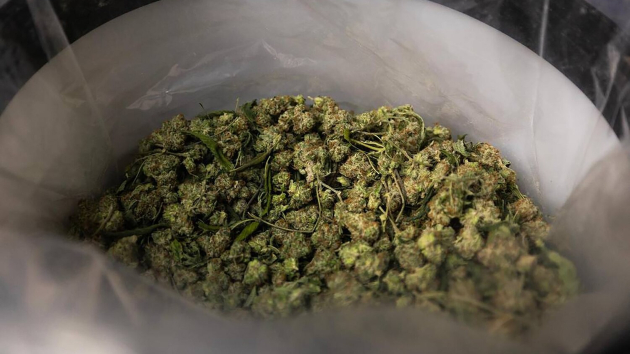
(WASHINGTON) — President Donald Trump on Monday confirmed he and his administration are considering reclassifying marijuana as a less dangerous drug.
Trump told reporters that it was early in the process but that he hoped to make a decision on the matter within the coming weeks.
“We’re looking at reclassification and we’ll make a determination over the next — I would say over the next few weeks, and that determination hopefully will be the right one. It’s very complicated subject,” Trump said as he held a news conference in the White House briefing room.
Trump was in the briefing room to announce a federal takeover of Washington’s police force and deployment of the National Guard to deal, he said, with the city’s crime and homelessness. He was asked at the news conference if reclassifying marijuana would send mixed messages as his administration says it wants to “clean up” crime in the nation’s capital and potentially other cities.
The Wall Street Journal first reported that Trump was weighing rescheduling marijuana from a Schedule 1 drug to a Schedule 3 drug.
Classified as a Schedule 1 drug, marijuana is listed alongside heroin and LSD as “drugs with no currently accepted medical use and a high potential for abuse.”
By contrast, Schedule 3 drugs are define as those with “moderate to low potential for physical and psychological dependence” and include ketamine, anabolic steroids and testosterone.
During the final year of the Biden administration, the Drug Enforcement Administration said it supported recommending the reclassification of marijuana.
Reclassifying marijuana would allow for more research into the drug and provide tax benefits to the cannabis industry.
Trump on Monday said he’s heard good and bad things regarding the drug.
“I’ve heard great things having to do with medical, and I’ve had bad things having to do with just about everything else. But medical, and, you know, for pain and various things,” Trump said.
“Some people like it, some people hate it,” the president said.
(WASHINGTON) — AI chipmakers Nvidia and Advanced Micro Devices struck an extraordinary accord to pay the United States government 15% of the revenue the two companies are set to make from products sold in China, a White House official confirmed to ABC News.
In exchange for the payment, the Trump administration will grant the companies export licenses for the AI chips, allowing the firms to tap into a large market in China.
The quid quo pro agreement between major corporations and the president holds little or no precedent. The Financial Times first reported the deal.
Speaking to reporters at the White House on Monday, Trump recounted the agreement with Nvidia. “I said, ‘If I’m going to do that, I want you to pay us as a country something, because I’m giving you a release,'” Trump said.
Here’s what to know about the deal reached between Nvidia, AMD and the Trump administration.
Trump green-lights AI chip exports to China
In recent years, Santa Clara, Calif.-based Nvidia has grown into one of the world’s largest companies as its advanced chips have fueled the rapid development of chatbots and other AI tools.
The company said last month that the Trump administration had granted the company permission to sell its H20 chip, a product specifically designed for sale to China. Nvidia developed the chip in compliance with export restrictions put in place by the Biden administration beginning in 2022.
Despite the Trump administration’s apparent green light last month, Nvidia did not receive licenses for chip exports to China over the ensuing weeks.
The deal recently struck between the Trump administration and Nvidia will allow the company to obtain the export licenses and begin the sale of chips in China, a White House official said. AMD, which offers an MI308 chip for Chinese customers, will also receive permission for such sales, the official added.
Some observers have opposed the sale of advanced AI chips in China, saying the technology would help the country keep up with the U.S. in the fast-growing AI industry. The Trump administration has previously challenged the view, describing Nvidia’s H20 chip as inferior to similar products sold in the U.S.
“We don’t sell them our best stuff, not our second best stuff, not even our third best,” Commerce Secretary Howard Lutnick told CNBC last month, referring to Nvidia’s H20 chip as its “fourth best.”
In a statement to ABC News, Nvidia did not directly comment on the terms of the agreement.
“We follow rules the U.S. government sets for our participation in worldwide markets,” Nvidia said. “While we haven’t shipped H20 to China for months, we hope export control rules will let America compete in China and worldwide. America cannot repeat 5G and lose telecommunication leadership. America’s AI tech stack can be the world’s standard if we race.”
AMD did not immediately respond to ABC News’ request for comment.
Chipmakers pay share of revenue to U.S. government
In exchange for approval of chip sales in China, Nvidia and AMD have agreed to pay the U.S. 15% of revenue derived from such business.
The move marks the Trump administration’s latest intervention in the affairs of an individual company. When Japan-based Nippon Steel acquired U.S. Steel in June, the Trump administration received a “golden share” that affords the White House significant influence over the company. The golden share allows the Trump administration to influence the makeup of the company’s board and assert veto power over a host of major decisions, though the White House does not retain a financial stake in the firm.
More recently, Trump last week called on the CEO of Intel, Lip-Bu Tan, to resign. In a message posted on social media, Trump accused Tan of being “HIGHLY conflicted.”
Trump did not explain why Tan should resign, nor did he provide evidence for his allegation of a conflict of interest. But the post came after Republican Sen. Tom Cotton raised concerns about Tan’s alleged ties to China. Tan is still the company’s CEO.
ABC News’ Michelle Stoddart contributed to this report.
(PITTSBURGH) — One person has died, two are believed to be unaccounted for and dozens are hurt following an explosion at a Pennsylvania steel plant on Monday, Allegheny County police said.
The blast at the U.S. Steel Clairton Coke Works plant in Clairton, about 15 miles outside of Pittsburgh, trapped people under rubble, prompting a rescue operation, according to Allegheny County officials.
The exact number of victims was not clear but many of the injuries are non-life-threatening, Allegheny County Emergency Services spokesperson Kasey Reigner said.
Allegheny County Director of Communications Abigail Gardner said the Health Department is on site monitoring air quality and Gov. Josh Shapiro said his administration is in touch with officials.
“The scene is still active, and folks nearby should follow the direction of local authorities,” the governor said on social media. “Please join Lori and me in praying for the Clairton community.”
The Bureau of Alcohol, Tobacco, Firearms and Explosives is also responding, according to a spokesman.
This is a developing story. Please check back for updates.
ABC News’ Michael Pappano contributed to this report.