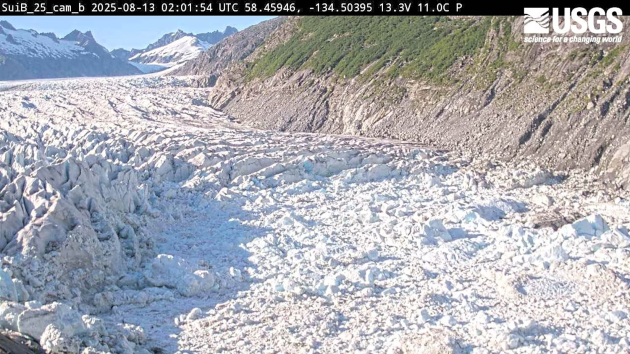
(JUNEAU, Alaska) — One of Alaska’s most populated cities is bracing for potentially catastrophic flooding as a basin dammed within the Mendenhall Glacier has started to release rainwater and snowmelt downstream, according to officials.
Suicide Basin, a side basin within the Mendenhall Glacier that sits above the city of Juneau, regularly releases glacier lake outburst floods, according to the National Weather Service. But recent measurements of water within the basement suggest the basin could release enough water to overwhelm the Mendenhall River and Mendenhall Lake, according to officials.
By 7 a.m. local time, the Mendenhall River had reached a major flood stage at 16.51 feet and was continuing to rise — surpassing the record flood stage set in 2024 of 15.99 feet, according to the NWS. Flood warnings have been issued for the lake and river due to the release.
Residents along the flood zones have been urged to evacuate the area, with the peak flooding expected Wednesday around 8 a.m. local time.
“Don’t Wait. Evacuate TONIGHT,” the City of Juneau wrote in a Facebook post Tuesday night.
City officials were warning residents early Wednesday to avoid driving on roads within the flood zone already inundated by water.
Alaska Sen. Lisa Murkowski posted to X on Wednesday, warning of how dire the situation could become.
“This is likely to become a life-threatening situation,” Murkowski said. “If you are told to evacuate, stop what you are doing and immediately go to an emergency shelter or another safe location.”
Floodwaters are expected to fall below the flood stage through Thursday, according to the NWS.
Mendenhall is a popular tourist attraction in Alaska, but the retreating glacier — which acts as a dam for Suicide Basin — has caused flooding in the region every summer in recent years after it refills with water from rain and melting snow in the spring.
In 2023, a glacier lake outburst at Mendenhall’s Suicide Basin destroyed several structures along the Mendenhall River as the water rushed downstream. The record flooding prompted city officials in Juneau to issue an emergency declaration.
The outburst, which caused a decade’s worth of erosion in one weekend, would not have happened without climate change, NOAA said in 2023. Alaska has warmed twice as fast as any U.S. state over the last several decades, according to NOAA’s National Centers for Environmental Information. Suicide Basin has been releasing glacier lake outburst floods since 2011, so the National Weather Service in Juneau’s monitoring program has a camera pointed directly at the basin to see how much water levels are rising and falling.
Glaciers in Alaska have been experiencing a steep decline since the late 1980s, according to the state’s Department of Geological and Geophysical Surveys.
Globally, glaciers are at risk of significant ice loss due to climate change, scientists say.
Glaciers around the world lost an estimated 7,211 billion tons of ice between 2000 and 2023, equating to an average annual loss of 301 billion tons, according to a Nature study published in February. The rate of ice loss has increased by about 36% in the past two decades, the researchers found.
Even if warming were to stabilize at current levels, the world’s glaciers would still likely lose at least 39% of mass, according to the World Economic Forum.
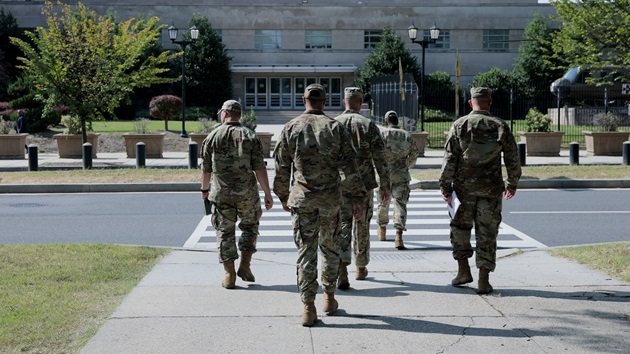
Members of the National Guard arrive at the Guard’s headquarters at the D.C. Armory on August 12, 2025 in Washington, DC. Anna Moneymaker/Getty Images
(WASHINGTON) — President Donald Trump said on Wednesday that he will seek more permanent federal control of the Washington, D.C., police force as he continues his efforts to ramp-up crime enforcement in the nation’s capital.
Earlier this week, Trump announced his plans to deploy National Guard troops in the nation’s capital, declaring a public safety emergency in order to put the Washington police department under federal control and station the National Guard on the city’s streets. Trump’s control of the D.C. police force expires in 30 days, after which Congress would have to weigh in.
Asked Wednesday whether he’d work with Congress to extend the emergency authorization allowing him to seize temporary control of local law enforcement, Trump said he’ll ask Congress for a “long-term” extension of federal control of the Washington police force.
“We’re going to be asking for extensions on that — long-term extensions, because you can’t have 30 days,” Trump said at an event at the Kennedy Center Wednesday afternoon.
Trump indicated at one point that he’d ask Congress for more funds to fight crime and to make repairs to Washington.
“We’re going to make Washington beautiful. We’re going to redo roads. We’re going to redo the medians. The pavers and the medians are all throughout the city. We’re going to take all the graffiti off. We’re going to have to remove the tents. And the people that are living in our parks, we’re going to be redoing the parks, the grasses and all. We’re going to be going to Congress for a relatively small amount of money. And Lindsey [Graham] and the Republicans are going to be approving it,” Trump said.
Trump has long threatened to take control of Washington, saying he wants to crack down on violent crime in the District although police statistics show that in the past two years, violent crime has fallen dramatically.
“Fighting crime is a good thing. We have to explain we’re going to fight crime — that’s a good thing,” Trump said Wednesday afternoon. “Already they’re saying, ‘He’s a dictator.’ The place is going to hell. We’ve got to stop it. So instead of saying, ‘He’s a dictator,’ they should say, ‘We’re going to join him and make Washington safe.'”
Trump pledged to make Washington “crime-free.”
“We’re going to be essentially crime-free. This is going to be a beacon, and it’s going to also serve as an example of what can be done,” Trump said.
On Tuesday night, more than 1,450 federal law enforcement officers and National Guard members patrolled Washington, according to a White House official. Forces made 43 arrests on Tuesday night — nearly twice the amount they made Monday night.
Those forces included 750 D.C. Metropolitan Police Department officers who were “uniformed, marked as patrol and directly assigned as anti-crime officers,” the White House official said. That was in addition to the federal law enforcement who had been previously mobilized in the area. The White House official said that there were about 30 National Guard troops on the ground last night.
The forces, which included 19 inter-agency teams, were “deployed throughout all seven districts in D.C. to promote public safety and arrest violent offenders,” the White House official said.
After Trump’s announcement Monday, approximately 850 officers and agents fanned out over D.C. right after Trump declared a crime emergency in the capital, making 23 arrests, White House press secretary Karoline Leavitt said Tuesday.
The surge in federal law enforcement has yielded more than 100 total arrests since Aug. 7, according to a White House official. The official said that the charges have included one homicide charge, seven narcotics charges, 33 firearms charges, 10 warrants, 23 charges against undocumented immigrants and 29 other charges. The official adds that they have seized 24 firearms since operations began.
The official said that on Wednesday night they expect “significantly higher National Guard presence to be on the ground throughout Washington, D.C.” The White House official adds that beginning Wednesday night, the operations will transition to round-the-clock, 24/7 operations. Operations had been previously focused on evening and overnight hours.
On Tuesday, National Guard troops were spotted on the National Mall, with many stationed around the base of the Washington Monument. The troops left Wednesday morning. It was not immediately clear why the presence of U.S. troops along the National Mall was needed, other than to put Trump’s orders on display. The area, marked by museums, monuments and long stretches of grass, is known as a relatively safe part of the city that attracts mostly tourists and school groups.
(WASHINGTON) — A federal appeals court has reversed a lower court’s ruling, clearing the way for the Trump administration to cut billions in foreign aid funding this year.
In a 2-1 decision Wednesday, the U.S. Court of Appeals for the D.C. Circuit overruled a lower court’s decision that prohibited the Trump administration from making drastic cuts to USAID funding that had already approved by Congress.
The court sidestepped the substantive question of whether the cuts were constitutional, instead deciding that the nonprofits that sued the Trump administration lacked the standing to bring a case.
Judges Karen Henderson and Gregory Katsas — appointed by Presidents George H. W. Bush and Donald Trump, respectively — determined that only the head of the Government Accountability Office has the authority to sue under the Impoundment Control Act.
“The district court erred in granting that relief because the grantees lack a cause of action to press their claims,” the majority wrote.
The lawsuit over USAID funding had been one of the first major legal successes for nonprofits challenging the Trump administration, which ordered the suspension of grants that didn’t comply with the president’s priorities.
After U.S. District Judge Amir Ali issued a temporary restraining order in February blocking Trump’s executive order from taking effect, both the D.C. circuit court and the United States Supreme Court sided with the nonprofits, denying a request from the Trump administration to block an order enforcing the TRO.
In a dissenting opinion issued with Wednesday’s ruling, Judge Florence Pan, a Biden appointee, criticized her colleagues for ignoring the concern that the funding cuts were unconstitutional and thus harmed “the rule of law and the very structure of our government.”
“At bottom, the court’s acquiescence in and facilitation of the Executive’s unlawful behavior derails the ‘carefully crafted system of checked and balanced power’ that serves as the ‘greatest security against tyranny — the accumulation of excessive authority in a single Branch,” she wrote.
On Tuesday night, more than 1,450 federal law enforcement officers and National Guard members patrolled Washington, according to a White House official. Forces made 43 arrests on Tuesday night — nearly twice the amount they made Monday night.
Those forces included 750 D.C. Metropolitan Police Department officers who were “uniformed, marked as patrol and directly assigned as anti-crime officers,” the White House official said. That was in addition to the federal law enforcement who had been previously mobilized in the area. The White House official said that there were about 30 National Guard troops on the ground last night.
The forces, which included 19 inter-agency teams, were “deployed throughout all seven districts in D.C. to promote public safety and arrest violent offenders,” the White House official said.
On Monday, Trump announced his plans to deploy National Guard troops in the nation’s capital, declaring a public safety emergency in order to put the Washington police department under federal control and station the National Guard on the city’s streets. Trump’s control of the D.C. police force expires in 30 days, after which Congress would have to weigh in.
Trump has long threatened to take control of Washington, saying he wants to crack down on violent crime in the district although police statistics show that in the past two years, violent crime in Washington has fallen dramatically.
“Fighting crime is a good thing. We have to explain we’re going to fight crime — that’s a good thing,” Trump said of the effort during an event at the Kennedy Center Wednesday afternoon. “Already they’re saying, ‘He’s a dictator.’ The place is going to hell. We’ve got to stop it. So instead of saying, ‘He’s a dictator,’ they should say, ‘We’re going to join him and make Washington safe.'”
After Trump’s announcement Monday, approximately 850 officers and agents fanned out over D.C. right after Trump declared a crime emergency in the capital, making 23 arrests, White House press secretary Karoline Leavitt said Tuesday.
The surge in federal law enforcement has yielded more than 100 total arrests since Aug. 7, according to a White House official. The official said that the charges have included one homicide charge, seven narcotics charges, 33 firearms charges, 10 warrants, 23 charges against undocumented immigrants and 29 other charges. The official adds that they have seized 24 firearms since operations began.
The official said that on Wednesday night they expect “significantly higher National Guard presence to be on the ground throughout Washington, D.C.” The White House official adds that beginning Wednesday night, the operations will transition to round-the-clock, 24/7 operations. Operations had been previously focused on evening and overnight hours.
On Tuesday, National Guard troops were spotted on the National Mall, with many stationed around the base of the Washington Monument. The troops left Wednesday morning. It was not immediately clear why the presence of U.S. troops along the National Mall was needed, other than to put Trump’s orders on display. The area, marked by museums, monuments and long stretches of grass, is known as a relatively safe part of the city that attracts mostly tourists and school groups.
In this photo released by the National Parks Service, Blake Kieckhafer is shown. Courtesy National Parks Service
(ROCKY MOUNTAIN NATIONAL PARK, Colo.) — Rocky Mountain Park Rangers are searching for a 23-year-old Nebraska man who went missing in the Colorado park after he was dropped off there by a ride share service last week, the National Park Service (NPS) said.
Blake Kieckhafer was reported missing to park rangers on Monday, according to NPS.
He was last seen in the Upper Beaver Meadows area of the park last Thursday at around 5:20 p.m. when he was dropped off, the park service said.
Upper Beaver Meadows Road is about a mile west of Beaver Meadows Entrance, on the east side of the park near U.S. Highway 36, according to NPS.
He was wearing a dark T-shirt, dark pants and a dark baseball cap with no logo, officials said. He was also carrying a small maroon daypack, they noted.
Kieckhafer is 5 foot 11 inches, weighs about 180 pounds, has buzzed, short blonde hair, a mustache and blue-green eyes, NPS said.
“If you have information that could help investigators or if you have seen Blake Kieckhafer, please contact us. You don’t have to tell us who you are, but please tell us what you know,” NPS said in a statement Wednesday.
The service noted that anyone with information can call or text the National Park Service Investigative Services Bureau Tip Line at 888-653-0009, fill in their online form or email them.
Stock image of stethoscope. ATU Images/Getty Images
(NEW YORK) — The labor market slowed sharply this summer, leaving job applicants with fewer places to turn for a new position.
Employers added an average of about 35,000 jobs over three months ending in July, which marks a major slowdown from roughly 128,000 jobs added monthly over the prior three months, the U.S. Bureau of Labor Statistics said earlier this month.
The hiring cooldown has hit nearly every industry, including manufacturing, leisure and hospitality and the federal government.
But two industries have bucked the trend: Health care and social assistance, the latter of which comprises services like child care and counseling, economists told ABC News. If not for job growth in those two sectors, the labor market would have suffered net job losses over the past three months.
“This is a job market where growth is very thin,” Daniel Zhao, chief economist at job-posting site Glassdoor, told ABC News. “Unfortunately, there aren’t many industries growing consistently and robustly.”
“The job market is being propped up by health care and social assistance,” Zhao added.
Health care
The health care sector added 55,000 jobs in July, which amounted to three of every four jobs added across the U.S. economy last month, BLS data showed. The performance in July extended robust growth that stretches back several years, economists said.
“There’s clearly an industry that stands out right now and that would be health care,” Cory Stahle, an economist at Indeed Hiring Lab, told ABC News.
The gangbusters hiring in the health care sector owes to two overlapping trends, economists said: persistent demand for health care from an aging population and ongoing recovery from job losses during the COVID-19 pandemic.
Unlike discretionary costs like luxury goods or restaurant dining, health care services are a necessity taken up by consumers regardless of financial conditions, economists said.
“Health care is a non-optional industry,” Stahle said. “If you need health care, you need health care.”
As the baby-boomer generation has aged, a growing share of people have experienced such healthcare needs. Between 2012 and 2050, the population of older people – aged 65 and above – is expected to nearly double from about 43 million to 83 million, the U.S. Census Bureau found in 2014.
Robust consumer demand has coincided with a shortage of workers in the aftermath of widespread job losses as health care professionals suffered burnout during the COVID-19 pandemic.
While overall employment in the sector has recovered to pre-pandemic levels, the new workers have been unevenly distributed, leaving shortages at workplaces such as skilled nursing facilities and intensive behavioral health centers, researchers at the University of Michigan found in June.
“We do expect job growth in health care to continue as the U.S. population ages and demand for health services continues to rise,” Zhao said.
Social assistance
Social assistance, the provision of support and emergency relief services, makes up the other bright spot in the job market.
The sector added 18,000 jobs in July, accounting for nearly one of every four jobs added last month, BLS data showed.
A subset of the sector, referred to by the descriptor “individual and family services,” accounted for all of the jobs added in July. Such work is made up of counseling, welfare and referral services.
Employers have continued to hire for therapist roles, despite a slowdown in the wider job market, Stahle said, citing job postings on Indeed.
If the economy tips into a recession, the industry will likely continue to grow, since a larger share of the population would need assistance in the event of financial hardship, Zhao said.
“This is a sector that grows even during bad times, because there is a demand for more social assistance when the economy is poor and people do need those services,” Zhao added.
Positions in the sector are not typically well compensated, however. Average hourly earnings in social assistance clocked in at $23.60 in June, the most recent month for which such data is available. That pay level came in well below an average of $36.32 per hour across the private sector, BLS data showed.
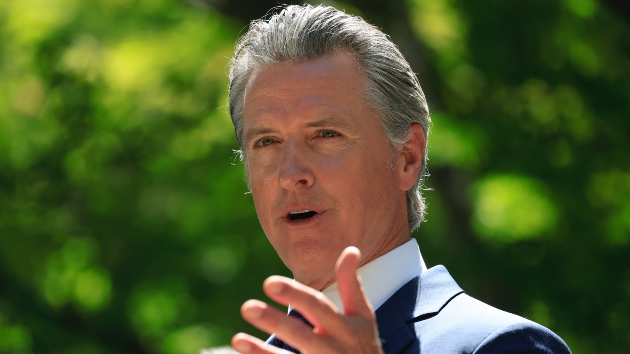
California Gov. Gavin Newsom speaks during a news conference with Texas lawmakers at the Governor’s Mansion on July 25, 2025 in Sacramento, California/Photo by Justin Sullivan/Getty Images
(SACRAMENTO, Calif.) — California Gov. Gavin Newsom said California will move forward with drawing new congressional maps that he said “WILL END THE TRUMP PRESIDENCY” and allow Democrats to take control of the U.S. House of Representatives.
“DONALD ‘TACO’ TRUMP, AS MANY CALL HIM, ‘MISSED’ THE DEADLINE!!! CALIFORNIA WILL NOW DRAW NEW, MORE ‘BEAUTIFUL MAPS,’ THEY WILL BE HISTORIC AS THEY WILL END THE TRUMP PRESIDENCY (DEMS TAKE BACK THE HOUSE!),” Newsom wrote Tuesday night, in a post written in the style of President Donald Trump’s occasionally all-caps social media posts.
The redistricting battle in Texas — and potentially other states — has national implications, with control of the U.S. House potentially at stake. The Texas GOP’s proposed congressional map could net Republicans between three and five seats in next year’s midterm elections — seats that could make a difference as Republicans work to maintain their small majority in the U.S. House.
A spokesperson for California State Assembly Speaker Robert Rivas confirmed to ABC News that the state legislature is aiming to release draft maps on Friday.
Newsom’s post did not offer any details on the maps or how he plans to get them approved, although Newsom has said previously he would consider trying to have maps on the ballot in a special election in November.
The California governor said he would be part of a press conference this week with “powerful” Democrats, but didn’t offer details about who would be in attendance.
Newsom sent a letter to Trump on Monday asking the president to tell Texas Gov. Greg Abbott and other Republican governors to abandon efforts to draw new congressional maps. Texas Democrats have fled the state in protest of the maps.
The Texas House of Representatives was once again unable to reach a quorum Tuesday. Texas House Speaker Dustin Burrows said that the House will convene once again on Friday, adding if there’s no quorum by then, Abbott will adjourn the current session and call a second special session to begin immediately.
California Gov. Gavin Newsom speaks during a news conference with Texas lawmakers at the Governor’s Mansion on July 25, 2025 in Sacramento, California/Photo by Justin Sullivan/Getty Images
(SACRAMENTO, Calif.) — California Gov. Gavin Newsom said California will move forward with drawing new congressional maps that he said “WILL END THE TRUMP PRESIDENCY” and allow Democrats to take control of the U.S. House of Representatives.
“DONALD ‘TACO’ TRUMP, AS MANY CALL HIM, ‘MISSED’ THE DEADLINE!!! CALIFORNIA WILL NOW DRAW NEW, MORE ‘BEAUTIFUL MAPS,’ THEY WILL BE HISTORIC AS THEY WILL END THE TRUMP PRESIDENCY (DEMS TAKE BACK THE HOUSE!),” Newsom wrote Tuesday night, in a post written in the style of President Donald Trump’s occasionally all-caps social media posts.
The announcement comes amid Texas Republicans’ efforts to redraw congressional maps in their party’s favor. The redistricting showdown in Texas has led blue states to threaten to retaliate — with Newsom proposing to cut five GOP-held seats in California.
The redistricting battle in Texas — and potentially other states — has national implications, with control of the U.S. House potentially at stake. The Texas GOP’s proposed congressional map could net Republicans between three and five seats in next year’s midterm elections — seats that could make a difference as Republicans work to maintain their small majority in the U.S. House.
A spokesperson for California State Assembly Speaker Robert Rivas confirmed to ABC News that the state legislature is aiming to release draft maps on Friday.
Newsom’s post did not offer any details on the maps or how he plans to get them approved, although Newsom has said previously he would consider trying to have maps on the ballot in a special election in November.
The California governor said he would be part of a press conference this week with “powerful” Democrats, but didn’t offer details about who would be in attendance.
Newsom sent a letter to Trump on Monday asking the president to tell Texas Gov. Greg Abbott and other Republican governors to abandon efforts to draw new congressional maps. Texas Democrats have fled the state in protest of the maps.
The Texas House of Representatives was once again unable to reach a quorum Tuesday. Texas House Speaker Dustin Burrows said that the House will convene once again on Friday, adding if there’s no quorum by then, Abbott will adjourn the current session and call a second special session to begin immediately.
Smoke rises from the area following an Israeli attack on former Social Development building on August 13, 2025 in Rafah, Gaza. Photo by Ali Jadallah/Anadolu via Getty Images
(LONDON) — Israel Defense Forces Chief of Staff Maj. Gen. Eyal Zamir on Wednesday approved “the main framework for the IDF’s operational plan in the Gaza Strip,” according to an IDF spokesperson.
“As part of the discussion, IDF operations to date were presented, including an attack in the Zeitoun area that began yesterday,” the spokesperson said in a statement.
“The central concept for the plan for the next stages in the Gaza Strip was presented and approved, in accordance with the directive of the political echelon,” the spokesperson added.
Last week, Israeli Prime Minister Benjamin Netanyahu and his security cabinet approved plans for the IDF to seize and occupy Gaza City — the strip’s largest urban area — as part of an expanded military operation to “demilitarize” the strip and remove Hamas from power.
The operation would force the IDF to operate in areas where Israel believes Hamas is holding living hostages.
Netanyahu set out “five principles” for the end of the war.
“One, Hamas disarmed. Second, all hostages freed. Third, Gaza demilitarized. Fourth, Israel has overriding security control. And five, non-Israeli, peaceful civil administration — by that I mean a civilian administration that doesn’t educate its children for terror, that doesn’t pay terrorists and doesn’t launch terrorist attacks against Israel.”
Netanyahu’s plans to expand the war have been sharply criticized by the families of the hostages who call it a death sentence for their loved ones. Israel believes 20 hostages are still alive in Hamas captivity — the terror group is also holding the bodies of 30 killed hostages.
Hospitals across Gaza recorded 123 deaths and 437 injuries over the previous 24 hours, Gaza’s Hamas-run Ministry of Health said Wednesday.
Among the dead were 21 people killed while trying to collect humanitarian aid, the ministry said, while another 185 people were injured.
Eight deaths due to hunger were also recorded across Gaza, the ministry said on Wednesday.
ABC News’ Morgan Winsor and Diaa Ostaz contributed to this report.
Ukraine’s then-Foreign Minister Dmytro Kuleba is pictured in Kyiv, Ukraine, on June 3, 2024./ Nurphoto/NurPhoto via Getty Images
(LONDON) — Dmytro Kuleba, who served as Ukraine’s foreign minister from 2020 to 2024 and was the youngest-ever appointed to the post, has no plans to rush back into the fray. But he retains deep convictions about Ukraine’s ongoing struggle against Russia’s full-scale invasion — and about the man he considers the prime obstacle to peace in Europe.
“It is the saddest thing, I have to say, but I do not see the end to this war in sight,” Kuleba told ABC News in a video interview from Kyiv, just under a year after he left his role as part of a sweeping government reshuffle.
“A ceasefire is possible, but ending the war as a result of the ceasefire does not seem to be possible at this stage,” Kuleba said. Even if Russian President Vladimir Putin “agrees to a ceasefire in order to avoid mounting pressure from the United States — the threat of mounting pressure from the United States — it will only be a pause,” he said.
No longer encumbered by the demands put on the country’s top diplomat, Kuleba has been speaking frankly on Kyiv’s situation and outlook since departing his former role.
Kuleba’s country remains under existential threat, more than three-and-a-half years into a full-scale Russian invasion. As the war wears on and its toll rises unrelentingly, President Donald Trump’s efforts to force a ceasefire and peace appear to be stalled.
Friday’s planned summit in Alaska between Trump and Putin has suddenly raised hopes that a deal may be possible, according to observers. But Kuleba urged caution over any apparent breakthroughs — particularly if they offer strategic opportunities for the Kremlin.
“There is a famous saying that if you see the light in the end of the tunnel, make sure it is not an incoming train,” Kuleba said. “The light of ceasefire in the end of the tunnel of the Russia-Ukraine war is actually an incoming train.”
Ukraine has backed the previous U.S. demand for a full and immediate ceasefire, during which time a peace settlement can be reached. Putin has repeatedly dodged ceasefire proposals, suggesting that the “new territorial realities” of Russian occupation of swaths of southern and eastern Ukraine must be recognized as part of any settlement.
Putin has also dismissed Kyiv’s offers of a direct meeting with Ukrainian counterpart Volodymyr Zelenskyy — a leader he has repeatedly and incorrectly framed as illegitimate, although he is a democratically elected leader.
Putin, Kuleba said, has shown no sign of abandoning his maximalist war goals, with or without a U.S.-brokered ceasefire. A pause in the fighting may only prove an opportunity for Moscow to prepare its next offensive, he said.
“I think Putin has said enough over the last years and Russia has done enough over the last years to make the point that their strategic goal is subjugating Ukraine as a whole,” he said.
‘He cannot lose this war’
As Ukraine’s top diplomat, Kuleba was deeply involved in peace talks with Russia that sought to end the full-scale invasion that began in 2022. In March 2022, just weeks after Russia’s full-scale invasion began, Kuleba met with Russian counterpart Sergei Lavrov in Turkey.
More than three years later, he said Putin’s fixation on a Russian historical narrative imbued with disinformation and chauvinism remains the main obstacle to a long-term resolution.
“The only thing President Putin really cares about is what will be written about him in history books,” he said. “He just cannot lose this war. He can pretend he’s winning it. But he can never drop the ambition, give up on the ambition, to subjugate Ukraine.”
Putin, Kuleba says, sees himself in the company of Russia’s great historic leaders like Ivan the Terrible, Peter the Great, Catherine the Great. All expanded the Russian empire — and subjugated the people and areas that now form Ukraine.
“He put all of his bets on this — this is his major legacy issue,” Kuleba said. “He throws everything into the fire of his legacy — his people, his country, his future, its future — because he doesn’t care about them.”
Asked if the Russia-Ukraine war can end while Putin is still alive, Kuleba responded, “No.”
“We can have a war of a much lower intensity with Russia,” he added. “But I cannot imagine eternal peace between Russia and Ukraine achieved during President Putin’s lifetime.”
“The West should not be afraid of who comes next,” Kuleba said when asked whether the next Russian president could be equally problematic. “Nothing helps Putin more to stay in power than the fear entrenched in Western intellectual circles that someone even worse than him can move in,” he said.
“This is a flawed strategy,” he said. “Ukrainians are paying the highest price for it. Europe will be paying a very high price for it if it continues like this.”
In Kyiv, Zelenskyy and his officials are sticking to their key demands. Ukraine’s intended accession to NATO and the EU is enshrined in the national constitution. Zelenskyy has also repeatedly dismissed any suggestion of surrendering Ukrainian territory in any peace deal. “Ukrainians will not give their land to the occupier,” he said last week.
Will Trump ‘walk the walk?’
Ukraine’s Western partners still have not done enough to help Kyiv succeed, Kuleba said, though he stressed that all Ukrainians are “immensely grateful and we will always remember it.”
European nations have collectively given some $182 billion in aid of all kinds to Ukraine as of April 2025, according to the Kiel Institute for the World Economy — a research group based in Germany that tracks support from foreign governments toward Ukraine. The U.S. has contributed around $133.5 billion, the institute said.
“I’ve been asked many times over the last three years — has the West supported Ukraine enough?” Kuleba said. “If the war is still raging, it means that the answer is no, not enough.”
Trump’s return to office posed the danger of a total U.S. withdrawal from the conflict. Recent months, though, have seen growing White House frustration at Putin’s apparent obstinance in continuing his war.
Kuleba sees a clear “evolution” in Trump’s approach. “He spent the first months of his presidency giving all sticks to Ukraine and offering all carrots to Russia as a negotiating strategy. It failed. So, now what we see today is his attempt to rebalance sticks and carrots among belligerent parties.”
Ukraine hears Trump’s threats, but is yet to see action, Kuleba said. “Putin understands only force,” he added. Without it, “he will come to the same conclusion he made about previous administrations and European governments — they talk the talk, but they don’t walk the walk.”
Trump, unlike Putin, is constrained by time, Kuleba said. “Putin will not be in a rush to accommodate Trump.”
The two salient options, Kuleba said, are “arming Ukraine and stripping Russia of its oil revenues. That’s it. Everything else may sound good, will be helpful, but it has zero chance to change the tide. A combination of these two factors is crucial to make Putin seriously think about revising his goals in this war.”
Meanwhile, Kuleba said Europeans should be bracing for the war to come to them.
Putin, Kuleba said, only needs one day of hesitation at NATO and European Union headquarters in Brussels to press an attack. “As it looks today, Putin will have his day of hesitation,” he said.
“Both headquarters realize that and they work tirelessly to mitigate this risk, to create a more holistic, coherent space. But I’m afraid there is still a long way to go to achieve that.”
Ukrainian policy still reflects Kuleba’s outlook, though he is no longer involved in its creation. His replacement, current Foreign Minister Andrii Sybiha, has continued Kuleba’s work in pressing Western partners to provide more aid and to do so faster.
Along with Zelenskyy’s office, Sybiha has repeatedly warned that without intense Western pressure, Putin and his government cannot be trusted to negotiate in good faith or to abide by any ceasefire or peace deal.
Ukraine’s ‘red lines’
Kuleba offered a sober assessment of Ukraine’s military situation, as Russian forces continue their grinding advance in the east of the country and expand their long-range drone and missile bombardments of cities across Ukraine.
Ukraine’s size, its industrial capabilities and Western support bolster its war effort, he said. “Remove one of these elements in the equation and then everything collapses,” he added.
And for all the talk of expanded American and European military aid, Kuleba cautioned against investing too much hope in any silver bullets.
“We should forget once and forever the idea of a magic weapon that will change the game,” he said. “This tune has been played so many times over three years and none of it worked,” Kuleba continued, recalling drawn-out debates and sensationalism over the supply of weapons systems like the ATACMS, Western tanks and F-16 fighter jets.
“What is required is the systemic effort to provide Ukraine with the weapons — all types of weapons — and intelligence information that it requires, in sufficient quantities and in good time that it requires to stabilize the front line.”
“The moment Putin has no news to deliver to his people that he’s making progress on the front line will also be an important factor in making him rethink or revise his goals in this war,” he said.
Ukraine has its own red lines in negotiations, he said. He said the government will not have public backing to agree to legally recognize Russian occupation of Ukrainian territory, limit the size and sophistication of Ukraine’s armed forces or abandon Kyiv’s NATO ambitions — a goal enshrined in the national constitution.
The government will not be able to agree to legally recognize Russian occupation of Ukrainian territory — which the nati — or limit the size and sophistication of Ukraine’s armed forces or abandon Kyiv’s NATO ambitions, Kuleba said.
“It would be a political suicide to do that,” he warned — a sentiment broadly shared by Ukrainian political analysts, though such thorny concessions will no doubt be under discussion within the president’s office.
Recent polling suggests Kuleba is correct. A survey conducted by the Kyiv International Institute of Sociology in July and August, for example, found that 76% of Ukrainians rejected Russia’s proposed peace plan, which would include Ukraine abandoning NATO accession, limiting its army and surrendering several southern and eastern regions.
Recent weeks have shown the potency of Ukrainian people power. Street protests erupted around the country last month after Zelenskyy’s government and the Ukrainian parliament approved a new law curtailing the independence of two key anti-corruption agencies.
The president was forced into a quick reversal as Ukrainian civil society and Western leaders expressed their concern over the bill. The brief crisis “was a very healthy thing for Ukrainian democracy,” Kuleba said. “I think that we came out of this crisis stronger than we were before that.”
Ukrainians, he added, are keenly focused on their political future despite the ongoing war. Last month’s anti-corruption groundswell only sharpened such sentiment, he said. The turmoil also revitalized talk of the post-war elections — currently delayed due to martial law — that will shape the country’s path, he added.
As for Kuleba, the former minister said he is in no hurry to return to public office. “It makes me very happy to spend more time at home,” he said.
“A diplomat’s life is when you know foreign countries better than your own country. So, I’m now correcting this professional mistake,” he added.
When the war does end, Kuleba said, Ukraine could face a political reckoning.
“When the war suppresses the politics for three years, the politics do not go away,” he explained. “The moment there is no war, the moment there is an open, full-fledged democratic political process, all of this energy is going to burst out. And there is a huge, big risk in that.”
Millions of veterans will form a potent voting bloc, he added. “I do not believe that there is a threat of a military takeover in Ukraine — no, this is not going to happen,” Kuleba said. “But people with combat experience will have a different sense of justice. And they will be demanding a higher role in politics.”
The good news, Kuleba said, is that the war is forging a “clear vision” of Ukraine’s Western — not Eastern — future.
“We will be far more politically consolidated in the sense that independence of Ukraine, its Western orientation, will not be questioned,” he said. “But we will be divided along the lines of populism and understanding of the sense of justice in the post-war era.”