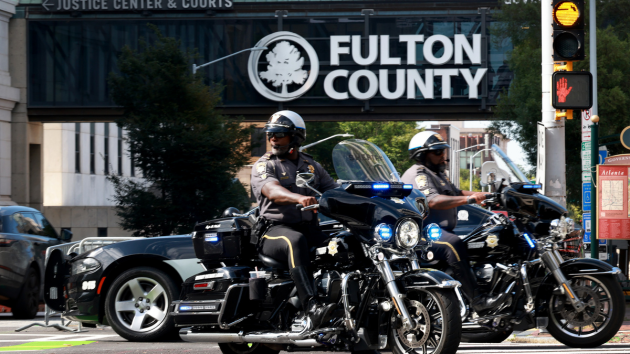
Fulton County Sheriff officers in front of the Fulton County Courthouse on September 06, 2023 in Atlanta, Georgia. Former U.S. President Donald Trump has entered a not-guilty plea and waived his right to appear at an arraignment hearing. Trump and his 18 co-defendants are charged in a 41-count indictment accusing them of scheming to overturn Georgia’s 2020 presidential election results. (Photo by Joe Raedle/Getty Images)
(FULTON COUNTY, Ga.) — Officials in Fulton County, Georgia, are renewing their effort to have the 2020 election files seized from their election office last month returned, arguing that a recently unsealed search warrant application falls “woefully short” of establishing probable cause of a crime.
In a court filing Tuesday, attorneys for Fulton County argued that the FBI agent behind the search warrant application “intentionally or recklessly omitted material facts” about purported discrepancies in the 2020 election in Georgia, after the Justice Department last week released the sworn affidavit that was the basis for the search warrant.
“Despite years of investigations of the 2020 election, the Affidavit does not identify facts that establish probable cause that anyone committed a crime,” Tuesday’s filing from Fulton County said.
FBI agents on Jan. 28 seized 700 boxes containing ballots and other materials associated with the 2020 election from Fulton County’s Elections Hub and Operations Center after obtaining a search warrant. President Donald Trump has repeatedly made baseless claims that there was voter fraud in the 2020 election, specifically in Georgia, despite Georgia officials auditing and certifying the results and courts rejecting numerous lawsuits challenging the election’s outcome.
FBI Special Agent Hugh Raymond Evans said in the sworn affidavit that following the 2020 election “there were many allegations of electoral impropriety relating to the voting process and ballot counting in Fulton County, Georgia” and that “Some of those allegations have been disproven while some of those allegations have been substantiated, including through admissions by Fulton County.”
Fulton County filed a motion earlier this month seeking the return of the records, and revised its request in light of the recently unsealed affidavit. They argue that the FBI’s investigation focuses on “human errors that its own sources confirm occur in almost every election … without any intentional wrongdoing whatsoever.”
“The Affidavit omits numerous material facts — including from the very reports and publicly-disclosed investigations that the Affiant cites — that confirm the alleged conduct was previously investigated and found to be unintentional,” the filing said.
Attorneys also argued that the FBI’s witnesses are unreliable and that the FBI failed to disclose information that would discredit its own witnesses.
“The Affiant failed to include facts — including from the very sources he cited — that shut the door on even the faintest possibility of probable cause,” the filing said.
Fulton County Sheriff officers in front of the Fulton County Courthouse on September 06, 2023 in Atlanta, Georgia. Former U.S. President Donald Trump has entered a not-guilty plea and waived his right to appear at an arraignment hearing. Trump and his 18 co-defendants are charged in a 41-count indictment accusing them of scheming to overturn Georgia’s 2020 presidential election results. (Photo by Joe Raedle/Getty Images)
(FULTON COUNTY, Ga.) — Officials in Fulton County, Georgia, are renewing their effort to have the 2020 election files seized from their election office last month returned, arguing that a recently unsealed search warrant application falls “woefully short” of establishing probable cause of a crime.
In a court filing Tuesday, attorneys for Fulton County argued that the FBI agent behind the search warrant application “intentionally or recklessly omitted material facts” about purported discrepancies in the 2020 election in Georgia, after the Justice Department last week released the sworn affidavit that was the basis for the search warrant.
“Despite years of investigations of the 2020 election, the Affidavit does not identify facts that establish probable cause that anyone committed a crime,” Tuesday’s filing from Fulton County said.
FBI agents on Jan. 28 seized 700 boxes containing ballots and other materials associated with the 2020 election from Fulton County’s Elections Hub and Operations Center after obtaining a search warrant. President Donald Trump has repeatedly made baseless claims that there was voter fraud in the 2020 election, specifically in Georgia, despite Georgia officials auditing and certifying the results and courts rejecting numerous lawsuits challenging the election’s outcome.
FBI Special Agent Hugh Raymond Evans said in the sworn affidavit that following the 2020 election “there were many allegations of electoral impropriety relating to the voting process and ballot counting in Fulton County, Georgia” and that “Some of those allegations have been disproven while some of those allegations have been substantiated, including through admissions by Fulton County.”
Fulton County filed a motion earlier this month seeking the return of the records, and revised its request in light of the recently unsealed affidavit. They argue that the FBI’s investigation focuses on “human errors that its own sources confirm occur in almost every election … without any intentional wrongdoing whatsoever.”
“The Affidavit omits numerous material facts — including from the very reports and publicly-disclosed investigations that the Affiant cites — that confirm the alleged conduct was previously investigated and found to be unintentional,” the filing said.
Attorneys also argued that the FBI’s witnesses are unreliable and that the FBI failed to disclose information that would discredit its own witnesses.
“The Affiant failed to include facts — including from the very sources he cited — that shut the door on even the faintest possibility of probable cause,” the filing said.
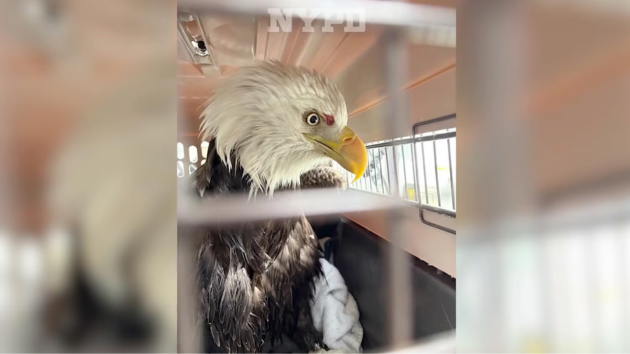
NYPD officers help rescue an injured bald eagle on the Hudson River in New York, Feb. 17, 2026. (NYPD)
(NEW YORK) — While surveying ice during a training exercise on the Hudson River on Tuesday, a New York City police officer with the department’s Harbor Unit spotted something unusual.
“Last week, when it was cold, a lot of stuff was getting stuck in the ice, whether it was a float, a buoy, but it looked different,” Officer Michael Russo told reporters on Wednesday. “I could see this white head from a distance. So I said, let’s get a little closer. I said, it looks like an eagle. And turns out it was an American bald eagle.”
Russo, a 16-year veteran of the NYPD’s Harbor Unit, said officers have rescued distressed boaters, sick cruise ship passengers and animals such as dogs while patrolling the city’s waterways. Though a bald eagle was a first.
The injured bird was screeching, wet and bloody, and as the boat approached, it didn’t leave the ice it was floating on, officers said.
Officers said they consulted with the state’s Department of Environmental Conservation to see if they should retrieve the bird, and once given the go-ahead, looked up how to safely do that.
“As we got closer, we put a plan together,” Russo said. “We used a catch noose to kind of subdue its wings from flapping and its claws.”
Another officer, Sgt. Michael Amello, then put a cloth over the bird’s head, to help keep it calm, and got it on board the boat.
“Once we did that, it really didn’t give us a hard time,” Russo said. “I think it kind of knew that we were trying to help it.”
The officers were worried about the bird’s large talons throughout the rescue.
“They don’t really train you for, you know, handling a bald eagle, but we made it work,” Amello told reporters. “It was impressive and kind of scary at the same time, being that close to a bald eagle. The talons were pretty long. But it came on, didn’t put up much of a fight. It was compliant.”
The officers kept the bird on board until they were able to meet with personnel from the state’s Department of Environmental Conservation.
“It’s an impressive creature. Even in its state, we were kind of taken back by how big it is and just the way it is, and the beauty of it,” Det. Nicholas Martin with the NYPD Harbor Unit told reporters. “It was impressive, to say the least.”
The bald eagle has since been brought to a sanctuary in New Jersey and was reported to be in stable condition, officers said.
The Raptor Trust, a wild bird rehabilitation center in Millington, New Jersey, said Wednesday that the bird is in their care and is “currently in very serious condition.”
“We are doing our best to keep the bird stable, and should it improve, we will do further diagnostics, x-rays and blood work to help determine a course of action going forward,” the center said in a statement.
NYPD officers help rescue an injured bald eagle on the Hudson River in New York, Feb. 17, 2026. (NYPD)
(NEW YORK) — While surveying ice during a training exercise on the Hudson River on Tuesday, a New York City police officer with the department’s Harbor Unit spotted something unusual.
“Last week, when it was cold, a lot of stuff was getting stuck in the ice, whether it was a float, a buoy, but it looked different,” Officer Michael Russo told reporters on Wednesday. “I could see this white head from a distance. So I said, let’s get a little closer. I said, it looks like an eagle. And turns out it was an American bald eagle.”
Russo, a 16-year veteran of the NYPD’s Harbor Unit, said officers have rescued distressed boaters, sick cruise ship passengers and animals such as dogs while patrolling the city’s waterways. Though a bald eagle was a first.
The injured bird was screeching, wet and bloody, and as the boat approached, it didn’t leave the ice it was floating on, officers said.
Officers said they consulted with the state’s Department of Environmental Conservation to see if they should retrieve the bird, and once given the go-ahead, looked up how to safely do that.
“As we got closer, we put a plan together,” Russo said. “We used a catch noose to kind of subdue its wings from flapping and its claws.”
Another officer, Sgt. Michael Amello, then put a cloth over the bird’s head, to help keep it calm, and got it on board the boat.
“Once we did that, it really didn’t give us a hard time,” Russo said. “I think it kind of knew that we were trying to help it.”
The officers were worried about the bird’s large talons throughout the rescue.
“They don’t really train you for, you know, handling a bald eagle, but we made it work,” Amello told reporters. “It was impressive and kind of scary at the same time, being that close to a bald eagle. The talons were pretty long. But it came on, didn’t put up much of a fight. It was compliant.”
The officers kept the bird on board until they were able to meet with personnel from the state’s Department of Environmental Conservation.
“It’s an impressive creature. Even in its state, we were kind of taken back by how big it is and just the way it is, and the beauty of it,” Det. Nicholas Martin with the NYPD Harbor Unit told reporters. “It was impressive, to say the least.”
The bald eagle has since been brought to a sanctuary in New Jersey and was reported to be in stable condition, officers said.
The Raptor Trust, a wild bird rehabilitation center in Millington, New Jersey, said Wednesday that the bird is in their care and is “currently in very serious condition.”
“We are doing our best to keep the bird stable, and should it improve, we will do further diagnostics, x-rays and blood work to help determine a course of action going forward,” the center said in a statement.
(WASHINGTON) — Dr. Jay Bhattacharya, director of the National Institutes of Health (NIH), will take over as acting director of the Centers for Disease Control and Prevention, a White House official and sources familiar with the matter told ABC News.
Bhattacharya will continue in his current duties as NIH director until a permanent CDC director is nominated and confirmed, according to the White House official.
He replaces Jim O’Neill, who served as acting director of the CDC from late August 2025 until he stepped down last week.
O’Neill will be nominated as the next head of the National Science Foundation, according to the White House official.
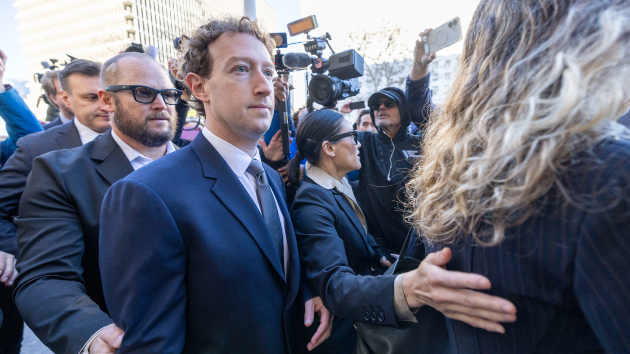
Meta CEO Mark Zuckerberg arrives to the Los Angeles Superior Court at United States Court House on February 18, 2026 in Los Angeles, California. (Jill Connelly/Getty Images)
(LOS ANGELES) — A landmark trial over social media addiction has drawn fresh scrutiny to a decades-old legal shield: Section 230.
The case, which began last Monday in Los Angeles County Superior Court, centers on claims against Meta — the parent company of Facebook and Instagram — and YouTube, which is owned by Google. Plaintiffs argue the companies knowingly built features that encouraged compulsive use among young users, contributing to long-term mental health harm.
The case is the first of more than 1,500 similar lawsuits nationwide to go before a jury, potentially setting a precedent for how tech companies could be held liable for product design. Meta CEO Mark Zuckerberg is testifying in the case on Wednesday.
The companies deny the allegations, arguing that mental health outcomes are shaped by a range of factors beyond social media use. They say they have implemented safeguards aimed at protecting young users, including parental controls and accounts designed specifically for teens.
In a statement to ABC News at the start of the trial, a Meta spokesperson said, “We strongly disagree with these allegations and are confident the evidence will show our longstanding commitment to supporting young people.”
Meta said that the company has made “meaningful changes” to its services, such as introducing accounts specifically for teenage users.
The tech giants are expected to challenge the plaintiff’s argument that there is a direct link between social media use and mental health issues. They may also invoke legal protection long-afforded by Section 230.
Section 230 of the 1996 Communications Decency Act protects social media platforms and other sites from legal liability that could result from content posted by users because they are not deemed to be publishers.
Plaintiffs have sought to circumvent that legal immunity in part by arguing that the platforms are addictive, which amounts to a defect in a product.
Section 230 grants broad protection for internet platforms, saying: “No provider or user of an interactive computer service shall be treated as the publisher or speaker of any information provided by another information content provider.”
Some tech giants, like Meta and Google, have supported reform of Section 230 that would raise the standard that platforms would need to meet in order to qualify for immunity. But the companies largely support preserving the law in some form to protect them from legal liability tied to user-generated content.
Section 230 has garnered backing from some free-speech advocacy groups such as the Electronic Frontier Foundation (EFF). The measure “protects internet users’ speech by protecting the online intermediaries we rely on,” EFF said in a blog post last week, praising Section 230 as “the legal support that sustains the internet as we know it.”
In 2023, the Supreme Court issued a pair of rulings that upheld Section 230, rejecting challenges from users alleging that harm had resulted from online posts.
One of the cases, Gonzalez v. Google LLC, concerned a lawsuit brought by the family of Nohemi Gonzalez, an American woman who was killed in an ISIS terrorist attack in Paris in 2015. The lawsuit against Google, the parent company of YouTube, alleged that YouTube recommended ISIS recruitment videos to users. The high court ruled against the plaintiffs.
Many Democrats argue that Section 230 allows platforms to evade accountability for allegedly permitting harmful or misleading content, claiming the rule lets platforms off the hook for policing too little speech.
Republicans have taken issue with what they consider big tech censorship, saying the legal protection allows the platforms to police too much speech without facing consequences.
In December, Sen. Dick Durbin, D-Ill., and Lindsey Graham, R-S.C., introduced the Sunset Section 230 Act, which would remove the legal protection from federal law within two years. A bipartisan group of seven senators has signed onto the bill but it remains well short of a majority.
ABC News’ Shafiq Najib contributed to this report.
Meta CEO Mark Zuckerberg arrives to the Los Angeles Superior Court at United States Court House on February 18, 2026 in Los Angeles, California. (Jill Connelly/Getty Images)
(LOS ANGELES) — A landmark trial over social media addiction has drawn fresh scrutiny to a decades-old legal shield: Section 230.
The case, which began last Monday in Los Angeles County Superior Court, centers on claims against Meta — the parent company of Facebook and Instagram — and YouTube, which is owned by Google. Plaintiffs argue the companies knowingly built features that encouraged compulsive use among young users, contributing to long-term mental health harm.
The case is the first of more than 1,500 similar lawsuits nationwide to go before a jury, potentially setting a precedent for how tech companies could be held liable for product design. Meta CEO Mark Zuckerberg is testifying in the case on Wednesday.
The companies deny the allegations, arguing that mental health outcomes are shaped by a range of factors beyond social media use. They say they have implemented safeguards aimed at protecting young users, including parental controls and accounts designed specifically for teens.
In a statement to ABC News at the start of the trial, a Meta spokesperson said, “We strongly disagree with these allegations and are confident the evidence will show our longstanding commitment to supporting young people.”
Meta said that the company has made “meaningful changes” to its services, such as introducing accounts specifically for teenage users.
The tech giants are expected to challenge the plaintiff’s argument that there is a direct link between social media use and mental health issues. They may also invoke legal protection long-afforded by Section 230.
Section 230 of the 1996 Communications Decency Act protects social media platforms and other sites from legal liability that could result from content posted by users because they are not deemed to be publishers.
Plaintiffs have sought to circumvent that legal immunity in part by arguing that the platforms are addictive, which amounts to a defect in a product.
Section 230 grants broad protection for internet platforms, saying: “No provider or user of an interactive computer service shall be treated as the publisher or speaker of any information provided by another information content provider.”
Some tech giants, like Meta and Google, have supported reform of Section 230 that would raise the standard that platforms would need to meet in order to qualify for immunity. But the companies largely support preserving the law in some form to protect them from legal liability tied to user-generated content.
Section 230 has garnered backing from some free-speech advocacy groups such as the Electronic Frontier Foundation (EFF). The measure “protects internet users’ speech by protecting the online intermediaries we rely on,” EFF said in a blog post last week, praising Section 230 as “the legal support that sustains the internet as we know it.”
In 2023, the Supreme Court issued a pair of rulings that upheld Section 230, rejecting challenges from users alleging that harm had resulted from online posts.
One of the cases, Gonzalez v. Google LLC, concerned a lawsuit brought by the family of Nohemi Gonzalez, an American woman who was killed in an ISIS terrorist attack in Paris in 2015. The lawsuit against Google, the parent company of YouTube, alleged that YouTube recommended ISIS recruitment videos to users. The high court ruled against the plaintiffs.
Many Democrats argue that Section 230 allows platforms to evade accountability for allegedly permitting harmful or misleading content, claiming the rule lets platforms off the hook for policing too little speech.
Republicans have taken issue with what they consider big tech censorship, saying the legal protection allows the platforms to police too much speech without facing consequences.
In December, Sen. Dick Durbin, D-Ill., and Lindsey Graham, R-S.C., introduced the Sunset Section 230 Act, which would remove the legal protection from federal law within two years. A bipartisan group of seven senators has signed onto the bill but it remains well short of a majority.
ABC News’ Shafiq Najib contributed to this report.
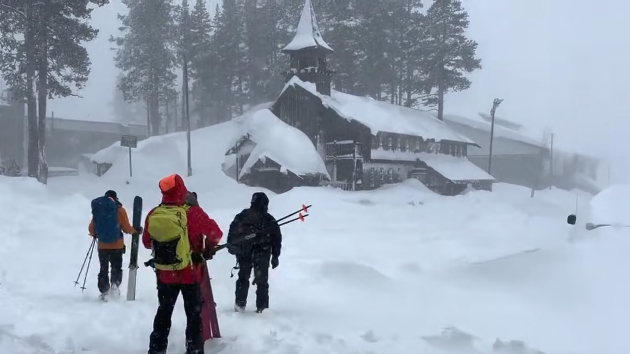
A rescue ski team makes their way to the area of an avalanche in the Castle Peak area of Truckee, Calif., February 17, 2026. (Nevada County Sheriff’s Office)
(NEVADA COUNTY, Calif.) — Eight backcountry skiers have been found dead, and one remains missing following an avalanche in California’s Sierra Nevada Mountains, officials announced Wednesday.
Search crews on Tuesday braved “highly dangerous” conditions to rescue six other skiers who were part of the same guided group, authorities said.
Crews were working on Wednesday to bring the remains of the eight dead skiers off the mountain to be reunited with their families after autopsies are performed to determine the cause of death, authorities said.
Perilous conditions near Donner Pass, where the avalanche occurred, continued on Wednesday morning. Rescuers faced a winter storm dumping more than 2 inches of snow an hour in the area, grounding rescue helicopters and hampering ground crews trying to reach the missing skiers, according to the Sierra Avalanche Center.
Tuesday’s avalanche was reported around 11:30 a.m. PT in the Castle Peak area at an elevation of 8,200 feet in the Sierra Nevada northwest of Lake Tahoe, according to the Nevada County Sheriff’s Office.
A group of 15 skiers, including four guides from the company Blackbird Mountain Guides, encountered the avalanche, according to the sheriff’s office.
“The group was in the process of returning to the trailhead at the conclusion of a three-day trip when the incident occurred,” Blackbird Mountain Guides said in a statement.
Preliminarily, the slide measured a D2.5 on the Destructive Force Scale, the avalanche version of the Enhanced Fujita Scale for rating tornadoes, meaning it was strong enough to injure, bury, or kill a person, according to the Sierra Avalanche Center. A D3 on the scale is strong enough to destroy a house.
Six people were successfully rescued Tuesday evening by search-and-rescue teams with varying injuries, authorities said. The survivors had been taking cover under a tarp when they were found alive, a source who communicated with the group told ABC News.
The survivors made a 911 call using an iPhone satellite SOS message, the sheriff’s officer said. Emergency beacons also helped rescuers find the stranded skiers, the sheriff’s office said.
“Due to extreme weather conditions, it took several hours for rescue personnel to safely reach the skiers and transport them to safety where they were medically evaluated by Truckee Fire,” the Nevada County Sheriff’s Office said in a statement. “Two of the six skiers have been transported to a hospital for treatment.”
Authorities initially said 16 skiers were in the group, and 10 were missing.
Rescuers faced very difficult conditions, including avalanche danger themselves, according to Brandon Schwartz, director of the Sierra Avalanche Center, which forecasts avalanche conditions in the area around Lake Tahoe. The area saw 2 to 3 feet of new snow in the last 36 hours and more was still falling at 2 to 4 inches per hour, Schwartz told ABC News.
The Blackbird Mountain Guides said the avalanche happened near the Frog Lake Backcountry Huts in the Castle Peak area, northwest of Truckee.
The group of skiers had been staying at the huts — which the company describes in online advertisements as “luxury-dormitories” — since Sunday. A 3-to-4-day stay at the huts normally costs $1,795, according to the company’s website.
The company lists prerequisites for customers, including requiring skiers to be “adept with their backcountry touring skills and have a solid foundation of touring before the trip.” Customers are also required to be in good physical shape, according to the company, “able to hike 4-6 miles and climb 1,500-2,500 vertical feet throughout the course of a day.”
The Sierra Avalanche Center said there was “high” avalanche danger in the backcountry on Tuesday, raising questions of why the group was in the rugged area.
On Monday, Blackbird Mountain Guides posted a video on Instagram showing what it described as “atypical layering from our normal mid season snowpack.”
“The result is a particularly weak layer in many northerly aspects, across various elevation bands,” a company employee said in the video. “As we move into a large storm cycle this week, pay close attention to places where faceting has been particularly strong — avalanches could behave abnormally and hazards could last longer than normal.”
The Sierra Avalanche Center said rapidly accumulating snowfall, weak layers of existing snowpack and gale-force winds that blow and drift snow “have created dangerous avalanche conditions in the mountains.”
“Natural avalanches are likely, and human-triggered avalanches large enough to bury or injure people are very likely,” the center said.
The center has issued an avalanche warning for the Central Sierra Nevada Mountains between Yuba Pass on the north and Ebbetts Pass on the south, including the greater Lake Tahoe area, through Wednesday morning.
In an updated statement on Wednesday morning, the center said, “HIGH avalanche danger continues,” and added, “travel in, near, or below avalanche terrain not recommended.”
“Increased uncertainty exists with ongoing reactivity of these buried weak layers under this large storm snow load. The potential continues for large to very large avalanches occurring in the backcountry today.”
Whiteout conditions have been reported in the region where the avalanche occurred.
The California Highway Patrol’s Truckee office warned that high winds are “creating full whiteout conditions” across the Donner Summit.
Interstate 80 over Donner Summit was closed in both directions on Tuesday and remained closed on Wednesday morning due to whiteout conditions and poor visibility.
A rescue ski team makes their way to the area of an avalanche in the Castle Peak area of Truckee, Calif., February 17, 2026. (Nevada County Sheriff’s Office)
(NEVADA COUNTY, Calif.) — Eight backcountry skiers have been found dead, and one remains missing following an avalanche in California’s Sierra Nevada Mountains, officials announced Wednesday.
Search crews on Tuesday braved “highly dangerous” conditions to rescue six other skiers who were part of the same guided group, authorities said.
Crews were working on Wednesday to bring the remains of the eight dead skiers off the mountain to be reunited with their families after autopsies are performed to determine the cause of death, authorities said.
Perilous conditions near Donner Pass, where the avalanche occurred, continued on Wednesday morning. Rescuers faced a winter storm dumping more than 2 inches of snow an hour in the area, grounding rescue helicopters and hampering ground crews trying to reach the missing skiers, according to the Sierra Avalanche Center.
Tuesday’s avalanche was reported around 11:30 a.m. PT in the Castle Peak area at an elevation of 8,200 feet in the Sierra Nevada northwest of Lake Tahoe, according to the Nevada County Sheriff’s Office.
A group of 15 skiers, including four guides from the company Blackbird Mountain Guides, encountered the avalanche, according to the sheriff’s office.
“The group was in the process of returning to the trailhead at the conclusion of a three-day trip when the incident occurred,” Blackbird Mountain Guides said in a statement.
Preliminarily, the slide measured a D2.5 on the Destructive Force Scale, the avalanche version of the Enhanced Fujita Scale for rating tornadoes, meaning it was strong enough to injure, bury, or kill a person, according to the Sierra Avalanche Center. A D3 on the scale is strong enough to destroy a house.
Six people were successfully rescued Tuesday evening by search-and-rescue teams with varying injuries, authorities said. The survivors had been taking cover under a tarp when they were found alive, a source who communicated with the group told ABC News.
The survivors made a 911 call using an iPhone satellite SOS message, the sheriff’s officer said. Emergency beacons also helped rescuers find the stranded skiers, the sheriff’s office said.
“Due to extreme weather conditions, it took several hours for rescue personnel to safely reach the skiers and transport them to safety where they were medically evaluated by Truckee Fire,” the Nevada County Sheriff’s Office said in a statement. “Two of the six skiers have been transported to a hospital for treatment.”
Authorities initially said 16 skiers were in the group, and 10 were missing.
Rescuers faced very difficult conditions, including avalanche danger themselves, according to Brandon Schwartz, director of the Sierra Avalanche Center, which forecasts avalanche conditions in the area around Lake Tahoe. The area saw 2 to 3 feet of new snow in the last 36 hours and more was still falling at 2 to 4 inches per hour, Schwartz told ABC News.
The Blackbird Mountain Guides said the avalanche happened near the Frog Lake Backcountry Huts in the Castle Peak area, northwest of Truckee.
The group of skiers had been staying at the huts — which the company describes in online advertisements as “luxury-dormitories” — since Sunday. A 3-to-4-day stay at the huts normally costs $1,795, according to the company’s website.
The company lists prerequisites for customers, including requiring skiers to be “adept with their backcountry touring skills and have a solid foundation of touring before the trip.” Customers are also required to be in good physical shape, according to the company, “able to hike 4-6 miles and climb 1,500-2,500 vertical feet throughout the course of a day.”
The Sierra Avalanche Center said there was “high” avalanche danger in the backcountry on Tuesday, raising questions of why the group was in the rugged area.
On Monday, Blackbird Mountain Guides posted a video on Instagram showing what it described as “atypical layering from our normal mid season snowpack.”
“The result is a particularly weak layer in many northerly aspects, across various elevation bands,” a company employee said in the video. “As we move into a large storm cycle this week, pay close attention to places where faceting has been particularly strong — avalanches could behave abnormally and hazards could last longer than normal.”
The Sierra Avalanche Center said rapidly accumulating snowfall, weak layers of existing snowpack and gale-force winds that blow and drift snow “have created dangerous avalanche conditions in the mountains.”
“Natural avalanches are likely, and human-triggered avalanches large enough to bury or injure people are very likely,” the center said.
The center has issued an avalanche warning for the Central Sierra Nevada Mountains between Yuba Pass on the north and Ebbetts Pass on the south, including the greater Lake Tahoe area, through Wednesday morning.
In an updated statement on Wednesday morning, the center said, “HIGH avalanche danger continues,” and added, “travel in, near, or below avalanche terrain not recommended.”
“Increased uncertainty exists with ongoing reactivity of these buried weak layers under this large storm snow load. The potential continues for large to very large avalanches occurring in the backcountry today.”
Whiteout conditions have been reported in the region where the avalanche occurred.
The California Highway Patrol’s Truckee office warned that high winds are “creating full whiteout conditions” across the Donner Summit.
Interstate 80 over Donner Summit was closed in both directions on Tuesday and remained closed on Wednesday morning due to whiteout conditions and poor visibility.
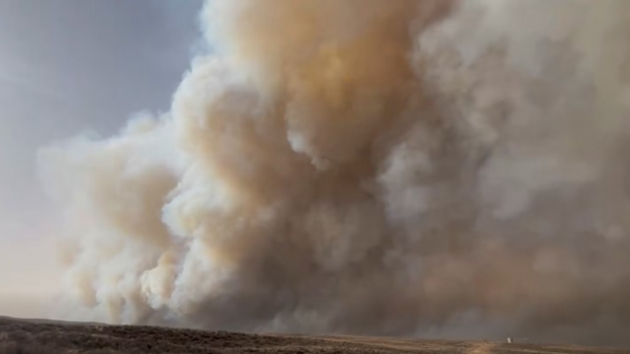
Oklahoma Forestry Services captured footage of the Ranger Road fire in Beaver County, Oklahoma. (Oklahoma Forestry Services)
(BEAVER COUNTY, Okla.) — The Oklahoma governor declared a state of emergency on Wednesday due to multiple wildfires in the state’s panhandle region, as critical fire weather conditions persist in the region.
A “series of destructive wildfires” is burning across northwest Oklahoma, the governor’s office said.
The largest, the Ranger Road Fire, has burned 145,000 acres since igniting in Oklahoma’s Beaver County on Tuesday and crossing into Kansas, according to fire officials. It was 0% contained as of Wednesday morning, according to the Oklahoma Forestry Services.
Additional local task forces are being deployed to Beaver County, the governor’s office said Wednesday.
Three other “significant” wildfires in Oklahoma’s Texas and Woodward counties were 20% to 25% contained as of Wednesday morning, according to fire officials.
Four firefighters were injured and several homes destroyed in the wildfire in Woodward County, according to Oklahoma Gov. Kevin Stitt.
The town of Tyrone in Texas County was also evacuated earlier Wednesday “as a precaution,” Stitt said.
The governor’s executive order stated that the state’s emergency operations plan has been activated and resources of all state departments and agencies are available “to meet this emergency.”
“As we head into today and tomorrow, conditions remain dangerous,” Stitt said in a statement Wednesday. “We need every Oklahoman to stay alert and continue taking fire warnings seriously.”
A red flag warning is in effect Wednesday across western and central Oklahoma and west of the I-35 corridor, according to the Oklahoma Forestry Services. The critical threat of fire danger is expected to continue into Thursday.
“Fire weather conditions will expand eastward across a larger part of Oklahoma as high winds combine with low humidity across most of the state,” the Oklahoma Department of Emergency Management said Wednesday.
Red flag warnings, fire weather watches and high wind warnings are also in effect across Kansas.
“There should be NO outdoor burning of any kind until this event is over, as the slightest ember could become tomorrow’s inferno,” the Kansas Division of Emergency Management said on social media.