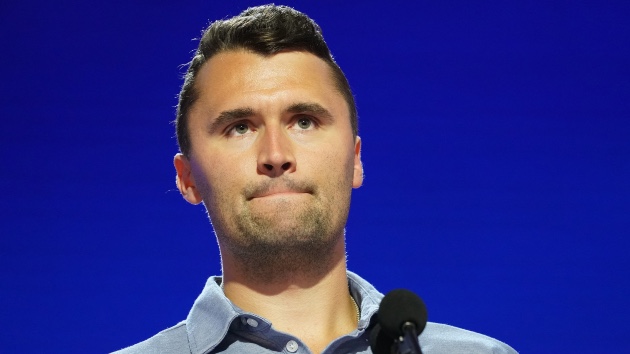
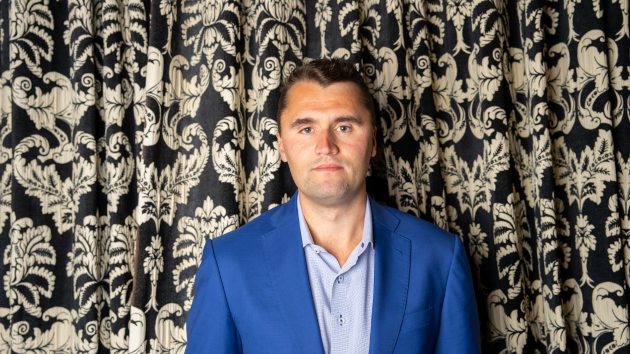
Turning Point USA Founder Charlie Kirk is seen onstage at the Fiserv Forum during preparations for the Republican National Convention (RNC) on July 14, 2024, in Milwaukee, Wisconsin. (Photo by Andrew Harnik/Getty Images)
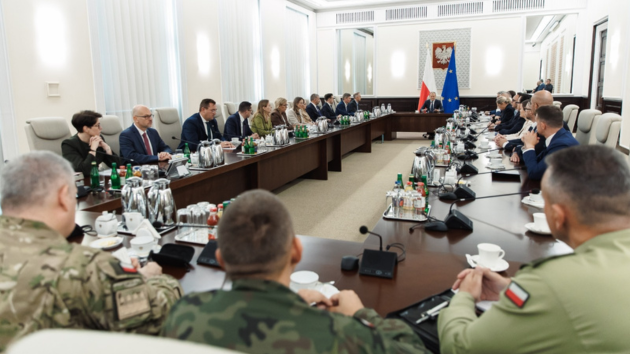
(WASHINGTON) — President Donald Trump, at a memorial event at the Pentagon on Thursday on the anniversary of the 9/11 terror attacks, announced he will posthumously award Charlie Kirk the Presidential Medal of Freedom.
Kirk, a prominent conservative activist, was shot during an event at Utah Valley University on Wednesday. Trump later that day announced his death.
“Charlie was a giant of his generation, a champion of liberty and and an inspiration to millions and millions of people,” Trump said on Thursday.
“We miss him greatly, yet I have no doubt that Charlie’s voice and courage put into the hearts of countless people, especially young people, will live on,” the president continued.
The Presidential Medal of Freedom is the highest civilian award in the U.S. Trump said that the day of that ceremony would be announced soon, adding he thought it would surely draw a big crowd.
A manhunt for Kirk’s killer is underway. The FBI said on Thursday it has recovered what is believed to be the weapon used by the shooter, and officials said the suspect is believed to be a college-aged individual.
This is a developing story. Please check back for updates.
(SALT LAKE CITY) — The FBI said it has recovered what is believed to be the weapon used in the fatal shooting of Charlie Kirk, the founder of the conservative youth activist organization Turning Point USA, during an event at Utah Valley University on Wednesday.
A “high-powered bolt action rifle,” which officials believe was the weapon used in the shooting, was recovered in a wooded area near where the shooting took place, according to Salt Lake City FBI Special Agent Robert Bohls.
The manhunt for the suspect, who is believed to be college-aged, continues, with officials working “around the clock” to locate the individual, officials said during a press conference on Thursday.
The FBI asked for tips from the public as the manhunt for the perpetrator continued, urging anyone with information, photos and video from the incident to share it with investigators.
FBI Director Kash Patel said earlier the agency “stands in full support of the ongoing response and investigation.”
UVU will be closed until Sept. 14, according to a notice posted on the university’s website.
As the search for the suspect continued, President Donald Trump and prominent MAGA personalities sought to tie the killing to Democratic political rhetoric.
In a video posted to social media, Trump said, “It’s a long past time for all Americans and the media to confront the fact that violence and murder are the tragic consequence of demonizing those with whom you disagree.”
“For years, those on the radical Left have compared wonderful Americans like Charlie to Nazis and the world’s worst mass murderers and criminals,” he added. “This kind of rhetoric is directly responsible for the terrorism that we’re seeing in our country today, and it must stop right now.”
Trump’s son Eric, meanwhile, told Fox News’ Sean Hannity he was “sick and tired of seeing the bullets — they are only going one way.”
Controversial campus visit
Kirk — a 31-year-old father of two — was considered a confidant of Trump and highly influential in the conservative youth movement.
He founded the conservative advocacy group Turning Point USA in 2012 at the age of 18, and in the 2024 elections was credited with building significant support for Trump among young voters.
He was hit by a single shot during the outdoors event at the university’s Orem campus shortly after noon. Kirk was taken to hospital but was later pronounced dead.
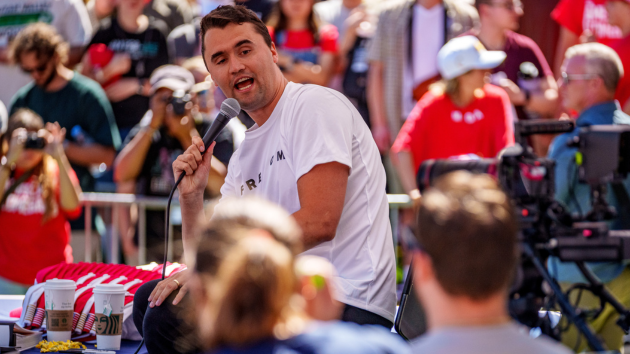
The Utah event was expected to include a “prove me wrong” table, according to the tour’s website.
Ahead of Kirk’s visit to Utah Valley University, some students started an online petition asking university administrators to stop him from coming.
Though Kirk’s visit was controversial on campus, police were tracking no specific or credible threats before the fatal shooting, Utah law enforcement sources told ABC News.
More than 3,000 people were estimated to be at the event, according to the university’s police chief, Jeff Long. There were six police officers, along with Kirk’s private security, according to Long.
Ongoing manhunt
Utah Department of Public Safety Commissioner Beau Mason called the shooting a “targeted attack,” and said the scene is a “very large area.”
Mason said the “only information” they have on the possible shooter was taken from CCTV on campus, and that the person was dressed in all dark clothing. The shot was fired on campus from a “longer distance,” potentially from a roof, he said.
There is no evidence that anyone else was involved, according to authorities.
Authorities are combing through video from the scene, including this video which appears to show a person on the roof immediately following the shooting, according to sources familiar with the ongoing investigation.
During a press conference yesterday, authorities said the shot came “potentially from a roof, yes. A longer distance shot from a roof.”
Separately, authorities said they are also looking at security camera video depicting someone dressed in all dark clothing and that “the shooter is believed to have fired from the roof of a building down to the location of the public event in the student courtyard,” according to a statement from law enforcement officials last night.
The FBI has established a digital media tip line for the public to provide any tips to investigators, including photos or video of the incident.
Salt Lake City FBI Special Agent in Charge Robert Bohls said the investigation is in the early stages.
“We are following all the leads and all the evidence,” he said during the press briefing on Wednesday.
The Utah Department of Public of Safety said in an update Wednesday night that two people were initially taken into custody after the shooting but later released.
The first was released and later charged with obstruction by university police. The second person was taken into custody and released after an “interrogation” by law enforcement, the department said.
Utah authorities said “there are no current ties to the shooting with either of these individuals.”
Tributes from both parties
Trump was among those who paid tribute to Kirk.
“The Great, and even Legendary, Charlie Kirk, is dead,” Trump said on social media. “No one understood or had the Heart of the Youth in the United States of America better than Charlie. He was loved and admired by ALL, especially me, and now, he is no longer with us. Melania and my Sympathies go out to his beautiful wife Erika, and family. Charlie, we love you!”
“It’s horrific. It’s one of the most horrible things I’ve ever seen,” Trump told ABC News Chief Washington Correspondent Jonathan Karl.
“He was a great guy,” Trump said. “He was a good man. He was an incredible guy. Nobody like him.”
Trump ordered all American flags throughout the country to be lowered to half-staff through Sunday evening in Kirk’s honor.
Utah Gov. Spencer Cox called the fatal shooting a “political assassination.”
Vice President JD Vance called Kirk “a genuinely good guy and a young father” while urging prayers in the aftermath of the shooting.
Cox said earlier he was being briefed “following the violence directed at Charlie Kirk” during the conservative political activist’s visit to the campus.
“Those responsible will be held fully accountable. Violence has no place in our public life. Americans of every political persuasion must unite in condemning this act,” he said on X.
Condemnation came from both sides of the political spectrum.
“There is no place in our country for this kind of violence. It must end now,” Former President Joe Biden said. “Jill and I are praying for Charlie Kirk’s family and loved ones.”
“The attack on Charlie Kirk is horrifying and this growing type of unconscionable violence cannot be allowed in our society,” Pennsylvania Gov. Josh Shapiro, a Democrat, said on X.
Fellow Democratic governor, California’s Gavin Newsom, said on X that the “attack on Charlie Kirk is disgusting, vile, and reprehensible. In the United States of America, we must reject political violence in EVERY form.”
ABC News’ Aaron Katersky, Ivan Pereira, Lalee Ibssa, Isabella Murray, Katherine Faulders, Jack Date, Chris Looft and Helena Skinner contributed to this report.
(NEW YORK) — Opening statements are set to begin Thursday in the criminal trial of Ryan Routh, the man accused of attempting to assassinate Donald Trump on his golf course last year.
With instances of political violence on the rise, the trial is expected to revisit one of the most high-profile instances of alleged violence directed at Trump in the waning days of the 2024 election.
Prosecutors allege that Routh put together a methodical plan — including purchasing a military-grade weapon, researching Trump’s movements, and utilizing a dozen burner phones — to kill Trump based on political grievances.
Hiding in the bushes of Trump’s Palm Beach golf course and armed with a rifle, Routh allegedly came within a few hundred yards of the then-presidential nominee before a Secret Service agent spotted his rifle poking out of the tree line.
Routh allegedly fled the scene but was later arrested by a local sheriff’s office on a nearby interstate.
Nearly a year after the failed assassination attempt, Routh now faces five criminal counts that risk sending him to prison for the rest of his life. Despite lacking any legal education or experience, Routh dismissed his lawyers earlier this year and intends to defend himself at trial.
“I will be representing myself moving forward; It was ridiculous from the outset to consider a random stranger that knows nothing of who I am to speak for me,” Routh told U.S. District Judge Aileen Cannon in a July letter. “I am so sorry, I know this makes your life harder.”
Routh’s self-representation created some issues during the three days of jury selection earlier this week. Judge Cannon — who previously oversaw and dismissed one of Trump’s criminal cases — refused to use many of his proposed jury questions, deeming them too “political.”
Among other subjects, Routh had proposed asking jurors about their stance on Palestine and Ukraine, and about Trump’s proposed acquisition of Greenland.
Routh has said in court filings that he plans to defend himself by focusing on his self-described peaceful nature and his care for humanity, in part by calling to the stand his son and multiple friends to testify about his character.
Judge Cannon has barred him from trying to argue that his alleged actions were justified, that he did not intend to carry out the assassination, or that his actions were protected by First Amendment rights.
President Donald Trump speaks to Treasury Secretary Scott Bessent while watching the men’s singles finals U.S. Open, September 7, 2025 in New York City. (Kevin Dietsch/Getty Images)
(NEW YORK) — Consumer prices rose 2.9% in August compared to a year ago, marking an uptick in price increases as President Donald Trump’s tariff policy intensified. The reading matched economists’ expectations.
The fresh inflation data indicated an acceleration from a 2.7% inflation rate recorded in the month prior, according to the U.S. Bureau of Labor Statistics. Price increases remain below the 3% rate recorded in January, the month Trump took office.
The new report arrives days before the Federal Reserve is set to announce a widely expected quarter-point interest rate cut. The price hike last month may give policymakers pause as they weigh an interest rate cut, since a reduction of borrowing costs could boost spending and put upward pressure on prices.
Egg prices, a longtime symbol of rising costs, were flat in the month of August. Still, the price of eggs stands nearly 11% higher than where it was a year ago. The price of coffee has surged 20% over the past year, the data showed.
Housing costs jumped 0.4% in August, which accounted for the largest share of the overall hike in prices, the BLS said. Food prices rose 0.5% last month, while energy costs climbed 0.7%, the data showed.
In all, prices climbed 0.4% from July to August, which marked the largest monthly increase since December.
In recent months, tariffs modestly contributed to the uptick in overall inflation, analysts previously told ABC News, but overall price increases owed largely to a rise in housing and food products with little connection to Trump’s levies.
The inflation report arrived at a wobbly moment for the nation’s economy. In recent months, inflation has picked up while hiring has slowed, posing a risk of an economic double-whammy known as “stagflation.”
A jobs report last week showed a sharp decrease in hiring in August, extending a lackluster period for the labor market. Meanwhile, a revision of previous hiring estimates on Tuesday revealed the U.S. economy added far fewer jobs in 2024 and early 2025 than previously estimated, deepening concern about the health of the U.S. job market.
The weak jobs data has raised alarm among some analysts that the U.S. economy may be slipping toward a recession, though the economy has largely averted the type of widespread job losses that often accompany a downturn.
The economic conditions have put Fed policymakers in a bind. If the Fed raises interest rates as a means of protecting against tariff-induced inflation, it risks tipping the economy into a downturn. On the other hand, if the Fed lowers rates to stimulate the economy in the face of a hiring slowdown, it threatens to boost spending and worsen inflation.
In response to the flagging labor market, the Fed is expected to cut interest rates when policymakers meet next week. Investors peg the chances of a quarter-point rate cut this month at about 90% and the odds of a half-point cut at roughly 9%, according to CME FedWatch Tool, a measure of market sentiment.
The inflation data on Thursday marks the latest figures unveiled by the BLS since Trump fired BLS Commissioner Erika McEntarfer last month in response to a weak monthly jobs report. Trump claimed without evidence that McEntarfer had manipulated statistics for political reasons.
McEntarfer, a Biden appointee who was confirmed by the Senate in 2024, had served in the federal government for two decades.
“It has been the honor of my life to serve as Commissioner of BLS alongside the many dedicated civil servants tasked with measuring a vast and dynamic economy,” McEntarfer said in a social media post after her dismissal. “It is vital and important work and I thank them for their service to this nation.”
William Beach, a former commissioner of the Bureau of Labor Statistics, who was appointed by Trump, condemned McEntarfer’s dismissal.
“The totally groundless firing of Dr. Erika McEntarfer, my successor as Commissioner of Labor Statistics at BLS, sets a dangerous precedent and undermines the statistical mission of the Bureau,” Beach posted on X.
McEntarfer did not respond to an earlier ABC News request for comment.
Polish Prime Minister’s Office / Handout/Anadolu via Getty Images
(LONDON) — Latvian Defense Miniter Andris Spruds announced Thursday that the country will become the latest NATO ally to close its airspace along its eastern borders with Russia and Belarus, following the intrusion of at least 19 Russian drones into Polish airspace this week.
“There is no immediate threat,” the minister said, adding that the border airspace will remain closed for at least one week until Sept. 18.
The country’s armed forces are “on heightened alert” during the “Namejs” military exercise, which began on Sept. 2 and will run until Oct. 8, Spruds said.
“Russian unmanned aerial vehicles in NATO airspace are a warning signal, and we must do everything possible to prevent an escalation of drone attacks,” the minister said in a statement published by the Defense Ministry.
“The closure of the Latvian airspace zone will allow us to fully control the restricted airspace, facilitate the detection of unauthorized flying objects, free up the restricted zone for NATO Baltic Air Policing mission fighter jets and our air defense,” Spruds said.
The closure will also “enable enhanced testing of acoustic airspace monitoring systems, conduct drone and counter-drone simulations, deploy additional mobile combat units and provide training,” he added.
Latvian forces “are permanently on duty in the eastern border area to shoot down aggressor-state drones if necessary,” the ministry said in its statement.
The Latvian announcement came hours after Poland’s Operational Command issued notification on Thursday of the closure of Polish airspace all along the 260-mile border with Belarus. Airspace was closed from late on Wednesday and will remain so until Dec. 9, the command said in a statement posted to X.
Last month, neighboring Lithuania declared a no-fly zone along its 56-mile border with Belarus from Aug. 14 until Oct. 1, with the option to extend the closure if deemed necessary. The restrictions there go up to 12,000 feet, meaning high-flying commercial aircraft can still transit the airspace.
Vilnius took the decision after two Russian Gerbera drones — one of which was carrying 4.4 pounds of explosives — crashed on Lithuanian territory having flown in from Belarus. Lithuania’s Defense Minister Dovile Sakaliene told ABC News that Lithuania is “ready” to shoot down any drones that enter the no-fly zone.
Estonia — which shares a 183-mile frontier with Russia — is now the only Baltic state not to have imposed new airspace restrictions along its eastern border.
Earlier this week, the Foreign Ministry in Tallinn summoned the Russian charge d’affaires at Moscow’s embassy after a Russian Mi-8 helicopter violated Estonian airspace over the Baltic Sea.
Foreign Minister Margus Tsahkna said the incident was the third of its kind in 2025. This week’s violation occurred near Vaindloo Island in the Gulf of Finland, around 17 miles north of Estonia’s coastline.
The helicopter was in Estonian airspace for around four minutes, the press service of Estonia’s Defence Forces said, with its transponder turned off and without a flight plan.
Estonia last month reported a Ukrainian drone crashing and exploding on its territory. Estonian police said the drone was likely en route to attack targets inside Russia. Tallinn blamed Russian jamming measures for the craft going off course.
A second Ukrainian drone crashed into the Russian portion of Lake Peipus, which forms part of the Estonia-Russia border, an Estonian military spokesperson confirmed to ABC News.
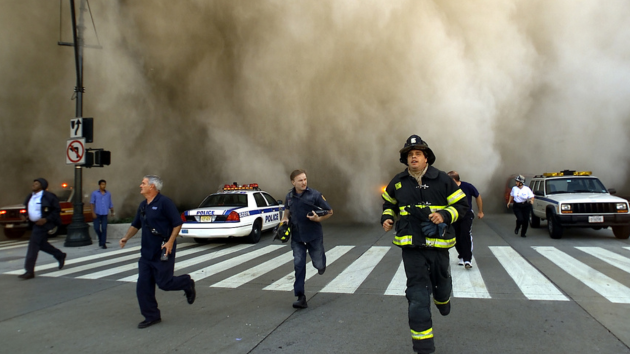
(NEW YORK) — Osama bin Laden had made targeting the United States a top priority of his al-Qaida terrorist organization. Al-Qaida translates from Arabic as “the base” – a base that bin Laden hoped to use to influence Muslims around the world to oppose Western influences and states and to establish fundamentalist Islamic regimes. Bin Laden’s motives were rooted in his extremist interpretation of Islamic theology, resentment over U.S. foreign policy in the Middle East, and a desire to overthrow the existing world order.
The “base” was so-called due to it being a centralized, hierarchical organization that provided funding, training and logistical support to terrorism worldwide, including for the so-called “Planes Operation” of Sept. 11, 2001.
In order to embolden and support his organization, bin Laden often videotaped himself with messages aimed at his target audience, established training centers in Afghanistan, had an expansive funding network that included wealthy individuals, couriers, mosques and other complex ways to raise funds.
Bin Laden, through the al-Qaida terrorist organization, targeted the United States for nearly a decade before the 9/11 attacks in 2001, utilizing this large and expansive infrastructure. While al-Qaida’s 1998 attacks against U.S. embassies in Africa and the 2000 attack against the U.S. Navy guided missile destroyer USS Cole were successful, the organization’s largest operation was the Sept. 11, 2001, attacks against the World Trade Center in New York City, the Pentagon, and the thwarted attack on Washington, D.C., that ended with the crash of United Airlines Flight 93 in Shanksville, Pa. – all of which included recruiting and training the nineteen terrorist operatives, funding their travel and expenses, and time.
It took bin Laden almost two years to put together the resources and training necessary for those attacks 24 years ago – something that today could be done almost instantly.
Bin Laden and the 9/11 attacks lacked something that present-day terrorists, criminals and violent extremists have ready access to: the internet and, specifically, the dark web. After the 9/11 attacks, as the United States was ramping up to attack al-Qaida, “the base” and affiliate organizations began moving to a more decentralized and incentivized form of terrorism and violence.
Terrorists expanded their use of the internet for a wide range of activities, including planning attacks, radicalization and recruitment, propaganda dissemination, and fundraising. While the internet facilitates covert planning through tools like encrypted messages, it also serves as a platform for psychological warfare, spreading disinformation and images to incite fear. This online presence includes social media platforms used for propaganda, communication and recruitment, creating a challenge for governments and platforms alike to manage the spread of extremist content in hopes of preventing potential violence.
In a 2004 study, the United States Institute of Peace said that hundreds of terrorist groups had migrated online, utilizing a tool meant for better communication for often nefarious purposes. Nearly 20 years later, a 2022 study titled “Terrorism and the internet: How dangerous is online radicalization?” highlighted how online radicalization had become a clear threat that can metastasize in dark corners, often unnoticed.
The main use of the internet by these terrorist groups – incentivizing and radicalizing supporters and stoking fear with propaganda – is something bin Laden would have had to do with videotapes played by the news. Likewise, the internet has made fundraising much easier with the use of online payment methods, which are easy to set up and difficult to trace. And now, with the advent of generative artificial intelligence (AI), terrorists have yet another tool at their disposal.
According to a U.S. House of Representatives Committee on Homeland Security hearing background advisory earlier this year, “GenAI is a rapidly emerging technology that can produce numerous kinds of content, such as text, images, or audio, when prompted by a user. Foreign terrorist organizations are actively seeking ways to exploit GenAI to support a variety of violent extremist tactics, techniques, and procedures, such as using AI-powered chatbots, to interact with potential recruits.”
“Foreign cloud-based mobile and desktop messaging applications like TikTok and Telegram have allowed their platforms to become a breeding ground for radical extremism,” the advisory continued. Essentially, terrorist groups have been able to weaponize the internet and incite violence in ways they couldn’t have imagined on Sept. 11.
While terrorism isn’t new, the use of the internet, and now AI, magnifies the capabilities and reach of terrorist groups that used to rely on scattered notes and videotapes to conduct their business. It seems reasonable to assume that if bin Laden had had access to the technologies of today, the 9/11 attacks may have been precursors to additional and more frequent deadly attacks.
The threats we face today are more complex, borderless, and technologically advanced than ever before. Counterterrorism strategies must continue to adapt to meet this evolving battleground, leveraging not only military and intelligence tools but also public-private partnerships with tech platforms, AI monitoring, and global diplomacy.
The legacy of 9/11 must be more than remembrance – it must be vigilance. As we honor the nearly 3,000 lives lost that day, and those first responders who have died in the years since, we must remain resolute in facing the ever-changing face of extremism, now armed with digital weapons and invisible armies.
The FBI said it is working alongside state and local law enforcement “to fully investigate and seek justice in the fatal shooting” of Charlie Kirk, the founder of the conservative youth activist organization Turning Point USA, during an event at Utah Valley University on Wednesday.
The FBI asked for tips from the public as the manhunt for the perpetrator continued, urging anyone with information, photos and video from the incident to share it with investigators.
FBI Director Kash Patel said earlier the agency “stands in full support of the ongoing response and investigation.”
Officials are due to hold a press conference at 9 a.m. ET on Thursday. UVU will be closed until Sept. 14, according to a notice posted on the university’s website.
As the search for the suspect continued, President Donald Trump and prominent MAGA personalities sought to tie the killing to Democratic political rhetoric.
In a video posted to social media, Trump said, “It’s a long past time for all Americans and the media to confront the fact that violence and murder are the tragic consequence of demonizing those with whom you disagree.”
“For years, those on the radical Left have compared wonderful Americans like Charlie to Nazis and the world’s worst mass murderers and criminals,” he added. “This kind of rhetoric is directly responsible for the terrorism that we’re seeing in our country today, and it must stop right now.”
Trump’s son Eric, meanwhile, told Fox News’ Sean Hannity he was “sick and tired of seeing the bullets — they are only going one way.”
Kirk — a 31-year-old father of two — was considered a confidant of Trump and highly influential in the conservative youth movement.
He founded the conservative advocacy group Turning Point USA in 2012 at the age of 18, and in the 2024 elections was credited with building significant support for Trump among young voters.
He was hit by a single shot during the outdoors event at the university’s Orem campus shortly after noon. Kirk was taken to hospital but was later pronounced dead.
The Utah event was expected to include a “prove me wrong” table, according to the tour’s website.
Ahead of Kirk’s visit to Utah Valley University, some students started an online petition asking university administrators to stop him from coming.
Though Kirk’s visit was controversial on campus, police were tracking no specific or credible threats before the fatal shooting, Utah law enforcement sources told ABC News.
More than 3,000 people were estimated to be at the event, according to the university’s police chief, Jeff Long. There were six police officers, along with Kirk’s private security, according to Long.
Utah Department of Public Safety Commissioner Beau Mason called the shooting a “targeted attack,” and said the scene is a “very large area.”
Mason said the “only information” they have on the possible shooter was taken from CCTV on campus, and that the person was dressed in all dark clothing. The shot was fired on campus from a “longer distance,” potentially from a roof, he said.
There is no evidence that anyone else was involved, according to authorities.
Salt Lake City FBI Special Agent in Charge Robert Bohls said the investigation is in the early stages.
“We are following all the leads and all the evidence,” he said during the press briefing on Wednesday.
(NEW YORK) — The Utah Department of Public of Safety said in an update Wednesday night that two people were initially taken into custody after the shooting but later released.
The first was released and later charged with obstruction by university police. The second person was taken into custody and released after an “interrogation” by law enforcement, the department said.
Utah authorities said “there are no current ties to the shooting with either of these individuals.”
Trump was among those who paid tribute to Kirk.
“The Great, and even Legendary, Charlie Kirk, is dead,” Trump said on social media. “No one understood or had the Heart of the Youth in the United States of America better than Charlie. He was loved and admired by ALL, especially me, and now, he is no longer with us. Melania and my Sympathies go out to his beautiful wife Erika, and family. Charlie, we love you!”
“It’s horrific. It’s one of the most horrible things I’ve ever seen,” Trump told ABC News Chief Washington Correspondent Jonathan Karl.
“He was a great guy,” Trump said. “He was a good man. He was an incredible guy. Nobody like him.”
Trump ordered all American flags throughout the country to be lowered to half-staff through Sunday evening in Kirk’s honor.
Utah Gov. Spencer Cox called the fatal shooting a “political assassination.”
Vice President JD Vance called Kirk “a genuinely good guy and a young father” while urging prayers in the aftermath of the shooting.
Cox said earlier he was being briefed “following the violence directed at Charlie Kirk” during the conservative political activist’s visit to the campus.
“Those responsible will be held fully accountable. Violence has no place in our public life. Americans of every political persuasion must unite in condemning this act,” he said on X.
Condemnation came from both sides of the political spectrum.
“There is no place in our country for this kind of violence. It must end now,” Former President Joe Biden said. “Jill and I are praying for Charlie Kirk’s family and loved ones.”
“The attack on Charlie Kirk is horrifying and this growing type of unconscionable violence cannot be allowed in our society,” Pennsylvania Gov. Josh Shapiro, a Democrat, said on X.
Fellow Democratic governor, California’s Gavin Newsom, said on X that the “attack on Charlie Kirk is disgusting, vile, and reprehensible. In the United States of America, we must reject political violence in EVERY form.”
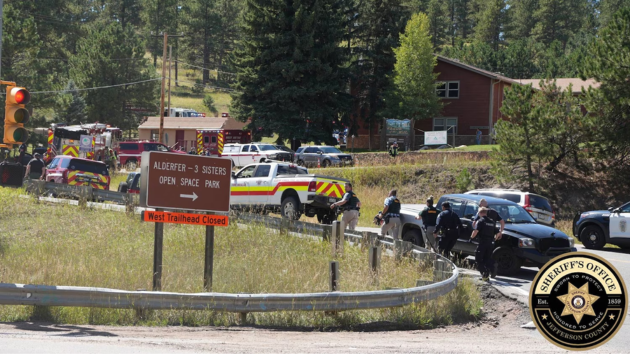
Law enforcement at the scene of a shooting at Evergreen High School in Evergreen, Colo., Sept. 10, 2025. Jefferson County Sheriff’s Office
(EVERGREEN, Colo.) — At least four students were injured after a shooting unfolded at a high school in Evergreen, Colorado, on Wednesday afternoon, according to the Jefferson County Sheriff’s Office.
The sheriff’s office confirmed to ABC News that students from Evergreen High School were on their way to the hospital. Officials said they received the first report of a shooting at the school at approximately 12:24 p.m. local time.
The suspect was engaged and neutralized, according to law enforcement officials. Officials are sweeping the campus, but the school is no longer in a lockdown.
“This is the scariest thing you’d think could ever happen” said sheriff’s office spokesperson Jacki Kelley.
Three students are in critical condition and are being transported to St. Anthony Hospital, a hospital spokesperson confirmed to ABC News. A fourth student has also been transported, but with an unknown injury.
Investigators believe the shooter is among the injured students.
“I don’t know if our suspect is even old enough to drive,” Kelley said.
The Bureau of Alcohol, Tobacco, Firearms and Explosives is also responding to the scene.
Denver FBI also said in a statement they are “aware of the situation,” have personnel responding to the scene and “stand ready to assist.”
Hundreds of police officers are on the scene searching each room on campus, according to law enforcement.
Parents are being asked to reunite with students at Bergen Meadow Elementary.
This is a developing story. Please check back for updates.
Charlie Kirk poses at The Cambridge Union on May 19, 2025 in Cambridge, Cambridgeshire. (Photo by Nordin Catic/Getty Images for The Cambridge Union)
(WASHINGTON) — President Donald Trump announced conservative activist Charlie Kirk died on Wednesday after being shot at a campus university event in Utah.
“The Great, and even Legendary, Charlie Kirk, is dead. No one understood or had the Heart of the Youth in the United States of America better than Charlie. He was loved and admired by ALL, especially me, and now, he is no longer with us. Melania and my Sympathies go out to his beautiful wife Erika, and family. Charlie, we love you!” Trump wrote on his social media platform.
Before the announcement, Trump told ABC News Chief Washington Correspondent Jonathan Karl, “It’s horrific. It’s one of the most horrible things I’ve ever seen.”
“He was a good man. He was an incredible guy. Nobody like him,” Trump told Karl.
Kirk, the founder of the conservative youth activist organization Turning Point USA, was a close ally to Trump and many members of his administration. Several top officials issued messages of support for Kirk and his family as news of the shooting first spread.
Vice President JD Vance shared Trump’s announcement of Kirk’s death and wrote on X, “Eternal rest grant unto him, O Lord.”
Secretary of State Marco Rubio said he was “heartbroken” by Kirk’s killing.
“He was an incredible husband and father and a great American. May he rest in eternal peace with our Lord,” Rubio posted on X.
The House of Representatives held a moment of silence for Kirk on Wednesday afternoon.
Republican and Democratic lawmakers condemned the shooting.
“This is detestable,” House Speaker Mike Johnson said. “Political violence has become all too common in American society, and this is not who they are.”
Johnson added, “We need every political figure, we need everyone who has a platform, to say this loudly and clearly, we can settle disagreements and disputes in a civil manner, and political violence must be pulled out, and it has to stop.”
“There is no place in our country for political violence. Period, full stop,” Senate Majority Leader John Thune wrote on X.
Republican Sen. Lindsey Graham called it a “sick and despicable attack.”
Former President Joe Biden said “there is no place in our country for this kind of violence.”
“It must end now. Jill and I are praying for Charlie Kirk’s family and loved ones,” Biden said in a post on X.
“I am deeply disturbed by the shooting in Utah,” former Vice President Kamala Harris wrote on X. “Doug and I send our prayers to Charlie Kirk and his family. Let me be clear: Political violence has no place in America. I condemn this act, and we all must work together to ensure this does not lead to more violence.”
California Gov. Gavin Newsom, who earlier this year hosted Kirk for the first episode of his new podcast, called the attack “disgusting, vile, and reprehensible. “
“In the United States of America, we must reject political violence in EVERY form,” California Gov. Gavin Newsom wrote on X.
House Democratic Leader Hakeem Jeffries wrote on X: “Political violence is NEVER acceptable. My thoughts and prayers are with Charlie Kirk and his family.”
Gabrielle Giffords, a former Democratic congresswoman who was shot in the head during a public event in 2011, also shared a message condemning acts of political violence. Giffords later founded a national gun violence prevention group.
“I’m horrified to hear that Charlie Kirk was shot at an event in Utah. Democratic societies will always have political disagreements, but we must never allow America to become a country that confronts those disagreements with violence. Mark and I are praying for Charlie’s recovery,” Giffords wrote.
Democratic Rep. Nancy Pelosi, whose husband was violently assaulted in their California home by an invader looking for Pelosi, called the shooting “horrific” and “reprehensible.”
“Political violence has absolutely no place in our nation,” Pelosi wrote on X. “All Americans should pray for Charlie Kirk’s recovery and hold the entire UVU community in our hearts as they endure the trauma of this gun violence.”
This is a developing story. Please check back for updates.
Law enforcement at the scene of a shooting at Evergreen High School in Evergreen, Colo., Sept. 10, 2025. Jefferson County Sheriff’s Office
(EVERGREEN, Colo.) — Three students were injured after a shooting unfolded at a high school in Evergreen, Colorado, on Wednesday afternoon, according to the Jefferson County Sheriff’s Office.
The sheriff’s office confirmed to ABC News that students from Evergreen High School were on their way to the hospital. Officials received the first report of a shooting at the school at approximately 12:24 p.m. local time, according to the sheriff’s office.
The suspect was engaged and neutralized, according to law enforcement officials. Officials are sweeping the campus, which is still on lockdown as it is considered an active scene.
The three patients are in critical condition and are being transported to St. Anthony Hospital, a hospital spokesperson confirmed to ABC News.
The Bureau of Alcohol, Tobacco, Firearms and Explosives is also responding to the scene.
Denver FBI also said in a statement they are “aware of the situation,” have personnel responding to the scene and “stand ready to assist.”
Hundreds of police officers are on the scene searching each room on campus, according to law enforcement.
Parents are being asked to reunite with students at Bergen Meadow Elementary.
This is a developing story. Please check back for updates.